
Published on 29 Dec 2016
The L85A1 (part of the SA80 small arms family) was adopted by the British military in 1985 as a new generation of small arms to replace the L1A1 FAL (one quick note, where “A1” indicates a revision in American designations, it is simply the first iteration in British ones – there was no “L85”). As a bullpup rifle, the L85A1 was intended to replace both the FAL and Sterling SMG, similar to the French replacing the MAS 49/56 and MAT 49 with the FAMAS.
Unfortunately, the L85A1 had massive problems of both reliability and durability. They were kept pretty much hidden until Desert Storm, when it became unavoidably clear that the weapon was seriously flawed. The UK government denied the problems for several years, until finally contracting with H&K (then owned by Royal Ordnance) to redesign and rebuild the rifles. The result, after changes to virtually every part of the rifle, was the L85A2 – a much better rifle that will be tainted with its predecessor’s reputation regardless.
Mechanically, the L85A1 and A2 are basically copies of the Armalite AR-180, with a multi-lug rotating bolt and a short stroke gas piston. It feeds from STANAG magazines, and it universally fitted with the heavy but rugged SUSAT optical sight.
Thanks to the Institute of Military Technology for allowing me to have access to this rifle (which is extremely rare in the US) and bring it to you! Check them out at:
June 7, 2017
Enfield L85A1: Perhaps the Worst Modern Military Rifle
June 6, 2017
Austro-Hungarian Uniforms of World War 1 I THE GREAT WAR Special
Published on 5 Jun 2017
For more details on Austro-Hungarian Uniforms: http://www.austro-hungarian-army.co.uk/
Austria-Hungary fielded probably the most diverse army of World War 1, the troops also had a proud tradition going back decades that influenced their uniform design as much as local customs. During the course of the war, the Habsburg Empire also suffered from a lack of supplies and still needed to modernise their equipment.
Where was the Luftwaffe on D-Day? – German Response to Operation Overlord, Normandy
Published on 26 May 2017
The 73 Anniversary of D-Day is nearly upon us so let us talk about the Luftwaffe‘s involvement in the Battle of Normandy!
D-Day in Colour
Published on 1 May 2017
(c) D-Day in Colour (2004), narrated by John Hurt
D-Day, 6th June 1944: the launch of Operation Overlord. The battle that began the liberation of Europe. The last moment the German Army might have rescued the fate of Adolf Hitler. The beginning of the end of the Second World War. D-Day is a date permanently etched in our nation’s memory.
From the makers of Britain At War In Colour, this documentary takes an in-depth look at the events and experiences of the greatest sea-borne invasion in history, focusing on the personal stories of those involved including not only the men in combat but also the family and friends anxiously awaiting news of their loved ones.
Narrated by John Hurt, D-Day In Colour relives the events of those decisive yet perilous days and reflects on the private triumphs and personal tragedies that proved crucial to the outcome of the Second World War. It provides an intimate first-hand account of the arduous months and crucial hours that shaped the future peace of the civilised world. The vivid colour film and personal witness material combine with original sound archive to illustrate the reality of battle, the complexity of human emotions and the sacrifices that were made in the fateful summer of 1944.
QotD: Comparing general staff “systems”
Throughout the 20th century and into the 21st there have been, largely, two staff systems:
- The continental system ~ which is used by most European armies and also used by the American and many, many Asian armies;
- The imperial, or British staff system which was used by the Canadian Army throughout most of the 20th century.
The two are fundamentally different.
The continental system is based on the great and impressive German General Staff system which grew up in the 19th century based on lessons learned in the Napoleonic Wars and then relearned in inter alia the Franco-Prussian Wars. The imperial system came later and reflected British thinking about what the Germans had formalized.
The best way to see the difference is to look at how the commanders and staff relate. In a French or German battalion ~ at least this was the case a few years ago ~ a company (100 to 150 soldiers) is commanded by a captain; there are only two or three officers in the company. The battalion, three, for or five companies, is commander by a lieutenant colonel, and there is a major deputy commander. The battalion staff consists of:
- S1 – personnel officer – a captain
- S2 – intelligence officer – a captain, sometimes a major
- S3 – operations officer – a major
- S4 – logistics officer – a major
- S5 – plans officer – a captain, often a major
For the German captain, company commander, looking “up the chain,” all he sees is higher ranks and he will never be blamed for being unsure if the commanding officer or the operations officer is the real “boss.” Ditto for French and American officers whose command-staff relationships are very, very similar. One of the great strengths of the German General Staff system was it “coherence.” The staff, at every level, was part of a single, coherent whole that stretched top to bottom from Berlin to the smallest battalion in the field. It is part of what made the German General Staff so famous and so feared by enemy armies. But the British, especially in 1914-18, saw a flaw in the continental system. The soldiers and commanders in the battalions and brigades in the trenches saw the general staff as being too remote, and even comfortable ~ removed from the horrors of combat and, consequently, many felt, making poor staff decisions. The system of the staff out-ranking subordinate commanders extends all the way to the top of the US Army and most European armies. Higher rank staff officers tend to build bigger and bigger HQs, too.
The British adapted the imperial system so that is was always crystal clear that commanders, from company up, always outranked and “out-appointed” the staff. Consider a British or Canadian battalion, also with, say, five companies. Like the US or European battalion the commanding officer is a lieutenant colonel, but each company commander is a major and the staff are:
- Adjutant (S1/personnel) – a captain
- Intelligence officer (S2) – a lieutenant, maybe a captain
- Operations officer (S3 and S5) – a captain, but, after about 1944 usually a major by “misemploying” the HQ Company commander
- Quartermaster (s4) – a captain
So a British or Australian or Canadian or Indian major, company commander, looking “up the chain” saw that there was no one between him (or her) and the CO except officers of equal or lower rank. The same applied, top to bottom: Field Marshal Montgomery’s (famously able) chief of staff was a major general … but you can be 100% certain that when Major-General Sir Francis Wilfred “Freddie” de Guingand, a two star level officer, phoned General (four stars) Henry Duncan Graham “Harry” Crerar, commander of the 1st Canadian Army in 1944/45 was wakened up and took the call because Monty’s chief-of-staff only dealt with important people and important matters. Rank didn’t really matter: de Guingand didn’t need any more stars ~ his appointment and ability both spoke (loudly) for themselves.
One result was that imperial (Commonwealth) armies tended to have smaller and lower ranked HQs, top to bottom.
There is no empirical proof that the continental staff system is better than the imperial one. The German General Staff was, indeed, superb, but that didn’t help, in 1944/45 when the German divisions and regiments and battalions were being defeated in detail on the front lines. Ditto in Korea and Vietnam: large numbers of excellent staff officers and superior communications systems didn’t help (and may have hindered) when the (first French and then) American brigades and battalions were being beaten in the jungles and rice paddies. The British, too, were defeated in battle ~ Dunkirk, Hong Kong, Singapore ~ but there is no evidence that bad operational staff work was to blame.
Ted Campbell, “The foundation (2)”, Ted Campbell’s Point of View, 2017-02-21.
June 5, 2017
What is Maskirovka? Russian Military Deception #Military 101
Published on 5 May 2017
A short introduction into Russian Military Deception – called Maskirovka. “Maskirovka is most simply defined as a set of processes designed to mislead, confuse, and interfere with accurate data collection regarding all areas of Soviet plans, objectives, and strengths or weaknesses.” (Smith, Charles L.: Soviet Maskirovka, in: Airpower Journal – Spring 1988)
Military History Visualized provides a series of short narrative and visual presentations like documentaries based on academic literature or sometimes primary sources. Videos are intended as introduction to military history, but also contain a lot of details for history buffs. Since the aim is to keep the episodes short and comprehensive some details are often cut.
» SOURCES «
Maier, Morgan: A Little Masquerade: Russia’s Evolving Employment of Maskirovka
http://cgsc.contentdm.oclc.org/cdm/singleitem/collection/p4013coll3/id/3507/rec/1Smith, Charles L.: Soviet Maskirovko, in: Airpower Journal – Spring 1988
http://www.airpower.maxwell.af.mil/airchronicles/apj/apj88/spr88/smith.htmlLindley-French, Julian: NATO: Countering Strategic Maskirovka. Canadian Defence & Foreign Affairs Institute. (2015)
Glantz: The Red Mask: The Nature and Legacy of Soviet Military Deception in the Second World War
https://en.wikipedia.org/wiki/Russian_military_deception
Keating, Kenneth: The Soviet System of Camouflage
http://www.dtic.mil/dtic/tr/fulltext/u2/a112903.pdfKrueger, Daniel: Maskirovka – What’s in it for us?
http://www.dtic.mil/dtic/tr/fulltext/u2/a190836.pdf
June 4, 2017
Exploring the Romagne 14-18 Museum in France I THE GREAT WAR Special
Published on 3 Jun 2017
Check out Jean-Paul’s museum or book him as a guide if you want to explore the Verdun or Meuse-Argonnes region: http://www.romagne14-18.com/index.php/de/
This winter we went to the Meuse region in France and explored the battlefield of Verdun and the Meuse-Argonne Offensive. Jean-Paul was our guide there and also showed us his impressive collection of WW1 relics that he all found in the area over the last decades.
The Battle of Midway, 4-7 June 1942
Last month, Victor Davis Hanson recounted the American side of the Battle of Midway, which many historians see as the turning point of the Pacific War:
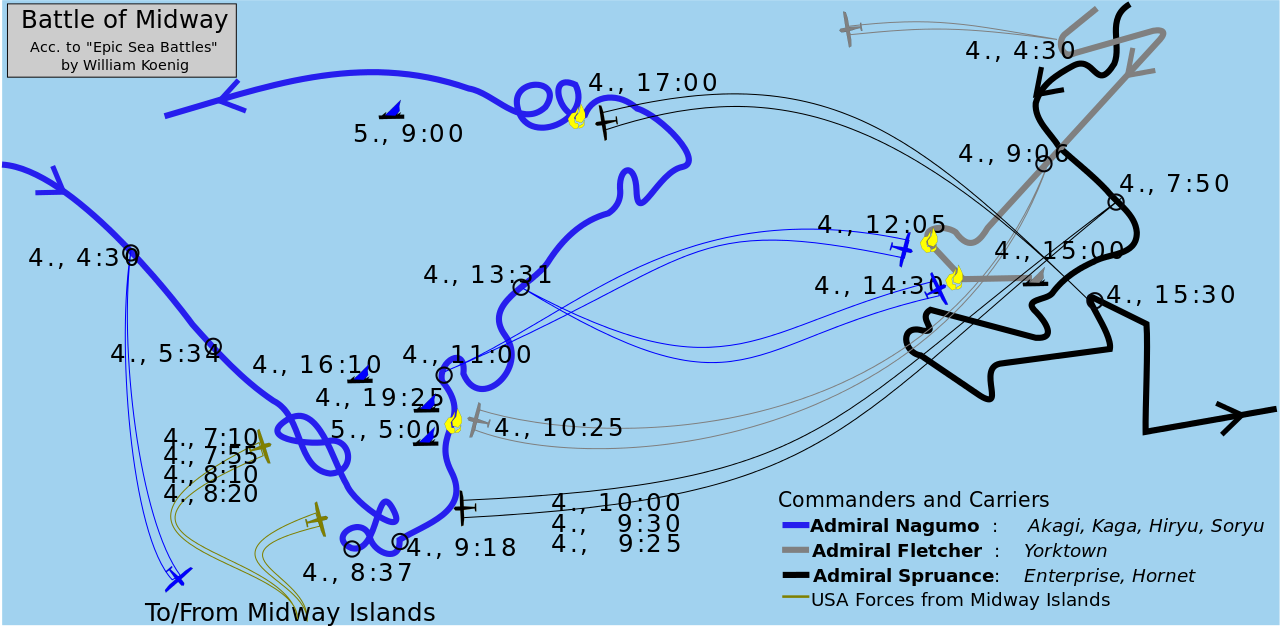
Battle of Midway deployment map, according to Seeschlachten der Weltgeschichte by William Koenig (German version of Epic Sea Battles) via Wikimedia
Seventy-five years ago (June 4-7, 1942), the astonishing American victory at the Battle of Midway changed the course of the Pacific War.
Just six months after the catastrophic Japanese surprise attack on Pearl Harbor, the U.S. crushed the Imperial Japanese Navy off Midway Island (about 1,300 miles northwest of Honolulu), sinking four of its aircraft carriers.
“Midway” referred to the small atoll roughly halfway between North America and Asia. But to Americans, “Midway” became a barometer of military progress. Just half a year after being surprised at Pearl Harbor, the U.S. Navy had already destroyed almost half of Japan’s existing carrier strength (after achieving a standoff at the Battle of the Coral Sea a month earlier).
The odds at the June 1942 battle favored the Japanese. The imperial fleet had four carriers to the Americans’ three, backed up by scores of battleships, cruisers and light carriers as part of the largest armada that had ever steamed from Japan.
No military had ever won more territory in six months than had Japan. Its Pacific Empire ranged from the Indian Ocean to the coast of the Aleutian Islands, and from the Russian-Manchurian border to Wake Island in the Pacific.
Yet the Japanese Navy was roundly defeated by an outnumbered and inexperienced American fleet at Midway. Why and how?
June 2, 2017
French Mutinies – Tunnels Under Messines Ridge I THE GREAT WAR Week 149
Published on 1 Jun 2017
The casualties and lack of success during the Nivelle Offensive were too much for the French Army and now the breaking point was reached. While parts of the French Army are in open mutiny, British Commander Douglas Haig is already planning the next offensive at Ypres. This time he wants to combine it with an amphibious landing along the Belgian coast.
May 30, 2017
Croatia in World War 1 I THE GREAT WAR Special
Published on 29 May 2017
Croatia was part of the Austro-Hungarian Empire during World War 1 and Croats were just one of the many ethnicities within the Habsburg Empire that went to to war in 1914. Croats served in Galicia, on the Isonzo Front or in the Navy and it was a Croat who built up the Austro-Hungarian Air Force. Still towards the end of the war, more and more Croats thought about independence.
May 29, 2017
Falklands War – Argentine Perspective – An Inevitable Defeat? (Guerra de las Malvinas)
Published on 12 Apr 2016
The Falklands War (Guerra de las Malvinas) in 1982 as seen by many as an inevitable defeat for Argentina, but taking a closer look at the preparations or better the lack of preparation on the Argentine side reveals that the British could have faced a far stronger opposition and might even had been defeated at least in their initial attacks. This video could also be seen as a how NOT to guide.
May 28, 2017
Indochina – Cyprus – Puerto Rico I OUT OF THE TRENCHES
Published on 27 May 2017
What do Indochina, Cyprus and Puerto Rico have in common? They are all featured in our newest episode of Out of The Trenches where Indy answers all your questions about World War 1.
May 27, 2017
Canada’s hollow army
 Thanks to a post at Army.ca, here is the rough outline of the NATO battle group that Canada will be leading in Latvia later this summer (oddly lacking in attached artillery support):
… the Canadian-led battalion level battle group will be composed of about 1,138 soldiers, as well as armor, armored transport and combat support. Of that number, 450 will be Canadian mechanized infantry bringing with them armored vehicles and various support elements. A specialized Canadian reconnaissance platoon will also be on the ground. Albania will send 18 combat (explosive ordnance disposal) engineers. Italy will send a mechanized infantry company consisting of 160 soldiers plus armored fighting vehicles. Poland will send a tank company with 160 troops. Slovenia will send 50 soldiers specializing in defense against weapons of mass destruction, (chemical, biological and nuclear weapon defense, decontamination operations etc). Spain will send the second-largest contingent: 300 soldiers from a mechanized infantry company and armored vehicles, combat engineers and support elements.
As Ted Campbell points out, this is an odd and unwieldy formation and seems unnecessarily multi-national for such a small tasking. Why isn’t the Canadian Army just sending a full battalion with the necessary supporting troops (artillery, armour, engineers, medical and logistics, etc.) to minimize operational and linguistic friction? It’s because we don’t have enough troops to do that successfully:
There is an old, tried and true, military expression to describe this: “it’s a dog’s bloody breakfast!” Can you imagine trying to command and control that organization? Especially under NATO’s rules that, as we saw in Afghanistan, allow each country to impose caveats on what where when and how its forces may be
toldasked to do anything at all.So how did we, Canada, get to this? How is it that we cannot, it appears, deploy a complete battle group without Albanian, Italian, Polish, Solvenian and Spanish troops? After all, we had a full battle group in Afghanistan just five years ago, didn’t we?
Well, yes, but …
First, a “battle group” is rarely a formed unit (never in the Canadian Army). It is, usually, either a full up armoured (tank) regiment or infantry battalion with add-ons: tanks or infantry, artillery in direct support, engineers and so on and so forth. Our battle group in Afghanistan was always based on one of Canada’s nine infantry battalions with attachments from a tank regiment, an artillery regiment and so on. But even the infantry battalion, the “base” of the battle group had to be augmented. Canada has not had one, single, full strength, properly organized and equipped infantry battalion for more than a decade. A battalion ought to have 950± soldiers and its own, organic, mortars, heavy machine guns, anti-tank or assault weapons, and, and , and … but many years ago, in an effort to “balance” the army the infantry was (stupidly) stripped of its mortars ~ the artillery will take care of it, it was said … and, bless ’em, the gunners have not let the infantry down, but that doesn’t mean the decision to strip the mortars, especially, from the infantry made any military sense at all. It didn’t; it was a dumb decision ~ the wrong thing for all the wrong reasons. But, a good friend tells, me, the prevailing view in the Army, especially, is that nothing must ever be cut because it will never, ever be gotten back. Thus we strip the battalions but leave the empty shells ~ a Canadian battalions circa 2017 has 500+ soldiers, not the 1,000- it needs. Even at the height of the Afghan campaign, when Major General (then Lieutenant Colonel) Omer Lavoie led Operation Medusa (you know, the one which Harjit Sajan said he conceived as “the architect”) his battalion, the 1st Battalion of the Royal Canadian Regiment 1RCR) had to be augmented with a company from the Princess Patricia’s Canadian Light Infantry because there were not enough companies in all three of the RCR battalions that had not been deployed within the last 18 months … the Army, in other words, had been hollowed out for years, even decades.
May 26, 2017
German Bombers Over Britain – Arab Revolt On The Advance I THE GREAT WAR Week 148
Published on 25 May 2017
This week 100 years ago, Germany is flying concentrated bomber attacks with multiple Gotha bombers on British cities – causing more damage than any Zeppelin raid before. In the Middle East, T.E. Lawrence and his allies from the Arab Revolt are on the march while on the Western Front, the last battles of the Nivelle Offensive come to an end.
A noteworthy historical “Oh, shit!” moment
At Catallaxy Files, a guest post on a most butt-puckering “Oh, shit!” from long ago:
My favourite Oh Shit moment of all time occurred a while ago. On the 4th of September 401 BC to be exact. At dawn.
Cyrus the brother of the Persian Emperor wanted to knock him off and take the throne. He had plenty of local soldiers, but to add some oomph he hired about 13,000 Greek mercenaries. Many of these were Athenians down on their luck after their city lost the Peloponnesian Wars. The Greek hoplites were the Abrams tanks of the day. Unstoppable.
The Battle of Cunaxa saw Cyrus and his brother face off. It was going reasonably well for Cyrus’s guys – the Greeks routed their Persian opponents. But then Cyrus spotted the Emperor and his guard. According to Xenophon he then took his bodyguard of 600 heavy cavalry off and attacked the Emperor’s 6,000. Cyrus went all in – he personally attacked his brother and wounded him. But in doing so he received a javelin just under one eye and expired.
Which brings us to dawn next morning. The Greeks had no idea that their paymaster had suffered a quite unsuccessful death or glory moment, until the news arrived just then.
The Persians, having sorted out their differences, were now united into a huge army under Artaxerxes the Emperor. Which left the small matter of the Greek mercenary force deep inside the Persian Empire and surrounded by a vast horde of very unhappy Persians.
Oh shit.
The story of their escape back to Greece is awe inspiring and amazing. Well worth reading. Xenophon’s Anabasis is available free from Project Gutenberg at the link.


