
One of the great paradoxes of the Second World War is that while German troops on the Eastern Front were starving and freezing to death for lack of supplies, the rail transport of Jews to the death camps proceeded with uninterrupted Teutonic efficiency. The explanation is found in a profound insight by the historian Gerhard Weinberg (born 1928); that for the Nazis the extermination of Europe’s Jews was the purpose of the war, not a distraction or a side show. A complication was that this “Final Solution to the Jewish Question” was a state secret, even though it might have been the worst-kept secret in history.
Yaron Pasher is a young Israeli historian who studied under Weinberg. In this book he sets out to explore how the implementation of the Holocaust fatally undermined the German war effort between 1941 and the final collapse in May 1945. Unfortunately Pasher is simply out of his depth trying to write military history from the perspective of logistics (admittedly, one of the hardest things that any historian can attempt!).
Much of the text is a mish-mash of rehashed secondary sources about the course of operations on the Eastern and Western fronts. The reader bogs down, like a Panzer division in the Spring thaw, in a welter of inconsistently transliterated Slavic place names. The narrative is interspersed with glimpses of the progress of the Final Solution repeatedly hammering home the same assertion: if all those trains that carried Jews to the death camps had been used to carry supplies and reinforcements to the Front, the Wehrmacht might have performed better against the Russians.
Yaron Pasher, “Holocaust versus Wehrmacht: How Hitler’s “Final Solution” Undermined the German War Effort”, Strategy Page, 2015-09-02.
July 14, 2017
QotD: Did the Holocaust Undermine the German War Effort?
July 12, 2017
World of Warships – Dunkirk
Published on 11 Jul 2017
It’s all well and good for Churchill to promise to “Fight them on the beaches…”, but first he had to get them off the beaches of France to ensure he had anyone to fight them on the beaches of England with…
July 11, 2017
Maria Bochkareva and the 1st Russian Women’s Battalion of Death I WHO DID WHAT IN WW1?
Published on 10 Jul 2017
Maria Bochkareva was one of several Russian women who volunteered to fight in the name of the Tsar in 1914. She fought with distinction on the Eastern Front until the Russian Revolution. To set an example against the falling morale in the post-revolutionary Russian Army, she requested to train and lead the first Russian Women’s Death Battalion – ready to die for their country. During the Kerensky Offensive they went over the top and suffered heavy casualties. Ultimately, Bochkareva was executed by the Bolsheviks during the turmoil of the Russian Civil War.
RPG-7: How it Works and a Demo Shot
Published on 11 Oct 2015
The RPG-7 is pretty far from being a forgotten weapon, but I was not going to pass up an opportunity to take a closer look at a live one. This example is one of the few live and registered RPGs in the US, and it belongs to Movie Gun Services (if you saw Black Hawk Down, you saw it in use…).
The RPG is a rocket-propelled shaped charge antitank weapon that took its philosophical foundation from the German WWII Panzerfaust (although it shares little with that weapon mechanically). Over the course of WWII, the armor on tanks quickly because too heavy for man-portable anti-tank rifles to defeat. The solution to this dilemma was the development of shaped charge warheads, in which directed explosive energy could be used much more efficiently than simple high explosive or even simpler kinetic energy.
After several earlier developmental iterations, the RPG-7 was introduced in 1961 by the Soviet Union and would prove to be an extremely effective, inexpensive and simple weapon. Today they are found in virtually all third world conflict zones. A variety of rocket types have made them much more than a dedicated anti-tank weapon, and they will be found used against everything from personnel to aircraft.
July 10, 2017
A Canadian Cold War innovation – “floppy” magnets as submarine detection tools
Steve Weintz on an experimental Canadian submarine detection device that was simple, effective, and too difficult to train with:
Desperate planners sought ways of making Soviet subs easier to hunt. Any technology that could speed up an undersea search was worth considering. “A submarine’s best defense is of course stealth, remaining quiet and undetected in the ocean deep,” Ballantyne notes. “Something that could rob the Soviets of that cloak of silence must have seemed irresistible and, at least initially, a stroke of genius.”
A Canadian scientist figured some kind of sticky undersea noisemaker would make a Soviet sub more detectable. He designed a simple hinged cluster of magnets that could attach to a submarine’s metal hull.
Movement would cause the flopping magnets to bang against the hull like a loose screen door, giving away the sub’s location to anyone listening. The simple devices would take time and effort to remove, thus also impairing the Soviet undersea fleet’s readiness.
At least that was the idea.
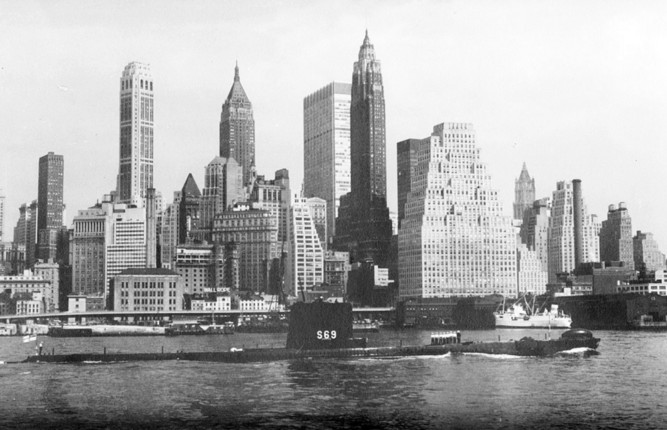
HMS Auriga against the New York City skyline in 1963. U.S. Navy photo.
In late 1962, the British Admiralty dispatched the A-class diesel submarine HMS Auriga to Nova Scotia for joint anti-submarine training with the Canadian navy. The British were helping Canada establish a submarine force, so Royal Navy subs routinely exercised with Canadian vessels.
Auriga had just returned to the submarine base at Faslane, Scotland after a combat patrol as part of the Cuban Missile Crisis. Other subs of the joint Canadian-British Submarine Squadron Six at Halifax had seen action during the crisis.
Did the device work? All too well:
As Auriga surfaced at the end of the exercise, the magnets made their way into holes and slots in the sub’s outer hull designed to let water flow. “They basically slid down the hull,” Ballantyne says of the magnets, “and remained firmly fixed inside the casing, on top of the ballast tanks, in various nooks and crannies.”
The floppy-magnets couldn’t be removed at sea. In fact, they couldn’t be removed at all until the submarine dry-docked back in Halifax weeks later.
In the meantime, one of Her Majesty’s submarines was about as stealthy as a mariachi band. No fighting, no training, no nothing until all those floppy little magnets were dug out of her skin at a cost of time, money and frustration.
The magnets worked on the Soviets with the same maddening results. The crews of several Foxtrots were driven bonkers by the noise and returned to port rather than complete their cruises.
July 9, 2017
German Defences In The Meuse-Argonne Region I THE GREAT WAR Special
Published on 8 Jul 2017
Tour the Meuse-Argonne region with Jean-Paul: http://bit.ly/MeuseArgonneTours
Indy and Jean-Paul from the Romagne 14-18 museum explore the German defence works in the region. These bunkers were used from 1914 till 1918 and saw heavy action during the American Meuse-Argonne Offensive later in the war.
July 8, 2017
Context the Media lacks: Austrian Troops to Italian Border
Published on 6 Jul 2017
This is a short commentary on a current situation/news that is related to Austrian Military History. On the 4th of July 2017, the Austrian government announced that it will ready troops to be sent to the Austro-Italian border in order to secure it, due to the large amount of migrants crossing into Austria. The Italian government wasn’t particularly pleased about this action. Additionally, at least the German media seems to be a bit upset as well.
Military History Visualized provides a series of short narrative and visual presentations like documentaries based on academic literature or sometimes primary sources. Videos are intended as introduction to military history, but also contain a lot of details for history buffs. Since the aim is to keep the episodes short and comprehensive some details are often cut.
For more information, here is a Daily Mail article discussing the situation.
Both Italy and Austria are members of the European Union’s Schengen open-border zone, but free movement has been jeopardised by the reimposition of controls at many crossings across the bloc since the surge in migrants seen in 2015 and 2016.
There was no immediate comment from Italy or EU officials, but Doskozil’s spokesman said there was no concrete timetable for the new controls.
The spokesman added: ‘We’ll see how the situation in Italy is becoming more acute and we have to be prepared to avoid a situation comparable to summer 2015.’
Italy has taken in more than 80,000 refugees and migrants so far this year, most of whom arrived by boat from Africa, making Italy the main point of entry to Europe.
Back in April, Defense Minister Hans Peter Doskozil visited the production plants of the armoured vehicles – Pandur crew transport tanks – that were sent to the border.
The tanks, with a production cost of €105million, were built at General Dynamics Land Systems-Steyr GmbH in Vienna-Simmering for the Austrian Armed Forces.
Four Fun Facts about the Oerlikon 20mm Antiaircraft Cannon!
Published on 13 Apr 2017
The 20mm Oerlikon automatic cannon was a mainstay of United States naval air defense during World War 2, and today we will look at a few of the characteristics and questions that apply to this sort of automatic cannon but not to typical small arms. Like, for instance, how do you cock a gun that has a 400 pound recoil spring? Or, what happens if you fire a high explosive shell into your muzzle cover?
July 7, 2017
Turmoil In The Reichstag – The Kerensky Offensive I THE GREAT WAR Week 154
Published on 6 Jul 2017
WW1 Flying Event with Indy & the Crew: http://bit.ly/TGWStowMaries
The German home front is shaken by a political scandal this week 100 years ago. A member of the Center party reveals that the German unrestricted submarine warfare is not achieving what the German high command had hoped for. Paul von Hindenburg and Erich Ludendorff, who pretty much run Germany as a military dictatorship by now, also dispose of chancellor Theobald von Bethmann Hollweg. Hollweg was actually secretly involved in peace negotiations but that chance is gone with him too. Russia unleashes their Kerensky Offensive on the Eastern Front and puts further pressure on the Central Powers.
July 6, 2017
Hunting the Bismarck – IV: Sink the Bismarck – Extra History
Published on Jun 1, 2017
Sponsored by Wargaming! New players: Download World of Warships and use the code EXTRA1 for free goodies! http://bit.ly/2rpKsch
European Players: Check out the “Hunt for Bismarck” Extra History bundle in the premium shop: http://bit.ly/2qLifdR
Sink the Bismarck. Churchill’s orders were simple, but executing them had proved tricky. Admiral Tovey and his hastily summoned handful of ships and planes had one more opportunity to sink the German juggernaut, and they were determined not to waste this chance.
July 5, 2017
Armored Trains in World War 1 – Germany & Austro-Hungary featuring The Great War Channel
Published on 26 Jun 2017
Armored trains were used to varying degrees by most countries during World War 1. This video takes a closer look at the German and Austro-Hungarian armored trains.
Check out the Great War’s Version on Armored Trains here: https://www.youtube.com/watch?v=e5Jl5KdG-Tc
July 4, 2017
The Destroyed Villages Of France – Fleury I THE GREAT WAR Special
Published on 3 Jul 2017
Fleury has a mayor and you can find it on a map. But the official population is: 0. The village has been completely destroyed during the Battle of Verdun and his now a memorial place. Indy walks the blasted landscape where you can still see the craters from constant bombardment.
July 2, 2017
Fighting Without A Country – Czechoslovak Legions of World War 1 I THE GREAT WAR Special
Published on 1 Jul 2017
Czechs and Slovaks were minorities with the Austro-Hungarian and Russian Empire. Even before the outbreak of the war they demanded more rights as industrious citizens but were often overheard. During the war, they decided to take matter into their own hands and fight. And that they did in many armies across Europe.
The US Navy’s WW2 floating drydocks
I’d never heard of these massive mobile drydock facilities before:
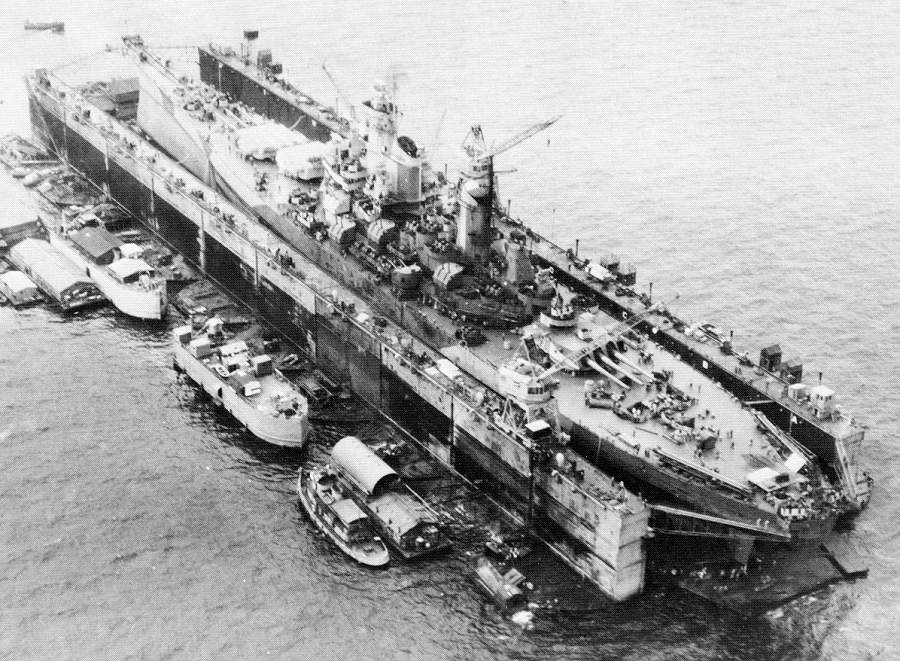
USS Iowa (BB-61) in a floating drydock at Manus Island, Admirality Islands, 28 December 1944. (via Wikimedia)
The United States Navy, during World War 2, decided to create a temporary forward base utilizing service stations; these stations meant the United States Navy could operate throughout the huge Pacific Ocean for more sustained amounts of time.
Creating these pretty much meant they could have a major naval base within a short distance of any operation carried out in the area. The base was able to repair; resupply and refit, meaning fewer ships had to make the journey to a facility at a major port, which allowed them to remain in the Pacific for up to a year and beyond.
These stations were officially named Advance Base Sectional Docks (ABSDs) and were put together section by section. Each part was welded to the next once in their correct position.
There were two different sizes of floating docks created, the largest ones were created using ten sections and could lift 10,000 tons each – being 80 feet wide and 256 feet long. Once these sections were welded together, it became a fully assembled dock that was a whopping 133 feet wide, 827 feet long and could lift up to 90,000 tons.
This was more than enough lifting power for any ship within the Fleet.
The post also included this film, showing the USS Idaho being moved into an ABSD at Esperitu Santo in August, 1944:
Published on 7 May 2015
On August 15, 1944 the mighty battleship Idaho arrived at Espiritu Santo in the Pacific and slipped into a floating dry dock so that emergency repairs could be made to the ship’s blisters. This special film — likely made by the crew of the battleship’s observation aircraft — documents the activities as the ship is maneuvered into position. The dry dock shown is likely one of the Large Auxiliary Floating Dry Docks (AFDB), probably AFDB/ABSD-1. This was constructed in sections during 1942 and 1943 at Everett Shipbuilding Co., Everett, WA., by the Chicago Bridge & Iron Co., Eureka, CA., the Pollack-Stockton Shipbuilding Co., Stockton, CA., and Chicago Bridge & Iron Co., Morgan City, LA. During World War II ABSD-1 was assigned to the Asiatic-Pacific Theater and towed to Espiritu Santo in the New Hebrides and assembled for service. Later it was disassembled and towed to Manicani Bay, P.I. and reassembled for service by September 1945.
USS Idaho had been damaged during long days of combat that began with the bombardment of Saipan in June. With the landing assault underway on 15 June, the battleship moved to Guam for bombardment assignments. As the American fleet destroyed Japanese carrier air power in the Battle of the Philippine Sea from 19–21 June, Idaho protected the precious transport area and reserve convoys. After returning to Eniwetok from 28 June to 9 July, the ship began preinvasion bombardment of Guam on 12 July, and continued the devastating shelling until the main assault eight days later. As ground troops battled for the island, Idaho stood offshore providing vital support until anchoring at Eniwetok on 2 August.
After repair, Idaho‘s mighty guns were needed for the next giant amphibious assault on the way to Japan. She sailed from San Diego on 20 January 1945 to join a battleship group at Pearl Harbor. After rehearsals, she steamed from the Marianas on 14 February for the invasion of Iwo Jima. As Marines stormed ashore on 19 February, Idaho was again blasting enemy positions with her big guns, and fired star shells at night to illuminate the battlefield. She remained off Iwo Jima until 7 March, when she underway for Ulithi and the last of the great Pacific assaults – Okinawa.
At the end of the conflict Idaho made her triumphal entry into Tokyo Bay with occupation troops on 27 August, and was anchored there during the signing of the surrender on board the Missouri on 2 September. Four days later she began the long voyage to the East Coast of the United States, steaming via the Panama Canal to arrive at Norfolk on 16 October. She decommissioned on 3 July 1946 and was placed in reserve until sold for scrap on 24 November 1947 to Lipsett, Incorporated, of New York City.
July 1, 2017
Hunting the Bismarck – III: A Chance to Strike – Extra History
Published on May 25, 2017
Sponsored by Wargaming! New players: Download World of Warships and use the code EXTRA1 for free goodies! http://cpm.wargaming.net/i3v7c6uu/?pu…
The order went out: Sink the Bismarck. Ships converged from all over the Atlantic to hunt down the pride of the German navy, and Swordfish planes launched from the aircraft carrier Ark Royal raced to harry the great warship.


