
Feature History
Published on 12 Mar 2017Hello and welcome to Feature History, featuring The Spanish Civil War, zero mic etiquette, and a super subtle political lesson.
March 22, 2018
Feature History – Spanish Civil War
Comments Off on Feature History – Spanish Civil War
March 20, 2018
Inside the German A7V WW1 Tank I THE GREAT WAR On The Road
The Great War
Published on 19 Mar 2018The German Tank Museum: http://daspanzermuseum.de/
We visited the German Tank Museum (in Munster, not Münster) and talked to the director Ralf Raths about the German tanks in World War 1. The only one that saw action was the A7V and will find out how it was designed, how up to 23 men fit inside one of these and what the operational history was.
Comments Off on Inside the German A7V WW1 Tank I THE GREAT WAR On The Road
March 18, 2018
King George V in World War 1 I WHO DID WHAT IN WW1?
The Great War
Published on 17 Mar 2018He was monarch over the largest empire the world has ever seen. When the war came he saw his duty as the face of determination for his people: King George V.
Comments Off on King George V in World War 1 I WHO DID WHAT IN WW1?
March 17, 2018
The Battle of Cannae (Second Punic War) (Lecture)
The Study of Antiquity and the Middle Ages
Published on 16 Mar 2018This lecture aimed towards High School students features the battle of Cannae.
The Battle of Cannae (/ˈkæniˌ-neɪˌ-naɪ/[) was a major battle of the Second Punic War that took place on 2 August 216 BC in Apulia, in southeast Italy. The army of Carthage, under Hannibal, surrounded and decisively defeated a larger army of the Roman Republic under the consuls Lucius Aemilius Paullus and Gaius Terentius Varro. It is regarded both as one of the greatest tactical feats in military history and as one of the worst defeats in Roman history.
Having recovered from their losses at Trebia (218 BC) and Lake Trasimene (217 BC), the Romans decided to engage Hannibal at Cannae, with roughly 86,000 Roman and allied troops. They massed their heavy infantry in a deeper formation than usual, while Hannibal used the double-envelopment tactic. This was so successful that the Roman army was effectively destroyed as a fighting force. Following the defeat, Capua and several other Italian city-states defected from the Roman Republic to Carthage.
Comments Off on The Battle of Cannae (Second Punic War) (Lecture)
Tank Chats #24 Vickers A1E1 Independent | The Tank Museum
The Tank Museum
Published on 5 Aug 2016In the 24th Tank Chat, David Fletcher looks at the rather unusual Vickers A1E1 Independent. The Independent originated in 1922 with a War Office specification for a heavy tank. Ultimately it proved to be a failed project was abandoned in 1935, by which time it had cost more than £150,000, and sent to Bovington. It is the only tank of its kind in existence.
Comments Off on Tank Chats #24 Vickers A1E1 Independent | The Tank Museum
March 16, 2018
Allied Unified Command On The Horizon I THE GREAT WAR Week 190
The Great War
Published on 15 Mar 2018While Germany is occupying a territory from the Baltics to the Black Sea and planning its huge spring offensive, the Allies are still trying to get behind the idea of a unified command.
Comments Off on Allied Unified Command On The Horizon I THE GREAT WAR Week 190
The Imperial German Army’s final throw of the dice – Operation Michael, March 1918
Victor Davis Hanson summarizes the Central Powers’ brief moment of strength early in 1918:
One hundred years ago this month, all hell broke loose in France. On March 21, 1918, the German army on the Western Front unleashed a series of massive attacks on the exhausted British and French armies.
German General Erich Ludendorff thought he could win World War I with one final blow. He planned to punch holes between the French and British armies. Then he would drive through their trenches to the English Channel, isolating and destroying the British army.
The Germans thought they had no choice but to gamble.
The British naval blockade of Germany after three years had reduced Germany to near famine. More than 200,000 American reinforcement troops were arriving each month in France. (Nearly 2 million would land altogether.) American farms and factories were sending over huge shipments of food and munitions to the Allies.
Yet for a brief moment, the war had suddenly swung in Germany’s favor by March 1918. The German army had just knocked Russia and its new Bolshevik government out of the war. The victory on the Eastern Front freed up nearly 1 million German and Austrian soldiers, who were transferred west.
Germany had refined new rolling artillery barrages. Its dreaded “Stormtroopers” had mastered dispersed advances. The result was a brief window of advantage before the American juggernaut changed the war’s arithmetic.
The Spring Offensive almost worked. Within days, the British army had suffered some 50,000 casualties. Altogether, about a half-million French, British and American troops were killed or wounded during the entire offensive.
But within a month, the Germans were sputtering. They could get neither supplies nor reinforcements to the English Channel. Germany had greedily left 1 million soldiers behind in the east to occupy and annex huge sections of conquered Eastern Europe and western Russia.
The British and French had learned new ways of strategic retreat. By summer of 2018, the Germans were exhausted. In August, the Allies began their own (even bigger) offensive and finally crushed the retreating Germans, ending the war in November 1918.
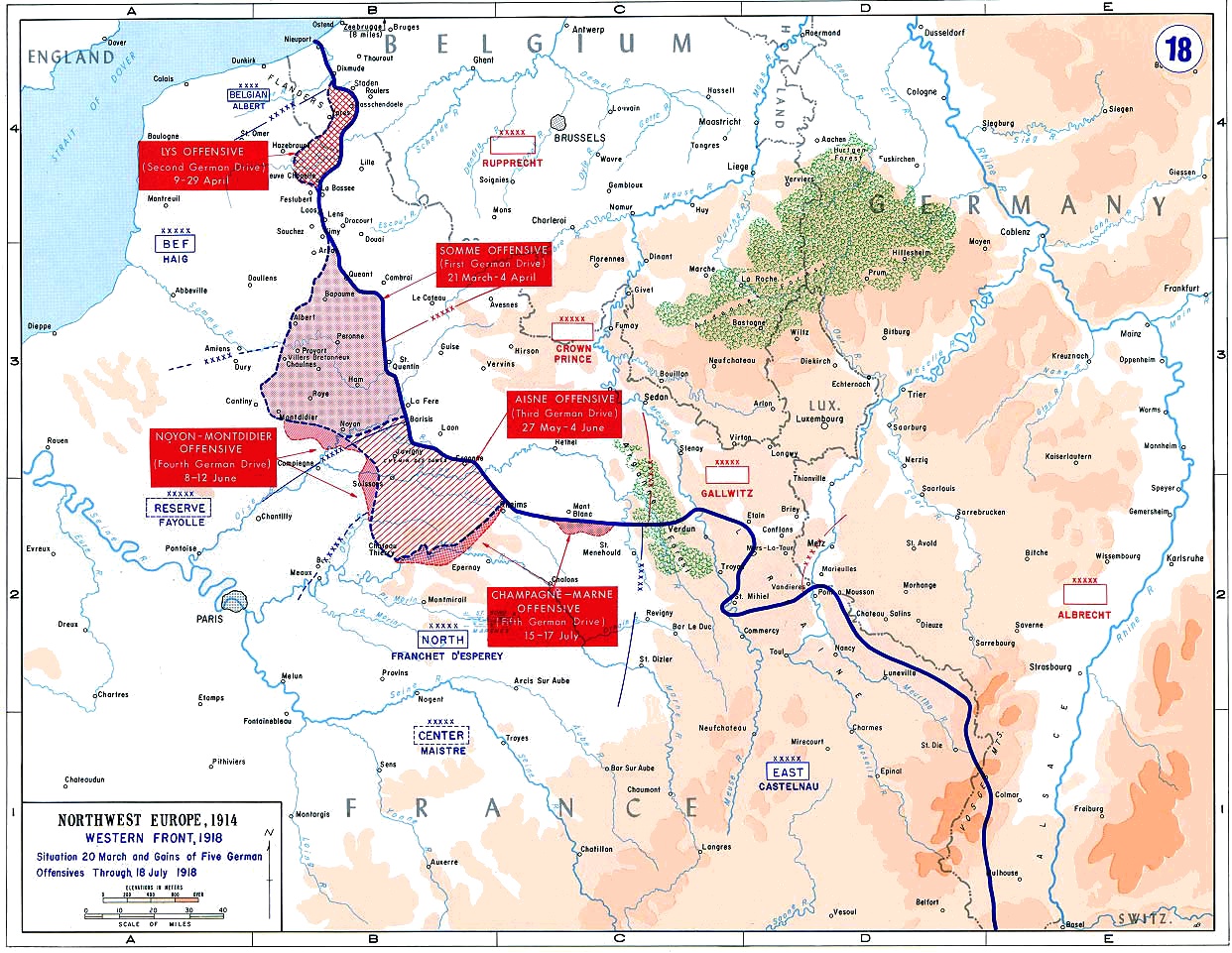
Click to see full-sized image.
For more information on Operation Michael, sometimes known as “The Kaiser’s Battle”, here’s the Wikipedia entry.
Comments Off on The Imperial German Army’s final throw of the dice – Operation Michael, March 1918
How Rifles & Railroads influenced Warfare in the 19th Century
Military History Vlogs
Published on 23 Feb 2018The introduction of the breech-loading rifle and the railroad had a tremendous influence on Warfare in the 19th Century. Although, not everyone was as fast or able to adopt then the Prussians. Austria, France and Russia had major issues. Most notably visible in the Austro-Prussian War (1866) and Franco-Prussian War (1870-1871).
Comments Off on How Rifles & Railroads influenced Warfare in the 19th Century
March 14, 2018
The navy we need versus the navy we’re willing to pay for
Ted Campbell recounts the ups and downs of the federal government’s plans for the Royal Canadian Navy over the last few decades:
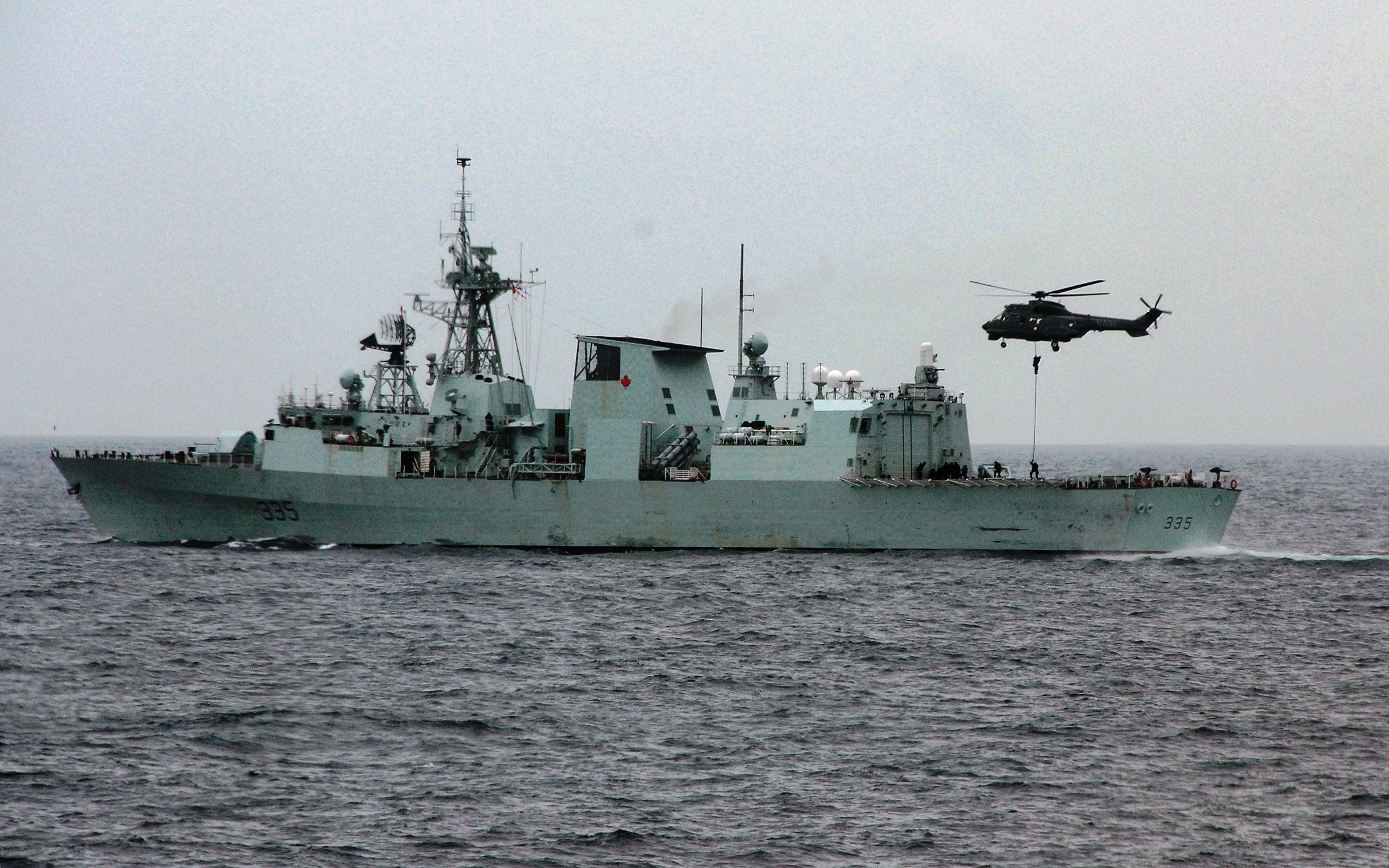
A Chilean navy boarding team fast-ropes onto the flight deck of RCN Halifax-class frigate HMCS Calgary (FFH 335) during multinational training exercise Fuerzas Aliadas PANAMAX 2009.
US Navy photo via Wikimedia.
One of my old friends, commenting to another equally old friend on social media, said this: “Surely, the PM and his government must see the obvious — that as the oceans warm and the ice melts the Northwest Passage becomes navigable year round. He’s been sounding off about climate change ad nauseum so that would seem to be understood by him. As a teacher he must also know that European colonial powers sought a shortcut between east and west but were deterred by ice. That’s changed, which he acknowledges, and Canada’s claim of the.increasingly ice free Northwest Passage as sovereign territory is under threat. Absent Canada’s willingness, and any capability, to enforce it’s claim, Canada surrenders any legitimate right to ownership of the Northwest Passage and the resources in the territory it abuts. That a maritime nation bordered by three oceans needs a blue-water navy is axiomatic. And once the PM acknowledges that the Northwest Passage is about to become Canada’s Suez Canal he must recognize that it, too, needs to be protected and defended by the Royal Canadian Navy. But the navy can only do that if it has ships and sailors. If Canada doesn’t expend the effort to protect its shores and assert its claims someone else will.” Sound pretty sensible, doesn’t it? Climate change will, very possibly, open the Northwest Passage; it Canada cannot patrol and police those waters then others will exploit them; it’s the Navy’s job to patrol and police our waters … I have argued that the “constabulary fleet” that should do that ought not to be in the Navy, but that’s a different issue … for now.
[…]
Way back when ~ I’m working from memory and I’m happy to have these numbers corrected ~ the Royal Canadian Navy said, in a document called “Leadmark,” if my memory serves, that, in addition to infrastructure (headquarters, schools, dockyards, etc) it needed:
- A fleet with global “reach” which meant more than a dozen “major combatants” (destroyers and frigates) plus four support ships so that, at any time, it could have one combat-ready task group in each of any two of the world’s oceans;
- A coastal (three coasts) patrol fleet consisting of a mix of submarines and another dozen “minor combatants” (corvettes and mine hunters);
- Organic air elements for those fleets;
- Auxiliary and training vessels.
Circumstances changed over time but the Paul Martin government finally committed to new helicopters for the fleet and thanks to his decision and to the perseverance of the Harper government they are, finally, entering service, only 25 years after Jean Chrétien abruptly cancelled the Mulroney government’s signed contracts for (then) new shipborne helicopters.
[…]
What we, Canadians, do not have is a properly funded plan to build the real Navy that the country with the world’s longest coastline, that borders three oceans, needs and deserves.
Since I am pretty sure that, absent some catastrophic events, Prime Minister Trudeau has no interest in warships (or the Coast Guard) I can be fairly confident that while new ships will be built they will be too few in number for the jobs that need doing.
There are no votes in promising to rebuild the military. The Liberals will ignore it and the Conservatives would be wise to not make it much of a campaign issue … Canadians, an overwhelming majority of Canadians just don’t care. But the Conservatives need to get some first rate naval and shipbuilding people into a room and decide, for themselves, what the real costs are for what the Royal Canadian Navy really needs.
The expected warming of the Arctic Ocean and the potential opening of new shipping lanes through areas currently claimed by Canada should be a huge encouragement for the federal government to get serious about ensuring that the RCN, the Canadian Coast Guard and the RCMP are properly prepared and equipped to protect our sovereignty in this region. As in so many other climate change matters, however, the government loves to talk the talk but is manifestly uninterested in walking the walk. More new ships, submarines, helicopters, bases, and the military staff to crew/staff them would be a very expensive commitment that wouldn’t shore up votes in those critical marginal constituencies and would reduce the government’s ability so spend money in aid of getting re-elected (the Liberals are in power now, but the same sort of political calculus applies to the Tories as well).
Mr. Campbell is a Conservative and clearly harbours hopes that Admiral Andrew Scheer will be more willing to make the RCN a priority, but history does not support that hope. The last time (and possibly only time outside periods of declared war) that a Canadian government was serious about the military was before 1957. Canadians are hopelessly in love with the idea of being a peaceful nation and have never been willing to engage with that old Latin tag “Si vis pacem, para bellum“
Comments Off on The navy we need versus the navy we’re willing to pay for
Battle Stack: The Battle of Isandlwana tactics
BattleStack
Published on 25 Nov 2016The Battle of Isandlwana was fought between the British and Zulus in 1879. Find out what happened with this animated tactics video!
Comments Off on Battle Stack: The Battle of Isandlwana tactics
March 13, 2018
German Tactics For 1918 Spring Offensive I THE GREAT WAR Special
The Great War
Published on 12 Mar 2018The German Spring Offensive in 1918, the so called Kaiserschlacht or Operation Michael, was the biggest German offensive of World War 1 and Quartermaster-general Erich Ludendorff prepared his troops for this battle by incorporating everything the German Army had learned in this war until now. Hutier Infiltration Tactics, Georg Bruchmüller’s artillery targeting and more lessons from the Eastern Front mean the Entente was facing a different army than before.
Comments Off on German Tactics For 1918 Spring Offensive I THE GREAT WAR Special
March 11, 2018
Savage Division – Displaced People – Sexual Relations I OUT OF THE TRENCHES
The Great War
Published on 10 Mar 2018Chair of Wisdom time!
Comments Off on Savage Division – Displaced People – Sexual Relations I OUT OF THE TRENCHES
March 9, 2018
Peace In The East – The Treaty of Brest-Litovsk I THE GREAT WAR Week 189
The Great War
Published on 8 Mar 2018Germany and the Russian Bolshevik Government sign the Treaty of Brest-Litovsk ending hostilities on the Eastern Front. Previously Germany had resumed the war in the East to put pressure on the Bolsheviks to accept the dictated terms. The Western Front Caucasian theatre were far from peaceful though.
Comments Off on Peace In The East – The Treaty of Brest-Litovsk I THE GREAT WAR Week 189
Devil’s Brigade – WWII First Special Service Force
farias615
Published on 24 May 2017
Comments Off on Devil’s Brigade – WWII First Special Service Force
March 7, 2018
USS Lexington‘s final resting place discovered by Paul Allen’s RV Petrel
As reported by News Corp Australia:
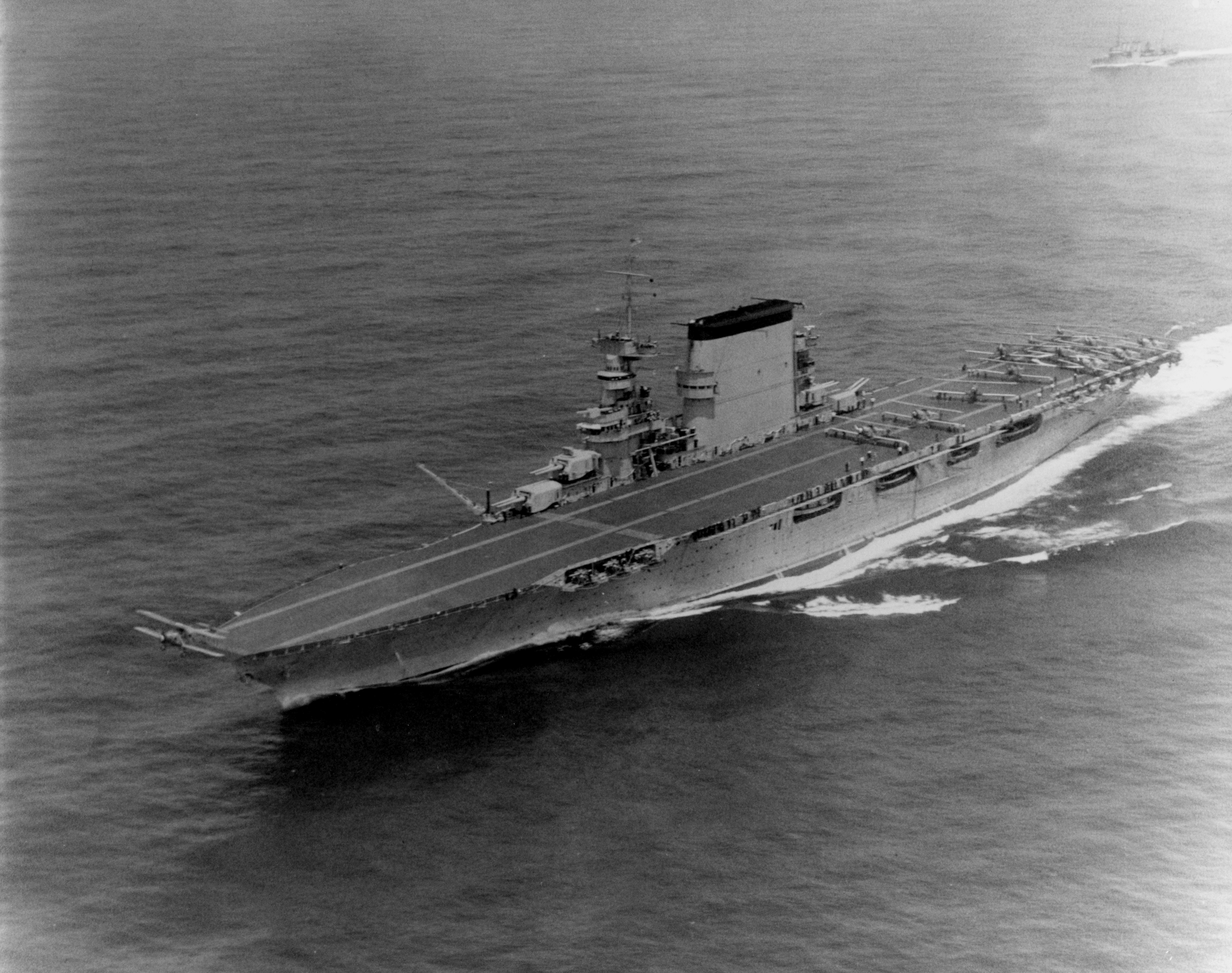
U.S. Navy Martin T4M-1 aircraft of Torpedo Squadron 1B (VT-1B) are launching from the deck of the aircraft carrier USS Lexington (CV-2) in 1931. Note the “four-stacker” (Clemson/Wickes-class destroyer) in the upper right corner.
US Navy photo via Wikimedia.
Now, 76 years after it settled to the bottom, it’s been found.
It’s the latest find by billionaire Paul Allen.
And it’s in a remarkably well preserved condition.
Soon-to-be US ambassador to Australia, US Pacific Commander Admiral Harry Harris says he is elated at the find.
“As the son of a survivor of the USS Lexington, I offer my congratulations to Paul Allen and the expedition crew of Research Vessel Petrel for locating the ‘Lady Lex’,” he said in a tweet.
[…]
Paul Allen’s research vessel Petrel located the wreck of the USS Lexington yesterday.
According to a post on the philanthropist’s website, it rests some 800km off the coast of Queensland at a depth of about 3km.
The find was the result of a six month project.
Photos so far returned by RV Petrel’s submersible show several aircraft that have tumbled out of the carrier and on to the ocean’s floor. Their original markings and paintwork remain remarkably clear.
The ship itself, while showing heavy scarring from the battle and the stresses of diving 3km to the sea floor, is also well preserved. Gun mounts and other fittings show only little sign of corrosion and deterioration.
Vulcan Inc.
Published on 5 Mar 2018Wreckage from the USS Lexington was discovered on March 4, 2018 by the expedition crew of Paul G. Allen’s Research Vessel (R/V) Petrel. The aircraft carrier, “Lady Lex” was found more than 3,000 meters below the surface, resting on the floor of the Coral Sea more than 500 miles off the eastern coast of Australia.
Comments Off on USS Lexington‘s final resting place discovered by Paul Allen’s RV Petrel


