Quotulatiousness

April 7, 2019

Germans and British make their way to the North – WW2 – 032 – April 6 1940

Filed under: Britain, Europe, Germany, History, Military, WW2 — Tags: , , , , , , — Nicholas @ 06:00

World War Two
Published on 6 Apr 2019

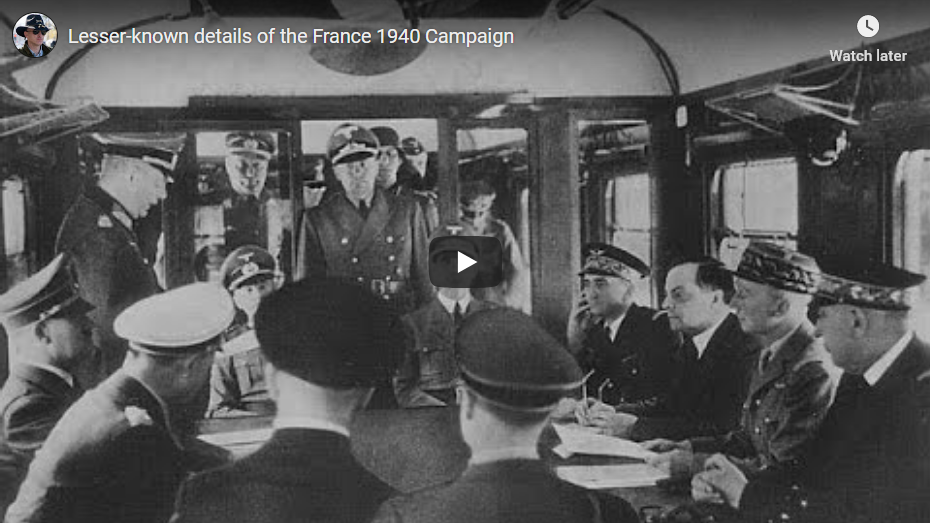
While China gets a new government, or at least in the eyes of Japan, the British are trying to cope with the rationing of meat and dairy products by trying out some new recipes. More importantly, Germany seems to be very serious about invading Norway. However, the British also plan to move closer to Norway.

Join us on Patreon: https://www.patreon.com/TimeGhostHistory
Or join The TimeGhost Army directly at: https://timeghost.tv

Follow WW2 day by day on Instagram @World_war_two_realtime https://www.instagram.com/world_war_t…
Join our Discord Server: https://discord.gg/D6D2aYN.
Between 2 Wars: https://www.youtube.com/playlist?list…
Source list: http://bit.ly/WW2sources

Written and Hosted by: Indy Neidell
Produced and Directed by: Spartacus Olsson and Astrid Deinhard
Executive Producers: Bodo Rittenauer, Astrid Deinhard, Indy Neidell, Spartacus Olsson
Creative Producer: Joram Appel
Research by: Indy Neidell
Edited by: Iryna Dulka
Map animations: Eastory

Colorisations by Norman Stewart

Eastory’s channel: https://www.youtube.com/channel/UCEly…
Archive by Screenocean/Reuters https://www.screenocean.com

A TimeGhost chronological documentary produced by OnLion Entertainment GmbH.

From the comments:

World War Two
2 days ago (edited)
The war seems to be heating up. As both the Germans and the Allies move towards Norway, the Soviets commit a big war crime in Katyn. We have made a ‘War Against Humanity’ episode in which we explain how Stalin and Beria ordered the mass murder. You can see that right here: https://www.youtube.com/watch?v=gd5YhhNcC44 And a friendly reminder for the existence of our own discord server: https://discord.gg/D6D2aYN.

Cheers!

Epic Moments in History – The 9 Lives of Alexander the Great

Filed under: History, India, Middle East, Military — Tags: , , , , , — Nicholas @ 02:00

Invicta
Published on 4 Sep 2017

Alexander the Great is one of the most famous historical figures of all time. Yet many are unaware of the 9 times he cheated death over the course of his epic campaigns into the east!

Support future documentaries: https://www.patreon.com/InvictaHistory
Twitter: https://twitter.com/InvictaHistory

Video Credits:
Research – Invicta
Script: Invicta
Narration – Invicta
Artwork – Robbie McSweeney (https://www.artstation.com/artist/rob…)

Bibliography:
Alexander the Great by Phillips Freeman
The Campaigns of Alexander by Arrian

Music: “Rome: Total War OST” by Jeff van Dyck
“Total War: Rome II OST” by Richard Beddow

April 6, 2019

George Orwell BBC Arena Part 3 Homage to Catalonia

Filed under: Books, Britain, Europe, History, Military, Politics — Tags: , , , — Nicholas @ 04:00

Alan Ruben
Published on 9 May 2013

Part 3 of an in-depth 5 part series about George Orwell made in 1983.

QotD: Truth and propaganda in the Spanish Civil War

Filed under: Europe, History, Military, Quotations — Tags: , , , , — Nicholas @ 01:00

The struggle for power between the Spanish Republican parties is an unhappy, far-off thing which I have no wish to revive at this date. I only mention it in order to say: believe nothing, or next to nothing, of what you read about internal affairs on the Government side. It is all, from whatever source, party propaganda — that is to say, lies. The broad truth about the war is simple enough. The Spanish bourgeoisie saw their chance of crushing the labour movement, and took it, aided by the Nazis and by the forces of reaction all over the world. It is doubtful whether more than that will ever be established.

I remember saying once to Arthur Koestler, ‘History stopped in 1936’, at which he nodded in immediate understanding. We were both thinking of totalitarianism in general, but more particularly of the Spanish civil war. Early in life I have noticed that no event is ever correctly reported in a newspaper, but in Spain, for the first time, I saw newspaper reports which did not bear any relation to the facts, not even the relationship which is implied in an ordinary lie. I saw great battles reported where there had been no fighting, and complete silence where hundreds of men had been killed. I saw troops who had fought bravely denounced as cowards and traitors, and others who had never seen a shot fired hailed as the heroes of imaginary victories; and I saw newspapers in London retailing these lies and eager intellectuals building emotional superstructures over events that had never happened. I saw, in fact, history being written not in terms of what happened but of what ought to have happened according to various ‘party lines’. Yet in a way, horrible as all this was, it was unimportant. It concerned secondary issues — namely, the struggle for power between the Comintern and the Spanish left-wing parties, and the efforts of the Russian Government to prevent revolution in Spain. But the broad picture of the war which the Spanish Government presented to the world was not untruthful. The main issues were what it said they were. But as for the Fascists and their backers, how could they come even as near to the truth as that? How could they possibly mention their real aims? Their version of the war was pure fantasy, and in the circumstances it could not have been otherwise.

The only propaganda line open to the Nazis and Fascists was to represent themselves as Christian patriots saving Spain from a Russian dictatorship. This involved pretending that life in Government Spain was just one long massacre (vide the Catholic Herald or the Daily Mail — but these were child’s play compared with the Continental Fascist press), and it involved immensely exaggerating the scale of Russian intervention. Out of the huge pyramid of lies which the Catholic and reactionary press all over the world built up, let me take just one point — the presence in Spain of a Russian army. Devout Franco partisans all believed in this; estimates of its strength went as high as half a million. Now, there was no Russian army in Spain. There may have been a handful of airmen and other technicians, a few hundred at the most, but an army there was not. Some thousands of foreigners who fought in Spain, not to mention millions of Spaniards, were witnesses of this. Well, their testimony made no impression at all upon the Franco propagandists, not one of whom had set foot in Government Spain. Simultaneously these people refused utterly to admit the fact of German or Italian intervention at the same time as the Germany and Italian press were openly boasting about the exploits of their’ legionaries’. I have chosen to mention only one point, but in fact the whole of Fascist propaganda about the war was on this level.

This kind of thing is frightening to me, because it often gives me the feeling that the very concept of objective truth is fading out of the world. After all, the chances are that those lies, or at any rate similar lies, will pass into history. How will the history of the Spanish war be written? If Franco remains in power his nominees will write the history books, and (to stick to my chosen point) that Russian army which never existed will become historical fact, and schoolchildren will learn about it generations hence. But suppose Fascism is finally defeated and some kind of democratic government restored in Spain in the fairly near future; even then, how is the history of the war to be written? What kind of records will Franco have left behind him? Suppose even that the records kept on the Government side are recoverable — even so, how is a true history of the war to be written? For, as I have pointed out already, the Government, also dealt extensively in lies. From the anti-Fascist angle one could write a broadly truthful history of the war, but it would be a partisan history, unreliable on every minor point. Yet, after all, some kind of history will be written, and after those who actually remember the war are dead, it will be universally accepted. So for all practical purposes the lie will have become truth.

George Orwell, “Looking back on the Spanish War”, New Road, 1943 (republished in England, Your England and Other Essays, 1953).

April 5, 2019

The Carolean’s Prayer – Soldiers of the Swedish Kings – Sabaton History 009

Filed under: Europe, History, Media, Military — Tags: , , , — Nicholas @ 06:00

Sabaton History
Published on 4 Apr 2019

The Swedish Kings had to rely on the quality of their armies, often facing foes that had superior numbers. A special soldier class was created. Admired in Sweden and feared on the battlefield, the Caroleans were the secret weapon of the Swedish army. The Sabaton song “The Carolean’s Prayer” is about these remarkable soldiers and their heroic status.

Check out the trailer for Sabaton’s new album The Great War right here: https://www.youtube.com/watch?v=HCZP1…

Support Sabaton History on Patreon (and possibly get a special edition of The Great War): https://www.patreon.com/sabatonhistory

Listen to Sabaton on Spotify: http://smarturl.it/SabatonSpotify
Official Sabaton Merchandise Shop: http://bit.ly/SabatonOfficialShop

Hosted by: Indy Neidell
Written by: Markus Linke and Indy Neidell
Directed by: Astrid Deinhard and Wieke Kapteijns
Produced by: Pär Sundström, Astrid Deinhard and Spartacus Olsson
Creative Producer: Joram Appel
Executive Producers: Pär Sundström, Joakim Broden, Tomas Sunmo, Indy Neidell, Astrid Deinhard, and Spartacus Olsson
Maps by: Eastory
Edited by: Iryna Dulka
Sound Editing by: Marek Kaminski

Eastory YouTube Channel: https://www.youtube.com/channel/UCEly…
Archive by: Reuters/Screenocean https://www.screenocean.com
Music by Sabaton.

An OnLion Entertainment GmbH and Raging Beaver Publishing AB co-Production.

© Raging Beaver Publishing AB, 2019 – all rights reserved.

Canada and the Battle of the Atlantic, part 6 by Alex Funk

Filed under: Cancon, History, Military, WW2 — Tags: , , , , — Nicholas @ 05:00

Editor’s Note: This series was originally published by Alex Funk on the TimeGhostArmy forums (original URL – https://community.timeghost.tv/t/canada-and-the-battle-of-the-atlantic-part-2-edited/1434).

Sources:

  • Far Distant Ships, Joseph Schull, ISBN 10 0773721606 (An official operational account published in 1950, somewhat sensationalist)
    [Schull’s book was published in part because the funding for the official history team had been cut and they did not feel that the RCN’s contribution to the Battle of the Atlantic should have no official recognition. It is very much an artifact of its era, and needs to be read that way. A more balanced (and weighty) history didn’t appear until the publication of No Higher Purpose and A Blue Water Navy in 2002, parts 1 and 2 of the Official Operational History of the RCN in WW2, covering 1939-1943 and 1943-1945, respectively.]
  • North Atlantic Run: the Royal Canadian Navy and the battle for the convoys, Marc Milner, ISBN 10 0802025447 (Written in an attempt to give a more strategic view of Canada’s contribution than Schull’s work, published 1985)
  • Reader’s Digest: The Canadians At War: Volumes 1 & 2 ISBN 10 0888501617 (A compilation of articles ranging from personal stories to overviews of Canadian involvement in a particular campaign. Contains excerpts from a number of more obscure Canadian books written after the war, published 1969)
  • All photos used exist in the Public Domain and are from the National Archives of Canada, unless otherwise noted in the caption.

I have inserted occasional comments in [square brackets] and links to other sources that do not appear in the original posts. A few minor edits have also been made for clarity.

Earlier parts of this series:

Part 6 — New ships, new challenges

Meanwhile at sea, for a year or more, HMCS Saguenay and a handful of other River-class destroyers had conducted Canada’s naval war virtually alone. Since spring they had fought beside Royal Navy warships against submarines prowling the coasts of Britain as part of the anti-invasion fleet. When the ships and RAF Coastal Command planes made things too difficult there, the U-boats moved west. With Iceland now available as a base (after the British invasion in May 1940), the aircraft and escort ships followed them.

The five Canadian destroyers remaining in Britain (Assiniboine, Ottawa, Restigouche, St. Laurent, and Saguenay), were employed escorting outbound convoys to their dispersal point, roughly 12-15 degrees west, and then returning with inbound convoys to harbour. On December 1 1940 while escorting a convoy, Saguenay was struck on her port bow by a torpedo fired by the Italian submarine Argo: she was the first Canadian naval vessel hit by an enemy torpedo. The ship was nearly sunk, with a bent propeller shaft, a major fire amidships, and a section of the bow broken off. The crew were able to keep the ship afloat and moving at a modest two knots. Five officers and thirty-five crew were evacuated to the RN destroyer Highlander to reduce potential casualties in case of another torpedo attack; and throughout the night and most of the next day a skeleton crew fought fires and kept the hull from further flooding. Tugs arrived later that evening, but the ship had built up to a respectable six knots by that point and the commanding officer decided she could carry on under her own power. At noon next day she rounded the north coast of Ireland with the fires out and her steering gear back in operation. She triggered an acoustic mine as she approached Barrow-in-Furness, and with new stern damage and salt water contaminating her remaining fuel, she had to accept a tow, and reached port on December 5th.

HMCS Saguenay near Montreal in 1932.
Clifford M. Johnston / Library and Archives Canada / PA-056550

Saguenay lost twenty-three men and sustained grievous injury to her hull but she had done the job she was supposed to do: the speed with which her guns went into action, said an Admiralty report, had forced the submarine to dive and prevented it from attacking any merchant ships. More and more Canada’s rapidly expanding navy was being forced into a new way of thinking, moving away from pre-war training and ideas. Sink U-boats when possible, but above all protect the convoy. Now Saguenay would be out of action for several months while the repairs were effected. Six destroyers had grown to seven with Assiniboine in October 1939, then back to six with the loss of Fraser in June 1940. HMCS Margaree (originally HMS Diana) had been purchased from the British to replace Fraser, but had been lost herself in a collision with a freighter at night in October 1940 with the loss of 142 of her 176 officers and crew. It was her first escort mission. Skeena was refitting in Halifax, leaving only five RCN destroyers to support the anti-submarine campaign.

Saguenay‘s involuntary removal from active service happened around the same time that help finally began to arrive from two sources. One was from the arsenal of a friendly neutral, the other from Canada’s own shipyards. The “Four-Stackers”, 50 overage destroyers given by the United States in exchange for 99-year leases on British bases in the Americas, began to arrive in December, 1940. Prime Minister Mackenzie King had been involved in the deal from the beginning, often acting as an intermediary between Winston Churchill and Franklin Roosevelt. The Americans were also pressing for basing rights in Canada and President Roosevelt wanted the Canadians to receive some of the destroyers being transferred. The Canadian government was not interested in granting base rights for what it felt was a small number of “ancient” destroyers, but the navy was told to prepare for them should they be forthcoming. The RCN was unenthusiastic — the ships were not considered to be as suitable as the River-class ships currently in service, and were unlikely to be of any long-term value at all.

Acting Captain (later Rear Admiral) H.G. DeWolf, Director of Operations in Halifax in late Summer 1940, recalls that the navy only grudgingly accepted the deal after Admiralty pleas for the RCN to take at least some of the ships. Canada accepted seven of what became known as the Town-class (the RN designation), six of which were named for Canadian rivers, the seventh, HMCS Hamilton, saw some RN service before transfer to the RCN, retaining her British name. As the American ships arrived in Canadian ports en route to the UK, the new crews were struck by American generosity; every inch of storage space was crammed with provisions now only a memory in England. There were bunks instead of hammocks; there were typewriters, radios, coffee-making machines. Unfortunately, there were also defects which quickly became apparent at sea. The lean, four-funnelled destroyers, emergency vessels laid down during the last year of the First World War, had been built in haste for a less technical conflict. They were not sufficiently maneuverable against U-boats and their sea-keeping qualities left much to be desired. Their narrow beam and shallow draft made them difficult to handle in rough North Atlantic weather. The mess deck bunks, for all their pleasant appearance, made exorbitant demands on the men’s crowded living space and their steering gear was flimsy and cranky. Any ships were better than no ships however, and although seldom loved and frequently hated by those condemned to sail them, four were sent to bolster the destroyers already operating in British waters. They would eventually form a crucial element of the fleet’s escort forces by virtue of their few positive qualities: they were fast and well-armed. Commodore L.W. Murray went with them and took command of all Canadian ships and establishments in the UK.

HMCS Columbia, originally US Navy destroyer USS Haraden, transferred to the RCN through the “destroyers for bases” deal.
Canada. Dept. of National Defence / Library and Archives Canada / PA-104178

[Editor’s Note: One of these four-stackers ended up with a fantastically varied post-transfer career: HMCS Leamington started as the USS Twiggs, becoming HMS Leamington in the destroyers-for-bases swap, was then transferred to the RCN (excitements in Canadian service included two collisions at sea and at least one near-sinking due to ice buildup while on winter convoy duty), then back to the RN, then she became a Soviet destroyer called the Zhguchi (“Fiery”), returned to RN service in 1950, then was temporarily renamed HMS Ballantrae for the film Gift Horse (released in North America as Glory at Sea), which was a fictionalized re-telling of the St. Nazaire raid in the HMS Campbeltown role, then finally sold for scrap in 1951. That is a full naval career!]

The autumn and winter of 1940 also saw the first of Canada’s new corvettes waddle their way down the St. Lawrence river into RCN service.

Returning to the Autumn of 1939, for purely RCN purposes, the navy estimated that around 40 anti-submarine vessels were needed over three years. Since some of the requisitioned ships were suitable for local duties, not all of the new vessels need be corvettes. It was also necessary to establish a rate of exchange if the smaller ships were to be bartered for Tribals. Quick resolution of these issues was essential if the full complement of the RCN’s first planned expansion phase (two Tribals, twenty corvettes, and twelve minesweepers) was to be in commission by Spring of 1940, as the Naval Staff hoped. The RCN did not get off the mark as quickly as it wished. Detailed drawings needed to begin construction of corvettes did not arrive from Britain until early 1940. The placing of orders was also complicated by the requirement that the navy deal with contractors through a third-party, the War Purchasing Board (later the Department of Munitions and Supply). In fact, the lack of official links to manufacturers and the interposition of another department between NSHQ and industry seriously complicated the process of modifying specifications in light of rapidly changing requirements.

Editor’s Note: J.L. Granatstein wrote of the creation of this ministry in Arming The Nation: Canada’s Industrial War Effort, 1939-1945 (PDF), emphasis mine:]

…the Liberal government of Mackenzie King in June 1939 had passed the “Defence Purchasing, Profits Control and Financial Act” which aimed to control profits and the costs of defence contracts. Profits could not exceed 5 percent, a stipulation that meant that soon after the war began, C.D. Howe, the Minister of Transport, told the House of Commons that Canada had not managed to place a single contract. The Act had also created the Defence Purchasing Board to coordinate purchases, and in its short life (July 14 to October 31, 1939) the Board managed to buy only $43.7 million worth of goods, with three-quarters of the orders placed after Nazi Germany had invaded Poland in September 1939 and Britain and France had declared war against the Hitler regime on September 3; Canada had followed with its own declaration of war one week later.

One of the first casualties of the Second World War was this system of profit controls, quickly repealed so that war orders could be placed. A second casualty was the Defence Purchasing Board itself, replaced on November 1, 1939 by the War Supply Board, led by Wallace Campbell, the president of the Ford Motor Company of Canada. Initially, the new Board fell under the control of the Finance Minister, but in mid-November, in a fateful and fortunate move, the Board came under the ambit of the Minister of Transport, the just-named Minister of Munitions and Supply, Clarence Decatur Howe. Howe had no department as yet, only a title. But when the War Supply Board was swallowed by the new department on April 9, 1940, just days after the King Liberals’ election victory, Canadian war production had found its czar.

The first Canadian orders for corvettes were not placed until February 1940, when fifty-four were contracted to be built. Of these, only twenty-four (roughly equivalent to first expansion phase) were intended for RCN service. The remainder were to be bartered for destroyers. Ten more corvettes were ordered by the RCN before the end of the month as replacements for some of the requisitioned auxiliary ships and to maintain a steady rate of construction in Canadian yards. By the end of February the First Construction Program was completed: sixty-four corvettes and twenty-four Bangor minesweepers (completion delayed until August 1940, as not enough qualified builders could be found right away). When the barter scheme (corvettes-for-Tribals) fell though in March 1940 because an exchange rate could not be agreed upon, the RCN found itself “holding contracts for considerably more corvettes than it intended to build”. The contracts could have been cancelled, having only just been signed, but the RN agreed to take ten of the vessels being built in Canadian yards, lowering the total for Canada down to 54, only seven more than what the navy had intended to have by 1942 anyway. For this reason, as well as political and economic pressures, the orders were allowed to stand. In August 1940 another six corvettes were ordered along with ten more Bangors to maintain continuous work in the shipyards (and to help retain the skilled workers).

Marc Milner continues:

What this embarrassment of riches meant was an acceleration of the navy’s hitherto cautious expansion plans and the jamming of three years of careful growth into less than two. Small wonder, then, that the personnel requirements overtook projections. Despite this, it is doubtful that the prospect of commissioning extra auxiliaries troubled anyone at NSHQ, particularly when the failure of the barter scheme was followed by the news that the British would allow the construction of Tribals to Canadian accounts in UK yards. The latter ensured that the main thrust of fleet expansion would go ahead. Two Tribals were duly ordered in 1940 and two more in early 1941, but none was completed in time to meet the requirements of the first expansion phase. As an interim measure, the navy requisitioned three small liners, Prince David, Prince Henry, and Prince Robert, and converted them to armed merchant cruisers (AMCs). The Prince ships remained the RCN’s most powerful units until the first of the UK-built Tribals were commissioned in early 1943.

HMCS Prince Robert, one of the RCN’s three armed merchant cruisers. All were converted to other roles later, and two were returned to civilian use after the war.
Photo via http://www.airmuseum.ca/rcn/princes.html

The matter of building Tribals in Canada was never wholly abandoned. The navy was well pleased with its arrangements of a British supply, but long term plans called for more than four. In April 1941 the subject of building Tribals in Canada was discussed once again by the Naval Council (the administrative and policy body of the naval service, chaired by the minister, with senior Naval Staff officers as members). The engineer-in-chief, Captain G.L. Stephens, advised against attempting such complicated building in Canada in the middle of a war. It was bound to be a long and expensive proposition, he warned, if for no other reason than that it was hardly worth tooling up industry to produce specialized steel plate and equipment for so small an order. Moreover, Stephens believed, construction of Tribals was likely to tie up manpower and resources which could be better used. Nelles agreed with his engineer’s views but felt that if such ships could be built in Canada, the navy should not waste its time on smaller “stepping stones”.

The problem had also been considered by the government. [The Minister of Defence for the Naval Service, Angus L.] Macdonald, was under considerable pressure from politicians and the press in his home province to secure wartime capital investment in Atlantic Canada. Indeed, although Canada was prospering from the war, an incredibly small percentage of new capital investment found its way eastward (just 2.5 per cent by 1944). Of the major wartime ship contracts let by May 1941, only three — all corvettes ordered from Saint John Ship Building and Drydock Company — were placed in the Maritimes. Mackenzie King wanted contracts for merchant ships let to Halifax shipyards, but Macdonald preferred destroyers. Without the latter, he explained in a letter to C.D. Howe, the dynamic minister of Munitions and Supply, the merchant ships would not get through. Macdonald wanted building in Halifax “confined to destroyers”, which were “all in all, the best type of escort.” Howe, who had survived the sinking of the SS Western Prince in December 1940 while on his first trip to Britain as minister of Supply, needed no convincing of the need for ships — or for escorts. Further, Howe, like Macdonald, wanted some construction undertaken soon in order to stabilize the employment situation for ship-repair workers, and thereby establish a pool of skilled labour for use in an emergency. Since the government was determined to build something, the navy was happy to support the construction of Tribals. Owing largely to the need to retool industry, it was not until September 1942 that the first keel was laid, and in the rush to complete the hulls, the Tribals drained manpower away from essential ship-repair tasks: quite the opposite of the original intention, and precisely the fear expressed by the navy’s senior engineer.

[Editor’s Note: J.L. Granatstein also discussed the RCN’s efforts to obtain Tribal-class destroyers:]

The growth was as rapid in naval construction which eventually employed some 30,000 workers. The first orders for corvettes, the Royal Canadian Navy’s main anti-submarine and convoy escort vessel, were placed in February 1940 and the first ten keels were laid that month. By the end of the year, 44 corvettes had been launched and an even dozen were manned. In all, 206 corvettes were built in Canada, most on the east and west coasts but many in Great Lakes ports and on the St Lawrence. At the same time, Canadian yards built frigates and minesweepers, tugs and landing craft, motor torpedo boats, patrol boats, and Tribal class destroyers. The last class of ships, greatly desired by the Navy, was the shipbuilding equivalent of the Lancaster, a step too far.

Half as big again as the destroyers with which the RCN began the war, the Tribals were heavily armed and fast, almost as powerful as a light cruiser. The Navy secured four such destroyers from the Royal Navy (Haida, Athabaskan, Huron, and Iroquois), but it wanted more and, late in the war, it secured Munitions and Supply’s permission to build four Tribals in Halifax yards. It was a quantum leap forward from constructing corvettes and frigates to building Tribals and, while they were completed, none was in the water and crewed before the war against the U-boats had ended on V-E Day, May 8, 1945.

Hull of an RCN corvette (probably HMCS Moncton) under construction at Saint John Drydock and Shipbuilding Ltd.
Canada. Dept. of National Defence / Library and Archives Canada / PA-104134

Returning to Winter 1940, the Towns were being taken into service, the first corvettes arrived, and the RCN’s River-class destroyers returned to ocean convoy escort duties. With the U-boats now operating from the Atlantic littoral and with the adoption of pack tactics, losses to convoyed shipping had been mounting during the second half of 1940. From the outbreak of war to February 1940, only seven of the one hundred and sixty-nine ships lost to enemy action had been sailing in convoys. In August, the U-boats began attacking at night and on the surface in the style of torpedo boats: losses jumped quickly. In September alone, forty of the fifty-nine U-boat attacks on shipping were directed at convoy targets. With the adoption of these tactics by the Germans the “Battle of the Atlantic”, as it captured the popular imagination and forms the basis of this study, finally began. The intensification of the U-boat campaign on Allied shipping eventually forced a reallocation of all available ships to escort duty.

Editor’s Note: As the first of Canada’s new corvettes joined the fleet, it’s worth getting a look at the cultural differences between the “real navy”, the professionals of the RCN, and the very different “hostilities only” officers and ratings of the RCNR and the RCNVR, as related by James B. Lamb in The Corvette Navy:

Canada’s second navy was a much different force: a bunch of amateur sailors, recruited from every walk of civilian life, manning ships deemed too small for command by professional naval officers. The ships — Algerines, corvettes, frigates, Bangors — were as cheap as they could be built, and their officers and men were involved, not with admirals and captains, but with characters like Two-Gun Ryan, Harry the Horse, Death Ray, Foghorn Davis, and The Mad Spaniard. It was an amateur, improvised, cut-rate navy, the little navy, Canada’s other navy, manned by amateurs like me.

The division between the two navies was surprisingly complete and clear-cut; few regular career Canadian naval officers ever kept watch aboard a corvette, and only a handful of corvette crewmen were RCN ratings. For shortly after the outbreak of war, a strange process began. The little handful of professional naval officers — all that the country possessed and the only Canadians trained over long peacetime years to fight a war at sea — were bustled ashore into offices. There they presided over clerks and typists in a series of administrative posts for which they had received no training at all. Most of them never went to sea again.

Their places afloat were taken by a handful of former merchant seamen, now officers of the Royal Canadian Naval Reserve, and by young men in the Royal Canadian Naval Volunteer Reserve, many of whom were culled from offices ashore and most of whom had never been to sea before. It was a situation worthy of Gilbert and Sullivan: trained seamen were put in offices ashore and trained office managers were sent to sea. As a result, Canada’s professional naval officers were to play an ever-diminishing role in the Battle of the Atlantic.

This curious situation had been brought about by a miscalculation of the role the corvettes could play in the naval war. Originally they had been regarded as a stop-gap, and, as such, unworthy as commands for Canada’s few, and precious, trained naval officers. Apart from those allowed afloat in the RCN’s handful of pre-war destroyers, permanent-force officers were hoarded ashore against the time when the new super-ships would appear to fight the glorious Armageddon against Germany’s powerful surface fleet.

[Editor’s Note: By the time the professionals got their hands on the “real” ships they’d been waiting for — Tribals, then cruisers and even an aircraft carrier — there was no German surface fleet left to fight, and the scruffy, disreputable amateurs had ended up being the ones to fight the real battle: the one that mattered after all.]

April 4, 2019

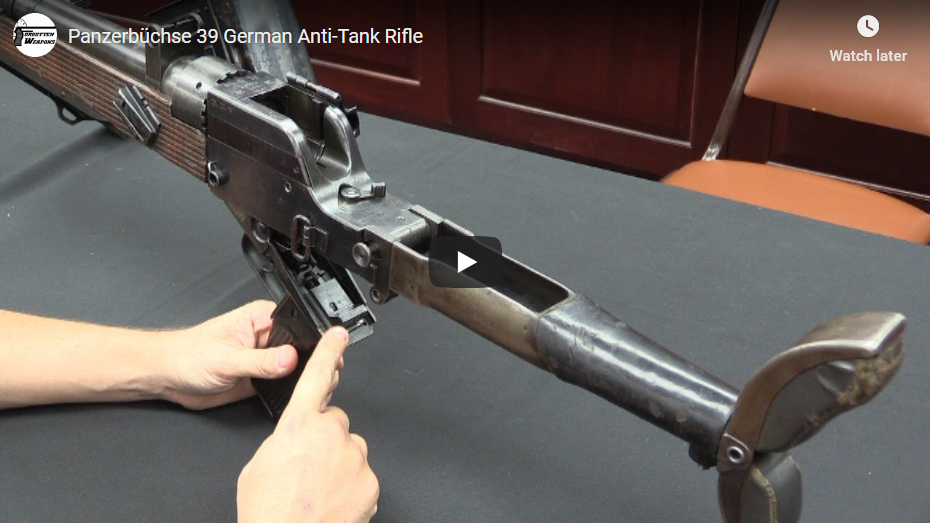
Ingram M10 & M11 SMGs: The Originals from Powder Springs

Filed under: Business, History, Military, Technology, USA, Weapons — Tags: , , , , — Nicholas @ 06:00

Forgotten Weapons
Published on 3 Apr 2019

These SMGs are lots 1069 (M10/45), 1070 (M10/9), and 1067 (M11) at Morphy’s April 2019 auction:
https://www.forgottenweapons.com/ingr…

After the commercial failure of Gordon Ingram’s M6 submachine gun in the early 50s, he would radically change the layout of his designs. Instead of a Thompson-lookalike Ingram’s M10 (the M7, M8, and M9 doing experimental prototypes only) would be a boxy and compact affair with a Czech-style telescoping bolt. It found little interest until a meeting between Gordon Ingram and Mitch WerBell resulted in WerBell demonstrating it to excited military audiences in Vietnam in 1969.

WerBell was an ex-OSS man who had started a company called Sionics, selling suppressors to the US military. He thought the combination of Ingram’s submachine gun and his suppressor would be a fantastic package, and he found plenty of interest among special operations personnel in Vietnam. He would create the Military Armament Corporation based at his farm in Powder Springs, GA and entice Ingram to join as his chief engineer. The result would be the .45ACP M10, a 9mm version of the M10 (made for use with subsonic 9mm ammunition), and a scaled-down .380 ACP M11 submachine gun.

MAC would have a short life, with all its assets sold at a bankruptcy auction in April 1976 – but it had plenty of time to create what would become an iconic gun – the Big MAC. Many imitations and copies would follow, but Powder Springs was the home of true original Ingram M10 and M11 submachine guns!

http://www.patreon.com/ForgottenWeapons

Cool Forgotten Weapons merch! http://shop.bbtv.com/collections/forg…

Contact:
Forgotten Weapons
PO Box 87647
Tucson, AZ 85754

April 3, 2019

Greater Poland Uprising – Book Picks – Veteran Care I BEYOND THE GREAT WAR

Filed under: Books, Economics, Europe, Government, History, Military, WW1 — Tags: , , , — Nicholas @ 06:00

The Great War
Published on 2 Apr 2019

It’s time for another episode of Beyond The Great War where we answer questions from the community. This time we take a look at the Greater Poland Uprising and the situation of Poland in early 1919, Jesse recommends a few of his favourite history books and we also talk about how veterans were treated after the 1918 armistice.

» SUPPORT THE CHANNEL
Patreon: https://www.patreon.com/thegreatwar
Merchandise: https://shop.spreadshirt.de/thegreatwar/

» SOURCES
Boysen, Jens. “Polish-German Border Conflict”, in 1914-1918 online. International Encyclopedia of the First World War. https://encyclopedia.1914-1918-online…

Davies, Norman. White Eagle, Red Star. The Polish-Soviet War 1919-1920 and the ‘Miracle on the Vistula’ (London: Pimlico, 2003 [1972]).

Gattrell, Peter. Russia’s First World War (Pearson, 2005).

Gerwarth, Robert. The Vanquished. Why the First World War Failed to End, 1917-1923 (Penguin, 2017).

Horne, John. “The Living,” in Jay Winter, ed. The Cambridge History of the First World War, vol. 3: Civil Society (Cambridge: Cambridge University Press, 2014): 592-617.

Leonhard, Jörn. Der überforderte Frieden. Versailles und die Welt 1918-1923 (CH Beck, 2018).

Pawlowsky, Verena/Wendelin, Harald. “Government Care of War Widows and Disabled Veterans after World War I,” in: Contemporary Austrian Studies, XIX: From Empire to Republic: Post-World War I Austria, eds. Bischof, Günter/Plasser, Fritz/Berger, Peter (2010): 171-191

Prost, Antoine. “Les anciens combattants”, in Stéphane Audoin-Rouzeau and Jean-Jacques Becker, eds. Encyclopédie de la Grande guerre 1914-1918 (Paris: Bayard, 2013): 1025-1036.

Snyder, Timothy. The Reconstruction of Nations. Poland, Ukraine, Lithuania, Belarus, 1569-1999 (Yale University Press, 2003).

Tank Chats #45 Major General Sir Percy Hobart | The Funnies | The Tank Museum

Filed under: Britain, History, Military, Technology, WW2 — Tags: , , , , — Nicholas @ 02:00

The Tank Museum
Published on 10 Feb 2018

Welcome to the first in the Tank Chat Funnies mini-series!

In Tank Chats #45 David begins a series on one of his personal interests, the Funnies of the 79th Armoured Division. However the 79th and its Funnies would have been nothing without its inspirational leader Major General Percy Hobart, so David starts with the man and we promise will follow very shortly with his machines.

Support the work of The Tank Museum on Patreon: ► https://www.patreon.com/tankmuseum
Or donate http://tankmuseum.org/support-us/donate

Visit The Tank Museum SHOP: ►https://tankmuseumshop.org/

Press the little bell above to enable NOTIFICATIONS so you don’t miss the latest Tank Museum videos.
Twitter: ► https://twitter.com/TankMuseum
Tiger Tank Blog: ► http://blog.tiger-tank.com/
Tank 100 First World War Centenary Blog: ► http://tank100.com/ #tankmuseum #tanks

April 2, 2019

How Trains Changed China | Stuff That I Find Interesting

Filed under: China, Economics, Government, History, Military, Railways — Tags: , — Nicholas @ 02:00

Jabzy
Published on 27 Mar 2016

Thanks to Xios, Alan Haskayne, Lachlan Lindenmayer, William Crabb, Derpvic, Seth Reeves and all my other Patrons. If you want to help out – https://www.patreon.com/Jabzy?ty=h

Music by Derek Fiechter – https://www.youtube.com/channel/UCVRJ…

April 1, 2019

Canada and the Battle of the Atlantic, part 5 by Alex Funk

Filed under: Cancon, History, Military, WW2 — Tags: , , , , — Nicholas @ 05:00

Editor’s Note: This series was originally published by Alex Funk on the TimeGhostArmy forums (original URL – https://community.timeghost.tv/t/canada-and-the-battle-of-the-atlantic-part-2-edited/1434).

Sources:

  • Far Distant Ships, Joseph Schull, ISBN 10 0773721606 (An official operational account published in 1950, somewhat sensationalist)
    [Schull’s book was published in part because the funding for the official history team had been cut and they did not feel that the RCN’s contribution to the Battle of the Atlantic should have no official recognition. It is very much an artifact of its era, and needs to be read that way. A more balanced (and weighty) history didn’t appear until the publication of No Higher Purpose and A Blue Water Navy in 2002, parts 1 and 2 of the Official Operational History of the RCN in WW2, covering 1939-1943 and 1943-1945, respectively.]
  • North Atlantic Run: the Royal Canadian Navy and the battle for the convoys, Marc Milner, ISBN 10 0802025447 (Written in an attempt to give a more strategic view of Canada’s contribution than Schull’s work, published 1985)
  • Reader’s Digest: The Canadians At War: Volumes 1 & 2 ISBN 10 0888501617 (A compilation of articles ranging from personal stories to overviews of Canadian involvement in a particular campaign. Contains excerpts from a number of more obscure Canadian books written after the war, published 1969)
  • All photos used exist in the Public Domain and are from the National Archives of Canada, unless otherwise noted in the caption.

I have inserted occasional comments in [square brackets] and links to other sources that do not appear in the original posts. A few minor edits have also been made for clarity.

Part 5 — The RCN’s desperate need for warships

Marc Milner picks up the story in North Atlantic Run:

The first year of the war at sea developed as Allied planners had anticipated. Germany’s U-boat fleet was small and remained so. Its operational strength of forty-six submarines (only twenty-two of which were capable of deep sea work) was far short of the three hundred U-boats that Rear Admiral Karl Dönitz, Befehlshaber der U-boote (BdU; commander-in-chief of U-boats), estimated he needed to sever Britain’s supply lines. Moreover, the U-boat fleet was initially circumscribed by Allied control of the exits from the North Sea. In the early months of the war U-boat captains generally obeyed their strict instructions not to anger neutral opinion through rash and illegal acts, despite their torpedoing of the liner Athenia on the first day of the war, which suggested that Germany would again adopt unrestricted submarine warfare. So the Allies concentrated on Germany’s powerful surface fleet, on her commerce raiders lurking in disguise on the oceans of the world, and on hapless offensive anti-submarine (A/S) sweeps.

The convoys were organized from the first days of the war and had some escort vessels, but the U-boats were not yet operating at full potential — this would become blatantly evident later — and the relatively few escorts were not hard pressed to keep the merchant ships safe in passage.

S.S. Athenia, at Montreal in 1933. She was torpedoed on the very first day of World War 2 by U-30 northwest of the coast of Ireland. Of the 1,103 passengers and 305 crew aboard, 118 were lost in the sinking (including 28 Americans).
Clifford M. Johnston / Library and Archives Canada / PA-056818

Through the spring and early summer, the U-boats operated mainly between Britain and Iceland; while they achieved nothing spectacular in terms of Allied tonnage sunk, the escort ships scored few victories in return. In one three-hour hunt HMCS St. Laurent and the RN destroyer Viscount dropped 80 depth charges in attacks on a submerged U-boat; when diesel oil bubbled to the surface they were sure they had gotten a kill. The Admiralty, cautious to award kills even in the early days, credited them with a “probable”.

Although Germany was now able to make good use of well-sited and easily defended new submarine bases on the Atlantic coast of France and to begin developing new tactics, it did not shake Allied belief that the U-boat threat had been rendered ineffective by ASDIC, convoys, and airpower.

Indeed, in a book on Modern Naval Strategy published by Admiral Sir Reginald Bacon, RN, and F.E. McMurtrie, two well-respected naval theorists, submarine attack on an escorted convoy was given little chance of success. Supposing the submariner could find the convoy in the first place, his distorted view of the world through a periscope was considered a grave handicap. With a periscope exposed in broad daylight — the only time, the authors believed, that an attack was possible — the submarine invited swift retribution from both escort and merchant vessel alike. Moreover, it was still generally believed that once a submarine was locked in ASDIC’s grip, destruction would follow from carefully placed depth charges. This view of anti-submarine sarfare (ASW) was utterly shattered by the Germans’ resourceful use of the U-boat in the second winter campaign on the sea lanes.

In practice, ASDIC was nowhere near perfect, and neither was depth charge placement especially when employed by Canadian escort ships — the inexperience of the majority of Canadian sailors played a role, as did their older and less sophisticated ASDIC sets. There were not enough escorts to protect convoys against multiple attackers, and air power was only available close to land and it proved not to be as capable as the Allied planners had hoped.

Air assets were so rare that the later war “mid-Atlantic air gap” did not exist because few of the necessary air bases that would be built by the end of the war were in place or even under construction yet. Canada’s pre-war air force was small, and though it was growing rapidly, it was not equipped or trained for ASW. The RAF had needed almost every available pilot during the Battle of Britain, and many pilots had been killed or wounded. Germany continued to build more U-boats, building at a far faster pace than Allied ASW forces could sink them, and now with far greater deployment flexibility than they had enjoyed during the First World War.

Marc Milner discusses the RCN’s expansion woes:

Fundamental to the whole problem of expansion was the availability of ships, and here too the RCN’s plans in the early days were never reliable. To upgrade local defences, to replace decrepit auxiliary vessels, and to provide A/S “strike forces”, the RCN had to undertake a modest shipbuilding program beyond that proposed in the pre-war plans. To round out local defences and the like it was decided in early September 1939 to build Bramble-class sloops and a small number of minesweepers. Further consideration was also given to the acquisition of Tribal-class destroyers. But the coming of war so early in the navy’s planned expansion threw it into serious disarray. Tribals could not be built in Canada without considerable assistance from British firms, and with British industry now fully absorbed in war work little help could be expected. Unfortunately, the RCN rejected a very sensible British suggestion that it seek expertise in naval ship construction in the United States. The Canadian navy also failed, initially, to obtain permission to place orders for Tribals in British yards. Faced with an almost impossible dilemma, the Naval Staff hit upon the idea of bartering less-sophisticated Canadian-built warships for British-built destroyers. The scheme had all the advantages of specialization. It permitted Canada to turn products from less-skilled manufacturers into high-value, long-term investments. For the government it meant good business and the possibility of future orders. For the RCN it meant the fulfillment of its expansion plans.

HMCS Cartier, later re-named HMCS Charny, in October 1940. An old Canadian Hydrographic survey vessel from 1910 pressed into service. Used for Naval Training and Naval Mine Avoidance Navigation.
Canada. Dept. of National Defence / Library and Archives Canada / PA-104169

As the Naval Staff sorted through the problems of destroyer acquisition, it also tackled the question of what type of auxiliary warship to build for its own purposes and what type to build for bartering. Initial hopes of building sloops were dashed by the news that Canadian yards were incapable of building even small warships to naval standards. As the problem was being discussed, basic plans for a much simpler auxiliary ship arrived at Naval Service Headquarters (NSHQ) from the National Research Council (NRC), which had acquired plans for “whale-catchers” in July during a fact finding trip to the UK. The whale-catchers immediately appealed to the Naval Staff as a workable substitute for sloops, given that they were intended to be auxiliary vessels for inshore duty. Moreover, their mercantile construction was ideally suited to Canadian yards, and British adoption of this class made them suitable for bartering.

Once agreed that corvettes (as the whale-catchers were called by early 1940) were to be built as the navy’s primary A/S ship and as the means whereby larger vessels might be acquired, the Naval Staff had to decide how many to produce.

[Editor’s Note: The development of the corvette goes back to a WW1 proposal for a submarine-hunting ship based on the design of whaling ships. In 1936, Smiths Dock Company of Middlesbrough built the whaling ship Southern Pride (displacing 700 tons, with a top speed of 16 knots), and eventually the design was adapted into a naval escort, the Flower-class corvette, that became the backbone of the convoy escort fleet. I’ve always been fascinated by the Flowers, as they originated in my home town and my maternal grandfather worked for Smiths Dock throughout the war as a plater (he very likely worked on several corvettes in that time). In War at Sea: Canada and the Battle of the Atlantic, Ken Smith provides this description:]

Diagram of the early Flower-class corvettes, via Lt. Mike Dunbar, RN (https://visualfix.wordpress.com/2017/04/12/dreadful-wale-4/)

The Royal Canadian Navy … had originally planned to build its own naval fleet with destroyers and larger ships, but it quickly became apparent that smaller ships were needed to protect major Atlantic ports and naval facilities, and to allow merchant shipping traffic sufficient convoy protection. It was imperative that some sort of small, speedy vessel with anti-sub competency be built and put into use as soon as possible. Corvettes were only intended for use until the larger and better-equipped destroyers and frigates were made available from the British shipyards. …

British shipbuilders at the Smiths Dock Company came up with a design based on a successful whaling ship which could be constructed cheaply in Canada. Thus the corvette was born, untested and unaware that the outcome of the U-boat challenge in the Battle of the Atlantic would rest heavily on its performance. Approximately half of the first order of corvettes produced were used as convoy escorts and over twenty of these workhorses were lost to German subs, but by the end of the war they had effectively proved their worth time and time again.

The name corvette, given to the short, wide-beamed ship by Winston Churchill after a small sailing ship of old, was deemed superior to the original name, the Patrol Whale Catcher. But the RN and RCN had ships in production by 1939*, albeit with slightly different designs. With a length of 205 feet and a 33-foot beam, the small ship was relatively slow at 16 knots, but could turn inside any other ship available. With moderate firepower, including a 4-inch bow gun, a pom-pom gun, several Lewis machine guns, depth charges, and later, Hedgehog equipment, the corvette proved able to tackle the roughest seas. But, as expected, there were shortcomings. They were considered “wet ships”, their decks often awash with water as they rolled, bucked, swerved, and veered violently, with even hardened sailors becoming sea-sick at times.

    * This is not quite correct. The first Canadian corvette wasn’t laid down until 2 February, 1940, according to the list of Canadian Flower-class corvettes at Wikipedia.

[Editor’s Note: The armament could vary, depending on what the RCN could scrounge from its own resources or cadge from the Royal Navy:]

HMCS Trillium, first of the Canadian-built Flower-class corvettes to be completed.
Photo from the Naval Museum of Manitoba, via Wikimedia Commons.

Armament consisted of a 4″ gun on the bow and (if they were lucky) a 2pdr Pom-Pom in a bandstand aft, this was initially rounded off with a pair of Lewis machine guns on the bridge. Many went to sea with a quadruple .50 machine gun mount in place of the 2pdr, and many more Royal Canadian Navy Flowers originally mounted a pair of twin .50s in this position. Eventually 20mm Oerlikons replaced the bridge guns. These early Flowers looked very much like quaint little merchantmen masquerading as warships with their short focsle, merchant type bridge, large vents around the funnel and on the engine room casing.

In The Corvette Navy, James B. Lamb explained why the decision to go with “old fashioned” engineering solutions turned out to be a very good idea in the long run:

Driven by a single three-bladed propeller, she was to have a maximum speed of 16 knots and a really remarkable endurance of 4,000 miles at 12 knots on only 200 tons of oil fuel. Her machinery — four-cylinder triple-expansion reciprocating engines of 2,750 horsepower, and twin cylindrical Scotch boilers — was deliberately kept simple, for ease both of manufacture and of operation, and the whole design was intended from the beginning to be capable of production by every sort of engineering firm other than the big shipbuilders, which were now crammed to capacity with large warship orders. […] But all unrecognized in these plans was a touch of genius; the dowdy maid-of-all-work had been endowed by her Good Fairy with a wholly unexpected range of qualities. For this ship of humble design proved to be capable of amazing versatility, able to carry more than twice her designed complement and a seemingly endless accumulation of ever more sophisticated armament and instrumentation. She could keep the sea in weather that overwhelmed huge merchant vessels and reduced destroyers to water-logged hulks; she could be used for anything from minesweeping to anti-aircraft protection. But, greatest blessing of all, she could turn on a dime, the only Allied warship with a turning circle tighter than that of a submarine, and in consequence she was the master of the U-boat in manoeuvring duels that would foil any other surface escort.

Adaptable and flexible in an ever-changing war, the corvette became the backbone of the Allied escort force, going through endless modification and improvement in the course of the building of no fewer than 269 ships, the largest warship class ever built.

Ultimately she evolved into a new class; two sets of corvette engines were jammed into a lengthened corvette hull to gain a little more speed, and the resulting super-corvette was called a “frigate”. By the war’s end, frigates and corvettes made up almost the entire strength of the Allied escort forces in the Atlantic, and their crews of reservists had brought the techniques of convoy escort and submarine detection and destruction to new heights of expertise.

And on the naming of the Flower-class ships themselves:

Right from the beginning, there was something suspect about corvettes in the eyes of right-thinking professional navy men; what was one to make of a man-of-war that looked like a fish trawler and called itself HMS Pansy? For the Admiralty, in a moment of inspiration, had designated the new ships as the Flower class, a tradition in escort vessels begun in the First World War. Each Royal Navy corvette was named after a flower, and the world was enriched by sea-stained fighting ships glorying in the name of His Majesty’s Ship Pennywort, Crocus, or Tulip. There was a Convolvulus, a Saxifrage, and a Cowslip. But even a Board of Admiralty has a heart; eventually HMS Pansy was allowed a change of name by a repentant Ships’ Names Committee. She became HMS Heartsease.

By the time the Royal Navy had built more than a hundred corvettes, flower names were becoming difficult to come by; HMS Bullrush probably reflects the growing desperation of this latter period, while HMS Burdock and HMS Ling show just how far the naming committee was prepared to cast its net. In Canada, HMCS Poison Ivy was openly conceded to be a possibility, but cooler heads prevailed; the Canadians decided to name their corvettes after towns and villages, although a handful of flower names — Spikenard, Snowberry, Windflower, etc. — were incorporated with ships originally built for the Royal Navy but taken over by the RCN.

It was widely believed in the wartime Allied navies that the naming of the Flower class was part of a form of psychological warfare practised on the enemy by a vengeful Britain; there must be an added [ignomy], it was felt, to being sunk by HMS Poppy, as U-605 was, or to being outfought and captured by a fierce HMS Hyacinth, as was the Italian submarine Perla. It was one thing to perish in the Wagnerian splendour hankered after by Hitler, but quite another for the proud Teuton to be vanquished by Rhododendron, as U-104 was, or sunk by Periwinkle, like U-147.

March 31, 2019

Allies Plan to Hit the Nazis Where it Hurts – WW2 – 031 – March 30 1940

Filed under: Britain, China, Europe, France, History, Military, WW2 — Tags: , , , , — Nicholas @ 04:00

World War Two
Published on 30 Mar 2019

Newly appointed French Prime Minister Paul Reynaud and his British counterpart Neville Chamberlain spend the week looking for ways to harm the Germans. Not just by targeting their direct opponent directly, but also by exploring the idea of expanding the war into much bigger territory. In the meantime, the French prepare for the expected invasion and the Allies are laying the foundations of what might one time become a weapon of mass destruction.

Join us on Patreon: https://www.patreon.com/TimeGhostHistory
Or join The TimeGhost Army directly at: https://timeghost.tv

Follow WW2 day by day on Instagram @World_war_two_realtime https://www.instagram.com/world_war_t…
Between 2 Wars: https://www.youtube.com/playlist?list…
Source list: http://bit.ly/WW2sources

Written and Hosted by: Indy Neidell
Produced and Directed by: Spartacus Olsson and Astrid Deinhard
Executive Producers: Bodo Rittenauer, Astrid Deinhard, Indy Neidell, Spartacus Olsson
Creative Producer: Joram Appel
Research by: Indy Neidell
Edited by: Iryna Dulka
Map animations: Eastory

Colorisations by Norman Stewart

Eastory’s channel: https://www.youtube.com/channel/UCEly…
Archive by Screenocean/Reuters https://www.screenocean.com

A TimeGhost chronological documentary produced by OnLion Entertainment GmbH.

From the comments:

World War Two
9 hours ago (edited)
If the Allies and the Germans follow through with all their plans, the phoney war will surely soon come to a close. But who knows what will happen. If one thing is certain, it is that they all have made plans before that never made it into reality.

A community member of ours set up a new Discord Channel. Come over to discuss the war, say hi to the community or share some memes. You can join right here: https://discord.gg/D6D2aYN

March 30, 2019

Canada and the Battle of the Atlantic, part 4 by Alex Funk

Filed under: Cancon, History, Military, WW2 — Tags: , , , , — Nicholas @ 05:00

Editor’s Note: This series was originally published by Alex Funk on the TimeGhostArmy forums (original URL – https://community.timeghost.tv/t/canada-and-the-battle-of-the-atlantic-part-2-edited/1434).

Sources:

  • Far Distant Ships, Joseph Schull, ISBN 10 0773721606 (An official operational account published in 1950, somewhat sensationalist)
    [Schull’s book was published in part because the funding for the official history team had been cut and they did not feel that the RCN’s contribution to the Battle of the Atlantic should have no official recognition. It is very much an artifact of its era, and needs to be read that way. A more balanced (and weighty) history didn’t appear until the publication of No Higher Purpose and A Blue Water Navy in 2002, parts 1 and 2 of the Official Operational History of the RCN in WW2, covering 1939-1943 and 1943-1945, respectively.]
  • North Atlantic Run: the Royal Canadian Navy and the battle for the convoys, Marc Milner, ISBN 10 0802025447 (Written in an attempt to give a more strategic view of Canada’s contribution than Schull’s work, published 1985)
  • Reader’s Digest: The Canadians At War: Volumes 1 & 2 ISBN 10 0888501617 (A compilation of articles ranging from personal stories to overviews of Canadian involvement in a particular campaign. Contains excerpts from a number of more obscure Canadian books written after the war, published 1969)
  • All photos used exist in the Public Domain and are from the National Archives of Canada, unless otherwise noted in the caption.

I have inserted occasional comments in [square brackets] and links to other sources that do not appear in the original posts. A few minor edits have also been made for clarity.

Part 4 — 1940: The fall of France, the battle begins, and the RCN dreams of expansion

Continued from Joseph Schull’s Far Distant Ships:

German infantry and armour were sweeping along the western coast of France, driving into the sea the broken fragments of British and French divisions. Here and there, at isolated bays and harbours, a few battalions of soldiers might be rescued by ship; a few hundreds out of the hundreds of thousands of refugees might be saved. Parties of engineers from England might be landed ahead of the advancing enemy to conduct vitally important demolitions. In this work the Canadian destroyers joined with many British ships.

The English Channel and the northern coast of France, 1940.
Map from www.naval-history.net

Restigouche and St. Laurent, at sea on June 9, saw from thirty miles distant the flames of Le Havre rising six hundred feet into the night sky. On June 11 they were off St. Valéry en Caux in the neighbourhood of Dieppe, assisting the British destroyer Broke to embark wounded. Part of the British 51st Division was holding a six-mile line in the vicinity but reported itself “in no immediate need of evacuation.” St. Laurent moved a little way up the coast to Veules and took on board forty French troops. She returned to the neighbourhood of St. Valéry an hour or so later to find Restigouche and the British destroyer still standing by for evacuation.

At about eight o’clock in the morning five or six salvoes splashed into the water a hundred yards from St. Laurent and Restigouche. A German battery had taken up position on the cliffs behind the town and there was no longer any possibility of embarking troops. The three destroyers engaged the battery, although they were unable to observe the fall of their shells behind the three hundred foot cliff. When they broke off after a desultory action, Canadian ships had exchanged their first fire with the German enemy.

In North Atlantic Run, Marc Milner explains the Canadian government’s concerns about protecting the eastern seaboard, initially limiting the number of RCN ships that could be sent to European waters:

Undoubtedly the alteration of this policy owed something to the stationing at Halifax of the RN’s Third Battle Squadron, a force of aged battleships and light cruisers intended to provide anti-raider protection for mercantile convoys and more than sufficient to guarantee a credible deterrence along Canada’s Atlantic coast. The alteration of the previous policy also inaugurated the principle of loaning ships to the RN, which became “for a considerable period the dominant element of RCN policy.”

The government’s change of heart not only suited the navy’s burning desire to join in the “active operations” of more distant waters but was also perhaps a response to growing public pressure for a more active involvement in the war. In April 1940, before the invasion of Norway began, Mackenzie King confessed to his diary that the pride of the nation demanded that Canada increase its military commitment overseas from a single division to a full corps. The slow expansion of the navy could not keep up with the national desire to pick up where the Canadian Corps had left off in 1918. Even Colonel Ralston, the minister of Defence, confessed that the military involvement in the land war would have to grow, although “we could have used our money more effectively if it had been confined to air and naval matters.” Canadians, the prime minister’s private secretary wrote years after the war, remained remote from the war, “despite the very large part Canadian airmen and sailors were taking in actual combat,” until the army landed in Sicily in July 1943.

On June 21, the day of France’s humiliation at Compiègne, HMCS Fraser was sent far down the west coast near the Franco-Spanish frontier, to land a Royal Navy evacuation party and to patrol off St. Jean-de-Luz, one of the last remaining French ports unblocked by German forces (this was part of Operation Aerial, the evacuations from the west coast of France). At dawn on the 23rd she was sent north to Arcachon to pick up Canadian and South African diplomats. Transferring them from the sardine fishing boat they had escaped in was no easy task, but eventually all were delivered safely aboard and then transferred to the cruiser HMS Galatea for transport back to England. Fraser returned to St. Jean-de-Luz and was joined by Restigouche and several British destroyers. “The melancholy tumult of evacuation was now fully underway. Boatloads of defeated soldiers and destitute civilians were streaming out from the jetties to the liners, tramp steamers, trawlers and pleasure craft which jostled each other in the rough waters of the harbour. Destroyers threaded a dangerous way among the thronging ships, marshaling the loaded vessels into groups for escort to England while other destroyers zigzagged outside on anti-submarine patrol.” In the dreary 48 hours of the St. Jean-de-Luz evacuation, 16,000 soldiers escaped.

HMCS Fraser (H48), commanded by Commander W.B. Creery, on the 25th of June, 1940 off St. Jean-de-Luz, three days before her loss.
Photo from the Canadian Navy Heritage Project, via Wikimedia Commons.

Rear Admiral W.B. Creery, at the time commanding officer of the Fraser, described the final evacuation to Reader’s Digest years later:

The Germans occupied Bordeaux and swept south. By the morning of June 25th, they were within 25 miles of St. Jean-de-Luz. The French, to conform to the armistice terms, had advised that all evacuation must cease by 1 p.m. Fraser had been ordered to remain in harbour during the final evacuation but we had difficulty finding a safe anchorage. We had to re-anchor twice. on the last attempt we held firm — for a reason we were not to discover until later.

We decided to remain where we were until the return of Sub-Lieutenant William Landymore who had been sent away in our motorboat to try and persuade some Belgian trawler skippers to sail to England instead of Spain. Suddenly the officer of the watch, who had a slight stammer, exclaimed “G-G-Good G-G-God, there’s a g-g-gun!” I looked where he was pointing. On a hill a small force of soldiers had appeared with a field gun and a tank. We couldn’t make out their nationality, but ships in harbour are sitting ducks and there was only one thing to do. We ordered the merchant ships to proceed to sea and had to watch several boatloads of evacuees turn sadly back to shore. Our motorboat returned and Landymore sent the boat’s crew swarming up the falls but remained in the boat himself. I was anxious to go to action stations and weigh anchor but it took all hands to hoist the boat.

All was going reasonably well until a steadying line parted, the boat canted sharply outboard and Landymore was catapulted into the sea. Just as this happened I was told the anchor had apparently fouled a cable on the bottom of the harbour and could not be hoisted. And the officer of the watch reported that there were now “a number” of field guns on the hill and they appeared to be taking aim at us. So we fished Landymore out of the sea, slipped our cable and departed in haste if not in dignity.

The merchant ships headed for England, escorted by several RN destroyers. Fraser and Restigouche were ordered to join the British cruiser Calcutta in a sweep north in search of an enemy ship of which there had been a vague report. No such ship was found and toward dusk the flag officer turned his small force toward home.

Joseph Schull continues this particular narrative in Far Distant Ships:

It was now about ten o’clock in the evening, with a fresh breeze, a moderate swell and visibility of one and a half miles. Fraser was off the starboard bow of Calcutta a mile and a half distant, Restigouche was on the cruiser’s port quarter a mile and a half to the left of her and slightly astern. The ships were travelling at high speed, with the possibility of attack by submarine or from the air at any time. They had been in continuous action for nearly a week, carrying on rescue work and embarking troops and refugees under threat of submarine attack, air attack and every harassment of a general evacuation. Fraser‘s commanding officer had had one night’s sleep in the preceding ten and there is little likelihood that the captain of the Calcutta had had more.

As the ships steamed on, just visible to each other in the darkness, Calcutta signalled for “single line ahead” and Fraser altered course to comply. Her commanding officer’s intention was to turn inward toward Calcutta, run back down to starboard of her and come into station astern. On the cruiser’s bridge, however, when the dim silhouette of Fraser was seen altering to port ahead, the assumption was made that she intended to come across Calcutta‘s bows and pass down her port side. At the speed the ships were making, the destroyer would had had little room to cross in front; and Calcutta‘s captain therefore ordered a sharp turn to starboard; at the same time giving the order for one blast to be sounded on the siren.

The turn to starboard by the cruiser and the turn to port by the destroyer put the two ships on courses converging with fatal rapidity. Calcutta‘s signal blast for a starboard turn was Fraser‘s first warning of approaching disaster; and nothing could now be done to avert it. The vessels were swinging under helm and moving together at a combined speed of thirty-four knots. Engines were put astern and wheels reversed but no order could take effect in time. The ships covered the last two hundred yards intervening between them in less than eleven seconds and Calcutta, still swinging to starboard, sheared her way through the forward part of Fraser. The destroyer’s forepart broke clean off and floated away bottom up. Her entire bridge, with the captain and bridge personnel, was lifted onto Calcutta‘s bow and remained there, swaying and groaning above the cruiser’s forecastle.

Restigouche was in station about fifteen hundred yards astern of Calcutta. With the crash of the impact she raced up alongside Fraser and worked her way inward toward the afterpart of the broken ship. Rocking in a heavy swell which threatened to dash her against the jagged mass of steel, Restigouche brought her stern around to touch the stern of Fraser. While the hulls of the two ships ground perilously together, sixty of Fraser‘s crew, including one stretcher case, were safely transferred. For the men already in the water, Restigouche and Calcutta lowered boats, dropped carley floats and let down scramble-nets along their sides.

Fraser‘s bow had floated away, carrying the cries of its marooned occupants into the darkness. Restigouche coming up from astern, had at first mistaken it for a half-submerged wreck. When she identified it for what it was, she endeavoured to work alongside, but just as she was approaching, the bow capsized. The men clinging to the guard-rails were thrown into the water and had to be picked up by the ships’ boats. Altogether, in spite of darkness and a rising swell, 16 officers and 134 men were rescued. Forty-seven Canadians and nineteen British sailors were lost.

The River-class destroyer HMCS Restigouche, May 1942.
Canada. Department of National Defence / Library and Archives Canada / ecopy.

Schull continues in Far Distant Ships:

The loss of Fraser, heavy blow though it was for the navy and for the homes of forty-seven Canadians, was a minor incident of those disastrous days; one of the casualties which were as certain to occur under conditions of prolonged and incessant strain as under direct shellfire. Nor could it be lingered upon. …

Skeena, Restigouche, and St. Laurent now turned with scores of British ships to a desperate battle for convoy routes through the southwestern approaches. The U-boats were beginning to arrive in greater numbers; the Luftwaffe was everywhere over the channel and far out to sea. The great ports of the south and east were under constant attack; in their scanty hours in harbour between U-boat hunts and the rescue of survivors from sunken vessels, Canadian destroyers landed men to assist in combatting air raids.

[Editor’s Note: By early July the Admiralty faced the hard decision to re-arrange the whole supply system that Britain now depended upon for food, fuel, armaments, and ammunition. The large southern and eastern ports were under bombing attack frequently enough to rule out receiving and unloading merchant convoys, without risking unacceptably high ship losses. The ports on the Mersey and Clyde rivers, being further away from German airfields, must accept the majority of the cargo from North America and elsewhere. The convoys had to be routed through the northwestern approaches, minimizing the risk of air attack. The escort vessels also had to shift to their new operational area; the remaining three Canadian destroyers in British waters would now operate from Liverpool, Greenock, Rosyth, and eventually Londonderry (where new port facilities were being hurriedly constructed).]

March 29, 2019

Smoking Snakes – Brazilian Expeditionary Force – Sabaton History 008

Filed under: Americas, Europe, History, Italy, Media, Military, WW2 — Tags: , , — Nicholas @ 06:00

Sabaton History
Published on 28 Mar 2019

You don’t generally think about Brazil when talking about World War Two. Still, they joined the Allied powers in 1942, after which the Brazilian Expeditionary Force played a role in the battle for Italy. The Sabaton song “Smoking Snakes” (from the Heroes album) is about the Brazilian effort during World War Two and especially about three Brazilian soldiers who wouldn’t surrender.

Support Sabaton History on Patreon: https://www.patreon.com/sabatonhistory

Watch more videos on the Sabaton YouTube channel: https://www.youtube.com/user/Sabaton?…
Listen to Sabaton on Spotify: http://smarturl.it/SabatonSpotify
Official Sabaton Merchandise Shop: http://bit.ly/SabatonOfficialShop

Hosted by: Indy Neidell
Written by: Markus Linke and Indy Neidell
Directed by: Astrid Deinhard and Wieke Kapteijns
Produced by: Pär Sundström, Astrid Deinhard and Spartacus Olsson
Creative Producer: Joram Appel
Executive Producers: Pär Sundström, Joakim Broden, Tomas Sunmo, Indy Neidell, Astrid Deinhard, and Spartacus Olsson
Maps by: Eastory
Edited by: Iryna Dulka
Sound Editing by: Marek Kaminski

Eastory YouTube Channel: https://www.youtube.com/channel/UCEly…
Archive by: Reuters/Screenocean https://www.screenocean.com
Music by Sabaton.
Research contribution: Leitura ObrigaHISTÓRIA – Check out their channel: https://www.youtube.com/obrigahistoria
The Mariners’ Museum and Park
Brazilian casualty chugs milk
https://catalogs.marinersmuseum.org/o…
P0003/01-#W-14256

An OnLion Entertainment GmbH and Raging Beaver Publishing AB co-Production.

© Raging Beaver Publishing AB, 2019 – all rights reserved.

Canada and the Battle of the Atlantic, part 3 by Alex Funk

Filed under: Cancon, History, Military, WW2 — Tags: , , , , — Nicholas @ 05:00

Editor’s Note: This series was originally published by Alex Funk on the TimeGhostArmy forums (original URL – https://community.timeghost.tv/t/canada-and-the-battle-of-the-atlantic-part-1-edited/1433).

Sources:

  • The Far Distant Ships, Joseph Schull, ISBN 10 0773721606 (An official operational account published in 1950, somewhat sensationalist)
    [Schull’s book was published in part because the funding for the official history team had been cut and they did not feel that the RCN’s contribution to the Battle of the Atlantic should have no official recognition. It is very much an artifact of its era, and needs to be read that way. A more balanced (and weighty) history didn’t appear until the publication of No Higher Purpose and A Blue Water Navy in 2002, parts 1 and 2 of the Official Operational History of the RCN in WW2, covering 1939-1943 and 1943-1945, respectively.]
  • North Atlantic Run: the Royal Canadian Navy and the battle for the convoys, Marc Milner, ISBN 10 0802025447 (Written in an attempt to give a more strategic view of Canada’s contribution than Schull’s work, published 1985)
  • Reader’s Digest: The Canadians At War: Volumes 1 & 2 ISBN 10 0888501617 (A compilation of articles ranging from personal stories to overviews of Canadian involvement in a particular campaign. Contains excerpts from a number of more obscure Canadian books written after the war, published 1969)
  • All photos used exist in the Public Domain and are from the National Archives of Canada, unless otherwise noted in the caption.

I have inserted occasional comments in [square brackets] and links to other sources that do not appear in the original posts. A few minor edits have also been made for clarity.

Part 3 — The professionals and the amateurs

Marc Milner picks up the story in North Atlantic Run:

While the operational side of the navy chafed at the bit, the shore side got on with the daunting work of expansion. The first task was to provide both personnel and ships for the system of defended ports. Acquisition of the ships was a manageable problem, though the results were far from satisfactory. By the end of 1939 the RCN had managed to beg, borrow, or buy over sixty auxiliary vessels of all shapes and sizes, enough to fill out the minesweeping, anti-submarine, and harbour duties of the defended ports. Many of the ships were unreliable or unsuitable for their assigned roles and therefore badly needed replacement. In fact, few were worthy of long-term service in any but the most menial tasks.

The bulk of the auxiliary vessels taken into the RCN came from other government departments. Manning them posed no problem because most of the ships’ crewmen transferred to naval service, enlisting in the RCN Reserves, Special Service, which respected their peculiar skills (for example, ice clearance). Retired officers of the Royal Navy resident in Canada, of whom about forty were designated for duty with the RCN, also helped fill the gap in manpower.

[Editor’s Note: In general, the regular RCN consisted of professional officers and ratings who planned to continue in the navy after the war. The RCNR were professional seamen in civilian life who would return to their profession at the end of hostilities. RCNR men were highly prized in the navy for their sea-going skills. The RCNR Special Service was (I believe) just a designation for RCNR officers and ratings who had specialized skills, like icebreaking experience, over and above ordinary merchant navy experience. The RCNVR were “hostilities-only” volunteers, with a core of longer-term reservists who had some limited experience before the war. RCNR and RCNVR officers had slightly different rank insignia than RCN officers, as summarized by the Canadian Military Police Virtual Museum:]

Regular Officers in the RCN wore gold stripes on their epaulettes or on the cuffs. The uppermost stripe incorporated the “Executive Curl”. This was a holdover from the early days of the Royal Navy when officers responsible for ship handling and command were separate from other officers such as Surgeons and Engineers. Engineers were granted the curl in 1915 and by 1919 the rest of the branches had been granted it.

Officers of the Royal Canadian Navy Volunteer Reserve (RCNVR) wore similar rank insignia to those of the Regular Navy, however the stripes were of a different pattern, being a zig zag design. This of course lead to the RCNVR being nicknamed the “Wavy Navy”. [The epaulette on the left is of an RCN Lieutenant Commander. The one on the right] is that of an RCNVR Lieutenant Commander. Officers of the Royal Canadian Navy Reserve (RCNR) [in the middle] wore another special pattern of rank stripes. In this case, the curl resembled a Star of David. An RCNR Lieutenant’s rank is illustrated. These patterns of special insignia were discontinued in the mid 1950’s, after which Regular and Reserve Officers wore identical rank insignia.

Marc Milner continues:

With the dispatch of the second — and final — draft of volunteer reservists (RCNVR) to the coast on 10 September, the RCN exhausted its cadre of readily available and “trained” personnel. The first plan for further mobilization was tabled on 17 September and called for an active strength of 5,472 all ranks by the end of March 1940, rising to seven thousand by the same date in 1941. As with other personnel projections in the early months of the war, this first one was based on the needs of home defence and the availability of ships. The RCN proved rather successful at cobbling together its auxiliary fleet, and the projections for March 1940 were surpassed much earlier. Yet, despite this early trend towards rapid growth, expansion in 1939 and 1940 was choked by shortages of every conceivable type. Sailors went without proper naval uniforms because no one foresaw, at the end of 1939, that the navy’s strength would rise to ten thousand by September 1940. Further, until 1943 the “key to expansion” as the Naval Staff liked to call it, was the shortage of training staff, a shortfall which the RN unwilling to help alleviate.

What the navy badly wanted were skilled men: men whom they were losing in large numbers to the other two services, particularly the air force. For the RCN did not even have the necessary housing to take in the throngs of eager and qualified volunteers waiting to join up. The problem occasioned debate at the first Naval Staff meeting in January of 1940. The urgent need for temporary accommodation was stressed, “in order that recruiting programme could be proceeded with before the new rapidly expanding RCAF seized all the best — and particularly most skilled, men”. The RCN also found that it had to lower the minimum age of entry from twenty-one to nineteen in order to counter the ravages of the air force on available manpower.

RCN rating operating the training mechanism of a 4.7-inch gun, Royal Canadian Navy Gunnery School, Halifax, Nova Scotia, 1940.
Canada. Dept. of National Defence / Library and Archives Canada / PA-104416

Despite the struggle over manpower and the navy’s reluctance to expand too quickly, the growth of the navy soon acquired a snowball effect which it seemed incapable — or perhaps undesirous — of firmly controlling. At the end of 1939 the Naval Staff anticipated a completed wartime strength (after three years) of 1,500 officers and 15,000 ratings. This figure was reached and passed in half the time. But the really hectic pace of expansion did not begin until after the fall of France and Norway. Up to that point the RCN had planned a very deliberate and selective growth, as Vice-Admiral Nelles, Chief of the Naval Staff (CNS), explained to the naval minister in January 1940.

Macdonald had broached the subject of giving preferences in RCNVR commissions to members of prominent yacht clubs. In an illuminating statement Nelles made it clear to the minister what role “Sunday Sailors” would play in Canada’s war at sea. “The RCN is in need of many men before this war is over,” Nelles wrote, “but the [types] of ships suitable to Canadian service conditions [Tribal-class destroyers or small inshore-patrol ships] are more suited to the employment of professional seamen than of amateur small boat yachtsmen.” The CNS’s comment was no idle remark on an easily dismissed subject. Earlier in the same day Nelles had received a memorandum from his director of Naval Personnel, who, no doubt responding to the minister’s inquiry, refused to countenance the mythical value of “Sunday Sailors”. Yachting, the DNP reported to his chief, had about as much to do with modern naval skills as flying a kite had to do with modern air operations. None the less, in order to find employment for these eager warriors, Nelles informed Macdonald that he was prepared to release fifty young yachtsmen to the Royal Navy “to serve in the more interesting appointments overseas and represent Canada at the scene of active operations”. His words suggest clearly what Nelles and the navy felt of keeping the fleet in home waters. In terms of manpower this option offered an alternative to simply turning recruits away, and they would not be lost to either Canada or the war effort. The loan scheme was approved, and it was initially decided to send all RCNVR recruits in excess of 4,500 to serve in the RN. Though this plan was later drastically altered, the incident illustrates the selective nature of the navy’s expansion before the fall of Western Europe, the desire to participate in the “active” theatre, and the problems inherent in trying to expand from too small a base.

Back at sea, the phony war was one of drudgery for the RCN, aside from its participation in the capture of the SS Hannover in the Caribbean. Shuttling convoys back and forth between the defended ports of Canada to meeting points offshore, the odd troop transport across the ocean, coastal convoys between ports. All essential, but not the work the navy had been hoping for.

HMS Dunedin and HMCS Assiniboine intercepted the blockade runner SS Hannover in early March, 1940. Later, this vessel was converted into an escort aircraft carrier, HMS Audacity.
Canada. Dept. of National Defence / Library and Archives Canada / PA-104055

They got their wish soon enough. The phony war ended quite spectacularly in the spring of 1940, and a request was sent from London to Ottawa for “all available destroyers”, even as the BEF fought to disengage itself and form a secure position from which to evacuate. The cabinet eventually more or less agreed, even thought it meant virtually stripping Canada herself of naval defenses.

The fall of France left some senior Canadian politicians, Mackenzie King among them, more concerned than ever for the vulnerability of Canada’s vast coastline. However, both the Canadian Chiefs of Staff and the British, including Prime Minister Churchill (by whose opinion Mackenzie King set great store), were able to convince the Canadian prime minister that Canada’s first line of defence was the English Channel.

The navy mustered four destroyers for travel to Europe. Joseph Schull writes of their departure and first subsequent action in Far Distant Ships:

In Halifax, on the afternoon of the 24th [of May], the Canadian destroyers Restigouche, Skeena and St. Laurent were preparing to go to sea on an unscheduled voyage. Leaves had been cancelled, libertymen summoned back to their ships and all prospect of an Empire Day celebration ruined with truly naval efficiency. The mood on board St. Laurent was particularly black, as she had been recalled from one convoy and was under orders for sea again before a man could step ashore. The mess deck “buzz”, discredited and discouraged by nine months of unvarying monotony, gave promise only of another local convoy run. If there was any bright feature of the day it must have been the mild spring weather which had enabled the men to relieve their crowded mess decks by sending heavy clothes and miscellaneous cold weather gear ashore.

With early evening came the familiar “cable party fall in” and the equally familiar call for sea dutymen to muster. The destroyers nosed their way out of the harbour while men on watch speculated without much curiosity over the fact that there appeared to be no convoy in evidence.

The explanation came several hours later. There was to be no convoy this time and no turning back to Halifax after twenty-four hours. The lambie coats left in Halifax would not be seen by their owners for a considerable time. An urgent cable from the United Kingdom had arrived at Ottawa the day before. Invasion was an imminent possibility and every ship which Canada could send was required in British waters.

Restigouche, Skeena and St. Laurent were on their way. Assiniboine and Ottawa were in refit in Halifax and would not be operational until about the middle of June. Saguenay could not make the crossing as she was also badly in need of refit. Fraser, en route to Bermuda, had been assigned to the Jamaica Force of the Royal Navy in March to conduct Caribbean patrols. En route to Bermuda, had been ordered to continue her voyage, refuel at Bermuda and proceed directly to the United Kingdom.

The first wartime passage of the three destroyers was uneventful but scarcely monotonous. By day and by night the men went through intensive air raid and anti-submarine exercises. The commanding officer of Restigouche saw the efficiency of his ship increase rapidly during the voyage and suggested that the improvement “was no doubt accelerated by the realization of the ship’s company that we were rapidly approaching an extremely active war zone.”

It may well have been so. While still a day’s steaming from the United Kingdom the ships were ordered to a position of Ushant on an abortive submarine hunt; and when they finally secured at Plymouth on June 1 the evacuation of Dunkirk was at its height. The First Lord of the Admiralty found time for cordial words to the newcomers:

    The presence of units of the Royal Canadian Navy in our midst inspires us all to a still harder effort. Confident both of your skill and of your valour we wish you good luck in the fierce and exacting toil which lies before you.

« Newer PostsOlder Posts »

Powered by WordPress