Today’s Special Presentation is an overview of all the semiautomatic pistols that were actually put into serial production before the year 1900. We have looked at these individually before, but I think it is worthwhile to examine them together in context, to gain a better understanding of what the automatic pistol scene was really like in the last years of the 19th century.
If you enjoy Forgotten Weapons, check out its sister channel, InRangeTV! http://www.youtube.com/InRangeTVShow
Contact:
Forgotten Weapons
6281 N Oracle #36270
Tucson, AZ 85704
From the comments:
Joseph Heschmeyer
2 years ago (edited)
“Hi guys, thanks for tuning in for another video on ForgottenWeapons.com. Today we’ll be looking at the science fair project that got me kicked out of middle school.”
Comments Off on Special Presentation: Semiauto Pistols of the 1800s
What would happen if Nazi Germany invaded Canada? You don’t need to imagine. In 1942, the government of Mackenzie King launched a propaganda effort that simulates Canada falling under Hitler’s yoke. Why? For the war economy of course!
Hosted by: Anna Deinhard
Written by: Fiona Rachel Fischer and Spartacus Olsson
Director: Astrid Deinhard
Producers: Astrid Deinhard and Spartacus Olsson
Executive Producers: Astrid Deinhard, Indy Neidell, Spartacus Olsson, Bodo Rittenauer
Creative Producer: Maria Kyhle
Post-Production Director: Wieke Kapteijns
Research by: Fiona Rachel Fischer
Edited by: Miki Cackowski
Sound design: Marek Kamiński
Map animations: Miki Cackowski and Eastory (https://www.youtube.com/c/eastory)
Sources:
IWM Art.IWM PST 18495, CH 27, CH 3231, CH 6831, HU 88386, HU 104482
nationaal archief
Photo Album of F.V. Light (1923-2000)
Soundtracks from the Epidemic Sound:
Howard Harper-Barnes – “London”
Johannes Bornlof – “The Inspector 4”
Howard Harper-Barnes – “Prescient”
Max Anson – “Ancient Saga”
Howard Harper-Barnes – “Sailing for Gold”
Philip Ayers – “Please Hear Me Out”
Jo Wandrini – “Puzzle Of Complexity”
Reynard Seidel – “Deflection”
Rannar Sillard – “March Of The Brave 4”
Phoenix Tail – “At the Front”
A TimeGhost chronological documentary produced by OnLion Entertainment GmbH.
From the comments:
World War Two
1 day ago
As you can see in the video, the efforts to raise money to pay for the war were extremely high. But when we read about the stuff that was going on in Winnipeg on “If-Day”, we were really surprised — talk about “playing” war! Of course, this top-notch high-effort propaganda had quite the impact on the citizens of Winnipeg, because — let´s be honest — who wouldn´t be frightened by any kind of Nazi invasion? And they did not spare any effort to get the details right, too. What is your impression of If-Day? Have you heard of it before? Please let us know in the comments!
Join The Tank Museum’s Curator David Willey as he discusses the Sd.Kfz 161, better known as Panzer IV: the most numerously produced tank by Germany during the Second World War.
Support the work of The Tank Museum on Patreon: ► https://www.patreon.com/tankmuseum
Visit The Tank Museum SHOP & become a Friend: ► tankmuseumshop.org
Capital ships could also only defeat their opponents’ armour IF they could find them and hit them accurately. Which was hardly a given, as only the British – with the eight WWI 15″ guns on Warspite — and Germans — with the nine modern 11″[!] guns on Scharnhorst — actually hit any moving target at 26,000 yards or more. (Both in relatively clear conditions in daylight, and both well inside the theoretical 35,000-45,000 yard full range of most battleship guns.)
[Three years later, in foul weather at night during the Battle of North Cape, the Germans had their fears that British radar had advanced far beyond theirs in gunfire direction completely confirmed, when Scharnhorst was pounded to scrap by Duke of York and a few cruisers in a battle where even the British cruisers could engage and score hits at ranges that didn’t allow Scharnhorst to reply accurately.]
No other navy came even close to hitting anything actually moving at any speed at 26,000 yards (though West Virginia managed within about 15% of it with 22,800 yards using the latest radar at Surigao Strait in late ’44). Certainly not the radar-deficient Italians and Japanese.
At night, or in bad weather, that meant radar-efficient nations had an unsurpassable advantage, particularly for fast moving targets at sea like those hit by Warspite and Scharnhorst.
[Although one USN 16″ battleship peppered stationary French targets in a port at even longer ranges, some USN engagements — like Guadalcanal — were at Jutland distances, if not closer. (5,000-8,000 yards, even though the US ships had radar … Which would have been fine if the USN had been consciously doing a Matapan-style 3,500 yard ambush, but South Dakota‘s radar and other power went down to “electrical fault”, and she accidentally wandered within 5,000 yards and was battered at close range, “leaving the ship in Lee’s words ‘deaf, dumb, blind, and impotent'”. Fortunately Washington‘s working radar allowed her to sneak up on the Japanese and win the battle.) ]
At Surigao Straits those USN battleships with more modern radar — the late war rebuilds West Virginia, California and Tennessee — spotted the enemy at over 30,000 yards, and opened fire at 22,000 yards, actually getting some hits with the opening salvos! But some ships with less effective radar — Maryland (eight 16″) — had to wait for visual sightings of shell splashes before joining in, and Pennsylvania (twelve 14″) with her older Mark III radar, failed to spot the enemy at all.
How many and how big your guns are, or what their range is, doesn’t matter a damn if you never see your opponent!
[Though please note, in every battle of the war, the navy which has the choice — either through speed in daylight, or radar superiority at night or in heavy weather — always closed the range to their maximum advantage (if not to point-blank where possible) before engaging.]
So instead of endlessly debating the value of ten or twelve 14″ versus eight 15″ or 16″ or even nine 11″ or 16″; or of 20 degree versus 30 degree or 40 degree elevation; or of heavier slower shells versus lighter faster ones: I tend to accept that most heavy guns could penetrate most armour, and just wonder whether they could only hit anything in good light and good weather, or if they were completely blind in the wrong conditions?
A spy story almost forgotten to history that is key to understanding the espionage campaign that was waged as Hitler, Stalin, Roosevelt, and Churchill publicly directed the frontlines. Coming together here are the histories of cryptography, Nazi double-agents, and nuclear weapons. (more…)
Comments Off on The Greatest Spy Story Almost Never Told – WW2 – Spies & Ties 02
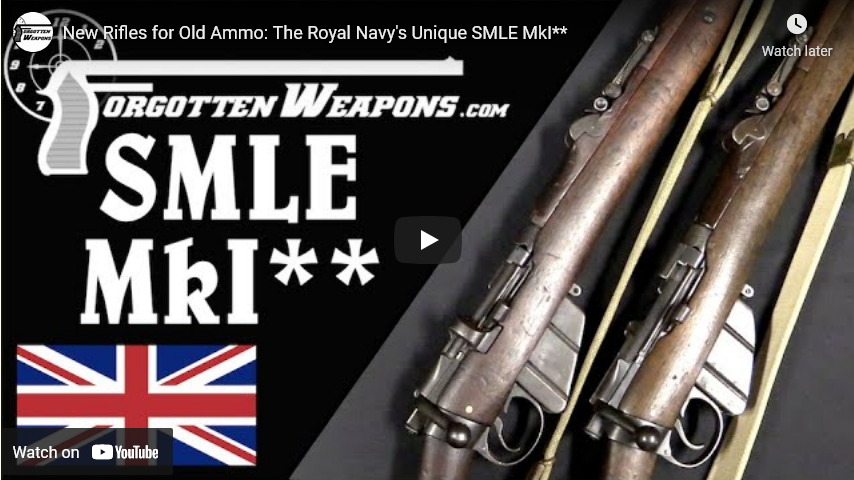
When the SMLE was adopted by the British, it was to be the new universal rifle for all branches of service, including the Royal Navy. This suited the Navy just fine; they like the features of the new design. However, the Army quickly moved to update their rifles for the new MkVII Spitzer ammunition, and this was an issue. The Navy still had substantial stockpiles of the older round-nose MkVI cartridge, and did not go through it nearly as quickly as the Army. The Navy did not want to simply throw out their ammunition, but the differences in trajectory between the two types of ammunition was substantial. So the Navy opted to adopt its own unique rifle variation, the MkI**. This in effect was the new Army pattern rifle, but with the rear sight still calibrated for the trajectory of MkVI ammunition.
This pattern was first adopted in 1908, using rifles with the then-standard split charger guide. When the fixed charger bridge was adopted, the Navy (which still had plenty of MkVI ammunition) chose to update its MkI** rifles to fixed charger bridges, without making any change to their designation. Once they finally ran out of the older ammunition during World War One, the rifles were updated once again to what was then the standard MkI*** pattern. As a result, intact MkI** rifles — especially ones with the split charger guide — are extremely rare to find today. Many thanks to the owner of these two specimens for giving me access to share them with you!
Contact:
Forgotten Weapons
6281 N. Oracle #36270
Tucson, AZ 85740
Comments Off on New Rifles for Old Ammo: The Royal Navy’s Unique SMLE MkI**
Now Burma and control of the Burma Road have fallen to the Japanese. Can nothing stop them? The Allies are thinking about maybe using the Solomon Islands as a base to build to try and fight back, but to do that they’ll need control of the Coral Sea, but both sides are sending warships there since the Japanese plan to take Port Moresby. The Allies are aware of this, however, since they have the advantage of being able to read a substantial part of Japan’s radio traffic. It is a week of foreshadowing not just there, but also as the Allies send ships to take Madagascar from the Vichy French and the Soviets prepare to launch an offensive in the south of the Eastern Front.
Written and Hosted by: Indy Neidell
Director: Astrid Deinhard
Producers: Astrid Deinhard and Spartacus Olsson
Executive Producers: Astrid Deinhard, Indy Neidell, Spartacus Olsson, Bodo Rittenauer
Creative Producer: Maria Kyhle
Post-Production Director: Wieke Kapteijns
Research by: Indy Neidell
Edited by: Iryna Dulka
Sound design: Marek Kamiński
Map animations: Eastory (https://www.youtube.com/c/eastory)
The weekend edition of The Line looks at the outrageous failure of Canada’s military high command and the government officials charged with oversight of the Canadian Armed Forces:
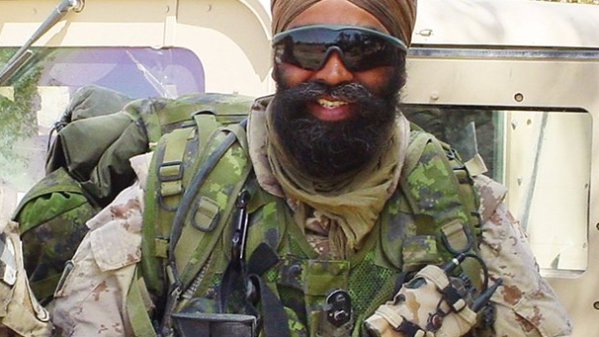
Canadian Defence Minister (at least for the moment) Harjit Sajjan.
This week saw a mealy mouthed political non-apology for the record books from Minister of National Defence Harjit Sajjan, who wants any women in the military who feel like they were let down to know that the government is very, very sorry. Gee, thanks, Minister. What a profile in courage that is. How reassuring to the women — and some men! — in the military either living with the reality or memory of sexual misconduct in the ranks.
And then there was the double-double approach to Supreme Court justices. Marie Deschamps wrote a detailed report on sexual misconduct in the military in 2015 (this report was discussed in depth here at The Line previously). Some of the action items in that report have been enacted, and things are therefore slightly better. But there is a lot more that could be done, that was already spelled out by Deschamps, and the report is just sitting there, neglected by all comers like those weird bagels with raisins in them. Now that the Minister has gotten the non-apology monkey off his back, maybe he’d like to grab the goddamn report he already has and, like, you know, do something with it?!
No. No, dear readers, he does not. What he’d like to do is appoint another former Supreme Court justice to write another report.
LOL! Just kidding. What he wants to do is buy time. The minister is hoping — and he will probably be proven right! — that Canadians won’t care about some lady soldiers getting harassed or outright raped in the military, not if his government can stick the vaccine landing, as seems increasingly likely. Sajjan has had literally years to take on the well-known issues inside the Canadian Forces, and he’s nibbled around the edges a bit, and no more. Only now that his ass is hanging out in the wind, along with a bunch of PMO staffer asses, and perhaps the prime minister’s, has the party rediscovered the urgency of the issue.
Pointing out the many ways that Trudeau and his government fail to live up to their own branding is almost a joke these days. Like, gosh, what more can we say? But if you have any capacity for shock and outrage left, and yeah, we know that’s a big if, this should set you off. The facts are plain. There’s no longer any dispute. The PMO was told that Canada’s top soldier was accused of sexual misconduct, and they ignored it. It just didn’t move their give-a-shit needle. That needle didn’t quiver for three years, until some great reporters at Global News dug this up and put the PM in danger of yet again being revealed to be a hypocritical fraud on women’s issues.
And we can’t have that! So let’s call in a retired Supreme to get to the bottom of all this. A few years from now.
Sorry, ladies of the armed forces. Better is always possible for you. But under Trudeau and Sajjan, it’s possible only in theory, and only when they get nervous about their own fates.
Thanks for your service, though.
Comments Off on “The PMO was told that Canada’s top soldier was accused of sexual misconduct, and they ignored it. It just didn’t move their give-a-shit needle.”
Overly Sarcastic Productions
Published 30 Apr 2021
History is full of Rulers, but most of them (especially some famous ones) can be Kind Of Terrible upon closer inspection. So let’s take a look at two kings we can actually consider to be Good — not perfect, not blameless, but a heck of a lot more virtuous than the average ruler, that’s for sure.
This topic was requested by our patron Duncan! Thank you for your patronage, and for the topic suggestion.
SOURCES & Further Reading: The Great Courses Plus lectures “Being Persian” by Robert Garland, “The Persian Era” by Jean-Pierre Isbouts, “Saladin: Chivalry and Conquest – 1187” by Eamonn Gearon, and “Saladin and the Defeat of the Crusaders” by Dorsey Armstrong.
Our content is intended for teenage audiences and up.
TRACKLIST: “Monkeys Spinning Monkeys,” “Pippin the Hunchback” Kevin MacLeod (incompetech.com)
Licensed under Creative Commons: By Attribution 4.0 License https://creativecommons.org/licenses/…
In 1907, the British adopted the final major pattern in the evolution of the Short, Magazine, Lee Enfield. Designated the ShtLE MkIII (Short Lee Enfield) at the time, it would be retroactively renamed Rifle No1 MkIII in the 1920s. This new design was simpler and more durable than its predecessors while actually improving the practical accuracy of the rifle. The rear sight protector wings were substantially strengthened, the front sight became a square post, the front sight protectors were opened up to allow more light in, and the rear sight windage adjustment was simplified — while retailing 1 MOA adjustment clicks and 25m elevation adjustments. A new bayonet was also adopted in 1907 for the MkIII. The previous 1903 pattern bayonet was deemed too short, and the British essentially copied the Japanese Type 30 Arisaka bayonet as its new Pattern 1907 — hooked quillion and all.
The example we are looking at in today’s video is a fantastic specimen, as it was sold out of service to an Australian reservist in 1912 having not received any post-production modifications or updates. It is still sighted for the early MkVI round-nose ammunition, for example, and its bayonet retains the hooked quillion. The rifle’s owner died prior to World War One, and the gun remained stored away and forgotten through both World Wars, where virtually all existing service rifles were taken back into service and updated. Only in the 1960s was this one found, making it a pristine collector’s example to show how the MkIII was originally produced.
Contact:
Forgotten Weapons
6281 N. Oracle #36270
Tucson, AZ 85740
Comments Off on SMLE MkIII: The Iconic Smelly of World War One
Sources:
IWM MH 24764, HU 36196, Q(HS) 256, D 16649
Yad Vashem 48AO3, 953, 86FO2, 3116/71
Bundesarchiv
Tito giving a speech in Foča, courtesy of Музеј Старе Херцеговине
Narodowe Archiwum Cyfrowe
Star of David, courtesy of Jacek Proszyk https://commons.wikimedia.org/wiki/Fi…
Picture of Gustav Braun von Stumm, courtesy of Thomas Föhl https://www.geni.com/photo/view/60000…
Soundtracks from the Epidemic Sound:
Wendel Scherer – “Defeated”
Johan Hynynen – “Dark Beginning”
Jon Bjork – “Disposal”
Christian Andersen – “Barrel”
Wendel Scherer – “Growing Doubt”
Jon Bjork – “For the Many”
Reynard Seidel – “Deflection”
Gavin Luke – “Drifting Emotions 3”
Jon Bjork – “Icicles”
Gunnar Johnsen – “Not Safe Yet”
A TimeGhost chronological documentary produced by OnLion Entertainment GmbH.
Update: TimeGhost had to repost a censored version of this episode and provided this explanation:
World War Two
1 hour ago (edited)
The original version of this video was age restricted by YouTube for containing pictures of dead bodies. We do not feel that it is correct to document these events by finessing history and self censoring, but YouTube has left us no choice. We have several problems with these age restrictions, but let’s start off with what an age restriction means on YouTube. In theory it simply restricts the video from anyone who isn’t over 18 and logged in to the YouTube platform, but in effect it does much more than that;
1. It takes the video out of most subscribers’ feeds and notification lists
2. In some countries like for instance South Korea, for legal reasons it is not accessible at all, for anyone
3. YouTube ranks it lower in their recommendation engines sending out recommendations to view to only a fraction of the ‘normal’ recommendations
4. It can no longer be viewed off YouTube as an embedded video – meaning that it won’t display even on our own website
5. It gets a boiler plate informing the viewer that the content has been “identified by the community as offensive to some viewers”
6. On many mobile devices it cannot be shared with the YouTube app
7. In countries were legal proof of age is required for adult content you have to provide a driver’s license, or credit card proving you are over 18
In effect that means that YouTube is soft censoring the video from a large section of potential viewers. The result is that we get around half, or less of the views on videos that are age restricted. And we should note that according to YouTube’s own system more than 90% of our viewers are over 18, so it’s not just an effect of losing underage viewers.
Now, this content is without any doubt hard to watch, but it’s educational content based on solid facts, documented through crystal clear academic research. It is about the crimes against humanity during WW2. It documents events that are to this day in 2021, denied by sympathizers of extreme ideologies. Because of the special importance for new generations to learn about these events, many countries, especially in the EU and North America, do not require in their youth protection laws or media regulation that this kind of content shall be for 18+ only. To the contrary many countries have these topics, told just as graphically as we document them on their school curriculum for ages 13 and above. Moreover, YouTube has in their own community guidelines a provision that allows for displays of violence, dead bodies, and so on in an educational context also for under 18s.
So in effect YouTube is here choosing to restrict, even censor content of high educational importance although they are not legally required to do so, and they have their own provisions to allow it to be unrestricted. Why do they do that? Well, we can’t read their minds, but we have some indications that;
A) they ere on the side of caution to avoid ANY legal risk.
B) They fear any kind of content that has to do with extremism, even when unmasking it after the advertising boycotts they faced a couple of years back.
C) when the community complains they put extra weight on those complaints
It is item C that troubles us the most. We have over 500 videos on our channels – very many of them contain graphic images of death and violence for reasons of the topics we document. Among these videos, a few dozen have been age restricted, while the rest have not. The common denominator between the age restricted videos is that they document events, or phenomena that unmask extremism by historical Communists, Nazis, and Imperialists. Its is difficult to not see the common interest by sympathizers of these groups and YouTube. If you want something suppressed, and there’s an easy way to just get it suppressed by just pressing a button – is it not reasonable to assume that you would use that button? We’re not conspiracy mythologists, we don’t believe there is a conspiracy here, but just by creating a simple path to fulfill different, but in effect common interests YouTube has made it easy for deniers of crimes against humanity, and war crimes to suppress information about these events.
We have explained to YouTube that inadvertently they are supporting the exact kind of hateful extremism they are fighting against with their other sword arm. We have implored them to lift the age restrictions in the interest of what society has decided: that content like this needs to be freely accessible in the public space. Despite an otherwise good and healthy relationship to the platform operators who are after all our distribution partners,, we have been met with standard replies, and a denial for our request.
Once again we express our dismay, sadness, and disappointment that YouTube chooses to restrict access to content that should serve a greater good; that we do not forget the victims of atrocities and extremism so that we can learn from our past and improve our societies.
Never Forget.
Comments Off on The Horrors of Partisan Warfare – WAH 033 – April 1942, Pt. 2
This is the story of “Tokyo Rose”, a Japanese-American from LA who broadcast propaganda for the Japanese during WW2. Was she a traitor or a victim?
Dr. Mark Felton is a well-known British historian, the author of 22 non-fiction books, including bestsellers Zero Night and Castle of the Eagles, both currently being developed into movies in Hollywood. In addition to writing, Mark also appears regularly in television documentaries around the world, including on The History Channel, Netflix, National Geographic, Quest, American Heroes Channel and RMC Decouverte. His books have formed the background to several TV and radio documentaries. More information about Mark can be found at: https://en.wikipedia.org/wiki/Mark_Fe…
Visit my audio book channel ‘War Stories with Mark Felton’: https://youtu.be/xszsAzbHcPE
Disclaimer: All opinions and comments expressed in the “Comments” section do not reflect the opinions of Mark Felton Productions. All opinions and comments should contribute to the dialogue. Mark Felton Productions does not condone written attacks, insults, racism, sexism, extremism, violence or otherwise questionable comments or material in the “Comments” section, and reserves the right to delete any comment violating this rule or to block any poster from the channel.
Comments Off on “Tokyo Rose” – WW2 Traitor or Victim?
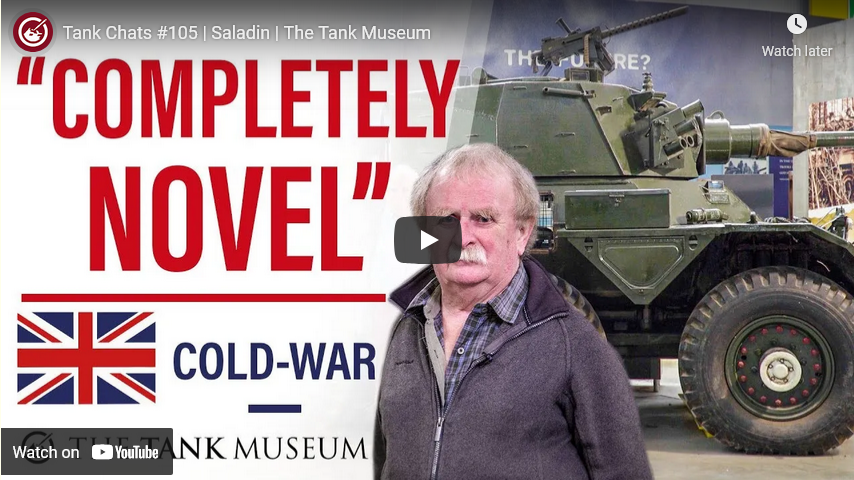
David Fletcher is back! Join him as he discusses the FV601 Saladin — a six wheeled armoured car developed by Crossley Motors and later produced by Alvis. The Saladin has had a long service life and despite its dated design, is still in service with some countries.
Support the work of The Tank Museum on Patreon: ► https://www.patreon.com/tankmuseum
Visit The Tank Museum SHOP & become a Friend: ► tankmuseumshop.org