
Extra Credits
Published on 7 Jun 2018A small handful of Grecian city-states have come together to stand off against the invading Persians at Thermopylae. At this fateful mountain pass, Greece will discover its identity as a nation.
The Battle of Thermopylae is one of the most significant events in the ancient world — and also one of the least understood.
Brought to you by Total War: Arena! Use the code HOPLITE for extra goodies:
https://totalwararena.net/join/4064_EN1…
June 9, 2018
Thermopylae – The Hellenic Alliance – Extra History – #1
Comments Off on Thermopylae – The Hellenic Alliance – Extra History – #1
May 28, 2018
Naval Operations In The Dardanelles Campaign 1915 I THE GREAT WAR On The Road
The Great War
Published on 25 May 2018In our first episode filmed on the former Gallipoli battlefields, Indy and our guide Can Balcioglu explore the naval campaign that preceded the landings at Gallipoli in early 1915.
Comments Off on Naval Operations In The Dardanelles Campaign 1915 I THE GREAT WAR On The Road
Leopard tanks in Afghanistan – “When the legend becomes fact, print the legend”
There’s a story that’s been told for more than a decade and — given the Canadian government’s legendary unwillingness to spend money on the military — widely believed. David Pugliese does his best to debunk it here:
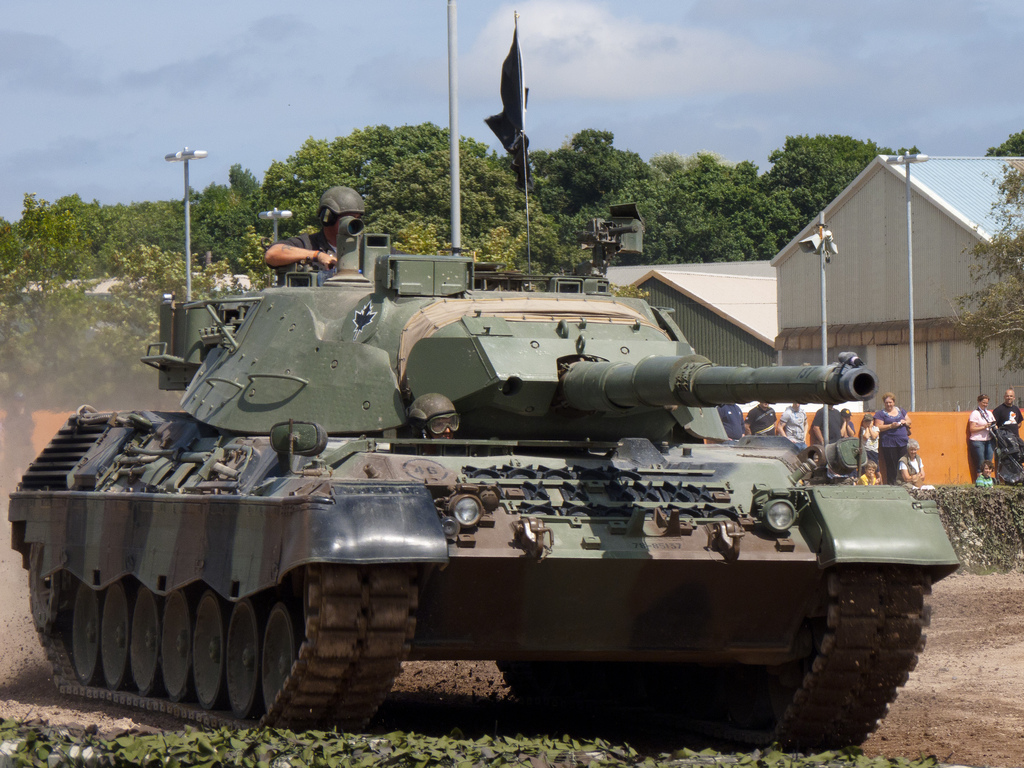
Canadian Leopard 1A3 (Leopard C1) at the Bovington Tank Museum.
Photo by Chris Parfeniuk, via Flickr.
As stories go it’s a pretty good one.
The Canadian Army was up against a tough enemy – the Taliban – in Afghanistan. Commanders called for Leopard tanks to join the battle but those armored vehicles had been mothballed and made into monuments.
So the ever resourceful Canadian Army crews jumped in the Leopard tanks mounted on concrete pads outside bases as monuments and drove them off those platforms, making sure they were shipped to their comrades in Afghanistan.
This myth has been around since 2007 and has once again resurfaced in a new book by retired Maj.-Gen. David Fraser about Operation Medusa.
Fraser also repeated the story in a recent CBC interview with Anna-Maria Tremonti, noting that he knew of at least one Leopard tank pulled off its concrete pad and brought back to serviceability and then shipped to Afghanistan.
In the 2008 book Kandahar Tour by Lee Windsor, David Charters and Brent Wilson the story gets even better. The tanks were driven off the concrete pads and then sent to Afghanistan, according to those authors.
A similar claim is made at the museum devoted to telling the story of the “Essex Regiment (Tank).” On its website the museum claims multiple numbers of Canadian Leopard tanks were taken from monuments (“A mad scramble to retrieve tanks from monuments and prepare them for war,” it claims).
Again, a great story.
But the Canadian Army says it never happened.
The Army points out that Leopard tanks, positioned on the concrete pads as monuments, had already been demilitarized so no one was driving them anywhere.
So what did happen?
Comments Off on Leopard tanks in Afghanistan – “When the legend becomes fact, print the legend”
Middle East: Palmyra Today – Afterword – Extra History
Extra Credits
Published on 31 Oct 2015Learn about Odenathus, King of Palmyra: http://bit.ly/1GDsDvz
____________Palmyra is an embodiment of our shared past, but right now it’s under the control of ISIS. They have destroyed the antiquities that remind us of our shared past. We would like to take a moment to honor Dr. Khaled al-Assad, the museum director who gave his life rather than reveal the locations of more Palmyrene relics for ISIS to destroy.
Comments Off on Middle East: Palmyra Today – Afterword – Extra History
May 27, 2018
Middle East: Odenathus – Ghosts of the Desert – Extra History
Extra Credits
Published on 31 Oct 2015Watch the afterword about Palmyra Today: http://bit.ly/1kiAKTN
Support us on Patreon: http://bit.ly/EHPatreon
____________In 260 CE, the Roman Empire was falling apart on all sides. Emperor Valerian gathered the legions to push back on the worst incursions from the Sassanid Empire in the east. They not only lost – they were massacred, and the emperor was taken captive. This left the empire in disarray. Into this desperate moment stepped Odenathus from the city-state of Palmyra. Palmyra was a vassal state that owed fealty to Rome and had been decorated with many honors and recognition in the past. If Rome fell, the Sassanid Empire would certainly look to conquer and annex Palmyra, so Odenathus rode to the rescue. He gathered all the soldiers he could find and took the Sassanid army by surprise on their way back from the battle with Valerian. He destroyed them. From there, he rode north to protect the emperor’s son, and the next heir to Rome, then south again where he pushed the Sassanids all the way back to their capitol twice. Despite his success and undeniable military power, he never took power for himself or declared himself an emperor. Rome showered him with appreciation and titles. Sadly, he was murdered by his nephew in 267 CE, but his loyalty had bought the Roman Empire enough time to recover and survive for another 200 years.
Comments Off on Middle East: Odenathus – Ghosts of the Desert – Extra History
May 25, 2018
Bombs Away – German Thirst For Caucasian Oil I THE GREAT WAR Week 200
The Great War
Published on 24 May 2018In the 200th week of the war, the total nature of modern warfare is truly showing its face. The warring nations escalate their bombing campaigns and the German troops in the Caucasus are so thirsty for Caucasian oil, that they are considering to double cross their own allies.
Comments Off on Bombs Away – German Thirst For Caucasian Oil I THE GREAT WAR Week 200
May 24, 2018
The Hamas pay scale for freelance protest attendees
Barbara Kay in the National Post:
Illuminating the validity of Col. Kemp’s statement, the Monday edition of the Wall Street Journal published an op ed by Israeli Brig. Ronen Manelis, spokesman for the IDF, titled “The Truth about Hamas and Israel.” In it Manelis reveals the depths of Hamas cynicism. Hamas provided free transportation to the security fence for all Gazans, including women and children. They were paid $14 a head or $100 per family to attend. The injured received $500. That’s pretty abominable. So’s this: Hamas gave everyone with a video camera VIP access to “the show,” and free wifi too to make sure no injury went unrecorded (both real and fake: one video shows an “injured” victim borne away on a stretcher hopping off completely unscathed when presumably out of camera range.)
According to Manelis, the “protest” theme was a complete fabrication: “The IDF had precise intelligence that the violent riots were masking a plan of mass infiltration into Israel in order to carry out a massacre against Israeli civilians.” Hamas operatives were dressed as civilians. On Facebook Hamas had posted maps for operatives indicating the fastest route from the border to nearby Israeli homes, schools and daycare centres. That’s abominable.
Manelis states that IDF soldiers “acted with courage and restraint, following strict rules of engagement to ensure minimum civilian injury and loss of life while still protecting the border.” The optics did not favour Israel, naturally, because the truth can’t make much headway when an enemy is prepared to put its own women and children in harm’s way, calculatedly using their bodies for propaganda purposes.
The IDF policy was indeed to warn first and shoot as a defensive action. Their first priority was, quite rightly, self-defence and defence of Israeli civilians. And as Manelis writes, “The soldiers of the IDF won this week by keeping Israeli families safe and by stopping Hamas from accomplishing its stated goals.”
But yeah, Hamas is winning the propaganda war, and the proof is that even a seasoned and objective journalist like Terry Glavin is so frustrated with the human cost of this reckless, feckless and essentially futile act of jihad, that he’s essentially asking Israel to find a way to stop it, as if there were some magical, casualty-free solution the IDF could employ, if only it chose to, in defending a border against a rabid mass of suicide-prone enemies.
Israel is constantly subjected to double standards — by the UN, by biased journalists, by anti-Semites on social media.
Comments Off on The Hamas pay scale for freelance protest attendees
May 22, 2018
“[Hamas] knows there is a market for stories of Palestinian pain, and it is happy to flood that market”
In Spiked, Brendan O’Neill explains why Hamas is so willing to literally sacrifice Palestinian lives for media coverage:
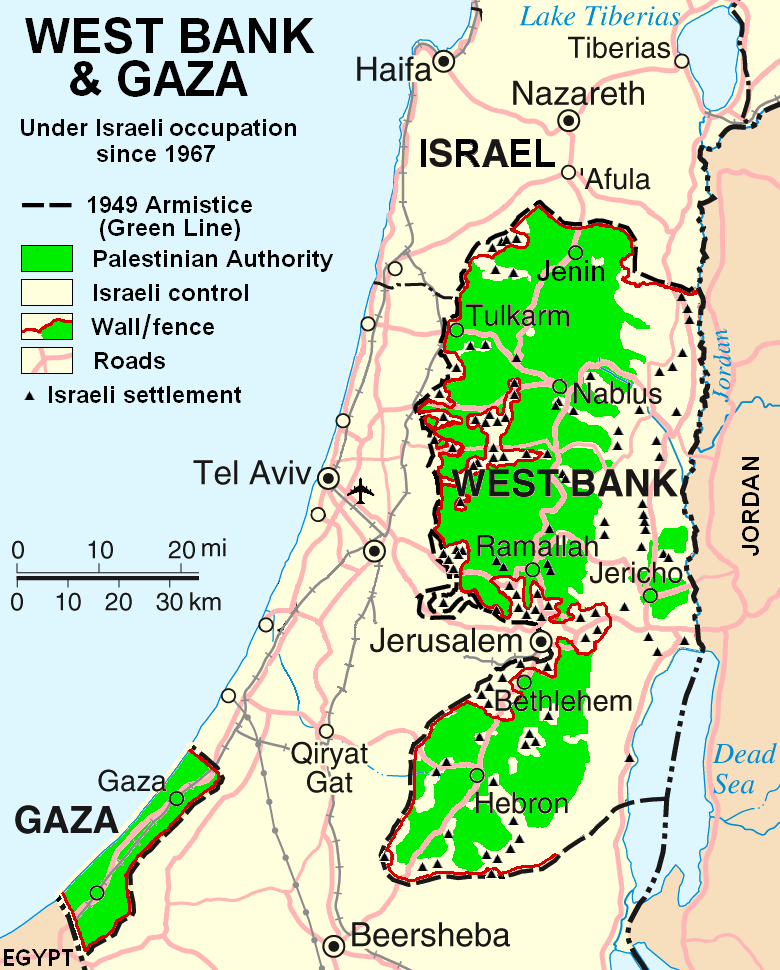
A 2007 map of the West Bank and Gaza, showing Israeli settlements
Via Wikimedia Commons
It is becoming increasingly clear that Hamas pushes Gaza’s people into harm’s way because it knows their suffering will strike a chord across the West. Because it knows images of their hardship will be shared widely, wept over, and held up as proof of the allegedly uniquely barbarous nature of the Jewish State. Hamas knows there is a hunger among the West’s so-called progressives for evidence of Palestinian pain, and by extension of Israeli evil, and it is more than willing to feed this hunger.
The clashes at the Gaza border, in which more than 60 Palestinians were killed and hundreds injured, cannot be viewed in isolation from Western liberals’ peculiar and disproportionate obsession with Israel. It now seems undeniable that this was no instinctive, grassroots protest, but rather one that was carefully orchestrated by Hamas. As a New York Times reporter described it, after midday prayers clerics and leaders of Hamas ‘urged thousands of worshippers to join the protests’. And Hamas’s urging was littered with false claims. It told people ‘the fence had already been breached’ and Palestinians were ‘flooding into Israel’. This was a lie. A Washington Post reporter details how Hamas’s leaders told people to keep attacking the border fence because ‘Israeli soldiers [are] fleeing their positions’. In truth, as Hamas knew only too well, the IDF was reinforcing its positions.
Israel had made clear, including in an airdrop of leaflets, that anyone who sought to dismantle the fence in Gaza, the de facto border between this part of Palestine and Israel, risked coming to harm. And still Hamas encouraged the protesters to strike at the fence. Still it sought to swell the angry ranks by pleading with people to go from their mosques to the border. Why would it do this? Why would the governing party of a territory knowingly put that territory’s citizens into serious danger?
This is the rub. This is the central question. And the answer is a disturbing one: Hamas does this because it knows it will benefit politically and morally if Palestinians suffer. It knows there is a market for stories of Palestinian pain, and it is happy to flood that market.
Writing in the New York Times last week, Matti Friedman, a former AP desk editor in Jerusalem, touched upon this trade in Palestinian horror. He said that during his years reporting from the Middle East he even developed a certain respect for Hamas’s ‘keen ability to tell a story’. Hamas’s great insight was to recognise that the vast majority of the Western media wanted ‘a simple story about villains and victims’, says Friedman. Most Western reporters and commentators weren’t interested in nuance and certainly not in any reading of events that might seek to understand the Israeli position. No, they wanted stories of ‘dead human beings’, made dead by ‘unwarranted Israeli slaughter’, says Friedman.
Comments Off on “[Hamas] knows there is a market for stories of Palestinian pain, and it is happy to flood that market”
May 19, 2018
“Don’t cry for Gaza. Gaza is a failed state and a failed society, marinated in hatred rather than aspiration”
Barbara Kay on the impossible situation Israeli troops find themselves in, with the media acting as cheerleaders and active propagandists for the Palestinian terrorists:
Optics play a huge role in any asymmetric war Israel is involved in. The media tend to favour the “underdog,” and seize on every incident that casts Israel in an inhumane light. In one story about the death of a baby, allegedly at IDF hands, an image in the news showed a group of Palestinian women comforting a mother holding her shrouded infant. The message conveyed was that of a heartless machine that kills indiscriminately. A closer look at the story reveals that it was a combination of tear gas and a pre-existing heart condition that killed the baby, with no direct intention on the part of the IDF. Rather than reflexive condemnation of Israel, the takeaway from the story should be: who brings an infant to a battle site? Children are purposefully being used as human shields. This is a tactic routinely deployed by Hamas, but rarely called out for the despicable war crime it is.
Israel’s critics point to the mounting death toll of Gazans with indignation, failing to distinguish between actual civilians and Hamas terror foot soldiers. But even Hamas has stated that the overwhelming majority of fatalities were their own fighters. Israel is killing mostly bad actors, and even then, relatively few in number. No army in the world can do better than “mostly.” No other army in the world would act as prudently as the IDF. The IDF uses rubber bullets when it can, but they only work at short range. They are using tear gas when they can, but that’s no good when it’s windy. They have senior commanders stationed at every confrontation point. Every single hit is reportedly documented and investigated in Excel spreadsheets. The collateral damage of actual non-combatants is around 20 deaths or fewer. It doesn’t get more humane than that in war.
Some critics ask why they don’t just “arrest” the invaders. That’s not feasible. If soldiers came near the crowds, they would be swarmed and a bloodbath could ensue. They use live ammunition as a last resort, but use it they must, for they cannot allow hundreds or thousands of Gazans to infiltrate their territory and imperil adjoining Israeli communities.
Comments Off on “Don’t cry for Gaza. Gaza is a failed state and a failed society, marinated in hatred rather than aspiration”
The Macedonian phalanx – structure and organization
Syntagma
Published on 19 Feb 2018A description of the Macedonian phalanx structure during the Alexander and Diadochi age, based on later written Asclepiodotos and Aelian infantry manuals.
Comments Off on The Macedonian phalanx – structure and organization
May 3, 2018
Total War History: The Theodosian Walls
Invicta
Published on 9 Jan 2015Amongst the most formidable structures ever built by the Romans would be the massive triple layered walls of Constantinople. Today we dive into the details of this super structure!
Comments Off on Total War History: The Theodosian Walls
April 21, 2018
That time Mossad ran a resort to rescue Sudanese refugees
Join Israel’s secret spy agency! Learn all the tricks of espionage! Run an exotic beachside resort! Wait, what?
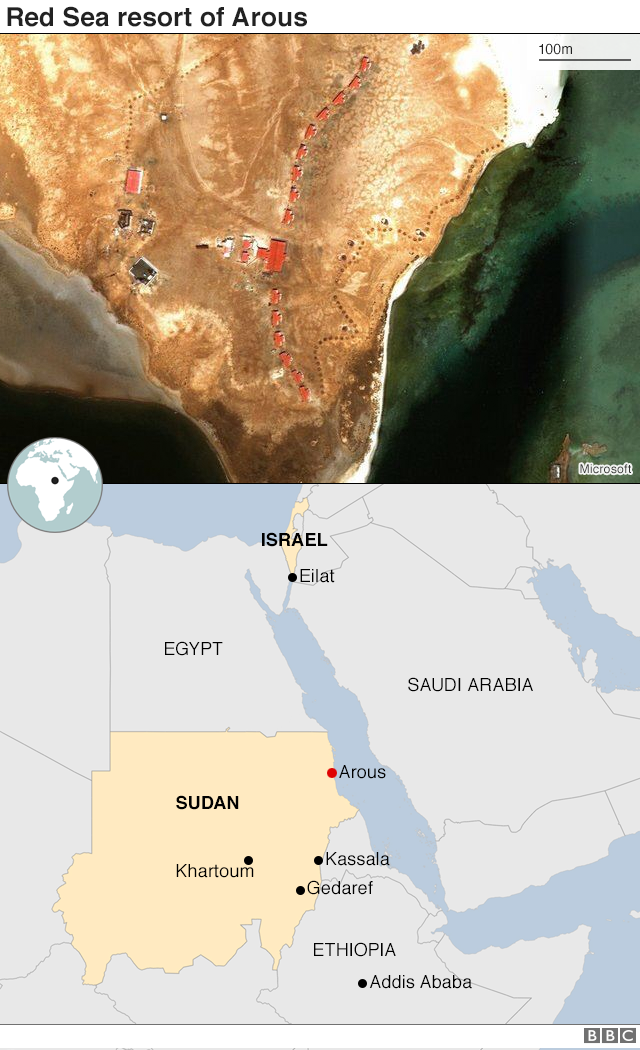
“Arous on the Red Sea, a wonderful world apart,” the glossy brochure says, pronouncing it “the diving and desert recreation centre of Sudan”
Illustrated with pictures of putty-coloured chalets on a sun-drenched beach, a smiling couple in scuba gear, and varieties of exotic fish, the advertisement boasts of “some of the best, clearest water in the world”. As night falls – “after the landscape colours have paled” – there are, it says, “breathtaking views of the heavens, aflame with millions of stars”.
Arous Village, on the fringe of spectacular coral reefs and the odd shipwreck, appears to be a diving enthusiast’s dream.
[…]
The only thing was, unbeknown to the guests or the authorities, the Red Sea diving resort was entirely fake.
It was a front, set up and run for more than four years in the early 1980s by operatives from the Mossad, Israel’s intelligence agency.
They used it as a cover for an extraordinary humanitarian mission – to rescue thousands of beleaguered Ethiopian Jews stranded in refugee camps in Sudan and evacuate them to Israel. Sudan was an enemy Arab country, and it had to be done without anyone finding out, either there or at home.
“It was a state secret, nobody talked about it,” says Gad Shimron, one of the agents who served at the village. “Even my family didn’t know.”
“For us it was a godsend. If we could get hold of this place and do it up, we could say we’re running a diving village, which would give us a reason for being in Sudan and furthermore for roaming around near the beach.”
What happened next is the subject of a soon-to be released Hollywood film called Red Sea Diving Resort. Filmed in Namibia and South Africa, it tells the story of the operation and the village. Though while it is based on true events, some of the scenes are fictitious.
[…]
While seeing to their guests by day, every so often at night a squad would leave under cover of darkness and head to a rendezvous point 10km (six miles) south of Gedaref.
“We’d tell the staff we’re going to Khartoum for a few days, or to meet some Swedish nurses from the hospital in Kassala,” says Gad.
They would pick up groups of Ethiopian Jews, smuggled out of the camps by so-called Committee Men – a handful of Beta Israelis recruited for the job.
“The Ethiopian Jews were given no notice, as we could not risk word getting out,” says Gad. “They did not even know we were Israelis. We told them we were mercenaries.”
From there, a convoy of lorries carrying dozens of bewildered refugees drove a two-day – 800km – journey, evading detection at numerous checkpoints along the way by a combination of guile, bribery and occasionally ramming their way through.
At breaks, they would try to pacify the frightened passengers.
“When we let them sit in the driver’s cabin and touch the wheel, they were in seventh heaven,” Gad says, in his book Mossad Exodus. “It was amazing to see how happy they were at sharing a piece of chewing gum among 20 children. They looked at us as though we were creatures from outer space.”
When they got to the beach, north of the holiday village, Israeli navy special forces would come ashore on Zodiac dinghies, collect the refugees and transport them a further hour and a half to a waiting naval vessel, the INS Bat Galim.
The ship then took them to Israel.
Comments Off on That time Mossad ran a resort to rescue Sudanese refugees
April 20, 2018
Knocking Out The Hejaz Railway I THE GREAT WAR Week 195
The Great War
Published on 19 Apr 2018While the Germans are still advancing in Flanders (Operation Georgette), the other fronts are not always quiet. In Palestine, the British forces and the Arab Revolt are taking the initiative again. T.E. Lawrence (Lawrence of Arabia) and the Arab Revolt are attacking the vital Hejaz Railway, a major transport factor for the Ottoman Empire.
Comments Off on Knocking Out The Hejaz Railway I THE GREAT WAR Week 195
April 18, 2018
Israel at 70
In the National Post, Barbara Kay explains why the world should (but largely will not) celebrate the 70th anniversary of the foundation of the state of Israel on Thursday:
Making the case for Israel’s territorial and political rights involves a deep knowledge of Jewish and Arab history, understanding of the complexities around the reconstruction of the modern Middle East from the ashes of the Ottoman empire, and a plod through a litany of declarations, mandates, commissions, conferences and international legal documents that most Israel defenders aren’t even aware of, let alone able to deploy in debate with rhetorical economy.
Moreover, since the 1967 war, which changed so much on the ground, even the Israeli government hasn’t pressed itself to defend Israel’s historic rights in any systematic way (apart from crises, as in 2016, when the Palestinians drafted a resolution for UNESCO, whose language deliberately detached Jewish ties from Judaism’s holiest sites). With the 1993 Oslo peace process, the issue of legal rights fell further off the communications radar.
When it became clear over the next tumultuous decade that terrorism could not destroy Israel, Israel’s enemies ramped up the campaign to undermine her legitimacy as a member state within the international community. Once the Palestinian strategy of revisionist history replaced organized physical violence — including outright lies as in the UNESCO fiasco — it became clear that a fact-based counteroffensive was needed.
For in the end, it will be international law and accords, not blood libels and emotional mantras, that will settle the matter of Israel’s literal legitimacy. Israel was created, like many other countries, after a successful war in which no other country came to its aid. Gaza, Judea and Samaria were conquered by Jordan and Egypt illegally, as they had no claim to them, while Israel did. The Palestinian territories are not in fact “occupied” in law; rather they are “disputed.” The word “settlements” imply Jews are foreigners in their own homeland, which they are not. Jews have built 140 communities in Judea and Samaria since 1967, which excites condemnation. The Arabs have built 260 communities in Judea and Samaria since 1967, which excites … silence.
Comments Off on Israel at 70
April 4, 2018
3,200 Year Old Stone May FINALLY Solve SEA PEOPLE Mystery
Beyond Science
Published on 12 Oct 2017Was it solved?
Comments Off on 3,200 Year Old Stone May FINALLY Solve SEA PEOPLE Mystery


