
The Great War
Published on 9 Aug 2018Ludendorff and his generals didn’t think the Allies had it in them, but this week they attack with the might off several hundred tanks near Amiens, the Black Day of the German Army.
August 10, 2018
The Black Day Of The German Army – The Battle of Amiens I THE GREAT WAR Week 211
Comments Off on The Black Day Of The German Army – The Battle of Amiens I THE GREAT WAR Week 211
August 7, 2018
QotD: Sailing past Byzantium
To those who know nothing about the mediaeval, “byzantine” East of Christendom (and what do I know about anything?) a book by the respectable Oxford scholar, Averil Cameron, is worth mentioning. It is a short survey of developments in her academic field, entitled, Byzantine Matters (2014). It poses five basic questions on which our common assumptions are mostly wrong, and provides succinct directions for thinking again.
Mediaeval Greece, the Byzantine dynasties, and Orthodox Christianity: these are far from interchangeable concepts. Moreover, “Byzantine art” — the focus of enthusiasm in the anglosphere through the last century or so — is misunderstood. The term “Byzantine” itself — conceived from late antiquity as a deprecation — persists in the academy as an intelligence neutralizer. The vanity of “the West” gets in the way of appreciating a parallel Christian realm, which flourished for more than a thousand years, and never succumbed to the Arabs. (It finally succumbed to the Turks.) We disdain what amounts to an alternative universe of Christian witness and high culture, of great variety and depth, even more obtusely than we disdain our own Middle Ages.
We are narrowed and prejudiced by the attitudinizing of Edward Gibbon, and the inheritance (or disinheritance) of our Western “Enlightenment,” to view as backward a civilization in most ways superior to our “modern” own, from pride in the tinsel of technology. From AD 330 (the founding of Constantine’s capital) to 1453 (when it fell into Ottoman hands), we see only a continuous story of “decline.” But there were many declines over this vast period, and in the intervals between them, many recoveries.
David Warren, “Sailing past Byzantium”, Essays in Idleness, 2016-11-07.
Comments Off on QotD: Sailing past Byzantium
August 3, 2018
QotD: The lost kingdom of Pontus
Pontus is that country, within modern Turkey, that follows the south-east Black Sea shore, and inland is enclosed as by an amphitheatre of mountains. It is the more interesting, archaeologically, for having been often by-passed, in the movements of conquering nomads and armies, from Hittites and Hurrians to Arabs and Turks. The Greeks took it, because they came by sea. They kept it, till late in the day; so that even after Constantinople fell to our short-sighted Franks (in 1204), the Empire of Trebizond immediately formed, and Byzantium persisted in Pontus, as in Crimea and elsewhere, until it could be restored at its centre.
David Warren, “A wonderworker”, Essays in Idleness, 2016-11-17.
Comments Off on QotD: The lost kingdom of Pontus
July 31, 2018
German Asia Corps In The Ottoman Empire During WW1 I THE GREAT WAR Special
The Great War
Published on 30 Jul 2018German-Ottoman military cooperation predated World War 1 by a few decades. But their alliance during the First World War meant that German (and Austrian) troops would actually fight in and with the Ottoman Empire.
Comments Off on German Asia Corps In The Ottoman Empire During WW1 I THE GREAT WAR Special
July 30, 2018
Pour Le Merite – Persia – Polish Legions I OUT OF THE TRENCHES
The Great War
Published on 28 Jul 2018Chair of Wisdom Time!
Comments Off on Pour Le Merite – Persia – Polish Legions I OUT OF THE TRENCHES
July 29, 2018
Carving up the Middle East and Preempting Rommel I BETWEEN 2 WARS I 1920 Part 3 of 4
TimeGhost History
Published on 27 Jul 2018In 1920 the colonial powers of the British Empire and France reverse course on their commitment to grant independence to the peoples of the Middle East. In a game to grab the oil fields of Arabia, Syria and Mesopotamia, and to control the Suez Canal they tighten their grip on the region, with far ranging consequences that will shape the world well into the 21st century.
Join us on Patreon: https://www.patreon.com/TimeGhostHistory
Hosted by: Indy Neidell
Written and directed by: Spartacus Olsson
Research Contributed by: Jonas Yazo Srouji
Produced by: Astrid Deinhard
Executive Producers: Bodo Rittenauer, Astrid Deinhard, Indy Neidell, Spartacus OlssonA TimeGhost chronological documentary produced by OnLion Entertainment GmbH
Comments Off on Carving up the Middle East and Preempting Rommel I BETWEEN 2 WARS I 1920 Part 3 of 4
July 18, 2018
An Israeli milestone is reached
Barbara Kay in the National Post:
The announcement was not unexpected.
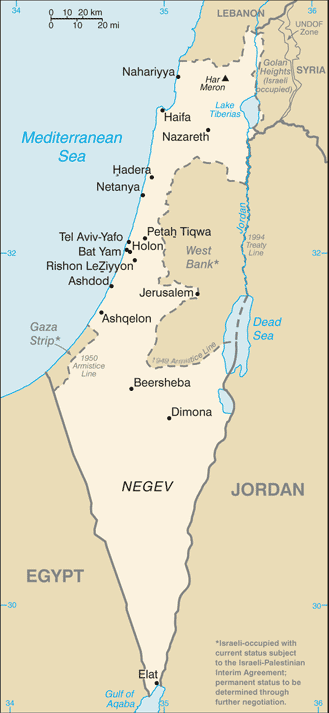
On the contrary, for those who follow the subject, it was long anticipated. But the words themselves, spoken by Israel’s Immigration Minister, Sofa Landver, still carried emotional force: “Israeli Jews now constitute the largest Jewish community in the world.”
Until now, the U.S., with its many millions of Jews, has been the most Jewish country in the world. For context, in 1948, when Israel achieved official nationhood, only 600,000 of the world’s 11.5 million Jews lived there (5.2 per cent of world Jewry). By 1967, Israel’s Jewish population was 2.4 million (almost 20 per cent), and in 2012, 5.9 million (43 per cent).
The exact numbers are disputed according to methodology and definition of Jewishness. Landver puts the Israeli number at 6.6 million, the U.S. figure at 5.7 million, while Pew has the U.S. number at 7.7 million Jews identifying as Jewish at some level, which includes 2.4 million people with “Jewish background,” but no affiliation or practice.
However one calculates who is or is not Jewish for census purposes, everyone agrees the trend is to a diminishing Jewish presence in America (secularization, intermarriage, low birthrate) and an escalating Jewish presence in Israel. So whether it’s this week or next year, the population dies are cast, and will, according to Hebrew University’s Sergio DellaPergolo, an expert on Jewish demographics, reflect a demographic reality not experienced by the Jewish people since 586 BCE.
In the age-old question: is this good or bad for the Jews?
It’s good in the sense that, since Israel is the Jewish homeland with Jews the only extant indigenous people who consider it sacred space, this is a return to an original norm. Twenty years ago, it was estimated that 98 per cent of Jews no longer reside in the place in which at least one grandparent was born. Perhaps it is a few percentage points fewer today. Still, such numbers speak to a rather lachrymose history of dispersion and insecurity, in which the dream of Zion restored has been both a comfort in adversity and motivation for endurance.
Once the dream came true (at a cost of two-thirds of European Jews’ deaths, numbers still not made up), it makes sense that Jews should gather in the one place where they know they will be unconditionally welcome. A steady stream of European Jews — notably from France, where the state has proved unequal to the task of quelling or reliably containing Muslim anti-Semitism — will continue to swell the ranks of highly cultured and well-educated Jews who can fairly seamlessly and productively integrate into Israeli society.
Comments Off on An Israeli milestone is reached
July 15, 2018
Alcibiades, the Athenian Byron
Not for poetry, but for the Byronian swathe he cut through a large portion of Classical Greece:
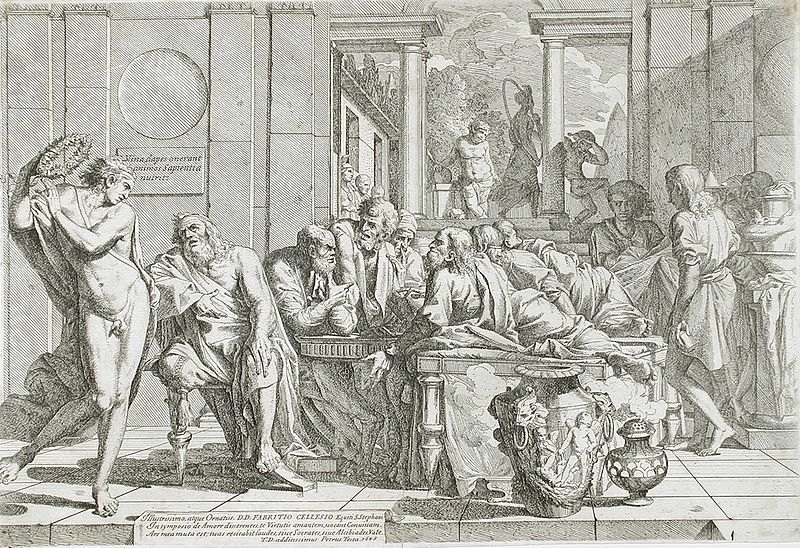
“Drunken Alcibiades interrupting the Symposium”, an engraving from 1648 by Pietro Testa (1611-1650)
Via Wikimedia Commons.
Of all personality traits, charisma is the hardest to appreciate at second hand. We read Cicero’s letters and can instantly tell that he was vain, insecure and ferociously clever; we read scraps of Samuel Johnson’s conversation in Boswell’s biography and know at once that he was magnificent, lovable and desperately unhappy. But as to what it was like to have Lord Byron turn the full force of his attention onto you – well, we have no conceivable way of knowing. We just have to trust his contemporaries that it felt like ‘the opening of the gate of heaven’.
This causes problems for a biographer of Alcibiades. On the face of it, the man was utterly insufferable. Born in around 450 BC into one of the oldest and richest families of ancient Athens, Alcibiades was the only Old Etonian (as it were) to play a leading role in the late-fifth-century radical democracy. The account of his childhood in Plutarch’s Life of Alcibiades suggests a bad case of antisocial personality disorder: biting during wrestling, mutilating dogs, punching his future father-in-law in the face for a dare. His later political career makes Boris Johnson seem like a man of firm and unbending principle. Exiled from Athens in 415 BC over some particularly odious Bullingdon Club antics, Alcibiades promptly sold his services to Sparta (where he seduced the king’s wife) before double-crossing both sides and wheedling his way into the court of a Persian satrap.
But Alcibiades, like Byron, clearly had that indefinable something. One catches a glimpse of it in the unforgettable last scene of Plato’s Symposium, when he crashes into the room, blind drunk, flirting with everything on legs, shouting about his love for Socrates. Thucydides captures it in his report of Alcibiades’s speech whipping up the Athenian assembly to vote for the disastrous Sicilian expedition of 415 BC – an extraordinary stew of egotistic bragging (about how successful his racehorses are), mendacious demagoguery and brilliantly acute strategic thinking. The unwashed Athenian masses, not usually prone to atavistic toff-grovelling, absolutely adored him: when Alcibiades finally returned to Athens in 407 BC after eight years of exile, sailing coolly into Piraeus on a ship with purple sails, they welcomed him back with paroxysms of joy.
Behind the Peloponnese-sized ego, Alcibiades was a general of spectacular genius – when he could be bothered. In 410 BC, shortly after his controversial reinstatement as admiral of the Athenian navy (on the back of a bogus promise of Persian support), he wiped out the entire Spartan fleet at the Battle of Cyzicus; two years later, through sheer chutzpah, he captured the city of Selymbria near Byzantium with only fifty soldiers, and without striking a blow. When things went wrong – as in 406 BC, after a disastrous campaigning season in the eastern Aegean – he showed an infuriating ability to wriggle out of trouble. His final years (406–404 BC) were spent once again in exile from Athens, holed up in a private castle on the Gallipoli peninsula. The circumstances of his death are still shrouded in mystery. One story tells that he died in the remote mountains of central Turkey at the hands of the brothers of a Phrygian noblewoman whom he had decided to seduce. This is, I fear, all too believable.
This is the introduction to a review by Peter Thonemann of a new biography of Alcibiades by David Stuttard in the Literary Review for July, 2018. H/T to Never Yet Melted for the link.
Comments Off on Alcibiades, the Athenian Byron
June 29, 2018
The Run For The Baku Oil Fields I THE GREAT WAR Week 205
The Great War
Published on 28 Jun 2018While the Ottoman Army of Islam is marching on Baku and the Caspian Sea, multiple other players are trying to stake their claim of the Baku oil fields.
Comments Off on The Run For The Baku Oil Fields I THE GREAT WAR Week 205
June 28, 2018
Shifting attitudes toward mass immigration in Europe
At Gates of Vienna, Baron Bodissey maps the way public sympathies are changing in the wake of the immigration/refugee waves of the last few years:
From Szczecin in the Baltic to Trieste in the Adriatic, a Razor-Wire Curtain Has Descended…
Immigration-related events are moving rapidly this in Europe summer. The situation is in such flux that now would be a good time to step back and try to get an overview of the process.
Three years ago the dead baby hysteria, followed by Chancellor Merkel’s invitation to the world (“Y’all come in and set a spell, bitte!“), launched the Great European Migration Crisis. Since then I’ve read hundreds of news articles and analyses about the flow of “refugees” and the reactions to their violent and fragrant arrival in Western Europe.
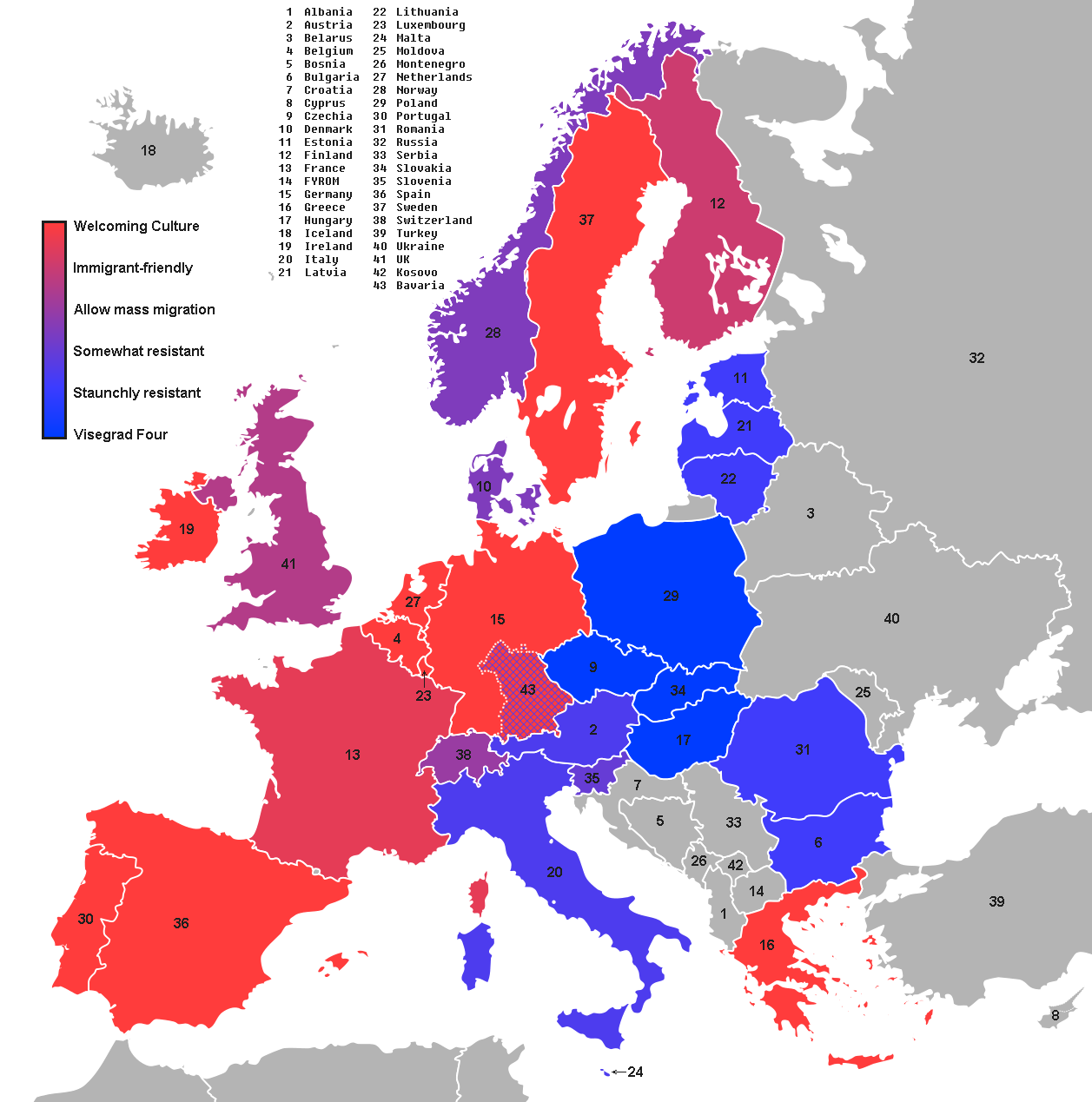
After digesting all that information I created the following map, which presents my subjective evaluation of the different approaches to migration by various European countries. I’ve rated the policies of 28 different countries (the EU 27 minus Croatia, plus Switzerland) on a scale from 0 to 100, from zero (red) for the open-borders attitude of the “Welcoming Culture” to 100 (blue) for the absolute refusal of mass migration by the Visegrád Four (Hungary, Poland, Slovakia, and the Czech Republic). Data from the last six months weighs more heavily in the score assigned to each country — for example, Spain and Italy recently changed governments, which has strongly affected each country’s migration policy.
[Click to see full-sized image]
The grouping of countries based on their stance on migration bears a striking resemblance to the division of Europe into East and West by the Iron Curtain. This is especially true if we roll the clock back three months — back then Italy and Bavaria would have been quite red. And the analogy becomes even more apt if we remember that Austria was occupied by Soviet troops until 1955, which gives it one foot in the Eastern camp.
The biggest change in the past three months has been the formation of a new anti-immigration government in Italy. The “xenophobia” of the East Bloc has now broken through the razor-wire curtain and gained a foothold in Western Europe. No wonder EU politics is in such turmoil! After failing to contain the “anti-European” attitudes of Poland and Hungary, Brussels now has to contend with Matteo Salvini. Italy is one of the “big four” pillars of the European Union, so its defection to the anti-migration side carries enormous significance for continental politics.
The situation is metamorphosing rapidly, but before we analyze the process of change — the “delta”, as they say in the military-industrial complex — let’s go over the snapshot of current European migration policies.
Comments Off on Shifting attitudes toward mass immigration in Europe
June 27, 2018
Canada’s euphemistically named “High Risk Returnees”
Judith Bergman on the Canadian government’s kid-gloves approach to dealing with Canadian citizens who return to Canada after volunteering to serve with terrorist organizations:
Canadians who go abroad to commit terrorism – predominantly jihadists, in other words – have a “right to return” according to government documents obtained by Global News. They not only have a right of return, but “… even if a Canadian engaged in terrorist activity abroad, the government must facilitate their return to Canada,” as one document says.
According to the government, there are still around 190 Canadian citizens volunteering as terrorists abroad. The majority are in Syria and Iraq, and 60 have returned. Police are reportedly expecting a new influx of returnees over the next couple of months.
The Canadian government is willing to go to great (and presumably costly) lengths to “facilitate” the return of Canadian jihadists, unlike the UK, for example, which has revoked the citizenship of ISIS fighters so they cannot return. The Canadian government has established a taskforce, the High Risk Returnee Interdepartmental Taskforce, that, according to government documents:
“… allows us to collectively identify what measures can mitigate the threat these individuals may pose during their return to Canada. This could include sending officers overseas to collect evidence before they depart, or their detention by police upon arrival in Canada.”
Undercover officers may also be used “to engage with the HRT [High Risk Traveler] to collect evidence, or monitor them during their flight home.”
In the sanitizing Orwellian newspeak employed by the Canadian government, the terrorists are not jihadis who left Canada to commit the most heinous crimes, such as torture, rape and murder, while fighting for ISIS in Syria and Iraq, but “High Risk Travelers” and “High Risk Returnees”.
The government is fully aware of the security risk to which it is subjecting Canadians: According to the documents, “HRRs [High Risk Returnees] can pose a significant threat to the national security of Canada”. This fact raises the question of why the government of Canada is keen to facilitate these people’s “right of return” — when presumably the primary obligation of the government is to safeguard the security of law-abiding Canadian citizens.
Comments Off on Canada’s euphemistically named “High Risk Returnees”
June 24, 2018
Europe and the refugees
Theodore Dalrymple on the various European governments’ attitudes and actions on the refugee problem:
Europe, despite its Union, is as divided as ever. Recently, when Italy’s new right-wing government — anxious to prove its credentials — refused to allow a boat carrying 629 African migrants to dock in Italy, Spain’s new left-wing government — equally anxious to do the same — accepted the boat. When the French president, Emmanuel Macron, criticized the Italians for their decision, the Italian government accused the French of hypocrisy, inasmuch as they had refused to take more than 9,000 migrants from Italy that they had previously agreed to accept.
This story is revealing in several aspects. The first is that, whatever attitude governments take to the migrants, no one truly believes that they are more of an asset than a liability. Madrid’s action, for example, was taken on “humanitarian” grounds, rather than because it believed that Spain would benefit from the migrants’ presence. When European leaders discuss the migrant question, it is always in terms of sharing the burden, not the assets, equitably. No one speaks of foreign investment in this way, which suggests that European politicians believe, whether rightly or wrongly, that the free movement of people and capital are different in an important way.
The leaders speak of sharing the burden, then, and are incensed when countries such as Hungary and Poland refuse point-blank to take any migrants from Africa or the Middle East. But I have never seen mentioned in this context the question of where the migrants themselves want to go. They might as well be inanimate toxic waste as far as the discussion is concerned, rather than human beings with wishes, desires, ambitions, and so forth. They are but pawns in a political game. Hungary, for example, is deemed duty-bound to take x number of migrants: no one asks whether x number of migrants can be found who want to go to Hungary. Nor is the question ever discussed in public whether Hungary, having open borders, would be held responsible for making the migrants stay there once they had arrived. Short of penning them in, how exactly would you keep them in Hungary, or in Poland?
Comments Off on Europe and the refugees
June 16, 2018
Thermopylae – East vs. West – Extra History – #2
Extra Credits
Published on 14 Jun 2018Brought to you by Total War: Arena! Use the code HOPLITE for extra goodies: https://totalwararena.net/join/4064_EN1…
Why does everyone know the Greek defeat at Thermopylae, but victories like Salamis and Plataea remain obscure? Because it helped define Greek, and thus “western” culture. And that’s thanks to one man: Herodotus.
The oracle said that a Spartan king must fall in battle or Sparta would burn. So when Persia said “hand over your weapons” Leonidas said “come and take them.”
Comments Off on Thermopylae – East vs. West – Extra History – #2
June 12, 2018
The Goeben & The Breslau – Two German Ships Under Ottoman Flag I THE GREAT WAR On The Road
The Great War
Published on 11 Jun 2018How SMS Goeben and SMS Breslau, two German warships in 1914 sailed under Ottoman flag and helped Enver Pasha to get the Ottoman Empire into World War 1.
Comments Off on The Goeben & The Breslau – Two German Ships Under Ottoman Flag I THE GREAT WAR On The Road
June 10, 2018
The Landings At Cape Helles 1915 I THE GREAT WAR On The Road
The Great War
Published on 9 Jun 2018Thank you to Mr Ali Serim for making this trip possible.
Indy and our guide Can Balcioglu explore the southern tip of Gallipoli where the British Army landed in April 1915.
Comments Off on The Landings At Cape Helles 1915 I THE GREAT WAR On The Road


