
Extra Credits
Published on 17 Nov 2018The Rus Vikings headed further inland into eastern Europe, raiding Constantinople (unsuccessfully) at first, and then eventually falling into negotiations with the Byzantines and changing their own culture over time. One of their most famous descending rulers was Olga of Kiev, who was also the grandmother of Vladimir.
Join us on Patreon! http://bit.ly/EHPatreon
November 19, 2018
Viking Expansion – The Lands of the Rus – Extra History – #4
Comments Off on Viking Expansion – The Lands of the Rus – Extra History – #4
November 18, 2018
New research shows 536AD to have been the true annus horribilis
There have been bad years in human history. There have been worse days in human history. But according to a recent study summarized in Science magazine, the worst year in recorded history was 536AD:
Ask medieval historian Michael McCormick what year was the worst to be alive, and he’s got an answer: “536.” Not 1349, when the Black Death wiped out half of Europe. Not 1918, when the flu killed 50 million to 100 million people, mostly young adults. But 536. In Europe, “It was the beginning of one of the worst periods to be alive, if not the worst year,” says McCormick, a historian and archaeologist who chairs the Harvard University Initiative for the Science of the Human Past.
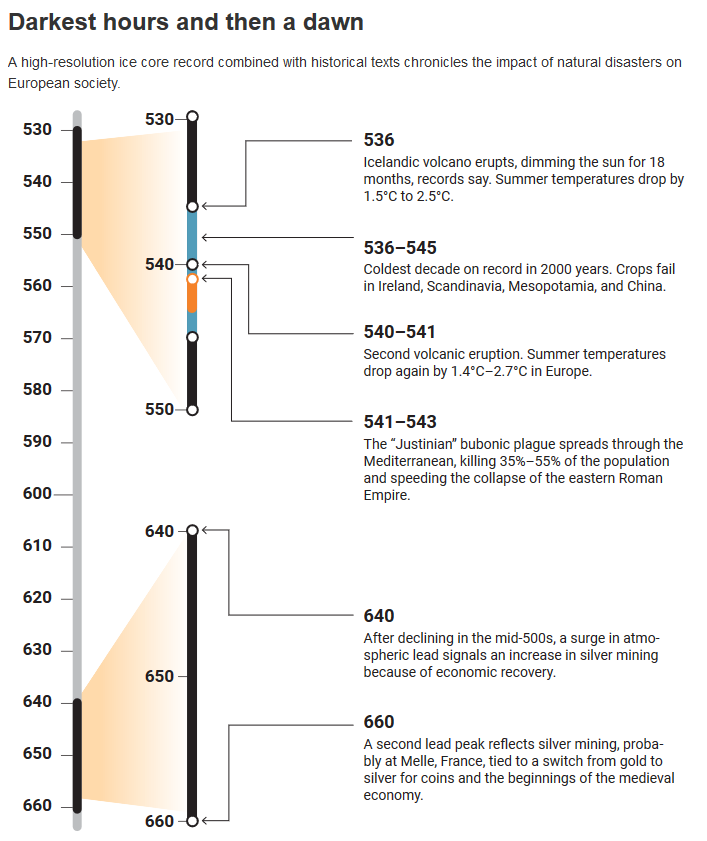
A mysterious fog plunged Europe, the Middle East, and parts of Asia into darkness, day and night — for 18 months. “For the sun gave forth its light without brightness, like the moon, during the whole year,” wrote Byzantine historian Procopius. Temperatures in the summer of 536 fell 1.5°C to 2.5°C, initiating the coldest decade in the past 2300 years. Snow fell that summer in China; crops failed; people starved. The Irish chronicles record “a failure of bread from the years 536–539.” Then, in 541, bubonic plague struck the Roman port of Pelusium, in Egypt. What came to be called the Plague of Justinian spread rapidly, wiping out one-third to one-half of the population of the eastern Roman Empire and hastening its collapse, McCormick says.
Historians have long known that the middle of the sixth century was a dark hour in what used to be called the Dark Ages, but the source of the mysterious clouds has long been a puzzle. Now, an ultraprecise analysis of ice from a Swiss glacier by a team led by McCormick and glaciologist Paul Mayewski at the Climate Change Institute of The University of Maine (UM) in Orono has fingered a culprit. At a workshop at Harvard this week, the team reported that a cataclysmic volcanic eruption in Iceland spewed ash across the Northern Hemisphere early in 536. Two other massive eruptions followed, in 540 and 547. The repeated blows, followed by plague, plunged Europe into economic stagnation that lasted until 640, when another signal in the ice — a spike in airborne lead — marks a resurgence of silver mining, as the team reports in Antiquity this week.
H/T to Blazing Cat Fur for the link.
Comments Off on New research shows 536AD to have been the true annus horribilis
November 2, 2018
Austria-Hungary Disintegrates – The Ottoman Empire Leaves the War I THE GREAT WAR Week 223
The Great War
Published on 1 Nov 2018The Ottoman Empire has been on the retreat in the Middle East since the renewed British offensive in September and now, as the allies are threatening the Turkish heartland and also Constantinople, the Ottoman Empire calls for an armistice. The Armistice of Mudros is signed as the remaining Central Powers also struggle to keep their Empires together.
Comments Off on Austria-Hungary Disintegrates – The Ottoman Empire Leaves the War I THE GREAT WAR Week 223
October 25, 2018
QotD: The unique situation of Israel
In 1948, one internationally recognized sovereign state (Israel) was invaded by the armies of various neighboring sovereign states (Jordan, Egypt, Syria, Iraq, Lebanon). At the end of that war, much of the former British Mandate of Palestine was in Israeli hands, but the West Bank wound up with Jordan and the Gaza Strip with Egypt. Over the next two decades, nobody referred to Egypt’s or Jordan’s exercise of its sovereignty in those lands under loaded terms such as “settlement”.
In 1967, the Arabs tried again to wipe out Israel, and again failed. And this time their defeat was even more total: Egypt lost the Gaza Strip (and the Sinai) and Jordan lost the West Bank. That was half-a-century ago. One of the most basic laws of war is: to the victor the spoils. If you launch a war and you lose, then the guy who took your territory is the one who determines its future. Instead, the “international community” decided to intervene in the matter in a way it has in no other supposed boundary dispute.
Thus began the “Palestiniazation” of the problem. Uniquely in such matters, the victorious sovereign state is forbidden from returning the spoils of war to the defeated sovereign states – Jordan and Egypt. Instead, it can only treat with the designated representatives of “Palestine”, who … have no interest in nation-building, or capacity for it, only in Jew-killing.
To repeat: the “international community”‘s treatment of this issue is like no other boundary dispute of the last 200 years. Maybe that’s because this situation is unique to one small patch of land in the Middle East. Or maybe it’s because the “international community” really really doesn’t like Jews.
I say that Israel (independent since 1948), Jordan (1946) and Egypt (1922) are all sovereign states entitled to act in their own interests, and live with the consequences – especially after two or three generations.
Mark Steyn, “License to Dye”, Steyn Online, 2016-12-30.
Comments Off on QotD: The unique situation of Israel
October 3, 2018
The Uzi Submachine Gun: Excellent or Overrated?
Forgotten Weapons
Published on 5 Mar 2018The Israeli Uzi has become a truly iconic submachine gun through both its military use and its Hollywood stunts – but how effective is it really?
I found this fully automatic Uzi Model A to be actually rather better than I had expected. Despite the uncomfortable sharp metal stock, the rate of fire and large sights make this a relatively easy gun to shoot. Not one of the absolute best, but certainly above average.
http://www.patreon.com/ForgottenWeapons
If you enjoy Forgotten Weapons, check out its sister channel, InRangeTV! http://www.youtube.com/InRangeTVShow
Comments Off on The Uzi Submachine Gun: Excellent or Overrated?
October 2, 2018
Stories From The Palestine Front – More About WW1 Trucks I OUT OF THE ETHER
The Great War
Published on 1 Oct 2018In this episode of Out of the Ether, we read a few excellent comments about WW1 Trucks and the Palestine Front.
Comments Off on Stories From The Palestine Front – More About WW1 Trucks I OUT OF THE ETHER
October 1, 2018
Britain’s Labour Party under Jeremy Corbyn has become a “force for antisemitism”
Hugh Fitzgerald on the British Labour Party’s slide into open anti-semitic actions under Jeremy Corbyn:

Jeremy Corbyn, Leader of the Labour Party speaking at a Rally in Hayfield, Peak District, UK on 25th July 2018 in support of Ruth George MP.
Photo by Sophie Brown via Wikimedia Commons.
In Great Britain, Jeremy Corbyn and his willing collaborators in the Labour Party continue their ferocious attacks on anyone in the party who still supports Israel. In the first week of September, a vote of no-confidence against Joan Ryan, the head of Labour Friends of Israel, passed 94-92 among local party members. Frank Field, another long-serving MP and prominent supporter of Israel, resigned as whip to protest the Labour Party becoming a “force for antisemitism” and for allowing a “culture of nastiness, bullying and intimidation” to develop; he was informed that as result he was no longer a member of the Party.
As is well known, Jeremy Corbyn intensely dislikes Israel. He refers to members of Hamas and Hezbollah, on the other hand, as “friends.” They feel the same about him. In a Twitter post, Hamas wrote: “We salute Jeremy Corbyn’s supportive positions to the Palestinians.”
When first accused of having honored dead terrorists at a graveside ceremony in Tunisia in October 2014, Corbyn denied that he had been anywhere near the graves of any terrorists, and he certainly had “no memory” of any wreath laying. Then some photographs surfaced. One of them shows Corbyn holding — with others — a large wreath. And the grave they are standing over turns out to have been that of one of those who planned the murder of the Israeli athletes at the Munich Olympics in 1972.
Another photo of Jeremy Corbyn shows him posing in the same graveyard next to a convicted terrorist, Fatima Bernawi, who was given a life sentence for trying to blow up a Israeli cinema in 1967. While the attempted terror attack did not come off, Bernawi boasted that it was successful because it “generated fear.” Bernawi was later freed in a prisoner swap, and was thus able to attend the same terrorist-honoring graveside ceremony as Jeremy Corbyn.
Asked to explain what he was doing next to a convicted terrorist, Mr Corbyn’s spokesman said: “Jeremy has a long and principled record of solidarity with the Palestinian people and engaging with actors in the conflict to support peace and justice in the Middle East.”
Comments Off on Britain’s Labour Party under Jeremy Corbyn has become a “force for antisemitism”
September 28, 2018
The Meuse-Argonne Offensive – Bulgarian Collapse I THE GREAT WAR Week 218
The Great War
Published on 27 Sep 2018This week, the biggest American military operation in history kicks off with 1.2 million American soldiers trying to take the Krimhilde Stellung. At the same time the Army of the Orient advances into Bulgaria and the Ottoman 7th and 8th armies collapse in Palestine.
Comments Off on The Meuse-Argonne Offensive – Bulgarian Collapse I THE GREAT WAR Week 218
September 21, 2018
Allied Breakthroughs In Palestine And Macedonia I THE GREAT WAR Week 217
The Great War
Published on 20 Sep 2018In a turbulent week of the First World War, the Allies break through at the Macedonian Front during the Battle of Vadar and in Palestine during the Battle for Palestine. At the same time, the Ottoman defeats the last defenders of Baku.
Comments Off on Allied Breakthroughs In Palestine And Macedonia I THE GREAT WAR Week 217
September 19, 2018
The Byzantine Empire should really be called the “Medieval Roman Empire”
Sean Gabb makes the case for the least well-known part of the Roman world that outlasted the western empire by a thousand years:
Properly considered, the history of what I will from now call not the Byzantine Empire, but the Mediaeval Roman Empire, is perhaps the most astonishing instance of how courage and determination can keep civilisation alive in the face of the most forbidding and apparently overpowering challenges. In setting out my argument, I hope you will forgive me if I begin with an introduction covering much that many of your will know at least as well as I do, but that may not be so familiar to those reading the text or watching the speech on YouTube.
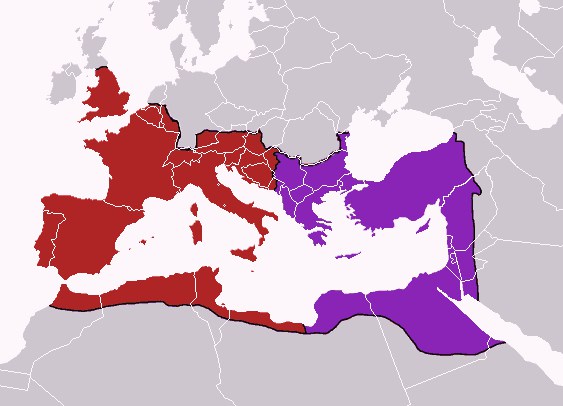
If you look at the first of the maps that I have put on your tables, you will see the Roman Empire as it was in the year 395 AD. This shows the Empire at something close it its greatest extent. The conquests that Trajan made to the north of the Danube and east of the Euphrates have been given up. But it includes the whole of the Mediterranean World and its various hinterlands – an area stretching from the North of England to Upper Egypt, from Casablanca to Trebizond. In that year, however, nearly a century of political experiments is formally ended with the division of the Empire into two administrative zones. There is the Western or the red Empire, ruled by an Emperor in Rome or Milan or Ravenna. There is the Eastern or the purple Empire, ruled by an Emperor in Constantinople.
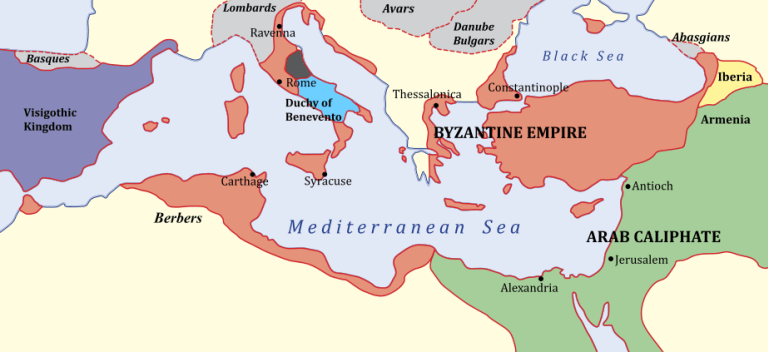
If you look at the second map, dated roughly 650 AD, you will see that the Western Empire has disappeared. Excepting North Africa and parts of Italy, now ruled from Constantinople, the whole of the Western Empire has disappeared – replaced by a set of barbarian kingdoms from which modern Europe takes its origin. The Eastern Empire itself has lost both Syria and Egypt to the Arabs.
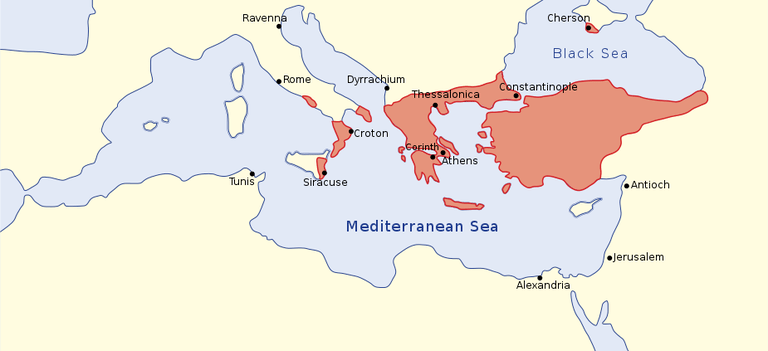
If you look at the third map, dated roughly 867 AD, you will see that the Empire has suffered the further loss of Cyprus and North Africa and most of Sicily. Nevertheless, what we have in that year should undeniably be called the Mediaeval Roman Empire. It has weathered the storm of the Early Middle Ages. It is the richest and most powerful state in the Mediterranean World. Indeed, during the next few centuries, it will expand. It has already reconquered Greece. It will conquer the Bulgarian Kingdom and re-establish its ancient frontier on the Danube. It will even retake Antioch and make Egypt for a while its economic and diplomatic client.
After 1071, the Empire falls on evil days. In that year, the Turks deprive it of its Anatolian heartland. But this loss is stabilised and in part reversed by a skilful handling of the Crusades. There is another disaster in 1204, when the Venetians take and plunder Constantinople. But this is not the end. The Empire is restored in large parts in 1261; and, even if as little more than a city-state based around Constantinople, it continues to the final Turkish conquest of 1453. Indeed, the formal extinction of the Empire comes nearly a decade after 1453, with the annexation of its last territories in Southern Greece.
There was a time when school textbooks in England dated the fall of the Roman Empire to 476 AD. Its continued survival for a thousand years after then had to be explained, where admitted, by taking a contemptuous view of what was called the Byzantine Empire. See, for example, W.E.H. Lecky:
Of that Byzantine empire, the universal verdict of history is that it constitutes, without a single exception, the most thoroughly base and despicable form that civilization has yet assumed. There has been no other enduring civilization so absolutely destitute of all forms and elements of greatness, and none to which the epithet “mean” may be so emphatically applied… The history of the empire is a monotonous story of the intrigues of priests, eunuchs, and women, of poisonings, of conspiracies, of uniform ingratitude.
Lecky is one of my favourite historians. But, if you look even at the mediaeval Greek and Italian historians of the Empire, you will see that this is a bizarre judgement. Undoubtedly, these historians tended to focus on intrigues in and about the Imperial Palace. But they also record much else. They record the story of a rich and powerful empire, directed with high military and diplomatic ability – an empire in which slavery and the death penalty have been almost abolished, where people lived, and knew that they lived, under a set of divinely-ordained laws that protected life, liberty and property to a degree unknown in any other mediaeval state.
Comments Off on The Byzantine Empire should really be called the “Medieval Roman Empire”
September 16, 2018
Early Arab Conquests | 3 Minute History
Jabzy
Published on 13 Dec 2015Covering the conquests during the Rashidun Caliphate. I will probably do a separate video on the First Fitna.
Thanks for the 15,000 subs. And thanks to Xios, Alan Haskayne, Lachlan Lindenmayer, Derpvic, Seth Reeves and all my other Patrons. If you want to help out – https://www.patreon.com/Jabzy?ty=h
Comments Off on Early Arab Conquests | 3 Minute History
August 25, 2018
Mediterranean trade in the Iron Age
Jan Bakker, Stephan Maurer, Jörn-Steffen Pischke, and Ferdinand Rauch look at the relationships between trade and economic growth around the Mediterranean during the Iron Age:
Economists often point out the benefits of trade, yet empirical evidence for these benefits has been hard to come by and tends to be recent. This column goes back to the first millennium BC to analyse the growth effects of one of the first major trade expansions in human history: the systematic crossing of the open sea in the Mediterranean by the Phoenicians. A strong positive relationship between connectedness and archaeological sites suggests a large role for geography and trade in development even at such an early juncture in history.
The effects of free trade inspire a lot of public debate these days, and policies to restrict trade are gaining in prominence. Economists since Adam Smith and David Ricardo have typically pointed out the benefits of trade. Yet empirical evidence for these benefits has been much harder to come by and is much more recent. In particular, empirical economists have tried to demonstrate that more open economies or more integrated markets see faster growth. The relationship between these two variables is not much disputed; the more difficult question is whether this is due to trade causing growth or richer economies being more open.
[…]
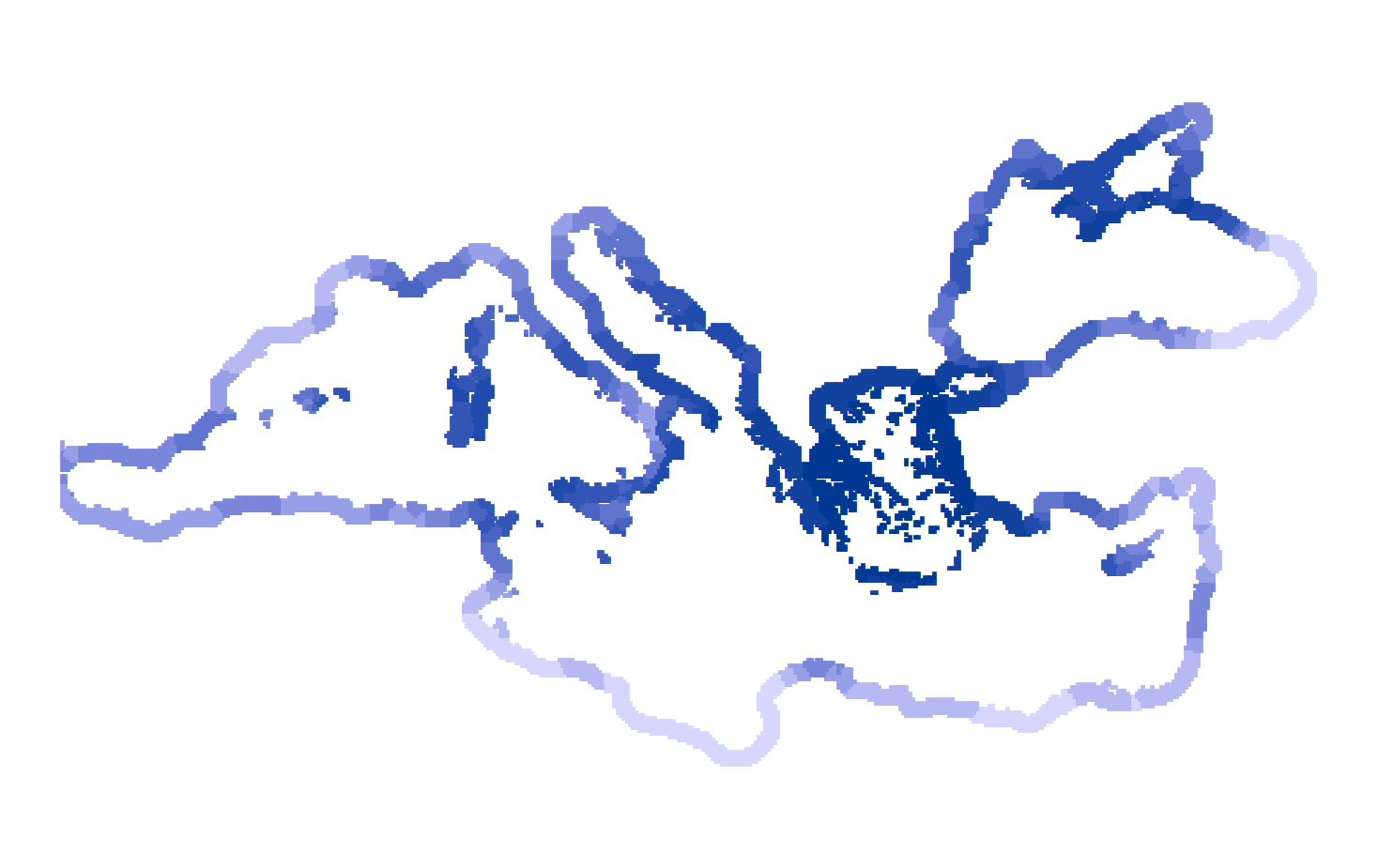
To analyse whether this increased trade also caused growth, we exploit the fact that open sea sailing creates different levels of connectedness for different points on the coast. The shape of the coast and the location of islands determineshow easy it is to reach other points, which might be potential trading partners, within a certain distance. We create such a measure of connectedness for travel via sea. Figure 1 shows the values of this measure on a map and demonstrates how some regions, for example the Aegean but also southern Italy and Sicily, are much better connected than others.
We use this measure of connectedness as a proxy for trading opportunities.
Figure 1 Log connectedness at 500km distance
Note: Darker blue indicates better connected locations.
Measuring growth for an early period of human history is more difficult as we have no standard measure of income, GDP, or even population. We quantify growth by the presence of archaeologic sites for settlements or urbanisations. While this is clearly not a perfect measure, more sites should imply more human presence and activity. We then relate the number of active archaeological sites in a particular period to our measure of connectedness.
We find a large positive relationship between connectedness and archaeological sites. The effect of connections on growth in the Iron Age Mediterranean are up to twice as large as the effects Donaldson and Hornbeck (2016) found for US railroads. Although these results are unlikely to be directly comparable, the magnitudes suggest a large role for geography and trade in development even at such an early juncture in history.
Comments Off on Mediterranean trade in the Iron Age
August 17, 2018
Assassination attempt on Lenin – German morale plummets I THE GREAT WAR Week 212
The Great War
Published on 16 Aug 2018As the Battle of Amiens is coming to an end, the Germans are desperately trying to stem the Allied advance and fortify new positions. But morale is crumbling and German High Command is running out of time to find a new strategy. Meanwhile in Russia, the struggle between Bolsheviks and Social Revolutionaries reaches a violent climax, as assassins prey on Lenin’s life. The Dunsterforce finally arrives in Baku to help defend the city from the Ottoman advance. But this is not the mighty British force the inhabitants had hoped for. Will Lenin survive? Does Ludendorff choose to abandon all the gains the German army made over the spring? And what about the attack on the Wookies? Find out this and more in the new episode of The Great War.
Comments Off on Assassination attempt on Lenin – German morale plummets I THE GREAT WAR Week 212
August 16, 2018
Three Great British Wartime Deceptions
Lindybeige
Published on 15 Aug 2018http://www.audible.com/Lindybeige or text ‘Lindybeige’ to 500 500 for a free thirty-day trial and one free audio book.
Support me on Patreon: https://www.patreon.com/LindybeigeTales of Gallipoli and the Dardanelles in World War One, El Alamein in WW2, and of the extraordinarily successful failure that was Operation Camilla in East Africa. One man with terrific hair rambles for over half an hour about ruses of deceit against the enemies of the Empire.
Lindybeige: a channel of archaeology, ancient and medieval warfare, rants, swing dance, travelogues, evolution, and whatever else occurs to me to make.
▼ Follow me…
Twitter: https://twitter.com/Lindybeige I may have some drivel to contribute to the Twittersphere, plus you get notice of uploads.
Facebook: https://www.facebook.com/Lindybeige (it’s a ‘page’ and now seems to be working).
website: http://www.LloydianAspects.co.uk
Comments Off on Three Great British Wartime Deceptions
August 11, 2018
Post-coup Turkey – every move has served to increase Erdoğan’s hold on power
Austin Bay‘s recent essay for Strategika on the post-coup Turkish political situation and its NATO membership:
Ataturk bequeathed Turkey what his greatest biographer, Andrew Mango, called “the structure of a democracy, not of a dictatorship.” He authored an orientation, not an ideology, creating a political, social, and cultural process that he believed would eventually make Turkey capable of perpetual self‐modernization. Ataturk was a political giant and a superb military commander. Eighty years after his death he remains a cult historical and political figure.
President Erdogan is a canny politician and, to be fair, Turkey’s most significant political figure since Ataturk. The green-eyed monster feeds his inner fire; Recep knows he disappears in Kemal’s giant shadow. Not capable of displacing Ataturk the man, he has chosen to replace Ataturk’s state, first under the guise of extending democracy, now behind the façade of maintaining stability. Erdogan also intends to remain in office over twice as long as Ataturk. Turkey 2034 will be an Erdoganist political construct, not Kemalist.
That last paragraph sketches a novelistic interpretation of Erdoğan’s motives. It expands on the answer I gave at Hoover’s October 2017 Military History and Contemporary Conflict symposium after Barry Strauss asked me what I thought drove Erdoğan — the deep drive that might shed light on his long-term vision for Turkey and help us craft policy responses to his challenge.
Novelistic speculations have numerous weaknesses. However, over the decades Erdoğan has supplied plot points and psychologically-indicative dialog. We are able to assess action through time. Early in his career Erdoğan routinely employed Islamist poetry: “Democracy is merely a train that we ride until we reach our destination. Mosques are our military barracks. Minarets are our spears.” That poetry led to his arrest for sedition. After his release he renounced his piously seditious poetry, claiming his fundamentalist views had fundamentally altered. His sudden commitment to Turkish democracy energized his “moderate Islamist” Justice and Development Party’s (AKP) 2002 victory over a tired and corrupted Republican Peoples Party (CHP). In 2003 the AKP became Turkey’s governing party with Erdoğan serving as prime minister.
First he tested Kemal’s structure, then he began to dismantle it. Erdoğan purged the military of suspected political opponents. A cunning narrative camouflaged his operation. He claimed European Union accession rules demanded he strip the military of its political powers and make certain Kemalist military coups entered history’s dustbin. Sometime in 2008, as Erdoğan began pursuing the Ergenekon conspiracy of “secular fundamentalists” and other secret nationalist vigilante organizations, I finally realized whatever explanation du jour Erdoğan offered for his actions, the dismantling scheme always expanded his personal power and influence.
The bizarre July 2016 coup follows the same pattern. The Turkish people defeated the coup. Ironically, Erdoğan remains in office today because Turkish citizens (across Turkey’s complex political and ethnic spectrum) courageously defended their hard-won democracy — a democracy nine challenging decades in the making. In its aftermath, however, Erdogan used emergency powers to purge Gulenist Islamists and his political opponents. He dismantled elements of the democratic system that saved him and his government.
Comments Off on Post-coup Turkey – every move has served to increase Erdoğan’s hold on power


