
It was my business for a long time to tell people that approached the bandstand that their favorite song was of absolutely no interest to everyone else in the room, and we weren’t going to play it. It’s a delicate thing to tell people that the song that contains both the name of their illegitimate children and their pit bulls, and whose album cover is featured on both a tattoo on their chest and painted on the side of their van, isn’t very entertaining. Such information upsets people, like going to the monkey house at the zoo and throwing your poo at the apes. Those monkeys stop in their tracks and stare at you, I’m telling you.
Don’t ask me how I know that.
Sippican Cottage, “Well, I Put The Quarter Right In That Can, But All They Played Was Disco, Man”, Sippican Cottage, 2013-05-06
April 20, 2014
QotD: Musical tastes
April 19, 2014
Mammary mummery
Everyone knows that only poor, lower-class men prefer women with larger breasts, right? There are even “scientific” studies that “prove” it. Michael Siegel is not convinced:
Sigh. It seems I am condemned to writing endlessly about mammary glands. I don’t have an objection to the subject but I do wish someone else would approach these “studies” with any degree of skepticism.
This is yet another iteration of the breast size study I lambasted last year and it runs into the same problems: the use of CG figures instead of real women, the underlying inbuilt assumptions and, most importantly, ignoring the role that social convention plays in this kind of analysis. To put it simply: men may feel a social pressure to choose less busty CG images, a point I’ll get to in a moment. I don’t see that this study sheds any new light on the subject. Men of low socioeconomic status might still feel less pressure to conform to social expectations, something this study does not seem to address at all. Like most studies of human sexuality, it makes the fundamental mistake of assuming that what people say is necessary reflective of what they think or do and not what is expected of them.
The authors think that men’s preference for bustier women when they are hungry supports their thesis that the breast fetish is connected to feeding young (even though is zero evidence that large breasts nurse better than small ones). I actually think their result has no bearing on their assumption. Why would hungrier men want fatter women? Because they want to eat them? To nurse off them? I can think of good reasons why hungry men would feel less bound by social convention, invest a little less thought in a silly social experiment and just press the button for the biggest boobs. I think that hungry men are more likely to give you an honest opinion and not care that preferring the bustier woman is frowned upon. Hunger is known to significantly alter people’s behavior in many subtle ways but these authors narrow it to one dimension, a dimension that may not even exist.
And why not run a parallel test on women? If bigger breasts somehow provoke a primal hunger response, might that preference be built into anyone who nursed in the first few years of life?
No, this is another garbage study that amounts to saying that “low-class” men like big boobs while “high-class” men are more immune to the lure of the decolletage and so … something. I don’t find that to be useful or insightful or meaningful. I find that it simply reinforces an existing preconception.
There is a cultural bias in some of the upper echelons of society against large breasts and men’s attraction to them. That may sound crazy in a society that made Pamela Anderson a star. But large breasts and the breast fetish are often seen, by elites, as a “low class” thing. Busty women in high-end professions sometimes have problems being taken seriously. Many busty women, including my wife, wear minimizer bras so they’ll be taken more seriously (or look less matronly). I’ve noticed that in the teen shows my daughter sometimes watches, girls with curves are either ditzy or femme fatales. In adult comedies, busty women are frequently portrayed as ditzy airheads. Men who are attracted to buxom women are often depicted as low-class, unintelligent and uneducated. Think Al Bundy.
Transaction costs, takedown notices, and the DMCA
Mike Masnick reports on an inadvertent natural experiment that just came to light:
We’ve written a few times in the past about research done by Paul Heald on copyright and its impact on the availability of certain content. He’s recently published an interesting new study on how the DMCA’s notice-and-takedown regime facilitates making content available by decreasing transaction costs among parties. As we’ve discussed at length, the entertainment industry’s main focus in the next round of copyright reform is to wipe out the notice-and-takedown provisions of the DMCA. The legacy recording and movie industries want everyone else to act as copyright cops, and hate the idea that notice-and-takedown puts the initial burden on themselves as copyright holders.
However, Heald’s research looks at music on YouTube and concludes that the notice-and-takedown system has actually enabled much greater authorized availability of music, by reducing transaction costs. The idea is pretty straightforward. Without a notice-and-takedown provision, someone who wants to post music to YouTube needs to go out and seek a license. Of course, getting permission from all the various rightsholders is frequently impossible. The transaction costs of getting permission make it such that it’s way too high. Yet, with notice-and-takedown, the person can upload the content without permission, and then the copyright holder is given the option of what to do with it. On YouTube, that includes the option of monetizing it, thus “authorizing” the use. That creates a natural experiment for Heald to explore, in which he can see how much content is “authorized” thanks to such a setup. And the result, not surprisingly, is that this system has enabled much greater authorized (and monetized) access to music than an alternative, high transaction cost system, under which uploaders must first seek out permission to upload everything.
April 18, 2014
QotD: Opera
Opera, to a person genuinely fond of aural beauty, must inevitably appear tawdry and obnoxious, if only because it presents aural beauty in a frame of purely visual gaudiness, with overtones of the grossest sexual provocation. The most successful opera singers of the female sex, at least in America, are not those whom the majority of auditors admire most as singers but those whom the majority of male spectators desire most as mistresses. Opera is chiefly supported in all countries by the same sort of wealthy sensualists who also support musical comedy. One finds in the directors’ room the traditional stock company of the stage-door alley. Such vermin, of course, pose in the newspapers as devout and almost fanatical partisans of art; they exhibit themselves at every performance; one hears of their grand doings, through their press agents, almost every day. But one has merely to observe the sort of opera they think is good to get the measure of their actual artistic discrimination.
The genuine music-lover may accept the carnal husk of opera to get at the kernel of actual music within, but that is no sign that he approves the carnal husk or enjoys gnawing through it. Most musicians, indeed, prefer to hear operatic music outside the opera house; that is why one so often hears such things as “The Ride of the Valkyrie” in the concert hall. “The Ride of the Valkyrie” has a certain intrinsic value as pure music; played by a competent orchestra it may give civilized pleasure. But as it is commonly performed in an opera house, with a posse of flat beldames throwing themselves about the stage, it can only produce the effect of a dose of ipecacuanha. The sort of person who actually delights in such spectacles is the sort of person who delights in plush furniture. Such half-wits are in a majority in every opera house west of the Rhine. They go to the opera, not to hear music, not even to hear bad music, but merely to see a more or less obscene circus. A few, perhaps, have a further purpose; they desire to assist in that circus, to show themselves in the capacity of fashionables, to enchant the yokelry with their splendor. But the majority must be content with the more lowly aim. What they get for the outrageous prices they pay for seats is a chance to feast their eyes upon glittering members of the superior demi-monde, and to abase their groveling souls before magnificoes on their own side of the footlights. They esteem a performance, not in proportion as true music is on tap, but in proportion as the display of notorious characters on the stage is copious, and the exhibition of wealth in the boxes is lavish.
H.L. Mencken, “The Allied Arts: Opera”, Prejudices: Second Series, 1920.
April 17, 2014
QotD: User interface design for all ages
As your body staggers down the winding road to death, user interfaces that require fighter pilot-grade eyesight, the dexterity of a neurosurgeon, and the mental agility of Derren Brown, are going to screw with you at some point.
Don’t kid yourself otherwise — disability, in one form or another, can strike at any moment.
Given that people are proving ever harder to kill off, you can expect to have decades of life ahead of you — during which you’ll be battling to figure out where on the touchscreen that trendy transdimensional two-pixel wide “OK” button is hiding.
Can you believe, people born today will spend their entire lives having to cope with this crap? The only way I can explain the web design of many Google products today is that some wannabe Picasso stole Larry Page’s girl when they were all 13, and is only now exacting his revenge. Nobody makes things that bad by accident, surely?
Dominic Connor, “Is tech the preserve of the young able-bodied? Let’s talk over a fine dinner and claret”, The Register, 2014-04-17
April 16, 2014
Thought experiment – in media reports, replace “scientist” with “some guy”
Frank Fleming makes an interesting point:
Our society holds scientists in high esteem. When scientists say something — whether it’s about the composition of matter, the beginning of the universe, or who would win a fight between a giant gorilla and a T. Rex — we all sit up and listen. And it doesn’t matter if they say something that sounds completely ridiculous; as long as a statement is preceded with “scientists say,” we assume it is truth.
There’s just one problem with that: There are no such things as scientists.
Okay, you’re probably saying, “What? Scientists are real! I’ve seen them before! There’s even a famous, blurry photo of a man in a lab coat walking through the woods.” Well, yes, there are people known as scientists and who call themselves such, but the word is pretty much meaningless.
[…]
Which brings us back to our problem. So much of science these days seems to be built on faith — faith being something that doesn’t have anything to do with science. Yet everyone apparently has faith that all these scientists we hear about follow good methods and are smart and logical and unbiased — when we can’t actually know any of that. So often news articles contain phrases such as, “scientists say,” “scientists have proven,” “scientists agree” — and people treat those phrases like they mean something by themselves, when they don’t mean anything at all. It’s like if you wanted music for your wedding, and someone came up to you and said, “I know a guy. He’s a musician.”
“What instrument does he play?”
“He’s a musician.”
“Is he any good?”
“He’s a musician.”
You see, when other occupations are vaguely described, we know to ask questions, but because we have blind faith in science, such reason is lost when we hear the term “scientist.” Which is why I’m arguing that for the sake of better scientific understanding, we should get rid of the word and simply replace it with “some guy.”
It’s not exactly a new phenomenon: Robert Heinlein put these words in the mouth of Lazarus Long, “Most ‘scientists’ are bottle washers and button sorters.” It was true then, and if anything it’s even more true now as we have so many more people working in scientific fields.
Handel’s Messiah – the Live Aid of 1750
In the Telegraph, Michael White explains why Handel’s Messiah really was the 18th century equivalent of Live Aid:
Every year, his masterpiece reliably comes round, filling musicians’ diaries with unending renditions of the Hallelujah Chorus and “Surely he hath borne our griefs” (or “worn our briefs” as choirboys have it), like a tonic for the flagging bank balance. And it will be the same this week, with a performance of some kind or other guaranteed to come your way, unless you’re living in the Outer Hebrides without a choir in sight or sound.
But for good measure, there’s also a BBC TV programme on Saturday in which the historian Amanda Vickery is looking at Messiah’s back story. And it seems her interest isn’t in the piece as a gift to musicians but as a gift to the poor — focusing on a London performance in 1750 that was, as she says, an 18th-century precedent for Live Aid.
This performance took place at the Foundling Hospital in London, which these days is a museum but was then a children’s home attracting the support of celebrated figures in the arts world. Painters including Hogarth gave it canvases to exhibit; composers such as Handel gave it music to perform. And the funds raised helped keep it going — in something like the manner of that other famous children’s home, the Ospedale della Pietà, Venice, where Vivaldi gave his services.
[…]
The only problem was that Handel depended for commercial success on operatic ventures that proved disastrously expensive and went sour when public tastes changed (as they always do). Hence his interest in writing English oratorios: they were cheaper to produce than opera, avoided over-priced Italian singers and attracted decent audiences.
Hence Messiah, which was written not for London but for Dublin, where it was premiered in April 1742. A large crowd was clearly expected because notices published in advance begged gentlemen to leave their swords at home and ladies to attend “without Hoops”. The critical information on those notices, though, was that making room for more people would “greatly increase the Charity”; because even this initial Dublin try-out was a fundraiser, designed for the relief of prisoners and an infirmary.
So it was good causes that helped swell the turnout. And from what we know of how it went, the audience was high-minded, entering into the spirit of an entertainment that was happening in a concert hall but none the less used sacred texts.
Jonathan Swift, the Dean of Dublin’s Anglican Cathedral, had initially tried to stop his choir being involved, on the grounds that a concert hall wasn’t the right place for such things, and that one of the soloists, Susannah Cibber, was a woman of loose morals. But when she sang “He was despised” she did so with such beauty that another clergyman in the audience stood up and shouted “Woman, thy sins be forgiven”: the kind of engagement you might wish of modern audiences, if only they could be distracted from their iPhones.
April 13, 2014
Ephemeral apps and the NSA
Bruce Schneier on the rising popularity of apps that only leave your content visible briefly and then automatically removes it:
Ephemeral messaging apps such as Snapchat, Wickr and Frankly, all of which advertise that your photo, message or update will only be accessible for a short period, are on the rise. Snapchat and Frankly, for example, claim they permanently delete messages, photos and videos after 10 seconds. After that, there’s no record.
This notion is especially popular with young people, and these apps are an antidote to sites such as Facebook where everything you post lasts forever unless you take it down—and taking it down is no guarantee that it isn’t still available.
These ephemeral apps are the first concerted push against the permanence of Internet conversation. We started losing ephemeral conversation when computers began to mediate our communications. Computers naturally produce conversation records, and that data was often saved and archived.
[…]
At best, the data is recorded, used, saved and then deliberately deleted. At worst, the ephemeral nature is faked. While the apps make the posts, texts or messages unavailable to users quickly, they probably don’t erase them off their systems immediately. They certainly don’t erase them from their backup tapes, if they end up there.
The companies offering these apps might very well analyze their content and make that information available to advertisers. We don’t know how much metadata is saved. In SnapChat, users can see the metadata even though they can’t see the content and what it’s used for. And if the government demanded copies of those conversations — either through a secret NSA demand or a more normal legal process involving an employer or school — the companies would have no choice but to hand them over.
Even worse, if the FBI or NSA demanded that American companies secretly store those conversations and not tell their users, breaking their promise of deletion, the companies would have no choice but to comply.
That last bit isn’t just paranoia.
Reason.tv – Glenn Reynolds on the Future of Higher Education
Published on 10 Apr 2014
“It’s kind of a weird thing that’s happened with American society — this idea that you have to have a college degree to be a respectable member of the middle class,” says Glenn Reynolds, professor of law at the University of Tennessee and purveyor of the popular Instapundit blog. Reynolds’ latest work, The New School: How the Information Age Will Save American Education From Itself, looks at the higher education bubble and how parents, students, and educators can remake the education system.
Reynolds sat down with Reason TV‘s Alexis Garcia to discuss why Americans are spending more for a college education and how students are responding to increasing tuition costs. “Given how expensive it is to go to college, there has to be a return sufficient to make it worth the time and especially the money,” Reynolds states. “You’re seeing declining enrollment in some schools and you’re seeing much more price resistance on the part of both parents and students.”
The discussion also includes Reynolds’ take on school choice, the upcoming elections, the current state of the blogosphere, and whether or not both political parties are necessary. Nearly a decade after Reynolds published An Army of Davids: How Markets and Technology Empower Ordinary People to Beat Big Media, Big Government, and Other Goliaths, the blogfather still remains optimistic about technology’s ability to empower the individual and inspire grassroots movements.
April 11, 2014
Dungeons and Dragons versus BADD
BBC News Magazine looks back at the moral panic about Dungeons & Dragons in the early 1980s:
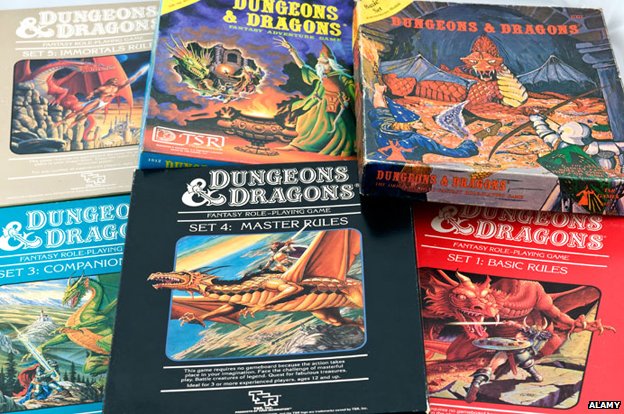
In 1982, high school student Irving Lee Pulling died after shooting himself in the chest. Despite an article in the Washington Post at the time commenting “how [Pulling] had trouble ‘fitting in'”, mother Patricia Pulling believed her son’s suicide was caused by him playing D&D.
Again, it was clear that more complex psychological factors were at play. Victoria Rockecharlie, a classmate of Irving Pulling, commented that “he had a lot of problems anyway that weren’t associated with the game”.
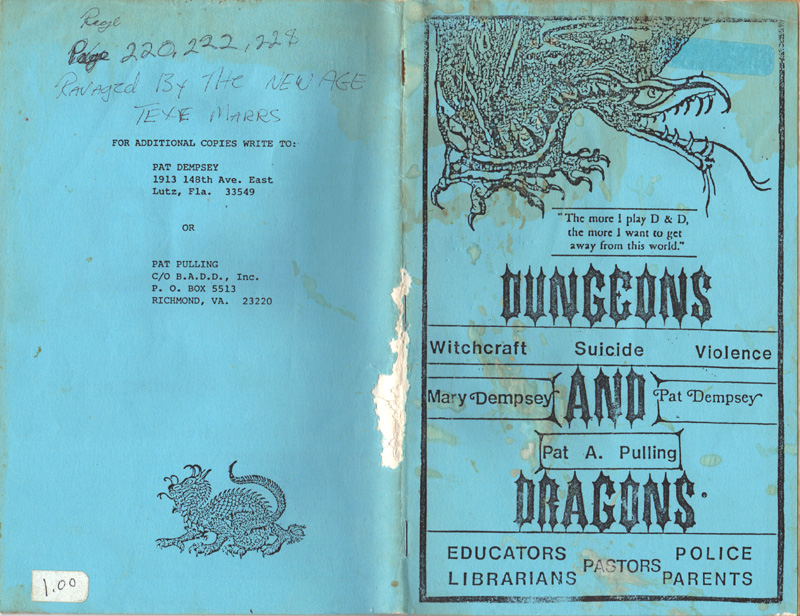
At first, Patricia Pulling attempted to sue her son’s high school principal, claiming the curse placed upon her son’s character during a game run by the principal was real. She also sued TSR Inc, the publishers of D&D. Despite the court dismissing these cases, Pulling continued her campaign by forming Bothered About Dungeons and Dragons (BADD) in 1983.
Pulling described D&D as “a fantasy role-playing game which uses demonology, witchcraft, voodoo, murder, rape, blasphemy, suicide, assassination, insanity, sex perversion, homosexuality, prostitution, satanic type rituals, gambling, barbarism, cannibalism, sadism, desecration, demon summoning, necromantics, divination and other teachings”.
Pulling’s pamphlet on the dangers of D&D:
In 1985, Jon Quigley, of the Lakeview Full Gospel Fellowship, spoke for many opponents when he claimed: “The game is an occult tool that opens up young people to influence or possession by demons.”
These fears also found their way into the UK. Fantasy author KT Davies recalls “showing a vicar a gaming figure – he likened D&D to demon worship because there were ‘gods’ in the game”.
Veteran roleplayer Andy Smith found himself in the unusual position of being both a roleplayer and a Christian. “While working for a Christian organisation I was told to remove my roleplaying books from the shared accommodation as they were offensive to some of the other workers and contained references to demon-worship.”
Looking back now, it’s possible to see the tendrils of a classic moral panic, and some elements of the slightly esoteric world of roleplaying did stir the imaginations of panicked outsiders.
April 10, 2014
QotD: Confirmation bias for thee but not for me
The last few days have provided both a good laugh and some food for thought on the important question of confirmation bias — people’s tendency to favor information that confirms their pre-existing views and ignore information that contradicts those views. It’s a subject well worth some reflection.
The laugh came from a familiar source. Without (it seems) a hint of irony, Paul Krugman argued on Monday that everyone is subject to confirmation bias except for people who agree with him. He was responding to this essay Ezra Klein wrote for his newly launched site, Vox.com, which took up the question of confirmation bias and the challenges it poses to democratic politics. Krugman acknowledged the research that Klein cites but then insisted that his own experience suggests it is actually mostly people he disagrees with who tend to ignore evidence and research that contradicts what they want to believe, while people who share his own views are more open-minded, skeptical, and evidence driven. I don’t know when I’ve seen a neater real-world example of an argument that disproves itself. Good times.
Yuval Levin, “Confirmation Bias and Its Limits”, National Review, 2014-04-09
New poll shows PCs leading Liberals in Ontario
As always with polls, take a big pinch of salt before you take them too seriously:
A new poll suggests Ontario’s Progressive Conservatives have taken the lead in popular support over the Liberals in the wake of the gas plant scandal, according to a published report.
A Forum Research poll conducted for the Toronto Star suggests Tim Hudak’s Tories have 38 per cent of support, versus 31 per cent for the Liberals. Andrea Howarth’s New Democrats are at 23 per cent.
Two weeks ago, Premier Kathleen Wynne’s Liberals led with 35 per cent of support, while the Tories were at 32 per cent and the NDP at 25 per cent.
The surge is attributed mainly to the simmering gas plants scandal.
“It’s almost all due to the scandal over the deletion of those emails concerning the gas plants,” Forum president Lorne Bozinoff told 680News.
The poll also reveals that 45 per cent of those surveyed believe Wynne knew about the alleged deleting of emails related to the gas plants.
It also found that 47 per cent believe she ordered deletions.
“We did ask was the premier aware — a lot of people believe the premier was aware,” Bozinoff said.
“We also asked if people think a crime has been committed and a lot of people also think a crime has been committed.”
Of course, as long as Horwath’s NDP continue to prop up the Liberals, there won’t be a provincial election … and I doubt Horwath sees much chance of improvement over the current poll numbers. The only way the Ontario NDP will topple the government is if the scandal gets worse: the NDP can get more of their agenda passed by the Liberals than they could in a Conservative legislature, but the NDP can’t afford to look as though they’re in any way complicit in covering up wrongdoing — that would offend their base even more than it would offend undecided voters.
Update: This is one of the reasons you need to take poll numbers with a degree of skepticism:
Ooookay. Forum poll of ON, today: PC 38 Lib 31 NDP 23. Ekos, *yesterday*: Lib 32 NDP 29 PC 27. http://t.co/RdS4ZBaTmt http://t.co/DKnC1rEwH0
— Andrew Coyne (@acoyne) April 10, 2014
Erasing the 49th parallel? Not so fast…
Froma Harrop reviews the latest hare-brained scheme geopolitical notion of Diane Francis:
What country do Americans overwhelmingly like the most? Canada.
What country do Canadians pretty much like the most? America.
What country has the natural resources America needs? Canada.
What country has the entrepreneurship, technology and defense capability Canada needs? America.
Has the time come to face the music and dance? Yes, says Diane Francis, editor-at-large at the National Post in Toronto. Her book Merger of the Century: Why Canada and America Should Become One Country is both provocative and persuasive.
“The genius of both societies is that they are very good at assimilating people from all over the world,” Francis told me. “So why can’t they do it themselves?”
Relatively small differences are why. Canadian intellectuals have long portrayed the United States as their violent, unruly twin. Many conservatives in this country, meanwhile, deride Canada as the socialistic land of single-payer medicine, gun control and other heavy regulation.
“I don’t buy the narrative of American exceptionalism or Canadian superiority,” says Francis, a dual citizen (born in Chicago). “Both have good points and bad points.”
Americans close to the border already think a lot like Canadians, she notes. Some northern states actually have more liberal laws and lower crime rates than Canada’s. “They are more Canadian than Canadians.”
We have a set of alliances that ensure continental security is underwritten by the world’s most powerful military. We have a free trade arrangement between the two countries that also includes Mexico. Our respective intelligence services co-operate (along with the UK, New Zealand, and Australia) at a very deep level — both for good (shared military surveillance, analysis, and security) and for ill (very significant individual privacy concerns).
Our economies are strongly inter-linked, but both are still subject to outside forces and inside stresses that affect each country differently.
In other words, aside from the minor convenience of not having to carry passports when moving from one country to the other (and the way the US is moving, that may no longer be true for Americans travelling domestically in a few years), we already have most of the benefits of a merger with none of the drawbacks: the American legal system is a terrifying beast to behold, US federal and state governments are far more intrusive and undemocratic in practice despite the legal framework of the Constitution and the Bill of Rights, and the US political system is if possible even more terrifying than their legal system.
Canada’s legal system could benefit from a few key reforms (getting rid of the human rights tribunals would be a good one, for example), but seem to work in a manner that is both faster and more visibly fair than their American counterparts. Our form of government looks (to American eyes) to be dictatorial, yet yields to democratic pressure from the voters most of the time (most recent example: Quebec). Our head of government is just a politician … and that’s all we expect of a Prime Minister. Our head of state doesn’t even live here, and we’re totally okay with that, too. Of course, if such a merger did take place, the head of state still wouldn’t live here…
A merger? I don’t think so.
April 9, 2014
Palin – “A lot of Python was crap, it really was”
The funny bits were very funny indeed, but we tend to forget the never-ending interminable repetitive repetitiveness of a lot of the other material:
Michael Palin has finally admitted what many of us have known in our hearts for some time: a lot of Monty Python‘s material was “crap.”
“People forgive you the things that don’t work. A lot of Python was crap, it really was,” said Palin, yesterday, at the launch of a tour called “Travelling To Work” announced at the London Book Fair.
“We put stuff in there that was not really that good, but fortunately there were a couple of things that everyone remembers while they’ve forgotten the dross,” he said.
Palin is dead right, of course. As a child in the 1970s I remember sitting stony-faced through entire episodes of Monty Python’s Flying Circus. But at the time, and ever since, there has existed a powerful omerta whereby no one can admit to finding Monty Python unfunny for fear of being thought humourless or not part of the gang.
Monty Python‘s inflated reputation derives as much as anything, I think, from a combination of obsessive repetition and peer pressure. That is, a lot of their sketches are not particularly funny in and of themselves, but have been conferred the status of classics as a result of being endlessly repeated by drunken students who brandish their knowledge of Python sketches as a way of acquiring cult credibility.
I know this because it’s exactly what I did myself at university in the mid-Eighties.
Yeah, well, on that last bit all I can say is “All right, it’s a fair cop, but society is to blame”.


