Quotulatiousness

May 17, 2018

Tom Wolfe “would spend the rest of his days in a golden cage of a book deal”

Filed under: Books, Media, USA — Tags: , , , — Nicholas @ 03:00

In the National Post Colby Cosh explains why Tom Wolfe was so significant in the literary world almost from his first published work:

… Tom Wolfe was an educated man: unlike any of the macho novelists he was sparring with, he was entitled to adjoin an honest-to-God PhD to his byline. In the end, he could not escape the prejudices imprinted on him in youth. It is a truth universally acknowledged: a prose artist must excrete a novel to demonstrate his true mettle.

Wolfe described it this way himself in a 2008 interview. “Originally, I was only going to write one novel, to prove to myself and any random doubters that I could do it.” “Random doubters” sounds so dismissive and calm until you remember the amount of work Wolfe was proposing to undertake in order to impress them. He continued: “But that novel, The Bonfire of the Vanities, was such an astounding success… I’m afraid I got swept away.”

Wolfe, I suppose, was too well-raised to utter the word “money” in front of an interviewer. (The explicit subject of all his work, his journalism and fiction, is social status: but social status and money do travel together mighty closely.) Bonfire (1987) became one of the publishing events of the epoch, and he would spend the rest of his days in a golden cage of a book deal. The dabbler in the novel had proved too much: he had proved that the novel really is still in a class by itself as a social phenomenon.

More novels in the vein of Bonfire — deeply researched, socially prescient, full of truculent conservative squareness — followed. I myself would not trade The Right Stuff, Wolfe’s 1979 nonfiction book about the Mercury astronauts, for the whole pile, Bonfire included. (And I say this knowing full well that there is some quantum of sheer bull in The Right Stuff.)

Wolfe continued to insist, returning to the interview already mentioned, that “Nonfiction remains the most important literary genre in American literature of the past 60 years.” He still, 20 years on from Bonfire, felt the need to half-apologize for abandoning non-fiction. My instinct is that it was indeed a mistake, but I am only a consumer of Wolfe, looking back at the corpus from without: none of us readers had to meet Wolfe’s dry-cleaning bills.

Dire Straits – “Sultans Of Swing” Gayageum ver. by Luna

Filed under: Media — Tags: , , — Nicholas @ 02:00

Luna Lee
Published on Aug 17, 2016

H/T to uDiscover Music for the link.

We’re indebted to the Open Culture website for bringing to our attention the work of the Korean musician Luna Lee. She performs Western music on the gayageum, a traditional 12-stringed instrument from Korea that’s something like a zither. Dating from the 6th century, it’s from the same family as the guzheng from China and the koto from Japan. One of her remakes will be particularly fascinating to Dire Straits fans.

Luna’s clip of her performance of the band’s early, classic Mark Knopfler composition “Sultans Of Swing”, nimbly performed on the aforementioned gayageum, already has some two million views. It may be hard to imagine a Korean-Greek-sounding instrumental version of this enduring tune, but here it is

QotD: Emotion beats the facts (to post on social media)

Filed under: Media, Politics, Quotations — Tags: , — Nicholas @ 01:00

Suppose a black guy is shot by a cop. I have absolutely no information about it. I don’t know if the black guy was shot, for example, accidentally or in a conflict. I don’t know if he was armed or not. I don’t know if the cop shooting is black or white.

I know nothing about it.

Now — should I have an opinion on this matter?

The obvious answer is “No, I should not,” but that’s not the real answer.

In this #HotTake non-culture culture, I should definitely have an opinion.

Based on what, if i have no information?

Based upon my tribal sympathies and chauvinisms, is the answer.

See, anyone can condemn a cop shooting once they know the actual facts and the facts turn out to show that the victim was innocent and the cop was blameworthy, fast on the trigger or negligent or what have you.

But if I wait to know the facts, what does that say about me as a person? It says nothing about me — again, anyone can see the facts of a bad shooting and then say “That was a bad shooting.”

No — to establish yourself as on a higher moral plane than other people, You have to offer a strident, emotionally-hot opinion without knowing anything.

Because only if you don’t have the proper facts upon which to make that determination can you successfully advertise the fact that you are knee-jerkedly siding with BlackLivesMatter.

(Or, for that matter, with cops, if that’s your preference.)

Again, this is not a game of showing that you’ve come to a reasoned judgment after the evidence has emerged and you have apprised yourself of it.

Bad people can use the power of reason too, after all. Racists can see a shooting was bad, if the evidence proves the shooting was bad.

The game is not to make a reasoned, fact-based judgment — because that says nothing about your default sympathies, tribal allegiances, and ideological priors.

The game is to make an unreasoned, non-fact-based judgment, a judgment based only on emotion and allegiance and chauvinism — because that, unlike a fact-based judgment, shows where your heart is.

That’s why people in the #HotTake culture pressure others to take positions before any facts are actually known — facts are for the emotionally cold.

Ace, “Our #HotTake Culture and Why It Exists, and Open Thread”, Ace of Spades H.Q., 2016-08-26.

May 15, 2018

Larry Correia gets the instant “unperson” treatment from Origins

Filed under: Books, Gaming, Liberty, Media — Tags: , , , — Nicholas @ 05:00

Science fiction writer Larry Correia was (briefly) the guest of honour at Origins. People threw tantrums and made unfounded accusations and the con chair melted:

So I’m no longer the writer guest of honor at Origins. My invitation has been revoked. It was the usual nonsense. Right after I was announced as a guest some people started throwing a temper tantrum about my alleged racist/sexist/homophobic/whatever (of course, with zero proof or actual examples), and the guy in charge (John Ward) immediately folded. He didn’t even talk to me first. He just accepted the slander and gave me the boot in an email that talked about how “inclusive” they are. I actually heard about it on facebook before I even saw the email.

Oh well.

They did this to John Ringo at ConCarolinas a little while ago, and took a lesson from it. This is just another new way for bullies to target people who disagree with them. Throw a fit, make up some accusations, and cry about how you feel unsafe. Now that they know it works, it is just another tool in their tool box.

For the record, I’m not any of the things they accuse me of. Despite writing a whole bunch of books, and a ton of political articles, and all of my many personal interactions with fans (I’ve done up to 15 cons and events in one year), none of these people can ever find any actual examples of me being sexist, racist, or homophobic (and the Guardian looked hard and still came up with nothing).

That’s because in reality, I’m a libertarian who does not give a shit who you are, or what you do, and it is none of my business, as long as you stay off my lawn. 🙂

This time they kept calling me a “rape apologist”. They dug up that classic that John Scalzi created about me several years ago. It’s total nonsense. I spent many years teaching self defense to women, and I’m all in favor of every rape attempt ending with the rapist receiving a couple hollow points to the chest. But that just goes to show the power of lies, rumor, and narrative.

So years later, complete strangers come out of the woodwork to talk about how evil I am. Yeah… That does get tiresome. It is wearying.

I’m really sorry for any fans who were planning on seeing me at Origins. Hopefully I’ll get to meet you at some other event.

For me personally, meh. I go to enough events. I’ll just do something else fun that weekend.

The saddest person in all of this is my son, who was my plus one. He was looking forward to playing a bunch of games, and then we were going to go to the zoo on Sunday. (They have manatees there!).

QotD: The making of Gandhi

Filed under: History, India, Media, Politics, Quotations — Tags: , , , — Nicholas @ 01:00

As it happens, the government of India openly admits to having provided one-third of the financing of Gandhi out of state funds, straight out of the national treasury — and after close study of the finished product I would not be a bit surprised to hear that it was 100 percent. If Pandit Nehru is portrayed flatteringly in the film, one must remember that Nehru himself took part in the initial story conferences (he originally wanted Gandhi to be played by Alec Guinness) and that his daughter Indira Gandhi is, after all, Prime Minister of India (though no relation to Mohandas Gandhi). The screenplay was checked and rechecked by Indian officials at every stage, often by the Prime Minister herself, with close consultations on plot and even casting. If the movie contains a particularly poisonous portrait of Mohammed Ali Jinnah, the founder of Pakistan, the Indian reply, I suppose, would be that if the Pakistanis want an attractive portrayal of Jinnah let them pay for their own movie. A friend of mine, highly sophisticated in political matters but innocent about film-making, declared that Gandhi should be preceded by the legend: The following film is a paid political advertisement by the government of India.

Gandhi, then, is a large, pious, historical morality tale centered on a saintly, sanitized Mahatma Gandhi cleansed of anything too embarrassingly Hindu (the word “caste” is not mentioned from one end of the film to the other) and, indeed, of most of the rest of Gandhi’s life, much of which would drastically diminish his saintliness in Western eyes. There is little to indicate that the India of today has followed Gandhi’s precepts in almost nothing. There is little, in fact, to indicate that India is even India. The spectator realizes the scene is the Indian subcontinent because there are thousands of extras dressed in dhotis and saris. The characters go about talking in these quaint Peter Sellers accents. We have occasional shots of India’s holy poverty, holy hovels, some landscapes, many of them photographed quite beautifully, for those who like travelogues. We have a character called Lord Mountbatten (India’s last Viceroy); a composite American journalist (assembled from Vincent Sheehan, William L. Shirer, Louis Fischer, and straight fiction); a character called simply “Viceroy” (presumably another composite); an assemblage of Gandhi’s Indian followers under the name of one of them (Patel); and of course Nehru.

I sorely missed the fabulous Annie Besant, that English clergyman’s wife, turned atheist, turned Theo-sophist, turned Indian nationalist, who actually became president of the Indian National Congress and had a terrific falling out with Gandhi, becoming his fierce opponent. And if the producers felt they had to work in a cameo role for an American star to add to the film’s appeal in the United States, it is positively embarrassing that they should have brought in the photographer Margaret Bourke-White, a person of no importance whatever in Gandhi’s life and a role Candice Bergen plays with a repellant unctuousness. If the film-makers had been interested in drama and not hagiography, it is hard to see how they could have resisted the awesome confrontation between Gandhi and, yes, Margaret Sanger. For the two did meet. Now there was a meeting of East and West, and may the better person win! (She did. Margaret Sanger argued her views on birth control with such vigor that Gandhi had a nervous breakdown.)

I cannot honestly say I had any reasonable expectation that the film would show scenes of Gandhi’s pretty teenage girl followers fighting “hysterically” (the word was used) for the honor of sleeping naked with the Mahatma and cuddling the nude septuagenarian in their arms. (Gandhi was “testing” his vow of chastity in order to gain moral strength for his mighty struggle with Jinnah.) When told there was a man named Freud who said that, despite his declared intention, Gandhi might actually be enjoying the caresses of the naked girls, Gandhi continued, unperturbed. Nor, frankly, did I expect to see Gandhi giving daily enemas to all the young girls in his ashrams (his daily greeting was, “Have you had a good bowel movement this morning, sisters?”), nor see the girls giving him his daily enema. Although Gandhi seems to have written less about home rule for India than he did about enemas, and excrement, and latrine cleaning (“The bathroom is a temple. It should be so clean and inviting that anyone would enjoy eating there”), I confess such scenes might pose problems for a Western director.

Richard Grenier, “The Gandhi Nobody Knows”, Commentary, 1983-03-01.

May 9, 2018

Comics and Hard-Boiled – Pulp! Noir – Extra Sci Fi

Filed under: Books, History, Media, USA — Tags: , — Nicholas @ 04:00

Extra Credits
Published on 8 May 2018

Many sci fi writers, especially in the United States, had backgrounds in reading and writing detective stories. They introduced to the sci-fi genre the action hero — no longer just scientific or philosophical protagonists.

May 8, 2018

Working at Rolling Stone in the early days

Filed under: Business, Media, USA — Tags: , , — Nicholas @ 03:00

According to Joe Hagan’s Sticky Fingers, the magazine was everything a well-heeled sexual predator could possibly want in a workplace:

Last fall, as the first #MeToo scandals scrolled across the cable news chyron, I happened to be reading Sticky Fingers, Joe Hagan’s superb new biography of Rolling Stone founder Jann Wenner. As Hagan describes the magazine’s early years in the 1960s, just about everyone on the staff — male and female — was having sex with everyone else, under and on top of desks, on the boss’s sofa, wherever the mood struck them. Hagan quotes one writer claiming that Wenner told him that “he had slept with everyone who had worked for him.” Compared with Wenner and the early Rolling Stone crowd, Harvey Weinstein was a wanker.

Did the women of Rolling Stone consent to the goings-on at what today would be regarded as an illegal den of workplace harassment? They appeared to. In the company’s bathroom, women employees scribbled graffiti ranking male staffers for their sexual performance — not, as they do on college campuses today, the names of rapists in their midst. Jane Wenner, Jann’s wife, was known to judge job seekers by “whether a candidate was attracted to her” and, in some cases, to test the depth of their ardor personally. Photographer Annie Leibovitz, who made her name at Rolling Stone, routinely slept with her subjects and was rumored to have had threesomes with the Wenners.

Different as they seem, there’s a direct line between that revolutionary time and our own enraged, post-Weinstein moment. What started out as a clear-cut protest against workplace harassment has mutated into a far-reaching counterrevolution — a revolt against the combustible contradictions that the sexual revolution set in motion 60-odd years ago.

QotD: Pay inequality

Filed under: Britain, Bureaucracy, Business, Media, Quotations — Tags: , , , , — Nicholas @ 01:00

It probably doesn’t come as news that airline companies pay pilots more than cabin crew — but according to the dogma of the gender wage gap, we’re supposed to find this fact troubling. The British government now requires companies to report their raw gender gap — that is, the difference in the median hourly wages earned by their male and female employees. Ignoring occupational differences, seniority, employment history, hours worked, or any of the countless other factors affecting salaries, these data are misleading at best. Nevertheless, when budget airline EasyJet reported a 51 percent pay gap between its male and female employees, the company knew that its reputation perched on the edge of a PR abyss.

And that’s the whole point of the exercise: simplify statistics to shock people at the seeming injustice done to women and shame companies into action; refuse to compare similar job functions; ignore the fact that, like every other airline, EasyJet’s pilots are disproportionately male, while their cabin crews skew female; forget that almost all carriers compete for the same 4 percent of the world’s female pilots; and whatever you do, don’t mention that the EasyJet CEO, who was in charge of this bigoted organization and also its highest-paid employee until retiring earlier this year, was a woman. The company should be branded with a scarlet “51 percent” until it … does what? Cuts pilots’ pay? Hikes the salaries of female cabin crew? Hires male attendants instead of female? Goes bankrupt?

Kay S. Hymowitz, “Equal Pay Myths: Activists for wage parity ignore stubborn truths”, City Journal, 2018-04-09.

May 7, 2018

“Playing Pied Piper for a lost generation of lefty-baiting edgelords has given an ambitious academic incentive to embrace his inner troll”

Filed under: Cancon, Health, Liberty, Media, Politics — Tags: , , , , , — Nicholas @ 05:00

In the June issue of Reason, Matt Welch looks at the Jordan Peterson phenomenon and notes that he’s not “the second coming”:

“If you think tough men are dangerous,” University of Toronto psychologist and overnight YouTube superstar Jordan Peterson writes in his new book, “wait until you see what weak men are capable of.” It’s a warning shot for would-be social engineers trying to defang maleness and for Peterson’s startlingly large audience of young dudes teetering on the edge of nihilism. Perhaps it is also a subconscious caution to the author himself.

January 2018 was the month Jordan Peterson went from unknown to inescapable. The two reasons for that were a Channel 4 News (U.K.) exchange that went viral after an increasingly hostile and flustered female interviewer failed to hang an unflappable Peterson as a misogynist, and then the appearance one week later of his 12 Rules for Life: An Antidote to Chaos (Random House Canada), which immediately shot up bestseller lists throughout the English-speaking world. “He has skyrocketed from relative obscurity to international celebrity in a couple of weeks,” Psychology Today noted with wonder.

As befits a lecturer fixated on the “tightrope” between chaos and order, good and evil, yin and yang, “the Jordan Peterson moment” (so christened by New York Times columnist David Brooks) has produced an almost perfectly polarized response. Celeb psychologist Jonathan Haidt called Peterson “one of the few fearless professors”; Houman Barekat in the L.A. Review of Books deemed him a peddler of “toxic masculinity” and “reactionary chauvinism.” He is “the most important and influential Canadian thinker since Marshall McLuhan” (Camille Paglia), or an “an intellectual fraud who uses a lot of words to say almost nothing” (Nathan J. Robinson).

What is indisputable — and what makes the Peterson pop phenomenon more interesting than the quality of his work — is the way it has galvanized a generation of wayward young men, including many who have clustered around the “alt-right.” The numbers are staggering, and vaulting upward by the minute: As of early April, there were 49 million views of his YouTube videos, 1,008,000 subscribers to his channel (plus 584,000 Twitter and 256,000 Facebook followers), and, most impressively, an estimated $90,000 a month donated to his account on the crowdfunding site Patreon. By Peterson’s own reckoning, the solid majority of his sold-out audiences on the lecture circuit are males between the ages of 20 and 35; their gratitude for his “grow the hell up” message has moved the man to tears on several public occasions.

Peterson self-identifies as a classical liberal, frequently retweets content from the Cato Institute, and forthrightly criticizes the alt-right for playing the “collectivist game” of identity politics. Yet he’s a lightning rod among libertarians too. I first became aware of the psychologist last fall when his name came up serially at a private gathering of libertarian activists anxious about the real and perceived overlap between their world and the reactionary right. One participant counseled keeping Peterson at arm’s length, lest “we end up with another cult-leader libertarian.” Taking the opposite view at the website Being Libertarian was Adam Barsouk, who argued that “Peterson is able to do something no libertarian commentator before him could: he can argue that a freer, less coddled way of life is not just ethical, but also adaptive, better for humanity as a whole.”

Peterson’s popularity has demonstrated the happy fact that you can reach illiberal ears with a message that contains some classical liberal content. But he has gotten there not via persuasive argument about intellectual ideas but through the top-down, teacher-student, authoritarian exhortations of self-help. Playing Pied Piper for a lost generation of lefty-baiting edgelords has given an ambitious academic incentive to embrace his inner troll.

QotD: Running for the presidency

Filed under: Media, Politics, Quotations, USA — Tags: , , , , — Nicholas @ 01:00

One of the most difficult problems for a journalist covering a presidential campaign is getting to know the candidates well enough to make confident judgments about them, because it is just about impossible for a journalist to establish a personal relationship with any candidate who has already made the big leap from “long shot” to “serious contender.” The problem becomes more and more serious as the stakes get higher, and by the time a candidate has survived enough primaries to convince himself and his staff that they will all be eating their lunches in the White House Mess for the next four years, he is long past the point of having either the time or the inclination to treat any journalist who doesn’t already know him personally as anything but just another face in the campaign “press corps.”

There are many complex theories about the progressive stages of a presidential campaign, but for the moment let’s say there are three: Stage One is the period between the decision to run for president and the morning after the New Hampshire primary when the field is still crowded, the staff organizations are still loose and relaxed, and most candidates are still hungry for all the help they can get – especially media exposure, so they can get their names in the Gallup Poll; Stage Two is the “winnowing out,” the separating of the sheep from the goats, when the two or three survivors of the early primaries begin looking like long-distance runners with a realistic shot at the party nomination; and Stage Three begins whenever the national media, the public opinion polls and Mayor Daley of Chicago decide that a candidate has picked up enough irreversible momentum to begin looking like at least a probable nominee, and a possible next president.

This three-stage breakdown is not rooted in any special wisdom or scientific analysis, but it fits both the 1972 and 1976 Democratic campaigns well enough to make the point that any journalist who doesn’t get a pretty firm personal fix on a candidate while he’s still in Stage One might just as well go with his or her instincts all the way to Election Day in November, because once a candidate gets to Stage Two his whole lifestyle changes drastically.

At that point he becomes a public figure, a serious contender, and the demands on his time and energy begin escalating to the level of madness. He wakes up every morning to face a split-second, 18-hour-a-day schedule of meetings, airports, speeches, press conferences, motorcades and handshaking. Instead of rambling, off-the-cuff talks over a drink or two with reporters from small-town newspapers, he is suddenly flying all over the country in his own chartered jet full of syndicated columnists and network TV stars……. Cameras and microphones follow him everywhere he goes, and instead of pleading long and earnestly for the support of 15 amateur political activists gathered in some English professor’s living room in Keene, New Hampshire, he is reading the same cliché-riddled speech – often three or four times in a single day – to vast auditoriums full of people who either laugh or applaud at all the wrong times and who may or may not be supporters……. And all the fat cats, labor leaders and big-time pols who couldn’t find the time to return his phone calls when he was desperately looking for help a few months ago are now ringing his phone off the hook within minutes after his arrival in whatever Boston, Miami or Milwaukee hotel his managers have booked him into that night. But they are not calling to offer their help and support, they just want to make sure he understands that they don’t plan to help or support anybody else, until they get to know him a little better.

It is a very mean game that these high-rolling, coldhearted hustlers play. The president of the United States may no longer be “the most powerful man in the world,” but he is still close enough to be sure that nobody else in the world is going to cross him by accident. And anybody who starts looking like he might get his hands on that kind of power had better get comfortable, right from the start, with the certain knowledge that he is going to have to lean on some very mean and merciless people just to get himself elected.

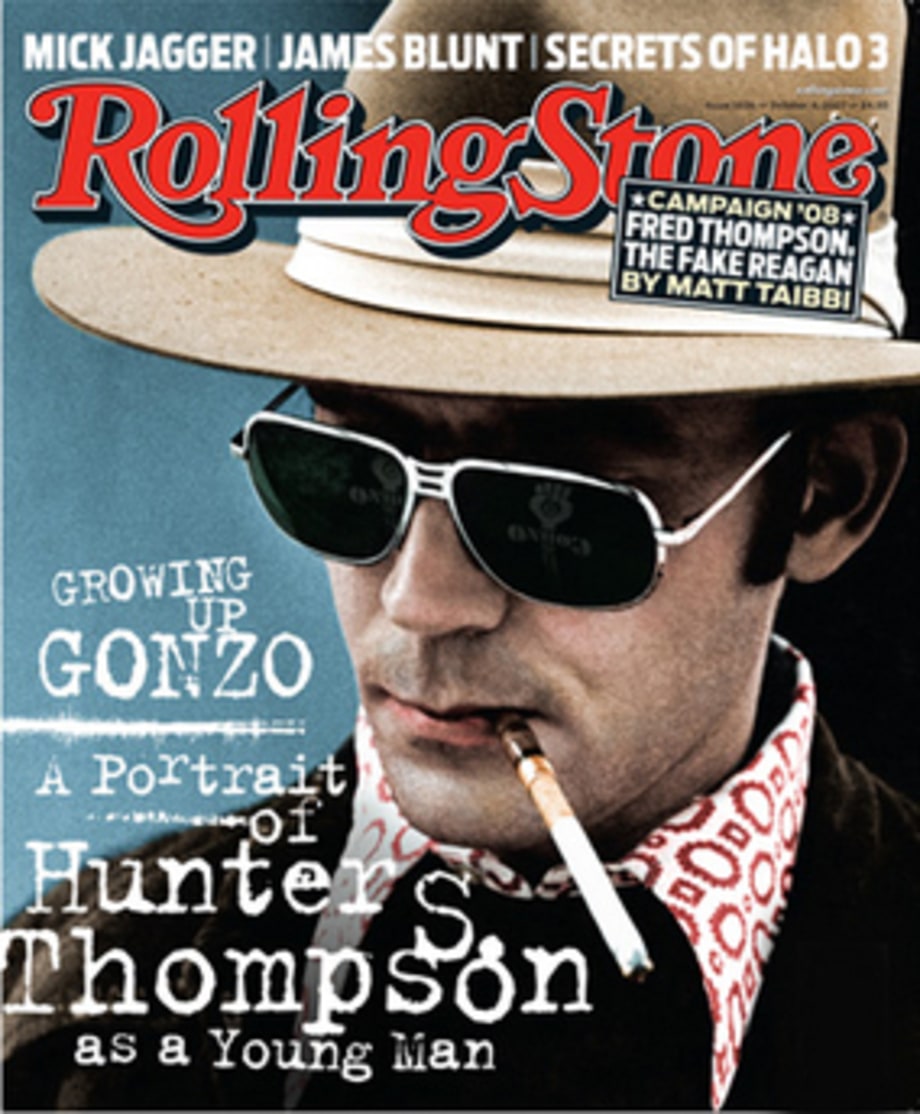
Hunter S. Thompson, “Fear and Loathing on the Campaign Trail ’76: Third-rate romance, low-rent rendezvous — hanging with Ted Kennedy, Jimmy Carter, and a bottle of Wild Turkey”, Rolling Stone, 1976-06-03.

May 6, 2018

QotD: The hierarchy of success for rock groups

Filed under: Business, Media, Quotations — Tags: — Nicholas @ 01:00

How do you define success for a rock group? The nature of the ladder is very clear at the bottom: the rungs are marked with “playing competently in the same key,” “playing for money for the first time,” “becoming spiritual leaders of a local music scene,” “having a national hit single” … it is all easy to work out. At the top, though, the standards are no longer technical and commercial. They become historical.

Above the level of “mere” successful hit-makers, there are artists whose core discography, or even their entire career in the studio, becomes part of a larger cultural story — the Led Zeppelins, Black Sabbaths and Kinks. And there’s a level above that, at which a group’s individual tracks become the subject of extensive study, entire mini-literatures — where even B-sides and cast-offs attract interest, and every move, every day, is extensively documented. That level’s pretty much Bob Dylan and the Beatles.

Colby Cosh, “The improbable media journey of The Tragically Hip”, National Post, 2016-08-22.

May 5, 2018

What’s Wrong With Wakanda?

Filed under: Africa, Economics, Media — Tags: , , — Nicholas @ 04:00

Foundation for Economic Education
Published on 3 May 2018

Wakanda could never exist in the real world.

Wakanda is frustrating because it perpetuates the myth that an abundance of a really valuable natural resource is all you need to create a prosperous and extremely advanced society. This is simply not true. Matt Ridley, author of The Rational Optimist, wrote about how isolationism actually leads to a regress in technology.

April 30, 2018

QotD: Gandhi versus Gandhi

Filed under: History, India, Media, Quotations, Religion — Tags: , , , , — Nicholas @ 01:00

I had the singular honor of attending an early private screening of Gandhi with an audience of invited guests from the National Council of Churches. At the end of the three-hour movie there was hardly, as they say, a dry eye in the house. When the lights came up I fell into conversation with a young woman who observed, reverently, that Gandhi’s last words were “Oh, God,” causing me to remark regretfully that the real Gandhi had not spoken in English, but had cried, Hai Rama! (“Oh, Rama”). Well, Rama was just Indian for God, she replied, at which I felt compelled to explain that, alas, Rama, collectively with his three half-brothers, represented the seventh reincarnation of Vishnu. The young woman, who seemed to have been under the impression that Hinduism was Christianity under another name, sensed somehow that she had fallen on an uncongenial spirit, and the conversation ended.

At a dinner party shortly afterward, a friend of mine, who had visited India many times and even gone to the trouble of learning Hindi, objected strenuously that the picture of Gandhi that emerges in the movie is grossly inaccurate, omitting, as one of many examples, that when Gandhi’s wife lay dying of pneumonia and British doctors insisted that a shot of penicillin would save her, Gandhi refused to have this alien medicine injected in her body and simply let her die. (It must be noted that when Gandhi contracted malaria shortly afterward he accepted for himself the alien medicine quinine, and that when he had appendicitis he allowed British doctors to perform on him the alien outrage of an appendectomy.) All of this produced a wistful mooing from an editor of a major newspaper and a recalcitrant, “But still …” I would prefer to explicate things more substantial than a wistful mooing, but there is little doubt it meant the editor in question felt that even if the real Mohandas K. Gandhi had been different from the Gandhi of the movie it would have been nice if he had been like the movie-Gandhi, and that presenting him in this admittedly false manner was beautiful, stirring, and perhaps socially beneficial.

Richard Grenier, “The Gandhi Nobody Knows”, Commentary, 1983-03-01.

April 26, 2018

Britain drops down a league table that really matters, for a change

Filed under: Britain, Liberty, Media, Politics — Tags: , , — Nicholas @ 05:00

Mick Hume on the parlous state of press freedoms in Britain:

Britain prides itself on being an historic home of freedom and the free press. So how come we are languishing in 40th place in the international press-freedom table?

Imagine the crowds singing an updated version of Rule Britannia at the Last Night of the Proms, about how Britain ‘shall flourish great and free / The dread and envy of them all / Except for the 39 freer nations, obvs’.

According to the 2018 World Press Freedom Index, published on Wednesday by Reporters Without Borders (RSF), the UK is now ‘one of the worst-ranked countries in Western Europe in terms of respect for press freedom’.

Its 40th place puts the UK one ahead of Burkina Faso and two clear of Taiwan, and suggests that journalists working in Britain have less freedom to hold the powerful to account than those in such liberal states as South Africa, Chile or Lithuania.

British observers are far more likely to bemoan how far we have fallen down the world rankings in football, another field we claim to have invented. Unlike the glorious irrelevance of football, however, freedom of the press really is a matter of life and death for a democratic society.

The UK’s 40th place is unchanged from 2017. But that is 18 lower than its ranking in the first Index, published in 2002 – and 12 places down on six years ago, before the publication of the Leveson report.

That should give a clue as to the new threats press freedom faces in the UK. Unlike in some other illiberal parts of the world, we are not confronted by old-fashioned government repression and state control of the press. Instead, and especially since the Leveson Inquiry, press freedom in the UK has been threatened by a more underhand assault from allegedly liberal political and cultural elites – backed, to their shame, by the Labour Party leadership and the Corbynite left.

QotD: Drama critics

Filed under: Humour, Media, Quotations — Tags: , , — Nicholas @ 01:00

Nobody loves them, and rightly, for they are creatures of the night. Has anybody ever seen a dramatic critic in the daytime? I doubt it. They come out after dark, and we know how we feel about things that come out after dark. Up to no good, we say to ourselves.

P.G. Wodehouse, Over Seventy: An Autobiography with Digressions, 1956.

« Newer PostsOlder Posts »

Powered by WordPress