
One reason Hobbes’s “state of nature” thought experiment is so seductive is because, though the premise is glaringly false, the conclusions are true. Every Dissident should memorize this, it’s the most important passage in modern philosophy (if not the whole of philosophy, from Socrates on):
I put for a general inclination of all mankind a perpetual and restless desire of Power after power, that ceaseth only in Death. And the cause of this is not always that a man hopes for a more intensive delight than he has already attained to, or that he cannot be content with a moderate power: but because he cannot assure the power and means to live well, which he hath present, without the acquisition of more.
Or, if you prefer it in slightly more modern English:
Now I will tell you the answer to my question. It is this. The Party seeks power entirely for its own sake. We are not interested in the good of others; we are interested solely in power. Not wealth or luxury or long life or happiness: only power, pure power … Power is not a means, it is an end. One does not establish a dictatorship in order to safeguard a revolution; one makes the revolution in order to establish the dictatorship. The object of persecution is persecution. The object of torture is torture. The object of power is power. Now do you begin to understand me?
That’s the bedrock of human existence, right there: Power. Everything that isn’t Power is nothing, until Power requires it; when it’s no longer useful to Power, it becomes nothing again. Nietzsche would’ve understood O’Brien perfectly.
But please note: Human existence.
Human — animals aren’t like that. They can’t be. They’re not mere automata, as Descartes would have it, but they’re obviously not self-conscious, either. All that Green hooey about animals living in harmony with their environment is, nonetheless, true. They can’t do any other, because they’re animals. Only humans can see that extra step ahead, all the potential dangers that will never let him rest content with the power he has.
And existence – not life, existence. The world Hobbes and O’Brien describe with such terrifying eloquence isn’t life, it’s mere existence. O’Brien couldn’t see where his philosophy led, but Hobbes could:
Whatsoever therefore is consequent to a time of War, where every man is Enemy to every man; the same is consequent to the time, wherein men live without other security, than what their own strength, and their own invention shall furnish them withal. In such condition, there is no place for Industry; because the fruit thereof is uncertain; and consequently no Culture of the Earth; no Navigation, nor use of the commodities that may be imported by Sea; no commodious Building; no Instruments of moving, and removing such things as require much force; no Knowledge of the face of the Earth; no account of Time; no Arts; no Letters; no Society; and which is worst of all, continual fear, and danger of violent death; And the life of man, solitary, poor, nasty, brutish, and short.
This is the end of power-for-power’s-sake. O’Brien was wrong about that boot stomping on a human face, forever. The “state of nature” doesn’t actually exist IN nature, but Big Brother’s Party created it artificially.
But for such a creation to continue, as O’Brien shows, it must be completely static … and that’s impossible. The opposite of Power is Entropy, and Entropy always wins in the end.
Severian, “Salute the Hat”, Founding Questions, 2021-12-07.
July 14, 2025
QotD: The inevitable endgame of power-for-power’s-sake
July 12, 2025
Noah Smith on how surprisingly well free market policies are working in Argentina
In the headline, you should read the unstated “surprising to far too many mainstream economists and political commentators”, but full credit to Noah Smith for admitting that Milei’s radical agenda has started to make life much better for ordinary Argentinians:

Javier Milei at CPAC in National Harbor, Maryland 20 February, 2025.
Photo by Gage Skidmore via Wikimedia Commons.
So to be clear, when I say that criticism of free markets has been overdone, I’m partly talking to myself. A couple of months ago, horrified by Trump’s tariff policies, I wrote an apology to libertarians, admitting that I had failed to see the political usefulness of their project in terms of maintaining economic sanity on the Right.
But it’s not just the political benefits of free markets that have been undersold; I think the purely economic advantages are also too often ignored.
Exhibit A is Javier Milei’s track record in Argentina. A year and a half ago, when Milei was elected President of Argentina, a bunch of left-wing economists warned darkly that his radical free-market program would lead to economic devastation:
The election of the radical rightwing economist Javier Milei as president of Argentina would probably inflict further economic “devastation” and social chaos on the South American country, a group of more than 100 leading economists has warned … [S]ignatories include influential economists such as France’s Thomas Piketty, India’s Jayati Ghosh, the Serbian-American Branko Milanović and Colombia’s former finance minister José Antonio Ocampo …
The letter said Milei’s proposals – while presented as “a radical departure from traditional economic thinking” – were actually “rooted in laissez-faire economics” and “fraught with risks that make them potentially very harmful for the Argentine economy and the Argentine people” … [T]he economists warned that “a major reduction in government spending would increase already high levels of poverty and inequality, and could result in significantly increased social tensions and conflict.”
“Javier Milei’s dollarization and fiscal austerity proposals overlook the complexities of modern economies, ignore lessons from historical crises, and open the door for accentuating already severe inequalities,” they wrote.
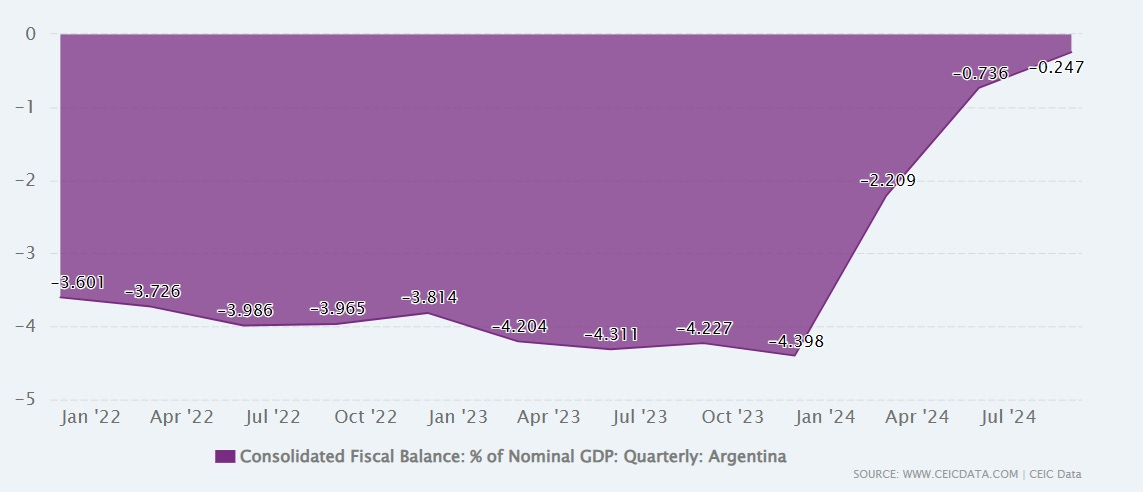
Milei won anyway. His first big policy, and the one the lefty economists fretted about the most, was deep fiscal austerity. Argentina’s long-standing economic model, created by dictator Juan Peron in the 1950s, involved a large and complex array of public works projects and subsidies for various consumer goods like energy and transportation. Milei slashed many of these, as well as cutting pensions, civil service employment, and transfers to provinces. Overall, he cut public spending by about 31%, resulting in a near-total elimination of Argentina’s chronic budget deficit:
The point of all this cutting wasn’t just to remove state intervention in the economy — it was to stop inflation. Basically, macroeconomic theory says that if deficits are high and persistent enough, then they convince everyone that the government will eventually inflate its debt away by printing money (which becomes a self-fulfilling prophecy). And most or all countries that experience hyperinflation end up escaping it only when they get their fiscal house in order. Perpetual deficits were part of Argentina’s “Peronist” system, and it’s probably a good bet that this has been responsible for the periodic bouts of hyperinflation that it experiences.
[…]
But still, Milei’s success so far should make us somewhat more confident about free-market policies — especially when we evaluate them against the new socialist ideas that have been gaining currency in the U.S. In the past, socialists and other left-leaning economic thinkers advocated central planning and nationalization of industry; in recent years, they have taken to calling for expansion of the state through fiscal policy, mixing macroeconomic justifications with micro. At all times, they call for deficit-financed expansion of social programs; when fiscal hawks want to tame the deficits, the lefties warn of the short-term macroeconomic harms of austerity.
If you’re always more terrified of austerity than you are of deficits, expansion of the state — and of the deficit — becomes a one-way ratchet. This approach is very different than Keynesianism, which advocates stimulus to overcome recessions, followed by austerity during boom times. You’ll recognize it as bearing a distinct similarity to MMT; that pseudo-theory has largely fallen out of favor, but there are plenty of more respectable progressive types whose ideas nonetheless have a lot of this “macroleftist” flavor.
July 9, 2025
Argentina after 18 months of Milei’s leadership
All the mainstream media folks were predicting that Argentina would be an utter economic disaster after the election of Javier Milei. A few of them are starting to come around to admitting that Argentina seems to have made the right move:
What’s happening in Argentina is super impressive, but it’s not a miracle.
Yes, Milei’s reforms are generating great results, but that is exactly what libertarians and small-government conservatives said would happen.
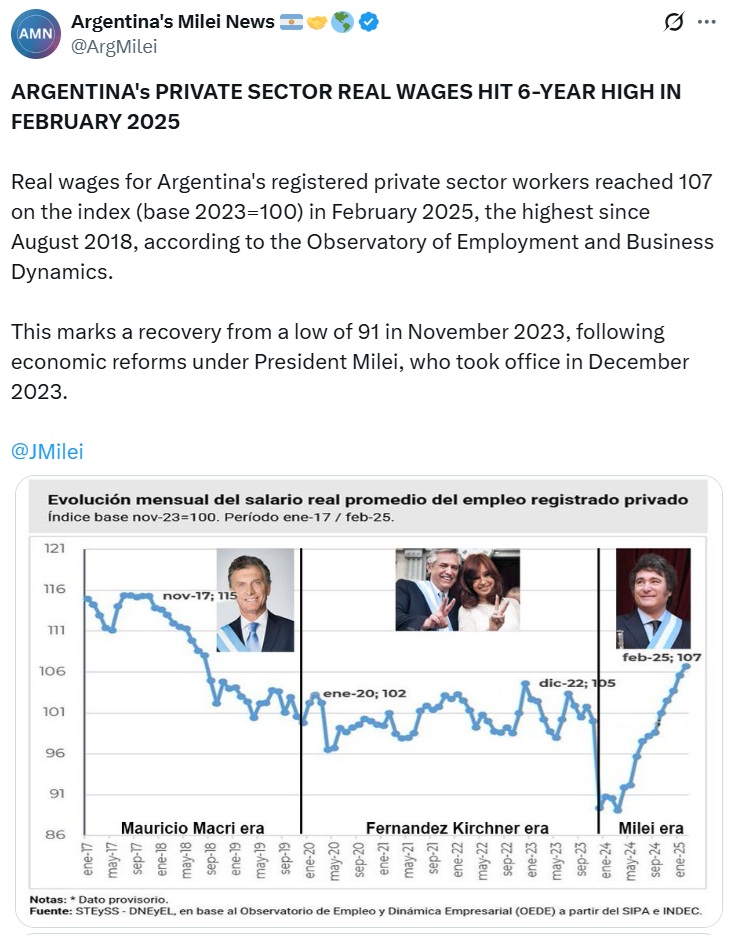
Let’s start with this celebration of the amazing growth of private-sector wages since Milei took office in late 2023.
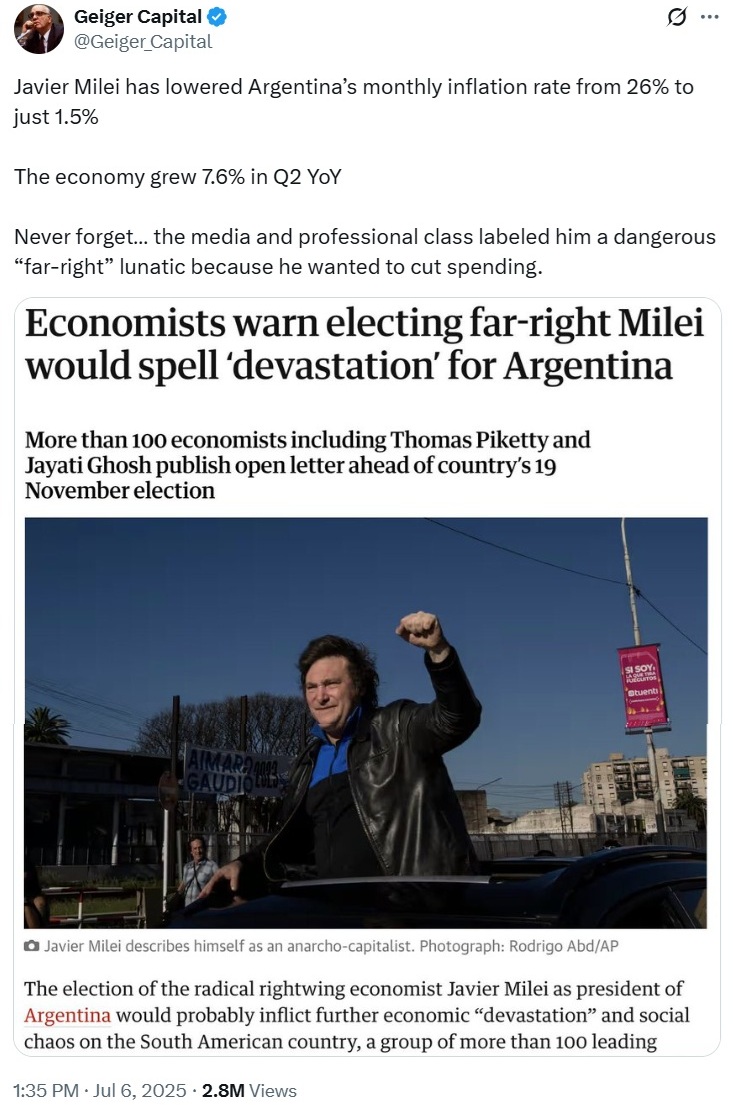
Or how about the astounding way that Milei has conquered inflation (I also like how this tweet mocks the statists like Piketty who frantically and erroneously warned that Milei’s election would produce an economic catastrophe).
[…]
Let’s close with another tweet.
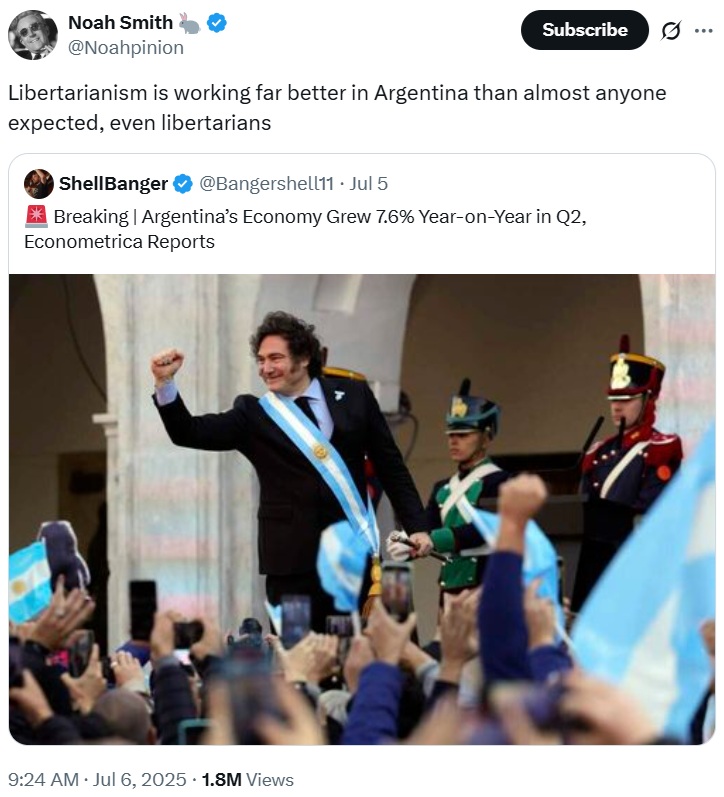
Here’s Noah Smith, who is not a libertarian, shared two days ago.
Give him credit for acknowledging Milei’s success.
I’ll add two comments about this tweet, one about economic data and the other about predicting whether Milei would get great results.
Regarding data, I don’t think anyone should get overly excited by one month or one quarter of economic data. Even one year of data might create a misleading impression (which is why my Anti-Convergence Club is always based on decades of data). That being said, there is every reason to expect continuing strong results for Argentina.
Regarding predictions, Smith’s tweet asserts that libertarians didn’t expect Milei to be so wildly successful. At the risk of sounding like a politician, I agree and disagree.
- The “agree” part is that many libertarians were worried at the beginning of Milei’s presidency that he might face immovable opposition from the Peronist-controlled legislature. We also worried that the special interest groups might launch massive – and successful – protests that would derail necessary reforms. So if you asked me in December 2023 for my prediction, I would not have been overflowing with optimism.
- The “disagree” part is that I have always had total and absolute confidence that radical pro-market policies will produce great results, anywhere and everywhere. And I assume other libertarians (as well as Reagan-type conservatives) share my faith that good policies lead to good outcomes. So if I was told in December 2023 what Milei would have accomplished in his first 18 months, I would have fully expected the great news we now see.
In other words, what’s miraculous is that the reforms happened. The subsequent economic renaissance has been boringly inevitable (but totally wonderful).
P.S. I am cautiously optimistic that Milei will get more allies in the legislature after Argentina’s mid-term elections later this year.
July 8, 2025
“One of the problems with being a writer is that all of your idiocies are still in print somewhere”
At the Foundation for Economic Education, Itxu Díaz considers the work of P.J. O’Rourke:
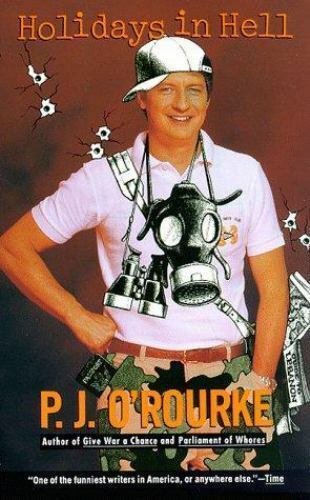
Though P.J. O’Rourke passed away three years ago, his sharp wit and defense of freedom continue to resonate in a world still tempted by interventionist solutions. Reclaiming his work is more vital now than ever. What he told us through laughs and jabs in recent decades has proven to be one of the sharpest diagnoses of the dangers of postmodern left-wing ideology — and one of the most inspired reflections on why we must root our societies in individual liberty, private property, the free market, and the Judeo-Christian values that shaped the West for centuries.
Progressives want bigger government, and often conservatives don’t want it as small as we ought to like. O’Rourke knew all too well that the larger the state grows, the smaller individuals become. He devoted much of his work to explaining this in a way anyone could understand — even those not particularly interested in politics. His words resonate today in a new light, and fortunately, they remain easy to access: the Internet is full of O’Rourke’s articles, and all his books are still in print. The ideas, the jokes — the profound, the outdated, and even the ones that haven’t aged all that well — are still out there, waiting to be discovered by any digital wanderer with a sense of humor and a thirst for sharp thinking. It’s almost frightening to realize that some of O’Rourke’s tech-related jokes would go completely over a Millennial or Zoomer’s head today. And it’s even more pitiful to think that some of his old comments would be cancelled in today’s dull, hypersensitive postmodern world. Perhaps it’s because, as he once said, “One of the problems with being a writer is that all of your idiocies are still in print somewhere”. Incidentally, that’s where O’Rourke found his only point of agreement with environmentalists: “I strongly support paper recycling”.
The hippie student he was in the ’60s lost his enthusiasm for leftist ideas the following decade, as soon as he got his first paycheck from National Lampoon: a $300 check that filled him with joy — until he was told $140 would be deducted for taxes, health insurance, and Social Security. That day, he got mad at the government, and the grudge never faded. Before that, while still sporting what he called “a bad haircut” — think John Lennon’s worst style — he’d decided to tell his Republican grandmother he’d become a communist. Her response threw him off: “Well, at least you’re not a Democrat”.
O’Rourke was never one to romanticize his drug-fueled college days. “Oh God, the ’60s are back,” he wrote. “Good thing I’ve got a double-barreled 12-gauge with a chamber for three-inch magnum shells. And speaking strictly as a retired hippie and former beatnik, if the ’60s come my way, they won’t make it past the porch steps. They’ll be history. Which, for God’s sake, is what they’re supposed to be.”
From his time as editor-in-chief of National Lampoon in the ’70s, we got his account in The Hollywood Reporter, “How I Killed National Lampoon“. The job was a blast, but the environment was hell: “Having a bunch of humorists in one place is like having a bunch of cats in a sack”. As a satirical war correspondent covering every late-century conflict, O’Rourke filled countless pages describing the struggle to find a damn glass of whiskey in the burning countries at the “end of history”. His last dangerous assignment was in Iraq. “I’d been writing about overseas troubles of one kind or another for twenty-one years, in forty-some countries, none of them the nice ones. I had a happy marriage and cute kids. There wasn’t much happy or cute about Iraq,” he wrote in Holidays in Heck.
June 26, 2025
German police raid homes to counteract online “hate speech” by “digital arsonists”
Things are getting worse for free speech in Germany, as eugyppius reports:
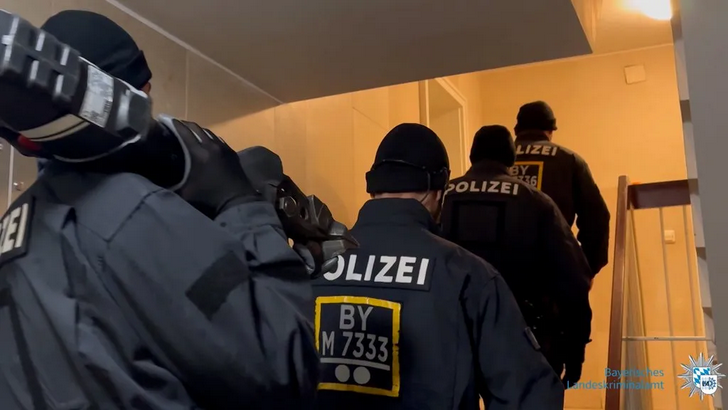
Apollo News reports on the newest, most irregular German holiday, which consists of the police conducting coordinated raids on and interrogations of ordinary people who are alleged to have said rude things on the internet:
On Tuesday morning police across Germany conducted raids targeting “hate speech and incitement” on the internet. According to the news agency dpa, there are currently 170 operations underway, including house searches and other measures. Those accused are charged with insulting politicians and inciting hatred …
The Federal Criminal Police Office (BKA) is in charge of the operation … In North Rhine-Westphalia, several police authorities struck simultaneously at 6 a.m. Police from Düsseldorf, Dortmund, Gelsenkirchen, Cologne, Bielefeld, Münster, Hagen, and Bonn are among those involved. Fourteen suspects are to be questioned and two search warrants executed.1 The individuals in question frequently express themselves on social media, such as on X.
… The Action Day against alleged hate posts has been taking place regularly for years. On June 18, the BKA joined forces with the reporting center “REspect!” to participate in the “International Day Against Hate and Incitement”. People were called upon to report posts that allegedly spread hate.
Today was the twelfth such “Action Day against Hate and Incitement on the Internet”. That is only an approximate title; it varies slightly across press sources. This dubious ritual began in 2016, after Merkel opened the German borders to the entirety of the developing world and our politicians grew tired of people calling them imbeciles online. Police are very open that the goal of these coordinated Action Days is intimidation – or, as they put it, “deterrence”.
Our federal police love this holiday so much they often celebrate it twice a year, which is why are already on the twelfth such day, even though we have only had nine years since the establishment of this custom. Sometimes our betters even throw in bonus action days that for some reason don’t count, as during Covid when they conducted a special “Action Day against Political Hate Postings” after the seventh “Nationwide Action Day against Hate Postings” but before the eighth “Nationwide Action Day against Hate Postings”. Who knows how many such action days we have really had, especially considering that since 2020 the broader EU has adopted this sporadic holiday and occasionally coordinates its own Continent-wide “Action Day against Hatred and Incitement on the Internet”.
[…]
By calling these Action Days idiotic, I don’t mean to minimise them. They are borderline illegal, for they exploit what should be purely investigative tactics (interrogations, house searches) to scare and punish people in advance of any criminal conviction. The emphasis is not only on right-leaning posters, but invariably and most disgracefully on ordinary people with relatively little social media reach, whose posts in many cases have been seen a mere handful of times. The message is clear: They can get you, whoever you are; they can get anybody. Living in a country whose authorities amuse themselves by periodically harassing their own citizens in this way is disturbing. It’s an absolute scandal that all the major political parties support this, save for Alternative für Deutschland. It’s a reason to vote AfD all by itself.
June 9, 2025
QotD: “Defending” democracy with totalitarian methods
These people don’t see that if you encourage totalitarian methods, the time may come when they will be used against you instead of for you. Make a habit of imprisoning Fascists without trial, and perhaps the process won’t stop at Fascists. Soon after the suppressed Daily Worker had been reinstated, I was lecturing to a working men’s college in South London. The audience were working‐class and lower‐middle‐class intellectuals — the same sort of audience that one used to meet at Left Book Club branches. The lecture had touched on the freedom of the press, and at the end, to my astonishment, several questioners stood up and asked me: Did I not think that the lifting of the ban on the Daily Worker was a great mistake? When asked why, they said that it was a paper of doubtful loyalty and ought not to he tolerated in war time. I found myself defending the Daily Worker, which has gone out of its way to libel me more than once. But where had these people learned this essentially totalitarian outlook? Pretty certainly they had learned it from the Communists themselves!
Tolerance and decency are deeply rooted in England, but they are not indestructible, and they have to be kept alive partly by conscious effort. The result of preaching totalitarian doctrines is to weaken the instinct by means of which free peoples know what is or is not dangerous. The case of Mosley illustrates this. In 1940, it was perfectly right to intern Mosley, whether or not he had committed any technical crime. We were fighting for our lives and could not allow a possible Quisling to go free. To keep him shut up, without trial, in 1943 was an outrage. The general failure to see this was a bad symptom, though it is true that the agitation against Mosley’s release was partly factitious and partly a rationalization of other discontents. But how much of the present slide to ward Fascist ways of thought is traceable to the “anti‐Fascism” of the past ten years, and the unscrupulousness it has entailed?
George Orwell, “The Freedom of the Press“, 1945 (written as the introduction to Animal Farm, but not published in Orwell’s lifetime).
June 5, 2025
The Liberals believe this time they’ll keep kids away from internet porn
Sometimes it’s hard to get a grip on what Liberals actually believe, as on the one hand they’re actively resisting pulling literal pornography out of school libraries (because it’s “LGBT friendly”) and on the other hand, they’re all gung-ho for yet another attempt to pass legislation that will try to prevent kids from seeing porn on the internet:

How does a website automatically, “responsibly” prove someone’s age down the end of an internet connection, without actually verifying their ID? Answer: It doesn’t. Obviously
There is another legislative effort afoot to keep Canadian children away from pornography. It’s well-intentioned effort, I suppose, but such efforts didn’t work very well when pornography was printed on glossy paper and distributed on VHS tapes and pay-per-view, so it seems particularly improbable in the internet age.
Bill S-209 is Independent (Liberal-appointed) Senator Julie Miville-Dechêne’s second attempt at a private member’s bill on the topic. It is predicated on the notion that it’s easier to verify age automatically than it used to be: “Online age-verification and age-estimation technology is increasingly sophisticated and can now effectively ascertain the age of users without breaching their privacy rights”, the bill’s preamble avers.
It is absolute rubbish, to the extent that even the Liberals under former prime minister Justin Trudeau seemed to realize it the first time it was tried. We can only hope Mark Carney’s Liberals are of similar mind. Early signs are not positive. The reappointment of Steven Guilbeault as heritage minister (now called Canadian identity and culture minister, for some reason) doesn’t bode well. He seems genuinely to dislike the online world on principle.
Or, maybe it does bode well. Guilbeault did a singularly terrible job trying to sell the Liberals’ anti-internet agenda in English Canada. I’m not sure he could give away ice cream in a Calgary heatwave. So if you think laws targeting “online harms” are doomed to fail at best — and could lead to dystopian outcomes — then maybe Guilbeault is exactly the fellow you want in charge.
When it came to online porn, the Trudeau Liberals seemed to have some sense of the Sisyphean proposition before them. Miville-Dechêne’s first attempt at a bill received support from MPs of all parties in the House of Commons last year, but the Liberal leadership cited privacy concerns in refusing to get behind it.
In large part that might just have been because Conservative Leader Pierre Poilievre supported the idea and, to Liberals, anything Poilievre supports must obviously be a serious threat to humanity’s survival. But still, Trudeau was pretty unequivocal in rejecting the idea.
June 3, 2025
QotD: Heinlein’s opinions on the right to bear arms
Between 1942 and 1966 Heinlein’s politics evolved from New Deal left-liberalism towards what after 1971 would come to be called libertarianism. But that way of putting it is actually misleading, because Heinlein did not merely approach libertarianism, he played a significant part in defining it. His 1966 novel The Moon Is A Harsh Mistress was formative of the movement, with the “rational anarchist” Bernardo de la Paz becoming a role model for later libertarians. By 1978, we have direct evidence (from an interview in Samuel Edward Konkin’s New Libertarian magazine, among other sources) that Heinlein self-identified as a libertarian and regretted his earlier statism.
But if Heinlein’s overall politics changed considerably and wandered down some odd byways during his lifetime, his uncompromising support of civilian firearms rights was a constant on display throughout his life. Brin observes that was already true in 1942, but attempts to attribute this position to John W. Campbell. Multiple lines of evidence refute this claim.
[…]
Heinlein, on the other hand, was a vocal and consistent advocate of civilian weapons ownership both during and after his association with Campbell. This is perhaps clearest in his 1949 novel Red Planet, written after their parting of the ways. In that novel, the bearing of personal weapons is explicitly connected to the assumption of adult responsibilities.
Red Planet is also interesting because, although we might consider the views of Heinlein’s characters an unreliable guide to Heinlein’s own, Heinlein’s letters about the novel reveal much more. His editor at Scribner attempted to delete the section of argument in which weapons-bearing is connected to adult responsibility; Heinlein rejected this, objecting that it eviscerated the book’s ethical core and making very clear that the views of the pro-gun mentor figures in the novel were his own.
Heinlein was to reiterate similar views not only in his later fiction but in the posthumous nonfiction collection Grumbles From The Grave – by which time they were no surprise to any Heinlein fan. And it would be difficult to overstate the influence they had on firearms-rights activists during the dark years between the Gun Control Act of 1968 and our vindication in the 2008 District of Columbia v. Heller ruling.
Heinlein’s gift to firearms-rights activism during that bleak four decades was to be able to draw on the principled case for civilian firearms going back to the framers of the U.S. Constitution and English Republican sources and restate it in language appealing to the brightest children of post-WWII America. But he did more than that, because in Red Planet and elsewhere firearms rights were presented as an inextricable part of a philosophical whole, with the personal firearm both as instrument and defining symbol of personal liberty and responsibility.
Eric S. Raymond, “Brin on Heinlein on guns is dead wrong”, Armed and Dangerous, 2011-07-18.
May 31, 2025
“U.S. libertarians [are] the best friends Canada doesn’t know it has”
In the National Post, Colby Cosh sings the praises of American libertarians for their work in trying to dismantle some of Donald Trump’s dubiously Constitutional extensions of presidential power:

The James L. Watson Court of International Trade Building at 1 Federal Plaza in Lower Manhattan, New York City.
Photo by Americasroof via Wikimedia Commons.
The U.S. Court of International Trade (CIT) issued a decision Wednesday that annuls various salvos of surprise economic tariffs, including ones on Canada, that have been enacted by President Donald Trump since his inauguration in January. I won’t lie to you: I had the same initial reaction to this consequential news that you probably did, which was “Hooray!” and then “Huh, there’s a U.S. Court of International Trade?”
This court is surely unfamiliar even to most Americans, no doubt because much of its work involves settling issues like “Do hockey pants count as ‘garments’ or ‘sports equipment’ under customs law?” Nevertheless, the CIT does have exclusive jurisdiction over civil actions involving U.S. trade law. It’s just that no president has ever before rewritten the tariff schedule of the republic in the half-mad fashion of a child taking crayons to a fresh-painted wall.
The American Constitution, from day one, has unambiguously assigned the right to set international tariffs to Congress. Congress is allowed to delegate its powers to the president and his agents for limited or temporary purposes, but it can’t abandon those powers to him altogether. Defining this legal frontier is what the CIT was asked to do, and their demarcation of it will now swim upward through higher appellate courts (its decision has been put on hold in the meantime).
The lawsuit was actually two parallel suits raising overlapping objections to the tariffs. One was brought forward by 12 U.S. states, and the other was filed by a group of tariff-exposed American businesses, including manufacturers of bikes, electronics kits and fishing equipment. The latter set of plaintiffs was roped together by the usual posse of heroic libertarians and legal originalists, including George Mason University law prof Ilya Somin.
About 24 hours after Trump originally announced the “Liberation Day” worldwide tariffs, Somin quickly blogged about how insanely unconstitutional the whole idea was, and concluded his article essentially by saying “I’m darn well gonna do something about this nonsense”. I don’t mean to suggest he deserves primary credit; I only intend to call attention, once again, to U.S. libertarians being the best friends Canada doesn’t know it has.
May 30, 2025
Senate to once again try to pass internet age verification and website blocking
Some ideas are so horrible that they never, ever die. The Canadian Senate nearly got an age verification and website blocking ban into law during the last Parliament, and as Michael Geist discusses, they’re not giving up now:
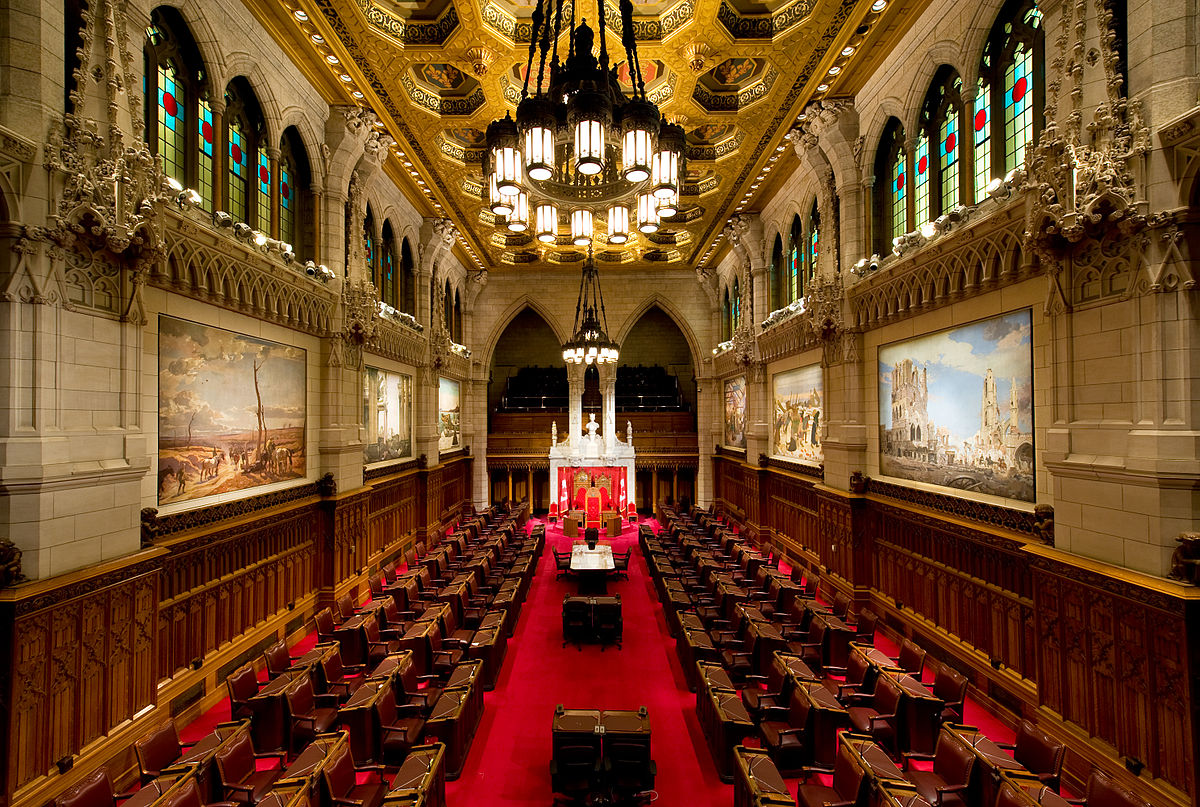
“In the east wing of the Centre Block is the Senate chamber, in which are the thrones for the Canadian monarch and consort, or for the federal viceroy and his or her consort, and from which either the sovereign or the governor general gives the Speech from the Throne and grants Royal Assent to bills passed by parliament. The senators themselves sit in the chamber, arranged so that those belonging to the governing party are to the right of the Speaker of the Senate and the opposition to the speaker’s left. The overall colour in the Senate chamber is red, seen in the upholstery, carpeting, and draperies, and reflecting the colour scheme of the House of Lords in the United Kingdom; red was a more royal colour, associated with the Crown and hereditary peers. Capping the room is a gilt ceiling with deep octagonal coffers, each filled with heraldic symbols, including maple leafs, fleur-de-lis, lions rampant, clàrsach, Welsh Dragons, and lions passant. On the east and west walls of the chamber are eight murals depicting scenes from the First World War; painted in between 1916 and 1920.”
Photo and description by Saffron Blaze via Wikimedia Commons.
The last Parliament featured debate over several contentious Internet-related bills, notably streaming and news laws (Bills C-11 and C-18), online harms (Bill C-63) and Internet age verification and website blocking (Bill S-210). Bill S-210 fell below the radar screen for many months as it started in the Senate and received only cursory review in the House. The bill faced only a final vote in the House but it died with the election call. This week, the bill’s sponsor, Senator Julie Miville-Dechêne, wasted no time in bringing it back. Now Bill S-209, the bill starts from scratch in the Senate with the same basic framework but with some notable changes that address at least some of the concerns raised by the prior bill (a fulsome review of those concerns can be heard in a Law Bytes podcast I conducted with Senator Miville-Dechêne).
Bill S-209 creates an offence for any organization making available pornographic material to anyone under the age of 18 for commercial purposes. The penalty for doing so is $250,000 for the first offence and up to $500,000 for any subsequent offences. The previous bill used the term “sexually explicit material”, borrowing from the Criminal Code provision. This raised concerns as the definition in the Criminal Code is used in conjunction with other sexual crimes. The bill now features its own definition for pornographic material, which is defined as
any photographic, film, video or other visual representation, whether or not it was made by electronic or mechanical means, the dominant characteristic of which is the depiction, for a sexual purpose, of a person’s genital organs or anal region or, if the person is female, her breasts, but does not include child pornography as defined in subsection 163.1(1) of the Criminal Code.
Organizations can rely on three potential defences:
- The organization instituted a government-approved “prescribed age-verification or age estimation method” to limit access. There is a major global business of vendors that sell these technologies and who are vocal proponents of this kind of legislation.
- The organization can make the case that there is “legitimate purpose related to science, medicine, education or the arts”.
- The organization took steps required to limit access after having received a notification from the enforcement agency (likely the CRTC).
Note that Bill S-209 has expanded the scope of available technologies for implementation: while S-210 only included age verification, S-209 adds age estimation technologies. Age estimation may benefit from limiting the amount of data that needs to be collected from an individual, but it also suffers from inaccuracies. For example, using estimation to distinguish between a 17 and 18 year old is difficult for both humans and computers, yet the law depends upon it. Given the standard for highly effective technologies, age estimation technologies may not receive government approvals, leaving only age verification in place.
May 22, 2025
Lucy Connolly, political prisoner
I’m no firebrand on social media — I’d probably have a lot more followers if I were — but I can easily imagine a situation like the one that got Lucy Connolly sent off to the British gulags for an ill-judged social media post:
In what has become an emblematic case of the UK’s betrayal of free speech, Lucy Connolly has now lost her appeal for early release. This mother and childminder had posted an offensive tweet in the direct aftermath of the Southport murders, in which a psychopath brutally attacked children with a knife at a yoga class. She had believed the false claim that the perpetrator was an asylum seeker, and written online that she had no objection to people burning down hotels where immigrants were residing.
The tweet was taken as evidence that Connolly had intended to “stir up racial hatred” and incite violence during the febrile climate of the summer riots. It had been deleted within hours, no violence occurred as a result, and yet she was sentenced to 31 months in prison. Given that the severity of Connolly’s sentence was doubtless related to unofficial government pressure on the judiciary, many have made the case that Connolly is a political prisoner.
For all our shared revulsion at the tweet, we must remember that we are still talking here about words, not actions. It was completely right that Philip Prescott, a man who attacked a mosque as part of a mob during the riots, was sentenced to 28 months in jail. But Connolly has received an even longer sentence having committed no acts of violence at all. Many rapists and paedophiles have been treated far more leniently. I know of no sound argument that could possibility justify this state of affairs. It is the very definition of two-tier justice.
Let’s get the caveats out of the way. Nobody is defending what Connolly wrote. It was unpleasant, rash, misjudged, and much else besides. Here is the post in full.
Grim stuff. But it by no means fulfils any serious definition of incitement to violence. For one thing, she is not calling on hotels to be torched, but is rather making clear that she would not care if that occurred. This distinction is key, but has been overlooked. Moreover, Connolly has zero influence or clout. It is not as though anyone reading this could have taken it as an instruction or order and acted accordingly. Those wishing to appreciate the full context of why Connolly behaved as rashly as she did should read this excellent piece by Allison Pearson for The Telegraph.
It should go without saying that in a free society some people are going to say ghastly things. That’s the price we pay for liberty. The judge in this case made a statement in his ruling that has been widely interpreted as political: “It is a strength of our society that it is both diverse and inclusive. There is always a very small minority of people who will seek an excuse to use violence and disorder causing injury, damage, loss and fear to wholly innocent members of the public and sentences for those who incite racial hatred and disharmony in our society are intended to both punish and deter.”

May 16, 2025
Those scary “Brexity books”
Andrew Doyle on the sudden interest British police seem to be taking about what kind of books you may have on your shelves at home:
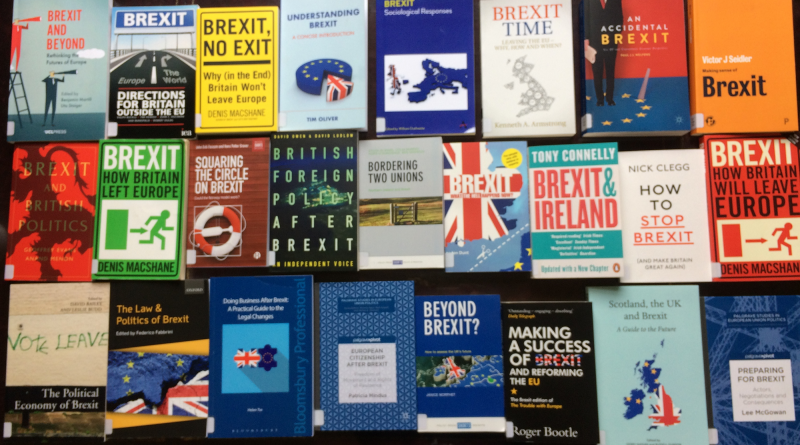
If the British police saw this collection, you’d be lucky to get out of prison in fifty years!
The UK police certainly seem to believe in that old aphorism that that “You can tell everything you need to know about a person from their bookshelf”. There has been much press coverage this week of the case of Julian Foulkes, a former policeman who was arrested at his home in Gillingham for tweetcrime. It took six officers to handcuff the pensioner and take him to a cell, and bodycam footage from the arrest shows them assessing the contents of his bookshelves. One was seen singling out The War on the West by Douglas Murray and another remarked that there were “very Brexity things”.
I have a fair few “Brexity” books on my shelf too. I have just as many “anti-Brexity” books, as it happens. It seems to have escaped the attention of these officers that it is possible to read multiple points of view without necessarily subscribing to any of them. They have also apparently forgotten that “Brexity” views are fairly commonplace, enough so to win the largest democratic mandate the country has ever seen. If it’s a majority view, is it really all that controversial?
I recall during the lockdown I was scheduled for a television interview and, having set up the webcam, I suddenly realised that the two volumes of Ian Kershaw’s excellent biography of Hitler were not only visible, but prominent. The design of the books’ spines is such that the word “HITLER” is displayed in huge letters. Very dramatic and marketable, but not so helpful if you’re about to appear on live television. I must confess that I repositioned my chair to ensure that the books were obscured.
But why? It isn’t as though any sensible person could possibly believe that my interest in the history of tyranny implies an endorsement of it. I could just as easily have a copy of Mein Kampf on the shelf and still retain my wholehearted opposition to its author and everything he stood for. If I owned a copy of the Koran, would that make me a Muslim? If I owned a copy of Jilly Cooper’s Riders, would that make me prone to passionate romps in stables? As a chronic hay fever sufferer, this hardly seems likely.
The assumption that the books we choose to read are a mirror-image of our private thoughts, or that we are so malleable that any opinion we encounter will automatically be assimilated, is very much a core tenet of faith in today’s woke mindset, one that has quite palpably infected the justice system. Those who are currently serving prison time for offensive tweets will be aware that the unevidenced belief that the public act on cue to the language they read has some very authoritarian consequences.
April 29, 2025
1984 and the Politicizing of Language
Feral Historian
Published 16 Aug 2024A dive into 1984 in relation to modern politics can’t be done without pissin’ in everyone’s Froot-Loops, so grab a tall glass of Victory Gin and let’s talk about how The Party functions, how doublethink makes us crazy, and how it’s not just those nutters on the other side that do it.
I take a few jabs at current sacred cows of the Left and Right here. Hopefully the comments won’t look like Hate Week.
00:00 Intro
01:46 Thoughtcrime and Doublethink
12:27 War is Peace
17:46 Oligarchal Collectivism
22:12 MiniTruePost-release edit: It’s been pointed out that I grossly oversimplified the military analysis later in the video, which is true. Man-portable air defense systems and maneuver warfare are a lot more complicated than this video implies. As for that one particular doublethink example mentioned so very briefly, some of the counterpoints have been … impressive contortions of language in their own right. But not interesting enough to discuss the matter further.
April 23, 2025
Germany’s extremely extreme extreme right AfD now the most popular party
Friedrich Merz, the leader of the “main” right-wing party in the Bundesrat seems to have a problem with math, as he keeps promising to cut the AfD support in half, yet ends up doubling it:
Many years ago – in 2018, to be precise – a man named Friedrich Merz was in the running to succeed Merkel as chairman of the CDU.
Merz said many interesting things back then. On 14 November 2018, for example, he gave an interview to BILD, in which he denounced Alternative für Deutschland as a party “that does not distance itself from the right” and said that “this makes them unsuitable for any coalition”. Merz pledged to win back all the CDU voters who had defected to the AfD over the years. “In the short term,” he said, “it will probably be impossible to get rid of the AfD,” but if he were chosen to succeed Merkel, he pledged that he could “cut their support in half“.
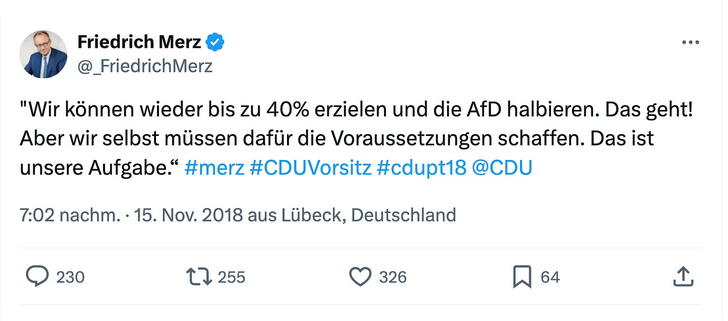
The very next day he tweeted the exact same thing – promising to lead the CDU back to 40% in the polls and to “halve the AfD“.
At a regional CDU conference around this time, Merz yet again promised to “cut the AfD in half,” adding that “this really is possible”. If I looked harder, I could probably find even more examples of Merz repeating this exact same promise. He made it such a core component of his campaign for the party chairmanship that the Frankfurter Allgemeine Zeitung observed in retrospect: “The whole idea of Merz as party chairman was based on the notion that he would win back votes that Angela Merkel had lost“.
[…]
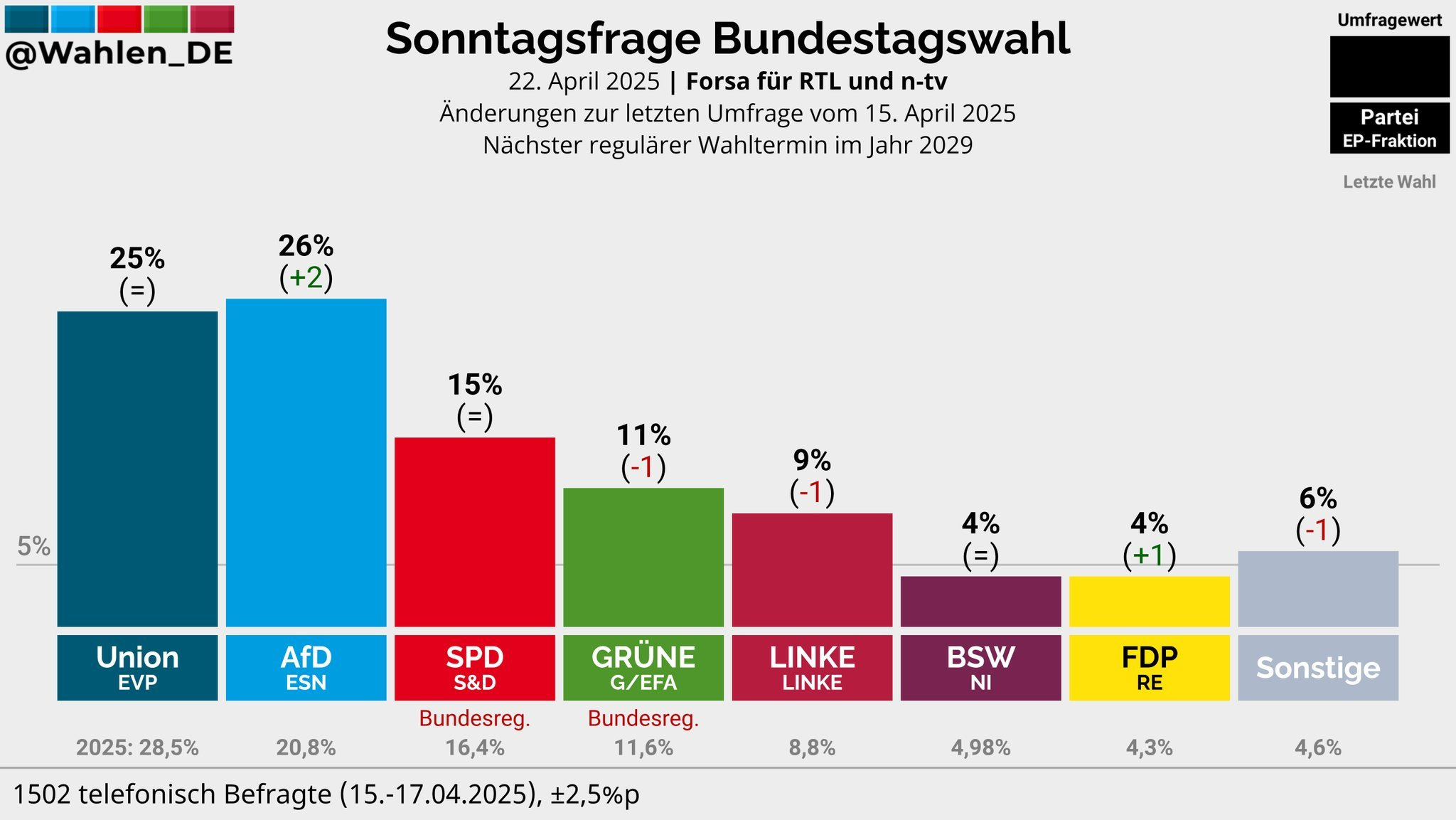
The latest Forsa poll (conducted for RTL and ntv) has Alternative für Deutschland at a cool 26%. That is their best result in history, and it makes them the strongest party in the Federal Republic. This is the second such poll that places AfD in first place, following an Ipsos survey from 9 April that pegged them at 25%.
Merz has indeed done something to AfD support involving the operand of 2. It’s just not exactly what he imagined.
Now all of that rhetoric we one once heard from the cartel parties – about the importance of dealing with the AfD on the issues and of making convincing appeals to the “democratically inclined” among AfD voters – have become yesteryear’s pablum. They are going to try to ban the AfD now. Because they can’t beat them in any other way, and because they believe Germans shouldn’t be allowed to cast their votes beyond the narrow confines of the political cartel that runs the Federal Republic, they’re going to try to remove the AfD from the board via legal trickery.
Of course, if the AfD is now the most popular party in Germany, it must be suppressed ASAP, and the individual members of the party must be punished “to save democracy”:
In Germany, owning guns is a privilege that can be taken away — not for breaking the law, but for holding the wrong political opinion.
Members and supporters of the right-leaning Alternative für Deutschland (AfD) party are now facing mass gun license revocations. The reason? The German government has labeled the AfD a “right-wing extremist” group — a political designation that suddenly makes its members “unreliable” under the country’s gun laws. And just like that, firearms must be surrendered or destroyed.
If that sounds outrageous, it should. But it’s not surprising.
[…]
In 2021, Germany’s domestic intelligence agency, the Bundesamt für Verfassungsschutz (BfV), designated the entire AfD as a “suspected threat to democracy”. That move allowed the government to surveil, wiretap, and investigate the party and its members.
It didn’t stop there.
Courts have now upheld revoking gun licenses from AfD members, based solely on their political affiliation. In one case, a couple in North Rhine-Westphalia lost legal ownership of over 200 firearms. They weren’t criminals. They weren’t accused of wrongdoing. They were just AfD members.
Another court in Thuringia blocked a blanket gun ban for all AfD members — but left the door wide open for revocations on a case-by-case basis.
In Saxony-Anhalt, officials are reviewing the gun licenses of 109 AfD members. As of last fall, 72 had already been targeted for revocation, with the rest under active review. The justification? Supporting a party the state now claims is “working against the constitutional order”.
And the courts are backing it up. According to a March 2024 ruling, former or current AfD supporters “lack the reliability” required to legally own firearms.
April 20, 2025
QotD: “Hate speech”
This is why they balk and protest when the words free speech are used against them. They detest the idea that they are enemies of liberty. But of course that is precisely what they are. Just consider that nonsensical chant “Hate speech is not free speech”. There are two profound moral problems with this idiotic tautology. The first is that, actually, even genuinely hateful speech, including racist gibberish and misogynistic blather, should be free speech. By its very definition freedom of speech should extend to all speech, even speech we detest. And secondly, “hate speech” has become a slippery, amorphous category that now covers not only foul old nonsense like Holocaust denial, but also trans-sceptical feminism, criticism of Islam, opposition to mass immigration, and so on. “Hate speech” really means thoughtcrime. It is an utterly ideological category used by the cultural and intellectual elites to demonise and censor ideas, beliefs and moral convictions they disapprove of. The war on “hate speech” is the new war on heresy, on free-thinking, on minority opinion, on challenging beliefs. It is blatant censorship.
The illiberal liberals’ conflation of genuine hatred with moral opinion, all of which then gets cynically collapsed under the name of “hate speech”, was beautifully captured in an exchange on the BBC’s Politics Live yesterday. Pushing back against the FSU’s Inaya Folarin Iman, Baroness Kennedy arrogantly predicted that the FSU would be embraced by “racists … people who hate homosexuals, who hate trans people, [and] people … who have hostile views towards Islam”. Hold on. One of these things is not like the others. What is wrong with having hostile views on Islam? Is hostility towards a powerful world religion now a form of “hate speech”? Yes, it is. Kennedy’s conflation of criticism of Islam with racism and homophobia perfectly encapsulated the way in which “hate speech” is now used to police not only genuinely hateful ideas, but also blasphemy against religious ideas. Even that key freedom human beings fought so hard for – the right to mock gods and prophets and religious ideology – is now threatened by the censorious ideology of “hate speech”.
Brendan O’Neill, “Why we must win the fight for free speech”, Spiked, 2020-02-26.


