
One of the peculiar phenomena of our time is the renegade Liberal. Over and above the familiar Marxist claim that “bourgeois liberty” is an illusion, there is now a widespread tendency to argue that one can only defend democracy by totalitarian methods. If one loves democracy, the argument runs, one must crush its enemies by no matter what means. And who are its enemies? It always appears that they are not only those who attack it openly and consciously, but those who “objectively” endanger it by spreading mistaken doctrines. In other words, defending democracy involves destroying all independence of thought. This argument was used, for instance, to justify the Russian purges. The most ardent Russophile hardly believed that all of the victims were guilty of all the things they were accused of: but by holding heretical opinions they “objectively” harmed the régime, and therefore it was quite right not only to massacre them but to discredit them by false accusations. The same argument was used to justify the quite conscious lying that went on in the leftwing press about the Trotskyists and other Republican minorities in the Spanish civil war. And it was used again as a reason for yelping against habeas corpus when Mosley was released in 1943.
These people don’t see that if you encourage totalitarian methods, the time may come when they will be used against you instead of for you. Make a habit of imprisoning Fascists without trial, and perhaps the process won’t stop at Fascists. Soon after the suppressed Daily Worker had been reinstated, I was lecturing to a workingmen’s college in South London. The audience were working-class and lower-middle class intellectuals — the same sort of audience that one used to meet at Left Book Club branches. The lecture had touched on the freedom of the press, and at the end, to my astonishment, several questioners stood up and asked me: Did I not think that the lifting of the ban on the Daily Worker was a great mistake? When asked why, they said that it was a paper of doubtful loyalty and ought not to be tolerated in war time. I found myself defending the Daily Worker, which has gone out of its way to libel me more than once. But where had these people learned this essentially totalitarian outlook? Pretty certainly they had learned it from the Communists themselves! Tolerance and decency are deeply rooted in England, but they are not indestructible, and they have to be kept alive partly by conscious effort. The result of preaching totalitarian doctrines is to weaken the instinct by means of which free peoples know what is or is not dangerous. The case of Mosley illustrates this. In 1940 it was perfectly right to intern Mosley, whether or not he had committed any technical crime. We were fighting for our lives and could not allow a possible quisling to go free. To keep him shut up, without trial, in 1943 was an outrage. The general failure to see this was a bad symptom, though it is true that the agitation against Mosley’s release was partly factitious and partly a rationalisation of other discontents. But how much of the present slide towards Fascist ways of thought is traceable to the “anti-Fascism” of the past ten years and the unscrupulousness it has entailed?
George Orwell, Unpublished Preface to Animal Farm, 1945.
June 10, 2021
QotD: “Defending” democracy using totalitarian methods
June 9, 2021
Bill C-10 – “… what occurred yesterday was far worse than a blunder. It was a betrayal.”
In another country it might be a fascinating and amusing thing to watch Steven Guilbeault faff about pretending to understand what his own bill says and how it will cause havoc for ordinary Canadians, but being in Canada the humour is lacking as Michael Geist shows:
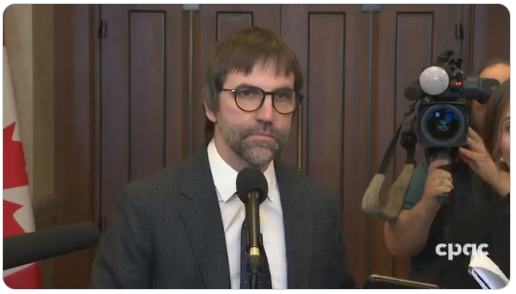
Canadian Heritage Minister Steven Guilbeault, 3 February 2020.
Screencapure from CPAC video.
Several weeks after Canadian Heritage Minister Steven Guilbeault introduced Bill C-10, I started a 20 part blog post series called the Broadcasting Act Blunder (podcast edition here). The series examined many of concerns with the bill, including issues such as over-broad regulation and discoverability requirements that would only garner public attention many months later. I thought about that series yesterday as I watched Guilbeault try in the House of Commons to defend the indefensible: a gag order on committee review of the bill, the first such order in two decades. While the bill is in dire need of fixing, what occurred yesterday was far worse than a blunder. It was a betrayal. A betrayal of the government’s commitment to “strengthen Parliamentary committees so that they can better scrutinize legislation.” A betrayal of the promise to do things differently from previous governments. A betrayal of Canada’s values as a Parliamentary democracy.
The 23 minute and 30 second question and comment period – the House Speaker ruled there could be no debate and that the period could not extend beyond 23 minutes and 30 seconds – notably featured NDP MP Peter Julian and Green MP Elizabeth May, two of the longer serving MPs in the House as among the first to speak. Julian was first elected in 2004, when Guilbeault was only a few years removed from activist stunts such as climbing the CN Tower. Meanwhile, May became the founding Executive Director of the Sierra Club in 1989, the same year Guilbeault started as a university student. It seemed to me that both had a message for an inexperienced cabinet minister elected less than two years ago, namely that some things are bigger than single bill. Bills come and go, but principles – or betrayal of those principles – endures.
Guilbeault clearly did not get it, wondering how the NDP could possibly reject the gag order and effectively support potential delays to his bill. Both the NDP and the Greens may ultimately vote for Bill C-10, but both understand that defending democracy and the freedom of expression of MPs (much less the freedom of expression of all Canadians) is far more important than a delay to any single bill. As May noted, the gag order will do real long term damage. One day it will be a different government on a different issue seeking to use the same procedure to cut short committee study. And the Liberals will have no credible response with no one to blame but themselves.
But we don’t need to look far into the future to see the consequences of the Guilbeault gag order. This past weekend, the Canadian government joined with other countries to criticize the Nigerian government for blocking Twitter and establishing registration requirements for social media. Yet calls for respecting freedom of expression rings hollow when you are shutting down Parliamentary debate on a bill with profound implications for freedom of expression. Indeed, Canada’s lost moral authority on Internet freedoms is an undeniable consequence of Bill C-10 and the Guilbeault gag order.
June 8, 2021
If you were trying to destroy American cities from within … what would you be doing differently?
Sarah Hoyt’s latest Libertarian Enterprise post considers the state of US urban areas after more than a year of Wuhan Coronavirus lockdowns, social controls, and medically “justified” repression:

“Homeless encampment above the 101 @ Spring” by Steve Devol is licensed under CC BY-NC-SA 2.0


Look, I’m sure this was suggested by China, and the dunderheads are totally buying it under their Compleate Illusions system.
Sure climate change. Climate change can justify anything. If we told them they needed to burn people alive to prevent climate change, they’d already been building the pyres.
But that’s just sort of a reflexive thing, like a Moslem saying “Insh Allah“. It’s not actually involved in their thinking as such. Or their thinking is not involved in it. whichever.
The truth is that they realized that the Covidiocy has destroyed the cities.
You see they had everything planned. They were going to force more and more of us into the city, because they were going to make running an internal combustion engine so hard. So if you had a job, you’d live in the city. Where you’re more easily controlled. And where they could make you believe bullshit like overpopulation and that — look at all the homeless — we needed more and more welfare. Their idea of their perfect world is the 1930s version of the future. Just megalopolisis, isolated, with people completely controlled. It has the bonus of leaving pristine wilderness outside that, for the elites to build their dachas.
And part of the problem is that they never understand other people have agency and respond to circumstances.
I don’t know what they expected when they went full fashboots and — in the case of Polis, and I bet not the only one — gave homeless the right to camp in every public land, and defecate in public as well as freeing a bunch of felons.
Did they expect this would just scare people more, and they’d lock themselves in, in fear and trembling, allowing the idiots to design society.
Instead, people left. Americans are on the move. I swear half of my friends are moving from more locked to less locked, from bluer to redder. Some demographers have caught on, seeing through the smoke and mirrors, and are confused — most of them being leftist — because Americans are in the middle of a full migration. As full and as all pervading as the movement west. Or after the civil war the movement of black people North.
Some of this must have penetrated the granite-like heads of the ruling left. Or at least the planning left.
They somehow didn’t expect—possibly because they don’t really get technology. I mean, I have my moments, but I swear most democrats were disappointed when laptops started being made with no “cup holders”. They’re at that level of stupid — that a tech that hasn’t been fully implemented, giving us the ability to work from home, would be kicked into high gear from the covidiocy.
I guess they expected people who work mostly from their computers to sit at home watching panic porn on TV and not work?
More importantly, I don’t think they expected people who have to work in person to follow that migration because, well … if you owned a restaurant that the covidiocy killed, you might, for instance, pay heed to the fact people are driving everywhere because, duh, masks on planes, and therefore build a roadside diner or perhaps find a small town that’s underserved and start anew there.
Oh … a lot of people are changing jobs too, and the jobs are no longer binding them to big cities.
Honestly, the only way for big cities to save themselves is to become touristic centers. NYC was halfway there when the covidiocy hit. Only not fully there because lefty governance sucks at making a city safe.
If I were a lefty governor or mayor right now, I’d aim the fashboots at crime and disorder, get rid of the homeless, spruce up the place, and go all out in courting tourism. Then people would move in to cater to the tourists, and eventually other businesses would move in, because that’s where people are.
But leftists don’t think that way. Carrot and incentive is beneath them (of course.) Their idea is rather that they will force those unwashed peasants to do what they want.
May 30, 2021
QotD: Pornography
Jesse Walker, “Guess Who’s Coming: Progress at the cineplex”, Reason, 2005-03-28.
May 28, 2021
The essential — and largely non-replenishable — trust in government
Last week, Tom posted a then-recent discussion he overheard at The Last Ditch:

[Click to see full-size flowchart]
Two svelte American ladies of a certain age were having coffee today at my West London health club. They were in the next “pod” to me outdoors as I had a post-swim coffee before heading home. Perhaps it’s those wide-open prairies but Americans, bless them, always speak a little more loudly than us so I didn’t really have a choice but to listen to their conversation.
The topic was their mothers. Both moms back in the States are apparently unsure of the wisdom of being vaccinated. One cost of parenthood no-one tells you about beforehand is that one day you will be judged and found wanting by humans you could not love more; your children for whom you would cheerfully die. I confess their mothers immediately had my sympathy, regardless of the correctness of their views.
There was a good deal of sneering about conspiracy theories circulating on the internet. I found it surprising that both errant moms believed 5G was involved, but having listened quietly for another few minutes discovered that neither had ever said so. Their daughters were simply assuming that if they doubted government advice on vaccines, they believed all the other stuff too. One of the mothers is apparently a 9/11 “truther” and her daughter’s observation that no government is capable of keeping such a dark secret struck me as fair.
[…]
There are available facts and facts that will only become available in the future. People must make their choices based on their own risk assessment today. That useless truism is not the point of this post. The truly significant thing I overheard was this. Having sneered at her mother’s belief that “we can’t trust government”, one of the ladies said;
I thought to myself – Mom, I don’t want to believe what you believe because if it’s true I can’t have any of the things I believe in.
There, I thought, was a moment of insight; a moment (almost) of self-awareness. If government can’t be trusted, then the societal change she wants isn’t possible. Therefore, whatever the evidence, government must be trusted. That pretty much sums up the statist mindset.
I don’t know whether these mothers or daughters are right about this issue. I do know that one of the daughters (and her companion seemed to agree) is allowing her desires to displace her reason. In consequence, sadly, her mind will only ever be changed by a catastrophe I would never wish upon her.
I suspect many such earnest, well-meaning souls as Goneril and Regan (as I christened them) felt they needed to believe the state could be trusted at key points in the deadly history of the 20th Century. If the brave new world of Communism was to happen, for example, government had to be trusted with enormous power to make immense change.
Many Gonerils and Regans must have ruefully reflected on that in the Gulag.
May 26, 2021
The Line refutes arguments recently posted in … The Line
Recently the editors at The Line accepted an article from the astroturf “advocacy” group Friends of Canadian Broadcasting, pushing the establishment line that all of us peons and useless idiots in the blogosphere and even a few undisciplined malcontents among the actual mainstream media are totally misunderstanding and misrepresenting what the government is trying to do with their “tax the web giants” initiative. Peter Menzies responds to the latest bullshit propaganda offensive:

[Mouthpiece for Friends of Canadian Broadcasting Daniel] Bernhard makes a great case for the regulation of tech giants, pointing to some truly dreadful things such as the New Zealand massacre streamed on Facebook, and exploitive content uploaded to Montreal’s PornHub.
To the best of my knowledge, none of the people listed above disagree with the Friends on this point. In fact, many have made the case that Bill C-10 is an unnecessary diversion from more serious online industry problems — some of which are addressed in another bill (C-11).
The big matters that need to be addressed by the government involve algorithms, data collection, privacy protection, and anti-competitive practices — not the facility of the Netflix search tool, nor whether the search term “Canadian” should pop up as a default selection.
My main point of disagreement to Bernhard’s piece is that the Internet is no more broadcasting than a cow is a caribou. Further, it’s ridiculous to think that an outmoded relic such as the 1991(!) Broadcasting Act is the proper tool to use to govern communications in the 21st Century (for those inclined, there is a complete policy paper available here that fleshes that out.)
In terms of the sections 2.1 vs 4.1 legal arguments, I’m pretty certain I will lose most of The Line readers if I delve into those details. I’m more than comfortable deferring to my fellow “militants” such as law professors Laidlaw and Geist, whose arguments have been so overwhelming that not even Attorney General David Lametti attempted to refute them in the defence of Guilbeault, who has now established himself as the most regressive Heritage Minister in the history of that ministry.
All readers really need to know is that, yes, Bill C-10 makes it legal for the CRTC to regulate your video or audio uploads if they are posted to “social media”, the definition of which will be left entirely up to the nine government-appointed CRTC commissioners. Who knows what they’ll come up with. There are no minutes of their meetings, so it’s impossible to know what they might be thinking.
I mean, if it was easy to define social media you’d think the government would have just done it, right? Similarly, if the legislation is aimed only at the bad behaviour of the “Web Giants” — the pejorative term Guilbeault has engaged — the bill ought to simply say that. But it doesn’t.
And as for the government-approved Canadian Content industry’s argument that it didn’t want to regulate/suppress the user generated content produced by the rest of us . . .
Oh Yes They Did.
May 25, 2021
QotD: Doctors and individual freedom
Brian Micklethwait, “Curbing liberty — except when they should”, Samizdata, 2005-10-10.
May 24, 2021
“The revolution will be defeated when people stop being scared”
Sean Gabb discusses some outrageous elements of the ongoing cultural revolution against freedom of speech in Britain, the United States and many other western nations:

David Hume Tower at the University of Edinburgh (listed building number 50189).
Photo by Enric via Wikimedia Commons.
If I am a self-employed plumber or electrician, I can speak my mind and laugh at the complaints. If, like the great majority in this country, I am a salaried employee — whether in the state or private sectors is unimportant: the pressures to conformity are the same in both sectors — I must be careful what I say. I am scared of the sack. I am scared of sudden redundancy. I am scared of missing out on promotions. I am scared of generally unfair treatment because of my opinions. I therefore hide my opinions. The Peter Tatchells among us then look round complacently, telling themselves and each other that silence equals agreement, and that the few squeaks of opposition are from “disreputable extremists.”
This explains the present unbalanced debates over slavery and colonialism. Take these examples:
- First, in September 2020, the David Hume Tower at Edinburgh University was “denamed”. Someone had bothered to read the 1748 essay “Of National Characters”, and found in one of its footnotes an unfashionable statement about race. It was at once set aside that Hume was a philosopher of at least considerable note. More important was the “non-overt disrespect, offence, and racism that Black students have to go through at the University of Edinburgh”.
- Second, the Music Department at Oxford is presently worried that its curriculum “structurally centres white European music”, and that this causes “students of colour great distress”. It therefore wants to change its focus from the European classical tradition to things like “Artists Demanding Trump Stop Using Their Songs”. It also wants to discourage students from studying musical notation, as this is a “colonialist representational system”.
I could give a third illustration, and a fourth. I could fill a pamphlet with more. Some would be more alarming, though few less absurd. But these two can stand well enough for all the others. What makes these debates so irritating is that they are not debates. One side can put its case just as it pleases. The other is reduced to accepting all the main charges and begging for mitigation: “What Hume said was evil and unpardonable — but he was important for other things.” Or: “I feel your pain, but Mozart owned no slaves, and everyone knows that Beethoven was really black.” Because it has been so humbly begged, full mitigation will, in both cases, be granted. Hume will continue to be studied in the universities. Music students at Oxford will continue to use the standard notation and to analyse the usual classics. But preventing these things was never part of the agenda. The agenda was and is to transform what were honoured or unquestioned parts of our civilisation into things useful but more or less suspect, things subject to a toleration that may be varied or withdrawn at any time without notice.
It should be plain that we are, in both England and America, living through a revolution. This is not a normal revolution as these things are considered. Unlike in France or Russia, there has been no overthrow of an established order, no burst of state violence, no establishment after that of an overtly new order. There are no secret police. There are no labour camps. No one is beaten to death in a police cell. All the same, we are living through a revolution. It is a revolution that has involved the gradual capture of education, the media, the administration, the charities and the more permeable religious institutions, and the recent aligning of the larger or more glamorous business concerns. I see no point in discussing its ultimate objects. I am not sure if these are wholly agreed. But its provisional object is the destruction of our traditional identity, and of our liberty so far as this stands in the way of that provisional object.
These two elements of the provisional object are equally important. Our civilisation is being pulled apart because doing so strips away the mass of associations that, left in place, might hold up the more alarming parts of the transformation. Opposition is so feeble not only because that is all that will be tolerated: feeble opposition is all that can be tolerated. This is a revolution in which opponents are not murdered, but only scared into silence. They are scared into silence chiefly by fear of destroyed or blighted careers. The revolution will be defeated when people stop being scared. Then, there will be vicious and unrelenting public mockery, and commercial boycotts, and shareholder rebellions, and lost elections, and the general feeling of solidarity and impunity still sometimes found in a football stadium.
May 23, 2021
QotD: The psychological impact of extended lockdowns
Theodore Dalrymple (TD): The first thing to say is that I do not like the term “mental health.” Was Isaac Newton mentally healthy, or Michelangelo? I think part of the problem is very concept of mental health. It implies that there is some state or condition of mind deviation from which is analogous to illness. Once this idea takes hold, it is clearly up to an expert to cure the person, or better still prevent him from getting ill in the first place. This expectation cannot be met, but the idea that it can be makes people more fragile.
Second, people clearly vary much in their response to confinements, lockdowns, closures of resorts of entertainment, etc. For myself, I have reached the age of misanthropy or self-sufficiency when these things make comparatively little difference to my life. I have plenty of space and plenty of things to do, in essence reading and writing. But that does not make me mentally healthier than a young man who is frustrated because he cannot play football with his friends and becomes ratty – moreover living in a very confined space.
Depression is so loosely defined a term that it has become almost valueless as a diagnosis. How often have you heard someone say “I’m unhappy” rather than “I’m depressed?” The semantic shift is very important. The proper response to someone who says that he is depressed is to give him antidepressants, even though these don’t work in the majority of cases, except as a placebo, and have potential side-effects. It is always tempting for people who are unhappy to drink alcohol – to drown their sorrows, as we say. Of course, if you drink too much, you might become really and truly depressed. A person who did not respond to the current situation with a little gloom would be odd.
Claudio Grass, “Theodore Dalrymple: Self-Control And Self-Respect Have Become Undervalued”, The Iconoclast, 2021-02-17.
May 21, 2021
Mission creep – to “make the web giants pay”, the feds will “need” to regulate everything Canadians view or post online
Michael Geist explains why we can safely discount any new lies that the Heritage Minister spews about his Bill C-10 censorship bill:

Canadian Heritage Minister Steven Guilbeault has tried to deflect public concern with the regulation of user generated content under Bill C-10 by claiming the intent is to make the “web giants” pay their fair share. Yet according to an internal government memo to Guilbeault signed by former Heritage Deputy Minister Hélène Laurendeau released under the Access to Information Act, the department has for months envisioned a far broader regulatory reach. The memo identifies a wide range of targets, including podcast apps such as Stitcher and Pocket Casts, audiobook services such as Audible, home workout apps, adult websites, sports streaming services such as MLB.TV and DAZN, niche video services such as Britbox, and even news sites such as the BBC and CPAC.
The regulations would bring the full power of CRTC regulation over these sites and services. This includes requiring CRTC registration, disclosure of financial and viewership data, Canadian content discoverability requirements (yes, that could mean Canadian discoverability for pornography services), and mandated payments to support Canadian film, television, and music production. The list also notably identifies potential regulation of Youtube Music, Snapchat Originals, and other social media services whose supposed exclusion has been cited as the rationale to extend regulation to user generated content.
The document was obtained by Postmedia journalist Anja Karadeglija, who first reported it last weekend, focusing on departmental warnings about the importance of excluding user generated content from the scope of regulation in Bill C-10 and the necessity of Sections 2.1 and 4.1 (Section 4.1 was removed by the government). The memo states:
Social media services like YouTube and Facebook greatly expand the number of individuals and other entities that can be said to be transmitting programs over the Internet. This provides an important limitation on the application of the Act by ensuring that under the Act the CRTC cannot regulate the audio or video communications of individuals (or other entities) simply because they use a social media service.
The government obviously ignored the warning and removed the limitation. The document continues by identifying a non-exhaustive list of services that “are likely to regulated under the Act.” The department acknowledges that some services may be exempted by the CRTC, though there are no specifics in the bill that identify thresholds for exemptions. Even if exempted, services may still be required to register with the CRTC and provide confidential commercial data in order to obtain an exemption. Indeed, the default approach is that all services are subject to Canadian regulation, leading to a dizzying array of regulated services identified by the department.
Emphasis mine.
May 19, 2021
The ginger Windsor loose cannon on “bonkers” free speech protection in the United States
James Delingpole on the latest unfortunate burble from one of the much lesser members of the House of Windsor:

Prince Harry and Meghan Markle visit Titanic Belfast in March 2018.
Photo from the Northern Ireland Office via Wikimedia Commons.
Prince Harry’s epic stupidity is probably inherited from his presumed father, the Prince of Wales. Prince Charles, too, only got two A levels — a B in History and a C in French — yet somehow strings were pulled to land him a place at Cambridge University (normally it would have required something like three A grades at A Level, plus a decent performance in the entrance exam), where he scraped a lowly 2:2 in History.
There is, of course, nothing wrong with being epically, fabulously, unbelievably stupid. Many upper-class men successfully make their brainlessness part of their comical charm. Where stupidity becomes unattractive and culpable, though, is when it’s deployed to comment on issues far, far above its pay grade, and when it’s afforded undeserved prestige.
No one as thick as Harry, it’s surely a given, ought ever be allowed on to a public platform to pronounce on issues as vital as the protection of free speech. Yet this is exactly what happened when Harry was given space to expound his half-baked views on a podcast. Sure, Harry had the good grace to admit that he hadn’t a clue what he was talking about:
I don’t want to start going down the First Amendment route because that’s a huge subject and one which I don’t understand because I’ve only been here a short time.
Unfortunately, that didn’t stop him declaring that he thought the First Amendment was “bonkers”.
His explanation as to why he thought so was a bit incoherent, but it seemed to involve his belief that it could be used for something bad called “ideology” and could be used as an excuse to “spread hate”. He added: “Laws were created to protect people.” What I’m guessing Harry was struggling to do was to try to wheel out the woke cliche that while free speech is fine, “hate speech” isn’t fine and should not enjoy constitutional protection. This threadbare argument can be demolished in a second by anyone with more than two A Levels. Essentially if “free speech” laws don’t protect “hate speech” then they are not really free speech protection laws at all.
Like Prince Harry, I wouldn’t consider myself to be an expert on U.S. history. But I do dimly recall that round about the second half of the 18th century America’s colonists successfully freed themselves from rule by one of Prince Harry’s ancestors. The U.S. Constitution — and that pesky First Amendment — was one of the consequences.
QotD: School is prison for kids
School is child prison. It’s forcing kids to spend their childhood — a happy time! a time of natural curiosity and exploration and wonder — sitting in un-air-conditioned blocky buildings, cramped into identical desks, listening to someone drone on about the difference between alliteration and assonance, desperate to even be able to fidget but knowing that if they do their teacher will yell at them, and maybe they’ll get a detention that extends their sentence even longer without parole. The anti-psychiatric-abuse community has invented the “Burrito Test” — if a place won’t let you microwave a burrito without asking permission, it’s an institution. Doesn’t matter if the name is “Center For Flourishing” or whatever and the aides are social workers in street clothes instead of nurses in scrubs — if it doesn’t pass the Burrito Test, it’s an institution. There is no way school will let you microwave a burrito without permission. THEY WILL NOT EVEN LET YOU GO TO THE BATHROOM WITHOUT PERMISSION. YOU HAVE TO RAISE YOUR HAND AND ASK YOUR TEACHER FOR SOMETHING CALLED “THE BATHROOM PASS” IN FRONT OF YOUR ENTIRE CLASS, AND IF SHE DOESN’T LIKE YOU, SHE CAN JUST SAY NO.
I don’t like actual prisons, the ones for criminals, but I will say this for them — people keep them around because they honestly believe they prevent crime. If someone found proof-positive that prisons didn’t prevent any crimes at all, but still suggested that we should keep sending people there, because it means we’d have “fewer middle-aged people on the streets” and “fewer adults forced to go home to empty apartments and houses”, then MAYBE YOU WOULD START TO UNDERSTAND HOW I FEEL ABOUT SENDING PEOPLE TO SCHOOL FOR THE SAME REASON.
I sometimes sit in on child psychiatrists’ case conferences, and I want to scream at them. There’s the kid who locks herself in the bathroom every morning so her parents can’t drag her to child prison, and her parents stand outside the bathroom door to yell at her for hours until she finally gives in and goes, and everyone is trying to medicate her or figure out how to remove the bathroom locks, and THEY ARE SOLVING THE WRONG PROBLEM. There are all the kids who had bedwetting or awful depression or constant panic attacks, and then as soon as the coronavirus caused the child prisons to shut down the kids mysteriously became instantly better. I have heard stories of kids bullied to the point where it would be unfair not to call it torture, and the child prisons respond according to Procedures which look very good on paper and hit all the right We-Are-Taking-This-Seriously buzzwords but somehow never result in the kids not being tortured every day, and if the kids’ parents were to stop bringing them to child prison every day to get tortured anew the cops would haul those parents to jail, and sometimes the only solution is the parents to switch them to the charter schools THAT FREDDIE DEBOER WANTS TO SHUT DOWN.
I see people on Twitter and Reddit post their stories from child prison, all of which they treat like it’s perfectly normal. The district that wanted to save money, so it banned teachers from turning the heat above 50 degrees in the depths of winter. The district that decided running was an unsafe activity, and so any child who ran or jumped or played other-than-sedately during recess would get sent to detention — yeah, that’s fine, let’s just make all our children spent the first 18 years of their life somewhere they’re not allowed to run, that’ll be totally normal child development. You might object that they can run at home, but of course teachers assign three hours of homework a day despite ample evidence that homework does not help learning. Preventing children from having any free time, or the ability to do any of the things they want to do seems to just be an end in itself. Every single doctor and psychologist in the world has pointed out that children and teens naturally follow a different sleep pattern than adults, probably closer to 12 PM to 9 AM than the average adult’s 10 – 7. Child prisons usually start around 7 or 8 AM, meaning any child who shows up on time is necessarily sleep-deprived in ways that probably harm their health and development.
School forces children to be confined in an uninhabitable environment, restrained from moving, and psychologically tortured in a state of profound sleep deprivation, under pain of imprisoning their parents if they refuse. The only possible justification for this is that it achieves some kind of profound social benefit like eliminating poverty. If it doesn’t, you might as well replace it with something less traumatizing, like child labor. The kid will still have to spend eight hours of their day toiling in a terrible environment, but at least they’ll get some pocket money! At least their boss can’t tell them to keep working off the clock under the guise of “homework”! I have worked as a medical resident, widely considered one of the most horrifying and abusive jobs it is possible to take in a First World country. I can say with absolute confidence that I would gladly do another four years of residency if the only alternative was another four years of high school.
Scott Alexander, “Book Review — The Cult of Smart”, Astral Codex Ten, 2021-02-17.
May 18, 2021
QotD: The imaginary problem of having “too much” choice
A famous scene in the film Moscow on the Hudson has Robin Williams as a Soviet immigrant collapsing at the sight of an American coffee aisle, circa 1984. Imagine what would happen in Starbucks.
A free economy multiplies variety, the better to serve buyers with different tastes and different needs and to give people the chance to experience different goods at different times. Arguing that this plenitude is inefficient went out decades ago. The problem with markets, the detractors now say, is that all these choices make us unhappy.
Virginia Postrel, “I’m Pro-Choice”, Forbes, 2005-03-28.
May 12, 2021
Critics are all conspiracy theorists says minister actively planning to regulate speech online
The Trudeau government has come a long, long way from those far-distant days when they were all about “openness” and “accountability” and especially about protecting free speech:
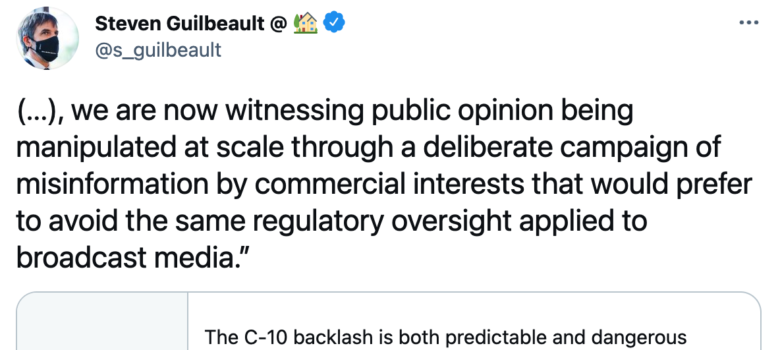
Last night, Canadian Heritage Minister Steven Guilbeault posted a remarkable tweet that should heighten concerns about Bill C-10, forthcoming online harms legislation, and the government’s intent with respect to free speech. In the weeks since it opened the door to treating all user generated content as a “program” subject to CRTC regulation, there has been mounting public criticism and concern about the implications for free speech. While the tech companies have remained relatively silent, Canadians have been speaking out. Those voices now include the Government of Saskatchewan, with Minister of Justice Gord Wyant writing to Guilbeault to urge the federal government to stop Bill C-10 from proceeding or amend it to ensure that “all creative Internet content generated by Canadians will be exempt from any regulatory supervision by federal government agencies.”
Given the opposition – as well as Guilbeault’s well-documented disastrous interviews on CBC and CTV – one would have thought the Minister would be seeking to assuage public concern. Instead, Guilbeault took to Twitter last night to suggest that the public anger over Bill C-10 was a matter of “public opinion being manipulated at scale through a deliberate campaign of misinformation by commercial interests that would prefer to avoid the same regulatory oversight applied to broadcast media.”
Over the past few weeks of intense Bill C-10 debate, nothing has left me angrier or more concerned than this tweet. First, the conspiracy theory amplified by Guilbeault is plainly wrong and itself quite clearly misinformation. The concerns regarding the bill have been backed by law professors, experts, Justice Ministers, former CRTC chairs, and hundreds of others. To claim this is a tech-inspired misinformation campaign lends support to the view that Guilbeault still does not understand his own bill and its implications. Moreover, not only have the tech companies remained relatively quiet, but most did not even appear before the Heritage Committee as part of its study. To suggest that having largely ignored the bill, the companies are now engaged in some grand conspiracy is lunacy.
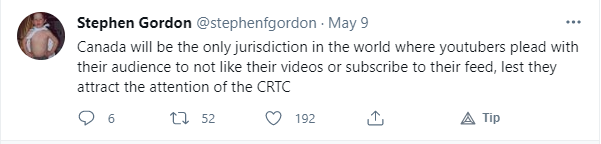
One of the fun notions of C-10 is having some sort of popularity cut-off for regulation to kick in … the more popular your online output becomes, the closer you’ll get to having one of Justin’s CRTC apparatchiks censoring your work:
May 10, 2021
QotD: Against the notion of the “Social Contract”
In all of his political writings, Scruton takes on the Left for scorning existing norms and customs, and for promoting a “culture of repudiation.” The Left is “negative.” It dismisses “every aspect of our cultural capital” with the language of brutal invective: accusing every defender of human nature and sound tradition of “racism,” “xenophobia,” “homophobia,” and “sexism.” Like 1984‘s “two minutes of hate,” this language tears down, intimidates, and can never build anything humane or constructive — it is nihilistic to the core. At the same time, Scruton wants to reach out to reasonable liberals who eschew ideology and who still believe in civility and the promise of national belonging. His conservatism can discern the truth in liberalism (another Aristotelian trait) while the partisans of repudiation see half the human race as enemies.
Daniel J. Mahoney, “Beyond the Culture of Repudiation”, Claremont Review of Books, 2018-06.


