Drachinifel
Published 1 Dec 2018Title says it all really, we look at something that was definitely worth doing, which really should have been done much sooner.


Drachinifel
Published 1 Dec 2018Title says it all really, we look at something that was definitely worth doing, which really should have been done much sooner.
In City Journal, John Tierney considers how political leaders and public health officials across the western world are going Rahm Emanual one better by continuously extending the Wuhan Coronavirus crisis:
Wuhan Institute of Virology.
Wikimedia Commons.
Throughout the pandemic, American political and public-health leaders have been following Rahm Emanuel’s classic dictum for power-seeking officials: “You never want a serious crisis to go to waste.” Now they’ve adopted a corollary: you never want a crisis to end.
So they are prolonging the national misery instead of easing it, which could be done with a few simple strategies. Explain to the public that the virus will never disappear but is no longer a mortal threat to the vast majority of Americans. Encourage the minority still at risk to get vaccinated by honestly discussing who is in jeopardy and what scientists have learned about infections. Promote treatments proven to prevent infection and speed recovery while avoiding unproven treatments and mandates that cause collateral damage and generate mistrust. Above all, make it clear to Americans that we finally have reason to celebrate: what once seemed an unprecedented danger is now just one of many pathogens that we know how to live with.
But the nation’s crisismongers aren’t about to relinquish their hold over the public, so they’ve set new goals that are as unachievable as they are unnecessary and harmful. Making vaccines available to every American adult is no longer sufficient; now the crisis cannot end until the entire population has been vaccinated. Instead of focusing efforts on vaccinating the vulnerable, officials obsess on compelling universal obedience, even if that means squandering vaccines on people who already have acquired natural immunity or are at minimal risk of serious illness.
The same progressives who regularly denounce “systemic racism” and “Western imperialism” are now enforcing policies that disproportionately punish minorities and the poor, both in the United States (the majority of black teenagers and young adults in New York have been banished from much of public life by the city’s new vaccine-passport policy) and in the rest of the world. The hypocrisy was deftly captured in a tweet by Martin Kulldorff, the Harvard epidemiologist: “If you favor university vaccine mandates for low-risk American and European students, when there is not enough vaccine for older high-risk people in Asia, Africa and Latin America, please remove your #BLM tags from your Twitter/Facebook profiles.”
Children are being sentenced to another round of unnecessary mask mandates and probably more school closures based on evidence-free warnings from Anthony Fauci and others that the Delta variant will be more deadly to them than the original virus. While the variant is more infectious, the evidence does not show it to be any more lethal. In fact, the current mortality rate among American children with Covid is lower than it was last year — and last year many more children died of the flu than of Covid. One of the most thorough studies, in England, shows that the survival rate for those under 18 with Covid is 99.995 percent. But instead of emphasizing these reassuring statistics, public-health officials like Jerome Adams, the former surgeon general, keep looking for new ways to scare parents and children.
Here’s the thing: contrary to what the left thinks, when you leave wealth in the hands of the individuals, they don’t just flush it down the toilet or build gigantic bins that they fill with money, in which they go for a refreshing swim every day.
People do things with that money. And even if all they do is buy stuff (thereby allowing someone else to accumulate wealth) or invest it, that money gets aggregated and finds things to do, as it were. Wealth goes to work on things that seem interesting, might be interesting, or are otherwise likely to make money for the individuals who hold the wealth.
Individuals have money to start new businesses that would never have existed if they’d paid that money in taxes. Or they “invest” in free time and a really nice garden, which in turn lifts the spirits of people who invent something because they feel better than they would otherwise.
The left insists that if they leave money in individual hands, it will just be “wasted”. (Because, you know, no money spent on a vast apparatus, most of it a jobs program for useless paper pushers or power-hungry martinets is ever wasted.)
How do they know? Have they tried leaving enough money in the hands of those who earn it to make a difference?
Not in the twentieth century. Though we can infer from the fact that the most sclerotic, dying countries are the highest taxed ones, that perhaps what government considers “best” and what we consider “best” are not the same.
Not just taxes, but regulations too weigh heavily on possibilities. Sure, the left sees “lands saved” (or created. oop) when say, regulations curtail oil drilling. But what I see is energy taking up an excessive amount of every family’s money, wealth that would otherwise be freed for other investments, for starting businesses, even “just” for fun.
The problem we have is that leftists lack utterly in imagination. They see the “pristine” plots of land, or the things government does with our money and they find it good.
But they’re mind’s-eye blind. They can’t see the wealth that has been consumed for almost 100 years now say on the war on poverty to create chronic poverty having instead been used by individuals to create, to invest, to build, so that, in that parallel world in which money stayed in individual hands, we now have interplanetary travel, colonies all over the solar system, and squid farms on Mars that feed all of humanity.
Their lack of vision, their killing of possibilities without the slightest thought to them: That is a tragedy.
Sara Hoyt, “The Tragedy of the Squid Farms on Mars”, Libertarian Enterprise, 2018-12-05.
Sean Gabb explains why even libertarians need to consider the non-state power in the hands of corporations that can — and does — force people out of their jobs, their homes, and even deprive them of the ability to communicate or to access financial services merely for expressing unpopular opinions. As I said in a different venue, it’s a short step from “no fly lists” to “no eat lists”, especially when the enforcing entity is a nominally private organization:
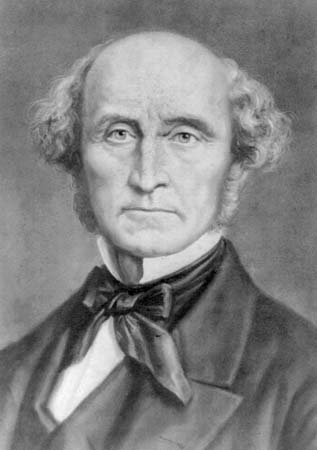
John Stuart Mill (1806-1873)
The old pressures to conform were wrong. So are the new. And they are wrong simply because they are pressures to conform. I find myself at last appreciating a part of Mill’s essay On Liberty for which I never used to have much time. Until recently, I would insist that the only real oppression was by the State: all else was the working of private choice. If the authorities fined a man £5 for having sex with another man, that was outrageous tyranny. If his tastes became public knowledge, and he was unable to find work, that was merely unfortunate. This is, I still believe, essentially true. Indeed, I could argue that, without a State having centralised and corporatised powers of discrimination that ought to be widely distributed, there would be no problem — or there would be a problem that was bearable. But these powers were centralised and corporatised a long time ago. They are now being used to achieve a uniformity of opinion outside the home in which the formal organs of compulsion have no obvious part. This is not the “tyranny of the majority” that worried Mill. I find it inconceivable that anything close to a majority could believe the insane drivel pouring from the regime media. Neither, though, is it the kind of oppression against which liberal bills of rights have traditionally been written. Because of this —
when society is itself the tyrant …, its means of tyrannising are not restricted to the acts which it may do by the hands of its political functionaries. Society can and does execute its own mandates: and if it issues wrong mandates instead of right, or any mandates at all in things with which it ought not to meddle, it practises a social tyranny more formidable than many kinds of political oppression, since, though not usually upheld by such extreme penalties, it leaves fewer means of escape, penetrating much more deeply into the details of life, and enslaving the soul itself. Protection, therefore, against the tyranny of the magistrate is not enough: there needs protection also against the tyranny of the prevailing opinion and feeling; against the tendency of society to impose, by other means than civil penalties, its own ideas and practices as rules of conduct on those who dissent from them …
(J.S. Mill On Liberty, 1859, “Introductory“)
We need protection indeed. But the protection we need is not yet another law telling the police to leave dissidents alone. We already have a stack of these, and they are protections against a threat that largely does not exist. The answer, I suggest, is an amendment to the anti-discrimination laws to outlaw discrimination on the grounds of what may be loosely called political opinion.
I say hardly anyone read my original essay. Sadly, most of those who did read it stand in the more wooden reaches of the libertarian movement, and these set up a cry that I had become a Communist. I was suggesting that private organisations should be coerced in their choices of whom and whom not to employ, and even in their choices of customer and supplier. I had abandoned the non-aggression principle. Here, briefly expressed, is my answer to these claims.
I run the Centre for Ancient Studies. This provides a range of tuition services in Greek and Latin. It is a sole tradership. As such, I reserve the unconditional right to decide what services I offer and to whom. If I dislike the colour of your face, or the status of your foreskin, or your tastes in love, or anything else that I may think relevant, it should be my right not to do business with you. It may be that only a fool turns away customers with money to spend, and I am not that sort of a fool. Even so, I do claim at least the theoretical right, and I ground it on my right to do as I please with my own. But I claim these rights as a human individual. A limited company is not a human individual. Whatever entrepreneurship may exist in them, these companies are artificial persons and creatures of the State. Their owners have the privilege of limited liability. That is, they have the right, in the event of insolvency, not to pay the debts of a company if these are greater than the assets of the company. If this were not a valuable right, there would not be so many limited companies. There are almost no large companies, and none lasting more than a single generation, that do not have limited liability.
This being so, limited companies benefit from a grant of privilege from the State, and are legitimate subjects of regulation by the State for as long as they are receipt of this privilege. No doubt, some forms of state regulation are bad in their objects, or bad as regards the means to their objects. But regulation is not in itself an aggression by the State. It follows that, whether or not we can get it, libertarians should not feel barred from demanding laws to prevent limited companies from discriminating against their employees on the grounds of political opinion, and to require them to do business with customers and suppliers regardless of political opinion.
I appreciate that I am asking for more than the regulation of limited companies. The anti-discrimination laws we have make no distinction between incorporated and unincorporated associations. Even so, the extension of these laws to cover political opinion would mainly affect only the larger limited companies. At the same time, there is an obvious and overriding public interest in the protection of political opinion. People are now scared to speak their minds. Whether intended or just revealed, this is part of the strategy. The reason why the collapse of both freedom and tradition is gathering pace is because no one dares stand up and protest. In the absence of protest, everything will carry on as it is. Given a restored right of protest, there is a chance of stopping the collapse. The only way to lift the blanket of fear that now lies over all but approved opinion is somehow or other to get a law making it clear that no one who speaks his mind can be loaded with shadow punishments.
“Somehow or other!” In a sense, I am making a fool of myself. I am asking the politicians to make a law against what they themselves may not be doing, but that has no effect on their main reason for being in politics, which is to fill their pockets. I am asking them to take on the entire mass of the non-elected Establishment. I am asking a lot of these people. On the other hand, the politicians still need to be elected, and that was the weak point in the Establishment’s plan to stay in the European Union. We had to spend four years voting and revoting, but we did eventually get what we wanted. It is conceivable that, if enough of us call loudly enough for protection, some kind of protection will be granted.
Short of that, we are lost.
In the latest Libertarian Enterprise, L. Neil Smith recounts the sad record of US political parties who claim to support causes but uniformly shrink from actual support of those causes or their advocates:
A late newspaper columnist named Sam Francis (ultimately denounced by the left as a racist, of course) once said that America is ruled by an Evil party (the Democrats) and a Stupid party (the Republicans). To “stupid”, I would rush to add “cowardly”: when the GOP finally got a leader with a spine and testicles and guts (extremely rare qualities among Republicans), they were so terrified of of the man that they betrayed and abandoned him. A third political party, the Libertarians, seems determined to be even more spineless, balless, and gutless; they have specialized for years in nominating con-men and crooks for President.
They also don’t seem to know who their friends are, or how to treat them when they’ve found them. A case in point is one Norma Jean Almadovar, a former police officer and professional sex-worker who wanted to advance the Libertarian Party’s cause and recognition. The party that had always claimed it wanted to legalize prostitution was embarrassed to be confronted by the beliefs they claimed to advocate, and froze her out.
Now the once-admirable conservative youth organization Turning Point USA has faced an almost identical “crisis” and has failed almost identically. The Internet pornography-star Brandi Love (look her up), was originally scheduled to speak at their recent convention — against sex-work — but she was suddenly disinvited and chucked out into the cold, just like Norma Jean. Words like “graceless”, “churlish”, petty, “mean”,and “pusillanimous” come immediately to mind. It appears that competition has worked just as Adam Smith predicted. TPUSA is just as cowardlly and stupid as the LP.
Years ago, I took it on myself to write to Norma Jean to tell her how deeply ashamed I was of the Libertarian Party; it was just one of many reasons that I eventually left the party. Now I’m writing this little ditty in the faint hope that Brandi (whose real name is Tracey Lynn Livermore) will see it. I mean to tell her the same thing about Republicans that’s true of the Libertarians. Sorry sweetie, put not thy trust in would-be princes.
There was a movie, some years ago (it was about police corruption; I don’t remember anything else about it), where the phrase “you’ve lost the meaning” recurred several times. The Libertaran Party and the GOP lost whatever meaning they had long, long ago. Unfortunately, the Marxists, Stalinists, and Maoists we’re up against never lose their meaning. To quote another movie (Die Hard) they want to kill you and cook you and eat you. Not necessarily in that order.
DailyHitchens
Published 22 Jan 2010Aug 7, 2009. Christopher Hitchens talks with EconTalk host Russ Roberts about George Orwell. Drawing on his book Why Orwell Matters, Hitchens talks about Orwell’s opposition to imperialism, fascism, and Stalinism, his moral courage, and his devotion to language. Along the way, Hitchens makes the case for why Orwell matters. For more videos, updates and info on Christopher Hitchens, please visit http://www.dailyhitchens.com
In Tuesday’s NP Platformed, Colby Cosh pays tribute to one of the holy places of free speech, Speakers’ Corner:
“Speakers’ Corner – Hyde Park – London” by Manolo Blanco is licensed under CC BY-NC-SA 2.0


We detect a slightly surprising absence of international media commotion over a dreadful event that happened Sunday: a woman giving a critique of Islam at Speakers’ Corner in London’s Hyde Park was slashed in the face by a fanatic. The victim, 39-year-old Hatun Tash, is said to be a familiar figure at the Mecca of free speech. And, yes, NP Platformed uses this geographic metaphor intentionally.
Probably every country has sites consecrated to its distinctive political ideals. Speakers’ Corner is different: it represents the ideal of absolute free speech for, and to, the entire world. A non-American visiting the Lincoln Memorial is there to honour the memory of a great man; if he visits the Washington Monument, it’s probably for the purpose of making phallic-themed jokes. But for 150 years, non-Englishmen visiting Hyde Park, from Lenin to Bishop Tutu, have been awestruck by the freedom that radical speakers enjoy at the original among the world’s many Speakers’ Corners.
Few Londoners pay it much mind anymore — not since the 19th century, when the nigh-inviolable freedom of speech enjoyed on the corner actually served to endanger governments and give impetus to liberal social change. Since about 1900, it has mostly been a place, almost a rehearsal space, for the tireless cranks of any given moment: dietary Savonarolas, village atheists, suffragettes, Trots and syndicalists and Maoists. They have been joined by generations of Muslims preaching various Islamic doctrines or far-out varieties of the faith.
Foreigners, however, have often been astonished to discover that Speakers’ Corner mostly lives up to its ideals, or that any place could. The British state really lets those people say those things in public without locking them up. The park has seen plenty of affrays in its time, but fights have become rare as the ritual purpose of the space has become universally understood.
Rare, too, are the United Kingdom’s infringements on its inviolability. After the Bloody Sunday shootings of 1972, three Irish republicans were arrested under the Treason Felony Act of 1848 for having proposed war against Britain in Hyde Park. They were found guilty of lesser charges, sentenced to time served and sent back across the Irish Sea, but Irish nationalists rightly dined out on the incident for many years, and the criminal offence of “treason felony” has never since been heard of in any English courtroom.
Mark Steyn on the life and work of cartoonist Kurt Westergaard:
Kurt Westergaard and I were successive winners of the Danish Free Press Society’s Sappho Award. I was very flattered to find myself in his company, but couldn’t honestly say I deserved to be. Kurt was one of the bravest men of our time – not because he was inclined to bravery, but simply because, when it was required, he met the challenge and never backed down.
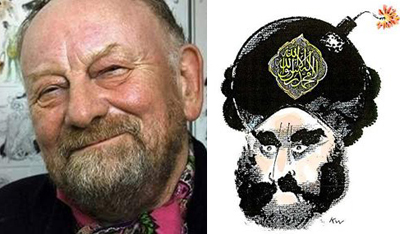
Sixteen years ago Flemming Rose of the Danish newspaper Jyllands-Posten decided to conduct a thought experiment in public after an author casually revealed that he couldn’t find any Danish artist willing to illustrate his book about “the Prophet Mohammed” (as the BBC now routinely styles him). So Flemming called twelve cartoonists and invited them to depict the late Prophet. Kurt Westergaard’s cartoon was the memorable one, and the one you recall as the years roll by. It was a pithy visual jest: Mohammed’s turban as a bomb with a lit fuse. See picture at top right.
“I attempted to show that terrorists get their spiritual ammunition from parts of Islam, and with this spiritual ammunition, and with dynamite and other explosives, they kill people,” Kurt told my old newspaper The National Post a few years back. “I showed this in a cartoon and what happened? They want to kill me, so I think I was right.”
An otherwise courtly, cultured Dane, Kurt Westergaard had a somewhat arresting dress code, preferring le rouge et le noir, the colors of anarchists, although, as a practical matter, it’s hard for a man of advanced years to carry off red trousers, whatever his motivation. He would qualify his pantaloons by explaining that he was not a political anarchist but a cultural one. Still, one can gather from the garb alone that Westergaard was no “right-winger”. Like most of the men and women I have shared a stage with in Europe this century, he was an old Sixties radical sufficiently principled to think the same kind of jokes he’d applied to church, monarchy, parliament and every other societal institution should also be applied to Islam. He never wanted to be a “free speech hero”, but gamely bore the burthen once it had been dropped on him. He certainly never wanted to be world-famous, albeit more so in Mogadishu than Manhattan and Lahore than Los Angeles. It cost him a comfortable retirement, weakened his health, and an ever more craven culture denied him the consolations of monetary exploitation. When I expressed sympathy, he laughed and said he’d do the same cartoon all over again even knowing what he was in for.
The blood lust began with a trio of imams on the make shopping the twelve cartoons (plus three cruder fakes) round the Muslim world, and leaving it to the usual Islamonutters to take it from there: In nothing flat, over two hundred people were dead – which meant that CNN & Co were obliged to cover the story. They did so by modifying Westergaard’s cartoon, with Mohammed’s face pixilated, as if he’d entered the witness protection programme. If only. In reality, it was that dwindling band of people who believe in free speech – and, indeed, free speech itself – that found itself in the witness protection programme.
Biographics
Published 29 Nov 2019This video is #sponsored by NordVPN.
Credits:
Host – Simon Whistler
Author – Morris M
Producer – Jennifer Da Silva
Executive Producer – Shell HarrisBusiness inquiries to biographics.email@gmail.com
Source/Further reading:
Britannica’s Orwell Bio: https://www.britannica.com/biography/…
Excellent, very informative ONDB biography (paywall for non-UK users. UK users need only enter library card number to access): https://www.oxforddnb.com/view/10.109…
Spanish civil war: https://encyclopedia.ushmm.org/conten…
https://www.history.com/this-day-in-h…
Orwell’s mistakes on the Spanish Civil War: https://www.theguardian.com/books/201…
Orwell at the BBC: https://www.bbc.com/news/entertainmen…
Matt Taibbi discusses the (recent?) US intelligence agencies’ apparent concentration on domestic “enemies” like Republicans, Jewish organizations, conservative broadcasters, and US Presidents and their appointed officials:
The scene was perfectly representative of what the erstwhile “liberal” press has become: collections of current and former enforcement types, masquerading as journalists, engaged in patriotic denunciations of critics and rote recitals of quasi-official statements.
Not that it matters to [Fox TV host Tucker] Carlson’s critics, but odds favor the NSA scandal being true. An extraordinarily rich recent history of illegal, politically-directed leaks has gone mostly uncovered, in another glaring recent press failure that itself is part of this story.
It’s admitted. Go back to December, 2015, and you’ll find a Wall Street Journal story by Adam Entous and Danny Yadron quoting senior government officials copping to the fact that the Obama White House reviewed intercepts of conversations between “U.S lawmakers and American-Jewish groups.”
The White House in that case was anxious to know what congressional opponents to Obama’s Iran deal were thinking, and peeked in the electronic cookie jar to get an advance preview at such “incidentally” collected info. This prompted what one official called an “Oh, shit” moment, when they realized that what they’d done might result in “the executive branch being accused of spying.”
After Obama left office, illegal leaks of classified intercepts became commonplace. Many, including the famed January, 2017 leak of conversations between Michael Flynn and Russian ambassador Sergei Kislyak, were key elements of major, news-cycle-dominating bombshells. Others, like “Russian ambassador told Moscow that Kushner wanted secret communications channel with Kremlin,” or news that former National Security Adviser Susan Rice unmasked the identities of senior Trump officials in foreign intercepts, were openly violative of the prohibition against disclosing the existence of such surveillance, let alone the contents.
These leaks tended to go to the same small coterie of reporters at outlets like the Washington Post, New York Times, and CNN, and not one prompted blowback. This was a major forgotten element of the Reality Winner story. Winner, a relatively low-level contractor acting on her own, was caught, charged, and jailed with extraordinary speed after leaking an NSA document about Russian interference to the Intercept. But these dozens of similar violations by senior intelligence officials, mainly in leaks about Trump, went not just unpunished but un-investigated. As Winner’s lawyer, Titus Nichols, told me years ago, his client’s case was “about low-hanging fruit.”
British MP Andrew Lewer on the inability (and determined unwillingness) of western governments at all levels to back away from all the restrictions they’ve been able to impose on their citizens since the start of the Wuhan Coronavirus pandemic:
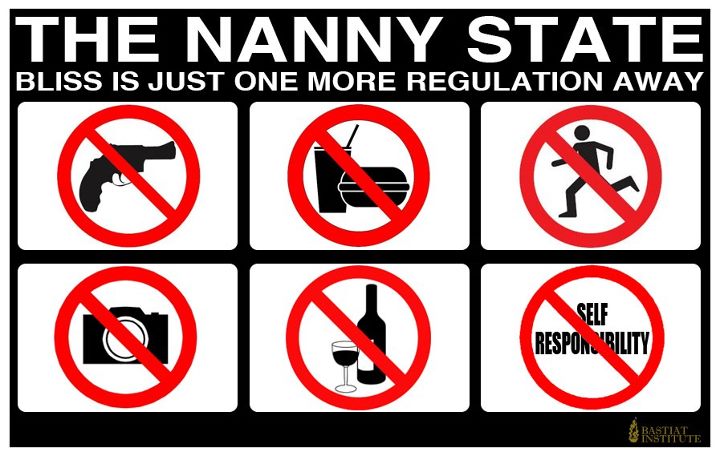
The list goes on. By the government’s own calculations it [banning advertising for “junk food” on TV] will reduce children’s diets by a meagre five calories a day – the equivalent of a third of a cherry tomato. And watch out for those Government figures. Pardon the pun, but given that they add weight to the arguments of those opposing their intrusiveness into our lives, would anyone be amazed if new and revised figures emerged during the course of detailed legislation? But even if the impact of these proposals was amplified by “the science”, it would still come at too high a cost to individual freedom and liberty.
And this is just the thin end of the wedge. For a moment back in winter, it looked like we had woken up and smelt the full English breakfast. It was reported that the advertisement ban would be discarded, which allowed the free market minded to hope, especially given the disbanding of Public Health England, that this might signal pushback against nanny state intrusion. Alas, no.
The appetite for ill-conceived, unworkable ideas is growing: we have plans to force pubs to disclose the number of calories in every drink they serve, just as they begin to fill their tills after months of lockdown. Plans to end deals like “buy one get one free” on foods high in fat, sugar and salt – a regressive measure that will hit the poorest consumers hardest while doing nothing to reduce our waistlines. Plans for further legislation around nutritional labelling – adding cost, probably not adding clarity.
We left the EU in part as a reaction to over-regulation. I remember well during my time as an MEP how skewed towards large corporations the regulatory regime could be in Brussels. If, having taken the difficult and painful decision to leave the bloc, we fail to roll back the overreach then people will start to ask what the last four years was all about. If freedoms regained are never applied, then what was the point? The food laws will diminish freedoms in everyday life, not just those of the important, but more esoteric and common room kind, that our political elites from time to time do remember to respect.
The left seems to be going off the same book when they say things like “How will you pay for the tax cuts?” as if the government is OF COURSE entitled to all your money, and if you’re getting some back, that part must be compensated for.
Sarah Hoyt, “The Tragedy of the Squid Farms on Mars”, Libertarian Enterprise, 2018-12-05.
Stewart Brand, “Environmental Heresies”, Technology Review, 2005-05
Michael Geist on how one of the worst pieces of legislation to get extruded from the bowels of the Liberal minority government got pinched off by main force and now sits, steaming, on the docket for the Senate to … well, “rubber stamp” isn’t quite the right phrase but it’s pretty rare for our unelected senators to do anything to benefit ordinary Canadians, so we’re depending on them somehow managing to display an almost supernatural effort to slow down this shitty bill until the end of the session:
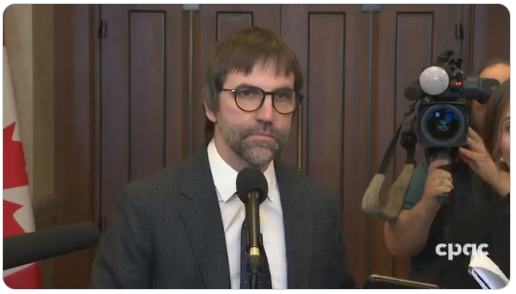
Canadian Heritage Minister Steven Guilbeault, 3 February 2020.
Screencapture from CPAC video.
The Liberal government strategy of multiple gag orders and a “super motion” to limit debate bore fruit last night as Bill C-10 received House of Commons approval at 1:30 am. The Parliamentary process took hours as the government passed multiple motions to cut short debate, re-inserted amendments that had been previously ruled null and void, and rejected a last-ditch attempt to restore the Section 4.1 safeguards for user generated content. The debate included obvious errors from Liberal MPs who were presumably chosen to defend the bill. For example, Julie Dabrusin, the Parliamentary Secretary to the Minister of Canadian Heritage, said that Section 2.1 in Bill C-10 “specifically excludes content uploaded by users.” Only it doesn’t as Dabrusin should know given that 2.1 covers users not content and she was the MP who introduced the amendment at committee to remove Section 4.1, which was the provision that excluded content uploaded by users.
Given the public support from the Bloc for cutting short debate, the outcome last night was never really in doubt. Perhaps the most interesting vote of the night came with a motion from Conservative MP Alain Rayes, which once again called for the re-insertion of Section 4.1. While the motion was defeated with the support of Liberal, NDP, and Bloc MPs, there were several notable exceptions. Liberal MPs Nate-Erskine Smith and Wayne Long both abstained and former Justice Minister (and now independent MP) Jody Wilson-Raybould voted in favour of the motion. The report stage was limited to one hour of debate, which meant that the 23 amendments were again subject to no real debate or discussion. Once the bill passed the report stage, it was on to third and final reading, which was limited to 15 minutes of debate per party. The vote followed just before 1:30 am with the Liberals, NDP, and Bloc once again supporting Bill C-10. Wilson-Raybould joined with the Conservatives in voting against it.
A rational government would comprehend that their pitch that the real purpose of the bill is to “make the web giants pay” is completely undermined by the obvious and deliberate attempt to introduce government censorship of what ordinary Canadians watch on the internet and share through social media. It’s all about the control, not about any imaginary financial windfall from shaking down tech companies for spare change. Why the rush to get it rammed through parliament right now, with so many other rather more pressing concerns at hand?
J.D. Tuccille reports on the latest US federal government proposals on changes to firearm regulations:
As expected, the Biden administration released proposed new rules for pistol braces and model legislation for “red flag” laws that make it easier to confiscate privately owned firearms. Also as expected, the proposals are ludicrous. On the one hand, they are pointless and nitpicky rules that are ultimately unenforceable, and on the other hand they are dangerous end-runs around due process that threaten fundamental rights. Taken together, they illustrate the unserious nature of gun regulations which are crafted more to appeal to political audiences than to achieve positive results.
The silliness inherent in this sort of rulemaking is apparent from the Department of Justice’s announcement of “a notice of proposed rulemaking that makes clear that when individuals use accessories to convert pistols into short-barreled rifles, they must comply with the heightened regulations on those dangerous and easily concealable weapons.”
For those new to this controversy, stabilizing braces were developed to help disabled veterans more accurately shoot pistols (usually those built around AR-15 receivers) one-handed. The “problem” is that many resemble shoulder stocks and can be used in that role. By no means does an attachment that lets a pistol be fired from the shoulder make it especially “dangerous and easily concealable.” Instead, it makes it less concealable since it has a brace sticking off the back. Braces do render pistols more accurate, which could be interpreted as dangerous if you’re upset by shooters hitting where they aim.
But a pistol that can be fired from the shoulder is arguably a short-barreled rifle under the National Firearms Act (NFA), and subject to special restrictions, taxes, and registration requirements that don’t apply to regular pistols or regular rifles, but do apply to (among other weapons) rifles with barrels shorter than 16 inches. These regulations are not evidence that short-barreled rifles are particularly dangerous, but that, like many laws, the NFA is thoroughly idiotic.
Braces have been treated as legal devices for years but have recently been targeted by the sort of people who see advantage in pretending that a firearm with a buttstock and a short barrel is more “dangerous and easily concealable” than stock-less pistols and long-barreled rifles. In compliance with White House direction, proposed rules from the Bureau of Alcohol, Tobacco, Firearms, and Explosives (ATF) would impose new requirements to determine if braced pistols achieve Great Pumpkin-level sincerity, or are super-dangerous and concealable short-barreled rifles in disguise.
Among other tests, the rule would set the maximum length of a pistol at 26 inches (because 27 inches is super-dangerous and concealable). These tests add up to a four-point assessment, ranging from “1 point: Minor Indicator (the weapon could be fired from the shoulder)” to “4 points: Decisive Indicator (the weapon is designed and intended to be fired from the shoulder)” with four points the ultimate sign that a firearm crosses the line into very naughty territory indeed.
[…]
But foolish stabilizer brace rules affect mostly disabled shooters and fanciers of a particular type of firearm. Red flag laws affect potentially any gun owner by allowing for property seizures and confrontations with law enforcement without due process.
Red flag laws “make it easier for states to craft ‘extreme risk protection orders’ authorizing courts to temporarily bar people in crisis from accessing firearms,” insists the Department of Justice. “By allowing family members or law enforcement to intervene and to petition for these orders before warning signs turn into tragedy, ‘extreme risk protection orders’ can save lives.”
Maybe such orders “can save lives”—all sorts of restrictions on personal liberty theoretically “can save lives” if that’s your only criteria. But the model legislation proposed by the Biden administration requires same-day issuance of orders that “prohibit the respondent from possessing, using, purchasing, manufacturing, or otherwise receiving a firearm” with a hearing to be held only after the fact. That certainly deprives those affected of their rights without due process of any sort before cops show up on their doorsteps to search the premises and confiscate property.



Powered by WordPress