
Published on 1 Jun 2017
The casualties and lack of success during the Nivelle Offensive were too much for the French Army and now the breaking point was reached. While parts of the French Army are in open mutiny, British Commander Douglas Haig is already planning the next offensive at Ypres. This time he wants to combine it with an amphibious landing along the Belgian coast.
June 2, 2017
French Mutinies – Tunnels Under Messines Ridge I THE GREAT WAR Week 149
Comments Off on French Mutinies – Tunnels Under Messines Ridge I THE GREAT WAR Week 149
May 31, 2017
“JFK before the speechwriters got to him is far more interesting”
Mark Steyn celebrates what would have been JFK’s 100th birthday by looking at the pre-Camelot JFK’s life:
Jack’s early life was certainly privileged but not idyllic. The family patriarch, Joe, is an easy target: an enthusiastic adulterer at home, and abroad, as US Ambassador to the Court of St James’s, an equally enthusiastic appeaser. His wife, Rose, reacted to his infidelities by retreating into her social life. The distance she put between her and her husband also left her nine children (four of whom she would outlive) beached on the other side of the divide. She regarded them, as one biographer put it, as “a management exercise”, and she believed in mostly hands-off management. Jack was a sickly child who spent months in hospital, but his mother was too far away to visit. Maternal affection was confined to a postcard from Paris, a ship-to-shore telegram from the Queen Mary. For the rest of his life, Kennedy disliked being touched or hugged even in the course of his many fleeting, transient sexual encounters.
Sex was fine. Anything more he found awkward and difficult. He showered up to five times a day. You can do your own analysis; everybody else does. “If he were my son,” declared a master at Choate, “I should take him to a gland specialist.” “He has never eaten enough vegetables,” decided Rose.
Duty is more easily borne when the the world’s eminences are your dinner companions. You meet the seigneurs, and you get to enjoy a little of their droit de, too. A former lover of Prince George, Duke of Kent introduced herself to young Jack as “a member of the British Royal Family by injection”. The line seemed fresh to him, as it might not have a quarter-century later were random showgirls and mob molls running around Vegas and Malibu introducing themselves as members of the Kennedy family by injection. He signed his letters from Harvard, “Stout-hearted Kennedy, despoiler of women.”
On the other hand, not many 24-year-olds get to shoot the breeze with Lord Halifax, British Ambassador in Washington, at the height of the Second World War about where the man he served as prime minister had gone wrong. “Halifax believed,” wrote young Kennedy after their conversation, “that Chamberlain was misled and defeated by his phrases, which he did not really believe in, such as ‘Peace in our time’.” By the time Kennedy got into the phrase-making business, he left it to the professionals to craft all that sing-songy seesawing jingles people seem to think meets the definition of powerful rhetoric: Ask not what your country can do for you, ask what you can do for your country. Mankind must put an end to war or war will put an end to mankind. Let us never negotiate out of fear, but let us never fear to negotiate. Mankind must put an end to cheap applause lines, but let us never fear to invert them formulaically yet portentously.
The JFK before the speechwriters got to him is far more interesting. “We are at a great disadvantage,” Kennedy the gunboat skipper writes from the Pacific. “The Russians could see their country invaded, the Chinese the same. The British were bombed, but we are fighting on some islands belonging to the Lever Company, a British concern making soap… I suppose if we were stockholders we would perhaps be doing better, but to see that by dying at Munda you are helping to ensure peace in our time takes a larger imagination than most men possess.”
Comments Off on “JFK before the speechwriters got to him is far more interesting”
QotD: Capitalism
Queen Elizabeth owned silk stockings. The capitalist achievement does not typically consist in providing more silk stockings for queens but in bringing them within the reach of factory girls in return for steadily decreasing amounts of effort…. [T]he capitalist process, not by coincidence but by virtue of its mechanism, progressively raises the standard of life of the masses.
Joseph Schumpeter, Capitalism, Socialism, and Democracy, 1942.
Comments Off on QotD: Capitalism
May 30, 2017
Croatia in World War 1 I THE GREAT WAR Special
Published on 29 May 2017
Croatia was part of the Austro-Hungarian Empire during World War 1 and Croats were just one of the many ethnicities within the Habsburg Empire that went to to war in 1914. Croats served in Galicia, on the Isonzo Front or in the Navy and it was a Croat who built up the Austro-Hungarian Air Force. Still towards the end of the war, more and more Croats thought about independence.
Comments Off on Croatia in World War 1 I THE GREAT WAR Special
The Belisarius fixation in SF&F
Jo Walton wonders why an otherwise obscure general of an otherwise obscure empire appears so often in fantasy and science fiction:
I once wrote jokingly here that there are only three plots, and they are Hamlet, Pride and Prejudice, and Belisarius, because those are the ones everyone keeps on reusing.
There is a conference in Uppsala in Sweden the weekend before the Helsinki Worldcon called “Reception Histories of the Future” which is about the use of Byzantium in science fiction. The moment I heard of it, I immediately started thinking about our obsessive reuse of the story of Belisarius. (I’m going. Lots of other writers are going. If you’re heading to Helsinki, it’s on your way, and you should come too!)
It’s strange that science fiction and fantasy are obsessed with retelling the story of Belisarius, when the mainstream world isn’t particularly interested. Robert Graves wrote a historical novel about him in 1938, Count Belisarius, and there’s Gillian Bradshaw’s The Bearkeeper’s Daughter (1987), but not much else. Whereas in genre, we’ve had the story of Belisarius retold by Guy Gavriel Kay, David Drake (twice) and Chelsea Quinn Yarbro, and used by L. Sprague de Camp, John M. Ford, Jerry Pournelle, Robert Silverberg, and Isaac Asimov. So what is it about this bit of history that makes everyone from Asimov to Yarbro use it? And how is it that the only place you’re likely to have come across it is SF?
First, let’s briefly review the story. First Rome was a huge unstoppable powerful indivisible empire. Then Rome divided into East and West, with the Eastern capital at Constantinople. Then the Western half fell to barbarians, while the Eastern half limped on for another millennium before falling to the Ottoman conqueror Mehmed II in 1453. We call the eastern half Byzantium, but they went right on calling themselves the Roman Empire, right up to the last minute. But long before that, in the sixth century, at the exact same time as the historical Arthur (if there was an Arthur) was trying to save something from the shreds of Roman civilization in Britain, Justinian (482-565) became emperor in Constantinople and tried to reunite the Roman Empire. He put his uncle on the throne, then followed him. He married an actress, the daughter of an animal trainer, some say a prostitute, called Theodora. He has a loyal general called Belisarius. He built the great church of Hagia Sophia. He withstood a giant city riot in the hippodrome, the great chariot-racing stadium, by having Belisarius’s soldiers massacre a huge number of people. He wrote a law code that remained the standard law code everywhere in Europe until Napoleon. And Belisarius reconquered really quite large chunks of the Roman Empire for him, including Rome itself. At the height of his success he was recalled to Rome and fired because Justinian was jealous. Belisarius had a huge army and could have taken the throne for himself, which was typical of both the Roman and the Byzantine empires, but he was loyal and let Justinian fire him. This is all happening at a time of Christian schism and squabbling about heresy between different sects.
While I’d quibble about her thumbnail sketch a bit, there’s more than enough there to fuel dozens of alt-history, fantasy, or science fiction novels … the fiction couldn’t be much more difficult to swallow than the reality. My first contact with the story of Belisarius was indeed the Robert Graves novel (which I still heartily recommend). I imagine that was true for most of the authors listed above.
The Disgusting Contents of Worcestershire Sauce (and Why It s Called That)
Published on 27 Mar 2017
In this video:
Worcestershire sauce, sometimes known as “Worcester sauce” is a savoury sauce that is often added to meat and fish dishes or, if you like your alcoholic beverages, the Bloody Mary cocktail. It may (or may not depending on how much you research your sauce choices) surprise you to learn that it’s literally made from fermented fish and spices.
Want the text version?: http://www.todayifoundout.com/index.php/2013/10/worcestershire-sauce-called/
May 29, 2017
On this day in 1453
In the Smithsonian Magazine in 2008, Fergus M. Bordewich described the events of 29 May, 1453:
In the 11th century, the Byzantines suffered the first in a series of devastating defeats at the hands of Turkish armies, who surged westward across Anatolia, steadily whittling away at the empire. The realm was further weakened in 1204 when western European crusaders en route to the Holy Land, overtaken by greed, captured and looted Constantinople. The city never fully recovered.
By the mid-15th century, Constantinople was hemmed in by Ottoman-controlled territories. On May 29, 1453, after a seven-week siege, the Turks launched a final assault. Bursting through the city’s defenses and overwhelming its outnumbered defenders, the invaders poured into the streets, sacking churches and palaces, and cutting down anyone who stood in their way. Terrified citizens flocked to Hagia Sophia, hoping that its sacred precincts would protect them, praying desperately that, as an ancient prophesied, an avenging angel would hurtle down to smite the invaders before they reached the great church.
Instead, the sultan’s janissaries battered through the great wood-and-bronze doors, bloody swords in hand, bringing an end to an empire that had endured for 1,123 years. “The scene must have been horrific, like the Devil entering heaven,” says Crowley. “The church was meant to embody heaven on earth, and here were these aliens in turbans and robes, smashing tombs, scattering bones, hacking up icons for their golden frames. Imagine appalling mayhem, screaming wives being ripped from the arms of their husbands, children torn from parents, and then chained and sold into slavery. For the Byzantines, it was the end of the world.” Memory of the catastrophe haunted the Greeks for centuries. Many clung to the legend that the priests who were performing services that day had disappeared into Hagia Sophia’s walls and would someday reappear, restored to life in a reborn Greek empire.
That same afternoon, Constantinople’s new overlord, Sultan Mehmet II, rode triumphantly to the shattered doors of Hagia Sophia. Mehmet was one of the great figures of his age. As ruthless as he was cultivated, the 21-year-old conqueror spoke at least four languages, including Greek, Turkish, Persian and Arabic, as well as some Latin. He was an admirer of European culture and patronized Italian artists, such as the Venetian master Gentile Bellini, who painted him as a bearded, introspective figure swathed in an enormous robe, his small eyes gazing reflectively over an aristocratically arched nose. “He was ambitious, superstitious, very cruel, very intelligent, paranoid and obsessed with world domination,” says Crowley. “His role models were Alexander the Great and Julius Caesar. He saw himself as coming not to destroy the empire, but to become the new Roman emperor.” Later, he would cast medallions that proclaimed him, in Latin, “Imperator Mundi” — “Emperor of the World.”
Before entering the church, Mehmet bent down to scoop up a fistful of earth, pouring it over his head to symbolize his abasement before God. Hagia Sophia was the physical embodiment of imperial power: now it was his. He declared that it was to be protected and was immediately to become a mosque. Calling for an imam to recite the call to prayer, he strode through the handful of terrified Greeks who had not already been carted off to slavery, offering mercy to some. Mehmet then climbed onto the altar and bowed down to pray.
Among Christians elsewhere, reports that Byzantium had fallen sparked widespread anxiety that Europe would be overrun by a wave of militant Islam. “It was a 9/11 moment,” says Crowley. “People wept in the streets of Rome. There was mass panic. People long afterward remembered exactly where they were when they heard the news.” The “terrible Turk,” a slur popularized in diatribes disseminated across Europe by the newly invented printing press, soon became a synonym for savagery.
Comments Off on On this day in 1453
Falklands War – Argentine Perspective – An Inevitable Defeat? (Guerra de las Malvinas)
Published on 12 Apr 2016
The Falklands War (Guerra de las Malvinas) in 1982 as seen by many as an inevitable defeat for Argentina, but taking a closer look at the preparations or better the lack of preparation on the Argentine side reveals that the British could have faced a far stronger opposition and might even had been defeated at least in their initial attacks. This video could also be seen as a how NOT to guide.
Comments Off on Falklands War – Argentine Perspective – An Inevitable Defeat? (Guerra de las Malvinas)
May 28, 2017
Indochina – Cyprus – Puerto Rico I OUT OF THE TRENCHES
Published on 27 May 2017
What do Indochina, Cyprus and Puerto Rico have in common? They are all featured in our newest episode of Out of The Trenches where Indy answers all your questions about World War 1.
Comments Off on Indochina – Cyprus – Puerto Rico I OUT OF THE TRENCHES
May 27, 2017
Currently reading
You could say that I don’t follow a particularly chronological pattern to my reading list.
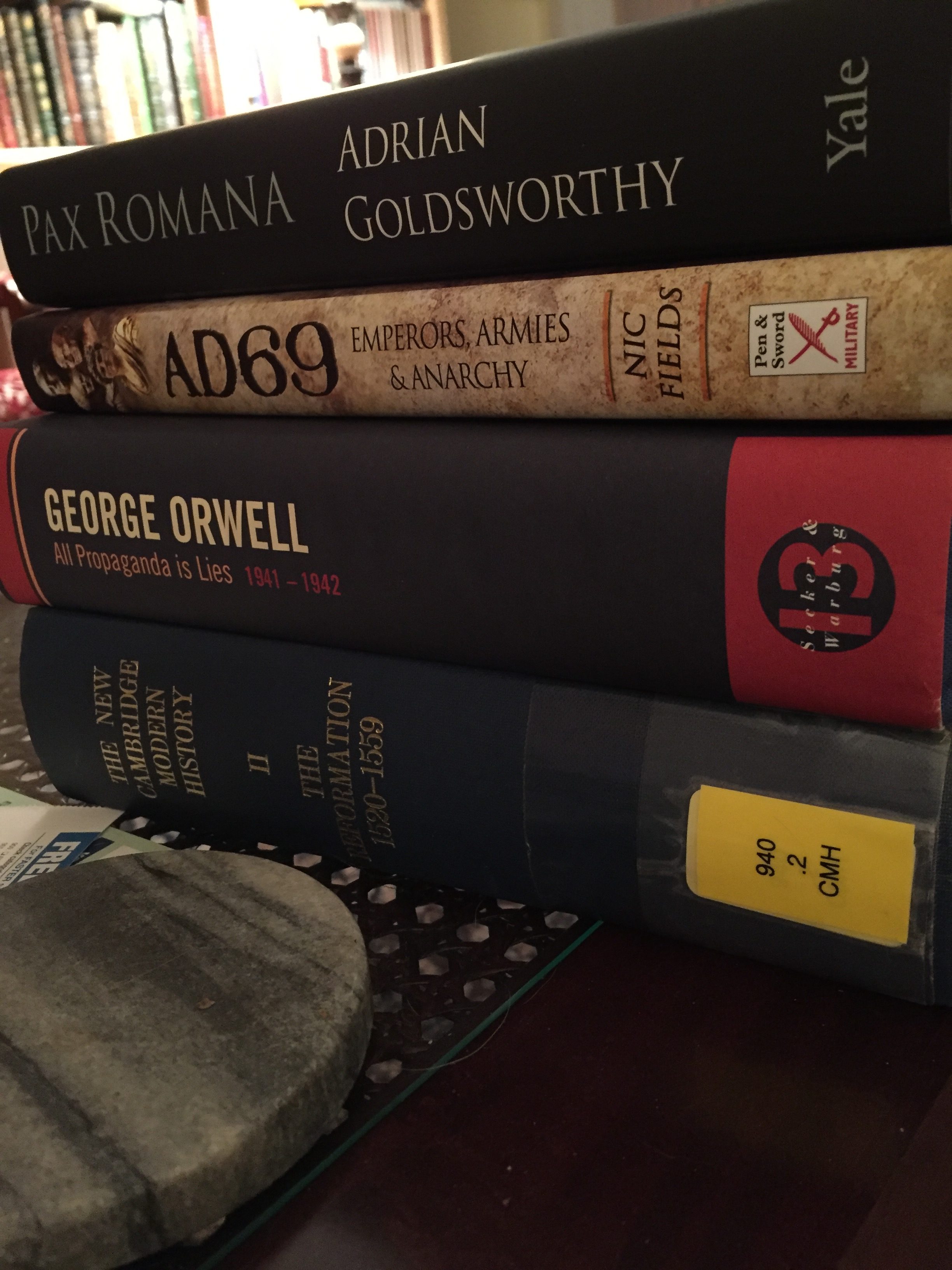
Pax Romana, Adrian Goldsworthy
AD69: Emperors, Armies & Anarchy, Nic Fields
All Propaganda is Lies: 1941-1942, George Orwell
The New Cambridge Modern History: II The Reformation 1520-1559 (no longer a library book despite the spine markings)
Comments Off on Currently reading
Mary Anning – Princess of Paleontology – Extra History
Published on 22 Apr 2017
“She sells seashells by the seashore.” Many have heard this old English rhyme, but few know the true story of the woman who inspired it. Her name was Mary Anning, and she did much more than sell seashells: she discovered some of the very first dinosaur fossils and laid the groundwork for the brand new field of paleontology. But she never got credit for her work.
Comments Off on Mary Anning – Princess of Paleontology – Extra History
QotD: When international sport replaced war between the Great Powers
I do not know if there was a meeting, in about 1961, of a subcommittee of the Bilderberg Commission (itself a characteristic consequence of the Great Change) at which it was resolved that, what with Great Wars needing now to be things of the past, some harmless outlet now had to be found for all those nationalistic passions which until so very recently it had been necessary for Great Powers to keep permanently inflamed (in case they found themselves having a Great War), but which they now needed to extinguish (in case these passions started a Great War). Discuss. Having created nationalism, what were the Great Powers now going to do with it? One big answer: sport. Don’t have the hoi polloi wave their national flags and have big urban demonstrations and nationalistic ecstasies and lamentations in their newspapers and internet sites and city squares because of war. Let them indulge in these things because of sport.
As I say, maybe there was such a meeting and maybe there has never been such a meeting. But, if such a meeting had occurred, events would probably have unfolded, in sport, much as they actually have. What did definitely happen, I assert, is that the end of Great Wars, and the coming of the Great Peace, has left a war-shaped gap, so to speak, in all the cultures of the Great Powers. And one of the many things that has flowed into this gap, like molten metal into a mould, has been professional sport.
The “professional” bit is important. The former manager of the Liverpool football team Bill Shankly once famously said something like: “A lot of people say that football is a matter of life and death, but it’s a lot more important than that.” And one of the ways in which it is “more important than that” is that the most successful sportsmen, successful footballers especially, are now paid such huge sums of money, a lot more now even than in Shankly’s time.
Professional sport means more, especially to spectators, than mere sport does. If a game is “only a game”, then people simply don’t watch it in large numbers. They may participate in large numbers, but when it comes just to watching, too little is at stake, in an “only a game” game. But if what potential spectators are offered as entertainment is the public struggle to become one of the absolute best at whatever it is, and as an intrinsic part of that the struggle to be either averagely well-off or worse (because of having placed your bets on sport and lost), or super-rich, depending on how things play out during the next hour or two, then millions will pay to attend. And that sets a positive feedback loop in motion, of more money being paid by spectators (including television spectators) and hence even more money being paid to the contestants, and hence even more being at stake when the contestants have their contests. And whereas the careers of earlier generations of sportsmen, then very poorly paid indeed compared to their successors, were often interrupted and frequently terminated by Great Wars, now, there is no such upheaval on anyone’s horizon, either to wreck sporting careers or to put sport into anything resembling “perspective”, in other words to make it not seem like a matter of life and death.
So, is sport in any sense a matter of life and death, or even, as Shankly said, only partly in jest, more than that? For many years I was puzzled by the constant use of the adjective “gladiatorial”, with all its ancient Roman associations of fighting literally to the death, to describe modern sporting contests. But recently, the experience of giving a talk about the sort of stuff in this posting made me realise that this is not an unreasonable way to describe something like this Anglo-Australian set-to that will be starting in about half and hour, as I first write this.
Nor is it coincidence that the original version of gladiatorial sport emerged into prominence during that earlier Great Peace, the Pax Romana. That too was a Great Peace that happened at a time when smaller wars continued, these smaller wars or the threat of them being the means by which Rome’s Great Peace was continuously contrived.
Brian Micklethwait, “From the Great Peace … to the ordeal of Adam Lyth at the Oval cricket ground”, Samizdata, 2015-08-20.
Comments Off on QotD: When international sport replaced war between the Great Powers
May 26, 2017
German Bombers Over Britain – Arab Revolt On The Advance I THE GREAT WAR Week 148
Published on 25 May 2017
This week 100 years ago, Germany is flying concentrated bomber attacks with multiple Gotha bombers on British cities – causing more damage than any Zeppelin raid before. In the Middle East, T.E. Lawrence and his allies from the Arab Revolt are on the march while on the Western Front, the last battles of the Nivelle Offensive come to an end.
Comments Off on German Bombers Over Britain – Arab Revolt On The Advance I THE GREAT WAR Week 148
A noteworthy historical “Oh, shit!” moment
At Catallaxy Files, a guest post on a most butt-puckering “Oh, shit!” from long ago:
My favourite Oh Shit moment of all time occurred a while ago. On the 4th of September 401 BC to be exact. At dawn.
Cyrus the brother of the Persian Emperor wanted to knock him off and take the throne. He had plenty of local soldiers, but to add some oomph he hired about 13,000 Greek mercenaries. Many of these were Athenians down on their luck after their city lost the Peloponnesian Wars. The Greek hoplites were the Abrams tanks of the day. Unstoppable.
The Battle of Cunaxa saw Cyrus and his brother face off. It was going reasonably well for Cyrus’s guys – the Greeks routed their Persian opponents. But then Cyrus spotted the Emperor and his guard. According to Xenophon he then took his bodyguard of 600 heavy cavalry off and attacked the Emperor’s 6,000. Cyrus went all in – he personally attacked his brother and wounded him. But in doing so he received a javelin just under one eye and expired.
Which brings us to dawn next morning. The Greeks had no idea that their paymaster had suffered a quite unsuccessful death or glory moment, until the news arrived just then.
The Persians, having sorted out their differences, were now united into a huge army under Artaxerxes the Emperor. Which left the small matter of the Greek mercenary force deep inside the Persian Empire and surrounded by a vast horde of very unhappy Persians.
Oh shit.
The story of their escape back to Greece is awe inspiring and amazing. Well worth reading. Xenophon’s Anabasis is available free from Project Gutenberg at the link.
Comments Off on A noteworthy historical “Oh, shit!” moment
May 25, 2017
Dangerous railway practices of the past
On Facebook, the New England, Berkshire & Western (“an HO scale layout created by the Rensselaer Model Railroad Society, which is a student club on the campus of Rensselaer Polytechnic Institute in Troy, NY”), posted a link to this fascinating — eventually banned for obvious safety reasons — method of moving railway cars on parallel track to the locomotive:
Raymond Breyer shared this video link on the pre-Depression page, about poling. […]
I always assumed they would move slowly and the trainman would have to hold the pole the entire time. Guess I was quite wrong! – JN
Comments Off on Dangerous railway practices of the past


