
Timeline – World History Documentaries
Published on 6 Dec 2018Let’s face it, there’s always been plenty of extra work to be done at Christmas time. Be it late night shelf-stacking at your local mall, cramming this year’s must-have items into valuable shop space in an effort to fuel the ‘pile ’em high, sell ’em dear’ festive shopping frenzy, or doing the night shift down the sorting office to help out the postie, it’s a tradition for students, down-at-pocket teenagers and lonely housewives.
But the seasonal labour market hasn’t always been just about earning pin money and having a lark. Back in the olden days, folks had to work their fingers to the bone in some of the worst Christmas jobs in history…
Content licensed from Spire. Any queries, please contact us at: realstories@littledotstudios.com
December 25, 2018
The Worst Christmas Jobs In History (Christmas History Documentary) | Timeline
December 24, 2018
Sun Yat-sen – A Kidnapping in London – Extra History – #2
Extra Credits
Published on 22 Dec 2018Sun Yat-sen moves to a new city for safety, but it will not last long — a year after the Revive China society is destroyed and scattered, he is unwittingly kidnapped in London. He must rely on the ingenuity of his outside ally, Dr. James Cantlie…
Join us on Patreon! http://bit.ly/EHPatreon
Bottom 5 British Tanks – David Fletcher | The Tank Museum
The Tank Museum
Published on 6 Oct 2018Tank Museum legend and Tank Chat superstar David Fletcher couldn’t possibly decide on a Top Five Tanks – so we asked him to pick the five worst!
Feel free to agree in the comments below, as we present David Fletcher’s Bottom Five Tanks
Visit The Tank Museum SHOP: ►https://tankmuseumshop.org/
Support the work of The Tank Museum on Patreon: ► https://www.patreon.com/tankmuseum Or donate http://tankmuseum.org/support-us/donateTwitter: ► https://twitter.com/TankMuseum
Tiger Tank Blog: ► http://blog.tiger-tank.com/
Tank 100 First World War Centenary Blog: ► http://tank100.com/ #tankmuseum #tanks
December 23, 2018
Trouble in China – WW2 – 017 22 December 1939
World War Two
Published on 22 Dec 2018While the Winter War continues with a Soviet armoured attack at Summa and the Lähde Road and the British attack the Germans from the skies in the first official aerial battle of World War Two, there’s trouble in China. Chiang Kai Shek is looking for ways to gain a new advantage on the Japanese.
Follow WW2 day by day on Instagram @World_war_two_realtime https://www.instagram.com/world_war_t…
Between 2 Wars: https://www.youtube.com/playlist?list…
Join us on Patreon: https://www.patreon.com/TimeGhostHistory
Or join The TimeGhost Army directly at: https://timeghost.tvWritten and Hosted by: Indy Neidell
Produced and Directed by: Spartacus Olsson and Astrid Deinhard
Executive Producers: Bodo Rittenauer, Astrid Deinhard, Indy Neidell, Spartacus Olsson
Research by: Indy Neidell
Edited by: Iryna Dulka
Map animations by: Mikk Tali aka Eastory
Community Manager: Joram AppelColorizations by Spartacus Olsson and Norman Steward.
Photos of the Winter War are mostly from the Finnish Wartime Photograph Archive (SA-Kuva).
Eastory’s channel: https://www.youtube.com/channel/UCEly…
Archive by Screenocean/Reuters https://www.screenocean.comA TimeGhost chronological documentary produced by OnLion Entertainment GmbH
December 21, 2018
Why do we celebrate Christmas in December?
The obvious answer is quite wrong: December 25th isn’t actually the birth date of Jesus … we don’t know when he was born (rather like the Queen’s Official Birthday, it’s been set to a particular date rather than tracking the actual natal day of the current monarch). So why did we end up with a fixed date in December? Tim Worstall explains:
… if you’re sitting in the middle of a culture that has a religious holiday that sends all children into a frenzy, you’re not part of that dominant religion, then you’d better come up with something quick. Don’t and you’ll find your hold on the minds – thus future religion of – the children loosening. Thus Hanukkah’s elevation in the holiday, if not liturgical, calendar. Thus, also, obviously the invention of Kwanzaa by those who would very much prefer not to be part of that dominant culture but were rather geographically stuck with it.
But then that’s why Jesus wasn’t born at Christmas too. We have absolutely no evidence at all that he turned up even one winter night let alone on Dec 25. What the Catholic Church in Europe did have – and at the relevant time there really only was the Catholic Church – was this inconvenient fact of a massive winter feast, what we might call Yuletide. This was very definitely pre-Christian and was sorta determined by climate.
You’re in Europe, you’re doing subsistence or at least peasant farming, this means you’ve not got enough fodder to keep all the animals going until the spring. Thus you slaughter near all – pigs not so much as they eat scraps, can forage for themselves etc – except your breeding stock. This gives you lots and lots of fresh meat and few good methods of meat preservation. This is also the last fresh meat you’re going to get until those spring lambs are ready in, say, April. So, you gorge on all that fresh meat.
Also, it’s cold outside, the days are short, why the heck not stay in by the fire while you burp through it all? Hey, bring the family ’round! And Pops, didn’t you get that beer going earlier in the year? OK, no hops, so ale. But mead maybe. Wine in many areas would be just about drinkable by now from that autumn crop.
This had been going on perhaps 6,000 years by the time those Christians turned up. The Church really needed to impose its views and authority on all of this, seriously, we can’t have the peasants continuing to celebrate the Old Gods, can we? Thus the invention of Christmas, a time for celebration, that called for lots of feasting of a happy event just about the time when everyone would be feasting anyway.
This is also the explanation for Halloween, All Hallows Eve. Or, All Souls Day followed By All Saints Day to replace the Celtic Samhaim. Hell, the oiks are going to be celebrating anyway, better make it a Church celebration.
Thus Hanukkah, thus Kwanzaa and thus whatever the next religion will come up with assuming that it’s one that initially grows in a European influenced culture. Even, perhaps any Northern Hemisphere, or northerly part of it, influenced one. Islam’s going to have a problem as it uses the lunar calendar and so no fixed feast will work, it’ll precess though the calendar and miss the yearly meeting with midwinter.
Hanukkah’s a big thing for the same reason Jesus wasn’t born at Christmas. At which point you’re expecting me to say Happy Holidays, aren’t you? Bah, Humbug!
QotD: “Baby, it’s cold outside”
Speaking of immorality, MGM’s censors cut the wrong song. A few decades back, a young middle-class Egyptian spending some time in the US had the misfortune to be invited to a dance one weekend and was horrified at what he witnessed:
The room convulsed with the feverish music from the gramophone. Dancing naked legs filled the hall, arms draped around the waists, chests met chests, lips met lips …
Where was this den of debauchery? Studio 54 in the 1970s? Haight-Ashbury in the summer of love? No, the throbbing pulsating sewer of sin was Greeley, Colorado, in 1949. As it happens, Greeley, Colorado, in 1949 was a dry town. The dance was a church social. And the feverish music was “Baby, It’s Cold Outside,” as introduced by Esther Williams in Neptune’s Daughter. Revolted by the experience, Sayyid Qutb decided that America (and modernity in general) was an abomination, returned to Egypt, became the leading intellectual muscle in the Muslim Brotherhood, and set off a chain that led from Qutb to Zawahiri to bin Laden to the Hindu Kush to the Balkans to 9/11 to the brief Muslim Brotherhood takeover of Egypt to the Islamic State marching across Syria and Iraq. Indeed, Qutb’s view of the West is the merest extension of “Baby, It’s Cold Outside” — America as the ultimate seducer, the Great Satan.
I’m a reasonable chap, and I’d be willing to meet the Muslim Brotherhood chaps halfway on a lot of the peripheral stuff like beheadings, stonings, clitoridectomies and whatnot. But you’ll have to pry “Baby, It’s Cold Outside” from my cold dead hands and my dancing naked legs. A world without “Baby, It’s Cold Outside” would be very cold indeed.
Mark Steyn, “Baby, It’s Cold Outside”, Steyn Online, 2014-12-01.
December 20, 2018
China’s Cultural Revolution
In Quillette, James David Banker describes the beginnings of Mao Zedong’s Cultural Revolution:
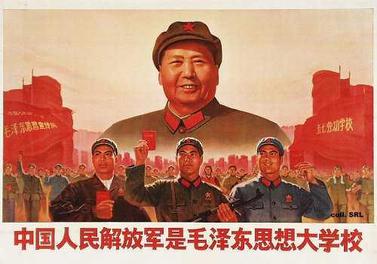
“The Chinese People’s Liberation Army is the great school of Mao Zedong Thought”, 1969.
A poster from the Cultural Revolution, featuring an image of Chairman Mao, published by the government of the People’s Republic of China.
Image via Wikimedia Commons.
“Nobody is more dangerous than he who imagines himself pure in heart,” wrote James Baldwin, “for his purity, by definition, is unassailable.” This observation has been confirmed many times throughout history. However, China’s Cultural Revolution offers perhaps the starkest illustration of just how dangerous the “pure in heart” can be. The ideological justification for the revolution was to purge the Chinese Communist Party (CCP), and the nation more broadly, of impure elements hidden in its midst: capitalists, counter-revolutionaries, and “representatives of the bourgeoisie.” To that end, Mao Zedong activated China’s youth — unblemished and uncorrupted in heart and mind — to lead the struggle for purity. Christened the “Red Guards,” they were placed at the vanguard of a revolution that was, in truth, a cynical effort by Mao to reassert his waning power in the Party. Nevertheless, it set in motion a self-destructive force of almost unimaginable depravity.
The Cultural Revolution commenced in spirit when Mao published a letter indicting a number of Party leaders on May 16, 1966. But it was a seemingly minor event nine days later that ignited the revolution in effect: a young philosophy professor at Peking University named Nie Yuanzi placed a “big-character poster” (a handwritten propaganda sheet featuring large Chinese characters) on a public bulletin board denouncing the university president and others in the administration as bourgeois revisionists. Mao immediately endorsed her protest, which set off a chain reaction of student revolt that swept through China.
That chain reaction was accelerated by “working groups” of ideologues sent to administer schools. Under their tenure, schools became centers of activism rather than learning. Students were encouraged to create big-character posters exposing their own teachers, officials, and even parents. The accused were humiliated in daily “struggle sessions” in which their students and colleagues interrogated them and demanded confessions. The viciousness of these sessions rapidly intensified. Students beat, spat upon, and tortured — in horrifically creative ways — their often elderly teachers and professors. In one case, students demanded their biology professor stare at the sun with wide open eyes. If he blinked or looked away, they beat him. Even middle and elementary school students participated in the struggle sessions, sometimes beating their teachers to death with sticks and belt buckles.
Students were also encouraged to turn on their classmates. As the sins of one generation passed to the next, a new hierarchy was born: the children of revolutionaries on top and the children of “landlords,” “capitalists,” and “rightists” at the bottom. These students were labeled “rotten eggs” and were fair game for the same treatment meted out to their parents. The current president of the People’s Republic of China, Xi Jinping, endured this fate. He was only 15 years old when his father, a loyal Maoist and one-time propaganda chief, was purged, his sister executed, and his own mother forced to denounced Xi as a reactionary. Amid the hysteria, teachers, professors, and intellectuals did not dare to stand up to the students or defend their colleagues lest they suffer similar fates. But they could not escape by being bystanders. With every word and action becoming potential evidence of capitalist sympathy, teachers and intellectuals enthusiastically joined their students in the struggle sessions and screaming rallies.
QotD: An “authentic” peasant diet
The fact is that you wouldn’t want to eat like a European peasant of yesteryear, or a Chinese peasant, either. Sure, peasants ate well when the garden was producing and the harvest was ripe. A lot of the year, they ate pretty meager, dull fare. Many of the spices we now take as ordinary — salt and pepper, for example — were pretty pricey. So were meat and cheese, which, like everything else, tended to get pretty scarce in winter. When you read about what people were actually eating most of the year, you realize that diets were dull, repetitive, and heavy on grains and legumes, lightly complimented by salted and dried things (home canning, like many of the other things we think of as traditional, was another Industrial Revolution contribution, and before modern farming practices, cows tended to be “dried off” in the winter to save the expense of the extra feed a milking cow needed). And this stayed true throughout the 19th century for large swaths of the population in both America and abroad.
The farther north you went, the more this was true — it’s probably no accident that Ireland and Scandinavia are not, let us say, renowned for their fantastic contributions to world cuisine. When your growing season is a short cloudy period between miserable winters, you don’t have the raw materials to construct amazing dining experiences. (Sure, every country has at least one or two really good fairly traditional foods. But the shorter the time fresh ingredients are available, the fewer culinary marvels you’ll be able to produce.)
Too, we must remember that not everyone was a good cook. Cooking was a job, not an absorbing hobby, and as with any other job, many people did it badly. Every farm wife could produce enough calories to feed her family (at least, if the raw materials were available). Not all of them could produce anything you’d want to eat. Modern food-processing technology has relieved us of that most “authentic” culinary experience: boring ingredients processed by an indifferent cook into something that you’d only voluntarily consume if you were pretty hungry. Even the memory of these cooks has fallen away, though you’ll encounter a lot of them if you read old novels.
Megan McArdle, “‘Authentic’ Food Is Not What You Think It Is”, Bloomberg View, 2017-02-24.
December 19, 2018
Krampus – Christmas Demon – Extra Mythology
Extra Credits
Published on 17 Dec 2018Join the Patreon community! http://bit.ly/EMPatreon
Krampus’s name is growing popular in the United States, but most of us don’t really know what he does OR that he is partners with St. Nicholas himself. He is in fact just one of many Christmas demons…
HMCS Haida – Guide 027 (Special)
Drachinifel
Published on 13 Aug 2017The most successful Canadian warship, HMCS Haida, is the subject of today’s video
The robotic narration on this video is painfully irritating!
Update, 14 February 2021: Drachinifel updated the narration at some point after I posted the original.
December 18, 2018
Conflicts & Wars In The Aftermath of WW1 I THE GREAT WAR Epilogue
The Great War
Published on 17 Dec 2018In our last epilogue special we outline the wars and conflicts that followed World War 1, some of them immediately and some of them with only a brief period of peace. Even in 1919 it was already clear that “the war to end all wars” didn’t in fact do that and that the new world order would be shaped by violence.
—
hey guys and girls, with this last video, our epilogue series is over and this was the very last episode featuring Indy. Again, this was more meant as an appetizer for the future of the show now. When we filmed this, we didn’t know, yet that we could continue working on the show. We will make an announcement about what to expect next year this week. Cheers Flo
—
– CREDITS –
Presented by: Indiana Neidell
Written by: Indiana Neidell
Director: Toni Steller & Florian Wittig
Director of Photography: Toni Steller
Sound: Toni Steller
Mixing, Mastering & Sound Design: www.above-zero.com
Editing: Toni Steller, Julian Zahn
Motion Design: Christian Graef
Research by: Indiana Neidell
Fact checking: Markus LinkeThe Great War Theme composed by Karim Theilgaard: http://bit.ly/karimyt
A Mediakraft Networks Original Channel
Based on a concept by Spartacus Olsson
Author: Indiana Neidell
Visual Concept: David van Stephold
Producer: Toni Steller & Florian Wittig
Social Media Manager: Florian WittigContains licenced Material by British Pathé
All rights reserved – © Mediakraft Networks GmbH, 2018
December 17, 2018
Sun Yat-sen – A Killing in Hong Kong – Extra History – #1
Extra Credits
Published on 15 Dec 2018Growing up in Honolulu, Sun Yat-sen had an expansive, exciting education, which would inspire him when he moved to Hong Kong as a young adult ready to change the world as a doctor — and as the leader of the “Revive China Society” interested in overthrowing the Qing government.
Sun Yat-sen was a dangerous man. The Qing were right to fear him. After all, he’d bring 2,000 years of imperial rule crashing down.
Join us on Patreon! http://bit.ly/EHPatreon
American Jeep vs German Kübelwagen: Truck Face-Off | Combat Dealers
Quest TV
Published on 23 Oct 2018Bruce puts two iconic World War II trucks to the test: the iconic American Jeep and the German Kübelwagen. Which truck will come out on top? #CombatDealers
QotD: Woodrow Wilson’s repressive regime
Not surprisingly, such intellectual kindling was easy to ignite when World War I broke out. The philosopher John Dewey, New Republic founder Herbert Croly, and countless other progressive intellectuals welcomed what Mr. Dewey dubbed “the social possibilities of war.” The war provided an opportunity to force Americans to, as journalist Frederick Lewis Allen put it, “lay by our good-natured individualism and march in step.” Or as another progressive put it, “Laissez faire is dead. Long live social control.”
With the intellectuals on their side, Wilson recruited journalist George Creel to become a propaganda minister as head of the newly formed Committee on Public Information (CPI).
Mr. Creel declared that it was his mission to inflame the American public into “one white-hot mass” under the banner of “100 percent Americanism.” Fear was a vital tool, he argued, “an important element to be bred in the civilian population.”
The CPI printed millions of posters, buttons, pamphlets, that did just that. A typical poster for Liberty Bonds cautioned, “I am Public Opinion. All men fear me!… [I]f you have the money to buy and do not buy, I will make this No Man’s Land for you!” One of Creel’s greatest ideas – an instance of “viral marketing” before its time – was the creation of an army of about 75,000 “Four Minute Men.” Each was equipped and trained by the CPI to deliver a four-minute speech at town meetings, in restaurants, in theaters – anyplace they could get an audience – to spread the word that the “very future of democracy” was at stake. In 1917-18 alone, some 7,555,190 speeches were delivered in 5,200 communities. These speeches celebrated Wilson as a larger-than-life leader and the Germans as less-than-human Huns.
Meanwhile, the CPI released a string of propaganda films with such titles as The Kaiser, The Beast of Berlin, and The Prussian Cur. Remember when French fries became “freedom fries” in the run-up to the Iraq war? Thanks in part to the CPI, sauerkraut become “victory cabbage.”
Under the Espionage Act of 1917 and the Sedition Act of 1918, Wilson’s administration shut down newspapers and magazines at an astounding pace. Indeed, any criticism of the government, even in your own home, could earn you a prison sentence. One man was brought to trial for explaining in his own home why he didn’t want to buy Liberty Bonds.
The Wilson administration sanctioned what could be called an American fascisti, the American Protective League. The APL – a quarter million strong at its height, with offices in 600 cities – carried government-issued badges while beating up dissidents and protesters and conducting warrantless searches and interrogations. Even after the war, Wilson refused to release the last of America’s political prisoners, leaving it to subsequent Republican administrations to free the anti-war Socialist Eugene V. Debs and others.
Jonah Goldberg, “You want a more ‘progressive’ America? Careful what you wish for: Voters should remember what happened under Woodrow Wilson”, Christian Science Monitor, 2008-02-05.
December 16, 2018
Perkele! Finland Strikes Back – WW2 – 016 15 December 1939
World War Two
Published on 15 Dec 2018In the second week of the Winter War, during multiple counteroffensives, including the famous Sausage War, the Finnish Defence Forces dash any hopes of a quick victory that the Red Army and Stalin might have had.
WW2 day by day on Instagram @World_war_two_realtime https://www.instagram.com/world_war_t…
Between 2 Wars: https://www.youtube.com/playlist?list…
Join us on Patreon: https://www.patreon.com/TimeGhostHistory
Or join The TimeGhost Army directly at: https://timeghost.tvWritten and Hosted by: Indy Neidell
Produced and Directed by: Spartacus Olsson and Astrid Deinhard
Executive Producers: Bodo Rittenauer, Astrid Deinhard, Indy Neidell, Spartacus Olsson
Research by: Indy Neidell
Edited by: Wieke Kapteijns
Map animations by: Mikk Tali aka Eastory
Community Manager: Joram AppelColoring by Spartacus Olsson
Thumbnail depicting Finnish soldiers using a slingshot to lob grenades at the Red Army. Colorized by Cassowary https://www.flickr.com/photos/cassowa…
Eastory’s channel: https://www.youtube.com/channel/UCEly…
Archive by Screenocean/Reuters https://www.screenocean.comA TimeGhost chronological documentary produced by OnLion Entertainment GmbH


