Quotulatiousness

October 7, 2019

The History of The London Underground

Filed under: Britain, History, Railways, Technology — Tags: , , , — Nicholas @ 02:00

Real Engineering
Published on 29 Dec 2017

Patreon:
https://www.patreon.com/user?u=282505…

October 6, 2019

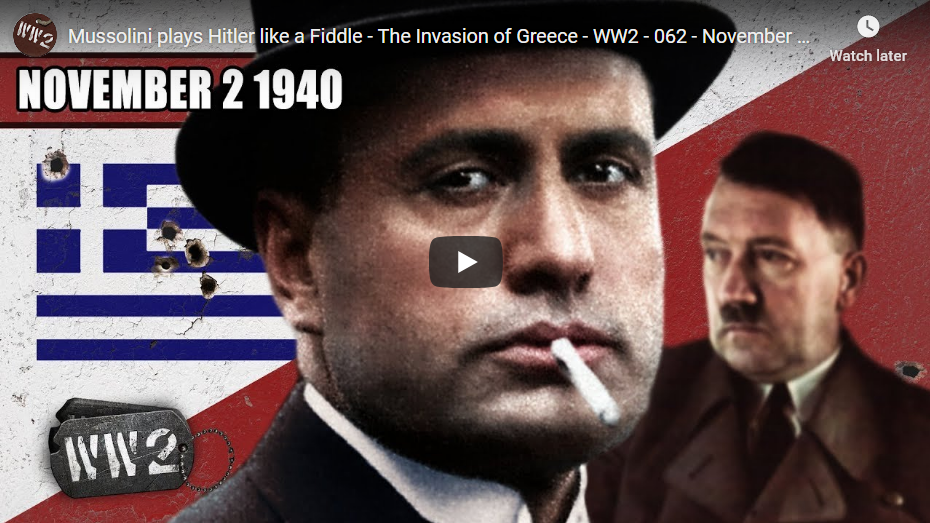
Hitler and the Art of the Deal – WW2 – 058 – October 5 1940

World War Two
Published 5 Oct 2019

Hitler is trying to get new Axis Powers on board in his fight against Britain, promising them all huge territorial gains.

Join us on Patreon: https://www.patreon.com/TimeGhostHistory
Or join The TimeGhost Army directly at: https://timeghost.tv

Follow WW2 day by day on Instagram @World_war_two_realtime https://www.instagram.com/world_war_t…

Join our Discord Server: https://discord.gg/D6D2aYN.
Between 2 Wars: https://www.youtube.com/playlist?list…
Source list: http://bit.ly/WW2sources

Written and Hosted by: Indy Neidell
Produced and Directed by: Spartacus Olsson and Astrid Deinhard
Executive Producers: Bodo Rittenauer, Astrid Deinhard, Indy Neidell, Spartacus Olsson
Creative Producer: Joram Appel
Post-Production Director: Wieke Kapteijns
Research by: Indy Neidell
Edited by: Iryna Dulka
Map animations: Eastory

Colorisations by Norman Stewart and Julius Jääskeläinen https://www.facebook.com/JJcolorization/

Eastory’s channel: https://www.youtube.com/channel/UCEly…
Archive by Screenocean/Reuters https://www.screenocean.com.

Sources:
– IWM: A 220
– Photos of Herbert Morrison and John Anderson by Yousuf Karsh, Dutch National Archives
– National Library of Australia
– Narodowe Archiwum Cyfrowe
– Colorized portrait of Mao Zedong by Olga Shirnina, aka Klimbim
– Flag of Spain by SanchoPanzaXXI on Wikimedia Commons

A TimeGhost chronological documentary produced by OnLion Entertainment GmbH.

The cultural influence of George Orwell

Filed under: Books, Britain, History — Tags: , , , , — Nicholas @ 03:00

George Orwell, the chosen pen name of Eric Blair, is one of the best known writers of the 20th century and even people who have never read any of his writings are aware of his influence. John Rodden and John Rossi outline the immediate post-war period that saw Orwell publish his final and best-known work:

Seven decades ago on June 8, George Orwell’s Nineteen Eighty-Four exploded on the cultural front—fittingly enough, just two months before the Soviet Union’s first successful atomic test that August, which broke America’s nuclear monopoly. Orwell’s warning was urgent — and timely. Almost overnight, in the wake of the surrender of Germany and Japan that ended World War II in 1945, a new war—the so-called Cold War — had emerged. (Orwell is often credited with coining the term.)

The Cold War pitted the capitalist West against the communist East, above all the United States against the USSR (and soon China). Just three weeks before the publication of Nineteen Eighty-Four, the Soviet Union lifted the Berlin Blockade, thereby avoiding a potentially deadly showdown with the West that might have triggered World War III. Two weeks later, on May 23, the Federal Republic of Germany (West Germany) was officially established, effectively ending prospects in the near future of German reunification. On the very day of Nineteen Eighty-Four‘s publication, June 8, fears swept through liberal America of a growing Red Scare when a leaked document named numerous celebrities as Communist Party members (e.g., Helen Keller, Dorothy Parker, Fredric March, Danny Kaye, Edward G. Robinson). That same month, the communist armies of Mao Zedong captured Shanghai, and less than six months later on October 1, declared victory in the civil war against the American-backed Nationalists and the founding of the People’s Republic of China.

What educated person is not at least vaguely familiar with the language and vision of Orwell’s novel — even if he or she does not recognize the source? Indeed the very ignorance of the source represents an inadvertent tribute to the power of Orwell’s language and vision. Like Shakespeare’s poetry (“All the world’s a stage,” “To be or not to be,” “This above all: to thine own self be true”), so deeply have some of Orwell’s locutions become lodged in the cultural lexicon and political imagination that most people no longer recognize their author, let alone the source.

Today, as in the case of Shakespeare, hundreds of millions of people mouth Orwell’s coinages and catchphrases, such as “Big Brother” and “doublethink” — including his name as proper adjective, “Orwellian” (i.e., nightmarish, oppressive). And that’s just in English. Tens of millions more recognize and repeat them in foreign translations, as I [Rodden] discovered in our travels and teaching in the communist East Germany as well as in Asia. Rudimentary acquaintance with such locutions is regarded as a sine qua non of cultural literacy in English — even today, when prolefeed (mindless chatter) floods the print columns and dominates the airwaves.

Nineteen Eighty-Four represents Orwell’s Orwellian vision — in the form of a fictional anti-utopia (or “dystopia”) — of what a nightmarish, oppressive future might hold. It projects a world 35 years away — half the biblical lifespan of three score and ten. Having completed his novel by the end of 1948, Orwell flipped the last two digits to underscore his anti-utopian theme of a world turned upside down and inside out. Or so many scholars have reasonably claimed. The date resultant from the flipped digits also gave the novel its immediacy. Previous anti-utopias, such as Aldous Huxley’s Brave New World (1932), had cast their ominous scenarios far into the future, which lessened their dramatic impact and tended to render them entertaining thought experiments. (Huxley’s action is set in the 26th century.) By contrast, Orwell’s dire future is too close for comfort — and depicts the planet in the immediate aftermath of a global nuclear war that has nearly annihilated the human species. His vision thus projects a world in which middle-aged readers in 1949 might find themselves in old age — and certainly their children and grandchildren were likely to witness it. (If he had lived, Orwell himself would have still been just 80 years old on April 4, 1984, when the story opens.)

Shieldwalls

Filed under: Greece, History, Military — Tags: , , , — Nicholas @ 02:00

Lindybeige
Published on 24 Mar 2011

This may address many of the comments I had for my spears video. Many of my theories are based on the I think fairly reliable notion that people in the past were similar to people today in that they tended towards a desire for self-preservation, and away from reckless bravery.

http://www.LloydianAspects.co.uk

October 5, 2019

Legends Summarized: El Dorado

Overly Sarcastic Productions
Published 4 Oct 2019

El Dorado! A shining golden city packed with promises of wealth, power and everlasting glory. An unspoiled paradise deep in the jungle, the PERFECT destination for treasure-hunters and anthropologists alike. Something that perfect is something EVERYONE wants to be real.

Aaaaand that’s the trick, isn’t it? Wanting something that badly isn’t healthy. Just ask the conquistadors!
(Oh wait, we can’t – because so many of them died on fruitless quests for El Dorado. And also it’s been five hundred years and they’d all be dead anyway)

PATREON: https://www.Patreon.com/OSP

MERCH LINKS: https://www.redbubble.com/people/OSPY…

OUR WEBSITE: https://www.OverlySarcasticProductions.com
Find us on Twitter https://www.Twitter.com/OSPYouTube
Find us on Reddit https://www.Reddit.com/r/OSP/

Dreyse Model 1835 Needlefire Breechloading Pistol

Filed under: Germany, History, Technology, Weapons — Tags: , , , — Nicholas @ 02:00

Forgotten Weapons
Published on 19 Aug 2019

RIA on YouTube: https://www.youtube.com/user/RockIsla…
RIA on Instagram: https://www.instagram.com/rockislanda…

Johann Nicolaus Dreyse, later promoted to the aristocracy as Nicolaus von Dreyse, designed the first mainstream military breechloading rifle. His rifle was adopted by Prussia and changed military history, but this was not his only work. Dreyse also endeavored to sell guns commercially, both rifles and handguns. This is an example of one of his first, the Model 1835. It is a single shot breechloader, with the chamber consisting of a rotating tumbler. The firing mechanism is identical in concept to that of his Model 1841 rifle, just scaled down for the smaller pistol. The piece uses a power charge of just 6 grains, but its breechloading action was quite advanced for the 1830s!

http://www.patreon.com/ForgottenWeapons

Cool Forgotten Weapons merch! http://shop.bbtv.com/collections/forg…

Contact:
Forgotten Weapons
PO Box 87647
Tucson, AZ 85754

October 4, 2019

Rise of Evil – From Populism to Fascism | BETWEEN 2 WARS I 1932 Part 4 of 4

Filed under: Europe, Germany, History, Politics — Tags: , , , , , — Nicholas @ 06:00

TimeGhost History
Published 3 Oct 2019

Democracy finds itself in a crisis as the 1930s take off. On a global scale, Fascist or otherwise authoritarian and repressive movements and governments seek to destroy the pillars of liberal society.

Join us on Patreon: https://www.patreon.com/TimeGhostHistory

Subscribe to our World War Two series: https://www.youtube.com/c/worldwartwo…

Hosted by: Indy Neidell
Written by: Spartacus Olsson and Joram Appel
Directed by: Spartacus Olsson and Astrid Deinhard
Executive Producers: Bodo Rittenauer, Astrid Deinhard, Indy Neidell, Spartacus Olsson
Creative Producer: Joram Appel
Post-Production Director: Wieke Kapteijns
Research by: Joram Appel and Spartacus Olsson
Edited by: Wieke Kapteijns
Sound design: Marek Kamiński

Sources icons: Graphic Enginer, Luis Prado
Colorizations: Daniel Weiss, Cassowary Colorizations, Klimbim

A TimeGhost chronological documentary produced by OnLion Entertainment GmbH.

From the comments:

TimeGhost History
1 hour ago (edited)
This episode might be a little more academic than our other episodes, but we wanted to cover the global Fascist surge AND that it’s just too simple to refer to all totalitarian states and authoritarian and repressive movements as “Fascist”. Fascism is a very complicated concept that is still today being debated by political scientists and historians, as well as politicians and journalists. We try to give some insight to what Fascism is, what it isn’t and what all those movements and countries were, if not Fascist. We appreciate that you might have a different opinion as to what Fascism was or is, and we’re interested to hear your opinion. Just keep it civil and try to stay away from modern political debates, as that is not what we’re here for. EDIT: As for comments claiming that Fascism was left-wing/socialist, watch the video again. Don’t bother commenting if you can’t bring a proper argument to the table.
Cheers,
Joram

“Metal Crüe” – The History of Metal – Sabaton History 035 [Official]

Filed under: History, Media — Tags: , , , — Nicholas @ 04:00

Sabaton History
Published 3 Oct 2019

This is a little different from our usual videos. We dive into the Sabaton song “Metal Crüe”, an ode to the Metal Legends that inspired Sabaton. Indy gives his subjective take on the musicians that defined a genre.

Support Sabaton History on Patreon: https://www.patreon.com/sabatonhistory

Listen to Attero Dominatus (where “Metal Crüe” is featured):

CD: http://bit.ly/AtteroDominatusStore
Spotify: http://bit.ly/AtteroDominatusSpotify
Apple Music: http://bit.ly/AtteroDominatusAppleMusic
iTunes: http://bit.ly/AtteroDominatusiTunes
Amazon: http://bit.ly/AtteroDominatusAmzn
Google Play: http://bit.ly/AtteroDominatusGooglePlay

Watch the Official Lyric Video of “Metal Crüe” here: https://www.youtube.com/watch?v=7Hd1Q…

Check out the trailer for Sabaton’s new album The Great War right here: https://www.youtube.com/watch?v=HCZP1…

Listen to Sabaton on Spotify: http://smarturl.it/SabatonSpotify
Official Sabaton Merchandise Shop: http://bit.ly/SabatonOfficialShop

Hosted by: Indy Neidell
Written by: Markus Linke and Indy Neidell
Directed by: Astrid Deinhard and Wieke Kapteijns
Produced by: Pär Sundström, Astrid Deinhard and Spartacus Olsson
Creative Producer: Joram Appel
Executive Producers: Pär Sundström, Joakim Broden, Tomas Sunmo, Indy Neidell, Astrid Deinhard, and Spartacus Olsson
Maps by: Eastory
Edited by: Iryna Dulka
Sound Editing by: Marek Kaminski

Archive by: Reuters/Screenocean https://www.screenocean.com
Music by Sabaton.

Sources:
The Song Remains The Same movie courtesy of Warner Bros.
– Nazareth photo by Ken Papai
– Thin Lizzy photo courtessy of Beeld En Geluid Wiki
– Thin Lizzy by Richard Marchewka
– Tony Iommy by Ronald Ali-Khan
– Deep Purple concert by Friedrich Magnussen
– Blue Cheer by Jac. de Nijs
– Led Zeppelin by Heinrich Klaffs
– Led Zeppelin in Apollo by Harry (Howard) Potts
– Judas Priest, Rob Halford by Fernando Catalina Landa
– Mike “Ozzy” Gibbens
– Kiss by Carl Lender
– Lee Kerslake and Uriah Heep photos by Heinrich Klaffs

An OnLion Entertainment GmbH and Raging Beaver Publishing AB co-Production.

© Raging Beaver Publishing AB, 2019 – all rights reserved.

October 3, 2019

The Puritans, then and now

Severian thinks on churchiness and churchianity in our times:

The most striking fact about the Middle Ages from a modern perspective is their love of lists, categories, forms. This is partly practical — Church art all looks the same because it has to communicate a consistent message to the aforesaid illiterate peasantry — but lots of it isn’t. They were simply obsessed with forms, with outward order, to the point that even the few true individuals were hard to tell apart — William of Ockham and Thomas Aquinas were as different as two thinkers could possibly be, but unless you’re a subject matter expert, their writings look identical.

“Individuality,” on the other hand, comes from inward experience. What, if anything, did the medieval peasant believe when he went to Mass? Impossible to say, but one of the reasons that’s so is because the form of his “piety” was so all-encompassing. Some years back, a Jew wrote a funny book about trying to live his life by the letter of the Mosaic law. One could do the same thing with medieval Catholicism. Take a gander at the liturgical year — hardly a day goes by without a feast, a commemoration, a celebration. Do all of that, and you’ll hardly have time for anything else. They were so focused on the outward show, at least in part, because there was so much showing to do.

When the Reformation shitcanned all that, piety turned inward. There are zillions of sources for what the Reformed believed (or, at least, said they believed), because the Reformation was a middle-class pursuit and the middle classes were literate … and, crucially, had the free time to be literate. I’m guessing here, but since people are people and always have been, I’m pretty sure that your medieval peasant loved the show of his religion, because it gave him a little much-needed time off from his hourly grind of back-breaking, ragged-edge-of-survival physical labor.

Your middle-class incipient Calvinist, on the other hand, was bored to tears with stuff like “creeping to the cross” — all those billable hours lost (surely no one is surprised that Calvin, Knox, et al were all lawyers or merchants). In their vanity, they insisted it wasn’t enough to seem pious; you actually had to be pious, which meant putting the time you would’ve spent doing public penance into contemplating the state of your soul. Check out The New England Mind — once you fight through prose, you’ll see that the vaunted Puritan piety was little more than Special Snowflakism with a New Testament twist. They’re “individuals,” all right, but only because they’re as obsessed as Tumblrinas with their very own pwecious widdle selves.

The point of this isn’t just to bash Puritans, fun as that is (and as richly as they deserve it). The point is that, as Current Year America is a thoroughly Puritan nation, we have to realize just how historically contingent Puritanism really is in order to beat them.

Puritans desperately wanted to be individuals in a world that couldn’t support very many individuals. You need a lot of free time to be a Puritan, and in the 16th century free time was almost inconceivably expensive. Whatever else it was, Puritanism was gross conspicuous consumption — Puritans announced to the world that they alone had the free time to indulge in expensive educations, books, Bible study, and the endless hours worrying about whether or not it’s Biblically justified to paint the altar. In a world where most everyone still knows someone who knows someone who starved to death, that’s one hell of a statement.

The Crimean War – History Matters

History Matters
Published on 7 Apr 2019

Twitter: https://twitter.com/Tenminhistory
Patreon: https://www.patreon.com/user?u=4973164

This episode covers the Crimean War (1853-1856) between the Russian Empire and the Ottomans, the British, the French and the Sardinians. It began largely out of Russo-Ottoman rivalry and because French Emperor Napoleon III had been appointed the protector of Christians within the Ottoman Empire, at the expense of the Russian Emperor Nicholas I. The war really kicked off in 1854 with the British and French invasion of Crimea and largely ended with the capture of Sevastopol in 1855, after which the Russians sued for peace.

October 2, 2019

That Downfall Scene Explained – What Is Hitler Freaking Out About? I 16 Days In Berlin

Filed under: Germany, History, Media, Military, WW2 — Tags: , , — Nicholas @ 04:00

The Great War
Published on 1 Oct 2019

Thank you for your support for 16 Days in Berlin: https://realtimehistory.net/indiegogo

» SUPPORT THE CHANNEL
Patreon: https://www.patreon.com/thegreatwar
Merchandise: https://shop.spreadshirt.de/thegreatwar/

»CREDITS
Presented by: Jesse Alexander
Written by: Jesse Alexander
Director: Toni Steller & Florian Wittig
Director of Photography: Toni Steller
Sound: Toni Steller
Editing: Toni Steller
Mixing, Mastering & Sound Design: http://above-zero.com
Maps: Daniel Kogosov (https://www.patreon.com/Zalezsky)
Research by: Jesse Alexander
Fact checking: Florian Wittig

Channel Design: Alexander Clark
Original Logo: David van Stephold

A Mediakraft Networks Original Channel

Contains licensed material by getty images
All rights reserved – Real Time History GmbH 2019

Marston 3-Barrel Selectable Pocket Derringer

Filed under: History, Technology, USA, Weapons — Tags: , , , , — Nicholas @ 02:00

Forgotten Weapons
Published on 18 Aug 2019

RIA on YouTube: https://www.youtube.com/user/RockIsla…
RIA on Instagram: https://www.instagram.com/rockislanda…

William Marston was born in the UK in 1822 and emigrated to the US in the 1830s with his father, who was a gunsmith. William became a naturalized citizen in 1843, and in 1844 went to work for his father in the family business. He would later open his own shop, and became successful making a wide variety of firearms — mostly concealable pocket pistols — until his death in 1872.

This is one of his 3-barrel derringers, with a pretty neat auto-indexing system. This one is in .32 rimfire with 3″ barrels, although 4″ barrels and .22 rimfire versions were also made. Production began in 1858, but really picked up with the addition of an extractor in 1864. That improved model would see some 3300 examples made.

http://www.patreon.com/ForgottenWeapons

Cool Forgotten Weapons merch! http://shop.bbtv.com/collections/forg…

Contact:
Forgotten Weapons
PO Box 87647
Tucson, AZ 85754

QotD: Senator Joe McCarthy

Filed under: Books, History, Media, Politics, Quotations, USA — Tags: , , , , — Nicholas @ 01:00

I’ve been reading M Stanton Evans’s excellent and scholarly Blacklisted by History: The Untold Story of Senator Joe McCarthy and His Fight Against America’s Enemies (published some 12 years ago) and marveling at the sheer extent of a shameless campaign of vilification, lies and sabotage to which McCarthy was subjected both during his brief public career as America’s number one “Red hunter” and ever afterwards, to the obvious extent that his name has become synonymous with a sinister and unprincipled persecution akin to witch trails. Ann Coulter has called Evans’s 600-plus pages tome, “the greatest book since the Bible”, and while I probably wouldn’t go to such an extent of praise, this book must surely rank as one of the best revisionist histories of recent times.

Pretty early on in the reading, it has occurred to me that the collusion between Democrat politicians, government departments and agencies, and liberal press to cover up the official sins of commission and omission, derail McCarthy’s investigations thereof, blacken his name, and destroy him personally and politically runs according to a very familiar script. It’s essentially what the progressive political and cultural elites have done to any number of conservative politicians and activists seen as a threat to their power and reputation. Donald Trump is merely the latest in a long and distinguished line.

To paraphrase Shakespeare’s Marc Antony, I came here not to praise Donald but to see how the left is trying to bury him. Until reading Evans’s book, I have not quite realised how similar and similarly underhand, vicious and persistent the campaign against Joe McCarthy had been. The “Swamp” is real; it was real in the 1940s and 1950s, and it is just as real now and just as committed to destroying any outside threats to its continuing position and influence. This is not a conspiracy theory; this is simply how power structures work to protect and perpetuate themselves. The viciousness is a function not just of the unshakable self-belief in one’s intellectual and moral rightness and superiority but also of a certain form of snobbery directed by the members of the “in-crowd” – what once used to be known as the Liberal or the East Coast Establishment and now more broadly, among many other names and designations, as the “coastal elites” – against outsiders who don’t share their sophisticated social, educational or professional background. The Swamp managed in the end to defeat McCarthy and turn him in the historical and popular memory into one of the great villains of American history; the book is still open on Trump’s ultimate fate and legacy. None of this is to suggest that McCarthy or Trump are flawless human beings and faultless political figures; quite the contrary. But the campaigns of destruction they are subjected to ultimately have little to do with their specific failings and mistakes. It’s a total war.

Arthur Chrenkoff, “Before there was Trump, there was Joe McCarthy”, Daily Chrenk, 2019-09-30.

October 1, 2019

Charles Darwin – The Voyage of the Beagle – Extra History

Filed under: Americas, Britain, History, Pacific, Science — Tags: , — Nicholas @ 04:00

Extra Credits
Published 29 Sep 2019

The 1830s were an exciting time for science. All throughout Europe, there was a great movement to explore, map, and classify the world. And it was this expanding world that young Charles Darwin graduated into … albeit with the wrong degree. Because although he would one day be known as “the Father of Modern Biology,” Darwin’s father was set on his son following in his footsteps — as a doctor.

Bring back the Aurochs!

Filed under: Europe, France, History, Science — Tags: , , — Nicholas @ 03:00

L. Neil Smith has a dream, and it includes lots and lots of barbecue sauce:

Aurochs in a cave painting in Lascaux, France.
Image via Infogalactic.com

The aurocs, you probably know, was a kind of wild bovine critter that lived and flourished in fairly recent prehistoric times. It ranged all over the Old World, from Japan and what became Sahara country, to Europe, where it first showed up about 270,000 years ago. (Homo sapiens arrived there about 100,000 years ago, when Adam and Eve got expelled from the Garden of Africa.

The aurocs is the number one game animal depicted lovingly in cavemens’ wet dreams, as painted by torchlight on the walls of certain caves, notably in France. I don’t know why French cavemen produced the most beautiful paintings in the world, but the genetic thread seems to have run true from 40,000 years ago, straight to Henri Toulouse-Lautrec, Paul Gauguin, and Claude Monet. Our ancestors hunted wooly mammoths, too — it must have seemed to them as massive an undertaking as the Space Progran — but I don’t think I’ve ever seen one depicted on a cave wall.

[…]

Julius Caesar described aurochs in Volume III of his Gallic Wars — another French connection, coinzidenza? The last one died, regrettably, in 1627, in a forest in Poland, but I recently learned to my delight that aurochs DNA abounds in the world’s laboratories (it’s found in their bones), and the entire genome has been mapped. It wouldn’t be much of a feat to plant some of it in the egg cell of a closely related descendant species — say an Indian cow — and bring it to term. It would certainly be less ambitious than trying to resurrect wooly mammoths (a favorite scientific undertaking of mine) and a hell of a lot more practical — and profitable.

Imagine, if you can, the Wyoming prairie (my wife is from Wyoming, the original Marlboro Girl, and as inveterate a Westerner as I am) or the flatlands of northern Texas, blackened from horizon to horizon, not with American bison (although I like them, too — yummy!) but with archaic European aurochs. Fifteen hundred pounds of politically incorrect red meet, stamping around, munching the prairie grass, paying court to the lady aurochs and doing whatever else aurocs did when Fred Flintstone and Ringo Starr were wandering the countryside with flint-tipped spears in their hands and growling stomachs under their aurochs-hide Speedos.

So that’s my idea, friends and readers. Resurrect the first big game animal our distant ancestors likely ever hunted and ate. It should prove to be a highly profitable enterprise. We may even discover that we have a genetic affinity for aurocs meat. Perhaps we’ll be less likely to gather deadly fat in our arteries, chowing down on the creature we evolved to consume.

Pass the barbecue sauce, please, and in any case, Bring Back The Aurochs!

« Newer PostsOlder Posts »

Powered by WordPress