World War Two
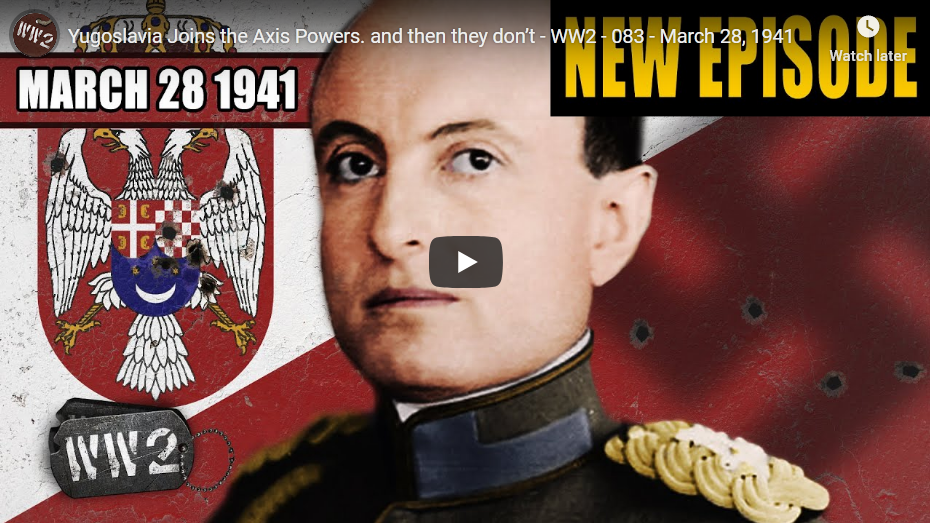
Published 29 Feb 2020Parts of the British forces in North-Africa are being send to Greece to strengthen the Allied position there. While the remaining British plan for the near future, others make huge advances in East-Africa and Hitler plans his attack on Greece through Bulgaria.
Join us on Patreon: https://www.patreon.com/TimeGhostHistory
Or join The TimeGhost Army directly at: https://timeghost.tvFollow WW2 day by day on Instagram @World_war_two_realtime https://www.instagram.com/world_war_t…
Join our Discord Server: https://discord.gg/D6D2aYN.
Between 2 Wars: https://www.youtube.com/playlist?list…
Source list: http://bit.ly/WW2sourcesWritten and Hosted by: Indy Neidell
Produced and Directed by: Spartacus Olsson and Astrid Deinhard
Executive Producers: Bodo Rittenauer, Astrid Deinhard, Indy Neidell, Spartacus Olsson
Creative Producer: Joram Appel
Post-Production Director: Wieke Kapteijns
Research by: Indy Neidell
Edited by: Mikołaj Cackowski
Map animations: Eastory (https://www.youtube.com/c/eastory)
Additional animation: Ryan WeatherbyColorizations by:
– Julius Jääskeläinen – https://www.facebook.com/JJcolorization/
– Norman Stewart – https://oldtimesincolor.blogspot.com/Sources:
IWM: E 2386, E 2372, E 2368, E 2388, E 450, E 1579, FL 10025
National Portrait Gallery
Letter by Mochammad Kafi from the Noun Project
Mil.ru
BASA (3K-15- 84-2, 3K-7-436-41)
Narodowe Archiwum Cyfrowe
Museum of Science and Technology BelgradeArchive by Screenocean/Reuters https://www.screenocean.com.
A TimeGhost chronological documentary produced by OnLion Entertainment GmbH.
March 1, 2020
The Nazis Building Bridges, Not Walls – WW2 – 079 – February 28, 1941
The Black Death of the 14th Century
Ed West looks at what we know of the spread of the worst plague to hit western Europe in the 1300s:

Map showing the spread of the Black Death in Europe between 1346 and 1353.
Map by Flappiefh via Wikimedia Commons.
There had never been a terror like it, and the “Great Mortality” as it was known — and much later, the “Black Death” — has seared itself in the European imagination. It changed the culture and tested the institutions of the time, and as we anxiously await the arrival of another — thankfully far less deadly — contagion from Italy its legacy and impact are worth remembering.
Epidemics have been around as long as civilization. Plaga — from the Greek for “strike” or “hit” — devastated classical Athens in the 5th century BC, when the historian Thucydides nursed sufferers; the Antonine Plague — probably smallpox or measles — killed as many as five million Romans at the empire’s peak. Far more deadly was the Plague of Justinian in the sixth century, which had a toll of 25 million and emptied whole regions of the eastern (Byzantine) Empire. Only in the 21st century did researchers confirm that this was the same illness that would appear eight centuries later — the Bubonic Plague.
Empires were particularly affected by these horrific epidemics, because empires are a form of globalisation — bringing different people into contact with each other and, more dangerously, into contact with other mammals, who act as disease vectors.
Another danger is climate change, which might turn a mild virus into a deadly one, or cause disease-carrying animals to migrate. This is what happened during the 14th century when the northern hemisphere became considerably cooler, soon after the Mongols had created the largest contiguous empire in history.
Genghis Khan’s people have generally received a historical bad press — people are more likely to recall the pyramid of skulls and the Tigris flowing black and red — yet their rule had opened up trade routes, allowing goods and people to cross Asia. Whether brought at the point of a sword or a trade deal, globalisation always brings the new: new cultures, new ideas, new languages and new pathogens.
Yersinia pestis had been living on gerbils and other rodents in central Asia, but unstable climate conditions in 1330s caused the disease to jump onto the rat flea. It was killing people by 1339, and in the mid-1340s Christians first heard of a disease raging in the Islamic world, which some at least took as divine punishment for the crusades.
After two centuries of Holy War this was understandable, yet hatred was not universal and during these conflicts Italian merchants had continually done business with Muslims, much to the Church’s fury. Now this trade, once the source of prosperity and peace, proved deadly: plague reached Europe via the Genovese colony of Caffa on the Black Sea (now Feodosiya, in the Ukraine). In October 1347, four ships escaping the diseased city had turned up in Sicily, condemning Italy to its fate.
The Freikorps Marches On Berlin – The Kapp Putsch I THE GREAT WAR 1920
The Great War
Published 28 Feb 2020Sign up for Curiosity Stream and Nebula: https://curiositystream.com/thegreatwar
Dissatisfied with the new German Republic and the terms of the Treaty of Versailles, parts of the new Reichswehr and the paramilitary Freikorps decide to take matters into their own hands. The Marinebrigade Ehrhardt marches on Berlin to topple the government: It’s the Kapp Putsch.
» SUPPORT THE CHANNEL
Patreon: https://www.patreon.com/thegreatwar
Merchandise: https://shop.spreadshirt.de/thegreatwar/» SOURCES
Grevelhörster, Ludwig: Kleine Geschichte der Weimarer Republik. 1918-1933. Ein
problemgeschichtlicher Überblick, 2000.
Haffner, Sebastian: Die Deutsche Revolution 1918/1919. 2010.
Heiden, Konrad: Adolf Hitler: Das Zeitalter der Verantwortungslosigkeit. Ein Mann gegen
Europa, 2016.
Kotowski, Georg (Hrsg.): Historisches Lesebuch. 1914-1933, 1968.
Möller, Horst: Die Weimarer Republik. Demokratie in der Krise, 2018.
Pöppinghege, Rainer: Republik im Bürgerkrieg. Kapp-Putsch und Gegenbewegung an Ruhr
und Lippe 1919/1920, 2019.
Stackelberg, Roderick & Winkle, Sally (Ed.), The Nazi Germany Sourcebook: An Anthology of Texts, (Florence : Taylor and Francis, 2003)
Ulrich, Volker: Adolf Hitler. Band 1: Die Jahre des Aufstiegs 1889-1939. 2013.
Sturm, Reinhard (2011). “Weimarer Republik, Informationen zur politischen Bildung”. Bonn: Bundeszentrale für politische Bildung.» SOCIAL MEDIA
Instagram: https://instagram.com/the_great_war
Twitter: https://twitter.com/WW1_Series
Reddit: https://reddit.com/r/TheGreatWarChannel»CREDITS
Presented by: Jesse Alexander
Written by: Mark Newton
Director: Toni Steller & Florian Wittig
Director of Photography: Toni Steller
Sound: Toni Steller
Editing: Toni Steller
Mixing, Mastering & Sound Design: http://above-zero.com
Maps: Daniel Kogosov (https://www.patreon.com/Zalezsky)
Research by: Markus Linke
Fact checking: Florian WittigChannel Design: Alexander Clark
Original Logo: David van StepholdA Mediakraft Networks Original Channel
Contains licensed material by getty images
All rights reserved – Real Time History GmbH 2020
The rise and fall of the Byzantine Empire – Leonora Neville
TED-Ed
Published 9 Apr 2018Check out our Patreon page: https://www.patreon.com/teded
View full lesson: https://ed.ted.com/lessons/the-rise-a…
Most history books will tell you that the Roman Empire fell in the fifth century CE, but this would’ve come as a surprise to the millions who lived in the Roman Empire through the Middle Ages. This Medieval Roman Empire, today called the Byzantine Empire, began when Constantine, the first Christian emperor, moved Rome’s capital. Leonora Neville details the rise and fall of the Byzantine Empire.
Lesson by Leonora Neville, animation by Remus & Kiki.
Thank you so much to our patrons for your support! Without you this video would not be possible! Abhijit Kiran Valluri, Mandeep Singh, Sama aafghani, Vinicius Lhullier, Connor Wytko, Marylise CHAUFFETON, Marvin Vizuett, Jayant Sahewal, Quinn Shen, Caleb ross, Elnathan Joshua Bangayan, Gaurav Rana, Mullaiarasu Sundaramurthy, Jose Henrique Leopoldo e Silva, Dan Paterniti, Jose Schroeder, Jerome Froelich, Tyler Yoshizumi, Martin Stephen, Justin Carpani, Faiza Imtiaz, Khalifa Alhulail, Tejas Dc, Govind Shukla, Srikote Naewchampa, Ex Foedus, Sage Curie, Exal Enrique Cisneros Tuch, Vignan Velivela, Ahmad Hyari, A Hundred Years, eden sher, Travis Wehrman, Minh Tran, Louisa Lee, Kiara Taylor, Hoang Viet, Nathan A. Wright, Jast3 , Аркадий Скайуокер, Milad Mostafavi, Singh Devesh Sourabh, Ashley Maldonado, Clarence E. Harper Jr., Bojana Golubovic, Mihail Radu Pantilimon, Sarah Yaghi, Benedict Chuah, Karthik Cherala, haventfiguredout, Violeta Cervantes, Elaine Fitzpatrick, Lyn-z Schulte, cnorahs, Henrique ‘Sorín’ Cassús, Tim Robinson, Jun Cai, Paul Schneider, Amber Wood, Ophelia Gibson Best, and Cas Jamieson.
February 29, 2020
Forced-Air Cooling in an Experimental Ross Machine Gun
Forgotten Weapons
Published 28 Feb 2020http://www.patreon.com/ForgottenWeapons
https://www.floatplane.com/channel/Fo…
Cool Forgotten Weapons merch! http://shop.bbtv.com/collections/forg…
In addition to building three main patterns of straight-pull bolt action rifle for the Canadian military and the commercial market, Sir Charles Ross also experimented with self-loading rifles. Starting with a standard Ross Mk III, this experimental rifle has a gas piston and trigger to allow automatic fire and a very neat forced-air cooling system. A one-way ratchet mechanism (now broken, unfortunately) spins the fan when the bolt cycles, pushing air into a barrel shroud similar to that of a Lewis gun. This rifle was most likely made in 1915 or 1916 with an eye to a military light machine gun or automatic rifle contract — which never happened.
Thanks to the Canadian War Museum for providing me access to film this Ross for you!
Contact:
Forgotten Weapons
6281 N. Oracle #36270
Tucson, AZ 85740
The metallic nickname of Henry VIII
In the most recent Age of Invention newsletter, Anton Howes outlines the rocky investment history for German mining firms in England during the Tudor period:

Cropped image of a Hans Holbein the Younger portrait of King Henry VIII at Petworth House.
Photo by Hans Bernhard via Wikimedia Commons.
It’s an especially interesting case of England’s technological backwardness, given that copper was a material of major strategic importance: a necessary ingredient for the casting of bronze cannon. And it was useful for other industries, especially when mixed with zinc to form brass. Brass was the material of choice for accurate navigational instruments, as well as for ordinary pots and kettles. Most importantly, brass wire was needed for wool cards, used to straighten the fibres ready for spinning into thread. A cheaper and more secure supply of copper might thus potentially make England’s principal export, woollen cloth, even more competitive — if only the English could also work out how to produce brass.
The opportunity to introduce a copper industry appeared in 1560, when German bankers became involved in restoring the gold and silver content of England’s currency. The expensive wars of Henry VIII and Edward VI in the 1540s had prompted debasements of the coinage, to the short-term benefit of the crown, but to the long-term cost of both crown and country. By the end of Henry VIII’s reign, the ostensibly silver coins were actually mostly made of copper (as the coins were used, Henry’s nose on the faces of the coins wore down, revealing the base metal underneath and earning him the nickname Old Coppernose). The debased money continued to circulate for over a decade, driving the good money out of circulation. People preferred to hoard the higher-value currency, to send it abroad to pay for imports, or even to melt it down for the bullion. The weakness of the pound was an especial problem for Thomas Gresham, Queen Elizabeth’s financier, in that government loans from bankers in London and Antwerp had to be repaid in currency that was assessed for its gold and silver content, rather than its face value. Ever short of cash, the government was constantly resorting to such loans, made more expensive by the lack of bullion.
Restoring the currency — calling in the debased coins, melting them down, and then re-minting them at a higher fineness — required expertise that the English did not have. From France, the mint hired Eloy Mestrelle to strike the new coins by machine rather than by hand. (He was likely available because the French authorities suspected him of counterfeiting — the first mention of him in English records is a pardon for forgery, a habit that apparently died hard as he was eventually hanged for the offence). And to do the refining, Gresham hired German metallurgists: Johannes Loner and Daniel Ulstätt got the job, taking payment in the form of the copper they extracted from the debased coinage (along with a little of the silver). It turned out to be a dangerous assignment: some of the copper may have been mixed with arsenic, which was released in fumes during the refining process, thus poisoning the workers. They were prescribed milk, to be drunk from human skulls, for which the government even gave permission to use the traitors’ heads that were displayed on spikes on London Bridge — but to little avail, unfortunately, as some of them still died.
Loner and Ulstätt’s payment in copper appears to be no accident. They were agents of the Augsburg banking firm of Haug, Langnauer and Company, who controlled the major copper mines in Tirol. Having obtained the English government as a client, they now proposed the creation of English copper mines. They saw a chance to use England as a source of cheap copper, with which they could supply the German brass industry. It turns out that the tale of the multinational firm seeking to take advantage of a developing country for its raw materials is an extremely old one: in the 1560s, the developing country was England.
Yet the investment did not quite go according to plan. Although the Germans possessed all of the metallurgical expertise, the English insisted that the endeavour be organised on their own terms: the Company of Mines Royal. Only a third of the company’s twenty-four shares were to be held by the Germans, with the rest purchased by England’s political and mercantile elite: people like William Cecil (the Secretary of State) and the Earl of Leicester, Robert Dudley (the Queen’s crush). It was an attractive investment, protected from competition by a patent monopoly for mines of gold, silver, copper, and mercury in many of the relevant counties, as well as a life-time exemption for the investors from all taxes raised by parliament (in those days, parliament was pretty much only assembled to legitimise the raising of new taxes).
Dardick Model 1500: The Very Unusual Magazine-fed Revolver
Forgotten Weapons
Published 12 Nov 2019This is Lot 1953 in the upcoming RIA December Premier auction.
The Dardick 1500 was a magazine-fed revolver designed by David Dardick in the 1950s. His patent was granted in 1958, and somewhere between 40 and 100 of the guns were made in 1959, before the company went out of business in 1960. The concept was based around a triangular cartridge (a “tround”) and a 3-chambered, open-sided cylinder. This wasn’t really of direct benefit to a handgun, but instead was ideal for a high rate of fire machine gun, where the system did not need to pull rounds forward or backward to chamber and eject them. In lieu of military machine gun contract, Dardick applied the idea to a sidearm.
The Model 1500 held 15 rounds, inside a blind magazine in the grip. It was chambered for a .38 caliber cartridge basically the same as .38 Special ballistically. A compact Model 1100 was also made in a small numbers, with a shorter grip and correspondingly reduced magazine capacity (11 trounds). A carbine barrel/stock adapter was also made. The guns were a complete commercial failure, with low production and lots of functional problems. Today, of course, they are highly collectible because of that scarcity and their sheer mechanical weirdness.
http://www.patreon.com/ForgottenWeapons
Cool Forgotten Weapons merch! http://shop.bbtv.com/collections/forg…
Contact:
Forgotten Weapons
6281 N. Oracle #36270
Tucson, AZ 85704
I’ve always had an interest in the Dardick, from their appearance in some of L. Neil Smith’s science fiction novels. I linked to an earlier article of his, and commented:
As Neil pointed out in one of his books, the Dardick was the answer to a bad crime writer’s prayers: it was literally an automatic revolver. (For those following along at home, an “automatic” has a magazine holding the bullets which are fed into the chamber to be fired by the action of the weapon: fire a bullet, the action cycles, clearing the expended cartridge and pushing a new one into place, cocking the weapon to fire again. A “revolver” holds bullets in the cylinder, rotating the cylinder when the gun is fired to put a new bullet in line with the barrel to be fired. The Dardick is the only example I know of that combines both in one gun.)
QotD: Perceived causes of madness during the Renaissance
Eventually the Renaissance became less of an impending threat and more of a fait accompli, and people’s worries died down a bit. Madness began to be treated more as ordinary immorality. This didn’t necessarily mean people freely chose to be mad – the classical age didn’t think in exactly the same “it’s your fault” vs. “it’s biological” terms we do – but it was considered due to a weakness of character in the same way as other failures.
In some cases, it was the result of an excess of passions, flightiness, or imagination: the most famous example is Don Quixote, who went crazy after reading too many fiction books. This was actually considered a very serious risk by practically all classical authorities, especially for women. Foucault quotes Edme-Pierre Beauchesne:
In the earliest epochs of French gallantry and manners, the less perfected minds of women were content with facts and events as marvelous as they were unbelievable; now they demand believable facts yet sentiments so marvelous that their own minds are disturbed and confounded by them; they then seek, in all that surrounds them, to realize the marvels by which they are enchanted; but everything seems to them without sentiment and without life, because they are trying to find what does not exist in nature.
And a newspaper of the time:
The existence of so many authors has produced a host of readers, and continued reading generates every nervous complaint; perhaps of all the causes that have harmed women’s health, the principal one has been the infinite multiplication of novels in the last hundred years … a girl who at ten reads instead of running will, at twenty, be a woman with the vapors and not a good nurse.
Novels weren’t the only danger, of course. There were other hazards to watch for, like waking up too late:
The moment at which our women rise in Paris is far removed from that which nature has indicated; the best hours of the day have slipped away; the purest air has disappeared; no one has benefited from it. The vapors, the harmful exhalations, attracted by the sun’s heat, are already rising in the atmosphere.
Also, freedom:
For a long time, certain forms of melancholia were considered specifically English; this was a fact in medicine and a constant in literature … Spurzheim made a synthesis of all these analyses in one of the last texts devoted to them. Madness, “more frequent in England than anywhere else,” is merely the penalty of the liberty that reigns there, and of the wealth universally enjoyed. Freedom of conscience entails more dangers than authority and despotism. “Religious sentiments exist without restriction; every individual is entitled to preach to anyone who will listen to him”, and by listening to such different opinions, “minds are disturbed in the search for truth.”
These are a very selective sampling of quotes from just one of Foucault’s many chapters, and some of them are separated by centuries from others, but the overall impression I got was that conformity/wholesomeness/clean living was salubrious, and deviations from these likely to cause madness. Essentially, if you deviate from your humanity a little bit of the way – by failing to be a godly, sober-living, and industrious person – then that can compound on itself and make you lose practically all of your humanity. You will end up a feral madman, little different from a beast.
Scott Alexander, “Book review: Madness and Civilization”, Slate Star Codex, 2018-01-04.
February 28, 2020
“The Future of Warfare” – British Tanks of the Great War – Sabaton History 056 [Official]
Sabaton History
Published 27 Feb 2020Tanks! What a terrible and frightening sight they must have been for the Germans, the first time they had appeared on the battlefield at the Somme in 1916. The tanks were the product of many different ideas and prototypes, that all sought to overcome the perils of the modern battlefield — the machine gun, the bombed out ground and the barbed wire. The British Mark I tank would crush those obstacles through its sheer weight and begin a new age of mechanized warfare!
Support Sabaton History on Patreon: https://www.patreon.com/sabatonhistory
Listen to “The Future of Warfare” on the album The Great War:
CD: http://nblast.de/SabatonTheGreatWar
Spotify: https://sabat.one/TheGreatWarSpotify
Apple Music: https://sabat.one/TheGreatWarAppleMusic
iTunes: https://sabat.one/TheGreatWarItunes
Amazon: https://sabat.one/TheGreatWarAmazon
Google Play: https://sabat.one/TheGreatWarGooglePlayWatch the official lyric video of “The Future of Warfare” here:
https://www.youtube.com/watch?v=t8qJi…Check out the trailer for Sabaton’s new album The Great War right here: https://www.youtube.com/watch?v=HCZP1…
Listen to Sabaton on Spotify: http://smarturl.it/SabatonSpotify
Official Sabaton Merchandise Shop: http://bit.ly/SabatonOfficialShopHosted by: Indy Neidell
Written by: Markus Linke and Indy Neidell
Directed by: Astrid Deinhard and Wieke Kapteijns
Produced by: Pär Sundström, Astrid Deinhard and Spartacus Olsson
Creative Producer: Joram Appel
Executive Producers: Pär Sundström, Joakim Broden, Tomas Sunmo, Indy Neidell, Astrid Deinhard, and Spartacus Olsson
Post-Production Director: Wieke Kapteijns
Edited by: Iryna Dulka
Sound Editing by: Marek Kaminski
Maps by: Eastory – https://www.youtube.com/c/eastoryArchive by: Reuters/Screenocean https://www.screenocean.com
Music by Sabaton.Sources:
– Bundesarchiv
– Bibliothèque nationale de France
– Library and Archives Canada
– National Library of Scotland
– Australian War Museum
– National Army Museum
– IWM: Q 53204, Q 115391, Q 1419, Q 78121, Q 72864, HU 55578, Q 14496, Q 14495, Q 2487, Q 2486, Q 5574, Q 52, Q 43463, Q 3565, Q 3542, Q 5578, Q 80026, Q 68975
– IWM ART: REPRO 000684 7
– Sound of tracktor engine by viertelnachvier, tank sound by nicstage, from freesound.orgAn OnLion Entertainment GmbH and Raging Beaver Publishing AB co-Production.
© Raging Beaver Publishing AB, 2019 – all rights reserved.
A history lesson from Roman Thessalonika
At Samizdata, Niall Kilmartin recounts a story that has some interesting modern parallels for those who choose to look:

The Course of Empire – Destruction by Thomas Cole, 1836.
From the New York Historical Society collection via Wikimedia Commons.
It happened in Thessalonika near the end of the Roman Empire.
The empire had been in trouble for some time. It was not reproducing itself – “The human harvest was bad” (Seeley). “Agri Deserti” – once-cultivated lands now abandoned for lack of people to till them – could be found in every province.
Internally, the empire tried its usual solution: more government, more laws, more force. Legislation to reward large families and tax bachelors was kept on the statute books for centuries although “successful it was not” (Power). As the empire waned, laws to deal with the consequence of this failure were added: binding cultivators to the soil (the origin of serfdom) was merely the most common example of assigning a hereditary obligation to more and more of the professions the state relied on as soon as a shortfall appeared in them, legally punishing any son who did not follow in his father’s footsteps. To draft and regulate these laws, the numbers and privileges of bureaucrats ballooned from Rome’s former proportion (though still small by our standards).
Successful all these laws were not – so, externally, the empire addressed its chronic shortage of manpower by immigration,
to dose it with barbarian vigour. Just a small injection to begin with and then more and more
Goths arrived, first as recruits to Roman army units, then as foederate units under their own leaders, growing like a cancer within the armed forces until an Egyptian mother quite naturally wrote the emperor to return her citizen son who “has gone off with the barbarians” – by which she meant he had joined the “Roman” army.
Emperor Theodosius made the Goths obey him, but his was an insecure authority over them. He used Gothic troops in battles where pyrrhic victories may have been welcome. As one summary of the costly victory of Frigidius (394 AD) puts it,
The loss of 10,000 Goths cannot have distressed Theodosius unduly.
Theodosius also had little choice but to use some of their leaders as governors. Mostly, the empire’s soldiers were also its police – so the leaders of those who were now increasingly providing those soldiers had to be both rewarded by, and used in, such posts. Thus did Butheric the Goth became governor (magister militum) over Illyricum, which included Thessalonika.
The urban elite of Thessalonika were university-educated Greeks.
It would be hard to imagine an education less suited to help them understand the dangers they faced. The study of rhetoric, its links with reality long severed, …
So Eileen Power described the “learned” of the dying Roman world. (Today, 8 decades after she wrote those sentences, it is easier to imagine an education even less suited to helping elite intellectuals understand the dangers facing them, one whose links with reality are even more completely severed.) In the empire’s second century, Hadrian had dispersed those Jews he did not kill around the empire, confident they’d soon lose their primitive prejudices and assimilate to being broad-minded Graeco-Roman intellectuals like himself. Fourth/fifth century Graeco-Roman intellectuals thought the same of the immigrants. Sidonius Appolinaris wrote a “good-natured” description of the “embarrassing friendliness” of the new barbarian neighbours he encountered on a fifth-century visit to Lyons:
“How can he be expected to compose six-foot metres”, [Sidonius] asks, “with so many seven-foot patrons all around him, all singing and all expecting him to admire their uncouth stream of non-Latin words.”
The shrug of the shoulders, the genial contempt of one conscious of an infinite superiority – how familiar it all seems.
Perhaps the Thessalonikan city leaders greeted their new governor in this spirit, as sure as Hadrian was about the Jews that this uncouth Goth would soon lose his barbaric prejudices.
The Robin Hood complex – Social banditry theory and myth making
The Cynical Historian
Published 15 Dec 2016There’s one historical theory that people keep deluding themselves with, and it’s about time I pointed it out. Social banditry, or the “Robin Hood theory” is problematic at best and cultural misanthropy at worst.
Social bandit or social crime is a term invented by the Marxist historian Eric Hobsbawm in his 1959 book Primitive Rebels, a study of popular forms of resistance that also incorporate behavior characterized by law as illegal. He further expanded the field in the 1969 study Bandits. Social banditry is a widespread phenomenon that has occurred in many societies throughout recorded history, and forms of social banditry still exist, as evidenced by piracy and organized crime syndicates. Later social scientists have also discussed the term’s applicability to more modern forms of crime, like street gangs and the economy associated with the trade in illegal drugs.
————————————————————
References:
Boessenecker, John. “California Bandidos.” Southern California Quarterly 80, i4 (Dec. 1, 1998), 419-434.Hall-Patton, Joseph. Pacifying Paradise: Violence and Vigilantism in San Luis Obispo. San Luis Obispo: California Polytechnic – San Luis Obispo thesis, 2016. http://www.digitalcommons.calpoly.edu…
Hobsbawm, Eric. Primitive Rebels: Studies in Archaic Forms of Social Movement in the 19th and 20th Centuries. New York: WW Norton & Company, 1965. https://amzn.to/2L6TDY0
Hobsbawm, Eric. Bandits. Rev. ed. New York: The New Press, 2000. https://amzn.to/2L4RagK
Rediker, Marcus. Outlaws of the Atlantic: Sailor, Pirates, and Motley Crews in the Age of Sail. Boston, Mass.: Beacon Press, 2014. https://amzn.to/2OasYf4
Linebaugh, Peter and Marcus Rediker. The Many-Headed Hydra: Sailors, Slaves, Commoners, and the Hidden History of the Revolutionary Atlantic. Boston, Mass.: Beacon Press, 2000. https://amzn.to/2JKq8tN
https://en.wikipedia.org/wiki/Social_…
https://en.wikipedia.org/wiki/Zorro
https://en.wikipedia.org/wiki/Pancho_…
https://en.wikipedia.org/wiki/Joaquin…
https://en.wikipedia.org/wiki/Salomon…
https://en.wikipedia.org/wiki/Black_B…
————————————————————
Patreon:
https://www.patreon.com/CynicalHistorianLET’S CONNECT:
https://twitter.com/Cynical_History
—————————————–
Hashtags: #History #SocialBanditry #PrimitiveRebellion #RobinHood #BillyTheKid
QotD: Greek and Roman views of markets
The debate over the Polanyi and Finley view of ancient economic organisation — or perhaps over the Marx and Weber and Polanyi and Finley views — does not seem to have been followed with much attention by libertarians and conservatives. It is worth following, even so. Beyond a very basic level, history is as much about the present as the past. Gibbon’s Decline and Fall of the Roman Empire is a masterpiece of pure history. But it is also an account of what he saw as the long night of reason — and its attendant nightmares — between the golden age of the Antonines and his own age, and an anxious search for reassurance that there would be no second sleep. Macaulay’s History of England is in part an attempt to legitimise the Victorian settlement as the culmination of historical processes that had their local origin in the 1680s. How readers can be brought to think about the past will insensibly affect how they see the present.
Now, if it could be shown that the Aztecs had no concept of market behaviour, and that they were motivated by considerations wholly different from our own, it would be of little consequence. Everything we know about Aztec civilisation raises doubts whether it was worth calling a civilisation. The Aztecs had no writing and were ignorant of metal working and wheeled transport. Their cultural values were expressed in ritual torture, mass human sacrifice and cannibalism. The Mayans and Toltecs and all the others of their sort seem to have been no better. We may deplore the brutality of the Spanish conquest, but still conclude that it was, on balance, a blessing for the peoples of South America.
But it is different with the empires of the ancient Near East — and very different with the Greeks and Romans. These latter races are our intellectual fathers. Everything we ourselves have achieved is built on the foundations they laid. They gave us the names of all our arts and sciences. Eighty per cent of the English vocabulary is derived from Greek or Latin. Knowledge of these languages may be less widely diffused than it was until a century ago. But the general prestige of the Greeks and Romans is barely less now than it was among the mediaeval pilgrims who gaped at the crumbling remains of the Colisseum and the Baths of Diocletian. If it can be shown that they were wholly unlike us in their economic motivations, that would surely place in doubt the notion that market behaviour is natural to us.
And if few people outside the relevant university departments have read Polanyi and Finley, their conclusions are transmitted through popular histories and newspaper articles and television documentaries, and through large numbers of students who, however superficially, are exposed to these conclusions.
Sean Gabb, “Market Behaviour in the Ancient World: An Overview of the Debate”, 2008-05.
February 27, 2020
Appeasement – How the West Helped Hitler Start WW2 | BETWEEN 2 WARS I 1938 Part 1 of 4
TimeGhost History
Published 26 Feb 2020With the increasing aggression of Italy, Japan, and Germany in the 1930s, the League of Nations is becoming increasingly ineffective in regulating international disputes. Britain and France adopt a diplomatic strategy of appeasement to hold off all-out war and buy some crucial time. But will it work, and can Adolf Hitler’s territorial ambitions be contained?
Join us on Patreon: https://www.patreon.com/TimeGhostHistory
Hosted by: Indy Neidell
Written by: Francis van Berkel and Spartacus Olsson
Directed by: Spartacus Olsson and Astrid Deinhard
Executive Producers: Bodo Rittenauer, Astrid Deinhard, Indy Neidell, Spartacus Olsson
Creative Producer: Joram Appel
Post-Production Director: Wieke Kapteijns
Research by: Tom Meaden, Izzy Wilson, and Francis van Berkel
Edited by: Daniel Weiss
Sound design: Marek KamińskiSources:
Bundesarchiv_Bild:
102-08806, 102-08810, 102-09042,
119-5243, 146-1970-052-24, 146-1985-108-27A,
183-1987-0922-500, 183-R03618,
Photo from color by klimbim.Colorizations by:
– Daniel Weiss
– Norman Stewart
– Julius Jääskeläinen – https://www.facebook.com/JJcolorization/Soundtracks from Epidemic Sound:
– “The Inspector 4” – Johannes Bornlöf
– “Last Point of Safe Return” – Fabien Tell
– “Split Decision” – Rannar Sillard
– “Death And Glory 1” – Johannes Bornlöf
– “Guilty Shadows 4” – Andreas Jamsheree
– “Disciples of Sun Tzu” – Christian Andersen
– “First Responders” – Skrya
– “Easy Target” – Rannar Sillard
– “Death And Glory 3” – Johannes Bornlöf
– “The Charleston 3” – Håkan ErikssonA TimeGhost chronological documentary produced by OnLion Entertainment GmbH.
From the comments:
TimeGhost History
2 days ago (edited)
Hindsight is 20/20. It’s easy to look back at Anglo-French foreign policy in the 1930s and be shocked at how many mistakes politicians like Neville Chamberlain could make. This video will probably only add to that judgement, it more or less charts all the times Hitler could have been stopped but wasn’t. But put yourself in the context of the time. Memories of the Great War are only twenty years ago old, and the public has no appetite for another massive conflict. The global economy is only just showing signs of recovery after the Great Depression, and Britain and France barely have the industrial capacity to fight a modern war. So, imagine you’re Chamberlain (or any other politician of the time), are you really going to commit your country to war over a territorial disagreement between Germany and Czechoslovakia? The invasion of Poland in September 1939 shows that appeasement was a mistake. But maybe it was an understandable one? Let us know what you think in the comments.Cheers,
Francis.
A French Civil War in 1937? – WW2 feat. Hearts of Iron IV [sponsored]
World War Two
Published 26 Feb 2020This video is sponsored by Paradox Interactive. Indy shares his thoughts on what he thinks would have happened if the French would have decided to meddle in the Spanish Civil War – triggering a Civil War.
Hearts of Iron IV: La Résistance is now available! You can play Hearts of Iron IV for free until next Sunday, the 1st of March! Discover it here: https://pdxint.at/39Re5ld
Watch our first collab video with HoI4 about the Spanish Civil War here: https://youtu.be/7QE1hvH8ZVU
Watch our Between Two Wars episode on the Spanish Civil War here: https://youtu.be/ncUkPavahCU
Watch our Between Two Wars episode on the French February Revolution in 1934 here: https://youtu.be/tLm1gWnlcYwJoin us on Patreon: https://www.patreon.com/TimeGhostHistory
Or join The TimeGhost Army directly at: https://timeghost.tvFollow WW2 day by day on Instagram @World_war_two_realtime https://www.instagram.com/world_war_t…
Join our Discord Server: https://discord.gg/D6D2aYN.
Between 2 Wars: https://www.youtube.com/playlist?list…
Source list: http://bit.ly/WW2sourcesWritten and Hosted by: Indy Neidell
Produced by: Spartacus Olsson and Astrid Deinhard
Directed by: Wieke Kapteijns
Executive Producers: Bodo Rittenauer, Astrid Deinhard, Indy Neidell, Spartacus Olsson
Creative Producer: Joram Appel
Post-Production Director: Wieke Kapteijns
Research by: Indy Neidell
Edited by: Guido Becker
Gameplay scenes: Sietse KenterColorizations by:
Dememorabilia – https://www.instagram.com/dememorabilia/
Julius Jääskeläinen – https://www.facebook.com/JJcolorization/
Adrien Fillon – https://www.instagram.com/adrien.colo…
Daniel WeissArchive by Screenocean/Reuters https://www.screenocean.com.
A TimeGhost chronological documentary produced by OnLion Entertainment GmbH.
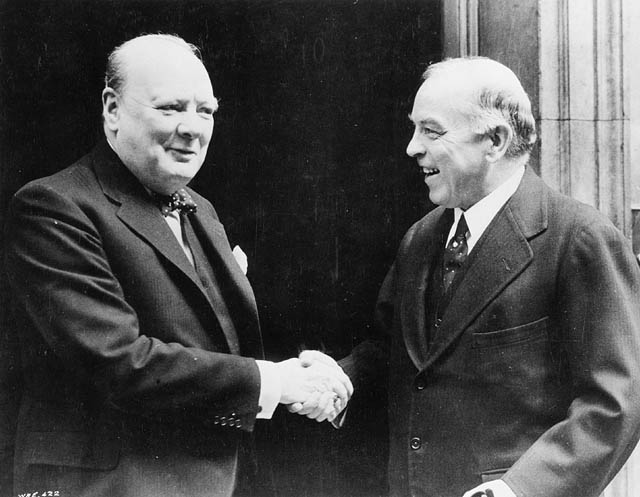
Winston Churchill Biography: In the Darkest Hour
Biographics
Published 13 Feb 2018We imagine Winston Churchill with his signature cane, drinking scotch whiskey, and puffing on a Cuban cigar. His mouth is downturned, and his voice is gruff and his words pointed. This is the image Hollywood portrays but it is a mere caricature of the flesh and blood version. Who was Winston Churchill? In Britain’s “darkest hour,” Churchill led his country from the brink of Nazi conquest by forging an alliance with the U.S. and Russia. He had many critics, and made mistakes on a grand scale. Yet, above it all, possessed an unwavering belief in his own power. To his beloved country he offered his “blood, toil, tears and sweat.”
Visit our companion website for more: http://biographics.org
Credits:
Host – Simon Whistler
Author – Crystal Sullivan
Producer – Samuel Avila
Executive Producer – Shell HarrisBusiness inquiries to biographics.email@gmail.com
Biographies by the book, get Winston Churchill’s biography from Amazon: http://amzn.to/2EAfh7b