Quotulatiousness

March 12, 2020

Canadian Ross MkIII Sniper Rifle with Warney & Swasey Scope

Filed under: Cancon, History, Military, USA, Weapons, WW1 — Tags: , , , , — Nicholas @ 04:00

Forgotten Weapons
Published 11 Mar 2020

http://www.patreon.com/ForgottenWeapons

https://www.floatplane.com/channel/Fo…

Cool Forgotten Weapons merch! http://shop.bbtv.com/collections/forg…

The Canadian infantry that went to Europe in the early years of World War One were equipped primarily with the Ross MkIII rifle. The Ross would become quite the scandal, and was replaced in service with the SMLE in 1916 — but as a sniper rifle the Ross excelled. Its problems in service were largely based on poor quality ammunition, and this was not an issue for the sniper corps. In addition, Great Britain was having enough trouble equipping its own snipers to have any extra scoped rifles to hand over to the dominions.

And so, the Canadians modified 500 Ross rifles into a sniper configuration using American-sourced Warner & Swasey M1913 “Musket Sight” scopes. These were 5x magnification prismatic scopes, also used by American forces on the M1903 sniper rifle and the M1909 Benet-Mercie machine guns. The scope was not very good, suffering from fogging and other issues, but it was available. The Canadian rifles were made in two batches of 250 each, one in 1915 and one in 1917. This was actually more rifles than needed, and many of them (including the two in this video) remained in Canada for training (and were used at least until 1942).

Canadian Warner & Swasey scopes can be identified by three elements. They have elevation dials marked out to 2400 yards, serial numbers between 1 and 500, and no data plate on top. Canadian scope cases are marked with the serial numbers of the scope and the rifle they were issued with.

Contact:
Forgotten Weapons
6281 N. Oracle #36270
Tucson, AZ 85740

M134 Minigun: The Modern Gatling Gun

Filed under: History, Military, USA, Weapons — Tags: , , , — Nicholas @ 02:00

Forgotten Weapons
Published 22 Dec 2016

Minigun in slow motion: https://www.youtube.com/watch?v=XeyVr…

The General Electric M134 “Minigun” is essentially an electrically-powered Gatling gun — the conceptual operation of the gun is identical to Dr. Gatling’s original creation. What has changed, however, is the chambering (it’s in 7.62 NATO), the power source (an electric motor), and the feed mechanism (belt-feed using M60 links instead of the Gatling’s Accles, Broadwell, or Bruce feeds). The weapon was a scaled down version of a 20mm rotary powered cannon devised for aircraft armament after WW2, hence the “mini” name. It was used primarily as helicopter armament, although it has found its way only ground vehicles as well. Firing between 3000 and 6000 rounds per minute, the Minigun is ideal for aerial engagements where the gunner only has a brief moment on target and needs to fire as much as possible during that moment.

It is a truly awe-inspiring weapon, and quite an experience to fire! In addition to destroying a truck with it, we will look at disassembly and functioning of the minigun — the delinking mechanism is really the most complex part of the weapon, and a very interesting device.

Thanks to Modern Arms of Tempe, AZ for providing the Minigun for this video! They offer the gun for rental, if you are interested in trying it out yourself.

http://www.patreon.com/ForgottenWeapons

Cool Forgotten Weapons merch! http://shop.bbtv.com/collections/forg…

If you enjoy Forgotten Weapons, check out its sister channel, InRangeTV! http://www.youtube.com/InRangeTVShow

March 11, 2020

Carton de Wiart – A Man For All Seasons – WW2 Biography Special

Filed under: Africa, Britain, Europe, History, Italy, Military, WW1, WW2 — Tags: , , , , , — Nicholas @ 06:00

World War Two
Published 10 Mar 2020

Carton de Wiart was a remarkable figure in World War One, but his story continues in World War Two, where he rolls from one adventure into the next.

Join us on Patreon: https://www.patreon.com/TimeGhostHistory
Or join The TimeGhost Army directly at: https://timeghost.tv

Follow WW2 day by day on Instagram @World_war_two_realtime https://www.instagram.com/world_war_t…
Between 2 Wars: https://www.youtube.com/playlist?list…
Source list: http://bit.ly/WW2sources

Hosted by: Indy Neidell
Written by: Francis van Berkel
Produced and Directed by: Spartacus Olsson and Astrid Deinhard
Executive Producers: Bodo Rittenauer, Astrid Deinhard, Indy Neidell, Spartacus Olsson
Creative Producer: Joram Appel
Post-Production Director: Wieke Kapteijns
Research by: Keith Kevelson
Edited by: Mikołaj Cackowski

Colorizations by:
Julius Jääskeläinen – https://www.facebook.com/JJcolorization/

Sources:
IWM Q 101768, Q 82958, Q 15472, Q 53680, Q 92257, Q 4511, Q 11429, Q 92207, Q 92214, N 228, N 110, N 68, H 7393, HU 128168, E(MOS) 1315, SE 3547, A 31225, A 20588, Q 92218
Skull by Mahmure Alp from the Noun Project
foot bone by Maxicons from the Noun Project
Ear by Vectors Market from the Noun Project
Hip Bones by ProSymbols from the Noun Project
Collection of Auckland Museum Tamaki Paenga Hira, 2001.25.480 Brent Mackrell Collection
Narodowe Archiwum Cyfrowe
Picture of Combe, Carton de Wiart, Todhunter and Gambier-Parry in Vincigliata Castle Prison, courtesy Michael Todhunter

Soundtracks from the Epidemic Sound:
Hakan Eriksson – “Epic Adventure Theme 3”
Jo Wandrini – “Dawn of Civilization”
Rannar Sillard – “March of the Brave 4”
Johannes Bornlof – “Death And Glory 3”
Farrell Wooten – “Blunt Object”
Philip Ayers – “Trapped in a Maze”
Phoenix Tail – “At the Front”

Archive by Screenocean/Reuters https://www.screenocean.com.

A TimeGhost chronological documentary produced by OnLion Entertainment GmbH.

From the comments:

World War Two
40 minutes ago (edited)
This episode was made thanks to our research volunteer Keith Kevelson. It is also the first of its kind, being the first proper Biography Special of our World War Two series. We will do one of these every other week, so be prepared to get to know the main protagonists of the Second World War up close and personal. Please support us on Patreon so we can continue making these. Sign up at www.patreon.com/timeghosthistory or https://timeghost.tv.

Cheers,
Joram

A Bridge Too Far | Military History Book Review

Filed under: Books, Britain, Germany, History, Military, USA, WW2 — Tags: , , , — Nicholas @ 02:00

TIK
Published 22 Feb 2016

The classic history book looking at the battle of Arnhem and Operation Market Garden. Cornelius Ryan’s A Bridge Too Far.

Have you seen my popular Operation Market Garden Documentary?
https://youtu.be/vTUC79o4Kmc

Also, if you haven’t done already, follow me on Twitter!
https://twitter.com/TIKhistory

March 10, 2020

The Hitchhiker’s Guide to the Galaxy turns 42

Filed under: Britain, History, Humour, Media — Tags: , — Nicholas @ 05:00

In The Register, Richard Speed notes a significant anniversary:

The weekend marked the 42nd anniversary of the first broadcast of The Hitchhiker’s Guide to the Galaxy, the hugely influential BBC radio show.

42 is a significant number for fans of the innovative series by Douglas Adams so (carefully) pour yourself a Pan Galactic Gargle Blaster, wrap yourself in a towel and join The Register for a trip back to 1978, when the BBC decided to do something quite different.

Writing in the introduction to the Pan Books’ 1985 publication of the radio scripts (which differ from the books, which differ from the television series, which differ from the film …), series producer Geoffrey Perkins described his first meeting with the author. Adams was giving a speech despite being aggressively heckled by the cast members of the Cambridge Footlights show he’d just directed.

He’d also elected to stand on a rickety chair to deliver the speech.

“Here,” recalled Perkins, “was someone prepared to stick his neck out further than most people, someone who would carry on in the face of adversity, and someone who would shortly fall off a chair.

“I was right on all three counts.”

Perkins went on to join the BBC, while Adams worked with the Monty Python team as well as contributing to Doctor Who as the 1970s went on. He pitched the idea for a science-fiction comedy radio series to radio producer Simon Brett. Brett recommended Perkins to the BBC as a potential producer and the series was given the go-ahead on 31 August 1977 (after the first episode was commissioned on 1 March 1977).

“We both owe him an enormous debt,” said Perkins of Brett.

Budapest 44: The Siege of Buda (December 44 – February 45)

Filed under: Europe, Germany, History, Military, Russia, WW2 — Tags: , , — Nicholas @ 04:00

Historigraph
Published 7 Mar 2020

Buy Siege of Budapest Poster here: https://teespring.com/en-GB/siege-of-…
Support the channel on Patreon: https://www.patreon.com/historigraph
Follow me on Twitch: https://www.twitch.tv/historigraph

#SiegeOfBudapest #SiegeOfBuda #Historigraph

►Twitter: https://twitter.com/historigraph
►Instagram: https://www.instagram.com/historigraph
►Patreon: https://www.patreon.com/historigraph

The Siege of Budapest and the battles that led to it have had precious little written about them (in English!), so the bulk of this video comes from one book:

Krisztián Ungváry, Battle for Budapest: 100 Days in World War 2

This is by far the most detailed account of the battle that I could find.

Music:

“Crypto”, Incompetech https://incompetech.com

“Rynos Theme”, Incompetech

“Stormfront”, Incompetech

Thought-saving inventions

Filed under: Britain, History, Science, Technology — Tags: , , , — Nicholas @ 03:00

In the latest issue of his Age of Invention newsletter, Anton Howes considers the innovations that helped provide short-cuts for thought, rather than labour:

The world on Mercator projection between 85°3’4″S and 85°3’4″N, such that image is square. 15° graticule. Imagery is a derivative of NASA’s Blue Marble summer month composite with oceans lightened to enhance legibility and contrast. Image created with the Geocart map projection software.
Image by Strebe via Wikimedia Commons.

When we think of labour-saving inventions, the kind of labour that springs to mind tends to be manual. We think of machines replacing the muscle of limbs and the dexterity of fingers, and we worry about their effects on unemployment and unrest. But there’s a subset of labour-saving inventions that rarely gets discussed. They might best be called thought-saving.

A few weeks ago I mentioned the introduction of mathematical techniques to navigation. Before the mid-sixteenth century in England, pilots very rarely even knew how to calculate their latitude, let alone their longitude. But over the course of just a few decades, England became one of the world leaders in navigational improvements. A handful of mathematicians saved pilots the trouble of calculation, by coming up with tables, instruments, diagrams, and rules of thumb. In the process, they improved navigation’s accuracy, and ushered in an age of English dominance of the high seas.

The historian Eric H. Ash gives a few great examples. In the 1590s, the explorer John Davis shared a way to calculate the time of high tide, without requiring multiplication. Likewise, William Bourne, a self-taught mathematician and gunner, in the 1560s provided an easy means of calculating the linear distance in one degree of longitude, at any given latitude. He provided a diagram — really an instrument, even if it wasn’t made of wood or brass — which with just a simple piece of string could be used to derive the answer without needing to understand cosines, or really any trigonometry.

The mathematicians did the same with maps, too (after all, aren’t all maps thought-saving?) The sixteenth-century cartographic innovations simplified the pilot’s ability to chart a route, for example by taking away all need to worry about the curvature of the earth. The famous 1560s map projection of Gerardus Mercator stretched the distance between the lines of latitude as they got closer to the poles, so that charting a course on such a map was a simple matter of drawing straight lines rather than complex trigonometry. The Mercator projection may well make Africa look smaller than Greenland — it’s actually almost fifteen times as large — but it made life significantly easier for mariners. For similar reasons, the mathematician John Dee designed a special chart — what he called the “paradoxall compass” — to aid the English explorers who in the 1550s went in search of a northeast and northwest passage to Asia. Conventional charts made navigating high latitudes confusing, as the north pole was a straight line — the map’s top border. Dee’s map made things easier by putting the pole at the centre, as a point, with the lines of latitude as concentric circles.

The Birth of a Nation | Based on a True Story

Filed under: History, Media, USA — Tags: , , , , , , — Nicholas @ 02:00

The Cynical Historian
Published 7 Oct 2016

The Birth of a Nation was the first major motion picture success, and because of its historical inaccuracy, the Ku Klux Klan was revived for another round of terror. This is the worst case of a “Based on a True Story” film. So today is a prime time to go into why it was so bad, and get some President Wilson bashing in.

Through YouTube’s cowardice, this video has been demonetized.
————————————————————
references:
Blee, Kathleen M. Women of the Klan: Racism and Gender in the 1920s. Berkeley: University of California Press, 1991. https://amzn.to/2NzeHbl

http://www.npr.org/sections/codeswitc…

https://en.wikipedia.org/wiki/The_Bir…
https://en.wikipedia.org/wiki/The_Cla…
https://en.wikipedia.org/wiki/Ku_Klux…
https://en.wikipedia.org/wiki/Reconst…
https://en.wikipedia.org/wiki/Woodrow…
https://en.wikipedia.org/wiki/1804_Ha…
https://en.wikipedia.org/wiki/Nat_Tur…
————————————————————
contribute to my Patreon:
https://www.patreon.com/CynicalHistorian

LET’S CONNECT:
https://twitter.com/Cynical_History
—————————————–
Wiki:
The Birth of a Nation (originally called The Clansman) is a 1915 American silent epic drama film directed and co-produced by D. W. Griffith and starring Lillian Gish. The screenplay is adapted from the novel and play The Clansman, both by Thomas Dixon Jr. Griffith co-wrote the screenplay (with Frank E. Woods), and co-produced the film (with Harry Aitken). It was released on February 8, 1915.

Three hours long, the film was originally presented in two parts separated by an intermission; it was the first 12-reel film in America. The film chronicles the relationship of two families in the American Civil War and Reconstruction era over the course of several years: the pro-Union Northern Stonemans and the pro-Confederacy Southern Camerons. The assassination of President Abraham Lincoln by John Wilkes Booth is dramatized.

The film was a commercial success, though it was highly controversial for its portrayal of black men (many played by white actors in blackface) as unintelligent and sexually aggressive towards white women, and the portrayal of the Ku Klux Klan (KKK) (whose original founding is dramatized) as a heroic force. There were widespread African-American protests against The Birth of a Nation, such as in Boston, while thousands of white Bostonians flocked to see the film. The NAACP spearheaded an unsuccessful campaign to ban the film. Griffith’s indignation at efforts to censor or ban the film motivated him to produce Intolerance the following year.

The film’s release is also credited as being one of the events that inspired the formation of the “second era” Ku Klux Klan at Stone Mountain, Georgia, in the same year. The Birth of a Nation, along with the trial and lynching of Leo Frank for the 1913 murder of Mary Phagan in Atlanta, was used as a recruiting tool for the KKK. Under President Woodrow Wilson, it was the first American motion picture to be screened at the White House.

Griffith’s innovative techniques and storytelling power have made The Birth of a Nation one of the landmarks of film history. In 1992, the United States Library of Congress deemed the film “culturally, historically, or aesthetically significant” and selected it for preservation in the National Film Registry.
————————————————————
Hashtags: #History #BirthOfANation #KKK #Review #BasedOnATrueStory #WoodrowWilson #DWGriffith

March 9, 2020

British Submachine Gun Overview: Lanchester, Sten, Sterling, and More!

Filed under: Britain, History, Military, Weapons, WW2 — Tags: , , , — Nicholas @ 02:00

Forgotten Weapons
Published 12 Mar 2017

Armament Research Services (ARES) is a specialist technical intelligence consultancy, offering expertise and analysis to a range of government and non-government entities in the arms and munitions field. For detailed photos of the guns in this video, don’t miss the ARES companion blog post:

http://armamentresearch.com/british-sub-machine-gun-development-an-overview/

Great Britain was one of the few countries that went into World War Two with virtually no submachine gun development. Not every country had an issued SMG by 1939, but virtually everyone had at least been working on experimental concepts — except the British. It was only with the outbreak of hostilities that the need for such a weapon suddenly became apparent and its acquisition became a military priority.

This was solved by acquiring and copying the German MP28/II, which was quickly followed by a simplification program that would lead to the MkI, MkI*, and ultimately MkII and MkIII Sten guns. The Stens were truly exceptional studies in simplification, getting down to a mere 5.5 man-hours of production time. Only after the threat of immediate German land invasion had subsided was the Sten allowed to become a little bit user-friendly, in the MkV guise.

At the end of WW2, the British were finally able to scrap the Sten (known to be a compromise gun all along) and replace it with something with more finesse. Tests were run on the MCEM series, on BSA guns, on interesting prototypes like the double-stack-magazine Vesely V42 — but it was George Patchett’s much improved Sten which would be chosen and come to be known as the Sterling SMG (named after its manufacturer).

A couple of corrections to the video:

— The MP28 was designed by Schmeisser, not Bergmann.

— The MCEM-2 was designed by Polish engineer Lt. Jerzy Podsendkowski. The -2 version of the MCEM was completed during WW2; it was the -4 and -6 versions that were post-war.

— George Lanchester was chief engineer at Sterling and ran the Lanchester project, but was not actually the lead designer himself.

http://www.patreon.com/ForgottenWeapons

Cool Forgotten Weapons merch! http://shop.bbtv.com/collections/forg…

If you enjoy Forgotten Weapons, check out its sister channel, InRangeTV! http://www.youtube.com/InRangeTVShow

QotD: The wrong lessons learned from World War II

Filed under: History, Military, Quotations, USA, WW2 — Tags: , , , , — Nicholas @ 01:00

Americans learned several misleading lessons from World War II. The first and greatest error was overestimating the effectiveness of military force. World War II — the last conflict in which the world’s great powers went toe-to-toe against each other, with no holds barred — created a new understanding of how wars are fought and won. But wars since then have not fit this paradigm, and many of our subsequent military mistakes came as a result of misapplying World War II’s lessons.

Lyndon Johnson led the country into a massive military commitment in South Vietnam in part because of misplaced faith in what the United States could accomplish by force of arms. The Johnson administration convinced itself that fighting modern wars was a branch of management science, akin to running a large corporation like General Motors, and that America’s military was a versatile instrument that could be dialed up or down to deliver precisely calibrated levels of violence, tailored to meet any foreign policy challenge. World War II also led many Americans to conclude that liberal democracy could be imposed on foreign peoples through the application of what George W. Bush’s administration would later call “shock and awe.”

It turns out that, even in the age of precision weapons, military power is a blunt instrument, ill-suited to nation-building, except in rare circumstances and at great cost. Germany and Japan — our preferred examples — are highly idiosyncratic. Liberal democracy flourished in each only after the deaths of millions of citizens and the reduction of their societies to rubble. Americans haven’t shown much stomach for projects of this scope after 1945.

E. M. Oblomov, “The Greatest Generation and the Greatest Illusion: Success in World War II led Americans to put too much faith in government—and we still do.”, City Journal, 2017-12-28.

March 8, 2020

Bulgaria Joins the Fascist Alliance – WW2 – 080 – March 7, 1941

World War Two
Published 7 March 2020

German troops pour into Bulgaria as they join the Axis alliance, while British troops enter Greece in anticipation of a German attack. Meanwhile, the British celebrate victories in East-Africa and on the Atlantic.

Join us on Patreon: https://www.patreon.com/TimeGhostHistory
Or join The TimeGhost Army directly at: https://timeghost.tv

Follow WW2 day by day on Instagram @World_war_two_realtime https://www.instagram.com/world_war_t…
Between 2 Wars: https://www.youtube.com/playlist?list…
Source list: http://bit.ly/WW2sources

Written and Hosted by: Indy Neidell
Produced and Directed by: Spartacus Olsson and Astrid Deinhard
Executive Producers: Bodo Rittenauer, Astrid Deinhard, Indy Neidell, Spartacus Olsson
Creative Producer: Joram Appel
Post-Production Director: Wieke Kapteijns
Research by: Indy Neidell
Edited by: Iryna Dulka
Map animations: Eastory (https://www.youtube.com/c/eastory)

Colorizations by:
– Royal Bulgaria In Colour
– Daniel Weiss
– Dememorabilia – https://www.instagram.com/dememorabilia/
– Julius Jääskeläinen – https://www.facebook.com/JJcolorization/
– Norman Stewart – https://oldtimesincolor.blogspot.com/

Sources:
– Bundesarchiv
– Narodowe Archiwum Cyfrowe
– IWM: TR 1762, CM 187, MH 27178, E 2370, E 2380, K 284, E 2376, E 1384, E 2383, E 3245, E 2001, E 2393
– Moscow icon by Graphic Tigers, film icon by Fernando Vasconcelos, oil barrel icon by Musmellow, from the Noun Project
– Slide projector sound by hpebley3 from Freesound.org

Archive by Screenocean/Reuters https://www.screenocean.com.

A TimeGhost chronological documentary produced by OnLion Entertainment GmbH.

Britain’s Post-WWII Naval Decline

Filed under: Britain, History, Military — Tags: , , , , , , — Nicholas @ 03:00

Sal Viscuso
Published 1 Dec 2013

Max Hastings describes the declining British post-WWII role in global affairs.

March 7, 2020

The death of Prince Imperial, The Last Napoleon

Filed under: Britain, France, History, Military — Tags: , , , — Nicholas @ 06:00

The History Guy: History Deserves to Be Remembered
Published 14 Jul 2017

The History Guy remembers when the hopes to restore the Second French Empire die in South Africa with Prince Imperial, the last Napoleon. It is history that deserves to be remembered.

The History Guy uses images that are in the Public Domain. As photographs of actual events are often not available, I will sometimes use photographs of similar events or objects for illustration.

Patreon: https://www.patreon.com/TheHistoryGuy

The History Guy: Five Minutes of History is the place to find short snippets of forgotten history from five to fifteen minutes long. If you like history too, this is the channel for you.

The episode is intended for educational purposes. All events are presented in historical context.

#worldhistory #thehistoryguy #militaryhistory

History Buffs: Lawrence of Arabia

Filed under: Britain, History, Media, Middle East, Military, WW1 — Tags: , , , , , , — Nicholas @ 02:00

History Buffs
Published 17 Apr 2016

BIG THANK YOU TO THE GREAT WAR CHANNEL FOR COLLABORATING WITH ME AND MAKING AWESOME VIDEOS!

Check out their T.E. Lawrence video here –
https://www.youtube.com/watch?v=iqvcjL6ObH0

And the rest of their awesome channel here 🙂
https://www.youtube.com/user/TheGreatWar

And thank you History Buffs so very much for being patient whilst I was in Ireland working on the Vikings podcasts for the History Channel and moving house at the same time. I sincerely hope you guys enjoy this review!

● Follow us on Twitter: https://twitter.com/HistoryBuffsNH

________________________________________­­_________________________________

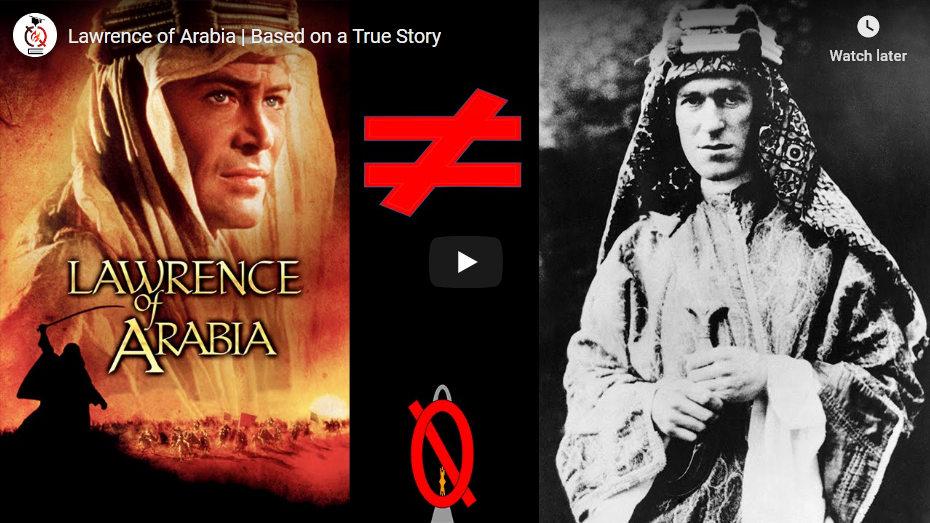
Lawrence of Arabia is a 1962 epic historical drama film based on the life of T. E. Lawrence. It was directed by David Lean and produced by Sam Spiegel through his British company Horizon Pictures, with the screenplay by Robert Bolt and Michael Wilson. The film stars Peter O’Toole in the title role. It is widely considered one of the greatest and most influential films in the history of cinema. The dramatic score by Maurice Jarre and the Super Panavision 70 cinematography by Freddie Young are also highly acclaimed. The film was nominated for ten Academy Awards and won seven in total including Best Director, Best Sound Editing, Best Film Editing, and Best Picture.

The film depicts Lawrence’s experiences in the Arabian peninsula during World War I, in particular his attacks on Aqaba and Damascus and his involvement in the Arab National Council. Its themes include Lawrence’s emotional struggles with the personal violence inherent in war, his own identity, and his divided allegiance between his native Britain and its army and his new-found comrades within the Arabian desert tribes.

In 1991, Lawrence of Arabia was deemed “culturally, historically, or aesthetically significant” and selected for preservation in the United States Library of Congress National Film Registry.

QotD: “Jim Crow” laws

Filed under: History, Law, Liberty, Quotations, USA — Tags: , , — Nicholas @ 01:00

Everyone raised in the Unites States over the last fifty years has been required to memorize the official dogma regarding Jim Crow laws. These were state and local laws that enforced racial segregation in the Southern United States. The official version preached to this day is that they were draconian restrictions on blacks preventing them from having a normal life. Modern blacks are told that their condition is the direct result of white discrimination against blacks via these laws.

Now, there is a debate as to the intent and the effect of these laws, mostly because the Left has re-imagined that period in American history. The official version of the Civil Rights era is a fantasy with little connection to reality. What is not under dispute is that these laws existed and they had a negative impact on blacks. Black institutions did not receive public support. Blacks were denied access to the legal system, which often denied them justice when the victims of white malfeasance.

The best argument against these sorts of laws is that they created a second class of citizens, as a legal construct. You cannot have democracy if you have second class citizens, as democracy assumes all men being equal before the law. If the effect of Jim Crow was separate and equal, then maybe they would fit into democracy. In reality, they were separate and unequal, even accounting for the differences in the races. Therefore, as a legal construct, they violated the ideal of equality before the law.

The Z Man, “The Jim Snow Laws”, The Z Blog, 2019-12-01.

« Newer PostsOlder Posts »

Powered by WordPress