
The Romans themselves had a lot of thoughts about the collapse of the republic. First, we should note that they were aware that something was going very wrong and we have a fair bit of evidence that at least some Romans were trying to figure out how to fix it. Sulla’s reforms (enforced at the point of a much-used sword) in 82-80 BC were an effort to fix what he saw as the progressive destabilization of the the republic going back to the tribunate of Tiberius Gracchus (133). Sulla’s solutions were hamfisted though – he assumed that if he annihilated the opposing faction, crippled the tribunate and strengthened the Senate that this would resolve all of the problems. Cicero likewise considered reforms during the 50s BCE which come out in his De re publica and De legibus. The 50s were a time of political tumult in Rome while at the same time the last years of the decade must have been loomed over by the knowledge of an impending crisis to come in 49. Cicero was never in a position to enact his idealized republic.
Overall the various Romans who contemplated reform were in a way hindered by the tendency of Roman elites to think in terms of the virtue of individuals rather than the tendency of systems. You can see this very clearly in the writings of Sallust – another Roman writing with considerable concern as the republic comes apart – who places the fault on the collapse of Roman morals rather than on any systemic problem.
We also get a sense of these feelings from the literature that emerges after Augustus takes power in 31, and here there is a lot of complexity. There is quite a lot of praise for Augustus of course – it would have been profoundly unwise to do otherwise – but also quite a lot of deep discomfort with the recent past, revealed in places like Livy’s deeply morally compromised legends of the founding of Rome or the sharp moral ambiguity in the final books of Vergil’s Aeneid. On the other hand, some of the praise for Augustus seems to have been genuine. There was clearly an awful lot of exhaustion after so many years of disruption and civil war and so a general openness to Augustus’ “restored republic”. Still, some Romans were clearly bothered by the collapse of the republic even much later; Lucan’s Pharsalia (65 AD) casts Pompey and Cato as heroes and views Caesar far more grimly.
We have less evidence for feeling in the provinces, but of course for many provincials, little would have changed. Few of Augustus’ changes would have done much to change much for people living in the provinces, whose taxes, laws and lives remained the same. They were clearly aware of what was going on and among the elite there was clearly a scramble to try to get on the right side of whoever was going to win; being on the wrong side of the eventual winner could be a very dangerous place to be. But for most regular provincials, the collapse of the Roman Republic only mattered if some rogue Roman general’s army happened to march through their part of the world.
Bret Devereaux, “Referenda ad Senatum: August 6, 2021: Feelings at the Fall of the Republic, Ancient and Medieval Living Standards, and Zombies!”, A Collection of Unmitigated Pedantry, 2021-08-06.
August 24, 2024
QotD: How did the Romans themselves view the change from Republic to Empire?
August 23, 2024
QotD: The decline of the British working class
Marxists themselves were perhaps the first to notice that the “proletariat” as their theory conceived it was vanishing, assimilated to the petty bourgeoisie by the postwar rise in living standards and the propagation of middlebrow culture through the then-new media of paperback books, radio, and television.
In the new environment, being “working class” became steadily less of a purchasing-power distinction and more one of culture, affiliation, and educational limits on upward mobility. A plumber might make more than an advertising copywriter per hour, but the copywriter could reasonably hope to run his own ad agency – or at least a corporate marketing department – some day. The plumber remained “working class” because, lacking his A-level, he could never hope to join the managerial elite.
At the same time, state socialism was becoming increasingly appealing to the managerial and upper classes because it offered the prospect not of revolution but of a managed economy that would freeze power relationships into a shape they were familiar with and knew how to manipulate. This came to be seen as greatly preferable to the chaotic dynamism of unrestrained free markets – and to upper-SES people who every year feared falling into poverty less but losing relative status more, it really was preferable.
In Great Britain, the formation of the National Health Service in 1947 was therefore not a radical move but a conservative one. It was a triumph not of revolutionary working-class fervor overthrowing elites but of managerial statism cementing elite power in place.
During the long recovery boom after World War II – until the early 1970s – it was possible to avoid noticing that the interests of the managerial elite and the working classes were diverging. Both the U.S. and Great Britain used their unmatched industrial capacity to act as price-takers in international markets, delivering profits fat enough to both buoy up working-class wages and blur the purchasing-power line between the upper-level managerial class and the owners of large capital concentrations almost out of existence.
The largest divergence was that the managerial elite, like capitalists before them, became de-localized and international. What mobility of money had done for the owners of capital by the end of the 19th century, mobility of skills did for the managerial class towards the end of the 20th.
As late as the 1960s, when I had an international childhood because my father was one of the few exceptions, the ability of capital owners to chase low labor costs was limited by the unwillingness of their hired managers to live and work outside their home countries.
The year my family returned to the U.S. for good – 1971 – was about the time the long post-war boom ended. The U.S. and Great Britain, exposed to competition (especially from a re-industrialized Germany and Japan) began a period of relative decline.
But while working-class wage gains were increasingly smothered, the managerial elite actually increased its ability to price-take in international markets after the boom. They became less and less tied to their home countries and communities – more willing and able to offshore not just themselves but working-class jobs as well. As that barrier eroded, the great hollowing out of the British industrial North and the American Rust Belt began.
The working class increasingly found itself trapped in dying towns. Where it wasn’t, credentialism often proved an equally effective barrier to upward mobility. My wife bootstrapped herself out of a hardscrabble working-class background after 1975 to become a partner at a law firm, but the way she did it would be unavailable to anyone outside the 1 in 100 of her peers at or above the IQ required to earn a graduate degree. She didn’t need that IQ to be a lawyer; she needed it to get the sheepskin that said she was allowed to be a lawyer.
The increasingly internationalized managerial-statist tribe traded increasingly in such permissions – both in getting them and in denying them to others. My older readers might be able to remember, just barely, when what medical treatment you could get was between you and your physician and didn’t depend on the gatekeeping of a faceless monitor at an insurance company.
Eventually, processing of those medical-insurance claims was largely outsourced to India. The whole tier of clerical jobs that had once been the least demanding white-collar work came under pressure from outsourcing and automation. effectively disappearing. This made the gap between working-class jobs and the lowest tier of the managerial elite more difficult to cross.
In this and other ways, the internationalized managerial elite grew more and more unlike a working class for which both economic and social life remained stubbornly local. Like every other ruling elite, as that distance increased it developed a correspondingly increasing demand for an ideology that justified that distinction and legitimized its power. And in the post-class-warfare mutations of Marxism, it found one.
Eric S. Raymond, “The Great Inversion”, Armed and Dangerous, 2019-12-23.
August 22, 2024
Abandoned Manitoba 2: Port Nelson, Manitoba’s Forgotten Seaport on Hudson Bay
Manitoba Historical Society
Published May 6, 2024The Abandoned Manitoba 2 video series by Graham Street, Shaun Cameron, and Gordon Goldsborough visits ghost towns, vacant buildings, and other historic sites from Manitoba’s past. Join us as we explore back roads to places that tell great stories about how things used to be, and how we have ended up where we are today.
In this video, we tour an abandoned seaport at the mouth of the Nelson River on Hudson Bay. Construction started in 1912 and stopped before the work was completed. It never resumed. Instead, all attention moved to Churchill where, in 1929, a deep water seaport opened. We explore the crumbling remains at Port Nelson, including an artificial island a half mile offshore, a rotting 17-span railway bridge, and a broken dredge.
QotD: The changing role of the Medieval housewife in England
Jane Psmith, “REVIEW: The Domestic Revolution by Ruth Goodman”, Mr. and Mrs. Psmith’s Bookshelf, 2023-05-22.
August 21, 2024
The Korean War Week 009 – Bloody UN Victory at Naktong Bulge – August 20, 1950
The Korean War by Indy Neidell
Published 20 Aug 2024The Marines are deployed to back up the UN forces facing disaster in the Naktong Bulge and by the end of the week the tide has turned, and the crack North Korean 4th Division has been shattered. There is also fighting around the whole rest of the Pusan Perimeter, and it is shrinking from all the attacks, though on the east coast the battle goes in favor of the South Korean forces this week at Pohang-Dong.
(more…)
MG08: The Devil’s Paintbrush
Forgotten Weapons
Published May 6, 2024The MG08 was the German Army standard Maxim gun in World War One. The Germany Navy adopted the Maxim first in 1894, followed by the Army in 1899, then a new pattern in 1901, and finally the MG08 in 1908. This was actually a somewhat old-fashioned pattern of Maxim when it was adopted, as the Germans chose to use the 1889-style lock, which was neither headspace-adjustable nor field-strippable. Their decision was based on the idea that they could produce locked to perfect interchangeable headspace, and field stripping was not really necessary — and they were not wrong in these assumptions. MG08 guns were issued with two spare locks in each sled mount, and that handled any broken parts that might occasionally happen. During the war, about 106,000 MG08s were built by two main factories, the Spandau Arsenal and the DWM company. This remained the standard German Army heavy machine gun until the adoption of the MG34.
(more…)
August 20, 2024
Folk tale fictions about childbirth in “traditional cultures”
Jane Psmith finds that “everyone” has been doing certain “traditional” things during and after childbirth that she somehow wasn’t informed about until just a short while ago:

I just had a baby, which means I have once again been immersed in a sea of advice about how “traditional cultures” do things. And miraculously, every single kid, I discover some new practice I’ve never heard of but that apparently just everyone did until about five minutes ago. This time it was vaginal steaming. (Don’t Google, it’s exactly what it says on the tin.)
Which cultures, exactly? Oh, you know … the traditional ones, the ones whose folk wisdom is untrammeled by Western medicalization, where the pregnant woman is treated to the most nutritious foods, birth is a joyous event surrounded by supportive kin, the new mother puts her baby to the breast the minute he’s born, and she’s waited on hand-and-foot in bed for a month afterwards. So, you know, not the Ngongo of central Africa, who forbid women from eating meat, or the Netsilik Inuit or !Kung, both of whom send laboring women off to give birth in silent isolation, or any of the peoples from Fiji to northern Alberta who delay nursing for days … In fact, you might be excused if you began to suspect that the real measure of how “traditional” a culture is boils down to how much it resembles the practices of crunchy WEIRD people. You might even, if you had a nasty suspicious frame of mind, conclude that all this discussion of “traditional cultures” is just a disguised way of asserting our own preferences.
None of which is actually unique to the babies. (I’ve written about the babies before.) It’s not even unique to our era. The idea that we have been corrupted by civilization, that more primitive societies lead purer, nobler, more harmonious lives and enjoy access to truths and virtues we have lost, goes back millennia.1 And so, naturally, does the practice of using the supposed superiority of those other cultures as clubs to beat our own. Tacitus’ Germania, for instance, is a fun read if borderline useless as a source on the actual Germanic tribes — but it’s a wonderful guide to the angst of the early Empire and the pervasive fear that greed, luxury, and ambition had replaced the nobility, valor, and honor that had once characterized the Romans. Nowadays, of course, no one writes about the barbarians’ fides and virtus; instead you’ll get paeans to their idyllic existence lived in harmony with nature, their peaceful sense of community, and probably their joyful embrace of gender and sexual diversity. But either way, most of the books about small-scale societies are actually books about us and what the people writing the books think we lack.
Even professional anthropologists tend to assume that small-scale (this is a polite way of saying “primitive”) societies are more satisfying, meaningful, and fulfilling than complex ones. But in their case it goes hand in hand with another, allied assumption: that these societies have developed beliefs, practices, and institutions that work well for them. After all, the thinking goes, we know that people change their tools and their behavior when their environment changes, abandoning anything that no longer serves their needs and adopting new ways of life. Therefore, anything they haven’t abandoned must be somehow adaptive. Sure, these “primal communities” might do things that seem odd to us — things like torture, infanticide, ceremonial rape, cannibalism, and so forth — but they must serve some useful function or they wouldn’t have persisted. Thus, for example, the classic ethnography of the Navajo argues that their overwhelming fear of witchcraft, which led to pervasive anxiety, a hypochondriacal obsession with magical curing rituals, and of course regular violence perpetrated against suspected witches, actually had great benefits because it allowed the Navajo direct their stress and hostility at marginal members of the community and “keep the core of the society solid”.
The problem with this framework becomes obvious as soon as you mentally translate from some strange foreigners with funny (or no) clothes to, say, a business in the industrialized world. (Which can easily be larger than the kind of small-scale society that interests anthropologists.) No one would ever say, “Well, sure, the leadership of this company allows their mediocre employees to bully their highly productive peers out of the department so they do better in the stack ranking, but the company hasn’t gone bankrupt so it must be a savvy business move. Probably the solidarity created by banding together to surreptitiously delete someone else’s code enhances productivity more than losing a 10x engineer detracts from it …” But this is exactly what anthropologists (professional and armchair) are tempted to do when they set out to understand and explain another culture. Yes, sometimes apparently bizarre behavior contains a deep and hidden wisdom, but sometimes it’s just messed up.
That’s the case the late UCLA anthropologist Robert Edgerton set out to make in Sick Societies: that some primitive societies are not actually happy and fulfilled, that some of their beliefs and institutions are inadequate or actively harmful to their people, and that some of them are frankly on their way to cultural suicide. The mere fact that people keep doing something doesn’t mean it’s actually working well for them, but just as the market can stay irrational longer than you can stay solvent, your society can stay dysfunctional longer than you can stay alive.
1. At least in the Occident. My informant tells me that the Noble Savage is a less common trope in, say, China. Maybe the Blue savages are just less noble.

You’re the Top! A History of the Top Hat
HatHistorian
Published Nov 21, 2021A short history of one of the most recognizable and formal hats of our time: the top hat!
Version française ici:
• Le top du top: l’histoire du Haut-de-…With thanks to Norman Caruso for advice on how to get me started on youtube. Please check out his channel
The first top hat belonged to my great grandfather and is the better part of a century old.
The collapsible top hat comes from from Delmonico Hatter https://www.delmonicohatter.com/Title sequence designed by Alexandre Mahler
am.design@live.comThis video was done for entertainment and educational purposes. No copyright infringement of any sort was intended.
QotD: The printing press was to the Reformation what social media is in the Current Year
The thing about Luther, then, wasn’t what he said, so much as how he said it.
Martin Luther was the world’s first spin doctor. Though he insisted for a long time that his famous 95 Theses were, and were always intended to be, a scholastic debate between clergymen, Luther mastered the use of printed propaganda. His opponents soon followed, or tried to, in an ever-increasing spiral of printed viciousness. Mutatis mutandis, the exchanges between Luther, Erasmus, Thomas More (to say nothing of a thousand lesser lights) and their opponents all sound shockingly Current Year. They’re snarky and waspish at best, grotesque ad hominem at worst. Modern flame wars have nothing on the way Thomas More and William Tyndale tore into each other, for instance, and More and Tyndale were rank amateurs compared to Luther.
As with the Current Year, where being first on social media is the only criterion that matters, so the printing press injected something very like “hot takes” into the late-Medieval intellectual atmosphere. If you tried to respond to your opponents the old-fashioned way — with closely reasoned, heavily cited arguments, on parchment, hand-copied by monks — you might win the intellectual battle … 500 years later, among historians who thank you for providing such a useful glimpse into late-Medieval mentalités, but in your own time you’d get fired at best, get burned at the stake at worst, if you didn’t respond instantly, in kind.
The printing press, in other words, represented a quantum leap in the velocity of information. Those who grasped its fundamentals prospered, while those who fell behind perished. King Henry VIII, for instance, fatally damaged his cherished intellectual reputation when he deigned to attack to Luther in person. Luther hit back with a tirade that wouldn’t be out of place on Twitter1, and Henry responded in kind, and now the king, who was hip-deep in self-inflicted shit by that point, had to drop the fight. Having been publicly abused by a mere ex-monk, he had to quit the field with his tail between his legs.
Severian, “Velocity of Information”, Rotten Chestnuts, 2021-08-10.
1. Again, mutatis mutandis. Though this sounds to modern ears like an abject apology on Luther’s part (“especially as I am the offscouring of the world, a mere worm who ought only to live in contemptuous neglect”, etc.), in context it’s a vicious attack. For one thing, what’s a great king like Henry doing responding to a “mere worm”? And Henry had to know, since Wolsey did nothing without his master’s orders … except everyone had heard the rumors that Henry was just a dimwitted playboy, and Cardinal Wolsey was really the king in all but name, so maybe he didn’t know. Either way Henry, who prided himself on being an intellectual, was a fool. That’s the kind of thing that would get you executed in the 16th century, and here’s this “mere worm” publishing it, for all the world to see, with no possibility of reprisal from a supposedly puissant monarch.
August 19, 2024
Bret Devereaux on Nathan Rosenstein’s Rome at War (2004)
Although Dr. Devereaux is taking a bit of time away from the more typical blogging topics he usually covers on A Collection of Unmitigated Pedantry, he still discusses books related to his area of specialty:
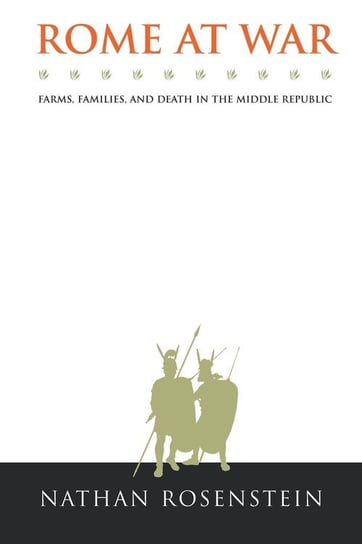
For this week’s book recommendation, I want to recommend N. Rosenstein, Rome at War: Farms, Families and Death in the Middle Republic (2004). This is something of a variation from my normal recommendations, so I want to lead with a necessary caveat: this book is not a light or easy read. It was written for specialists and expects the reader to do some work to fully understand its arguments. That said, it isn’t written in impenetrable “academese” – indeed, the ideas here are very concrete, dealing with food production, family formation, mortality and military service. But they’re also fairly technical and Rosenstein doesn’t always stop to recap what he has said and draw fully the conclusions he has reached and so a bit of that work is left to the reader.
That said, this is probably in the top ten or so books that have shaped me as a scholar and influenced my own thinking – as attentive readers can no doubt recall seeing this book show up a lot in my footnotes and citations. And much like another book I’ve recommended, Landers, The Field and the Forge: Population, Production and Power in the Pre-Industrial West (2003), this is the sort of book that moves you beyond the generalizations about ancient societies you might get in a more general treatment (“low productivity, high mortality, youth-shifted age profile, etc.”) down to the actual evidence and methods we have to estimate and understand that.
Fundamentally, Rome at War is an exercise in “modeling” – creating (fairly simple) statistical models to simulate things for which we do not have vast amounts of hard data, but for which we can more or less estimate. For instance, we do not have the complete financial records for a statistically significant sample of Roman small farmers; indeed, we do not have such for any Roman small farmers. So instead, Rosenstein begins with some evidence-informed estimates about typical family size and construction and combines them with some equally evidence-informed estimates about the productivity of ancient farms and their size and then “simulates” that household. That sort of approach informs the entire book.
Fundamentally, Rosenstein is seeking to examine the causes of a key Roman political event: the agrarian land-reform program of Tiberius Gracchus in 133, but the road he takes getting there is equally interesting. He begins by demonstrating that based on what we know the issue with the structure of agriculture in Roman Italy was not, strictly speaking “low productivity” so much as inefficient labor allocation (a note you will have seen me come back to a lot): farms too small for the families – as units of labor – which farmed them. That is a very interesting observation generally, but his point in reaching it is to show that this is why Roman can conscript these fellows so aggressively: this is mostly surplus labor so pulling it out of the countryside does not undermine these households (usually). But that pulls a major pillar – that heavy Roman conscription undermined small freeholders in Italy in the Second Century – out of the traditional reading of the land reforms.
Instead, Rosenstein then moves on to modeling Roman military mortality, arguing that, based on what we know, the real problem is that Rome spends the second century winning a lot. As a result, lots of young men who normally might have died in war – certainly in the massive wars of the third century (Pyrrhic and Punic) – survived their military service, but remained surplus to the labor needs of the countryside and thus a strain on their small households. These fellows then started to accumulate. Meanwhile, the nature of the Roman census (self-reported on the honor system) and late second century Roman military service (often unprofitable and dangerous in Spain, but not with the sort of massive armies of the previous centuries which might cause demographically significant losses) meant that more Romans might have been dodging the draft by under-reporting in the census. Which leads to his conclusion: when Tiberius Gracchus looks out, he sees both large numbers of landless Romans accumulating in Rome (and angry) and also falling census rolls for the Roman smallholder class and assumes that the Roman peasantry is being economically devastated by expanding slave estates and his solution is land reform. But what is actually happening is population growth combined with falling census registration, which in turn explains why the land reform program doesn’t produce nearly as much change as you’d expect, despite being more or less implemented.
Those conclusions remain both important and contested. What I think will be more valuable for most readers is instead the path Rosenstein takes to reach them, which walks through so much of the nuts-and-bolts of Roman life: marriage patterns, childbearing patterns, agricultural productivity, military service rates, mortality rates and so on. These are, invariably, estimates built on estimates of estimates and so exist with fairly large “error bars” and uncertainty, but they are, for the most part, the best the evidence will support and serve to put meat on the bones of those standard generalizing descriptions of ancient society.
Evolution of WW2 German Tank Destroyers
The Tank Museum
Published May 3, 2024 19 productsUsed extensively by the German army of World War Two, the “tank destroyer” was developed to counter the increasing dominance of the tank on the battlefield.
Germany would field a massive 18 different types of tank destroyer in World War Two – compared with the 7 or 8 different types used by US, British and Commonwealth forces. One of these in particular, Sturmgeschütz III, would destroy more tanks than any other AFV in the entire conflict.
In this video we look at the development, strengths and weaknesses of German tank destroyers: from the 17 tonne Hetzer to the massive 70 tonne Jagdtiger — the heaviest tracked vehicle of the War.
00:00 | Introduction
00:59 | The First Tank Destroyers
04:14 | Avoiding Close Combat
06:59 | Jagdpanther
12:05 | Jagdtiger
15:31 | Hetzer
18:01 | Stug III
22:51 | ConclusionThis video features archive footage courtesy of British Pathé.
#tankmuseum #jagdpanther #stugiii #hetzer #jagdtiger
August 18, 2024
Hirohito Announces Surrender – War Continues – WW2 – Week 312 – August 17, 1945
World War Two
Published 17 Aug 2024Hirohito broadcasts Japan’s surrender to the world- despite an attempted to coup to prevent it from happening, and much of the world celebrates, but the war isn’t really over. The Soviets are busy invading Manchuria, and there’s revolution in Vietnam and Indonesia.
00:00 Intro
00:22 Recap
00:49 Attempted Coup In Japan
04:12 Hirohito Surrenders
08:54 Japanese Surrender In China
12:05 Soviets In Manchuria
17:52 Revolution In Vietnam
20:33 Summary
21:07 Conclusion
(more…)
.30-06 M1918 American Chauchat – Doughboys Go to France
Forgotten Weapons
Published May 4, 2024When the US entered World War One, the country had a grand total of 1,453 machine guns, split between four different models. This was not a useful inventory to equip even a single division headed for France, and so the US had to look to France for automatic weapons. In June 1917 Springfield Armory tested a French CSRG Chauchat automatic rifle, and found it good enough to inquire about making an American version chambered for the .30-06 cartridge. This happened quickly, and after testing in August 1917, a batch of 25,000 was ordered. Of these, 18,000 were delivered and they were used to arm several divisions of American troops on the Continent.
Unfortunately, the American Chauchat was beset by extraction problems. These have today be traced to incorrectly cut chambers, which were slightly too short and caused stuck cases when the guns got hot. It is unclear exactly what caused the problem, but the result was that most of the guns were restricted to training use (as best we can tell today), and exchanged for French 8mm Chauchats when units deployed to the front. Today, American Chauchats are extremely rare, but also very much underappreciated for their role as significant American WWI small arms.
(more…)
August 17, 2024
Forgotten War Ep1 – Witness the Rising Sun
HardThrasher
Published Aug 14, 2024In January 1942 the Japanese Army poured over the border with Burma, and pushed back the Indian and British Armies to the border with Burma. Today we look at how that disaster came about, why and the first phase of the campaign
(more…)
“The notion of a pre-existing Palestinian state is a modern fabrication that ignores the region’s actual history”
Debunking some of the common talking points about the Arab-Israeli conflicts down to the present day:
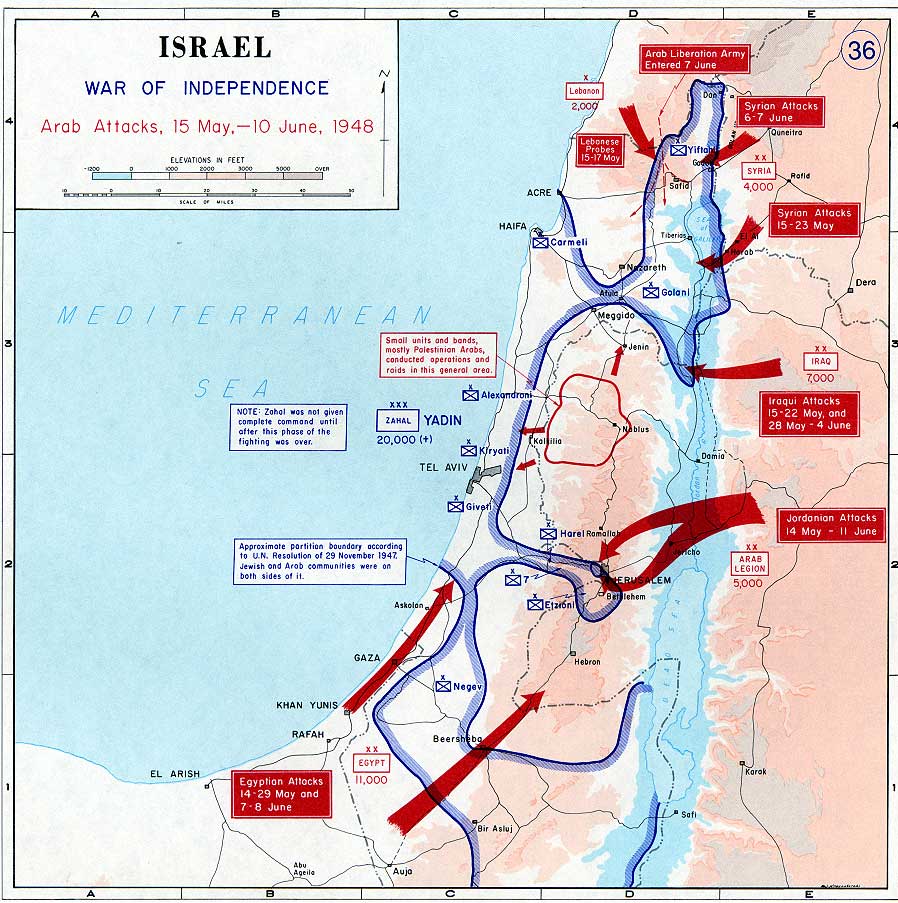
Arab attacks in May and June 1948.
United States Military Academy Atlas, Link.
Before Israel declared independence in 1948, the region now known as Israel, the West Bank and the Gaza Strip was part of the British Mandate for Palestine, which was established by the League of Nations after the fall of the Ottoman Empire in the First World War.
Under Ottoman rule, the area was divided into various administrative districts, with no distinct political entity known as “Palestine”. The concept of a Palestinian national identity emerged in the 20th century, largely in response to the Zionist movement and increased Jewish immigration in the area.
However, there was never a Palestinian state, flag or anthem. The notion of a pre-existing Palestinian state is a modern fabrication that ignores the region’s actual history.
The modern State of Israel’s legitimacy is rooted in international law and global recognition. On Nov. 29, 1947, the United Nations General Assembly passed Resolution 181, known as the “Partition Plan”, proposing two states — one Jewish and one Arab.
The Jewish community accepted the plan, demonstrating a willingness to compromise for peace. However, the Arab states rejected it, refusing to recognize any Jewish state, and instead launched a military assault on Israel following its declaration of independence on May 14, 1948.
Another pervasive myth is the “Nakba” or “catastrophe”, narrative, which claims that Palestinians were forcibly expelled by Israel in 1948. This version omits the critical context that it was the Arab nations that invaded Israel, causing many Arabs to be expelled or flee their homes.
Rather than absorbing the displaced population, the surrounding Arab countries kept them in refugee camps, using them as pawns to pressure Israel. Organizations like UNRWA perpetuated this situation, keeping Palestinians in limbo rather than encouraging their integration into their host countries. This contrasts sharply with how other refugee populations have been handled, where integration and resettlement are the norm.
The land referred to as “Palestine” has always been inherently Jewish. The Jewish people have maintained a continuous presence there for thousands of years, long before Islam or the Arab conquests.


