What is this creepy obsession with the elite telling us to eat bugs? Every few weeks, some mainstream media outlet has one of its gooey writers go off on how delicious and nutritious insects supposedly are, and it’s downright bizarre. The latest piece of pro-pillbug propaganda is from the formerly prestigious Economist, “Why Eating Bugs Is So Popular In Congo,” where the author assures us that “The creepy superfood is rich in protein and magnesium.” Thanks, but I think I’ll get my protein and magnesium in a manner that does not involve gobbling grubs.
What is with these people?
This bug bingeing is a running theme in the mainstream media. The New York Times, taking a break from passively aggressively correcting its garbage takes, asks “Why Aren’t We Eating More Insects?” The answer is, of course, “Because they are insects, you weirdos.”
CNN goes on about “Bugs: The Food That Can Feed, And Maybe Save, The Planet,” as if Brian “Tater” Stelter is going to give up stuffing Cheetos in his talk-hole in exchange for caterpillars.
And National Geographic manages to do the impossible and make us hate the United Nations even more by informing us that the “U.N. Urges Eating Insects,” and offering us “8 Popular Bugs to Try.” Popular with whom?
The Economist is talking about people munching millipedes in Congo, and you have to wonder why we would take Congo’s lead in anything. It’s the Congo – you should carefully examine what the Congo does, then do the opposite. That goes for other strange countries too. Frankly, foreign countries are generally terrible and there is not a lot that other countries have to teach us – I lived on two other continents and this bizarre notion liberal Americans have about other countries being better than us is grossly misplaced. Other countries are mostly terrible.
Exhibit A: They eat bugs.
Do you think the people of Congo are saying, “Beef? Pass. Hand me that plate of maggots!” You don’t eat grasshoppers because you have other options. No one’s first choice is fruit flies.
Kurt Schlicter, “Tell The Nags To Go Pound Sand”, Townhall.com, 2019-11-19.
February 23, 2020
QotD: Go eat bugs, plebs!
February 18, 2020
“The real battle for the immortal soul of France is about something far more important — cheese”
John Lichfield on the plight of the cheesemakers (get your MPATHG jokes out of the way now):
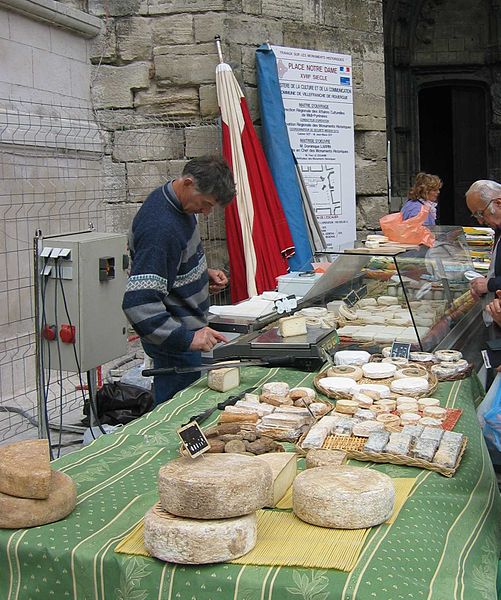
French cheese seller, offering Villefranche de Rouergue and other artisanal cheeses.
Photo by Sybren via Wikimedia Commons.
In his small fromagerie at Saint Point Lac in the Jura, Fabrice Michelin produces authentic, hand-made, raw-milk Mont d’Or cheeses. He is the last person in France to do so — the last in a line of local cheese-makers which goes back for centuries.
“I get up at 5am. I collect the milk myself from the farms in the village. I warm the milk,” Mr Michelin told me. “I scoop it carefully into cylinders. I pay attention to the varying consistency and taste of the curd. It alters subtly with the seasons, depending on the qualities of the grass. I mold the cheeses by hand. Every cheese is a little different.”
Individual, artisanal cheeses? Wonderful.
Not any more, it seems.
“That’s what gets me into trouble these days,” M. Michelin said. “Brussels and Paris say that the cheeses must all be the same. There seem to be new rules every month. How can I carry on if all my cheeses have to be identical?”
Forget the yellow vests. Forget the strikes against pension reform. The real battle for the immortal soul of France is about something far more important — cheese.
The infinite variety of French cheeses — one of the finest achievements of French culture — is gradually being eroded and dumbed down. Only one in ten of the cheeses now consumed in France is made with raw milk or “lait cru” in the authentic manner.
Search where you like in the finest cheese shops in France, you will no longer find a Bleu de Termignon or a Galette des Monts-d’Or. They are among 50 species of French cheese that have vanished, like rare flowers or butterflies, in the last 40 years. Other varieties, like Vacherin d’Abondance and M. Michelin’s hand-made Mont d’Or have been reduced to a single producer.
Many of the best-known French cheeses — Brie or Pont L’Evêque or Camembert — thrive at home and abroad, but they are overwhelmingly made in large factories with pasteurised or sterilised milk. To purists, that is a betrayal of the French tradition of “living cheese”.
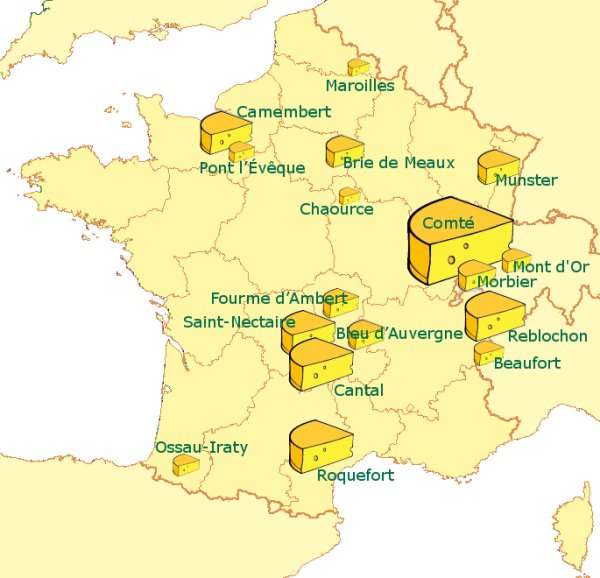
Major French AOC cheese designations: the size of the symbol indicates the relative production of that variety. Many smaller cheese varieties not shown.
Graphic by FrancoisFC – Own work, CC BY-SA 3.0, https://commons.wikimedia.org/w/index.php?curid=3640022
February 11, 2020
Animal “rights”
In the latest Libertarian Enterprise, L. Neil Smith republished a short essay he wrote for the March 1996 edition which is still fully relevant today:

An olive ridley sea turtle, a species of the sea turtle superfamily.
NASA image via Wikimedia Commons.
Last Friday I watched an episode of X-Files in which innocent zoo animals were being abducted — apparently by benign, superior UFOsies (the ones who mutilate cattle and stick needles in women’s bellies) — to save them from a despicable mankind responsible for the erasure of thousands of species every year.
Or every week, I forget which.
I was reminded of a debate I’d found myself involved in about sea turtles; I’d suggested that laws prohibiting international trade in certain animal products be repealed so the turtles might be privately farmed and thereby kept from extinction. After all, who ever heard of chickens being an endangered species? From the hysteria I provoked — by breathing the sacred phrase “animal rights” and the vile epithet “profit” in one sentence — you’d have thought I’d demanded that the Virgin be depicted henceforth in mesh stockings and a merry widow like Frank N. Furter in The Rocky Horror Picture Show.
That debate convinced me of two things. First: I wasn’t dealing with politics, here, or even philosophy, but with a religion, one that would irrationally sacrifice its highest value — the survival of a species — if the only way to assure it was to let the moneylenders back into the temple. Its adherents abominate free enterprise more than they adore sea turtles.
Second (on evidence indirect but undeniable): those who cynically constructed this religion have no interest in the true believers at its gullible grassroots, but see it simply as a new way to pursue the same old sinister objective. A friend of mine used to refer to “watermelons” — green on the outside, red on the inside — who use environmental advocacy to abuse individualism and capitalism. Even the impenetrable Rush Limbaugh understands that animal rights and related issues are just another way socialism pursues its obsolete, discredited agenda.
In my experience, those who profess to believe in animal rights usually don’t believe in human rights. That’s the point, after all.
QotD: Agriculture and the rise of the state
The key to the nexus between grains and states lies, I believe, in the fact that only the cereal grains can serve as a basis for taxation: visible, divisible, assessable, storable, transportable, and “rationable.” Other crops — legumes, tubers, and starch plants — have some of these desirable state-adapted qualities, but none has all of these advantages. To appreciate the unique advantages of the cereal grains, it helps to place yourself in the sandals of an ancient tax-collection official interested, above all, in the ease and efficiency of appropriation.
The fact that cereal grains grow above ground and ripen at roughly the same time makes the job of any would-be taxman that much easier. If the army or the tax officials arrive at the right time, they can cut, thresh, and confiscate the entire harvest in one operation. For a hostile army, cereal grains make a scorched-earth policy that much simpler; they can burn the harvest-ready grain fields and reduce the cultivators to flight or starvation. Better yet, a tax collector or enemy can simply wait until the crop has been threshed and stored and confiscate the entire contents of the granary.
Compare this situation with, say, that of farmers whose staple crops are tubers such as potatoes or cassava/manioc. Such crops ripen in a year but may be safely left in the ground for an additional year or two. They can be dug up as needed and the reaminder stored where they grew, underground. If an army or tax collectors want your tubers, they will have to dig them up tuber by tuber, as the farmer does, and then they will have a cartload of potatoes which is far less valuable (either calorically or at the market) than a cartload of wheat, and is also more likely to spoil quickly. Frederick the Great of Prussia, when he ordered his subjects to plant potatoes, understood that, as planters of tubers, they could not be so easily dispersed by invading armies.
The “aboveground” simultaneous ripening of cereal grains has the inestimable advantage of being legible and assessable by the state tax collectors. These characteristics are what make wheat, barley, rice, millet, and maize the premier political crops. A tax assessor typically classifies fields in terms of soil quality and, knowing the average yield of a particular grain from such soil, is able to estimate a tax. If a year-to-year adjustment is required, fields can be surveyed and crop cuttings taken from a representative patch just before harvest to arrive at an estimated yield for that particular crop year. As we shall see, state officials tried to raise crop yields and taxes in kind by mandating techniques of cultivation; in Mesopotamia this included insisting on repeated ploughing to break up the large clods of earth and repeated harrowing for better rooting and nutrient delivery. The point is that with cereal grains and soil preparation, the planting, the condition of the crop, and the ultimate yield were more visible and assessable.
James Scott, Against The Grain: A deep history of the earliest states, 2017.
January 30, 2020
QotD: Nutrition and aging from the middle ages to the 20th century
Look Portugal is fertile enough that a careful planner can feed a family on less than an acre of land (particularly the area I come from, apparently one of the oldest inhabited in Europe and whose name in Indo European translated as wet and fertile valley.) I’m sure the food available to us in the 20th century when you could buy improved seeds, etc. was way better than the one available to people in the middle ages.
But … yeah, no. We didn’t eat like people do now. Not even close. For one, meat was fairly scarce. We mostly ate fish (thanks to the coasts!) and vegetables. Oh, and we were relatively lucky. A lot of people got almost no protein. The most common lunch among the people was the “isca” that is a bit of fried flour which might or might not have a couple of shreds of codfish in it. The very poor ate a lot of vegetable soup.
And again this was in the 20th century. In winter vegetables more or less vanished and the only fruit available were the wrinkled, flour-like apples.
Christmas treats were dried fruit, not cookies. It tells you all you need to know. (Yes, it was healthy too except for the scarce protein for most people, but no one said the way we eat is particularly healthy.)
I’m not complaining, but I know that we ate massively better than my parents did in the mid 20th century. And they ate better than their parents. So, kindly, do not tell me some serf on a medieval estate got his choice of however many flavors of ice-cream.
Sure the very rich ate well, if sometimes oddly. But the average person, not so much.
And as for living as long? Yeah, no.
I still remember vividly — as do many our age — when 60 was old, 70 VERY old.
Yes, I’m concerned for my parents in their late eighties. And that’s, as my dad puts it “after 80, that’s old”. But it would surprise no one is they lived another 10 years. Because a lot of people do now. And now one makes a big deal of people who turn 100. (Even though 114 seems to be, a little inexplicably, our hard drop-off limit.)
And besides we KNOW. Shakespeare at 58 — two years older than I’m now — was “very old.”
So kindly take your “people lived about as long,” fold it all in corners and put it where the sun don’t shine, even if people in the arctic in winter will be a little puzzled by it.
Sarah Hoyt, “What if I Told You?”, According to Hoyt, 2019-11-05.
January 3, 2020
QotD: Against The Grain
Against The Grain should be read as a prequel to Scott’s most famous work, Seeing Like A State. SLaS argued that much of what we think of as “progress” towards a more orderly world – like Prussian scientific forestry, or planned cities with wide streets – didn’t make anyone better off or grow the economy. It was “progress” only from a state’s-eye perspective of wanting everything to be legible to top-down control and taxation. He particularly criticizes the High Modernists, Le Corbusier-style architects who replaced flourishing organic cities with grandiose but sterile rectangular grids.
Against the Grain extends the analysis from the 19th century all the way back to the dawn of civilization. If, as Samuel Johnson claimed, “The Devil was the first Whig”, Against the Grain argues that wheat was the first High Modernist.
Scott Alexander, “Book Review: Against The Grain“, Slate Star Codex, 2019-10-15.
December 23, 2019
QotD: British meals – puddings
Orwell’s press card portrait, 1943
Suet crust, which appears in innumerable combinations, and enters into savoury dishes as well as sweet ones, is simply ordinary pastry crust chopped beef suet substituted for the butter or lard. It can be baked, but more often is boiled in a cloth or steamed in a basin covered with a cloth. Far and away the best of all suet puddings is plum pudding, which is an extremely rich, elaborate and expensive dish, and is eaten by everyone in Britain at Christmas time, though not often at other times of the year. In simpler kinds of pudding the suet crust is sweetened with sugar and stuck full of figs, dates, currents or raisins, or it is flavoured with ginger or orange marmalade, or it is used as a casing for stewed apples or gooseberries, or it is rolled round successive layers of jam into a cylindrical shape which is called roly-poly pudding, or it is eaten in plain slices with treacle poured over it. One of the best forms of suet pudding is the boiled apple dumpling. The core is removed from a large apple, the cavity is filled up with brown sugar, and the apple is covered all over with a thin layer of suet crust, tied tightly into a cloth, and boiled.
British pastry is not outstandingly good, but there are certain fillings for pies and tarts which are excellent, and which are hardly to be found in other countries. Treacle tart is a delicious dish, and the large or small mince pies which are eaten especially at Christmas, but else fairly frequently at other times, are almost equally good. The mince-meat with which they are filled is a mixture of various kinds of dried fruits, chopped fine, mixed up with sugar and raw beef suet, and flavoured with brandy. Other favourite fillings are jams of various kinds, lemon curd – a preparation of lemon juice, yolk of egg and sugar – and stewed apples flavoured with lemon juice or cloves. An apple pie is often given an exceptionally fine flavour by including one quince among about half a dozen apples.
The other main category of puddings – milk puddings – is the kind of thing that one would prefer to pass over in silence, but it must be mentioned, since these dishes are, unfortunately, characteristic of Britain. They are preparations of rice, semolina, barley, sago or even macaroni, mixed with milk and sugar and baked in the oven. The one made with barley is somewhat less bad then the others: the one made with macaroni is intolerable to any civilised palate. As all of these puddings are easy to make, they tend to be a stand-by in cheap hotels, restaurants and apartment houses, and they are one of the chief reasons why British cookery has a bad name among foreign visitors.
There are, of course, XXX countless other sweet dishes, including the whole range of jellies, blancmanges, custards, soufflés, ice puddings, meringues and what-nots, which are much the same in all European counties. A few oddments which do not fit into any of the above categories are pancakes – British pancakes are thinner than those of most countries, and are always eaten with lemon juice, – batter pudding, which is made of much the same ingredients as Yorkshire pudding, but is steamed instead of being baked and is eaten with treacle, and baked apples. The apples are cored but not peeled, filled up with butter and sugar, and cooked in the oven: it is important that they should be served in the dish in which they are cooked With cooked fruit of any kind British people always eat cream, if they can get it. In the West of England a particularly delicious kind of clotted cream is made by slowly simmering large pens of milk and skimming off the cream as it comes to the surface.
George Orwell, “British Cookery”, 1946. (Originally commissioned by the British Council, but refused by them and later published in abbreviated form.)

December 20, 2019
QotD: Ontario pubs
Nicholas Pashley, Notes on a Beermat: Drinking and Why It’s Necessary, 2001.
December 17, 2019
My Wife vs. Ben & Jerry’s Ice Cream Lock
LockPickingLawyer
Published 15 Dec 2018
From the comments:
Hacker Lord
4 months ago
He sounds so calm for someone who’s probably sleeping on the couch tonight lol

December 14, 2019
QotD: Chocolate, Ankh-Morpork style
Terry Pratchett, Thief of Time, 2001.
December 10, 2019
QotD: British breakfast – “Not a snack but a serious meal”
After the meat course comes bread, or more often toast, with butter and orange marmalade. It must be orange marmalade, though honey is a possible substitute. Other kinds of jam are seldom eaten at breakfast, and marmalade does not often appear at other times of [the] day. For the great bulk of British people, the invariable breakfast drink is tea. Coffee in Britain is almost always nasty, either in restaurants or in private houses; the majority of people, though they drink it fairly freely, are uninterested in it and do not know good coffee from bad. Of tea, on the other hand, they are extremely critical, and everyone has his favourite brand and his pet theory as to how it should be made. Tea is always drunk with milk, and it is usual to brew it very strong, about one spoonful of dry tea leaves being allowed for each cup. Most people prefer Indian to Chinese tea, and they like to put sugar in it. Here, however, one comes upon a class distinction, or more exactly a cultural distinction. Virtually all British working-people put sugar in their tea, and indeed will not drink tea without it. Unsweetened tea is an upper-class or middle-class habit, and even in those classes it tends to be associated with a Europeanised palate. If one made a list of the people in Britain who prefer wine to beer, one would probably find that it included most of the people who prefer tea without sugar.
After this solid breakfast – and even now, in a time of rationing, it is usual to eat a fairly large bulk of food, chiefly bread, at breakfast – it is natural that the midday meal should be somewhat lighter than it is in many other countries.
George Orwell, “British Cookery”, 1946. (Originally commissioned by the British Council, but refused by them and later published in abbreviated form.)
November 9, 2019
QotD: British Cookery
Generalising further, one may say that the characteristic British diet is a simple, rather heavy, perhaps slightly barbarous diet, drawing much of its virtue from the excellence of the local materials, and with its main emphasis on sugar and animal fats. It is the diet of a wet northern country where butter is plentiful and vegetable oils are scarce, where hot drinks are acceptable at most hours of the day, and where all the spices and some of the stronger-tasting herbs are exotic products. Garlic, for instance, is unknown in British cookery proper: on the other hand mint, which is completely neglected in some European countries, figures largely. In general, British people prefer sweet things to spicy things, and they combine sugar with meat in a way that is seldom seen elsewhere.
Finally, it must be remembered that in talking about “British cookery” one is referring to the characteristic native diet of the British Isles and not necessarily to the food that the average British citizen eats at this moment. Quite apart from the economic difference between the various blocks of the population, there is the stringent food rationing which has now been in operation for six years. In talking of British cookery, therefore, one is talking of the past or the future – of dishes that the British people now see somewhat rarely, but which they would gladly eat if they had the chance, and which they did eat fairly frequently up to 1939.
George Orwell, “British Cookery”, 1946. (Originally commissioned by the British Council, but refused by them and later published in abbreviated form.)
October 23, 2019
QotD: Climbing Maslow’s Pyramid again
If people want little orchards of native (well, you know) apples then people should have little orchards of native apples. As long as, of course, they’re creating and maintaining those little orchards of native apples at their own expense. This is, after all, what liberalism means, that the peeps get to do what the peeps want. And if we’re to add some Burkean conservatism so that it’s the little platoons sorting it out for themselves then all the better.
As long as no one is being forced to pay for this through taxation then what could possibly be the problem?
At another level this is climbing Maslow’s Pyramid again. At one level of income we’ll take fruit in the only way we can, seasonally and in a limited manner. We get richer, technology advances, we can have apples year round – but that does mean trade, commercially sized operations and the inevitable limited selection. We get richer again and now we’ve more than sufficiency, let’s have that variety back again.
After all, it’s not as if we’re not seeing this right across the food chain, is it?
That roast beef of Olde Englande was most certainly better than the bully beef from Argentina or the Fray Bentos pie. As is the best grass fed British beef of today. But we moved through the cycle to get from most not being able to eat any beef, to all being able to have bad beef, to now again thinking more about the quality – we have a more than sufficiency of beef and can be picky about it.
Tim Worstall, “I fully approve of this”, Tim Worstall, 2017-10-22.
August 22, 2019
No Wheat? Rice Bread – Gluten Free Recipe
Townsends
Published on 18 Jun 2018Today’s featured cookbook ➧ https://amzn.to/2MCOF6A ➧➧
Visit Our Website! ➧ http://www.townsends.us/ ➧➧
Help support the channel with Patreon ➧ https://www.patreon.com/townsend ➧➧

August 19, 2019
Cooking With Carrow – Episode 02
Zombie Orpheus Entertainment
Published on 11 Jul 2019“Conjure Milk Raspberry Scones” with Brian Lewis and Christian Doyle, from the recipe by The Gluttonous Geek.