I’m here to help. This is a safe place, Canada. I want to see you get through this. Which is why I need you to listen to me closely. These words will be painful, but it’s important you hear them:
Tim Hortons is not a defining national institution. Rather, it is a chain of thousands of doughnut shops, several of which have working toilets.
Tim Hortons is not an indispensable part of the Canadian experience. Rather, it is a place that sells a breakfast sandwich that tastes like a dishcloth soaked in egg yolk and left out overnight on top of a radiator.
Tim Hortons is not an anti-Starbucks choice that makes you a more relatable politician or a more authentic Canadian. Rather, it is a great place to buy a muffin if you’ve always wondered what it would be like to eat blueberry air.
There is no shame in having been caught up in the Hortons hype. It happens. Just last week, a columnist in the Toronto Star likened Tim Hortons to a precious vase that’s about to be juggled by its new owner, a monkey. (I was so irate at this irresponsible journalism that I wrote a letter demanding the Star issue a retraction. Everyone knows monkeys juggle only coconuts.)
Meanwhile, the NDP’s Peggy Nash — who, by all accounts, is an actual person and not a fictional construct of The Onion — gravely warned of the potential consequences of the Tim Hortons brand “falling into foreign hands.”
Yes, imagine the consequences. Maybe these madcap foreign owners will go so far as to alter the sandwiches so they taste like … something. Preferably like sandwich, but, at this point, most of us have stopped being picky.
Am I getting through to you, Canada? While we’re on the topic of hard truths, there is something else that needs to be said.
Canada, you sure do like your double-double — or, as it is by law referred to in news reports, the “beloved double-double.” But here’s a newsflash for you: If you drink your coffee with two creams and two sugars, the quality of the coffee itself is of little consequence. You might as well pour a mug of instant coffee or sip the urine of a house cat mixed with a clump of dirt from your golf spikes. It’s all basically the same thing once you bombard it with sweet and dairy. You’re really just wasting your …
I see from your reaction that I’ve crossed a line. I hereby withdraw my defamatory comments about the double-double and kindly ask that you return that handful of my chest hair.
Scott Feschuk, “Okay, Canada: It’s time for the hard truth about Tim Hortons”, Macleans, 2014-09-14.
July 24, 2021
QotD: Demolishing the Tim Hortons myth
July 16, 2021
The lure of London and agricultural specialization in post-Black Death England
In the latest edition of his Age of Invention newsletter, Anton Howes outlines the “push” and “pull” theories to account for the vast growth of London and how that urban growth strongly encouraged specialization in English agriculture to feed the great city:
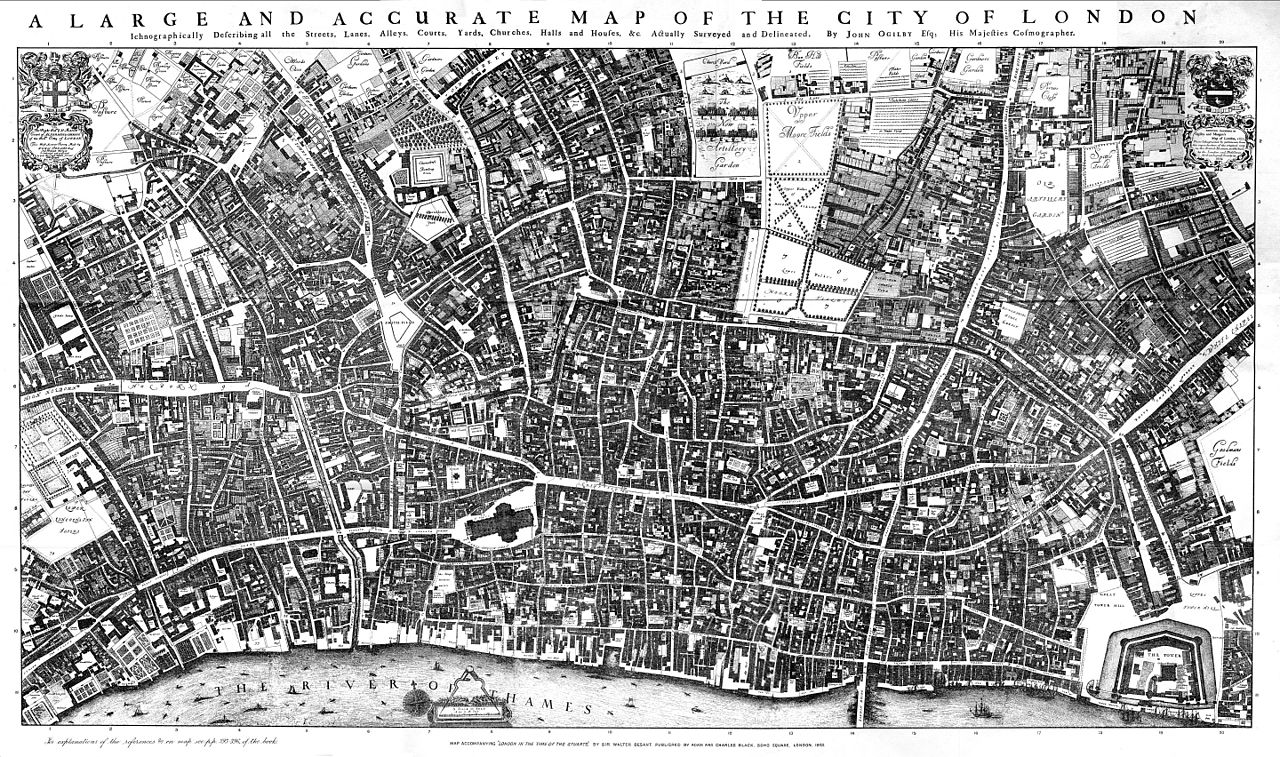
The 1677 original of this map is 8 feet 5 inches by 4 feet 7 inches, in 20 sheets. In 1894 the British Museum granted permission to the London and Middlesex Archaeological Society to make a reduced copy, of which the original of this scan is a copy. The L&M Society copy apparently did not match the dissected sheets perfectly, and the misjoins can be seen in places in this reproduction.
Scanned copy of reproduction in Maps of Old London (1908) of Ogilby & Morgan’s Map of London.
Something significant happened to the English countryside in the century before 1650. Although England’s population merely recovered to its pre-Black Death high of about 5 million, the economy was transformed. Having once been an overwhelmingly agrarian society, by 1650 a small but unprecedented proportion of the population now lived in cities, and less than half of the workforce was employed in agriculture. The country had de-agrarianised, and most remarkably of all, its food was still grown at home.
[…]
One possibly explanation is that there was some special change in England’s agricultural technology that increased its productivity, requiring fewer and fewer people, and possibly even driving them off the land, so that they were forced to find alternative employment. This thesis comes in various forms, many of which I’m still coming to grips with, but broadly speaking it implies a “push” from the fields, and into industry and the cities. Desperate, and unable to demand high wages, these cheaper workers should have stimulated industry’s growth.
The alternative, however, is that there was nothing very special or innovative about English agriculture, and that instead there was an even larger increase in the demand for workers in industry and services. The thesis implies a “pull” into industry and the cities, causing people to abandon agriculture for more profitable pursuits, and thereby making England’s agriculture de facto more productive — something that may or may not have actually been accompanied by any changes to agricultural technology, depending on how much slack there was in how the labourers or land had been employed.
The push thesis implies agricultural productivity was an original cause of England’s structural transformation; the pull thesis that it was a result. The evidence, I think, is in favour of a pull — specifically one caused by the dramatic growth of London’s trade.
Even though the population eventually recovered from the massive impact of the Black Death, not all of the land that was under plough was returned to active farming and a much greater diversity of uses for rural land emerged, including more pastures for grazing livestock, and small cash crops to be sold into the cities (especially into London).
With the dramatic growth of London in the sixteenth and seventeenth centuries, the more intensive methods came to be in much higher demand. Indeed, the extraordinary pull of the city’s growth resulted in English agriculture becoming increasingly specialised. Not only were there millions of acres of pasture still left that could be returned to the plough, but despite the relative fall in the prices of livestock, some areas actually became even more devoted to pasture. Many of the villages that had been abandoned after the Black Death were, even by the 1870s, over half a millennium later, still not being farmed. With wealthy Londoners demanding more varied diets, with meat and dairy, the various regions of England discovered their comparative advantages rather than all shifting to grain. There was thus extra room for agriculture to become more productive simply by devoting the best land for pasture to pasture, and the best soils for arable to arable, then trading the produce with one another, rather than have each area try to be self-sufficient. It’s something we also see in the decline of grains like rye, especially near London, to be replaced by wheat — the switching of a crop best-suited to local subsistence, to one that could be sold elsewhere and in bulk for cash.
In general, the south and east of England became increasingly arable, while the north-west concentrated on pasture. Yet there were also exceptions to be made for London’s particular wants. Thus, county Durham converted more land to arable to feed the miners of Newcastle coal, used to heat London’s homes; and the county of Middlesex, now largely disappeared under London’s own expansion, specialised in pasture for horses, rather than feeding people, so as to feed the city’s main sources of transportation. As the writer Daniel Defoe put it in the 1720s, “this whole Kingdom, as well the people, as the land, and even the sea, in every part of it, are employed to furnish something, and I may add, the best of everything, to supply the city of London with provisions.”
July 15, 2021
Out: “War is the health of the state”, In: “Pandemic restrictions are the health of the nanny state”
British MP Andrew Lewer on the inability (and determined unwillingness) of western governments at all levels to back away from all the restrictions they’ve been able to impose on their citizens since the start of the Wuhan Coronavirus pandemic:

The list goes on. By the government’s own calculations it [banning advertising for “junk food” on TV] will reduce children’s diets by a meagre five calories a day – the equivalent of a third of a cherry tomato. And watch out for those Government figures. Pardon the pun, but given that they add weight to the arguments of those opposing their intrusiveness into our lives, would anyone be amazed if new and revised figures emerged during the course of detailed legislation? But even if the impact of these proposals was amplified by “the science”, it would still come at too high a cost to individual freedom and liberty.
And this is just the thin end of the wedge. For a moment back in winter, it looked like we had woken up and smelt the full English breakfast. It was reported that the advertisement ban would be discarded, which allowed the free market minded to hope, especially given the disbanding of Public Health England, that this might signal pushback against nanny state intrusion. Alas, no.
The appetite for ill-conceived, unworkable ideas is growing: we have plans to force pubs to disclose the number of calories in every drink they serve, just as they begin to fill their tills after months of lockdown. Plans to end deals like “buy one get one free” on foods high in fat, sugar and salt – a regressive measure that will hit the poorest consumers hardest while doing nothing to reduce our waistlines. Plans for further legislation around nutritional labelling – adding cost, probably not adding clarity.
We left the EU in part as a reaction to over-regulation. I remember well during my time as an MEP how skewed towards large corporations the regulatory regime could be in Brussels. If, having taken the difficult and painful decision to leave the bloc, we fail to roll back the overreach then people will start to ask what the last four years was all about. If freedoms regained are never applied, then what was the point? The food laws will diminish freedoms in everyday life, not just those of the important, but more esoteric and common room kind, that our political elites from time to time do remember to respect.
July 8, 2021
The initial findings of our months-long dietary natural experiment
As we’ve all been told many, many times by the food nannies, access to fast food restaurants makes us fat. The food is too greasy, too salty, too tasty for our feeble wills to fight so we just engorge ourselves on those bad calories. We eat too much fast food and we get fat. Case closed. Well, that’s what we’ve been told. Our recent fast food deprivation diets say something else again:
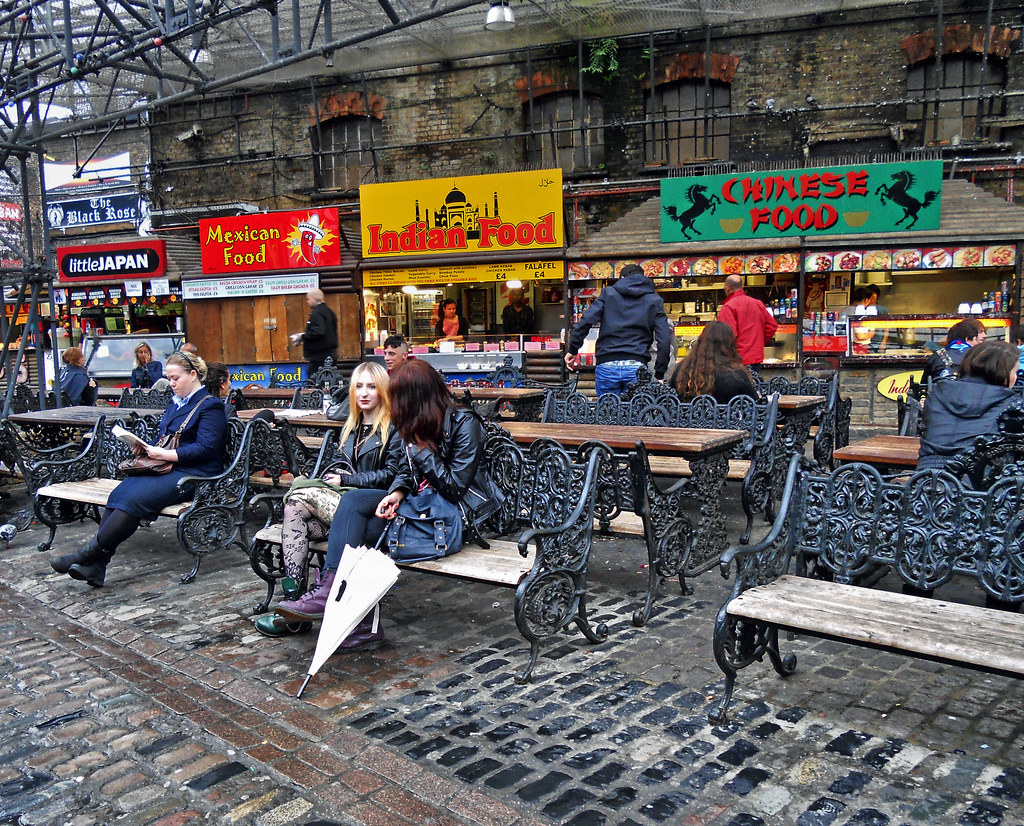
“Camden Fast Food” by It’s No Game is licensed under CC BY 2.0

OK, well, we’ve just had a grand experiment, haven’t we? Peeps haven’t been able to queue at Maccy D’s to get their greaseburger. People have had to – and have had time to – buy actual food and then prepare it for themselves at home.
Which is something that does rather kill the case about those burgers. Because what has been happening is that we’ve been – in the absence of greaseburgers – been eating more.
Using data on millions of food and non-alcoholic drink purchases from shops, takeaways and restaurants, the study found that the pandemic led to calories from restaurant meals falling to zero during the UK’s first national lockdown. That increased somewhat over the summer and declined again as restrictions in the hospitality sector were reintroduced in the autumn.
However, this was more than offset by a large increase in calories from takeaways, which peaked at more than double the usual levels in the UK’s second national lockdown in November 2020.
Overall, people increased their calories from raw ingredients by more than those from ready-to-eat meals and snacks and treats, with the pandemic leading to a shift in the balance of calories towards foods that required home preparation.
It’s that last paragraph that’s important. More home food preparation was being done from raw ingredients. And yet calorie consumption rose.
The report said the most plausible explanation for the sustained increase over the pandemic was higher consumption rather than changes in household composition, food waste or stocking up.
The study is specific to Britain, but it’s highly likely that the same results will be observed in Canada, the United States, Australia, and many other places. But I wouldn’t expect it will be given much coverage, like so much these days that contravenes the messaging that our dying media all seem to prefer to spread.
June 24, 2021
The Founder | Based on a True Story
The Cynical Historian
Published 27 Jul 2017This one is a contender for best historical film of 2016. The Founder is an amazing movie about the beginning of the McDonald’s food chain. Seriously, more films should take cues from this.
————————————————————
references:
http://www.historyvshollywood.com/ree…http://time.com/money/4602541/the-fou…
http://content.time.com/time/magazine…
https://www.bustle.com/p/how-accurate…
https://www.washingtonpost.com/entert…
https://www.theatlantic.com/entertain…
https://www.nytimes.com/2016/05/20/bu…
http://www.abc.net.au/news/2016-11-24…
http://www.cbsnews.com/news/the-real-…
https://en.wikipedia.org/wiki/Ray_Kroc
https://en.wikipedia.org/wiki/Richard…
————————————————————
contribute to my Patreon:
https://www.patreon.com/CynicalHistorianLET’S CONNECT:
https://twitter.com/Cynical_History
————————————————————
Wiki:
The Founder is a 2016 American biographical drama film directed by John Lee Hancock and written by Robert Siegel. The film stars Michael Keaton as businessman Ray Kroc, and portrays the story of his creation of the McDonald’s fast food chain. Nick Offerman and John Carroll Lynch co-star as McDonald’s founders Richard and Maurice McDonald.The film premiered at Arclight Hollywood on December 7, 2016 and was released in the United States on January 20, 2017, by The Weinstein Company. It grossed $23 million worldwide and received generally positive reviews from critics, with praise for Keaton’s performance.
————————————————————
Hashtags: #History #TheFounder #McDonalds #Review #BasedOnATrueStory #RayKroc

June 18, 2021
Feeding “the masses”
Sarah Hoyt looked at the perennial question “Dude, where’s my (flying) car?” and the even more relevant to most women “Where’s my automated house?”:

The cry of my generation, for years now, has been: “Dude, where’s my flying car?”
My friend Jeff Greason is fond of explaining that as an engineering problem, a flying car is no issue at all. It is as a legal problem that flying cars get interesting, because of course the FAA won’t let such a thing exist without clutching it madly and distorting it with its hands made of bureaucracy and crazy. (Okay, he doesn’t put it that way, but I do.)
[…]
But in all this, I have to say: Dude, where’s my automated house?
It was fifteen years ago or so, while out at lunch with an older writer friend, that she said “We always thought that when it came to this time, there would be communal lunch rooms and cafeterias that would do all the cooking so women would be free to work.”
I didn’t say anything. I knew our politics weren’t congruent, but really the only societies that managed that “Cafeterias, where everyone eats” were the most totalitarian ones, and that food was nothing you wanted to eat. If there was food. Because the only way to feed everyone industrial style is to take away their right to choose how to feed themselves and what to eat. And that, over an entire nation, would be a nightmare. Consider the eighties, when the funny critters decided that we should all live on a Russian Peasant diet of carbs, carbs and more carbs. Potatoes were healthy and good for you, and you should live on them.
It will surprise you to know – not — that just as with the mask idiocy, no study of any kind supports feeding the population on mostly vegetables, much less starches. What those whole “recommendations” were based on was “diet for a small planet” and the bureaucrats invincible ignorance, stupidity and assumption of their own intelligence and superiority. I.e. most of what they knew — that population was exploding, that people would soon be starving, that growing vegetables is less taxing on the environment and produces more calories than growing animals to eat — just wasn’t so. But they “knew” and by gum were going to force everyone to follow “the plan”. (BTW one of the ways you know that Q-Anon is in fact a black ops operation from the other side; no one on the right in this country trusts a plan, much less one that can’t be shared or discussed.) Then the complete idiots were shocked, surprised, nay, astonished when their proposed diet led to an “epidemic of obesity” and diabetes. Even though anyone who suffered through the peasant diet in communist countries, could have told the that’s where it would lead, and to both obesity and Mal-nutrition at once.
So, yeah, communal cafeterias are not a solution to anything.
My concern about the “automated house of the future” is nicely prefigured by the “wonders” of Big Tech surveillance devices we’ve voluntarily imported into our homes for the convenience, while awarding untold volumes of free data for the tech firms to market. Plus, the mindset that “you must be online at all times” that many/most of these devices require means you’re out of luck if your internet connection is a bit wobbly (looking at you, Rogers).
June 10, 2021
The odd history of Irish Cream as we make Irish Cream hard candy at Lofty Pursuits
Lofty Pursuits
Published 25 Feb 2021Jake makes Irish Cream green shamrock hard candy for St. Patrick’s day. We discuss the history of the weird flavor and how it has become a tradition even though it was invented in the 1970’s
A great article about the history of Irish Cream
https://www.irishtimes.com/culture/bo…Buy our candy: http://www.pd.net
Listen to our podcast: http://loftypursuits.libsyn.com/website
Join our Patreon at https://www.patreon.com/LoftyPursuits

April 1, 2021
How to Make Preserved Lemons in the Workshop
Uri Tuchman
Published 12 Jul 2019Preserved lemon recipe:
For the lemons:
– 6 lemons
– 300 gram salt
Cutting board:
– 40x25x1.5 cm cherry wood
Knife:
– 20x5x0.2 cm O1 steel
– 10x3x2 cm Maple wood
– 4x3x2 cm walnut wood
Airtight container:
– 14x14x1.5 cm cherry wood x2
– 10x14x1.5 cm cherry wood x4
– brass screw rod x8
– brass thumb nut x8
Serving board
– 20x6x1.5 cm beech wood
– 6x1x0.5 cm walnut
Fork:
– 6x1x0.2 cm brass plate
– 1cm brass tube
– 10 wooden handle from some nice burlMix everything in a bowl and you’re golden!
Patreon: https://www.patreon.com/urituchman
Instagram: https://www.instagram.com/urituchman/Music:
Acid Trumpet
Kevin MacLeod
incompetech.com)
Licensed under Creative Commons: By Attribution 3.0 License
http://creativecommons.org/licenses/b…
March 22, 2021
The Geography of Spices and Herbs
Atlas Pro
Published 4 Jan 2019Fun fact, I got the idea for this video while working as a cook in a Taco Bar.
Support me on patreon maybe? https://www.patreon.com/atlaspro
“Arroz Con Pollo” Kevin MacLeod (incompetech.com)
Licensed under Creative Commons: By Attribution 3.0 License
http://creativecommons.org/licenses/b…
March 21, 2021
The two Britains, gastronomically speaking
Theodore Dalrymple on the British diet (at least before the neverending lockdowns):
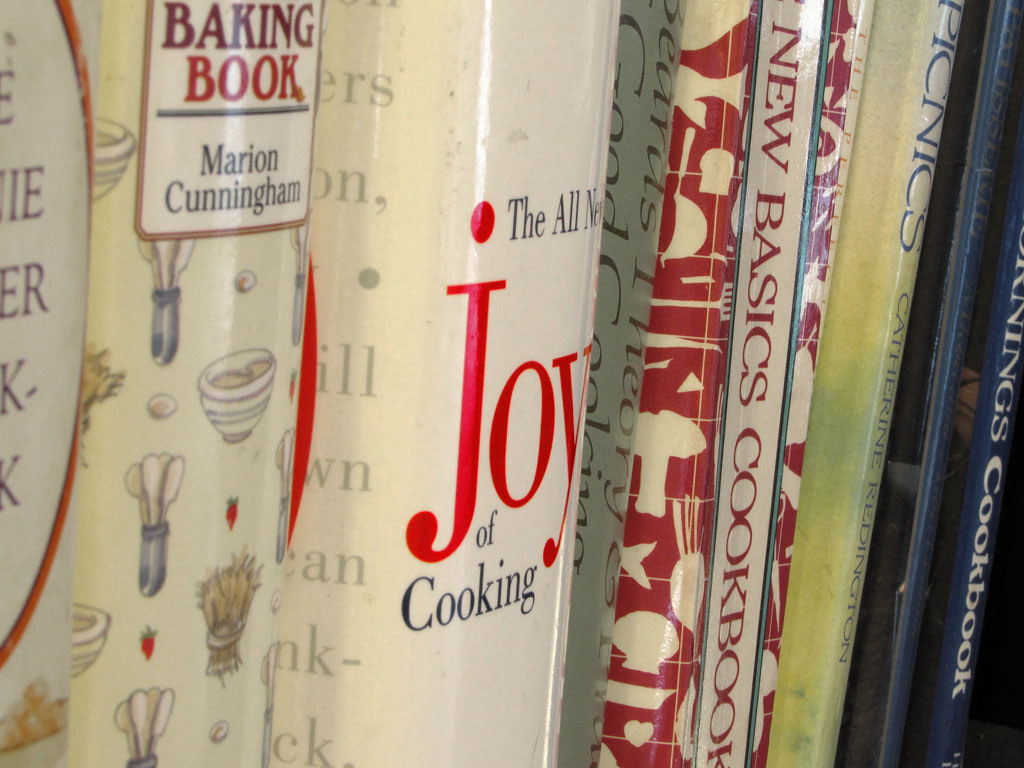
“The Joy of Cookbooks” by shoutabyss is licensed under CC BY 2.0
As in many other things, the population has divided into two: those with increasingly refined tastes in gastronomy, and those who eat mainly junk and takeaway food for the quickest but also crudest possible gratification.
Gastronomy often seems the only aesthetic sphere in which the modern British display any real interest. Their dress, their music, their art (or at least such as gains any publicity), their literature, and of course their architecture, are hideously ugly, even militantly so, but a Michelin-starred restaurant receives their adulation — or did in the now-distant days when restaurants were open.
But the modern interest in food is not the same as a mass market for fish, which has, alas, mainly to be cooked, and the fact is that the British are, grosso modo, too lazy and ignorant to cook properly. Many millions of them would be horrified by the sight of a whole fish, or even any part of a raw fish: they don’t want to eat anything that hasn’t been through a complex industrial process, had chemicals and preservatives added to it, and cannot be just stuck in a microwave for a few minutes before consumption in front of the television. Besides, they wouldn’t know what to do with a fish, let alone a crustacean.
It is said that about a fifth of British children do not eat a meal with another member of their household (family would, perhaps, be a misleading term) more than once a fortnight, turning meals into asocial and even furtive occasions. Many households do not have a dining table, and in my visiting days as a doctor I discovered that the microwave is often a household’s entire batterie de cuisine.
This slovenly and asocial approach to eating — evident in the detritus left behind in British streets as people eat wherever they happen to be, in their cars, walking along, in trains and buses, in fact anywhere but a dining room and with others — is not the consequence of poverty, but of a degraded style of life.
Many years ago I noticed that shops in poor areas where there were many immigrants of Indian origin had enormous piles of a vast array of vegetables so cheap that the problem was carrying them home rather than their cost. I would see Indian housewives selecting their purchases with care and attention: the quality and not just the price mattered to them. Uncompelled by economic necessity to shop there, I would nevertheless do so; but I never saw poor whites doing so. The problem with all those vegetables was that they required cooking, preferably with skill, which very few poor whites, as against poor Indians, had. And this is a cultural problem, if the taste for and consumption of a diet of junk food (what the French more vividly call malbouffe) is a problem.
The Indians are fat, with bad health consequences, from eating too much good food; the native British, with bad health consequences, from eating too much bad food. The prevalence of obesity in Britain, greater than in most other European countries, is possibly one of the reasons that its death rate from COVID-19 is so high, among the highest if not actually the highest. And this obesity is immediately obvious on arrival in Britain from any European country.
March 19, 2021
QotD: English food
Maybe the first question is how English cooking got to be so bad in the first place. A good guess is that the country’s early industrialization and urbanization was the culprit. Millions of people moved rapidly off the land and away from access to traditional ingredients. Worse, they did so at a time when the technology of urban food supply was still primitive: Victorian London already had well over a million people, but most of its food came in by horse-drawn barge. And so ordinary people, and even the middle classes, were forced into a cuisine based on canned goods (mushy peas!), preserved meats (hence those pies), and root vegetables that didn’t need refrigeration (e.g. potatoes, which explain the chips).
But why did the food stay so bad after refrigerated railroad cars and ships, frozen foods (better than canned, anyway), and eventually air-freight deliveries of fresh fish and vegetables had become available? Now we’re talking about economics — and about the limits of conventional economic theory. For the answer is surely that by the time it became possible for urban Britons to eat decently, they no longer knew the difference. The appreciation of good food is, quite literally, an acquired taste — but because your typical Englishman, circa, say, 1975, had never had a really good meal, he didn’t demand one. And because consumers didn’t demand good food, they didn’t get it. Even then there were surely some people who would have liked better, just not enough to provide a critical mass.
And then things changed. Partly this may have been the result of immigration. (Although earlier waves of immigrants simply adapted to English standards — I remember visiting one fairly expensive London Italian restaurant in 1983 that advised diners to call in advance if they wanted their pasta freshly cooked.) Growing affluence and the overseas vacations it made possible may have been more important — how can you keep them eating bangers once they’ve had foie gras? But at a certain point the process became self-reinforcing: Enough people knew what good food tasted like that stores and restaurants began providing it — and that allowed even more people to acquire civilized taste buds.
Paul Krugman, “Supply, Demand, and English Food”, https://web.mit.edu/krugman/www/mushy.html.
March 12, 2021
QotD: The modern university campus
… but pretty soon you’ll notice that it’s a very battered, grimy sort of heaven. Nobody’s from there, nobody stays there, everyone’s just passing through on the way to something better. Certainly including the faculty: Every single professor not currently at Harvard
thinksknows xzhe deserves to be at Harvard, and will get there someday. Everything’s on-demand in a college town, because everything’s rented. That “distressed” look hipsters love so much isn’t an affectation on campus; it’s a logical outcome of the transient lifestyle. Why fix a pothole, paint a building, trim a tree, teach a class anyone could ever actually use? Anyone who complains will be gone next semester anyway.Get yours before it’s gone, and if that means skipping town one day ahead of the bill collectors, remember: Capitalism is evil.
It’s not just campus, either. The rest of the lifestyle is just as evanescent, just as ugly. Think of the food. Whatever you do, you can’t eat what the Normals eat, drink what the Normals drink. Here again, foodie culture isn’t a hipster affectation on campus. It’s deadly serious status-jockeying with your temporary — always temporary — peers. You’ve got to win now, because next semester they’ll be gone, probably to Harvard, those cheating, ass-kissing bastards. Sure, it looks, smells, and tastes like cold dog puke, but at least you’re the first to eat it!
Severian, “Politics for Fugly People”, Rotten Chestnuts, 2018-08-24.
March 6, 2021
Vaccinations and Communist Famine | B2W: ZEITGEIST! I E.12 – Summer1921
TimeGhost History
Published 5 Mar 2021This season there is a major breakthrough in combatting one of humanity’s oldest diseases, but a deadly famine also strikes Soviet Russia. Will the international community come to the fledgling state’s aid?
Join us on Patreon: https://www.patreon.com/TimeGhostHistory
Hosted by: Indy Neidell
Written by: Francis van Berkel
Director: Astrid Deinhard
Producers: Astrid Deinhard and Spartacus Olsson
Executive Producers: Astrid Deinhard, Indy Neidell, Spartacus Olsson, Bodo Rittenauer
Creative Producer: Maria Kyhle
Post-Production Director: Wieke Kapteijns
Research by: Francis van Berkel
Image Research by: Daniel Weiss
Edited by: Daniel Weiss
Sound design: Marek KamińskiColorizations:
– Daniel Weiss – https://www.facebook.com/TheYankeeCol…Sources:
Some images from the Library of Congress
Albert Calmette. Photograph, 1930. Credit: Wellcome Collection
World health : the magazine of the World Health Organization Credit: Wellcome Collection Hannokarlhuber https://www.hanno-karlhuber.at/galeri…
https://wellcomeimages.org/indexplus/…
art of Atlit-Yam from Hanay
Photo by J P Davidson https://flickr.com/photos/50616401@N0…From the Noun Project:
– people by Gregor Cresnar
– Earth by RF_Design
– sick By Adrien Coquet, FR
– Man by Milinda CoureySoundtracks from Epidemic Sound and ODJB
– “One More for the Road” – Golden Age Radio
– “Not Safe Yet” – Gunnar Johnsen
– “The Inspector 4” – Johannes Bornlöf
– “Guilty Shadows 4” – Andreas Jamsheree
– “Dark Shadow” – Etienne Roussel
– “Brighter Days Will Come” – Oakwood Station
– “Just Like Old Times” – Jackie MartinArchive by Screenocean/Reuters https://www.screenocean.com.
A TimeGhost chronological documentary produced by OnLion Entertainment GmbH.
From the comments:
TimeGhost History
3 days ago
As usual this episode sees the balance of dark and light that is so typical of the interwar period. Famine in Russia and the first fast-food chain in America; the turning of the tide against TB and tragic Hollywood scandal.So a mixture of serious and fun. Regular viewers will know that our comment section is the same, running from intense debate to long-running memes. In this episode Indy mentions the first ice-cream candy bar, so to encourage things to stay on the light-hearted side why don’t you comment below telling us what’s your favourite candy bar or fast-food joint?

February 28, 2021
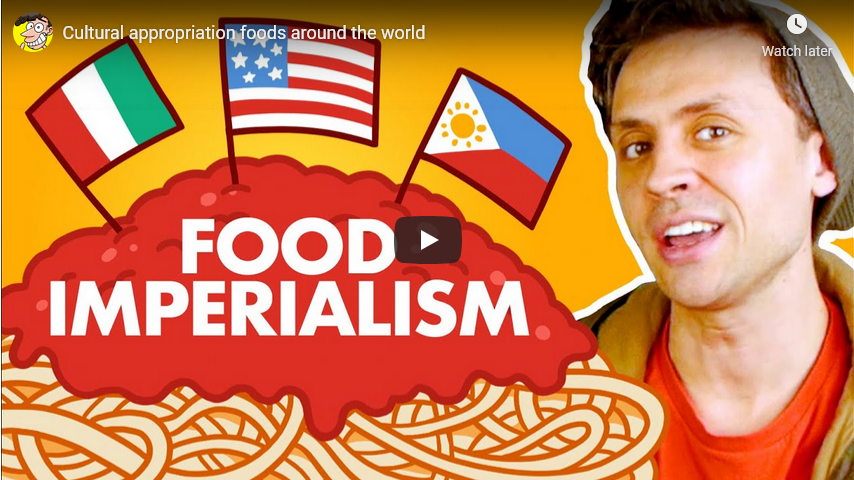
Cultural appropriation foods around the world
J.J. McCullough
Published 14 Dec 2019Baguettes in Vietnam! Curry in Japan! Tea in India! Let’s look at the practice of eating food from other countries, which is more widespread than you might think, thanks to imperialism and immigration.
FOLLOW ME:
🇨🇦Support me on Patreon! https://www.patreon.com/jjmccullough
🤖Join my Discord! https://discord.gg/3X64ww7
🇺🇸Follow me on Instagram! https://www.instagram.com/jjmccullough/
🇨🇦Read my latest Washington Post columns: https://www.washingtonpost.com/people…
🇨🇦Visit my Canada Website http://thecanadaguide.comHASHTAGS:
#food #curry #empire
February 27, 2021
Q&A: Shooting the $ɦ!☦ with InRangeTV
Atun-Shei Films
Published 26 Feb 2021See the rest of our conversation over on Karl’s channel ► https://youtu.be/3sgc0BckrB8
Atun-Shei and InRange finally got together for a chat! In this video we answer questions from our generous patrons, discussing New Orleans culture, Creole food, the gunfight at the OK Corral, urban life in the ancient world, Confederate monuments, historical justifications for slavery, Louisiana Voodoo, Cajun French, Ron Maxwell movies, and the importance of compassion and empathy.
Support Atun-Shei Films on Patreon ► https://www.patreon.com/atunsheifilms
Leave a Tip via Paypal ► https://www.paypal.me/atunsheifilmsBuy Merch ► teespring.com/stores/atun-shei-films
#AtunSheiFilms #InRangeTV #History
Original Music by Dillon DeRosa ► http://dillonderosa.com/
Reddit ► https://www.reddit.com/r/atunsheifilms
Twitter ► https://twitter.com/atun_shei