
World War Two and Spartacus Olsson
Published 13 Jun 2026In 1937, Nazi Germany moved from controlling politics to controlling thought itself. Churches, artists, workers, and dissenters all came under attack.
Berlin, September 1937. From the outside, Germany can seem strangely quiet while the rest of the world slides deeper into war, civil conflict, and authoritarianism. But inside the Reich, the Nazi state is tightening its grip on the last spaces where dissent can still exist.
This quarter, the Gestapo arrests Pastor Martin Niemöller and intensifies the attack on the Confessing Church. The regime opens the House of German Art in Munich, then stages the infamous “Degenerate Art” exhibition to mock, vilify, and destroy modernist culture. The SS establishes Buchenwald near Weimar, forcing prisoners to build their own prison. Meanwhile, Göring’s new state industrial empire and the Nuremberg “Rally of Work” reveal a society being reorganized for war.
This is Step 19 in the death of democracy: when the authoritarian state stops merely silencing opposition and begins fighting the inner freedom to believe, imagine, worship, create, and think.
June 14, 2026
How to Make Dissent Disappear – Death of Democracy 19 – Q3 1937
Mauser M80SA: Actually a High Power and Actually Hungarian
Forgotten Weapons
Published 21 Jan 2026In the 1980s, the Mauser company was completely adrift, without any real plans or goals or good leadership. They had been trying to get by on relaunched old designs, and not been very successful. By the late 80s they move on to just buying guns from other companies (like Renato Gamba) and relabelling them as Mauser. One of these partnerships was with FEG in Hungary.
In 1990, Mauser contracted with FEG to buy Browning High Power copies. FEG had actually licensed the high Power design from FN back in the 1970s, and was already tooled up for production, so they just added a Mauser roll mark and called the gun the M80. It was a straight copy of the High Power, except for the omission of the magazine safety. Production ran from 1990 until 1995, with only 3,200 made. The gun did not sell well, which should [not] be very surprising — this was a very outdated design by the 1990s and the Mauser name just wasn’t worth much as a value-add.
(more…)
QotD: Some of H.G. Wells’ more awkward views
When I was researching my biography of H.G. Wells in the early 1990s what shocked me, apart from his habitual and extreme selfishness, was the man’s life-long support for social engineering and eugenics. Put simply, his socialism embraced the idea that for the bulk of humanity to be free, prosperous, and happy a sizeable minority had to simply disappear. For Wells this included the disabled, the “perverse”, and even perhaps many who were non-white. What became apparent very quickly was that such an approach wasn’t confined to the author of The War of the Worlds and The Invisible Man, but was extraordinarily common on the intellectual left. Many in the Fabian Society and Labour Party shared these ideas, as did mainstream socialist thinkers in Europe and North America.
This was, of course, before the genocidal policies of the Nazis were implemented, and while many of these grand men and women of the left had died before the camps were liberated and the horrors known, others certainly lived on. Some were contrite, others not. Either way, it hardly forgives them their ideology and influence – naiveté and ignorance simply isn’t a viable defence in such circumstances.
Michael Coren, “Eugenics and the intellectual left”, The Critic, 2020-09-16.
Update, 15 June: Welcome, Instapundit readers! Have a look around at some of my other posts you may find of interest. I send out a daily summary of posts here through my Substack – https://substack.com/@nicholasrusson that you can subscribe to if you’d like to be informed of new posts in the future.
June 13, 2026
The intellectual dangers of “nostalgia economics”
Mani Basharzad explains that although resurgent socialist beliefs are a bad sign, there’s actually a worse danger to modern economies that isn’t a coherent ideology but all the more potent because of it:
Custom image by FEE
If someone asked me what the most dangerous economic ideology is, many would expect an Austrian to give a typical answer: Marxism, socialism, or Modern Monetary Theory. Yet I believe there is another way of thinking that is even more pervasive. It is not a coherent body of ideas like those ideologies. Rather, it is a sentiment so widespread and socially accepted that it threatens not merely economic freedom, but our very understanding of progress itself. I call it “nostalgia economics”.
Recently, the singer Sting suggested that the rise of toxic masculinity is partly the result of the “loss of manual jobs”, claiming that because many men no longer use their hands and physical strength in their daily work, unhealthy masculine traits are on the rise. Like many commentators on the political left, he also blamed Margaret Thatcher for Britain’s economic transformation. “Britain’s wealth was created in the coalfields and the steel towns and the mill towns and the shipyards”, Sting said. “All of those skill sets were thrown on the scrapheap … for Thatcher’s dream of a service economy.”
This is nostalgia economics in action. A global celebrity whose music can be streamed instantly on another continent, who earns income through digital platforms, and whose career depends on modern communications and services, criticizes the very service economy that makes his success possible.
A person in thrall to nostalgia economics will take the blessings of progress for granted while romanticizing a past that never truly existed. Imagine living in the world of Charles Dickens: you would not have had access to a typewriter for much of your life, if at all, since it was only commercialized in the late 19th century. More importantly, you would not have had access to electricity. The conveniences we now consider basic would have been unimaginable luxuries.
The economic historian Norman Stone illustrated the extraordinary pace of modern progress through the experience of the novelist Henry James:
In 1895 the novelist Henry James acquired electric lighting; in 1896 he rode a bicycle; in 1897 he wrote on a typewriter; in 1898 he saw a cinematograph. Within very few years, he could have had a Freudian analysis, travelled in an aircraft, understood the principles of the jet-engine or even of space-travel.
Had Sting been alive in 1890, a world tour would have looked very different. A journey from London to New York would have taken more than a week rather than a few hours. International audiences, instant communication, and global entertainment markets would have been beyond imagination.
The glorification of manual labor is one of the most overrated ideas in modern political discourse. This tendency is not confined to the left. Ambitions to revive manufacturing employment through government policy often draw on the same nostalgic impulse. But what exactly are we trying to return to?
Perhaps literature offers a more honest answer than politics. Oscar Wilde observed that “all unintellectual labour, all monotonous, dull labour” involved unpleasant conditions. He went even further, commenting that “there is nothing necessarily dignified about manual labour at all, and most of it is absolutely degrading”.
The reality of industrial labor was far harsher than many modern observers imagine. In Britain, workplace fatalities have fallen dramatically over the last century: fatal injuries to employees dropped from around 4,400 a year early in the 20th century to around 200 a year by the end of the century. Coal mining, one of the occupations most frequently romanticized today and the first industry Sting evoked, exposed workers to constant danger and disease. Throughout the 1950s and 1960s, coal workers’ pneumoconiosis (“black lung”) claimed well over a thousand lives annually. What would a laborer enduring dangerous conditions, long hours, and chronic health risks have given for an air-conditioned office job?
One thing Sting did identify is that men generally do need more physical activity in their lives both for general physical health but also for mental health.
Sing, Muse, of A Complicated Man: Why the Narrative Structure of The Odyssey is VITAL
MoAn Inc.
Published 2 Jan 2026
(more…)
June 12, 2026
Protests and riots send different messages to the PTB
While this is specifically related to the situation in Belfast, it applies to protests and riots generally:
The message of a protest is “we don’t like this”.
The message of a riot is “we don’t like this, and we’re able to do something about it”.
People who unconditionally call for peace and calm, regardless of the provocation, don’t fundamentally understand how politics works in the real world.
They do understand that the purpose of politics is to provide an alternative to violence, but that’s as far as their understanding goes. They don’t think through the implications, usually because they are quite comfortable with things as they are.
If politics is an alternative to violence, then politics is a proxy for violence.
And that means you have to dole out power in proportion to capacity for violence. Or someone’s going to figure out they can do better by flipping the table.
Monarchy wasn’t replaced by democracy because of fine-sounding philosophical ideals and eloquent documents declaring this or that.
Democracy happened because if you added rifling to the flintlock firearm, suddenly a individual farmer with a tube was the pinnacle of military technology, and now you had to keep all the farmers with tubes happy by giving them political power.
(Ancient Greek democracy had a similar relationship with the hoplite warrior.)
When political systems work well, for a while, the violence they represent becomes further and further from people’s minds, and those who can’t effectively commit or direct violence worm their way into power, and begin to take it away from those who can.
And they’ll defend their position by saying that violence is unthinkable, barbaric, always bad, must be disavowed at all costs, etc.
This isn’t some sort of high-minded principle on their part. It simply means one of two things. Either “the status quo works for me, so I don’t want you to upset it”, or “I suck at violence, and I don’t want to have to fight”.
They want young men demoralized, so that their artificial meritocracy of spreadsheets, or their non-meritocracy of patronage networks, can be protected from the natural meritocracy of conflict.
This means that riots aren’t actually for achieving any specific material aim. They are for reminding the comfortable that judges and bureaucrats and policemen have home addresses and families. And that violence is always on the table.
A protest would only send the message that the Irish don’t want to be ethnically cleansed. But the bureaucrats and judges and lawyers already know that. They just don’t care.
A riot reminds them that they have to care, because the Irish have a long tradition of doing something about it.

How one German soldier survived WW1
The Great War
Published 12 Dec 2025Order Alexander’s Diary in The Other Trench in English and Der andere Graben in German: https://www.theothertrench.com
More than 13 million men served in the German army during the First World War. Most wrote letters home, some kept diaries, and some wrote memoirs if they survived. But over a century later, it’s rare to have a window into the everyday thoughts and feelings of one man, a time capsule of the experience of one of those 13 million.
(more…)
QotD: George Bernard Shaw
On the other hand, he was one of the few playwrights in English whose plays can still be performed for the pleasure of an audience a century later. One or two of them might even, without absurdity, be called great. He was undoubtedly very witty, and if he was unbearably opinionated, his prose was always vigorous and quite often elegant. I learned to write from him. Many of his bons mots are still nearly as funny as those of Oscar Wilde.
It was as a playwright — one whose fame stretched around the world — not as a thinker or guide to policy that he is commemorated in the name of the theatre [at Britain’s Royal Academy of Dramatic Art]. His plays have been in print ever since they were written. His achievements in the theatre can hardly be denied. He is virtually the founder of the modern drama in English. I can extract at least 20 of his plays from the vaults of my mind.
Theodore Dalrymple, “Man and Underman at RADA”, City Journal, 2020-09-17.
June 11, 2026
“Thoughts and prayers” in a Two-Tier Keir accent
Sir Keir Starmer posted to X in response to the attempted beheading of a Belfast man a few days ago:
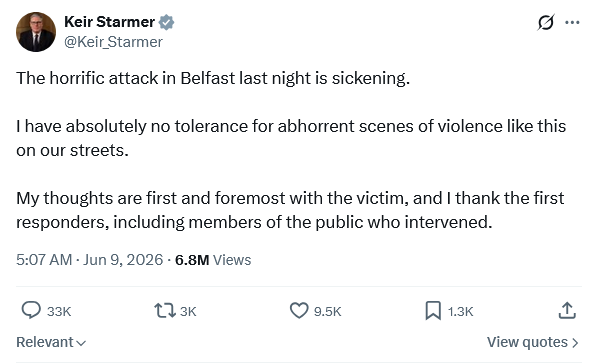
It drew some angry responses like this:
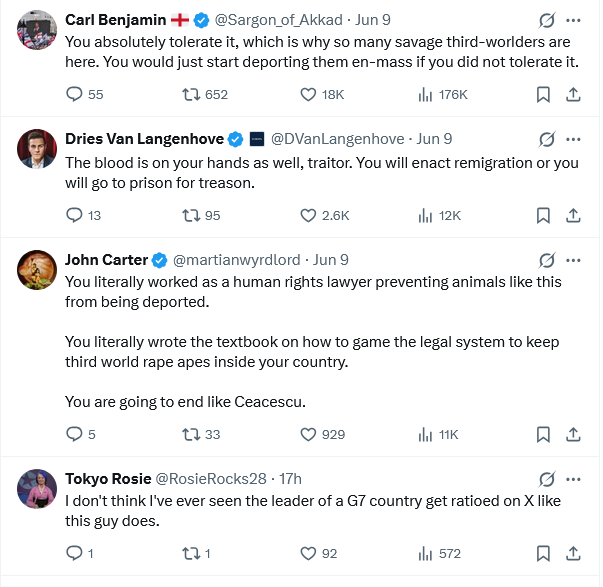
And a longer response from Jim Chimirie:
.@Keir_Starmer, your statement says you have absolutely no tolerance for abhorrent scenes of violence like this on our streets.
With respect, tolerance is not the issue. Nobody tolerates a near beheading on a residential street in Belfast. The question your statement carefully avoids is prevention. And prevention requires honesty about a pattern your government has consistently refused to name.
A man in his thirties, a Somali national, pinned a man to the ground on a residential street and stabbed him repeatedly in the face and neck. Members of the public intervened with a hurling stick. A woman required hospital treatment for the stress of witnessing it. This happened in Northern Ireland, a place that has known more than its share of violence, and even there residents said they had never seen anything like it.
Your government has presided over record small boat crossings. It has failed to proscribe the IRGC despite repeated promises. It has blocked the grooming gang inquiry for a year before being forced to concede it. It has spent £10 billion on asylum accommodation contracts. It has actively resisted measures that would have reduced the number of unvetted individuals entering and remaining in this country.
The victims of these attacks are not statistics. They are British people, going about their lives on their own streets, who were failed before the attack happened. Failed at the border. Failed by a system that prioritises the rights of those who arrive illegally over the safety of those who were already here.
Your thoughts are with the victim. So are ours. The difference is that thoughts are not policy. Thoughts do not secure borders. Thoughts do not remove individuals with no right to be here. Thoughts do not protect the next victim, whose name we do not yet know, on a street we cannot yet identify, from an attack that has not yet happened.
How many more before the thoughts become action?

The family of the victim talked to the media and it in no way seems to have been pre-scripted by the government and was clearly uncoerced and of their free will and is in no way any kind of hostage statement:
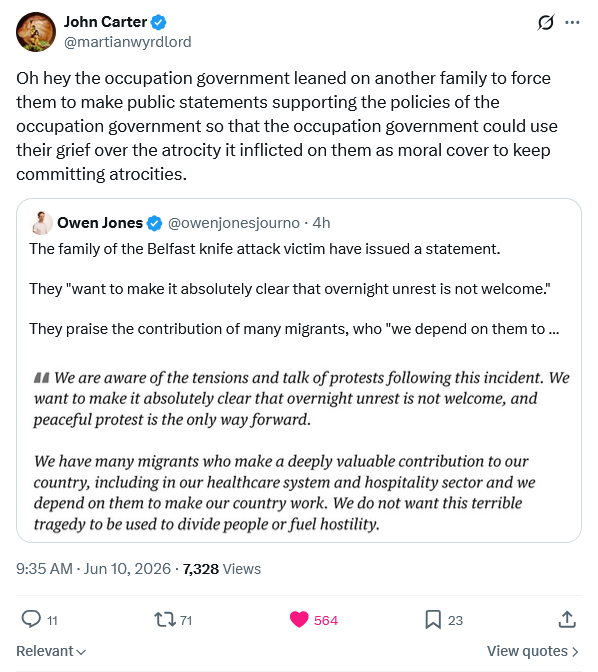
Northern Ireland has seen a lot over the last few decades, but I doubt anybody expected to see the two opposing sides of “The Troubles” joining forces:

Between them, the Ulster Protestant paramilitaries and the IRA operatives have a lot of hard-won skills at avoiding the authorities and committing direct violence. At The Bugscuffle Gazette, Ian notes that he predicted this earlier:
In June of last year I penned an essay titled “Popular Misconceptions” in which I opined that if the “good men and true” of an area get “fed up with lawlessness” they tend to take matters into their own hands.
We are now seeing this play out in real time in Northern Ireland.
For those of you not paying attention to the news, a refugee from the Sudan attempted to saw off the head of an Irish man in Belfast on Monday, 08 JUN 26. He was on a public street when he did so, and several locals rushed to stop his assault. His victim has lost an eye from the attack, and is in critical care at a local hospital.
If you read my previous essay, I postulated that when the vigilance committees show up, a lot of collateral damage come with them — so nobody should be shocked to understand that a whole bunch of immigrant homes and businesses are currently on fire in Northern Ireland.
I will now expound upon that previous essay. I will even go so far as to issue a warning that the people who should heed said warning are going to ignore:
If the “good men and true” get the perception that the government and officialdom are not only facilitating what has them all riled up, but just might be a source of what has them all riled up … well, history has shown that the “good men and true” have very little problem with expanding the “extra-judicial punishments” to include Minions of the Law and Government.
And for those folks who pish-tosh any sort of threat from the British “subjects” — this is Northern-bloody-Ireland. The time and area where the locals refined the “Vehicle-Borne Improved Explosive Device” to the point a popular cocktail was named after the practice.
This is the area where there are more SLRs, Sterlings, and Browning Hi-Powers buried around that little island than any three countries in Africa.
Hell, the Irish made the AR-18 famous.
I speak to the government and officials of Northern Ireland, Ireland, and the United Kingdom: Listen to me — you won’t, but listen to me … You’d better — at the very least — pay some sort of lip service towards a credible perception that you give a tinker’s damn about what has the people all lathered up, and make the people believe that you’re doing something about it.
If you don’t — and you won’t — don’t come whinging to me when your dance card abruptly becomes filled with such exhilarating numbers as: the Hemp Fandango, the Beatdown Boogie, and the Arson Waltz.
You have failed the people. You have failed them utterly, completely, and totally. They’re about to rectify that situation. You might want to get ahead of that power curve before you find yourself watching folks get loaded onto cattle cars alongside you.
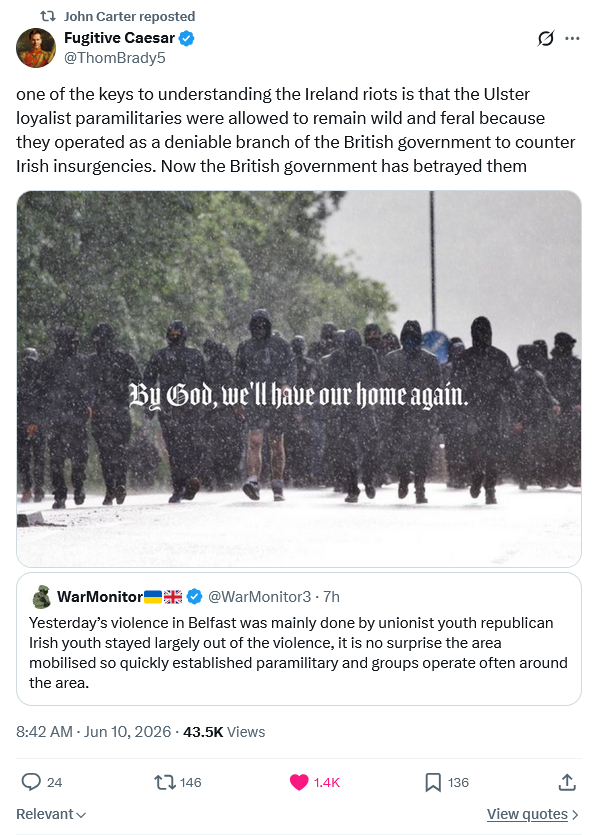
John Ringo on X:
One more post on the subject of the Irish getting their dander up.
The Irish Troubles (a continuous low level insurgency) lasted from the 1960s to 1998. But they were the continuation of “Troubles” stretching back to the 1800s.
1998, that’s a bit over 25 years ago.
Both sides in the Troubles, the Catholics and the Protestants, are one generation away from a civil war that lasted for TWO GENERATIONS.
The Gen Z men of today were raised on the stories of the heroism and patriotism of their fathers and grandfathers and THEY HAVE HAD NO SIMILAR OUTLET.
The IRA did not invent the vehicle borne IED. The Vietnamese used it before them.
They just invented a cocktail from their name as well as a drinking song.
“Former” IRA weapons dealers are still some of the top illegal weapons dealers in the world.
1/10th of “British” SAS come from Ulster. A significant fraction of the British infantry as well.
Many of them served in GWOT so they have a recent master’s class in insurgency.
And now Keir Bloody Starmer and the Irish Government have given BOTH SIDES a reason to start again, but this time UNITED.
We may be about to get a glimpse of what a civil war in the US looks like up against a massive surveillance state.
Take notes.
Update, 12 June: Welcome, Instapundit readers! Have a look around at some of my other posts you may find of interest. I send out a daily summary of posts here through my Substack – https://substack.com/@nicholasrusson that you can subscribe to if you’d like to be informed of new posts in the future.
The First Red Dot Sights: Aimpoint Electronic, MkIII, and Aimpoint 1000
Forgotten Weapons
Published 17 Jan 2026Today we are looking at the first commercial red dot optic, and its successors. In 1975, Aimpoint released the Aimpoint Electronic, a collimating optic using an LED as a light source. It was intended for the hunting market, where an unmagnified optic that could be used with both eyes open offered a significant improvement over traditional magnified optics for short-range moving targets. The sight proved popular, and led to a second generation in 1978 with an improved mount. In 1983, a third generation (the MkIII) was introduced. This model was zeroed by moving the collimating lens inside the optic, instead of moving the whole optic on its base as on the previous models.
In 1985 Aimpoint released their first optic that mounted in standard scope rings, the Aimpoint 2000. However, they continued to market and develop the initial family of optics as well, releasing the Aimpoint 1000 in 1987. This pattern was still very popular with hunters, and offered a lower mounting position than possible with scope rings. Ultimately the ring-style models became much more popular and the Aimpoint 1000 was the last of its type offered by the company.
How Red Dot Sights Work: • How Red Dot Sights Work (What is a Collima…
(more…)
June 10, 2026
QotD: Tiberius Gracchus, Tribune of the Plebs
And here it is worth noting that kind of government the Romans had to understand the response. The Roman Republic had written laws but no written constitution – instead, the rules for office holding, for conducting the business of the Senate, for running the assemblies and so on were all customary: the Romans governed themselves in accordance with what they called the mos maiorum, “the custom of the ancestors”. In a sense then, certain practices, if practiced long enough, became a sort of law-of-tradition to themselves and of course one of those customs – practiced at this point for, at minimum around 150 years – was the continual leasing of large amounts of ager publicus to the point that the leases were treated as a form of ownership: people used that land as security for loans, they built houses on it, they buried their parents on it and so on. Because the leases were presumptively renewable and had been for decades if not centuries, under the mos maiorum, the holders of ager publicus had long considered the land theirs. And of course the upset parties are rich and powerful, so their opposition was significant and meaningful, politically.
In brief, the way this plays out is that while Tiberius Gracchus does have significant popular support for his motion (Plut. Ti. Gracch. 9.1), much of the elite are opposed. He draws up a quite conciliatory version of the law, which proposes to compensate the holders of large amounts of ager publicus for their lost leasing rights and to then give them the remainder of their leased land (so they needn’t fear a second lex agraria and a third and a fourth and so on), but according to Plutarch in the face of continued elite opposition, shifts back to a less conciliatory version of the law (Plut. Ti. Gracch. 10.3). The resistance to his law centers on another tribune, Marcus Octavius, himself a large holder of public lands, who plans to veto the law and uses his own powers as a tribune to disrupt the process (along with some fairly clear shenanigans by some of the wealthy, like trying to hide the voting urns to prevent a vote on the law and so on).
Now there are a few things to note at this juncture in the story. First, there being ten tribunes, it must never have been very hard to find a tribute willing to gum up the passage of a given law, but that, traditionally, this was a tactic of delay, rather than a hard-stop the way Octavius is using it. At the same time, with real public momentum to make this law happen, one could easily imagine simply waiting Octavius out – he only has one year in office. Except. Except that, remember, Tiberius Gracchus needs a big victory in his tribunate to get his political career [back] on track, a consideration that was clearly significant (thus the reason we’re informed of his quaestorship; we usually don’t know much about even very significant figures’ time in junior offices!). That consideration, I think, serves as important context for Tiberius’ decision to escalate every time he encounters resistance: he cannot afford to simply be the prelude to someone else passing this law: he needs to pass it himself.
The normal method for “deconflicting” two magistrates with opposing vetoes like this was to go to the Senate, which Tiberius Gracchus, hoping his influential supporters would carry the day, did. Instead, according to Plutarch (Ti. Gracch. 11.2) the Senate was merely no help, whereas Appian (BCiv 1.12) describes the Senate as openly upbraiding Tiberius, a strong negative response. Now under the mos maiorum, that would be the end of it: the authority of the Senate (the auctoritas senatus) ought to be so intense that when the Senate speaks in one voice and says, “not right now” then you desist. Remember that in the Roman conception, the Republic is a partnership of sorts between the Senate and the People (the S and the P in SPQR), rather than a situation in which the Senate is purely subordinate to the popular will: if the Senate is strongly opposed, that is supposed to be a veto point that is respected.
But remember: Tiberius Gracchus cannot, politically, desist. He must push through because his political career requires a victory this year. Note that the cause does not require a victory in 133; there is nothing to stop another tribune in 132 from trying to advance the same bill or a more limited or different version of it. But Tiberius Gracchus’ career absolutely requires success in 133. So instead of desisting, he escalates.
He now breaks clearly with the mos maiorum and plans to take his law directly to the people against the advice of the Senate. Octavius is obviously a problem – he’ll veto anything Tiberius Gracchus tries to do – so Tiberius Gracchus introduces a law to depose Octavius from office. The Roman Republic doesn’t have anything like impeachment, there is no framework to remove someone from office. Instead, the way the Republic works is that all of the offices are held for short duration (one year) and while tribunes and office holders with imperium are immune from prosecution while in office, they can be prosecuted the moment they leave office for any crimes they committed. There is no framework for booting out a tribune like this; the remedy in the customary Roman system is to make sure the next year you elect tribunes who support the idea and try to pass it then. But that remedy doesn’t work for Tiberius Gracchus.
So Tiberius Gracchus passes the law deposing Octavius and then has him dragged from the speaker’s platform (the rostra) and now we have a problem. Because of course Octavius’ supporters are going to view this law itself as illegal and invalid: tribunes are, you will recall sacrosanct, so it’s not clear they can be deposed and it is very clear they cannot be assaulted or dragged. Violating the sacrosanctity of a tribune is, at least notionally, a capital offense and a severe violation of religion and if you think that Tiberius Gracchus’ legal basis for all of this is rubbish, you think he just did it twice. Of course, Tiberius is also a tribune, so you can’t attack him now, but once his year is done, you are probably planning to haul him in to court and let a jury decide if what he did was legal or not.2
In any case, with Octavius removed, Tiberius passes his land reform bill. The law provided for a three-man commission to handle the assessment of what public land was held in excess and then to hand it out. Tiberius Gracchus names as those commissioners himself, his brother and his father-in-law (Appius Claudius Pulcher (cos. 143)). Needless to say, that is a set of commissioners which does not inspire a lot of confidence that the commission will be uncorrupted by politics, a point we’ll get back to in just a moment.
In the meantime, the Senate looked to exert its traditional prerogative over state funds (as it advised the quaestors who superintended the treasury) to hamstring the new commission, but Tiberius Gracchus took advantage of the recent death of Attalus III, King of Pergamum. Attalus had notionally willed his kingdom “to the Roman people” – he had no clear heirs and so perhaps thought by this act to get the Romans to pick one of his relatives to run the kingdom, thus avoiding a damaging civil war – but instead Tiberius, getting the news early, rushed to pass a law annexing the kingdom and using the windfall to fund his commission. The law passes, but this is a breach both of the Senate’s traditional power over state finances, but also its very important role managing Roman foreign policy.
What I want to note in this sequence which is important for understanding what comes next is that Tiberius Gracchus has just demonstrated that, so long as he remained popular, he could use the powers of the tribunate to essentially run the Roman state from the tribune’s chair. Tiberius has now forced not merely a domestic land issue, but also a finance issue and a foreign policy issue over the objection of the Senate and another elected tribune, essentially running roughshod over all of the customary limits intended to keep any one Roman politician from coming to dominate the Roman political system.
Of course if you were an opponent of Tiberius Gracchus, you could at least tell yourself that this is all bad, but at the very least, Tiberius Gracchus will be out of office next year, as it was contrary to custom to run for any office immediately after holding it. Indeed, it was unusual to hold basically any office more than once, save for the consulship (and even then, only for very successful consuls and never multiple years in a row). Those limits are customary but everything about the Roman Republic is customary; if you discounted the mos maiorum, there wouldn’t be any republic left. You’d instead expect that Tiberius would go back to being a senator for a few years while planning his shot at the praetorship – during which he’ll have to survive a series of court battles over the legality of his actions.
So even if he is doing potentially outrageous, dangerous things, at least he’ll be gone in a year, right?
Bret Devereaux, “Collections: On the Gracchi, Part I: Tiberius Gracchus”, A Collection of Unmitigated Pedantry, 2025-01-17.
- Which, again, noting the complications above, probably means applying that limit for the first time to at least some classifications of land it had not applied to before and also applying it against the socii.
- The Roman court system leaves questions of law – which in most modern courts would be decided by a judge – to the jury itself.
June 9, 2026
Road to Rangoon, Ep. 1 – Slim’s Hammer and Anvil
HardThrasher
Published 8 Jun 2026The Road to Rangoon Ep1: Hammer & A Hard Place — The Battle for Burma Begins By the start of the monsoon rains in 1944, British and Indian forces of General Sir William “Bill” Slim’s XIVth Army had been pegged back inside India. Five months later, after the battles of Imphal and Kohima, the Fourteenth Army had not only retaken the ground it had lost, but inflicted catastrophic losses on the Imperial Japanese Army.
The question was: what now? There would be no more forces coming from Europe, no additional fire power or support, and apparently no belief in the men by the Imperial General Staff in London or the US Army high command in Washington. Could the DUKE forces push into Burma through monsoon rains, jungle, mountains, disease, impossible supply lines and against an enemy willing to die for each yard of ground? Could Slim, Mountbatten, Oliver Leese, the US-led Northern Combat Area Command — NCAC — turn victory in India into the reconquest of Burma?
In this opening episode of “The Road to Rangoon”, we begin the story of the epic advance that would throw the Imperial Japanese Army out of Burma (modern day Myanmar) and become familiar with some of the places, names and concepts that will shape our story.
We look at the geography of Burma and eastern India, the aftermath of Imphal and Kohima, the state of the Japanese Burma Area Army under General Kimura Heitarō, the role of XIVth Army, XV Corps and NCAC, and the Allied plans that became Operation ROMULUS, Operation CAPITAL, Operation DRACULA and EXTENDED CAPITAL. This is the story of how the Burma Campaign moved from defence to attack — and how Slim planned one of the most ambitious offensives of the Second World War.
(more…)
June 8, 2026
“Friedrich Nietzsche predicted our culture more than a century ago”
On the social media site formerly known as Twitter, Creative Deduction give Nietzsche credit for predicting how western cultures would change to the state we find ourselves in today:
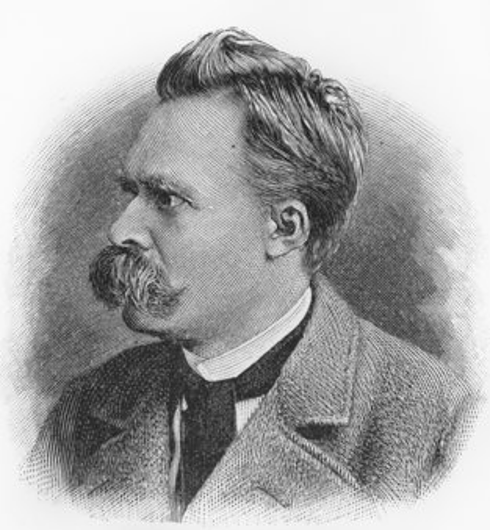
Friedrich Nietzsche predicted our culture more than a century ago.
A society where victimhood confers status; where weakness is celebrated as virtue; where grievance brings moral authority; and where the highest aspiration is not greatness, but comfort.
He regarded it as a symptom of civilisational decline. In place of the old aristocratic values of strength, courage and self-overcoming, Nietzsche saw the rise of what he called “slave morality” — a worldview that elevates weakness, suffering and resentment into virtues. The modern celebration of victimhood, where people compete to present themselves as the most oppressed, is this mentality. Rather than striving to overcome hardship, many now seek status and moral authority through claims of injury and grievance.
Nietzsche was deeply contemptuous of those who pursue safety and comfort above all else. He mocked the “last man”, the small-souled creature who wants nothing more than a warm bed, entertainment and protection from anything difficult or dangerous. For Nietzsche, struggle was not an unfortunate condition to be eliminated, but the very source of meaning, growth and greatness. Without resistance, there is no self-creation.
The modern welfare state would have horrified Nietzsche. By shielding people from the consequences of their actions and removing the necessity of struggle, it does not liberate — it enfeebles. It creates populations that are materially secure but existentially empty, dependent on the state rather than on their own strength and initiative. Nietzsche believed that genuine human flourishing requires the willingness to endure hardship and take responsibility for one’s life. A society that makes comfort its highest value and victimhood its highest status inevitably produces weak, resentful people who have forgotten how to live.
June 7, 2026
Those “decorations” or “doodles” on medieval manuscripts
In this week’s Substack Post of links they included this gem from weird medieval guys providing lots of illuminated explanations of the visual additions to pages of handwritten text generated in monasteries all over Europe during the Middle Ages:
After perhaps my 9,000th time seeing someone describe medieval marginalia as “doodles” or the product of “boredom”, I thought it might be nice to put together a brief guide to some of the themes and ideas that recur in the margins of manuscripts, hopefully helping to showcase the fact that these drawings were usually anything but “random”! In fact, far more interestingly, these little characters and scenes were part of a complex and visually dense world rooted in religion, pop culture, humour, and folklore. This is just a whistle-stop tour, but I’d love to add a second part soon.
Context matters
Illuminated manuscripts were essentially always written first and illustrated second in the late Middle Ages. The scribes would add their writing to unbound, empty pages, working carefully around blank fields where painted miniatures and initials would later be added by a separate artist or artists. We do not know exactly what sort of education these artists would have obtained. However, they almost certainly would have had a degree of literacy in their native tongue and a familiarity with the scriptures they were illustrating, even if this did not extend to a firm grasp of written Latin.
Understanding this is crucial for pushing back on the idea of medieval marginalia as “random”, since it opens up the possibility of considering marginal drawings in relation to the rest of the page and manuscript as a whole — crucial context that is often neglected when we encounter marginalia as isolated snippets online. Artists were not simply filling in blank voids but adding adornment to a canvas already rich with meaning imparted by the scribe. Thus, the first step to understanding a piece of marginalia should always be to trace it back to its source, if possible. Have a look through the entire work and see what themes and images recur.
Works like the 13th century English prayerbook known as the Rutland Psalter show extensive evidence of the marginal artists playing on specific words and lines from the scriptures featured on the same page. I highly recommend Betsy Chunko Dominguez’ fantastic paper “Playing on Timbrels: The Margins of the Rutland Psalter” for a more complete exposition, but I will go over a couple examples here.
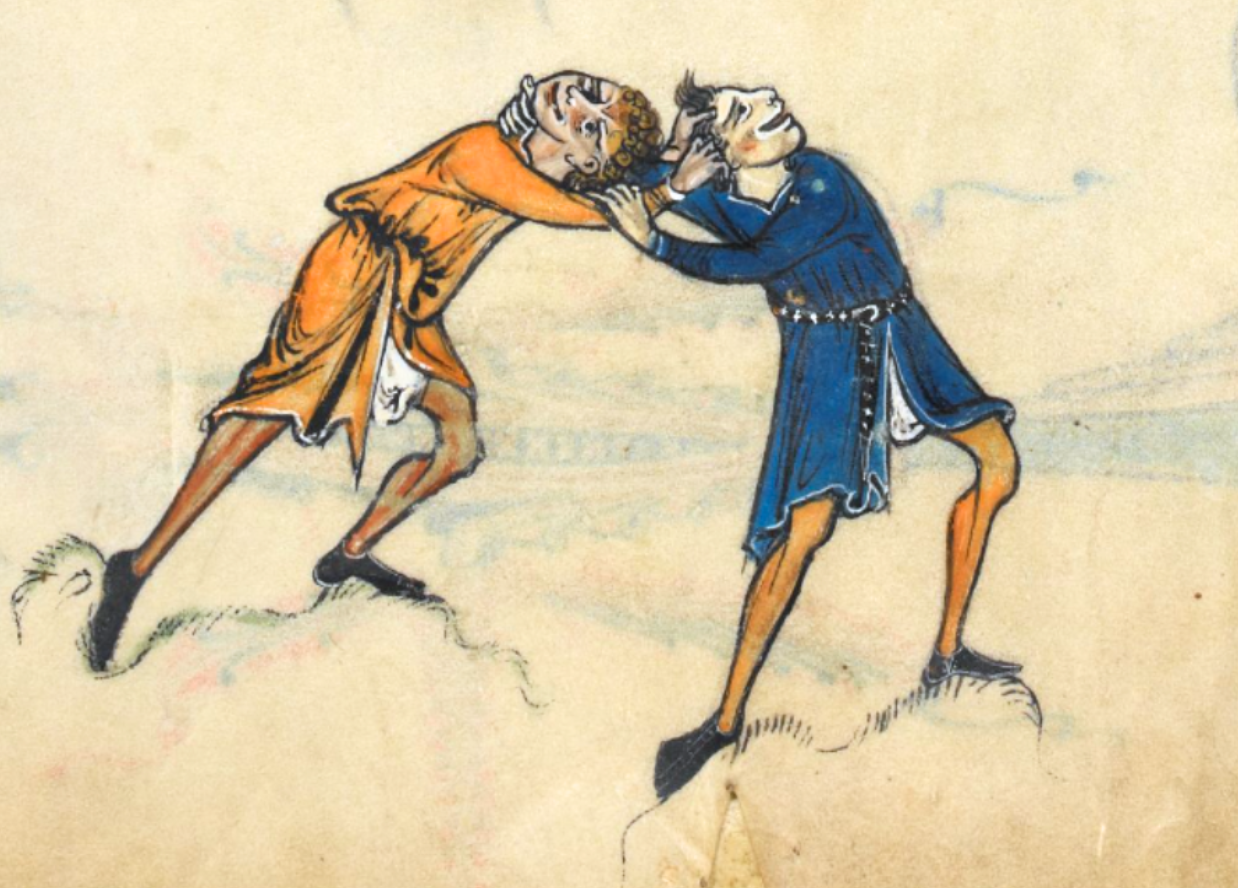
In the lower margin of folio 11r of the Psalter, two men seem to be engaged in a fierce struggle, with one of them apparently trying to rip off the other’s ear. Moving their eyes back up to the start of the opposite page, a reader would have been greeted by the following line from Psalm 5:
Verba mea auribus percipe Domine intellege clamorem meum.
Give ear, O Lord, to my words, understand my cry.
Thus, our marginal brawl becomes a clever pun on the notion of “giving ear” — perhaps a way of making the text more engaging and memorable for its reader.
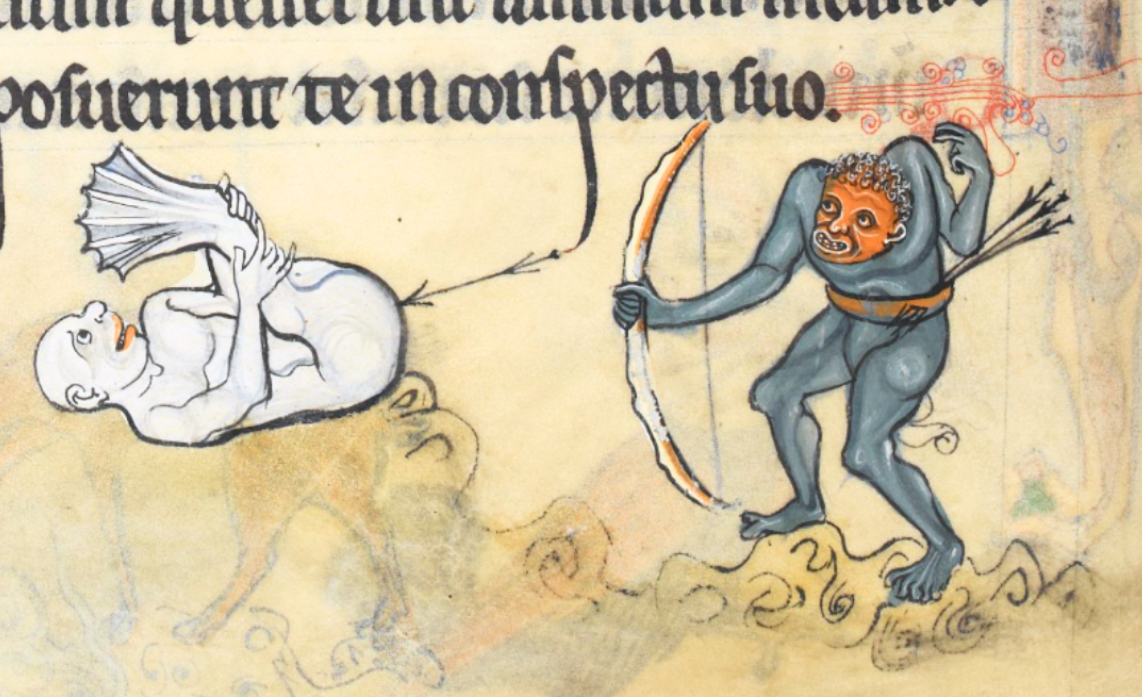
On folio 87v, the artist has extended the letter p from the word conspectu in Psalm 86 (85 in the Vulgate) into an arrow fired from the bow of one monster into the rear end of another.
Conspectu means “to behold” or “to consider”, and the famous medieval scholar Michael Camille connected the arrow’s placement to the notion of gaze as a type of visual penetration. One might also consider the entire verse from the Psalm, which reads:
Deus, iniqui insurrexerunt super me, et synagoga potentium quaesierunt animam meam: et non proposuerunt te in conspectu suo.
Arrogant men are rising up against me, O God; a violent mob seeks my life; they do not keep you before their eyes.
In redirecting the word for “gaze” into the supine creature’s rear end, the artist has perhaps emphasised the evils of turning one’s eyes away from God, connecting the two monsters with the violent mob evoked in the text above.
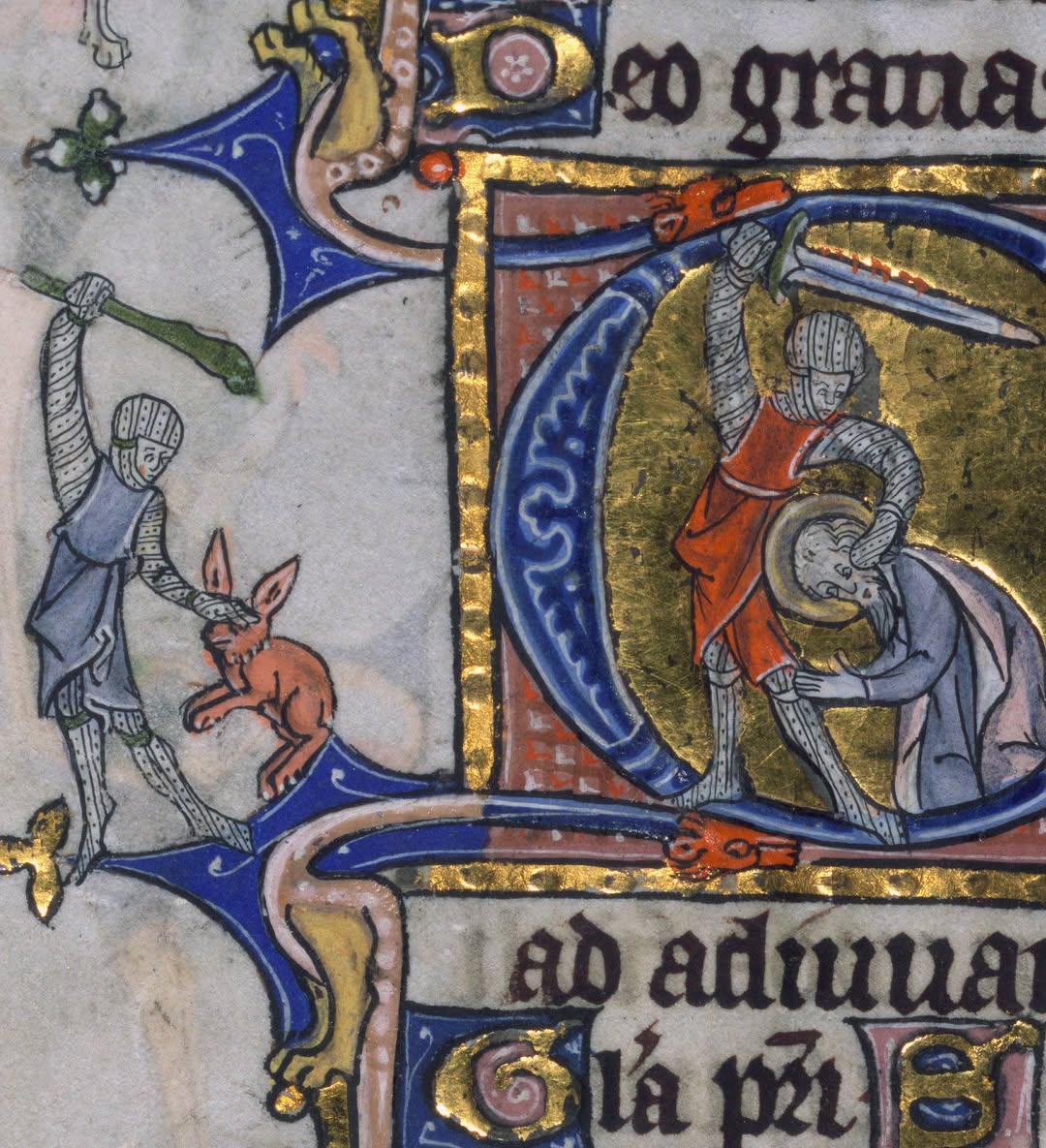
For those who lack an education in Latin, this type of wordplay can be tricky to identify. What may be easier to find are visual parallels between different drawings in a manuscript: the margins could function as a sort of antithesis to the “orthodox” miniatures and initials in the centre of the page. In one 14th century French book of hours, the martyrdom of St Paul in an initial D is reenacted directly to the left by a soldier about to club a rabbit — a humorous elevation of lapine suffering that perhaps emphasises Paul’s innocence.
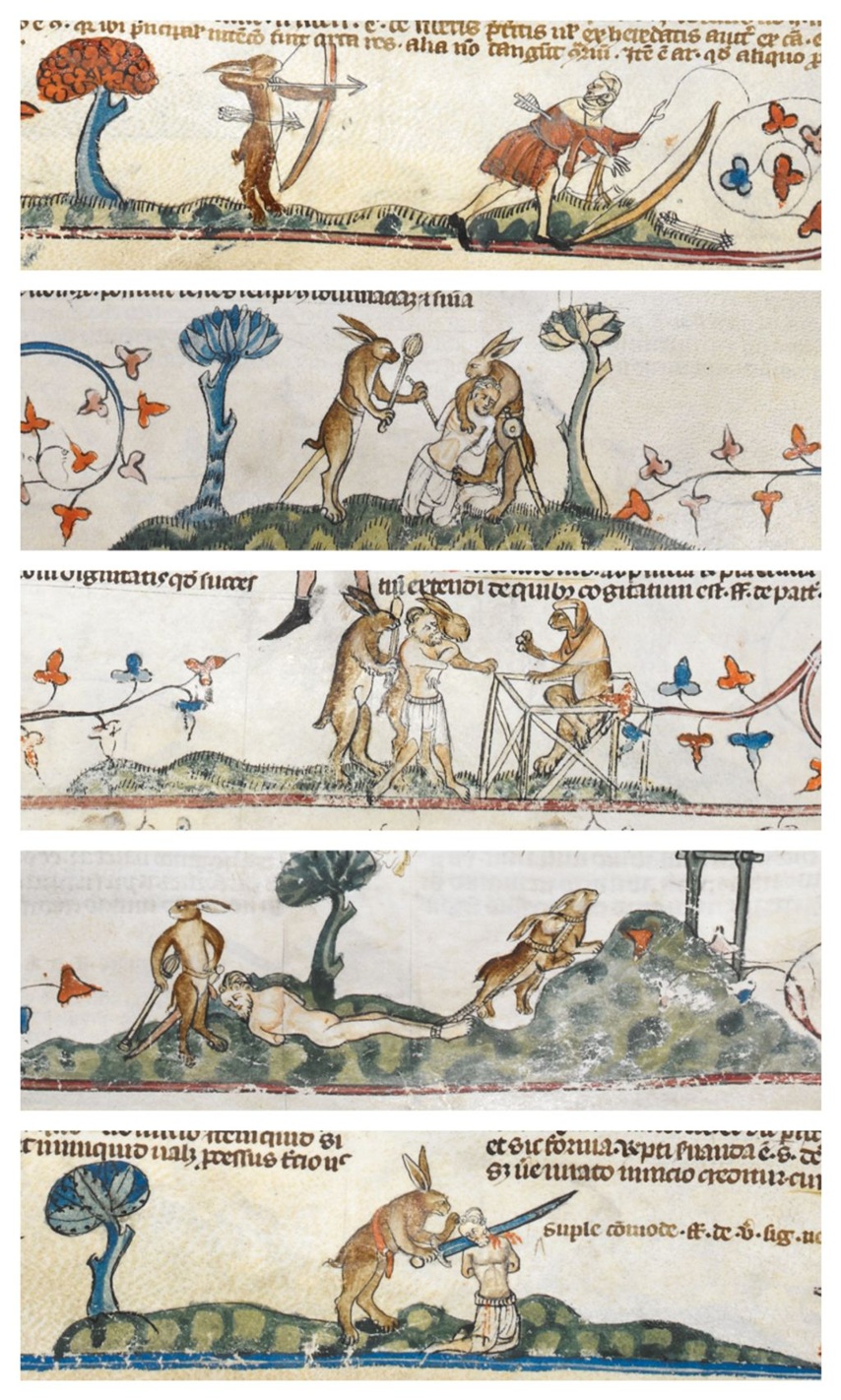
Other manuscripts show narratives playing out in the margins across multiple pages in a comic-book fashion. The 14th century Smithfield Decretals contains more than a dozen multi-page stories, including those of several saints, naughty priests, henpecked husbands, and a group of rabbits who capture, try, convict, and execute a hunter for his crimes against their kind.
British Library, Royal MS 10 E IV
How Hitler Tested His Next War in Spain – Death of Democracy 18 – Q2 1937
World War Two and Spartacus Olsson
Published 6 Jun 2026Berlin, June 30, 1937. Hitler has not staged a major diplomatic shock this quarter — but beneath the surface, Nazi Germany is preparing for war.
In Spain, the Condor Legion helps Franco’s Nationalists and the bombing of Guernica gives the world a terrifying preview of modern aerial terror. At home, the regime escalates its assault on the Catholic Church, begins the purge of “degenerate art”, tightens the link between courts and concentration camps, and hides rearmament behind spectacles of economic success.
This episode of Death of Democracy looks at Q2 1937: the quarter when Nazi Germany normalized aggression abroad while deepening tyranny at home.
00:00 Berlin, June 30, 1937
00:05 No Hitler Surprise — But War Preparations Continue
00:51 The Hindenburg and the Shadow of Modern War
01:50 The “Give Me Four Years” Exhibition
02:25 Guernica and the Condor Legion
02:55 The Bombardment of Almería
03:11 Case Green and Case Otto
03:54 Degenerate Art and Cultural Cleansing
04:22 The Judiciary and the Concentration Camps
05:13 The Nazi Assault on the Catholic Church
06:07 Goebbels, Propaganda, and the Morality Trials
07:45 Autarky, Rearmament, and Hidden Austerity
08:52 Mood Inside the Nazi Leadership
09:48 Ordinary Germans and Apathy
12:15 Analysis: War Abroad, Tyranny at Home
14:19 Conclusion: Nazi Double-Talk


