
seangabb
Published 31 Jan 2026Greece: A Brief History, c.700 BC – 500 AD
This final section examines what the Greeks achieved with the intellectual tools they developed — and where those tools fell short.
It discusses Greek science through figures such as Archimedes and the Antikythera Mechanism, highlighting both technical brilliance and flawed cosmology. It then turns to Greek art, explaining why Greek sculpture represents a decisive shift towards realism, embodiment, and the truthful representation of the human body.
The section concludes with an assessment of Greek democracy: its radical nature, its severe limits, and its enduring influence.
The lecture ends by drawing together the central argument: the Greeks were not morally exemplary, but they were intellectually revolutionary.
June 7, 2026
The Ancient Greeks: 01 – What Made Them Special? (e) Science, Art, and the Limits of Greek Freedom
June 6, 2026
D-Day landings on Sword, Gold, and Juno Beaches
Imperial War Museums
Published 5 Jun 2020On 6 June 1944, Sergeant Ian Grant was among the thousands of men landing on Sword Beach in Normandy on D Day, armed only with a revolver and a cine camera. He was part of the Army Film and Photographic Unit (AFPU) and captured this incredible mute footage of the landings. Fewer than a dozen men filmed the D Day landings and this extraordinary record is now held exclusively by the Imperial War Museum. Film curator Michelle Kirby introduces us to this film.
(more…)
June 5, 2026
The First Ever British SLR: Serial Number One L1A1 Explained
Royal Armouries
Published Jan 14, 2026The L1A1 Self-Loading Rifle is one of the most iconic service rifles in British military history and on this week’s episode we have the very first one ever produced.
Next week: an original Royal Small Arms Factory archive film found by our archive team showing how the L1A1 was made.
0:00 Intro
0:46 Serial Number One Explained (UE57 Alpha 1)
1:40 Factory Plaque, Proof Marks & Enfield Details
4:26 Condition, Finish & Standard Configuration
5:17 Distinctive British L1A1 Features
7:08 Controls, Ergonomics & Fire Selector Choices
10:35 Why the L1A1 Won & Closing ThoughtsThis week’s object’s collections online page: https://royalarmouries.org/collection…
(more…)
June 4, 2026
The murder of Henry Nowak and the failure of British policing
Andrew Doyle notes that the very first mention of Henry Nowak’s murder in Spain’s El País (approximately Spain’s equivalent of the Toronto Star, The Guardian, or the New York Times) frames the story as “evil extremely extreme extreme-right-wing Führers pounce”:
While the country is still reeling from the horrific murder of eighteen-year-old student Henry Nowak, an astonishing article has appeared in El País, Spain’s largest national newspaper. Rather than focus on the failures of the police officers, or the institutional bias within the force, the headline steers its readers away from the case and towards the outlet’s own obsessions. The headline translates as “Farage’s far right stirs up hatred in the UK after a young man is stabbed to death by a Sikh man”.
As Alejo Schapire (an Argentine journalist based in France) has pointed out, this is the first and only article produced by El País on the subject of the Nowak killing. Instead of an image of the victim, the newspaper has opted for a photograph of Nigel Farage. The Guardian was similarly histrionic and detached from reality in its coverage: “As ethnonationalist far right drives racist agenda, Reform UK leader felt need to weigh in on murder of Henry Nowak”.
It is one thing to take issue with those who seek to weaponise human tragedies for their own political gain, and quite another to dismiss legitimate criticism of a failed system. Reform UK is by no means a “far right” party, but of course the term has been so promiscuously misused in the press that at this point it might be best to dispense with it altogether. But of course, this is not really about Farage or his response to the murder at all. It is a cynical means of deflecting from the fate of Nowak and what it reveals about the state of policing in the UK.
So what exactly did Farage say to have the Guardian fulminate about his “racist agenda” and for El País to make him the focus of the story rather than the victim? During a live broadcast, Farage praised the Nowak family for their “extraordinarily dignified” response following the conviction of their son’s killer, and went on to say: “I suggest the rest of us respond to this with pure cold rage”.
And why not indeed? Let’s not forget the shocking details of what happened in this case. Nowak was stabbed multiple times by Vickrum Digwa using a Sikh ceremonial dagger. His mother hid the murder weapon, and his brother called 999 claiming that Nowak had been racially abusive. When police arrived, Digwa repeated this lie. And when Nowak repeatedly told the officers he had been stabbed, one replied “I don’t think you have, mate” and handcuffed him as he lay dying.

At Always the Horizon, Copernican shares his thoughts on the political response to the murder:
Riots have been growing over the last few years in the UK when incidents like this occur. Nigel Farage addressed the incident in a youtube video here. Referring it as a “moment to take a long hard look at ourselves and the country that we’ve become”. He proceeds to say, “All the values and standards of living in a free country, where everyone is judged equally before the law, have been trashed and thrown away”. Nigel Farage demands that “the police complaints operation, the IOPC, needs to get to the bottom of this and produce a report very very quickly.” He also states that the sentencing is unacceptable, as the sentencing of the Sikh was less severe than the minimum recommended for a sustained, aggressive, murderous assault.
Nigel knows how to fix this: file some more reports. Maybe even reprimand a judge for being too lenient. That will surely bring back the murdered man, make whole his family, and un-rape and un-murder the children that have been attacked over the years by numerous violent psychos imported from the third world by domestic traitors. What a British solution: file another report about it.
Keir Starmer took another position. He condemned Nigel Farage for “Whipping up” division against the wishes of Nowak’s family. He believes “Nigel Farage’s Reaction” is the “wrong reaction”. We wouldn’t want division at a time like this. What we really need to do is respect the wishes of the cucked cowards whose son was killed and who took no flesh or blood from the offending Sikh as recompense. Who were cowed by government processes and report filing. Those are the people whose feelings we should be worried about. We would hate for the Sikh community to feel threatened.
To be honest, I agree with Keir Starmer. Nigel Farage’s reaction is the wrong reaction
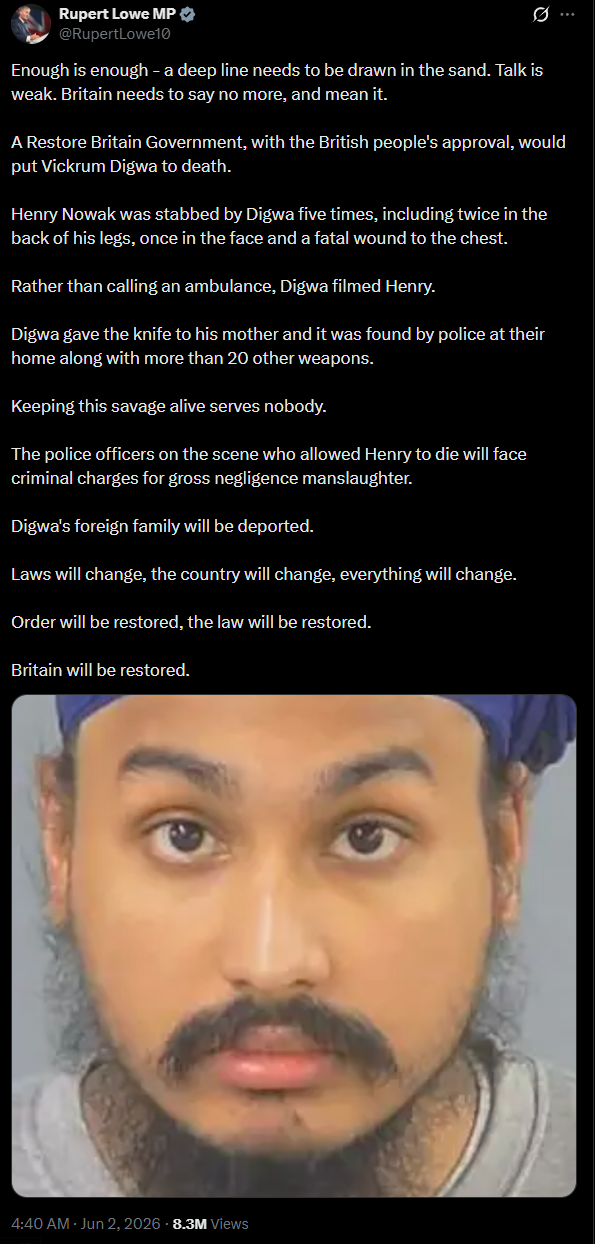
Rupert Lowe, an MP of the “far-right” British Reform party [correction: Lowe is the leader of the Restore Britain party], is getting closer to the correct reaction when it comes to this murderous Sikh, his community, and the managerial bureaucracy that brought them here and protected them.
That said, I think Rupert Lowe is also heavily couching his language for fear of public backlash, or getting arrested for “inflaming racial tensions”.
Update, 5 June: Welcome, Instapundit readers! Have a look around at some of my other posts you may find of interest. I send out a daily summary of posts here through my Substack – https://substack.com/@nicholasrusson that you can subscribe to if you’d like to be informed of new posts in the future.
QotD: Demographic decline in the late western Roman Empire
As we’ve seen, the evidence – largely archaeological evidence, by the by (Liebeschuetz thus fits with many other historians in the “decline and fall” counter-reformation in relying heavily on archaeological data) – suggests that urban centers declined markedly beginning in the fourth century, with that decline accelerating as the empire crumbled. That of course raises the fairly obvious question: where did all of the people go? One possible theory is that the population mostly ruralized, moving out of the city and into the countryside. That might even suggest a positive change, if one accepts the view that ancient cities were mostly “consumer” cities which didn’t produce much value but instead survived off of taxes and rents extracted from the countryside. In that view, the decline of cities could simply be a product of the collapse of systems of exploitation as the political order which maintained them weakened.
It’s a plausible theory and the only problem with it is that it doesn’t appear to have actually happened.
Here the key archaeological method is what is called “field survey“. While readers are probably more familiar with the intensive excavation work done at famous sites like Pompeii or Vindolanda, one tool archaeologists have to study the past is to survey large areas, sometimes by air, sometimes by on foot, sometimes with ground penetrating radar, in an effort to map out larger scale settlement patterns in the past than would be possible by labor-intensive single-site excavation work. Dateable remains (pottery most often) allow for archaeologists to get a rough sense of the dates in which sites were inhabited and in some cases building remains and the like can give some sense of what kind of settlement was present. The “error-bars” on some of this data can of course be large, but they offer a tool for tracking long-term changes in land use patterns. On the flip side, these sorts of studies really become valuable only when you have a lot of them to create a robust data-set over a fairly large area that lets you adjust for purely local patterns and distortions. Fortunately in much of the former Western Roman Empire and especially in Roman Italy (where these studies are very important for the study of Roman demography and agriculture) we’ve hit the tipping point where there is enough archaeological data to begin reaching for conclusions.
Now there is an immediate difficulty with using this kind of evidence, which is that for reasons we’ll get to in a moment (though they are reasons that tend to also be bad for the “change and continuity” argument), we have a major confounding variable here: site visibility. Our ability to see a site, archaeologically, is heavily dependent on factors like building material and the quantity of imperishable goods (especially pottery) that people are using. For reasons we’ll get to, compared to, say, second century AD communities, sixth century AD communities tended to build their buildings in far more perishable (and thus less visible) materials (like wood) and also tended to use a lot less imperishable household goods. Consequently, it is substantially harder to see a sixth century village than it is to see a second century villa.
Nevertheless, the decline is so marked and so consistent as to strongly suggest there is something real here. R.P. Duncan Jones (in “Economic Change and the Transition to Late Antiquity” in Swain and Edwards (eds) Approaching Late Antiquity (2006)) assembles some of the site data from around the empire; there is unsurprisingly a lot of regional variation (with some regions, like Syria, actually moving against trend), but in the western Empire (except N. Africa; decline there comes later) the trend is fairly clear, with site numbers declining (often drastically by half or more) beginning in the late third or fourth centuries. Bryan Ward-Perkins in The Fall of Rome notes a field study outside of Rome in which the number of sites declines by three quarters. Site data accumulated like this isn’t often very chronologically precise, so we’re dealing with centuries, not decades, but the clear trend suggests rural population decline, not an urban population ruralizing. To be visible to us in this way, the decline must have been quite severe.
To give a sense of the scale of the decline, here is an abbreviated version of a chart from Bruce Friar’s “Demography” chapter in the second edition of the Cambridge Ancient History, which breaks down the estimated population of the Roman Empire by region and adds the dates when each of those regions got back to their Roman-era population:
Chart from Frier, “Demography” CAH2 XI (2000), 814. Some of these figures would likely see some revision today, mostly downward revisions of growth combined with upward revisions in population reflecting a somewhat (but generally not massively) higher estimated pre-Roman population.
Note that the decline in the East was, as noted last time, both later and generally slower. The reason for the later times to reattain Roman population here in many cases is that the major medieval Islamic population centers were further East (e.g. Baghdad under the Abbasids) placing them outside the traditional bounds of the Roman Empire, but also that the Roman East was much more urbanized and densely populated compared to its land area than the Roman West in the second century (or at any time during the Roman Period) so the “population to attain” bar on the East was much higher. After all, the cities of places like Syria or Egypt were in many cases centuries or even millennia old when the Romans showed up.Now the long times there to regain the Roman population can be a bit deceiving (and are very approximate). For reasons we’ll get into shortly, population growth from 600 to 900 or so in Europe was very low, so the issue here isn’t that the decline was so steep that it took many centuries to recover from, but rather that the decline was from a high population equilibrium to a low population equilibrium, both of which were, under their own conditions, stable (if that is confusing, don’t worry, we’ll delve more into it in a moment). Second, the apparent gap between places that “caught up” before 1300 and those that “caught up” after it is smaller than it looks, because of course the mid-1300s represent a massive population discontinuity over the entire broader Mediterranean world due to the Black Death such that a lot of those places “catching up” in the 1200s probably fell behind again due to the plague and then caught up again in the 1400s or early 1500s.
But this now raises two related questions: first, why did population decline so sharply and second, what was the impact on quality of life that resulted? The old answer to the first question was of course “the barbarians killed everyone” but as we’ve seen, while the fifth century was a violent time, the violent discontinuities were not that extreme. Surely the violence of the period has something to do with some of this declining population, but as noted, the underlying population (with their language and religion) didn’t much change (and the raw number of “barbarians” coming over the frontier was, in demographic terms, fairly small). Most of those Roman cities decayed, rather than being burned. But if the “barbarians” didn’t kill everyone, what did and why did that somehow have a negative impact on the survivors? The answers to these two questions are actually linked in that they depend on the same evidence, so that is where we will go next.
Bret Devereaux, “Collections: Rome: Decline and Fall? Part III: Things”, A Collection of Unmitigated Pedantry, 2022-02-11.

June 3, 2026
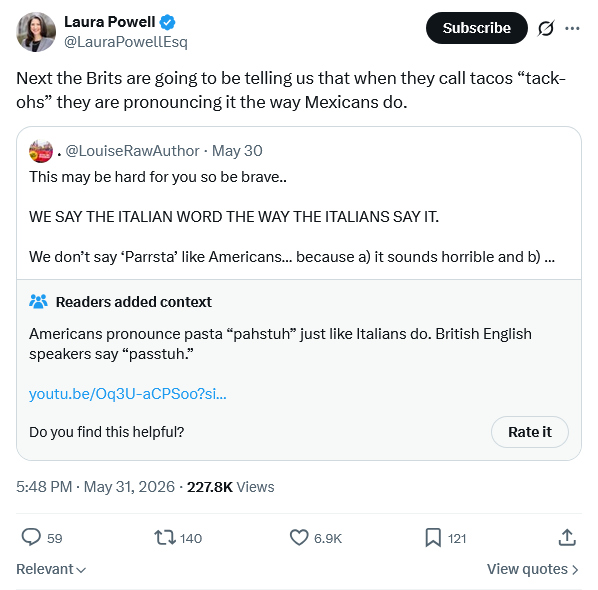
Brits and Americans mispronounce foreign words differently, film at 11
ESR explains why American mispronunciations of Spanish or Italian words tend to be less offensive to those cultures than equivalent British linguistic manglings:
Ah, yet another round of the great pasta-pronunciation debate.
My credentials to speak on this: I am American. I have lived in Great Britain. I have lived in Italy. I pay attention to descriptive phonology. And I was at one time bilingual in English and Spanish.
These facts make me an expert witness on this issue.
Yes, Brits do in fact systematically mispronounce words like “pasta” and “taco” in a way Americans find amusing. But the interesting part of this story is the reason *why* Americans pronounce these words in a way much closer to the Italian and Spanish originals.
It isn’t superior virtue or worldly sophistication or anything like that. It’s the result of an important feature of the American linguistic environment that it doesn’t share with the British one, and which Americans themselves seldom even notice.
Many Americans have heavy exposure to the phonology of Spanish. Brits do not. The result is even that even those of us who are completely monolingual (which is most of us) tend to have models for two phonological systems in our heads rather than one; the second one being Spanish.
There’s a video about this somewhere on YouTube by a linguist, an English one as it happens, who explains that Americans attempting to reproduce the vowel sounds of a foreign language often bend it to try and fit it into the five-vowel system of Spanish. And this is true even when they don’t actually speak Spanish themselves.
One consequence is that even Americans who don’t know Spanish pronounce it tolerably well. Intelligibly, at least. Same goes for Italian, the phonology is slightly different but similar enough.
We crash-land on languages that have vowel systems quite unlike either English or Spanish. There are good reasons that when an American says “pasta” or “taco” his pronunciation is quite unlikely to make a native wince or laugh, but there is no such guarantee about French. Or German. Or Russian. Or just about anything else.
We’re just as lost as the Brits are trying to pronounce those languages. The difference is that, unlike a Brit, we may not mispronounce the local language in a way that makes it sound like a mangled version of English. Americans are likely to make it sound like a mangled version of Spanish instead.
What is Turkish Delight? How to make real Ottoman Turkish Delight
Tasting History with Max Miller
Published 9 Dec 2025Beautiful red Turkish delight dusted with powdered sugar and starch and flavored with rose water and musk
City/Region: Ottoman Empire
Time Period: 1844I don’t know about you, but I first learned about Turkish delight from The Chronicles of Narnia, where Edmund sells out his family for a box of the confection. True Turkish delight, made in Turkey or Greece, is made of sugar and starch, but when other countries tried to copy it, they often added gelatin, which gives it a completely different texture.
While we can’t be absolutely certain which kind Edmund liked, I hope it was the true Turkish kind that melts in your mouth beautifully. If you’ve never tried musk, it’s a unique flavor that reminds me of clean laundry and perfume, and mixes with the rose water to make a flavor profile unlike anything else I’ve had. All in all, I wouldn’t sell my family out for it, but it is very good.
Rose water or musk aren’t your thing? Feel free to change the flavorings to whatever you like. Almond, orange blossom water, and pistachio were popular at the time.
Rahatu’l-hulkum
Method: Take one kiyye of the finest sugar and prepare a syrup with three kiyyes of water in a tinned pan … take 75 dirhems of the finest pounded starch and slowly stir into the syrup. It must be stirred constantly so that it does not form lumps or stick to the bottom of the pan … Then blend 35 dirhems of rose water with a grain of musk and after adding to the mixture stir a few more times before removing from the heat. Oil a tray with almond oil and pour in the cooked mixture. When cool cut into pieces of the desired size and toss into a mixture consisting half of sieved starch and half of powdered sugar, and stir until they do not stick together. It will be delicious.— Melceü’t-tabbahîn by Mehmet Kamil, 1844
June 2, 2026
Low IQ, mens rea, and actus reus
For those like me whose legal Latin isn’t great, “mens rea” is “the mental state of a defendant who is accused of committing a crime”, while actus reus is a “guilty act” (from Wikipedia). On his Substack, William M. Briggs discusses how legal systems decide when an accused person’s IQ is so low that they lack the ability to understand that their action is illegal:
A gang of gypsies in England gang raped a young girl (and another previously) at knifepoint while filming the deeds, laughing all the while and even posted one of the rapes on social media. At their trial, Judge Nicholas Rowland excused their crimes because he said the criminals were “‘very young’, had low intelligence, a ‘limited understanding of consent’ and were susceptible to ‘peer pressure'”.
[Rowland] said that the second boy fell into the bottom one per cent in IQ for his age, and he had been diagnosed with ADHD, while the third boy had ‘low intellectual capacity’ and he had a ‘limited understanding of consent’.
Iryna Zarutska, 23, was riding a train in Charlotte, when Decarlos Dejuan Brown Jr rose up, slit her throat, and as he was exiting the train gleefully declared he “got” his white woman. Brown had been arrested some 14 times before he murdered Zarutska, for crimes including armed robbery. He was freed each time. For the murder, he was found by Experts to be “incompetent to stand trial”.
Brown and the gypsies were not alone. Recently, there were these cases:
Many states have humane destruction laws that apply when animals (usually dogs) have attacked or killed humans. Florida, for instance, confiscates vicious dogs and puts them down. When any animal kills and eats a man it is usually put down, and most think it wise and prudent to do so. But some curiously argue the animals cannot help themselves, that it is their nature to attack and kill and even eat people, and who are we to judge?
In any case, it is clear that dogs, nor any animal, are not as intelligent as man. Just as it is clear obvious truth that some men are not as intelligent as others. Yet this fact does meet resistance from Equalitarians and Universalists, both forgiving every sin except the sin of claiming sin exists.
[…]
The Eighth Amendment reads: “Excessive bail shall not be required, nor excessive fines imposed, nor cruel and unusual punishments inflicted“.
Since 2002, executing a dumb criminal is “cruel”, yet executing an intelligent criminal is not cruel nor unusual. This is odd because, as any dog owner can attest, even dogs can know right from wrong, and even stupid men know murder is wrong.
Scalia wrote in his dissent that an Expert (a psychologist) on one of the appeals testified Smith had “an IQ of 59”. Smith also, and in this case, really had “16 prior felony convictions for robbery, attempted robbery, abduction, use of a firearm, and maiming”. He noted previous courts ruled only the profoundly retarded, those “idiots” who “had an IQ of 25 or below”, had a “‘deficiency in will’ rendering them unable to tell right from wrong”.

On the general topic of IQ, but not directly related to violent crime, ESR discusses the relationship between IQ and the caste system of India:
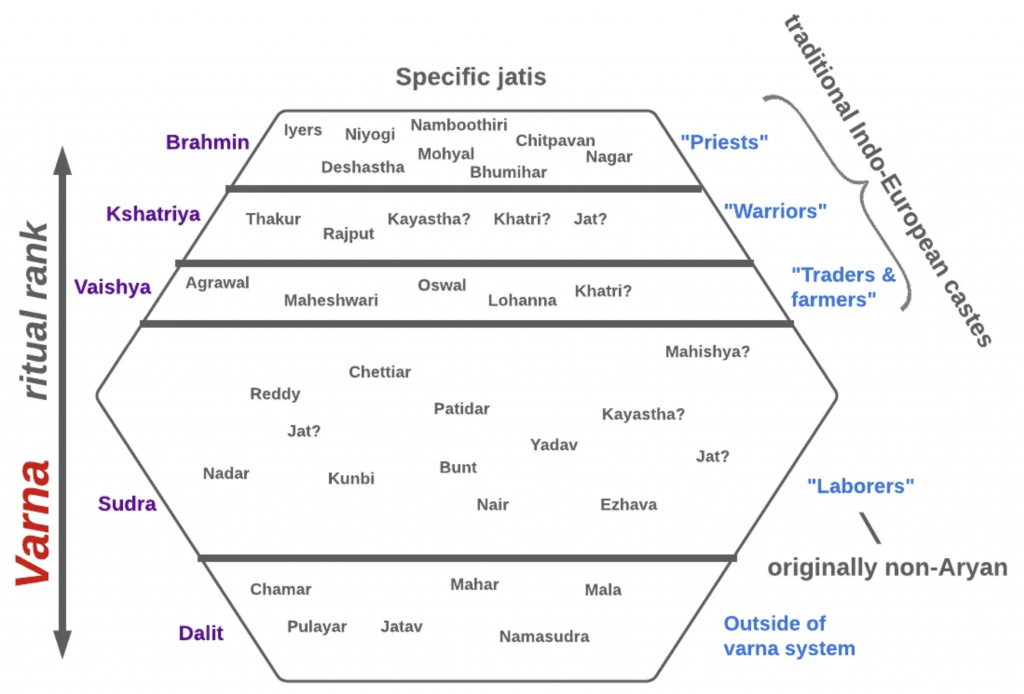
The caste system as a layered varna system with five classes and numerous integrated jati communities.
Razib Khan
That feeling when your knowledge about how average IQ varies with caste rank in India stops being peculiar arcana and suddenly becomes deeply relevant to US domestic politics …
Anybody who has studied the matter knows that castes in India have been maintaining almost perfect endogamy for thousands of years. About the only significant category of exceptions is that if you have an exceptionally beautiful daughter you *might* succeed in getting her taken as a concubine by a higher-caste man, so their offspring might jump a rank.
With no significant gene flow between jatis, divergences in important traits like IQ and time preference not only don’t smooth out, but actually amplify due to genetic drift and differing selective pressures.
Highest-caste Indians have an IQ distribution a lot like Europeans. Low-caste Indians … don’t. They’re not quite as genetically handicapped as the dimmest populations in sub-Saharan Africa, thankfully, but the spread is wide.
This doesn’t mean all low-caste Indians are stupid; Gaussian distributions don’t work that way. It does mean that importing 10,000 low-caste Indians has very different implications for the host society then importing 10,000 Brahmins.
Segue to the recent news stories about American families getting killed by illiterate Indian truck drivers doing crazy stupid things on the roadways. Those truck drivers are not Brahmins.
This is a recent phenomenon because, until one of our political parties decided to import the entire Third World for vote-farming purposes, we were cream-skimming India. Now we’re not, and this makes a serious difference.
Update: Fixed broken link to ESR’s X post.
Rare & Unique Sightings From 100 French FR-F2 Sniper Rifles
Forgotten Weapons
Published Jan 12, 2026Today I had a chance to dig through no less than one hundred FR-F2 snipers brought in by Navy Arms. I found a number of interesting and unusual things in the process, including a number of three-digit serial numbered very early production examples and some renumbered guns. We’ll also be looking at the Scrome J8, the modern picatinny scope mounts for the FR-F2, and things like depot refurbishment markings.
(more…)
QotD: Christian heresies
An Albigensian is an inhabitant of Albi, in the South of France. Before we get to that, though, we need to talk about the Cathars. An important rule of thumb in the history of Christianity is that heresies generally originate in the East and gradually spread to the West. I think this is mostly because, at least for the first thousand years or so, the vast majority of the population, GDP, and theological disputation was happening in the East. If you have theological ferment, you will have heresies, as assuredly as modifying software produces bugs and copying a cell’s DNA produces cancer. There were just a lot more people arguing about the nature of God in the East for a long time, and so given a constant error rate we should expect that most of the bad ideas come from there as well as most of the good ones. Now, why it is that this rule of thumb still holds true, despite the bulk of population and GDP moving to the West, is a very interesting question. Perhaps the legalistic Latin mind is just not as given to flights of fancy.
Whatever the case, the East was doing its usual thing and spitting out heresies, and two in particular are important to our story here. The first is dualism, which is a very old solution to the Problem of Evil, and which states that the forces of good and the forces of evil are evenly matched in some ontological sense. Many religions (for instance Zoroastrianism) are officially dualist. Christian dualism, on the other hand, has always been severely frowned upon if not outright condemned. Yet it’s also always been there, almost from the very start. I theorize that the dualist temptation arises again and again in Christianity because it “humanizes” an otherwise quite otherworldly faith, making it more like the stories and situations that human beings hear and encounter elsewhere.1
The second heresy is gnosticism, the belief that the physical world we all experience is an illusion, or a deception, or at least very much worse than the world of pure spirit. Once again, this is an important official element of religions like Buddhism, and once again it’s a tendency that Christianity has had to battle from the very start, probably because of some common, cross-cultural psychological quirk about human beings. Many modern Christians don’t actually realize that gnosticism is, technically speaking, totally heretical, because much modern Christianity is quite gnostic-inflected. But in the early days, and still today in some more traditionalist corners, Christianity is an earthy religion of bodies and physical substances and matter that is capable of being sanctified. For much more on all of this, read our review of Origen’s Revenge.
Anyway, relatively early in the history of Christianity, these two great ur-heresies flowed into one, like Godzilla and Mothra becoming a single monster that both flies and is radioactive. According to this grand synthesis, the false, illusory world of our physical reality is the domain of the forces of evil. The “god” of this world, often called the demiurge, is a diabolical figure, an anti-god that has trapped us all in prisons of flesh and blood. The real God is somewhere above and outside this reality, and our mission is to use secret knowledge, gnosis, to transcend to the spirit world. The guy who codified and turbo-charged this combined doctrine was a rich shipowner named Marcion (from the East, naturally), so you may sometimes see this heresy referred to as “Marcionism”.
If the physical world is the creation of an evil demiurge, then all physicality and physical matter must be irredeemably corrupt. In fact a much later Marcionist theologian actually used this as an argument for his views: “God is perfect; nothing in the world is perfect; therefore nothing in the world was made by God”. Consequently, the Marcionists practiced unbelievably extreme forms of asceticism to try to disconnect themselves from this corrupted world. They meditated and wore rags and occasionally starved themselves to death. Needless to say, having children was severely frowned upon, because it meant trapping new souls in the prison of reality. Critics of Marcionism accused them of endorsing sodomy as an alternative to normal sexual intercourse. The Marcionists also rejected the entire Old Testament on the grounds that the God of the Old Testament was actually the Devil, because only an evil being would do something as terrible as create the world.
The Marcionists were persecuted by the Roman authorities just as much as the Christians were, and this kept their numbers under control until by chance they spread to an empire with different laws. A wild-man from Persia named Mani, claimed by his followers to be a prophet and a magician, became deeply influenced by Marcion, traveled to India, returned to Persia, and created his own spin on Marcionism that incorporated elements of Buddhism and of his native Zoroastrianism. This combined religion became known as “Manicheanism,” and his followers refused to work normal jobs, serve in the military, or marry. Mani was promptly killed, but his teachings jumped back into the Eastern Roman Empire, and started spreading like a wildfire.
In the 8th century, Manicheanism (via a quick detour through a dualist Armenian group called the Paulicians) jumped the firebreak separating Asia from Europe and took off amongst the Bulgarian Slavs. Here, their champion was a priest named Bogomil, and his followers became the “Bogomils“. The English slang-term “buggery” is actually derived from the word “Bulgaria,” because of the old knock against the Marcionists. Did Bogomil in fact endorse buggery? It’s a little hard to say, but the “radical” Bogomils really got quite wild.2 The most extreme of them preached that performing disgusting or blasphemous acts was actually good, because it was a way of debasing and disrespecting our corrupted physical reality. It was also in Bulgaria that the word “Cathari” meaning “the purified ones” began to appear as an alternative name for this church.3
John Psmith, “REVIEW: The Albigensian Crusade, by Jonathan Sumption”, Mr. and Mrs. Psmith’s Bookshelf, 2024-09-02.
- You can also see it as injecting some excitement and drama and narrative stakes into the religion. A critic of Christianity might call it boring because the forces of evil are always and everywhere ultimately powerless. I don’t agree with this characterization, because the drama is taking place on a different level, namely the struggle towards sanctification that every living being engages in. But that might be too abstract for some. A much more immediate kind of drama is angels and demons duking it out on roughly equal terms, which is why you see this in all kinds of popular media, movie, video games, etc. Again, this is not an anomaly, it’s been present in Christian folk culture forever.
- Thought not as wild as some even later Slavic adherents of Dualism/Gnosticism. The 18th century sect of the skoptsy interpreted the anti-physical, anti-reproduction message of Marcion as requiring castration for all true believers. Warning: the Wikipedia page has graphic pictures.
- Anything you read about the Dualists, Gnostics, Marcionists, Manicheans, Paulicians, Bogomils, and Cathars is made considerably more confusing by the fact that tons of authors use these terms completely interchangeably (including ancient authors, and including the Dualists/Gnostics/Marcionists/Manicheans/Paulicians/Bogomils/Cathars themselves). It’s not even entirely wrong to do so, because there really is a continuous tradition here that all these groups are manifestations of.
June 1, 2026
The Ancient Greeks: 01 – What Made Them Special? (d) Alphabetic Writing: the Rise of Secular Thought
seangabb
Published 31 Jan 2026Greece: A Brief History, c.700 BC – 500 AD
This section explains the most important structural innovation of Greek civilisation: alphabetic writing.It contrasts the Greek alphabet with the complex writing systems of Egypt and Mesopotamia, showing how earlier scripts restricted literacy to priestly and bureaucratic elites. By encoding sound rather than meaning, the Greek alphabet transformed writing into a general-purpose tool.
The section explores how this made possible secular literature, philosophy, mathematics, and science. Figures such as Euclid and Eratosthenes are discussed, along with the emergence of written proof, abstraction, and cumulative intellectual traditions.
The central claim is that without alphabetic writing, there is no secular intellectual life in the modern sense.
May 31, 2026
How the Nazis Got Rich Preparing Germany for War – Death of Democracy 17 – Q1 1937
World War Two
Published 30 May 2026By March 1937, Nazi Germany had renewed dictatorship, buried Versailles, and turned rearmament into a corruption machine.
Berlin, March 31, 1937. Adolf Hitler’s regime appears stronger than ever. The Enabling Act is extended for another four years, the civil service is bound more tightly to Hitler personally, and Germany formally rescinds its signature from the war-guilt clause of the Versailles Treaty.
But behind the speeches about honor, work, and national revival, another transformation is underway.
In the first quarter of 1937, Nazi Germany moves deeper into an economy built around rearmament, Party patronage, racial exclusion, corporate privilege, and theft. The new German Corporation Law weakens ordinary shareholder control and strengthens management boards. Industrial giants profit from military preparation. Jewish property becomes a field of extortion and enrichment. Hitler himself grows wealthy through book royalties, image rights, hidden payments, and political slush funds.At the same time, the regime tightens control over public life. Civil servants are required to serve the Nazi state without reservation. Journalists, professors, doctors, artists, and Jewish Germans are pushed out of public and professional life. Concentration camp roundups expand beyond political opponents. And on Palm Sunday, Pope Pius XI’s Mit brennender Sorge is read from Catholic pulpits across Germany, openly challenging Nazi ideology.
This episode looks at Germany in the first quarter of 1937: a moment when dictatorship no longer needs to look revolutionary. It looks administrative, profitable, respectable — and permanent. This is the story of how power, profit, propaganda, and fear helped turn a modern state into a robber regime preparing for war.
0:00 Berlin, March 31, 1937
0:47 A World in Crisis
01:10 Germany Extends the Legal Shell of Dictatorship
01:23 Civil Servants Bound to Hitler
01:51 Hitler Rejects the Versailles War-Guilt Clause
02:21 The Enabling Act Is Renewed
02:48 Göring in Rome, Reassurances in Warsaw
03:44 The New Corporation Law
04:00 The Catholic Church Challenges Nazi Ideology
05:08 Police Roundups and Expanding Concentration Camps
05:46 Press, Education, Medicine, and Culture Under Control
08:20 The Nazi Economy: Private Profit, State Power
09:41 Aryanization and Organized Theft
10:20 Rearmament, Industry, and Oligarch Profits
12:21 How Hitler Personally Got Rich
14:55 The Party Mood: Confidence at the Top
15:22 German Public Sentiment and Victor Klemperer
16:20 Analysis: How Results Become Consent
17:06 Conclusion: The Quiet Theft of Democracy
18:27 Never Forget / Support TimeGhost
The Battle Of Jutland: How Britain Should Have “ANNIHILATED” Germany’s Fleet & Won EASILY
History Undone with James Hanson
Published 13 Dec 2024James Hanson is joined by Rear Admiral Dr Chris Parry and the YouTuber and naval historian @Drachinifel to discuss the Battle of Jutland. It was the largest naval battle of the First World War and the only time the British and German fleets went head to head.
So just how significant was it and should it have ended differently? This is History Undone.
May 30, 2026
Unlike Canada, Sweden can have a sensible, rational public discussion on indigenous issues
Yeah, I know. I’m just as shocked as you are, but Warren Mirko and Laurisa Dohm have the receipts:
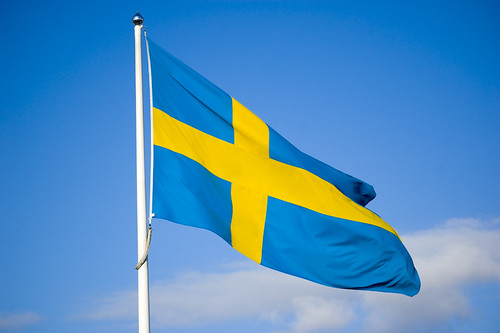


Something happened in Sweden recently that would be nearly unthinkable in Canada.
There was a substantive public discourse about the tension between Indigenous rights, the broader public interest, and the state’s jurisdiction, in prominent newspapers and on television.
Ebba Busch, Deputy Prime Minister of Sweden, stood at a press conference in Luleå and argued that reindeer herding should no longer be classified as a riksintresse, a formal national interest designation that grants legal protection in land-use planning. She proposed that reindeer stocks should be cut and subsidies re-allocated to other cultural programs in order to ease tensions between competing land-use interests in northern Sweden. Her reasoning: reindeer herding affects very large areas of Sweden’s land mass but carries limited economic significance.
The response was immediate. Indigenous Sámi groups called it election propaganda. The chairman of Girjas Sámi village published a rebuttal arguing that Sámi rights to hunt and fish are grounded in ancient tradition, and that her party’s framing mischaracterizes those rights as economic interest rather than constitutionally recognized Indigenous rights. The Swedish public broadcaster’s own reporter called the debate “a hornet’s nest“.
And yet the debate actually took place. On the nightly news, no less.
Deputy Prime Minister Busch made a substantive argument about how she thinks the state should weigh competing interests in its northern regions, with her reasoning stated plainly, and Sámi leaders answered in kind. That is democratic governance.
Canada’s political class has spent decades avoiding exactly this kind of clarity and honest intellectual engagement. It has been sacrificed at the altar of conflict avoidance and by the acceptance of canned platitudes carefully crafted to say precisely nothing at all.
Sweden ranks fourth in the world on the Economist Intelligence Unit’s Democracy Index, with a near perfect score of 9.4/10 for political culture. It also takes Indigenous rights seriously, having established an independent truth commission in 2020 to study historical abuses against the Sámi.
And yet Sweden’s Supreme Administrative Court upheld the government’s decision in June 2024 to grant an iron ore mining concession at Kallak in northern Lapland, despite contentious opposition and legal arguments that insufficient consultation had violated Sámi’s rights to free, prior, and informed consent. Now, its Deputy Prime Minister is arguing publicly that the state must regain clearer authority to make decisions across its entire territory, and that the interests of reindeer herding cannot be allowed to dominate and block decision making processes as they do today.
Sadly, Canada does not seem to take lessons from more mature nations. Or any lessons, really. Our politicians are so afraid of “third rail” issues and controversy that they avoid any hint of actually addressing real problems in favour of performative announcements, repeated endlessly with no attempt to actually perform actions.
Buying W.W. Greener: Tales from the Golden Age of Surplus
Forgotten Weapons
Published 7 Jan 2026I am joined today by Val Forgett III of Navy Arms for the first in a series of videos telling some of his stories form growing up in the golden age of surplus, with a father who was one of the largest arms dealers in the US. Today, we are talking about how his father ended up owning the W.W. Greener company for five days, and taking a look at a sniper rifle from the Greener museum collection — a .280 Ross fitted with a Zeiss optic used by Greener’s nephew to significant effect in the First World War.
Minor correction: The guns Val still has were duplicates for Edward VII, not Edward VI.
In addition, Mr Bailey’s story has a happy ending. Val’s father gave him the machine tools from the Greener shop and prepaid for six months lease on a nearby building for him to start his own business. He eventually partnered with a former Greener employee named Leonard Onions and they formed Bailons Gunmakers Ltd, which was in business for many years.
(more…)


