
The Korean War by Indy Neidell
Published 6 Oct 2026The Chinese are busy this week; they open the floodgates of a reservoir and attack Arrowhead Hill, but it turns out these are diversions from their main attack, which begins the Battle of White Horse Hill. It does not at all begin well for the Chinese, although the ROK take pretty heavy casualties too. There are also plans afoot for a new UN offensive operation, and a naval exercise begins off the east coast.
00:00 Phone Call
00:50 Recap
01:21 Reinforcing ROK 9th Division
03:01 Diversions
07:02 Operation Showdown
08:47 Naval Exercise
10:38 Increasing the ROK
13:17 Commonwealth Division
15:43 Warsaw and Seattle
17:29 Summary
17:45 Conclusion
October 7, 2026
The Korean War Week 120 – The Battle of White Horse Hill begins – October 6, 1952
Comments Off on The Korean War Week 120 – The Battle of White Horse Hill begins – October 6, 1952
USAF re-evaluating the risks of stationing aircraft in Al Biriṭāniyā
The US military leadership got an unwelcome security wake-up call after a reported incident adjacent to a Royal Air Force base used by USAF B-1 bombers:
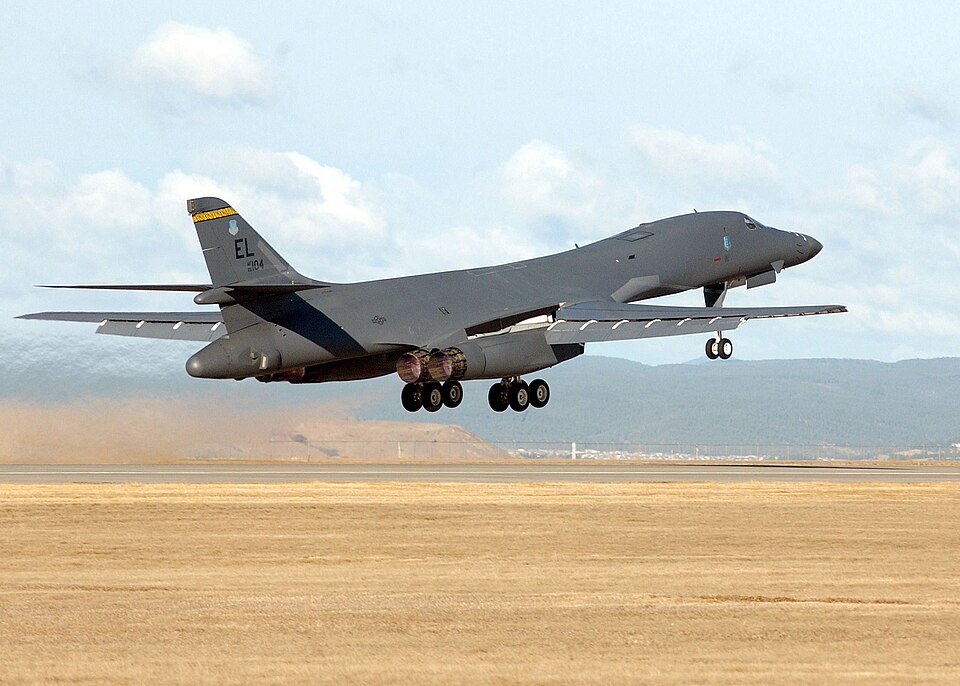
USAF B-1B Lancer takes off on a routine mission from Ellsworth AFB, South Dakota. Carrying the largest payload of both guided and unguided weapons in the Air Force inventory, the multi-mission Lancer is the backbone of America’s long-range bomber force.
USAF photo by Senior Airman Michael B. Keller via Wikimedia Commons.
To say that the reporting of the last few days about the sudden departure of our B-1B bombers from RAF Fairford has been frustrating — for me at least — is an understatement.
Airfield security has been a pebble in my shoe for a very long time. I assume everyone is familiar with my post from 11 months ago a bout the wake-up call at Whitman AFB? If not, give it a read, then come back.
Let’s all get our reference point first from last week.
Five men who were arrested on suspicion of explosive and terrorism offences after a major incident was declared at an RAF airbase in the west of England have been released on police bail.
Three vans were spotted near RAF Fairford in the early hours of Sunday morning and the police were called. A major incident was declared, and everyone in the small village of Whelford was evacuated.
The head of Counter Terrorism Policing has stressed that the five men remain under investigation and must adhere to strict bail conditions. It has since come to light that the first of two 999 calls was made by one of the arrested men.
A dual UK-Iranian national, aged 25, has also since been arrested on suspicion of preparing terrorist acts.
Investigators are exploring “multiple lines of enquiry”, Assistant Commissioner Laurence Taylor said on Monday, including whether proxies or individuals were working on behalf of a foreign state — knowingly or not.
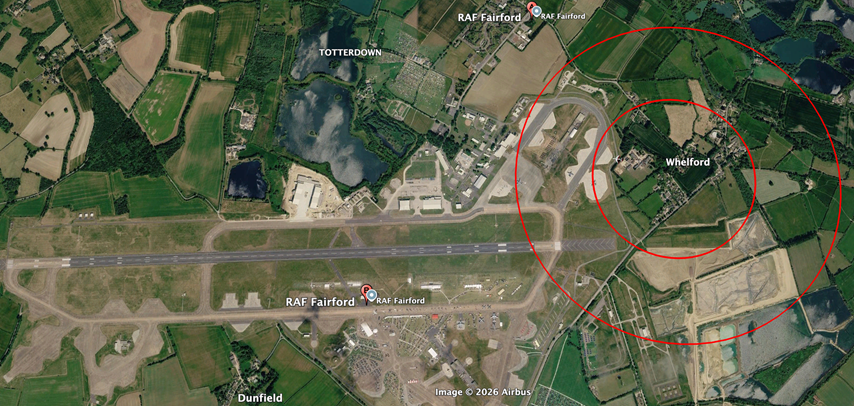
Like all professionals do, let’s go to the map room.
This is what the geometry looks like.
OK. Soak that in a bit. Whelford is one of the few little residential areas around this base where our literally irreplaceable heavy bombers were operating from. The parking apron they are using? There it is, right around where the “RAF Fairford” label is.
Now, let’s give you some scale. The smaller circle is 500 yards from where the vans and “fellas” were. The larger circle is 1,000 yards.
Put on your force protection hat. Remember Operation Spider Web from over a year ago and what it was warning us about?
I know for a fact that there has been a rather heated argument over whether we are simply taking too many risks with some of our “There’s nothing dangerous about this airfield! Why, four generations of my family have been flying out of here“. attitude. Habits, inertia, etc.
We Americans make some assumptions about distance that is simply not a reality overseas, especially in Europe.

Comments Off on USAF re-evaluating the risks of stationing aircraft in Al Biriṭāniyā
Why do British trains still rely on century-old levers?
Tom Scott
Published 8 Jun 2026At National Rail’s Manchester classroom, I learn why it’s very rare for trains to collide … and try out signalling for real.
(more…)
Comments Off on Why do British trains still rely on century-old levers?
October 6, 2026
Humour and the British Green Party
In the Daily Sceptic, Steven Tucker discusses the state of comedy in Britain today, in the light of the recent Green Party internal report on what members are supposed to deem funny or not funny. Not joking:
In the very same week these letters were publicised, the UK Green Party did actually launch its own internal in-depth report on what was and was not funny, with party activists receiving training informing them they should maintain detailed records of any jokes fellow members had told to them, “including dates, times [and] locations”, in case anyone later found them to be offensive – particularly if they touched upon sensitive issues like race, religion, sexuality or class. Even if the particular big fat black lesbian affected made a joke about themselves, this was still to be noted down and eliminated, as it nonetheless created “an environment in this space where derogatory jokes are allowed to happen”.
To prevent such jocular genocide occurring again in future, Greens were advised to perform an “audit” of their friendship groups to ensure they were diverse enough so that this simply would not happen: an Englishman, an Irishman and a Scotsman all walk into a pub, and nobody says anything even remotely untoward whatsoever, as diversity is clearly our strength.
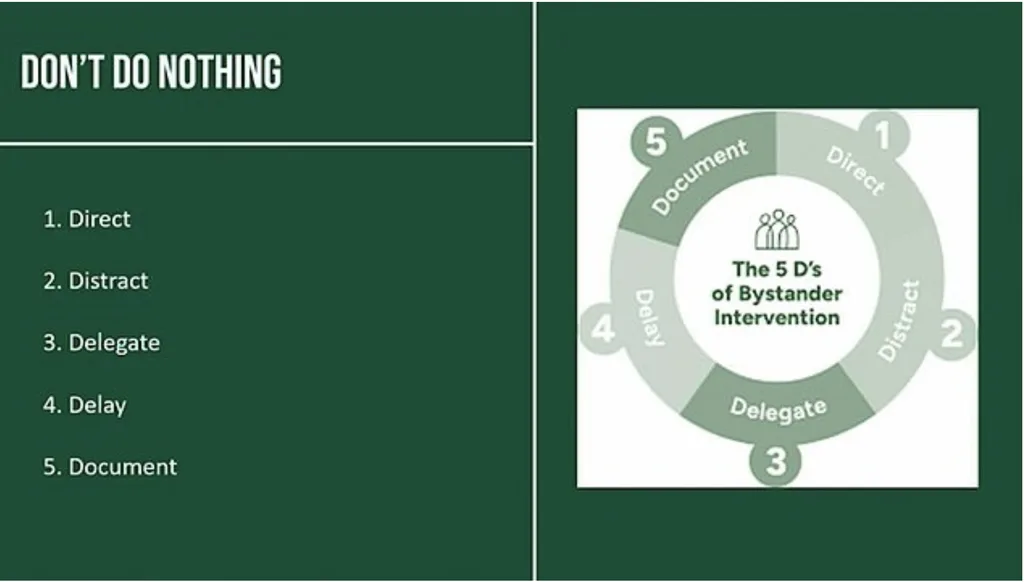
Official Green Party advice on what to do if you happen to hear a joke one day. Nowhere does the option “laugh” appear
For a preview of what a future Green-led Ministry of Laughter might one day look like, we should look towards a current controversy involving the quasi-state-run BBC (Bowdlerising British Comedy), which in September decided to mark 20 years since the first broadcast of award-winning sketch-show That Mitchell and Webb Look – by cutting out several sketches, and deeming the show to be “racist”. The now samizdat sketches involved scenarios like English Civil War re-enactors getting bored and deciding to black up and recreate modern-day conflicts in the Democratic Republic of Congo, a brownface Amazonian tribe found secretly living behind flower-pots in a garden centre and a woman wearing a burka being an unsuccessful participant in a TV makeover programme.
Even more primly, the BBC also wiped or butchered entire episodes of popular children’s comedy history series Horrible Histories, as they featured jokes about sensitive topics like slavery – despite the fact they pretty obviously were not of a “Let’s bring it back!”-type perspective, but attempting to satirise the practice’s brutality.
One horrified reaction came from Graham Linehan, the cancelled Anglo-Irish comedy writer who today lives in exile in America, as nobody in the UK industry will now touch his work with a bargepole. Not only does it commit the cardinal post-2010s sin of actually being funny, Linehan’s writing is also deemed to be “transphobic”; Channel 4 refuses to re-show an old episode of his sitcom the IT Crowd, as it features a joke about a cross-dresser (see my review of his 2023 autobiography).
Writing in the Telegraph, Linehan observes that most British comedians who get their back-catalogues politically ruined these days, like Mitchell and Webb, either keep silent and go along with it for an easy life, or else actively denounce themselves in classic Soviet show-trial fashion, so as to keep raking in the cash on the panel-show circuit. Because of this cowardice, he says, “somewhere out there, the next generation of comedy writers and performers, the ones who might have pushed the form further, taken bigger risks, made the joke nobody else would touch, will quietly decide it isn’t worth it, and nobody will have to ban anything ever again”. Sounds a bit like how Islam operates in such matters, too …
The Great Exhibition shows Victorians were anything but “stuffy”
That’s not to say they didn’t like accumulating “stuff”, however, as the Great Exhibition was in many ways a celebration of “stuff”:
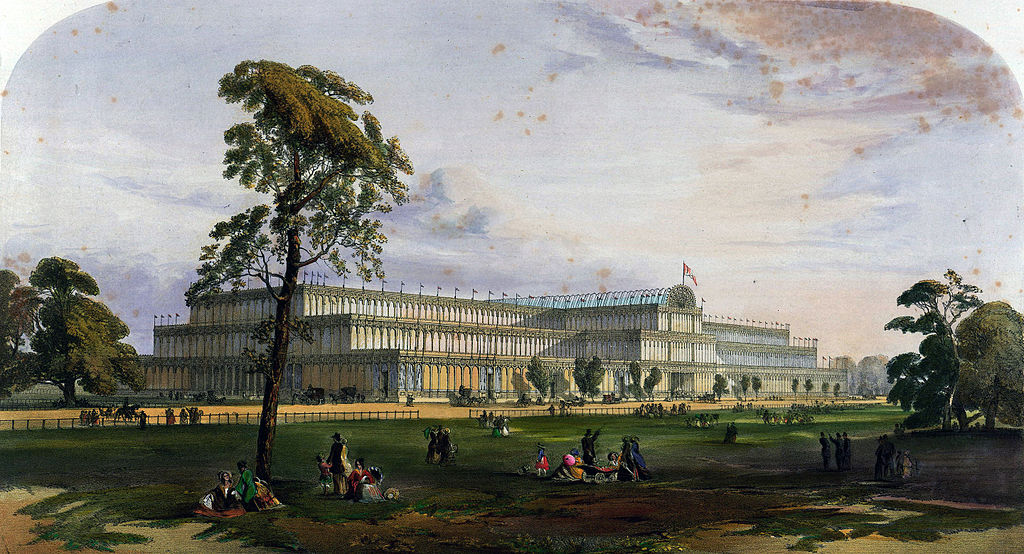
The Crystal Palace from the northeast during the Great Exhibition of 1851.
Image from the 1852 book Dickinsons’ comprehensive pictures of the Great Exhibition of 1851 via Wikimedia Commons.
One wonders whether enough time will ever elapse for our Victorian ancestors to break free from the prevailing stereotype that they were demure, dull, prudish, obsessed with death and weirdly repressed. Still, a full 125 years after the death of the eponymous Queen, “Victorian” remains a word synonymous with “stuffy”, “insular”, “puritanical” and “sanctimonious”.
Despite many attempts at historiographical rehabilitation, the popular conceptualisation of the Victorians sadly remains the same. The truth, however, as A.N. Wilson proves yet again with The Wise and Their Works — his latest foray into the age of Empire and top hats — is far more colourful.
Wilson’s subject is the Great Exhibition of 1851, which famously brought the whole world to Britain’s door for one giddy summer, to see the accumulated ingenuity of 19th-century manufacturers crammed under the vast glass roof of the Crystal Palace in Hyde Park. The east half of the building was given over to foreign exhibits, the west to British curiosities. That this was a quite coherent and acceptable division of spoils tells us something about Britain’s status as technological and political hegemon at the time.
The Exhibition was an epic testament to Victorian production and scientific experimentation. Within and without the exhibition hall, visitors could gawk at giant lumps of coal, pearls from Aberdeenshire and china clay from Cornwall. Glittering above all this raw material was the most valuable gem ever dug from the earth, the now controversial Koh-i-Noor diamond. Apparently, it wasn’t shiny enough or big enough for our supercilious Victorian brethren. Such valuable nuggets give us an insight into what eventually did for the Victorians: they were always wanting more.
Part of the point of the Great Exhibition was that the human ingenuity on display outdazzled even the wonders of the natural world. There were innumerable clocks, cameras and barometers, a printing machine capable of churning out five thousand copies of the Illustrated London News an hour, a steam hammer that could crack an egg on its lightest setting or forge a warship’s bearings on its heaviest, alongside such delightful curiosities as a collapsible piano built for yacht cabins.
Even Queen Victoria found the siamese piano with two players at each end a step too far, but I suspect it’s the sort of thing that would go viral overnight on TikTok today. It is perhaps by focusing on their obsession with the weird that we can learn that the Victorians were not so different to us after all.
There can be no better guide to the Exhibition and broader era than Wilson — a veritable time traveller and arch-Victorian himself, whose acclaimed biographies of Victoria, Albert and Dickens, as well as his more contentious life of Charles Darwin and his superb general histories, all point to a man for whom the 19th century remains a never-ending source of inspiration. This lively narrator is a boon in a history that can feel acute in scope at times.
And Wilson doesn’t beat around the bush: the Exhibition was in his words, “a monument to consumerism”. And 19th-century consumerism was not without its dark underbelly. On display, in a detail that wreaks havoc upon cosy nostalgia, were shackles and leg irons manufactured in Birmingham for export to the slave-owning American South.
As much fun as this time-travelling escapade proves to be, wandering the stalls, marvelling at taxidermied frogs, Wilson’s deeper concern lies in the bureaucratic machinery that made the whole enterprise possible. It’s easy to glaze over the grant values, leases, committee votes and acreage negotiations, but it is essential to show exactly how a project of this magnitude could ever come into being.
As Wilson puts it, in one of the book’s loveliest lines, “It is from small things … that some of the most remarkable achievements have grown”. Forget the history buffs, it’s today’s civil servants, project managers and bureaucratic naysayers who have most to learn from the Great Exhibition of 1851.
Comments Off on The Great Exhibition shows Victorians were anything but “stuffy”
Sako M92S: Finland’s Last Civilian AK (now being imported to the US)
Forgotten Weapons
Published 5 Jun 2026The M92S is the semiautomatic civilian version of the Finnish military rk95 rifle. The rk95 was intended to be a modernization of the Finnish AK platform, but it fell victim to military funding cuts as a result of the collapse of the Soviet Union. Only a small number were procured by the Finnish Defense Forces, and Sako only made about 2500 of the semiautomatic model for civilian and reservist use.
The M92 uses a brand new milled receiver design and includes a reinforced dust cover with rear aperture sight, a gas cutoff for rifle grenades (albeit never used), and mounting points for an optics siderail. The military rk95s all had side-folding stocks, but the civilian model got a fixed stock as the folder would have made it much harder to register and own in Finland at the time.
These rifles, along with all the other Valmet factory semiauto rifles, just recently became importable thanks to the efforts of Postrock, of Garden City Kansas.
Military rk95 video: • RK95: Finland’s Ultimate AK
Comments Off on Sako M92S: Finland’s Last Civilian AK (now being imported to the US)
October 5, 2026
Tom Holland Explains the Entire History of Wine in 72 Minutes
The Rest Is History
Published 5 May 2026What does The Odyssey teach us about the history of wine in the ancient world? How did Julius Caesar use wine to conquer the world? And why was The Judgement of Paris – when America took on France – the most controversial incident in the history of wine?
Join Dominic and Tom as they discuss the long history of wine; from ancient Jordan, to Bronze Age Greece, to the Vikings, and beyond …
00:00 The complete history of wine in 8,000 years
00:41 Lloyds
02:14 Pliny the Elder and the first wine snob
06:02 Why wine is such a rich subject for history
09:27 Noah, Mount Ararat and the biblical origins of wine
11:31 Georgia, Armenia and the world’s first wineries
13:15 The Canaanites and the invention of the wine trade
16:19 The Phoenicians, Greeks and wine culture across the Mediterranean
18:32 How Rome created the first international wine culture
20:32 Wine, slavery and the Roman conquest of Gaul
23:12 Italy becomes the heartland of Roman wine
24:40 How Christianity preserved wine after Rome’s fall
27:22 Why Islam transformed the history of wine
30:09 Wine drinking, loopholes and the caliphs
33:41 Rumi, Sufism and wine as a metaphor for divine love
37:29 England and the invention of the modern wine bottle
40:08 Kenelm Digby and the rise of English bottles
43:22 Cork, port and the Methuen Treaty
45:12 The English invention of the corkscrew
47:10 How French became the language of wine
50:07 Samuel Pepys discovers Haut-Brion
52:33 First growths, Bordeaux and the hierarchy of wine
56:09 Why wine was once an elite English obsession
57:49 Terroir and the spiritual language of French wine
1:00:59 The Judgment of Paris
1:03:57 Prohibition and the collapse of Californian wine
1:06:19 The blind tasting that humiliated France
1:08:08 Stag’s Leap and California’s victory
1:09:11 How New World wine changed the industry
1:10:44 Wine, competition and partnership
1:11:46 Henry Jeff, the bonus episode and the Mona LisaVideo Editor: Jack Meek, Adam Thornton & Harry Swan
Social Producer: Harry Balden
Producers: Aaliyah Akude & Tabby Syrett
Senior Producer: Callum Hill
Executive Producer: Dom Johnson
Head of Digital & Social: Sam Oakley
Comments Off on Tom Holland Explains the Entire History of Wine in 72 Minutes
QotD: Socialism and the world wars
What gave socialism a shot was that the hypertrophic nationalism of the first half of the twentieth century plunged the world into not just one but two world wars. Without these catastrophes, it is inconceivable that so many devotees of Marx would have come to power in the seventy years after 1917. The world wars made the case for socialism in multiple ways. First, they seemed to confirm the destructive tendencies of “imperialism, the highest form of capitalism”, in Vladimir Lenin’s words. Second, they greatly expanded the role of the state, which became the principal purchaser of goods and services in most combatant countries, creating precisely the kind of state-controlled economy that socialist theory claimed would perform better than free markets. Third, the wars acted as a great leveler, imposing very high marginal rates of taxation, wage controls, and price controls in ways that tended to reduce wealth and income disparities. Fourth, in 1917 the German government financed the Bolshevik coup in Russia that brought Lenin to power.
The tragedy was that those who promised utopia generally delivered hell on earth. According to the estimates in the Black Book of Communism, the “grand total of victims of Communism was between 85 and 100 million” for the twentieth century as a whole. The lowest estimate for the total number of Soviet citizens who lost their lives as a direct result of Stalin’s policies was more than 20 million, a quarter of them in the years after World War II. Mao alone, as Frank Dikötter has shown, accounted for tens of millions: two million between 1949 and 1951, another three million by the end of the 1950s, a staggering 45 million in the man-made famine known as the Great Leap Forward, yet more in the mayhem of the Cultural Revolution. Even the less bloodthirsty regimes of Eastern Europe killed and imprisoned their citizens on a shocking scale. In the Soviet Union, 2.75 million people were in the Gulag at Stalin’s death. The numbers were greatly reduced thereafter, but until the very end of the Soviet system its inhabitants lived in the knowledge that there was nothing but their own guile to protect them from an arbitrary and corrupt state. Other communist regimes around the world, including the very durable dictatorships in North Korea and Cuba, were strikingly similar in the miseries they inflicted on their own citizens.
The various socialist regimes could not even justify their murderous behavior by providing those they spared with higher living standards than their counterparts living under capitalism. On the contrary, they were economically disastrous. The collectivization of agriculture invariably reduced farming productivity. A substantial proportion of the victims of communism lost their lives because of the famines that resulted from collectivization in the Soviet Union and China. North Korea had a similarly disastrous experience. Central planning was a miserable failure for reasons long ago identified by Ludwig von Mises, Friedrich Hayek, and Janos Kornai, amongst others. Indeed, the economic performance of strictly socialist countries got worse over time because of rigidities and perverse incentives institutionalized by planning.
Moreover, the evidence is clear that, as countries moved away from socialist policies of state ownership and toward a greater reliance on market forces, they did better economically. The most striking example — but one of many — is that of China, which achieved a true great leap forward in economic output after beginning to dismantle restrictions on private initiative in 1978. After the collapse of “real existing socialism” in Central and Eastern Europe in 1989 and the dissolution of the Soviet Union in 1991, there was widespread recognition (the “Washington consensus”) that all countries would benefit from reducing state ownership of the economy through privatization and from lowering marginal tax rates. […] the highest marginal personal income tax rate was reduced in nearly all Organisation for Economic Co-operation and Development (OECD) countries between the mid-1970s and mid-2000s.
Niall Ferguson, “Capitalism, Socialism and Nationalism: Lessons from History”, 2020-02.
Comments Off on QotD: Socialism and the world wars
October 4, 2026
From MG 34 to MG 42: Building Hitler’s Buzzsaw – Nazi Rearmament 08
World War Two
Published 3 Oct 2026The MG 34 pioneered the modern general-purpose machine gun. The MG 42 preserved that battlefield versatility while cutting manufacturing labor roughly in half and producing the terrifying sound remembered as “Hitler’s Buzzsaw”.
In this Nazi Rearmament episode, Spartacus traces the development of the MG 34 and MG 42 from clandestine German weapons programs during the 1930s through mass production and combat in World War II.
We examine how one basic weapon could accompany an infantry squad, deliver sustained long-range fire, engage low-flying aircraft, and serve inside tanks and fortifications. We also explore why the beautifully machined MG 34 became an industrial problem, and how stamped steel, roller locking, rapid barrel changes, and a cyclic rate reaching 1,500 rounds per minute transformed its successor.
But this is more than the story of two famous German machine guns. It is also a study of Nazi Germany’s war economy: technically ambitious and capable of remarkable innovation, yet ultimately unable to overcome the manpower and industrial resources of the coalition it chose to fight.
Finally, we follow the weapons beyond 1945, from the continued foreign service of the MG 34 to the MG 42’s postwar descendants, the MG 1, MG 2, and MG 3.
Which small arm should we cover next: the MP 40, FG 42, or StG 44?
Comments Off on From MG 34 to MG 42: Building Hitler’s Buzzsaw – Nazi Rearmament 08
Jaguar – a case study in brand suicide
The Jaguar E-type was, in my opinion, the best-looking car of the 20th century. It was all downhill from that point, sadly:

Jaguar killed itself. No villain required, no recession to blame, no supply chain disruption to hide behind. Tata Motors bought a fading but salvageable brand in 2008 for $2.3 billion and spent the next fifteen years turning it into a case study in how to destroy capital.
The rebranding campaign of late 2024 was the public execution. Jaguar dropped its leaping cat logo, fired its entire existing customer demographic via press release, and replaced a century of racing heritage with a pastel-colored advertisement featuring zero cars. The marketing team apparently decided the path to profitability ran directly through alienating the people who actually bought Jaguars. Brilliant.
The rebrand was just the visible wound. The rot started earlier. Jaguar spent years producing vehicles with reliability ratings that made Land Rover look like a Swiss watch, while charging Mercedes money for the privilege. The F-Pace, the E-Pace, the I-Pace: each one a beautiful object that dealers apologized for in advance. You bought the badge and got a subscription to your mechanic’s vacation fund.
The pivot to an all-electric lineup, announced with great fanfare in 2021, then delayed, then sort-of-delayed-again, captured everything wrong with a company led by government subsidy chasers rather than engineers. Jaguar chased EV tax credits and green virtue points instead of fixing the fundamental problem. Nobody trusted the cars.
Markets are merciless precisely because they are honest. Customers stopped buying, and no amount of rebranding or regulatory coddling reversed that verdict. Capital allocated to a brand that cannot hold a customer is capital destroyed. Tata learned this lesson expensively. You, having never bought the car, learned it for free.
The ad campaign is just a sign on the door that reads, “This company is woke trash”. The real rot lies beneath the surface. Firing the marketing agency won’t change that.
Comments Off on Jaguar – a case study in brand suicide
Why the Allies Lost the Battle of Gallipoli 1915
The Great War
Published 8 May 2026On April 25, 1915 Australian, British, New Zealand and French forces landed at the mouth of the Dardanelles to capture the Gallipoli peninsular and march on Constantinople. But the Ottoman defenders, including legendary officer Mustafa Kemal, held firm and the Battle of Gallipoli would last for 7 bloody months.
(more…)
Comments Off on Why the Allies Lost the Battle of Gallipoli 1915
October 3, 2026
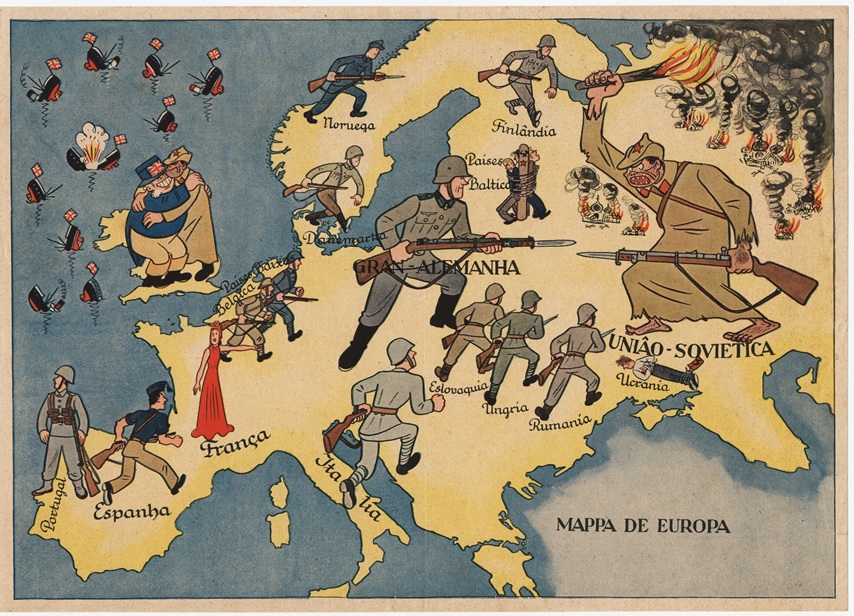
Portuguese propaganda maps
I swear this isn’t a deliberate ploy to attract Sarah Hoyt’s attention … although her links from Instapundit are always a welcome boost to daily readership. This is a post from Merryn Walters’ Mapping History Substack trying to determine the origins and intent of a map created for Portuguese use in WW2:
Maps are a weapon – a powerful weapon – because maps look, simply, like facts. A map says, “this is how things are”, and a mapmaker can change the world … so it’s no surprise, mapping had its run as a propaganda tool during the Second World War.
Our main map in this article, for example, begs the question: is it a propaganda map of Portugal or a Portuguese propaganda map? The two are very different, and between 1939 and 1945 the difference mattered. A Portuguese propaganda map was one made by Portugal, for Portuguese purposes. A propaganda map of Portugal – or, more often, one dressed up in Portuguese – was made by someone else entirely, and slipped under Lisbon’s door. Portugal was neutral, you see, which made it one of the few places left in Europe where both sides could still advertise their intentions: British and German propagandists worked the same streets targeting the same people, each assuring the Portuguese that the other lot were dastardly fellows.
A map was ideal for this. There’s a snag though, in this propaganda metier, and it’s worth keeping at the back of our minds as we admire the pretty pictures; no matter how good the mapmaking, the actual map can only inform and persuade a person who’s able to read it.
THIS IS NOT A SMALL COUNTRY
Portugal não é um país pequeno
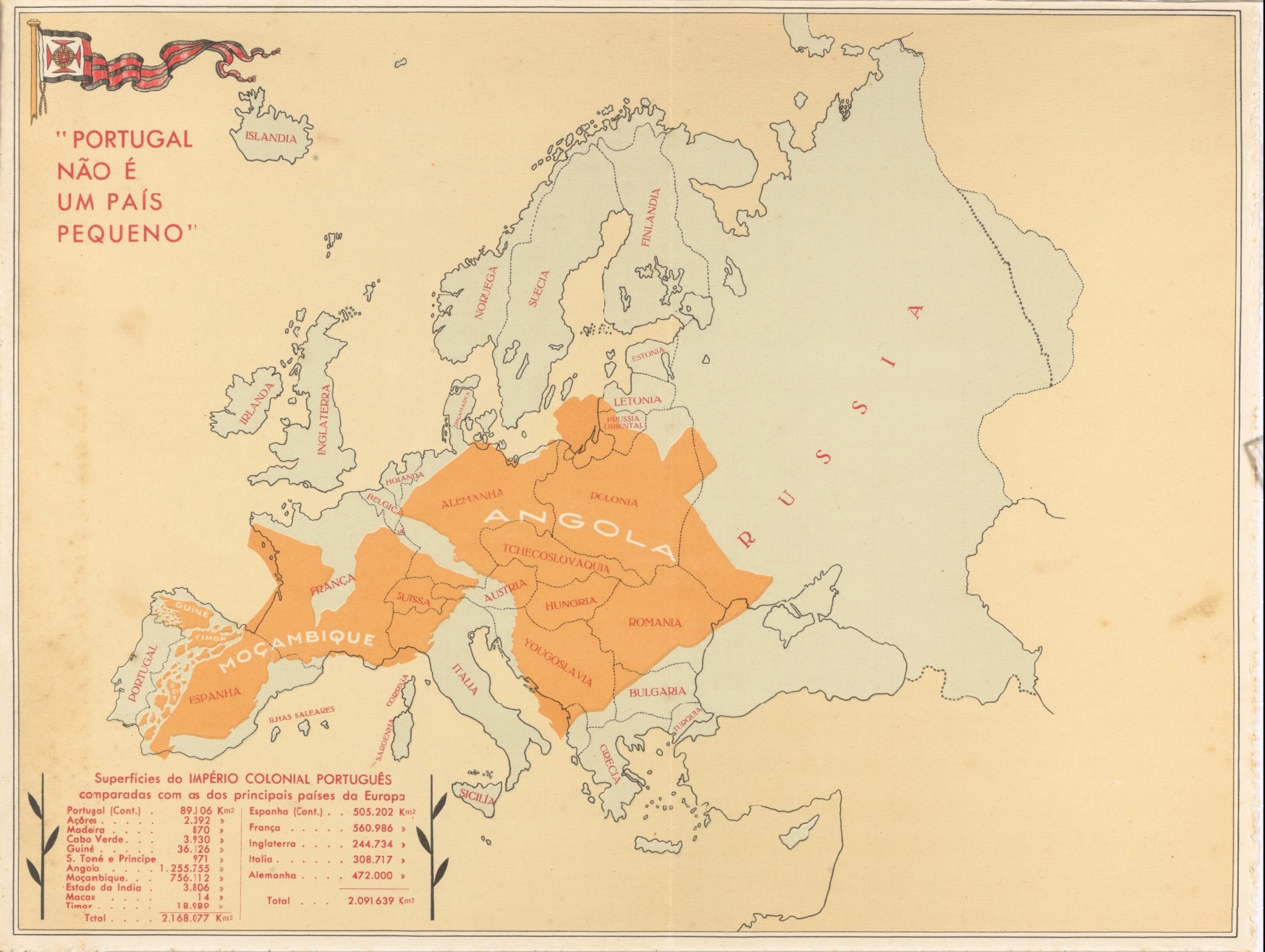
Let’s start with the real thing. Portugal não é um país pequeno – “Portugal is not a small country” – was produced in 1934 by Henrique Galvão, an army officer and colonial administrator, for the First Portuguese Colonial Exhibition in Porto; an exhibition he also happened to be directing, which does rather simplify the commissioning process somewhat. The map was printed by Litografia Nacional, of Porto, and uses a simple trick that’s mirrored today by online whizzymajigs. thetruesize.com is one such.
Take Angola, Mozambique and the rest of the empire; colour them brightly; and lay them down, right across Europe, as if you’re floofing a blanket. Add a table of figures proving that Portugal and its colonies, together, outsize Spain, France, England, Italy and Germany combined. Small country? Certainly not, mon ami. Just badly folded.
This map worked so well, Salazar’s regime reprinted it for decades: postcards in Portuguese for home consumption; French and English versions for visitors; and — by 1951 — an edition from the Secretariado da Propaganda Nacional laid the whole lot over the United States instead – for the benefit of American tourists, who presumably needed a unit of measurement they could relate to. People ask where Brazil has gone. Independent since 1822, I’m afraid – a century too late to help with the arithmetic.
Galvão himself deserves more than a footnote. Post-war, in 1947, he reported on forced labour in those same colonies, concluding only the dead were truly exempt; he fell out with Salazar, was arrested in 1952, escaped – and in 1961 hijacked a liner, the Santa Maria, to make his point. Not many mapmakers manage a second act like that.
Comments Off on Portuguese propaganda maps
QotD: How to besiege a trace italienne fortress
At the same time, this shift back towards defensive stalemate didn’t lead towards more fragmentation – as the castle had – because trace italienne fortresses were too expensive for any individual aristocrat to build merely to protect his house. Not merely because of the massive fortifications themselves, but the large garrisons they required, either of full-time soldiers or town militia, which were simply beyond the resources of what was left of the old medieval aristocracy. Indeed, warfare in this period (both offensive and defensive) largely proved to be beyond the resources of Europe’s newly centralizing states; the Spanish crown, for instance, went bankrupt, primarily from military expenses, in 1557, 1560, 1575, 1596, 1607, 1627, 1647 and 1653.
It is part and parcel of the era that as much as building and defending a trace italienne fortress was an exercise in mathematics, so was attacking one. Because the entire point of the fortress is to project firepower – often at great distances (with cannon) – the attacker cannot simply form up outside or just set up their artillery in an open field and begin firing; they’d be cut up by counter-battery fire before they had gotten very far. So the attacker had to set up their own earthworks, which naturally being based on the same principles and weapons as the defender’s, would resemble them.
First, the attacking army would generally set up its own fortified camp, outside of cannon-shot. Because that camp needed to be resistant to enemy attack either from the garrison of a relieving army, it was likely to be built in the same style as a trace italienne fortification, albeit with earthworks and gabions (wicker baskets filled with earth) in place of the heavier stonework of the fort. The attacker then has to isolate their target from help, preventing the defenders from leaving, or supplies or reinforcements from arriving. The act of enclosing a besieged settlement in a wall is called circumvallation (recall our word vallum there; this is “walling around”). The act of constructing a line of outward facing defenses to defend that line from attack by a relieving army from behind is called contravallation. Armies in this period would do both.
The first such line of defenses was often started from the fortified camps and was built effectively out of range of the fort; this was the “first parallel”. Now, by the time this project was well along, both the defenders and the attackers could do some basic calculations. They both might have a sense of how quickly reinforcements could arrive and if they were likely to be large enough to give battle or lift the siege. Both sides also know how long their supplies will last and can probably have a decent guess of how long their opponent’s supplies will last. And at this point, they can both calculate fairly well how many meters of earthwork and trench the attackers can dig per day and how many they need to dig to complete their siege operations.
But – and this is important – no one wants this siege to come down to its conclusive, final assault. The attackers don’t want this: every day their siege army sits out here, it is eating money such that each day wasted besieging this town limits what this army can accomplish overall before supplies and money run out. Moreover, the actual assault is likely to incur very high losses on the attackers, because even with a breach, they have to cross all of that open, fire-swept ground and then force the breach in close combat – and the defenders will know exactly where they are going days in advance. On the other hand, if the defenders make the attackers go through all of that effort, danger and death and lose – and they must assume the attackers wouldn’t have laid siege if they weren’t confident they had enough men to take the breach when it comes to it – then the city would be looted, its populace raped or massacred as the attackers vent their rage on the city. This was, at the time, considered the normal result of holding out, to the point that it seems to have been general practice that it was appropriate to wait something like three days before beginning the process of getting control of an army that had breached a city in this fashion.
So once the attacker has completed that first parallel, he is going to send a message to the garrison, announcing that he has done so and offering them the chance to surrender. The standard terms for such surrender was called the “honors of war” – normally the defenders would be permitted to march out, with its flags flying, bayonets fixed, matches (for their matchlock muskets) lot on both ends and “ball in mouth” (that is, a musketball held in their mouth ready to be swiftly loaded as protection against treachery). The defeated army was generally required to turn over its arms, but generally allowed to march back to their own territory. And finally, a town that surrenders like this might have to pay a ransom, but ought to be immune from pillage. To modern readers, these sorts of rituals seem quaint, like having a battle break for tea in the midafternoon (a thing that, to be clear, did not happen), but in fact these were fairly hard-nosed considerations: generous surrender terms aimed to induce a garrison or town to surrender and so spare the attacker both the time but also the blood of storming the place, because after all the goal here isn’t to destroy the enemy garrison but to get control of the town.
One that first parallel is completed, assuming the defender, upon doing the math, doesn’t decide the matter is hopeless and just give up, the attacker now proceeds to begin digging his works forward to set up advanced firing positions (most of the digging was done at night when enemy artillery couldn’t accurately fire at the work parties); there were typically three parallels, the first two providing protection to the digging works and the third parallel, dug into the glacis, providing the firing position directly into the structure of the fort. Once the cannon were emplaced, the attacker might again report that he was prepared to begin firing but if the defenders would just surrender, we could all skip that nasty business. If not, the attacker’s cannon – now secured in their own trace italienne-style firing positions – would start working on the enemy fortifications in a gunnery duel (since the defender’s guns are firing back). Progress here would mean both demolishing ravelins and other outworks which shielded the main curtain wall, as well as storming assaults on various outworks to take them and deny them to the enemy (Americans may note effectively all of these steps in the Siege of Yorktown (1781), albeit on fast-forward since this was a siege of a fairly small town defended merely by field fortifications rather than a large trace italienne fortress complex). The final option to surrender came once the curtain wall had been breached (there was little use in trying to “rush” the breach since it would take days to produce so everyone knew where the final fight would be). The defender then had the terrible choice of either surrendering or risking the terrible slaughter that would follow if the breach was forced (as it was very likely to be).
This whole process could take a really long time and it involved a lot of digging, but it was almost mechanistic in its push towards success. In a sense, those demands forced European states to develop the sort of state capacity that had been the norm under Rome or in China in order to run this new version of the “big army” siege playbook which demanded such tremendous amounts of work. As I’ve noted elsewhere, sieges of these sorts against large trace italienne complexes could last a long time; Parker (Military Revolution, 13) notes the siege of Breda in 1624 lasted nine months and was fairly short while the siege at Ostend in Flanders in 1601 lasted three years and was fairly long, to give a sense of the range.
Bret Devereaux, “Collections: Fortification, Part IV: French Guns and Italian Lines”, A Collection of Unmitigated Pedantry, 2021-12-17.
Comments Off on QotD: How to besiege a trace italienne fortress
October 2, 2026
Britain’s best general in World War II
If you’ve been following for a while, you’ll know that I’m a big fan of Field Marshal Bill Slim, the best but also least well known British general of the Second World War. His achievements in Burma and India are overshadowed in popular memory by the struggle against the Nazis in Europe and the vast Pacific campaigns against the Japanese by primarily American forces. In recent years, there’s been a bit more attention paid to the XIV Army’s long and bitter fight, but there’s always more to discover about that incredible struggle:
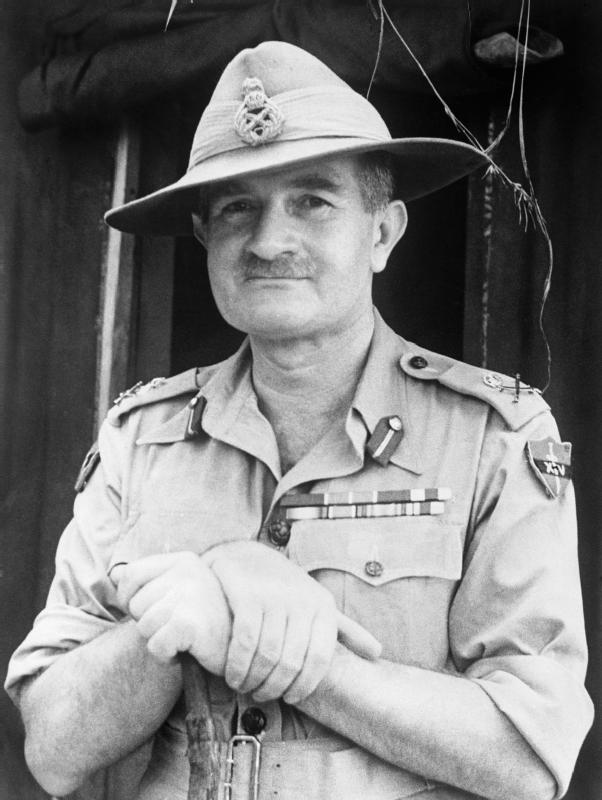
Field Marshal Sir William Slim (1891-1970), during his time as GOC XIVth Army.
Portrait by No. 9 Army Film & Photographic Unit via Wikimedia Commons.
But I see him clear, with that robber-baron face under the Gurkha hat … looking like a rather scruffy private with a general’s tab — which of course is what he was.
– one of General Slim’s soldiers remembers
A search on Amazon using the term “military memoir” yields more than forty thousand results. With so many choices, why read Field Marshal William Slim’s World War II memoir entitled Defeat into Victory? Interestingly enough, there are two answers. The short answer was revealed in 2011 when the National Army Museum in London held a debate and a public poll to answer the question — Who is Britain’s greatest general? Great Britain, of course, has a long and distinguished military history with a great many famous military commanders who could all vie for this honor. In what turned out to be a surprise to many, Field Marshal Slim tied with the Duke of Wellington as the winner. So, if you are considering whether to read Slim’s memoir, ask yourself — how much do you know about someone who might be one of the greatest generals in history?
Before continuing this essay with a longer, more structured answer about the value of Slim’s memoir, a few words about William Slim himself. He began his military career as a temporary lieutenant at the beginning of World War I, without the benefit of a university education or Sandhurst training. By the end of World War I, he had achieved a sterling military record — wounded twice, awarded the Military Cross and temporarily promoted to major. He spent the inter-war years assigned to the Indian Army and was notably associated with the 6th and 7th Gurkha Rifles. At the beginning of World War II, he was given brigade command in East Africa and then command of the 10th Indian Division in the Middle East. His memoir begins in early 1942 when Slim is suddenly and unexpectedly told to leave his command and report immediately to Army Headquarters in India. The summons was so abrupt that Slim thought he was being relieved of command. He didn’t know it at the time but he was about to spend the rest of the war in India and Burma.
A distinct three-act narrative arc forms the structure of his book. In Act I (1942), Slim takes command of Burma Corps. This was an ad hoc two-division force that was in the middle of conducting a fighting retreat while being overwhelmed by the surging Japanese Army. Slim and his men end up suffering through a one hundred day, nine-hundred-mile retreat back to India in what historians have called the longest retreat ever conducted by a British army. By May 1942, the remnants of his Corps finally reached safe haven in India.
In Act II (1943), Slim regroups, retrains and resupplies his forces in preparation for his reconquest of Burma. This was not as straightforward a task as it sounds. Slim now commands the Fourteenth Army which, at its height, consisted of nearly one million soldiers and was one of the largest armies in the world. But the size of the Fourteenth Army was not as striking as the diversity of its composition. Slim had to make a disciplined, cohesive and effective fighting force using regiments from England, Scotland, South Africa, Nigeria, Kenya and a vast array of Indian units including Sikhs, Rajputs, Pathans and Gurkhas from Nepal. Later in the war, Slim described a routine tactical operation: “The Japanese had for some time been harassing 28 East African Brigade Group … and a Punjabi battalion had been sent in to stiffen it”. The Japanese counterattacked “and a British battalion was hurriedly transferred from the east bank and joined them”. One routine tactical operation — involving allied soldiers from three continents.
In Act III, (1944-45), Slim and his army return to Burma and achieve triumph after triumph. The first triumph is the battle of Imphal (March-July 1944). The famed novelist George MacDonald Fraser was a young Scottish soldier in Slim’s Fourteenth Army and he later wrote; “I imagine that every teenager today has heard of Stalingrad and Alamein and D-Day but I wonder how many know the name of Imphal … where Japan suffered the greatest catastrophe in its military history”. The subsequent battle of Meiktila (February- March 1945) was equally significant and has been characterized by British military historian Corelli Barnett as, “the cleverest, boldest and most brilliant single British victory in World War II”. By mid-1945, Slim’s victorious Fourteenth Army had retaken Rangoon and destroyed the Japanese army in Burma.
There are three dimensions to Slim’s memoir that make it so memorable. It is a tale well-written, it is a tale of wonder and it is a tale filled with wisdom.
Comments Off on Britain’s best general in World War II
Explaining the Yugoslav / Zastava M70 Series of Rifles
Forgotten Weapons
Published 30 May 2026Yugoslavia never received a technical data package or license for the AK; they reverse engineered the system themselves in the 1960s. In the process, they created a version of the AK noted for its ruggedness. In addition, they added a number of features to facilitate rifle grenade usage. Over the course of many iterations the rifle remained designated the M70, leading to a lot of confusion about what models are what. Today we are going through the whole series of changes.
M70 – Original milled receiver, with bolt hold-open, fixed stock, and screwed-in barrel
M70A – Underfolder version of the M70M70B – Milled receiver, pinned-in barrel, standard magazines, fixed stock
M70AB – Underfolder version of M70BM70B1 – Stamped receiver (1.5mm), bulged trunnion, fixed stock
M70AB1 – Stamped receiver (0.9mm), flat trunnion, underfolder
M70AB2 – Stamped receiver (1.5mm), bulged trunnion, underfolderThanks to Zastava USA for making this video possible!
(more…)
Comments Off on Explaining the Yugoslav / Zastava M70 Series of Rifles


