
World War Two
Published 8 Aug 2022The typical image of the French Resistance is of a man, beret at an angle, cigarette hanging from his bottom lip, captured MP40 across his chest. But one of the most successful resistance leaders is a woman – Marie-Madeline Fourcade. And right now, the Germans have her on the run!
(more…)
August 9, 2022
The Never Ending Failures in France – WW2 – Spies & Ties 21
Comments Off on The Never Ending Failures in France – WW2 – Spies & Ties 21
August 7, 2022
Allied Tidal Wave in Romania – WW2 – 206 – August 6, 1943
World War Two
Published 6 Aug 2022The Allies bomb the Romanian oil fields, a major Axis source of oil, but it does not go well for the attackers. They do advance in both Sicily and the Solomon Islands — where a future President has one heck of an adventure, and in the USSR a huge Soviet counteroffensive begins, taking Belgorod after just a few days and threatening Kharkov.
(more…)
Comments Off on Allied Tidal Wave in Romania – WW2 – 206 – August 6, 1943
August 5, 2022
ARNHEM – A Bridge Too Far – THE TRUE STORY (2001)
British Army Documentaries
Published 25 Jun 2022Please help us to keep bringing you great content! We are able to bring you these interesting documentaries, which would otherwise be held in a vault, or away from public view because we purchase commercial licenses often at considerable expense. Unfortunately, YouTube’s re-use policy now means we can’t monetise it. This means we can’t invest in new licenses for new documentaries. Please help us by subscribing to our Patreon page from just £2/month so we can keep bringing you great content, otherwise, this channel may need to close forever. Thank You
https://www.patreon.com/BritishArmyDocs
——————————————————————————————————————————
At 3:00 a.m., the commanders of the 2nd South Staffordshire battalion and the 1st and 11th Parachute battalions met to plan their attack. At 4:30 a.m., before dawn, the 1st Parachute Brigade began its attack towards Arnhem bridge, with the 1st Battalion leading supported by remnants of the 3rd Battalion, with the 2nd South Staffordshires on the 1st Battalion’s left flank and the 11th Battalion following. As soon as it became light the 1st Battalion was spotted and halted by fire from the main German defensive line. Trapped in open ground and under heavy fire from three sides, the 1st Battalion disintegrated and what remained of the 3rd Battalion fell back. The 2nd South Staffordshires were similarly cut off and, save for about 150 men, overcome by midday. The 11th Battalion, (which had stayed out of much of the fighting) was then overwhelmed in exposed positions while attempting to capture high ground to the north. With no hope of breaking through, the 500 remaining men of these four battalions withdrew westwards in the direction of the main force, 5 km (3.1 mi) away in Oosterbeek.
The 2nd Battalion and attached units (approximately 600 men) were still in control of the northern approach ramp to the Arnhem bridge. They had been ceaselessly bombarded by enemy tanks and artillery from two battle groups led by SS-Sturmbannführer [Major] Brinkmann and one commanded by Major Hans-Peter Knaust. The Germans recognized that they would not be moved by infantry attacks such as those that had been bloodily repulsed on the previous day so instead, they heavily shelled the short British perimeter with mortars, artillery, and tanks; systematically demolishing each house to enable their infantry to exploit gaps and dislodge the defenders. Although in the battle against enormous odds, the British clung to their positions, and much of the perimeter was held.
(more…)
Comments Off on ARNHEM – A Bridge Too Far – THE TRUE STORY (2001)
August 2, 2022
The Last Battle in the West – How The Allies Crossed The Rhine 1945
Real Time History
Published 30 Jul 2022Get CuriosityStream + Watch Rhineland 45 on Nebula: https://curiositystream.com/realtimeh…
The Rhine river was the last major natural obstacle on the Western Front of WW2 in early 1945. The Allied armies needed to cross the symbolic river to enter the heart of Nazi Germany. While General Patton’s 1st Army crossed the river at Remagen first, the actual set-piece battle of the Rhine took place further north and involved the biggest airborne operation in a single day in the entire war.
(more…)
Comments Off on The Last Battle in the West – How The Allies Crossed The Rhine 1945
August 1, 2022
Hannah Arendt on Adolf Eichmann’s exemplification of the “banality of evil”
Lawrence W. Reed on what Hannah Arendt observed during Eichmann’s trial:
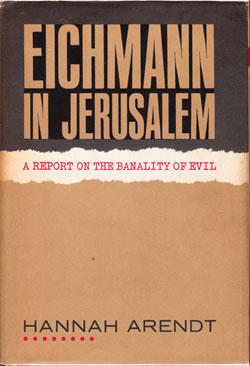
Nine months after the Nazi war criminal Adolf Eichmann died at the end of a noose in Israel, a controversial but thoughtful commentary about his trial appeared in The New Yorker. The public reaction stunned its author, the famed political theorist and Holocaust survivor Hannah Arendt (1906-1975). It was February 1963.
Arendt’s eyewitness assessment of Eichmann as “terribly and terrifyingly normal” took the world by surprise. Her phrase, “the banality of evil”, entered the lexicon of social science, probably forever. It was taken for granted that Eichmann, despite his soft-spoken and avuncular demeanor, must be a monster of epic proportions to play such an important role in one of the greatest crimes of the 20th Century.
“I was only following orders,” he claimed in the colorless, matter-of-fact fashion of a typical bureaucrat. The world thought his performance a fiendishly deceptive show, but Hannah Arendt concluded that Eichmann was indeed a rather “ordinary” and “unthinking” functionary.
[…]
As Arendt explained, “Going along with the rest and wanting to say ‘we’ were quite enough to make the greatest of all crimes possible.”
Eichmann was a “shallow” and “clueless” joiner, someone whose thoughts never ventured any deeper than how to become a cog in the great, historic Nazi machine. In a sense, he was a tool of Evil more than evil himself.
Commenting on Arendt’s “banality of evil” thesis, philosopher Thomas White writes, “Eichmann reminds us of the protagonist in Albert Camus’s novel The Stranger (1942), who randomly and casually kills a man, but then afterwards feels no remorse. There was no particular intention or obvious evil motive: the deed just ‘happened’.”
Perhaps Hannah Arendt underestimated Eichmann. He did, after all, attempt to conceal evidence and cover his tracks long before the Israelis nabbed him in Argentina in 1960 — facts which suggest he did indeed comprehend the gravity of his offenses. It is undeniable, however, that “ordinary” people are capable of horrific crimes when possessed with power or a desire to obtain it, especially if it helps them “fit in” with the gang that already wields it.
The big lesson of her thesis, I think, is this: If Evil comes calling, do not expect it to be stupid enough to advertise itself as such. It’s far more likely that it will look like your favorite uncle or your sweet grandmother. It just might cloak itself in grandiloquent platitudes like “equality”, “social justice”, and the “common good”. It could even be a prominent member of Parliament or Congress.
Comments Off on Hannah Arendt on Adolf Eichmann’s exemplification of the “banality of evil”
Hamburg’s Citizens Burnt Alive – WAH 071 – July 31, 1943
World War Two
Published 31 Jul 2022In Italy the Fascists fall from power in a peaceful coup, while in Germany the RAF and USAAF bring down a rain of fire of biblical proportions in Operation Gomorrah, launching the Firestorm of Hamburg.
(more…)
Comments Off on Hamburg’s Citizens Burnt Alive – WAH 071 – July 31, 1943
July 31, 2022
Milton Mayer’s They Thought They Were Free
Joshua Styles on a book written after the Second World War that appears to have renewed relevance today:
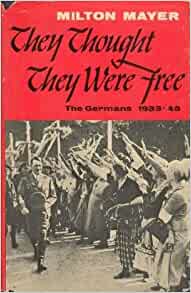
“I came back home a little afraid for my country, afraid of what it might want, and get, and like, under pressure of combined reality and illusion. I felt — and feel — that it was not German man that I had met, but Man. He happened to be in Germany under certain conditions. He might, under certain conditions, be I.” — Milton Mayer, They Thought They Were Free, ix.
It’s been more than seventy-five years since the Nazis were defeated and Auschwitz was liberated. Seventy-five years is a long time — so long, in fact, that while many still learn of the horrors of the Holocaust, far fewer understand how the murder of the Jews happened. How were millions of people systematically exterminated in an advanced Western nation — a constitutional republic? How did such respectable and intelligent citizens become complicit in the murder of their countrymen? These are the questions Milton Mayer sought to answer in his book They Thought They Were Free.
In 1952, Mayer moved his family to a small German town to live among ten ordinary men, hoping to understand not only how the Nazis came to power but how ordinary Germans — ordinary people — became unwitting participants in one of history’s greatest genocides. The men Mayer lived among came from all walks of life: a tailor, a cabinetmaker, a bill-collector, a salesman, a student, a teacher, a bank clerk, a baker, a soldier, and a police officer.
Significantly, Mayer did not simply conduct formal interviews in order to “study” these men; rather, Mayer had dinner in these men’s homes, befriended their families, and lived as one of them for nearly a year. His own children went to the same school as their children. And by the end of his time in Germany, Mayer could genuinely call them friends. They Thought They Were Free is Mayer’s account of their stories, and the title of the book is his thesis. Mayer explains:
“Only one of my ten Nazi friends saw Nazism as we — you and I — saw it in any respect. This was Hildebrandt, the teacher. And even he then believed, and still believes, in part of its program and practice, ‘the democratic part’. The other nine, decent, hard-working, ordinarily intelligent and honest men, did not know before 1933 that Nazism was evil. They did not know between 1933 and 1945 that it was evil. And they do not know it now. None of them ever knew, or now knows, Nazism as we knew and know it; and they lived under it, served it, and, indeed, made it” (47).
Until reading this book, I thought of what happened in Germany with a bit of arrogance. How could they not know Nazism was evil? And how could they see what was happening and not speak out? Cowards. All of them. But as I read Mayer’s book, I felt a knot in my stomach, a growing fear that what happened in Germany was not a result of some defect in the German people of this era.
The men and women of Germany in the 1930s and 40s were not unlike Americans in the 2010s and 20s — or the people of any nation at any time throughout history. They are human, just as we are human. And as humans, we have a great tendency to harshly judge the evils of other societies but fail to recognize our own moral failures — failures that have been on full display the past two years during the covid panic.
Mayer’s book is frighteningly prescient; reading his words is like staring into our own souls. The following paragraphs will show just how similar the world’s response to covid has been to the German response to the “threat” of the Jews. If we can truly understand the parallels between our response to covid and the situation in Hitler’s Germany, if we can see what lies at the end of “two weeks to flatten the curve”, perhaps we can prevent the greatest atrocities from being fully realized in our own day. But to stop our bent toward tyranny, we must first be willing to grapple with the darkest parts of our nature, including our tendency to dehumanize others and to treat our neighbors as enemies.
Comments Off on Milton Mayer’s They Thought They Were Free
Mussolini Falls from Power – WW2 – 205 – July 30, 1943
World War Two
Published 30 Jul 2022The Allied advance on Sicily continues, though they’re really gearing up for operations next week. The Soviet advances in the USSR and in New Georgia also continue, with the enemy deciding to withdraw in both; Allied firebombing kills tens of thousands of German civilians, but the big news is still the fall of Benito Mussolini from power in Italy.
(more…)
Comments Off on Mussolini Falls from Power – WW2 – 205 – July 30, 1943
QotD: Intervention and non-intervention in the Spanish Civil War
The outcome of the Spanish war was settled in London, Paris, Rome, Berlin — at any rate not in Spain. After the summer of 1937 those with eyes in their heads realized that the Government could not win the war unless there were some profound change in the international set-up, and in deciding to fight on Negrin and the others may have been partly influenced by the expectation that the world war which actually broke out in 1939 was coming in 1938. The much-publicized disunity on the Government side was not a main cause of defeat. The Government militias were hurriedly raised, ill-armed and unimaginative in their military outlook, but they would have been the same if complete political agreement had existed from the start. At the outbreak of war the average Spanish factory-worker did not even know how to fire a rifle (there had never been universal conscription in Spain), and the traditional pacifism of the Left was a great handicap. The thousands of foreigners who served in Spain made good infantry, but there were very few experts of any kind among them. The Trotskyist thesis that the war could have been won if the revolution had not been sabotaged was probably false. To nationalize factories, demolish churches, and issue revolutionary manifestoes would not have made the armies more efficient. The Fascists won because they were the stronger; they had modern arms and the others hadn’t. No political strategy could offset that.
The most baffling thing in the Spanish war was the behaviour of the great powers. The war was actually won for Franco by the Germans and Italians, whose motives were obvious enough. The motives of France and Britain are less easy to understand. In 1936 it was clear to everyone that if Britain would only help the Spanish Government, even to the extent of a few million pounds’ worth of arms, Franco would collapse and German strategy would be severely dislocated. By that time one did not need to be a clairvoyant to foresee that war between Britain and Germany was coming; one could even foretell within a year or two when it would come. Yet in the most mean, cowardly, hypocritical way the British ruling class did all they could to hand Spain over to Franco and the Nazis. Why? Because they were pro-Fascist, was the obvious answer. Undoubtedly they were, and yet when it came to the final showdown they chose to stand up to Germany. It is still very uncertain what plan they acted on in backing Franco, and they may have had no clear plan at all. Whether the British ruling class are wicked or merely stupid is one of the most difficult questions of our time, and at certain moments a very important question. As to the Russians, their motives in the Spanish war are completely inscrutable. Did they, as the pinks believed, intervene in Spain in order to defend Democracy and thwart the Nazis? Then why did they intervene on such a niggardly scale and finally leave Spain in the lurch? Or did they, as the Catholics maintained, intervene in order to foster revolution in Spain? Then why did they do all in their power to crush the Spanish revolutionary movements, defend private property and hand power to the middle class as against the working class? Or did they, as the Trotskyists suggested, intervene simply in order to prevent a Spanish revolution? Then why not have backed Franco? Indeed, their actions are most easily explained if one assumes that they were acting on several contradictory motives. I believe that in the future we shall come to feel that Stalin’s foreign policy, instead of being so diabolically clever as it is claimed to be, has been merely opportunistic and stupid. But at any rate, the Spanish civil war demonstrated that the Nazis knew what they were doing and their opponents did not. The war was fought at a low technical level and its major strategy was very simple. That side which had arms would win. The Nazis and the Italians gave arms to the Spanish Fascist friends, and the western democracies and the Russians didn’t give arms to those who should have been their friends. So the Spanish Republic perished, having “gained what no republic missed”.
Whether it was right, as all left-wingers in other countries undoubtedly did, to encourage the Spaniards to go on fighting when they could not win is a question hard to answer. I myself think it was right, because I believe that it is better even from the point of view of survival to fight and be conquered than to surrender without fighting. The effects on the grand strategy of the struggle against Fascism cannot be assessed yet. The ragged, weaponless armies of the Republic held out for two and a half years, which was undoubtedly longer than their enemies expected. But whether that dislocated the Fascist timetable, or whether, on the other hand, it merely postponed the major war and gave the Nazis extra time to get their war machine into trim, is still uncertain.
George Orwell, “Looking back on the Spanish War”, New Road, 1943 (republished in England, Your England and Other Essays, 1953).
Comments Off on QotD: Intervention and non-intervention in the Spanish Civil War
July 29, 2022
Why Ghost Division? What did Rommel do?
Military History Visualized
Published 5 Feb 2019Why was Rommel’s 7th Panzer Division called Gespensterdivsion – the “Ghost Division”? From all we know it earned this name during the Battle of France.
(more…)
Comments Off on Why Ghost Division? What did Rommel do?
July 25, 2022
Stalin, Hitler, and Churchill – Architects of Death – WAH 070 – July 24, 1943
Comments Off on Stalin, Hitler, and Churchill – Architects of Death – WAH 070 – July 24, 1943
July 24, 2022
After a Victory at Kursk, The Soviets Attack Everywhere – WW2 – 204 – July 23, 1943
World War Two
Published 23 Jul 2022The Allied invasion of Italy powers on and puts the future of a key axis power at play. In the USSR, the Soviets have learnt to deal with German offensives, as the Wehrmacht struggles to make a dent.
(more…)
Comments Off on After a Victory at Kursk, The Soviets Attack Everywhere – WW2 – 204 – July 23, 1943
QotD: British armour from BAOR to the first Gulf War
To that end generations of British soldiers were stationed there training for a war that they hoped would never come. To this day there are still serving Cold War veterans who even into the late 1980s knew where they would deploy to, and the likely exact spot in the field or woods where they would dig their trenches and realistically be killed.
This force though was essentially a static one, designed to operate defensively and underpinned by an enormous static logistical and support network stretching from the Inner German Border all the way back to Antwerp and then the UK. The British Army was able to sustain armour in large numbers in part because it had the threat to face, the space to operate and the support network in place to enable this to occur. To this day the subject of how well supported BAOR was through the extensive rear communications zone efforts, and the widespread workshops (such as in Belgium) designed to repair and support UK units is not widely known or told, but deserves much greater recognition.
This matters because when people look back to the size of the British Army in 1990 and look at how many tanks we had then compared to now, they forget that the Army’s MBT capability was essentially a static garrison force waiting to conduct a defensive campaign against a peer threat where it expected to take heavy losses and probably operate very quickly in an NBC environment. It was not intended to be a deployable force capable of operating across the planet on an enduring basis.
This is why when people talk about how many tanks were deployed in 1991 to the Gulf War (some 220 Challenger 1’s were deployed) they forget that this was the first time since Suez that the UK had operated heavy armour overseas. It took many months to get this force into place, and it came at the cost of gutting the operational capability of the remaining BAOR units, who found their logistical support chains hammered in order to support the forces assigned to GRANBY.
The harsh, and perhaps slightly uncomfortable reality for the UK is that OP GRANBY required nearly 6 months of build up at the cost of gutting wider armoured warfare capability – proving that away from home, having 900 tanks is irrelevant if you are operating outside normal parameters and are having to effectively cannibalise or mothball most of them to keep 220 in the Gulf.
By contrast OP TELIC saw over 100 tanks deployed, but a significantly shorter lead in time for the deployment – testament to the significant investments made in the intervening period in logistical capabilities.
Sir Humphrey, “Tanks for nothing — Why it does not matter if the British Army has fewer tanks than Cambodia”, Thin Pinstriped Line, 2019-04-24.
Comments Off on QotD: British armour from BAOR to the first Gulf War
July 22, 2022
Why Did The First World War Break Out? (July Crisis 1914)
[My 2014 series on “The Origins of World War I” can be read here. Although I’d read a fair bit of history on the period, once I began researching the period, even I was surprised at how many different contributing causes there were.]
The Great War
Published 15 Jul 2022The assassination of Archduke Franz Ferdinand and his wife in Sarajevo on the 28th of June 1914 kicked off a crisis among the European Powers. Tensions that built up in the decades before erupted and in early August 1914 the world was at war. But what happened in these fateful July weeks 1914?
(more…)
Comments Off on Why Did The First World War Break Out? (July Crisis 1914)
QotD: Spoiler – there was no technological solution to trench warfare in WW1
All of which is to say, again, that the problem facing generals – German, French, British and later American – on the Western Front (and also Italian and Austrian generals on the Italian front) was effectively unsolvable with the technologies at the time. Methodical Battle probably represented the best that could be done with the technology of the time. The technologies that would have enabled actually breaking the trench stalemate were decades away in their maturity: tanks that could be paired with motorized infantry to create fast moving forces, aircraft that could effectively deliver close air support, cheaper, smaller radios which could coordinate those operations and so on. These were not small development problems that could have been solved with a bit more focus and funding but major complexes of multiple interlocking engineering problems combined with multiple necessary doctrinal revolutions which were in turn premised on technologies that didn’t exist yet which even in the heat of war would have taken many more years to solve; one need merely look at the progression of design in interwar tanks to see all of the problems and variations that needed to be developed and refined to see that even a legion of genius engineers would have required far more time than the war allowed.
It is easy to sit in judgement over the policy makers and generals of the war – and again, to be fair, some of those men made terrible decisions out of a mix of incompetence, malice and indifference (though I am fascinated how, in the Anglophone world, so much of the opprobrium is focused on British generals when frankly probably no British commander even makes the bottom five worst generals. Most lists of “worst generals” are really just “generals people have heard of” with little regard to their actual records and so you see baffling choices like placing Joseph Joffre who stopped the German offensive in 1914 on such lists while leaving Helmuth von Moltke who botched the offensive off of them. Robert Doughty does a good job of pointing out that men like Haig and Foch who were supposedly such incompetent generals in 1915 and 1916 show remarkable skill in 1918).
But the problem these generals faced was fundamentally beyond their ability or anyone’s ability to solve. We didn’t get into it here, but every conceivable secondary theater of war was also tried, along with naval actions, submarines, propaganda, and internal agitation. This on top of the invention of entirely new branches of the army (armor! air!) and the development of almost entirely new sciences to facilitate those branches. Did the generals of WWI solve the trench stalemate? No. But I’d argue no one could have.
Bret Devereaux, “Collections: No Man’s Land, Part II: Breaking the Stalemate”, A Collection of Unmitigated Pedantry, 2021-09-24.
Comments Off on QotD: Spoiler – there was no technological solution to trench warfare in WW1


