
World War Two
Published 22 Feb 2025In their struggle to defeat German and Japanese espionage efforts, the Allied intelligence agencies of the KGB, CIA, MI6 and DGSE are all transformed into modern, global, espionage forces. But even as East and West work together to defeat the Axis, they are fighting the first underground battles of a new Cold War against one another.
(more…)
February 23, 2025
How WW2 Changed Espionage Forever
Comments Off on How WW2 Changed Espionage Forever
Portuguese Navy Lugers: Model m/910 from DWM and Mauser
Forgotten Weapons
Published 2 Nov 2024Following Portuguese Army adoption in 1908, the Portuguese Navy adopted the Luger in 1909 as the m/910. The pattern they chose was a “new model” Luger in 9x19mm, with a 100mm / 4″ barrel. A total of 650 were ordered in late 1909 and delivered between 1910 and 1912. The guns had Portuguese-language safety and extractor markings (“Seguranca” and “Carregada“) and included grip safeties. They were in a dedicated serial number range of 1 to 650. The first 350 were delivered under the reign of Portuguese King Manuel II and had crown-over-anchor chamber crests. With the establishment of a Republic in Portugal, that marking was changed to “R.P.” over an anchor, which was used on the remaining guns (351-650).
In the mid 1930s, the Navy ordered another 156 m/910 Luger pistols, this time from the Mauser company. These had the same Portuguese markings, but without any special crest — just blank chambers. They were numbered in Mauser’s export/commercial serial number range, and are in the “v” block of numbers. A few more very small orders were placed in 1941 and 1942, but these were filled with basically straight German P08 pistols.
(more…)
Comments Off on Portuguese Navy Lugers: Model m/910 from DWM and Mauser
February 22, 2025
“German politics have become a sad farce”
German elections will be held very soon, and the all-party-but-one alliance to keep the extremely extreme extreme right wing out is sagging badly but the technocrats and the media are doing everything they can to hold the line:
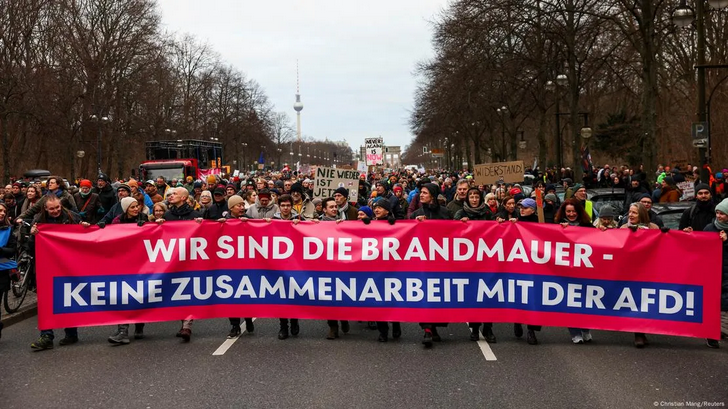
“We are the cordon sanitaire – no cooperation with the AfD”: the banner leading the Berlin protest against AfD and CDU on 2 February, which was financed in part by the German taxpayer and arranged by semi-affiliated apron organisations of the governing Green and Social Democrat parties of Germany.
Behind all of the disingenuous fact-checking and the performative outrage, one detects in German mainstream commentary the deeper recognition that J.D. Vance was very far from wrong about a great many things in his landmark speech at the Munich Security Conference last Friday. Only the truth can provoke the kind of panicked and intemperate reactions that followed Vance’s remarks. German politics have become a sad farce – a ridiculous performance that every day I find a little more embarrassing. The primary reason for this farce, as Vance said, is the fear our political class harbour towards their own people, and their complete inability to reverse course on any of the catastrophic policies they have put their names to, from the energy transition to mass migration to the war in Ukraine.
The firewall will keep German politics frozen in amber for some time still. It will keep everything as it was ten years ago under Angela Merkel, until this inflexible, sclerotic system suddenly breaks and unleashes all of the potential energy it has accumulated in one great chaotic crisis. And make no mistake about it, that crisis coming, precisely because the controlled demolition that would be in the best interests of our rulers is also utterly beyond their imaginations and their talents. This might read at first like a pessimistic post, but I promise it’s not. I’m developing a cautious optimism almost despite myself as I try to ponder what will happen in the coming months.
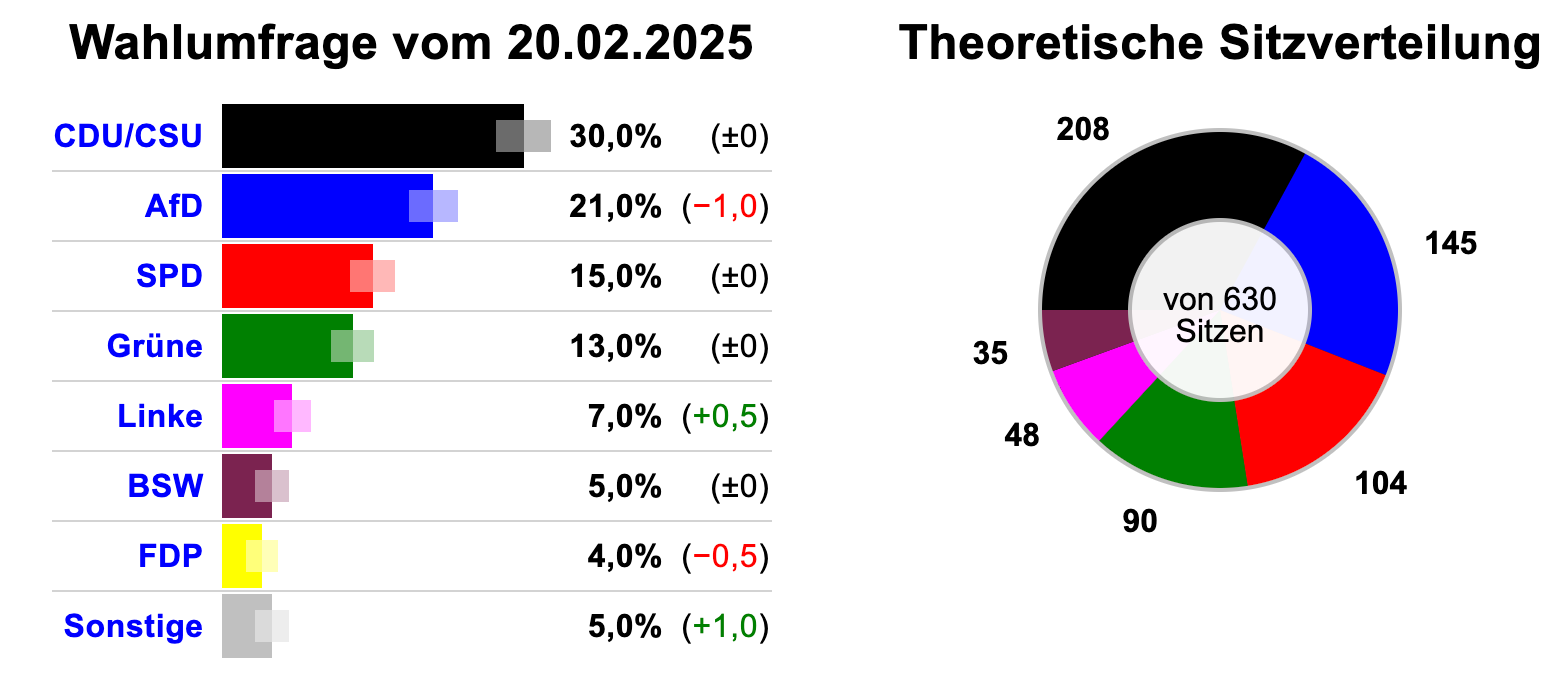
In two days and thirteen hours, German voters will elect a new Bundestag. The polls could not be worse for the centre-right Christian Democratic Union and their smaller Bavarian sister party, the Christian Social Union. The latest INSA survey presents a nightmare scenario for both parties. It has CDU/CSU at 30%, Alternative für Deutschland at 21%, the Social Democrats (SPD) at 15%, the Greens at 13%, Die Linke (the Left Party) at 7% and the Bündnis Sahra Wagenknecht (BSW) at 5%.
On the left are the INSA poll results, and on the right is the “theoretical seat distribution” that these numbers, if they were election results, would yield.
Readers often ask me whether the polls are understating AfD support. That is possible, but I’d argue the question is not important, because whether AfD come in at 20% or 23% won’t make much difference. Everything actually depends on the small socialist parties that few are talking about right now. Die Linke – successor to the DDR-era Socialist Unity Party – seems all but certain to make it back into the Bundestag, following a social media blitz that has won them wild popularity with young voters. The BSW, meanwhile, probably have even odds of clearing the 5% hurdle for representation.
If both Linke and BSW make it in, CDU and CSU are absolutely screwed, and this by their own cowardly insistence on the firewall. Refusing AfD votes means they will have to cave to the SPD and the Greens on everything to form a coalition with them. Otherwise, the left-wing parties will band together, hijack Bundestag procedure and form their own minority government right under their noses.
That’s right: The firewall means we stand a real chance of getting basically the same deeply unpopular SPD-Green government we have now, additionally radicalised by the hardline socialists of Die Linke. This is precisely the thing nobody wants and precisely the thing our political elites are prepared to deliver, all to keep the Evil Fascist Nazi Party away from power. If this happens, we’ll get a paralysed leftoid Chancellor who is incapable of so much as passing a budget. The AfD will climb in the polls and the CDU will bleed voters until the pressure grows so great, or the political crisis so intense, that they decide to break the firewall after all and chase the leftists out of power.
Comments Off on “German politics have become a sad farce”
February 21, 2025
Berlin ’45: City of Spies
World War Two
Published 20 Feb 2025In 1945, Berlin is a city in ruins — but for the world’s spies, it’s a goldmine. As the Soviets, Americans, British, and French carve up the capital, they scramble to seize Nazi secrets, recruit informants, and outmaneuver each other in an intelligence war that will define the Cold War. From stolen blueprints to fabricated reports, Berlin becomes the world’s first battleground of espionage.
(more…)
Comments Off on Berlin ’45: City of Spies
February 16, 2025
Bismarck’s Final Battle – The Bismarck Part 4
World War Two
Published 15 Feb 2025It is the end for the Bismarck; crippled by airstrikes, there is no hope of salvation. As the British battleships close in, Admiral Gunter Lutjens gives a final Sieg Heil, readies his guns, and prepares to meet his destiny.
(more…)
Comments Off on Bismarck’s Final Battle – The Bismarck Part 4
February 14, 2025
“Over half of all Germans now find themselves on ‘the right’ and urgently require democratic reeducation”
Ah, poor German democracy … you guessed it, once again it’s hanging by a thread as protests against the extremely extreme extreme right (the AfD) have now grown to include protests against the merely extreme extreme right (the CDU and CSU):
“We are the cordon sanitaire – no cooperation with the AfD”: the banner leading the Berlin protest against AfD and CDU on 2 February, which was financed in part by the German taxpayer and arranged by semi-affiliated apron organisations of the governing Green and Social Democrat parties of Germany.
All the activists are out in force.
Every day there are new protests “against the right”, and by “the right” they do not merely mean Alternative für Deutschland and the one-in-five Germans who vote for them, as was the case last year at this time. Since Friedrich Merz stepped over the cordon sanitaire at the beginning of this month, “the right” now also includes the centre-right CDU and CSU parties. Over half of all Germans now find themselves on “the right” and urgently require democratic reeducation. What is worse, it is not just crazy pink-haired activists and septum-pierced Antifa who want to do the reeducating, oh no. It is the government itself; the activists are merely their agents.
According to taz, 500,000 right-thinking Germans took to the streets this past weekend to combat the out-of-bounds radical views held by 52% of everybody. Perhaps 200,000 or 250,000 or 320,000 turned out for the massive “Democracy Needs You” protest in Munich on Saturday. A further 35,000 people “warned against a shift to the right” in Bremen, the absurd “Grannies against the Right” brought 24,000 people to the streets of Hannover, and another 14,000 denounced “right-wing extremism” in Marburg. There were also protests throughout Nordrhein-Westfalen, in Wuppertal, Aachen, Duisburg, Gütersloh, Gummersbach and Euskirchen. Yesterday 15,000 showed up to protest an AfD event in Freiburg; they were less than peaceful. And that is just what I found by scanning a few headlines. I could easily expand this paragraph into an entire post because they are protesting everywhere and all the time “against the right” these days.
I must emphasise again the extremely expansive notion of “the right” that is in play at these protests. Basically everyone who is not on the left – and particularly everyone who does not vote for the Greens or the Social Democrats (SPD) – presently attracts the activists’ ire. That is very interesting, because we are in the final stages of an election campaign and the Greens and the SPD are the only parties in government. Could it be that the Greens and the SPD are using the substantial resources of the German state to call forth massive street protests against all the Germans who are not planning to vote for them?
Yes, in fact that is exactly how it could be:
When 160,000 demonstrators turned out to protest on behalf of the cordon sanitaire on the first weekend in February, and organisers projected the words “All Berlin hates the CDU” onto the Victory Column, the red-green federal government provided financial support. The rally was co-sponsored from the coffers of the federal budget … indirectly and in two ways. As in many German cities, the organiser was the association Campact. Campact itself does not receive government funds. Yet they are the primary stakeholder of the nonprofit HateAid, which receives funds from the Ministry for Family Affairs. Since 2020, HateAid has received a total of almost 2.5 million Euros from the “Live Democracy” project, and their funding has just been extended. According to the Ministry for Family Affairs, HateAid can expect 424,823 Euros this year for its work against online hate speech.
Thousands also took to the streets in Dresden and Leipzig to protest CDU plans for migration policy. In both cities, the SPD and the Greens indirectly sponsored the rallies with taxpayer money, this time through the Workers’ Welfare Association (AWO). This association enjoys the favour of the Ministry of the Interior and the Ministry of Family Affairs. The AWO received tens of thousands of Euros … in 2024. In Saxony-Anhalt, the AWO state association received 90,043 Euros from the Ministry of Family Affairs in 2025, among other things from the ‘Live Democracy’ project …
Paus’s ministry also provides financial support to many of the organisers of demonstrations in Schleswig-Holstein. This year, a total of 1.525 million Euros will flow … The municipalities divide the money equally among themselves, with each receiving 140,000 Euros to form local “partnerships for democracy”. Many of the sponsored organisations have sponsored demonstrations on behalf of the cordon sanitaire. In Kiel, the Green-financed “Central Education and Advice Centre for Migrants” … called for a protest in front of the CDU headquarters, in Lübeck the “Lübeck Refugee Forum” did the same …
All of this is to varying degrees illegal. Non-profit organisations, which receive tax-deductible contributions from supporters, are bound to political neutrality. Nor can the government finance (directly or otherwise) campaign events against the political opposition. Since 2021, however, in the name of defending democracy, the traffic light coalition have called into being an absolute jungle of NGOs to intimidate voters, censor the internet and riot on the streets against parliamentary votes. Their semi-affiliated activist cadres police German politics and redefine as right-wing and forbidden whatever it is our rulers happen to disagree with at the moment.
Comments Off on “Over half of all Germans now find themselves on ‘the right’ and urgently require democratic reeducation”
Disarmament Talks, Budget Battles, and Student Duels – Nov 1930
World War Two
Published 13 February 2025November 1930 sees Germany caught between political instability and international disputes. Brüning fights to pass his controversial budget while Germany’s push for global disarmament meets French resistance and Nazi outrage. Meanwhile, Hitler restructures the SA and SS, student duels make headlines, and Berlin’s police chief is attacked in court.
(more…)
Comments Off on Disarmament Talks, Budget Battles, and Student Duels – Nov 1930
February 13, 2025
From Ruins to Recovery: The Fight to Rebuild – W2W 004
TimeGhost History
Published 12 Feb 2025In 1946, the world is struggling to rebuild from the devastation of WWII. Cities lie in ruins, economies are shattered, and millions are displaced. As the old powers of Britain and France weaken, the rising superpowers — the U.S. and USSR — compete to shape the new world order. Will reconstruction lead to stability, or is the world heading for another conflict?
(more…)
Comments Off on From Ruins to Recovery: The Fight to Rebuild – W2W 004
February 10, 2025
The Swordfish Strike! – The Bismarck Part 3
World War Two
Published 9 Feb 2025Reeling from the loss of HMS Hood, the Royal Navy chases Bismarck across the Atlantic Ocean. Battleships and search planes comb the vast expanses of water. Finally, they spot the German behemoth. It’s time to unleash the Swordfish!
(more…)
Comments Off on The Swordfish Strike! – The Bismarck Part 3
February 8, 2025
Hungarian WWII Rifles (35M, 43M, G98/40)
Forgotten Weapons
Published 11 Jun 2015After the breakup of the Austro-Hungarian Empire, the Hungarian army was armed primarily with Steyr M95 straight-pull rifles and carbines, chambered for the 8x56mm rimmed cartridge. In 1935 they adopted a new Mannlicher turnbolt rifle, the 35M, which used the same 8x56R ammunition and en bloc clips. The rifle was modified in 1940 for production to German specifications as the Gewehr 98/40 (including conversion to 8×57 rimless ammunition and a stripper-clip-fed box magazine). The resulting rifle was good enough that it was adopted by Hungary as well in 1943 as the 43M.
Comments Off on Hungarian WWII Rifles (35M, 43M, G98/40)
February 7, 2025
Justice for WW2?! – W2W News 1945
TimeGhost History
Published 6 Feb 2025Join SPARTACUS and INDY on the War2War 1945 Newscast as we explore a world tumbling from war to war. European colonies face fresh conflicts and groundbreaking polymer innovations spark industrial revolutions. All the while Nazi war criminals are brought to justice at the Nuremberg Trials.
(more…)
Comments Off on Justice for WW2?! – W2W News 1945
February 3, 2025
A New World Order – War 2 War 01 – Q4 1945
TimeGhost History
Published 1 Feb 2025World War Two is over. The anti-Axis alliance has promised that their victory shall usher in a time of peace, stability, and freedom. They have pledged to uphold new values of humanity, tolerance, solidarity, and the right to self determination. Have they spoken the truth or has it been a string of lies all along?
(more…)
Comments Off on A New World Order – War 2 War 01 – Q4 1945
February 2, 2025
HMS Hood – Death in 17 Mins – The Bismarck Part 2
World War Two
Published 1 Feb 2025On May 24, 1941, the Kriegsmarine‘s mighty battleship Bismarck goes head to head with the Royal Navy’s HMS Hood. Seventeen minutes later, just one of the steel titans is left afloat and 1,400 men are dead.
Special thanks goes to the HMS Hood Association, to learn more about HMS hood visit hmshood.org.uk
(more…)
Comments Off on HMS Hood – Death in 17 Mins – The Bismarck Part 2
January 30, 2025
Hitler Testifies, Brüning Battles On – Rise of Hitler 10, October 1930
World War Two
Published 28 Jan 2025October 1930 brings more unrest to Weimar Germany. Chancellor Brüning survives no-confidence votes, while Nazi and Communist clashes escalate into chaos. Berlin sees mass protests, Jewish businesses attacked, and rumors of a Nazi-Soviet conspiracy swirl.
(more…)
Comments Off on Hitler Testifies, Brüning Battles On – Rise of Hitler 10, October 1930
January 29, 2025
German democracy in its death throes as extremely extreme extreme right gets an anti-immigration bill up for a vote
The situation in Germany appears critical, as the extreme right Christian Democrats (CDU) seem to be moving closer to working with the extremely extreme extreme right Alternative für Deutschland (AfD) to pass an anti-immigration bill:


Despite everything, the cordon sanitaire against the Evil Hitler Nazi Fascist party known as Alternative für Deutschland really appears to be crumbling. CDU Chancellor candidate Friedrich Merz has set in motion a chain of events he can no longer control. This coming Friday, there is every chance that anti-migration legislation will pass the Bundestag and become law with the help of AfD votes – an eventuality that was unimaginable even seven days ago.
As I reported in my prior post, Merz said last week that he was open to passing anti-migration bills with AfD support. His statement was remarkable, because it violated the most important tabu in German politics, namely that against achieving any outcomes with votes from the AfD. This tabu excludes the political voice of opposition voters and insulates the traditional party system from political change.
Almost from the beginning, there was messaging confusion from within the CDU about Merz’s statement. The reversals, re-reversals, doublings down, and contradictions that have flowed from Merz and his party over the weekend are highly significant. They suggest a panicked CDU leadership that is in disarray, eager to stem the tide of defections to the AfD and desperate to weaken the negotiating positions of the leftist SPD and Green parties. The cordon sanitaire is a wedge driven straight through the right that allows an ever more unpopular left to punch far above their weight and maintain their vice-grip on German migration policy. It was intended to wall out the AfD, but as the AfD has grown stronger, it has only walled in the CDU. Remarkably, the CDU seem to have finally figured this out.
Merz responded to the growing cries of outrage from the left at first predictably – by backtracking. He insisted he wanted not the AfD but the “political middle” to support his anti-migration legislation. In a strange statement on Saturday, he announced that “We have sent the SPD, the Greens and the FDP all the texts that we want to pass next week” so that “We can … agree on how we will vote next week.” He added bizarrely that “The AfD is not receiving these texts.” These “texts” leaked almost immediately; they turned out to be resolutions calling on the Green and SPD government to tighten border security and increase deportations.
Comments Off on German democracy in its death throes as extremely extreme extreme right gets an anti-immigration bill up for a vote


