
Forgotten Weapons
Published 15 Jun 2022In 1954, the Unique company (MAPF) in Hendaye France rebuilt a batch of 800 Berthier carbines into .22LR caliber for use by the Sûreté Nationale (later renamed the Police Nationale). These were to be used for training and also issued to prison guards. Both 1892 and 1916 pattern carbines were used, and so the CRS .22s can be found both with and without upper handguards. They were fitted with 5-round magazines from one of Unique’s pistol models. The change of the firing system from centerfire to rimfire was rather cleverly done, with the new barrels bored at a slight angle to obviate the need to change the firing pin geometry. This did require shaving down the cocking piece and changing the sights, however.
(more…)
November 23, 2023
A .22LR Berthier for the French National Police (CRS)
November 3, 2023
Understanding Combined Arms Warfare
Army University Press
Published 24 Mar 2023Designed to support the U.S. Army Captains Career Course, “Understanding Combined Arms Warfare” defines and outlines the important aspects of modern combined arms operations. This is not a complete history of combined arms warfare. It is intended to highlight the most important aspects of the subject.
The beginning of the documentary establishes a common understanding of combined arms warfare by discussing doctrinal and equipment developments in World War I. The second part compares the development of French and German Army mechanization during the interwar period and describes how each country fared during the Battle of France in 1940. The film concludes by showing how the United States applied combined arms operations in the European Theater in World War II.
(more…)
October 17, 2023
Why WW1 Cavalry Was Essential On The Battlefield
The Great War
Published 13 Oct 2023The First World War was a catalyst for modern warfare with tanks, poison gas, flamethrowers and more. Cavalry didn’t have a place anymore on the modern battlefield – or so the common misconception goes. In this video we show how useful cavalry still was in WW1.
(more…)
October 16, 2023
The Allied Rape Wave of 1944 – War Against Humanity 116
World War Two
Published 12 Oct 2023Since the earliest days of humanity, where there has been war, there has been rape. This war is no different. As vast armies battle across Europe, the chaos in their wake breeds an epidemic of rape. In its action and its punishment the European rape wave is also highly racialised. It adds up to a storm of suffering.
(more…)
October 14, 2023
A Jacobite spy for Bonnie Prince Charlie
In the latest Age of Invention newsletter, Anton Howes talks about the career of John Holker of Manchester, cloth manufacturer, who joined the army of Prince Charles Edward Stewart in 1745, and eventually became an expert in industrial espionage:
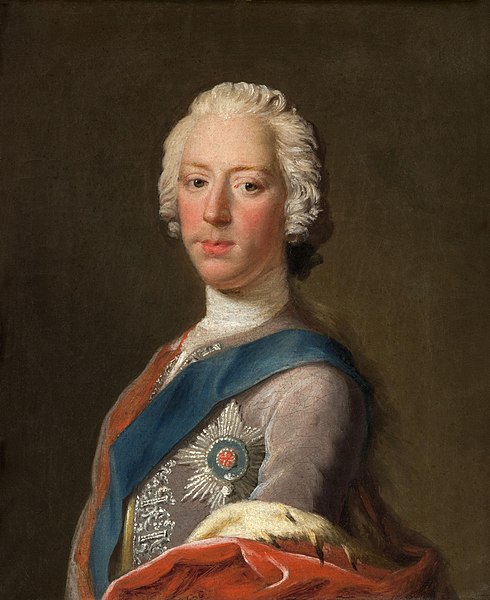
Prince Charles Edward Stuart, 1720 – 1788. Eldest Son of Prince James Francis Edward Stuart.
Portrait by Allan Ramsay, National Galleries Scotland via Wikimedia Commons.
I’ve lately been reading about one of history’s greatest spies — not a James Bond-like agent with licence to kill, but a master of industrial espionage, John Holker.1
Holker was originally from Manchester, in Lancashire, where he was a skilled cloth manufacturer in the early eighteenth century, his specialty being calendering — a finishing process to give cloth a kind of sheen or glazed effect. But Holker was also a Catholic and a Jacobite — a believer in the claim of the Catholic descendants of the deposed king James II to be the rightful rulers of Great Britain, instead of the Hanoverian George I and George II who had only succeeded to the throne because they were Protestants. In 1745 James II’s grandson Charles, also known as Bonnie Prince Charlie — likely the “Bonnie” who lies over the ocean in the famous song — landed in the Scottish Highlands and raised the royal standard. Charles’s uprising defeated the British troops stationed in Scotland, captured Edinburgh, and then marched down the west coast of England, capturing Carlisle and entering Lancashire.
To Holker, who had been born in the same year as the last Jacobite rebellion in 1719, the arrival of Charles in Manchester must have seemed like a once-in-a-generation opportunity. He and his business partner instantly joined Charles’s troops and he was appointed a lieutenant. But Manchester was the last place to provide many eager volunteers for the uprising, and when Charles reached Derby he lost heart and turned around. Holker and his business partner ended up being left to garrison Carlisle as Charles and his force retreated into Scotland to hunker down, and they were soon captured by the British troops sent to quash the uprising. They were then, as officers, sent to Newgate prison in London to sit with their legs bound in irons and await trial and certain execution.
But they never made it to trial. In the first demonstration of Holker’s extraordinary talent for espionage, they escaped. Holker had been allowed visitors in prison, so had drawn on London’s crypto-Jacobite circle to smuggle in files, ropes, and information about the prison and its surroundings. They managed to file through the leg-irons and window bars, climbed up the gutters onto the prison roof, and then used planks from the cell’s tabletop to cross onto the roof of a nearby house. In the event, they disturbed a dog guarding the house, and so Holker hid in a water-butt and became separated from the others. He eventually found refuge at a crypto-Jacobite’s house, then escaped into the countryside before managing to make his way to France.
In France, Holker joined his fellow veterans of the failed uprising of ‘45, becoming a lieutenant in a Jacobite regiment of the French army. He fought for the French in the Austrian Netherlands — present-day Belgium — against the Hapsburgs, the Hanoverians, the Dutch, and the British. Even more extraordinary, however, was that when Bonnie Prince Charlie wanted to go in secret to England in 1750, it was Holker who went with him as his sole companion and guide. Although Charles failed to persuade his supporters in England to rise up in rebellion on their own, Holker managed to get the prince secretly and safely to London and back.
By the time Holker reached his early thirties he had been an industrialist, rebel, prisoner, fugitive, soldier, undercover agent, and even spy-catcher: he successfully identified a spy for the British in Charles’s circle, even if Charles failed to heed his warning. But in 1751 Holker’s career took yet another turn when he was recruited by the French government as an industrial spymaster.
Holker’s chief task was to steal British textile technologies.
1. Unless otherwise stated, I’ve drawn much of my information on Holker and the industries that the French attempted to copy from John R. Harris, Industrial Espionage and Technology Transfer: Britain and France in the 18th Century (Taylor & Francis, 2017), particularly chapter 3.
October 13, 2023
Elvira, the Party Girl Double Agent
World War Two
Published 11 Oct 2023She’s the gambler with a hotline to the Abwehr. The party girl tearing up the London social scene. Now she’s doing her bit to hold back the Panzer divisions and pave the way for D-Day. This is the story of Elvira Concepcion Josefina de la Fuente Chaudoir, Double Cross’s most flamboyant double agent.
(more…)
October 11, 2023
Art Deco in 9 Minutes: Why Is It The Most Popular Architectural Style? 🗽
Curious Muse
Published 3 Sept 2021What comes to your mind when you think of the 1920s? For most people, the 1920s conjures up images of jazz, flappers, Old Hollywood, the Great Gatsby, and the Chrysler Building in New York City. It was a time of prosperity, exorbitant spending, and entertainment that gave rise to one of the most popular decorative arts and architecture movements — known as Art Deco.
Characterized by exquisite craftsmanship, lavish decoration, and rich materials, the style has become synonymous with the Roaring Twenties. So, what was the Art Deco movement all about and what differentiates it from other major movements? Finally, despite its popularity today, what makes Art Deco so closely associated with the 1920s?
In this week’s video, we’ll dive into the history of the era and learn about Art Déco, the style that continues to inspire designers and architects around the world!
(more…)
October 10, 2023
MAS-36 LG48: A Grenade Launcher for the Bolt Action Infantry
Forgotten Weapons
Published 28 Sept 2017Once it became apparent that the MAS-36 was going to be used in a substantial amount of frontline combat (contrary to its intended role as a reserve or secondary rifle), it became important to provide it with grenade launching capability. The French military really liked rifle grenades as a way to have explosive support firepower always available with the frontline infantry, without needing to call for specialized units like mortar crews.
After various experiments with clamp-on launchers (like and including the WW1 VB launcher), the LG48 (lance grenade, or grenade throwing) rifle was adopted in 1948. It used the same basic projectile as the Mle 1937 50mm light mortar, but with a new tail assembly fitted which allowed it to slide over the muzzle of a MAS-36 rifle. The LG48 rifle was essentially just a MAS-36 with a new nosecap assembly which included a simple grenade sight and a range-setting adjustable sleeve over the barrel.
The LG48 pattern rifles were made both brand new in the St Etienne factory and also supplied as conversion kits to be applied in the field. Neither type ever received new or special markings to identify their grenade launching status. The Mle 1948 grenades and the LG48 rifles were declared obsolete in 1968, as the French had switched to the NATO standard type of rifle grenades in the early 1950s. In 1968 the existing rifles were ordered to be retrofitted back to standard MAS-36 pattern, and their lack of special markings makes those retrofitted rifles virtually indistinguishable from original MAS-36 rifles. The surviving examples, like the one in this video, are almost all from nations which received the rifles as military aid from France and were not subject to the French retrofitting order (this particular rifle was imported as part of a batch from Lebanon in the 1990s).
(more…)
October 5, 2023
The Great War: Its End and Effects, Lecture by Prof Margaret MacMillan
McDonald Centre
Published 25 Jan 201922 January 2019, “How far did the Versailles Treaty make Peace?”, Professor Margaret MacMillan, Warden of St Antony’s College, Oxford. The lecture was sponsored by Christ Church Cathedral and the McDonald Centre for Theology, Ethics, and Public Life, Oxford.
October 4, 2023
Paris under the Swastika – Collaboration and Resistance – On the Homefront 019
World War Two
Published 3 Oct 2023Occupied Paris, a paradoxical city of banality and brutality, of resistance and collaboration. Join Anna as she takes you on a tour of the city from occupation, the establishment of the Pétain regime and collaboration, the growth of resistance, and finally liberation. But the story doesn’t end there and into the 21st century, the city of lights is haunted by its occupation.
(more…)
October 2, 2023
Why France Lost Vietnam: The Battle of Dien Bien Phu
Real Time History
Published 29 Sept 2023After the French success in the Battle of Na San, the battle of Dien Bien Phu is supposed to defeat the Viet Minh once and for all. But instead the weeks-long siege becomes a symbol of the French defeat in Vietnam.
(more…)
QotD: Who were the Celts?
Now already some of you are noting a curious feature here which is that I keep using the word “Gauls” to describe these folks rather than “Celts” and you are probably wondering why. We’ve actually addressed this question before, but we ought to revisit it here, because I think any approach to “Celtic Warfare” is already potentially begging some pretty important questions (assuming it hasn’t stopped to address them) and, alas, begged the wrong answers (unless it has defined “Celtic” very narrowly). The problem, entirely unaddressed in the original video, is that there is a pretty big gap between what the Greeks meant by the word keltoi, what the keltoi may have meant by the word keltoi and most important what people today understand by the word “Celts”. Instead everyone gets smashed together, with all of the Celtic-language speakers mashed in under the label of “Celts”, a practice that hasn’t been acceptable in serious scholarship for at least 30 years. Let’s talk about why.
From antiquity we have two standard terms. On the one hand, the Greeks encountered a people in the Mediterranean and called them keltoi. From Caesar and Strabo we know that at least some peoples called themselves keltoi (or celtae), though as we’re going to see the people who did this are not actually co-terminus with this military system or with all the people folks (including the original video) think of as Celtic or any identifiable polity or political structure. In particular, Caesar reports that the folks living in what is today France (then Gaul) north of the Garonne and south of the Marne and the Seine called themselves celtae, which he takes to be equivalent to the Latin galli (Caes. BGall. 1.1). Strabo, meanwhile, describes peoples in Spain as both keltoi and also keltiberes (which enters English as Celtiberians, Strabo, Geography 3.2.15) as well as those in Gaul (Geography 4.1ff), but doesn’t make the claim that they call themselves that (instead repeatedly noting these groups broken up into smaller tribal units with their own names). Both Caesar (Caes. BGall. 1.1) and Strabo (Geography 4.1.1) go out of their way to stress that the folks they’re talking about do not have the same languages, institutions or mode of life, even those who are, to Strabo, galatikos – “Gallic” or more precisely “Galatian-like” (referring to the sub-group of Gallic peoples the Greeks were the most familiar with).
Galli, rendered into modern English as “the Gauls” (though the latter is not a descendant of that word, but a wholly different derivation), is likewise tricky. We’re fairly sure that both keltoi and galli are Celtic-language words, meaning that (contrary to the video) they’re both probably “endonyms”, (a thing people call themselves) but it is really common for peoples in history to take the endonym of the first group of people they meet and apply it to a much larger group of “similar” (or not so similar) people. The example I use with my students is “Frank”; – it was common in both the Eastern Mediterranean and later in East Asia to use some derivative of “Frank” or “Frankish” to mean “Western or Central European” – the term got applied to the Portuguese in China, and to both Germans and Sicilian Normans during the Crusades. It’s possible that galli in Latin is connected to the Galatai (Greek) or Galatae (Latin), the Galatians, a Celtic-language speaking La Tène material culture group who migrated into Anatolia in the 270s, but a number of etymologies have been proposed. It certainly wouldn’t be the first time the Romans named a massive ethnic group after the first people they met; this is how we get the word “Greek” when the Greeks call themselves Hellenes. So assuming off the bat that all of these different tribal groups that Caesar or Strabo treat as a cultural unity thought of themselves that way is most unwise. The most we know is that if you called some of these folks (but not all of them, as we’ll see) keltoi or galli, they’d say, “yeah, I guess that more or less describes me”, perhaps in the same way describe a Swiss person as “European” isn’t wrong, but it also isn’t quite right.1
Surely here linguistics will help us out? If we can identify a Celtic language then surely everyone who speaks that language will have that culture? First, this is yet more question begging; English is the official language of South Sudan and yet the South Sudanese are not English, British or American. Linguistic connections do not always imply ethnic or cultural connections extending beyond language. And, in fact, examining the Celtic language family is a brilliant way to illustrate this.
There is, in fact, a family of Celtic languages and indeed it is only in the sense of languages which you will see me use the word Celtic in a formal way precisely to avoid the giant pickle of confusion we are currently working through. Very briefly, it has been shown linguistically that the various surviving Celtic languages are related to each other and also to the extinct languages of pre-Roman continental Europe that were spoken in Gaul, Noricum and parts of Spain. So far so good, right, we have a nice, perfect match between our keltoi and Celtic-language-speakers, right?
Of course not. That would be easy! Because notice there that Irish, Manx, Scottish Gaelic and Welsh are all Celtic languages. But our sources are actually quite clear that at least the Romans and the Greeks did not consider these folks to be galli or keltoi. Indeed, Strabo explicitly defines the people of Britain against the keltoi as two distinct groups, making it clear he doesn’t think the inhabitants of the British Isles were “Celts” (Geography 4.5.2); Caesar doesn’t either (BGall. 4.21ff). Tacitus sees in the britanniae evidence of German, Iberian and Gallic influence, marking them as distinct from all three, but concludes that Gallic settlement is the most likely cause, a point on which we may be quite certain he is wrong, for reasons discussed just below (Tac. Agr. 11). So the groups described as “Celts” don’t entirely overlap with Celtic language speakers.
Well, surely here the archaeologists can help us out, right? Yes and no. On the one hand, we have a collection of object types, artistic motifs and archaeologically visible patterns that we associate with some of the areas settled by people who our sources regard as “Celts” and who were Celtic language speakers. The older of these two material culture groupings we call “Halstatt culture” after the original type-site in Hallstatt, Austria, though we find Hallstatt culture objects (remember, these are objects, not people, a thing to be relevant in a moment) in a territorial range that forms a sort of crescent shape embracing the northern edges of the Alps, from around 1200 BC to around 500 BC. We then shift to a material culture pattern which may have developed out of late Hallstatt culture which we call La Tène culture after its type-site of La Tène in Switzerland; it runs from around 500 BC (very roughly) to around 50 AD, with lots of subdivisions.
And just about all of the folks our sources will identify as “Celts” or “Gauls” tend to live in areas where where we find, by the third century or so, at least some elements of La Tène material culture (and many in places where they have the full package). So do we at last have a way to identify some “Celts”, by matching wherever we find La Tène material culture?
No. Of course not. That would be easy and history is not easy.
First, not all of the people our sources describe as Celts adopt all or even most of the elements of La Tène material culture. Most notably, the folks in Iberia who were keltoi (according to Strabo) or Celtiberians have some elements of La Tène material culture, but are notably missing others. They don’t have, for instance, the whole La Tène military package – mail in particular is absent in Iberia until the Romans arrive, and the La Tène swords they have are local variations of early La Tène I swords by the third and second centuries, not the La Tène II swords we find in most of the rest of the cultural zone.2 The artistic style in “Celtic” Spain is also different and unsurprisingly there’s a lot of Iberian borrowing. As a result, archaeologically, the keltoi of south-western Iberia aren’t some sort of carbon-copy of the keltoi of central France. There’s not no connection here, they are Celtic-language speakers and they have some La Tène stuff, but the Iberian Celtici are quite a bit further from the Helvetii (the folks who probably inhabited the La Tène site) than, say, the Senones.
Meanwhile, we find some La Tène material culture objects in southern Britain, but they don’t fully penetrate the Isles (despite the general assumption that all of the people of Britain and Ireland were Celtic language speakers) and many appear to be expensive, high-status imports. Indeed, while it was once supposed that the arrival of La Tène material culture objects signified some invasion or settlement of Britain by people from Gaul, an analysis of burial patterns3 demonstrates pretty clearly that this isn’t happening in this period, because burial practices in southern Britain remain distinct from those on the continent. Instead, we’re seeing trade.
Meanwhile, we find tons of La Tène material culture objects in cultural contexts that we know were neither “Celtic” in any cultural sense nor filled with Celtic-language speakers. The clearest instance of these are in Illyria and Thrace, who spoke Indo-European but not Celtic language (so a language as close to Celtic languages as Latin or Greek or German), where it’s clear that folks adopted at least some La Tène material culture, including weapons and armor. Of course by the third century, when it came to militaria, we’d have the same problem with the Romans, who by the end of the Second Punic War, had adopted a La Tène sword (albeit from Spain and with a different suspension system), a variant of the La Tène shield, a La Tène helmet type (domestically manufactured), and La Tène body armor (mail). If we didn’t have any surviving Latin language material, I am almost certain there would be nationalist pseudo-archaeologists claiming the Roman Empire was clearly some “pan-Celtic” imperial construct on that basis.4 And of course in the third century, a Greek variant of the La Tène shield, the thureos, begins showing up everywhere in the Hellenistic East, but that doesn’t make them Celts either (they’d be the first to tell you).
Meanwhile, there’s even more complexity than this, because objects of La Tène material culture aren’t the whole of archaeologically visible culture. There are building habits, burial habits, evidence for social organization and on and on. And those vary significantly within the La Tène material culture zone. I put this in the bibliography and I’m afraid it is a (necessarily) difficult and technical read, but if you want to get a sense of just how complex this can get, check out Rachel Pope’s efforts to define the Celts in the Journal of Archaeological Research (2022). To quote some of her conclusions, “In fact, ‘Celts’ as a historical label does not map neatly onto any archaeological tradition; it overlaps with late Hallstatt traditions in northeast France and less ostentatious archaeologies farther west … Nor did the name ‘Celt’ ever equate to all of Gaul, let alone all of Europe.”
So to be clear, we have Celtic-language speakers who aren’t called Celts by our sources and don’t have La Tène material culture (Ireland, N. Britain), Celtic-language speakers who are called Celts by our sources but don’t have the full La Tène material culture package (Spain, Portugal), non-Celtic language speakers who do have some of the La Tène material culture package but who are clearly not Celts to our sources (Thracians, Illyrians, Dacians, etc.), full La Tène material culture-havers who are explicitly not Celts in our sources (Caesar, specifically) and maybe speak a Celtic-language (the Belgae), and partial La Tène material-culture-havers who do speak a Celtic language but are still explicitly not Celts in our sources (S. Britain). Oh, and while we’re here, by the second century we also have La Tène material culture-havers who probably still speak a Celtic-language and are called Celts/galli by our sources but write inscriptions in Greek (the Galatians) and seem to have different religious structures and folks identified as Celts in our sources who are in the process of ditching large parts of La Tène material culture and learning Latin (Cisalpine Gaul), who might, à la Pope (op. cit.), actually be the direct, local descendants of the “original” Celts.
And then of course we have a band across parts of the Alps and central France where everything lines up: Celtic-language speakers with La Tène material culture who our sources call keltoi or galli and live in a place called Gallia by the Romans. But it would be a mistake to assume this is the cultural “heartland” of a “Celtic” people – indeed, La Tène material culture may be more deeply rooted in more Northern parts of France [than in] the Danube region, which has a lot of non-Celtic language speakers in it in this period! Because, to be clear, what we actually have are a host of smaller, tribal societies which share come cultural elements and differ in others, who seem to think of themselves primarily as members of a tribe and who lack notable “pan-Celtic” institutions, to which Greeks and Romans, needing a way to label their neighbors, took whatever ethnic signifiers they had and applied them (over)broadly.
[…]
At no point where all of these people united in a single polity (the closest they get is that most of them get conquered by the Romans) and there’s no indication that they ever saw themselves as a cultural or ethnic unity. And of course we haven’t even gotten into the idea that they might all be somehow closely ethnically related but let’s just go ahead and tag that as “very unlikely” and keep moving.
All of that is to make the point that any treatment of “Celtic” warfare is immediately begging an enormous question because “who were the Celts?” is at best an unanswered question and to be frank, probably an unanswerable question. Crucially, “the Celts” do not share a military system. Warfare among Celtic-language speakers in the British Isles isn’t necessarily based around La Tène material culture, nor is warfare in S. Portugal among peoples identified by our sources as keltoi; both areas seem to have very substantial regional variation. By contrast, the galli of central France and Cisalpine Gaul do seem to share at least substantial elements of a military system with the – according to Caesar – non-celtae of broader Gaul and as well as with the Galatians who live, I must repeat, in Anatolia (having migrated there in the third century). There is thus no “Celtic” military system which maps clearly onto either Celtic-language distribution or peoples described as keltoi by our sources.
Bret Devereaux, “Collections: Who Were ‘the Celts’ and How Did They (Some of Them) Fight?”, A Collection of Unmitigated Pedantry, 2023-05-12.
1. Especially in the sense that “European” gets used to mean “citizen of a country in the European Union”, which Switzerland is not. Mostly. The EU is complicated.
2. On these differences, see F. Quesada Sanz, “Patterns of Interaction: ‘Celtic’ and ‘Iberian’ weapons in Iron Age Spain” in Celtic Connections, vol. 2, eds. W. Gillies and D.W. Harding (2005) and in even more detail F. Quesada Sanz, “El Armamento Ibérico. Estudio tipológico, geográfico, functional, social y simbólico de las armas en la Cultura ibérica” (siglos VI-I a.C.) (1997). Interestingly, the Roman gladius Hispaniensis seems likely to have been a Roman adaptation of the peculiar Iberian La Tène swords, so you have the La Tène I sword making its way to Iberia, becoming distinctive, being adopted by the Romans instead of the more common (to them) La Tène II sword, thus becoming the gladius. On this, see F. Quesada Sanz, “Gladius Hispaniensis: an Archaeological View from Iberia” JRMES 8 (1997).
3. On this, see S. James, The Atlantic Celts: Ancient People or Modern Invention (1999).
4. On this, see M.J. Taylor, “Panoply and Identity During the Roman Republic” PBSR 88 (2020). On the helmet type and its evolution, see U. Schaaff, “Keltische Helme”, in Antike Helme (1988) for a rundown; P. Connolly Greece and Rome At War (1981), 121 also has a fantastic visual chart of the development of the type in the La Tène material culture zone, where you can see quite clearly where in the fourth century the Italic variants of this helmet type are breaking off from, while the La Tène helmets continue their development in other directions, later to be re-adopted by the Romans who thought it was so nice, they borrowed it twice.
October 1, 2023
MGD PM9 Rotary-Action Submachine Gun
Forgotten Weapons
Published 23 May 2017The PM9 was an interesting an unique submachine gun designed by Louis Debuit for the French firm Merlin and Gerin (hence the MGD name – Merlin, Gerin, Debuit) in the late 1940s and early 50s. The design was intended to provide a very compact package, which it did with a very short action, folding stock, and folding magazine.
The PM9 uses a delayed blowback action, and the delaying is done by a rotating flywheel-type block and clock spring. The bolt and flywheel act somewhat like the piston and crank in an engine. As the bolt (piston) moved rearward in a straight line, it forces the flywheel (crank) to rotate because the two are connected. In the case of the PM9, the connection is a nub on the flywheel that rides in a vertical slot in the bolt. The flywheel is pushing against the clock spring to rotate, and the combination of the its inertia and spring pressure keep the bolt closed long enough for pressure to drop to a safe level. The rotary action allows this to be done in a much smaller package than typical submachine guns.
The PM9 was initially chambered for 7.65 French Long, but quickly changed to standard 9mm Parabellum for the production models. It used the same magazine as the German MP38/MP40, giving it a 32-round capacity. In addition to the model with a skeletonized folding stock, the PM9 was also available with a fixed wooden stock and either short barrel of long carbine barrel. A relatively small number of guns were produced in France in 1954 and 1955, but they failed to find commercial success. In 1956 the German Erma company acquired a license to build the PM9, but abandoned the idea after making a few prototypes.
(more…)
September 28, 2023
Gaulois Palm Pistol
Forgotten Weapons
Published 23 Nov 2014The Gaulois (Gallic) was a compact squeeze-type palm pistol made by the Manufrance concern in St. Etienne in the 1890s. It held 5 rounds of 8mm ammunition (similar to the .32 Extra-Short used in other types of palm pistols) and was fired by squeezing the rear grip into the body of the gun.
As with the other weapons of this type that achieved some popularity in the 1880s through early 1900s, the Gaulois eventually faded from the market because of the improvements in conventional handguns. Something like a compact Iver Johnson revolver offered all the capabilities (if not more) of a Chicago Protector or My Friend or Gaulois, without the loading and aiming difficulties of those designs.
(more…)
September 22, 2023
MAS 49: A Universal Service Rifle
Forgotten Weapons
Published 20 May 2019As the MAS 44 saw combat service with French Marines in Indochina, some of its shortcomings began to reveal themselves. The rifle was reliable and durable, but it lacked some capabilities, most importantly rifle grenade launching and an optics mounting. After a test series of MAS 44A rifles, a new pattern was adopted as the MAS 49 and put into production in 1951.
A total of about 80,000 MAS 49 rifles were made, and they incorporated a scope mounting dovetail in the left side of the receiver and a grenade launching muzzle device and sight. In addition, the bayonet was left out, as it was no longer seen as necessary. Not all rifles were used with scopes or for launching grenades, but with the universal capability it was simple to adapt any rifle to whatever specialized role was required. Ultimately the MAS 49 would be replaced again in only a few year, by the MAS 49-56 iterative improvement — but that’s a subject for a future video.
(more…)


