
World War Two
Published 20 Jan 2024The huge new Soviet offensives charge ahead this week, taking Warsaw and Krakow; in the west the Battle of the Bulge is officially called over … though there is still fighting there. On Luzon, the Americans push out of their beachhead, though there is heavy fighting to secure their flank.
(more…)
January 21, 2024
The Red Army Overruns Poland! – WW2 – Week 282 – January 20, 1945
Comments Off on The Red Army Overruns Poland! – WW2 – Week 282 – January 20, 1945
A Book and a Rifle: The Vercors Resistance in WWII
Forgotten Weapons
Published 20 May 2018One of the single largest actions of the French Resistance during World War Two was Operation Montagnards — the plan to drop about 4,000 Allied paratroops onto the Vercors Massif when the resistance was activated in support of the Allied landings in Normandy and Provence. If you are scratching your head trying to figure out why you don’t remember that operation, it is because it never actually happened. The two Allied landings were originally intended to take place simultaneously, but logistical limitations forced the southern landings to be delayed about two months. In an deliberate decision to prevent the Germans from immediately understanding the nature of the Allied attack, the whole of the French Resistance was activated to support the Normandy landings in June 1944. The internal attacks in the south would force the Germans to keep significant forces in that area in expectation of a second landing, which would increase the chances of the Normandy landings succeeding. Unfortunately, the other result of this decision was that Resistance cells would come into the open in anticipation of imminent military support, which would not be coming. The southern elements of the Resistance were basically sacrificed in this gambit.
The Vercors Massif is a large geographical feature near Lyon and Grenoble which comprises basically a triangular sheer-walled plateau rising well above the surrounding plains. It offers a fantastically defensible redoubt, and that is what it was planned to be. Paratroops dropped onto the top of the massif would reinforce a substantial force of Maquis fighters, and create a serious strong point behind the German lines to aid in the fight inland from the landing beaches. The plan was organized in Algiers by Resistance representatives from the Vercors and Free French officers earlier in the war. Some have argued that the lack of support was simply due to the compromises of the single-landing plan, while others fault de Gaulle for deliberately abandoning the men and women on Vercors as part of a strategy to consolidate post-war political support — but that debate is beyond the scope of today’s discussion.
The fighters and civilians on the massif ultimately held out for about 6 weeks — only just too little to still be there when the Allied armored columns reached Grenoble. The German commander in the area spent several weeks making small probing attacks before the final assault with about 10,000 veteran Wehrmacht soldiers, glider-borne infantry, and tanks. Once that attack came, the fate of the Vercors was sealed. With proper military backing they could have defended their redoubt, but instead they had only a smattering of small arms and no heavy weaponry at all. It was a fight that was gloriously courageous but hopelessly doomed to failure.
I am privileged to have in my own collection a Berthier carbine tied to the Vercors Resistance, as evidenced by the brass embellishments on its stock. While I cannot conclusively prove it came from the Resistance, it was sold to me without any premium attached to them, and I have no reason to believe it is fake. And, of course, since I have no plans to sell it, I am not really concerned about conclusively proving its veracity to others. For me, it is a poignant icon of a tremendously heroic group. I hope I would live up to the bar they set should I ever be in a comparable situation!
(more…)
Comments Off on A Book and a Rifle: The Vercors Resistance in WWII
January 16, 2024
Why Real Dijon Mustard Is So Expensive | So Expensive Food | Business Insider
Insider Business
Published 12 Jul 2022Dijon mustard has a tangier, sharper, and spicier flavor compared to other types of mustard. It takes its name from the town of Dijon in Burgundy, France, where it originated. But despite its name, the majority of Dijon mustard that is sold all over the world doesn’t come from France. The few jars that do will cost you up to six times more than regular Dijon mustard (or double if we want to compare it to Grey Poupon). So how is real Dijon mustard different? And why is it so expensive?
Editor’s Note: In this video, the translations at 2:10 and 3:16 are incorrect. The rind of the mustard seed is wrongly referred to as “sound of mustard”. The correct translation is mustard bran. Insider regrets the error.
(more…)
Comments Off on Why Real Dijon Mustard Is So Expensive | So Expensive Food | Business Insider
January 14, 2024
Soviet and American Massive Attacks – Week 281 – January 13, 1945
World War Two
Published 13 Jan 2024In the East, the Soviets launch a massive series of new offensives. In the West, Monty holds an ill-judged press conference about the Battle of the Bulge. Operation Nordwind, the German offensive in Alsace, continues. In Hungary, there’s house to house fighting as the Red Army besieges Budapest. In Asia, the Allies wrestle with the Kamikazes, begin their landings on Luzon, and advance in Burma.
00:54 Intro
01:12 Recap
01:22 Montgomery’s Press Conference
05:53 Operation Nordwind
07:07 The battle for Hungary
09:38 The huge Soviet offensive begins!
12:22 American landings on Luzon
15:29 Anti-Kamikaze tactics
18:11 Slim’s advance in Burma
21:11 Conclusion
(more…)
Comments Off on Soviet and American Massive Attacks – Week 281 – January 13, 1945
January 9, 2024
AMX-13 | Tank Chats #174
The Tank Museum
Published 6 Oct 2023With over 7,700 units built and still in service today, this French light tank stands as a testament to its enduring legacy and historical significance. David Willey gives us an in-depth analysis of the development and history of the AMX-13.
(more…)
Comments Off on AMX-13 | Tank Chats #174
January 7, 2024
1945 Begins! – WW2 – Week 280 – January 6, 1945
World War Two
Published 6 Jan 2024The Germans launch a new offensive, Operation Nordwind, in Alsace, even as their offensive in the Ardennes is stalled. The Allies in the west don’t just have to fight these, they are also having serious issues amongst themselves in High Command that threaten their unity. The siege of Budapest is in full swing and is a hard, fought, bloody battle, and the Soviets and the Americans have big plans for new offensives soon to kick off in Eastern Europe and the Philippines (respectively).
00:00 INTRO
01:20 The Siege of Budapest
04:51 German defense plans in the East
06:38 Montgomery versus Eisenhower
08:32 Eisenhower versus the French
10:35 New German Offensive in Alsace
13:49 Monty’s plans for the press
15:04 The Battle of the Bulge
17:45 Preparations for the Luzon Landings
20:56 Notes to end the week
21:51 Summary and conclusion
(more…)
Comments Off on 1945 Begins! – WW2 – Week 280 – January 6, 1945
January 4, 2024
QotD: Displays of intelligence as a status good
… noblemen in France (in the rest of Europe too, but France’s old kingdom was special for how wide the disparity was) were used to being by far the richest in their surroundings. And they were used to the peasants being less than dirt under their feet. Or their chariot wheels.
And then that changed, in what is a cultural eye-blink. Forget the crazy slogan. Humans don’t like change. Particularly they hate change that challenges their status. Unable to actually increase their net worth (within the prescribed realms in which noblemen could do such) or stop spending, the nobility instead went for displays of wealth. Big and extravagant ones. And the wigs were … quite, quite insane.
So what does that have to do with Facebook?
For a few generations, since the left captured the academia, entertainment and the industrial-news complex, aka, the opinion makers, to be a leftist has been synonymous with being smart.
And being smart, since the renaissance, but definitely since the world wars has been the greatest social “good” there is.
No, I’m not saying the left was smart. Increasingly, most of them weren’t, because as it became a matter of social display, the easily led started imitating it.
No, I’m saying that to parrot leftist ideas was to be considered smart. Partly because of the left’s conceit that Marxism was “scientific” there has always been, attached to the modern left the idea that to believe as they do is “rational” and “smart” and that their opponents are stupid.
Not only did they hold onto this while their ideas were proven wrong by reality over and over again, but having captured academia, they pushed leftist ideas as synonymous with being educated. I mean, if you’d attended an elite school, you received these ideas, and the way to signal you’ve attended the school is to parrot it. Thus leftism became the old school tie (mostly around the neck of our economy, but never mind.)
While they had full control of the media, be it entertainment or informational, they could reinforce the message, as well as revile anyone who challenged them as stupid, wrong and illiterate, and GET AWAY WITH IT.
With intelligence being the highest status-good in our society, the left had secure status. Forever, they thought.
The change has been very rapid. The fall of the USSR and [the rise of] talk radio were the beginning, and since the internet took off, they’ve been trying to hold on to the tail of the comet, as it streaks away from them.
I’ve said it before and I maintain it. If Mr. Obama had been president in a country where the information tech was the same as in the 30s, all his failures would have been hidden, and people would believe him a staggering genius, instead of the little man who wasn’t there. Because that’s how the industrial-media complex presented him.
And then … And then they went all in for Hillary! They were “With her” 300%.
Unbelievably, it didn’t work.
I think they’d suspected, before, that things had changed. But they could still tell themselves stories, dismiss the opposition, preen on having all the power. And then … it failed.
Since then they’ve been running scared with social insecurity. They display their “brilliance” for all the world, and it didn’t work? Oh. Must signal louder, larger, crazier.
All the “Wokeness” over everything possible (and mostly imaginary) in the last few years? That’s social signaling by a social group losing power and trying to regain it.
The less it works, the more extravagant it will get. I am in premonitory awe over what will happen should Trump beat the margin of fraud in 2020. You thought the Democratic Socialist meeting was funny? You ain’t seen nothing yet. They won’t be able to open their mouths without announcing “point of personal privilege” and their pronouns, and interrupting each other with ever finer intersectional victimhood.
If you think having a woman who won an SF award malign the person the award is named after with a bunch of ahistorical nonsense, and seeing the institution cave within days was peak wokeness, you’re deluding yourself.
Soon and very soon the “Wokeness” displays will be the equivalent of having live birds in your hair.
Because in their subconscious, if they just signal loud enough they’ll regain their status as “smart” and “educated”.
Meanwhile, we’ll be buying popcorn stocks and saying “Is that a ship on your head, or are you that insecure?”
Sarah Hoyt, “Is That A Ship On Your Head?”, Libertarian Enterprise, 2019-09-01.
Comments Off on QotD: Displays of intelligence as a status good
December 27, 2023
The never-settled “Pétain question”
Theodore Dalrymple reviews a new book on the trial of Marshal Pétain after the liberation of France in WW2:
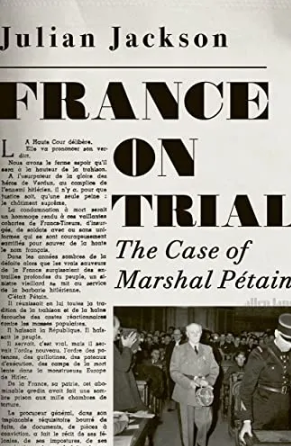
François Mauriac, the left-leaning, Nobel Prize–winning, Catholic novelist, said of the trial of Marshal Pétain that it would never be over: a sentiment more or less echoed by General de Gaulle. And certainly, the figure of Pétain continues to divide opinion in France, at least among those with opinions on such matters. Was he a traitor to France, or its savior, or perhaps something in between the two?
Professor Julian Jackson has written a superb book about Pétain’s trial, its circumstances, and its aftermath. I would like to say that I read it in one sitting, but it was too long for that; but I looked forward impatiently to picking it up again, all else being but a regrettable interruption.
The continued salience of what might be called the “Pétain question” is illustrated by the fact that one of the candidates in the last French presidential election, Éric Zemmour, claimed that Pétain was the savior of the French Jews. This was all the more startling because Zemmour himself is Jewish (his parents emigrated from Algeria to France not long before independence), and because, if Pétain is exonerated in the matter of the deportation of seventy-five thousand Jews during the war to Germany, there to be murdered, his reputation is all but saved: for it is in this matter that his record is most excoriated.
As Jackson reminds us, this was not always so. In the immediate post-war period, and during his trial for treason, the fate of the Jews of France was not much emphasized. According to Éric Conan and Henry Rousso, in their book Vichy, un passé qui ne passe pas (Vichy, a past that does not pass), the Jews of France themselves were not anxious that their treatment by Vichy should be emphasized, for they had had more than enough of being treated as a population apart. They wanted their suffering to be subsumed under that of the nation as a whole, and it was only later, by the subsequent generation, that the deportation assumed its great historiographical importance. It is not that nothing about the deportation was known before, it was merely that less emphasis was placed on it. There is an analogy with the historiography of the Soviet Union. Solzhenitsyn revealed nothing that was not, or could not have been, known before, with all its human and moral significance; the difference was that the world was now ready or willing to believe it.
But what of Zemmour’s claim, which is precisely that which Pétain’s defenders, when they are not outright anti-Semites, make on the Marshal’s behalf? It is certainly true that a far higher percentage of French Jews survived than, say, of Belgian or Dutch Jews (the figures are seventy-five, fifty, and twenty-five percent, respectively). But how much of the difference was attributable to the alleged relative decency, and cunning, of Vichy and its marshal?
Allow me a personal anecdote. Above my mother-in-law’s flat in Paris lived an old Jewish lady whose brother had been deported on the last convoy of Jews from Paris before the end of the occupation. She, however, had been saved by having been sent out of Paris to the care of nuns, who disguised her identity. Hence, she survived.
One day my mother-in-law was traveling on a bus and started to talk to an old lady next to her, who asked her where she lived. She gave the street, then the number, then the number of the flat, whereupon the lady next to her, who was Jewish, burst into tears. This was the very flat in which she had been hidden by family friends during the four years of the occupation, being careful never to appear at the window because opposite was the German Kommandantur, formerly and afterwards a police station. Four years of claustrophobic terror during adolescence: it was like something from a novel by Patrick Modiano.
The survival of these two old ladies owed nothing to Vichy or Marshal Pétain, but this does not settle the historical question. What percentage of the survivors owed their survival to the bravery of individuals, and what to policy decisions? We shall probably never know with any certainty. If one compares the survival rates of France and the Netherlands, what part did the relative geographies of the two countries play? France is much larger and less densely populated, and has many landscapes more conducive to concealment than the Netherlands.
Again, what of the pétainiste claim, repeated by Zemmour, that Vichy sacrificed Jews of non-French origin in order to save those of French origin? The former, however, were more conspicuous, with much smaller networks of potential defenders, than the latter. This might explain the large difference in the survival rates between the French-born and foreign-born Jews, an explanation which would hardly redound to the regime’s credit.
Comments Off on The never-settled “Pétain question”
December 18, 2023
Napoleon Bonaparte on film
In The Critic, Peter Caddick-Adams considers the revival of the biopic, with emphasis on Napoleon Bonaparte, thanks to the recent Ridley Scott movie:
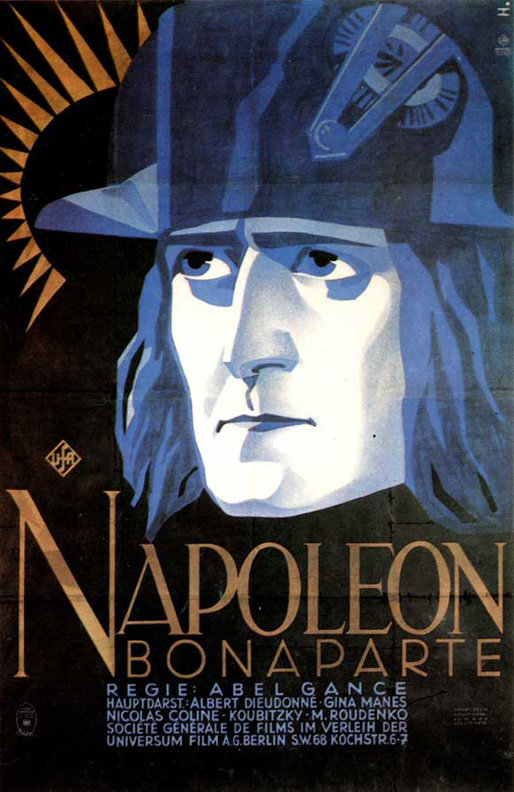
One of the posters for a much-shortened cut of Abel Gance’s Napoléon for the German market, 1927.
Some of the first motion pictures were biopics, initially silent. In portraying a high-minded individual, historical or contemporary, who has influenced our lives in some way, cinema’s hope is that some of the character’s prestige will rub off into the film. Both sides of the Atlantic have seen countless examples, because the genre is traditionally presented as culturally above a thriller, western or a musical. Its offer is an invitation to see history. Let us take Oppenheimer or Napoleon, with Cillian Murphy and Joachim Phoenix in the title roles. Viewers are attracted by the concept of a true story, be it the designer of the first atomic bomb, or the little emperor who dominated Europe. They may know little or a lot about the subject, even if only hazy knowledge from distant schooldays, but they start with more base knowledge than any other genre.
Gifted directors, in this case Christopher Nolan and Ridley Scott, with their cast hold our hands and walk us into an historical context, hinting at grandeur or importance. We are led into a panorama of life that’s now seen as great or significant. Whether you’re glued to a small screen nightly, or whether you go to the cinema only once or twice a year, the biopic demands attention as “education”, in a way a thriller, horror or romcom flick does not. We are sold the idea that reel history (which can never be real history) somehow merits our valuable time, more than mere “entertainment”.
Napoleon first burst onto the screen in 1927 with a silent-era masterpiece directed by Abel Gance. Far ahead of its time, the final scenes were shot by three parallel cameras, designed to be projected simultaneously onto triple screens, arrayed in a horizontal row called a Triptych, the process labelled “Polyvision” by Gance. It widened the cinematic aspect to a field of vision unknown then or since. The director tried to film the whole in his Polyvision, but found it too technical and expensive. When released, only the centre screen of footage was shown, to a specially composed score. Designed as one episode of several to tell the emperor’s life, which we would today label a franchise, the 1927 extravaganza came in at 5.5 hours, necessitating three intermissions, including one for dinner. Gance had interpreted his biopic as a grand opera. It has been much trimmed and revisited by other directors, including Francis Ford Coppola in the 1980s, and restoration of lost footage is still ongoing. I saw the 5.5-hour version in the Royal Festival Hall in 2000, with a score by Carl Davies (of World at War fame). For a film emerging from the Stone Age of cinematography, its excitingly modern ambition was worth my bum ache. I could see what all the fuss was about.
Curiously, the real value of Gance’s Napoléon was in technique rather than content. If you think of the silent era, it’s mostly the comics who come to mind, playing out their dramas in front of a single static camera. Gance seized this new medium, first embraced in December 1895 by the Parisian Lumière Brothers, and turned it on its head. Napoléon featured not just the Triptych experiment, but many other innovative techniques commonplace today. These included fast cutting between scenes of alternating dialogue, extensive close-ups, a wide variety of hand-held camera shots, location shooting, multiple-camera setups and film tinting (colouring), so altering cinematography for ever.
Although Rod Steiger gave us a different take on Napoleon in Sergei Bondarchuk’s Waterloo of 1970, with its leading actors of the day and massive cast of extras, comprising much of a Soviet army division in period costume and filmed behind the old Iron Curtain, Ridley Scott’s new Napoleon is clearly paying homage to the Gance Napoléon in ambition and length. Scott pretty much picks up the story where Gance left off, and he is able to deploy technology of which Gance could only dream. However, with both films, screenwriter, director and actors are at a disadvantage common to all biopics of having to work against the viewers’ check-list of facts they know, or expect to see included. Thus Scott, like Gance, relies on spectacular technique over storyline. This brings viewers, especially my fellow fuming historians, into a collision between historical truth and the possibilities of celluloid story-making.
Most of us have a mental picture of the character we are invited to watch, which constrains actors and their make-up teams, who have to imitate particular people, with all the wigs, prosthetics and accents that entails. Yet, to view the biopic as a piece of history is to miss the point of the motion picture industry. Pick up a screenplay, and you will be surprised at how few pages it comprises, how few words on each page. None read like a literary biography. With only 90–120 minutes in a typical movie, there is not enough time to cover a character’s full life — not even that of Napoleon in 5.5 hours. Instead, the challenge for the writing-directing team is to extract snippets of a life to demonstrate the evolution of character.
Comments Off on Napoleon Bonaparte on film
December 12, 2023
La trahison des intellectuels modernes
Niall Ferguson explains why the situation in Europe in the late 1920s persuaded Julien Benda to publish the famous La trahison des clercs … and how similar the situation in western academia is to a century ago:
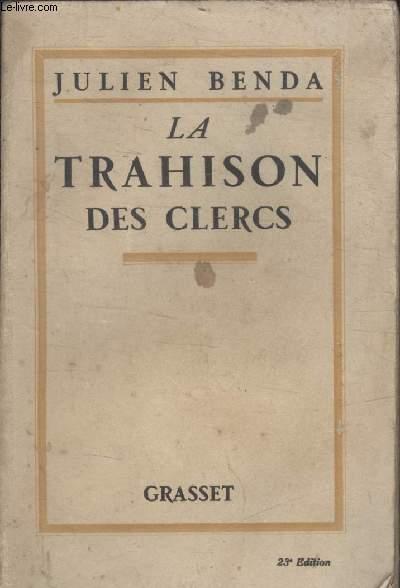
In 1927 the French philosopher Julien Benda published La trahison des clercs — “The Treason of the Intellectuals” — which condemned the descent of European intellectuals into extreme nationalism and racism. By that point, although Benito Mussolini had been in power in Italy for five years, Adolf Hitler was still six years away from power in Germany and 13 years away from victory over France. But already Benda could see the pernicious role that many European academics were playing in politics.
Those who were meant to pursue the life of the mind, he wrote, had ushered in “the age of the intellectual organization of political hatreds”. And those hatreds were already moving from the realm of the ideas into the realm of violence — with results that would be catastrophic for all of Europe.
A century later, American academia has gone in the opposite political direction — leftward instead of rightward — but has ended up in much the same place. The question is whether we — unlike the Germans — can do something about it.
For nearly ten years, rather like Benda, I have marveled at the treason of my fellow intellectuals. I have also witnessed the willingness of trustees, donors, and alumni to tolerate the politicization of American universities by an illiberal coalition of “woke” progressives, adherents of “critical race theory”, and apologists for Islamist extremism.
Throughout that period, friends assured me that I was exaggerating. Who could possibly object to more diversity, equity, and inclusion on campus? In any case, weren’t American universities always left-leaning? Were my concerns perhaps just another sign that I was the kind of conservative who had no real future in the academy?
Such arguments fell apart after October 7, as the response of “radical” students and professors to the Hamas atrocities against Israel revealed the realities of contemporary campus life. That hostility to Israeli policy in Gaza regularly slides into antisemitism is now impossible to deny.
I cannot stop thinking of the son of a Jewish friend of mine, who is a graduate student at one of the Ivy League colleges. Just this week, he went to the desk assigned to him to find, carefully placed under his computer keyboard, a note with the words “ZIONIST KIKE!!!” in red and green letters.
Just as disturbing as such incidents — and there are too many to recount — has been the dismally confused responses of university leaders.
Comments Off on La trahison des intellectuels modernes
December 10, 2023
Can the Americans Stop the Kamikazes? – WW2 – Week 276 – December 9, 1944
World War Two
Published 9 Dec 2023This is a very busy week of the war. In the west, the Americans manage to reach the Roer River in force, but haven’t taken any of its dams; in Italy, the Allies liberate Ravenna; the Soviet advance in Hungary continues, and the Soviets even set up a new Hungarian government; martial law is declared in Greece; the Japanese make a corridor to Indochina; the fighting on Leyte continues, and the kamikaze menace becomes ever more worrisome.
00:00 INTRO
01:10 British intelligence failure
01:55 Allies reach the Roer River
05:35 Problems with Devers’ 6th Army Group
07:41 Allies liberate Ravenna
08:50 Soviet advances in Hungary
12:10 Soviets set up a new Hungarian government
13:47 A deadly demonstration and martial law in Greece
18:33 Japanese establish a corridor to Indochina
19:59 Leyte and kamikaze attacks
23:45 CONCLUSION
(more…)
Comments Off on Can the Americans Stop the Kamikazes? – WW2 – Week 276 – December 9, 1944
Engines of War: How Wars Were Won and Lost on the Railways
WW2TV
Published 15 Jun 2023Engines of War: How Wars Were Won and Lost on the Railways With Christian Wolmar
Before the nineteenth century, armies had to rely on slow and unreliable methods of transportation to move soldiers and equipment during times of conflict. But with the birth of the railroad in the early 1830s, the way wars were fought would change forever. In this show renowned expert Christian Wolmar tells the story of that transformation with a focus on railways in WWII and especially the Normandy campaign.
Christian Wolmar is a British journalist, author, railway historian and Labour Party politician. He is known for his commentary on transport, especially as a pundit on Britain’s railway industry, and was named Transport Journalist of the Year in the National Transport Awards in 2007.
(more…)
Comments Off on Engines of War: How Wars Were Won and Lost on the Railways
December 6, 2023
QotD: What Charles VIII brought back from his Naples vacation
There was still a long “shaking out” period for the new technology: figuring out how to get enough saltpeter for gunpowder (now that’s a story we’ll come back to some day), how to build a large enough and strong enough metal barrel, and how to actually use the weapons (in sieges? against infantry? big guns? little guns?) and so on. By 1453, the Ottomans have a capable siege-train of gunpowder artillery. Mehmed II (r. 1444-1481) pummeled the walls of Constantinople with some 5,000 shots using some 55,000 pounds of gunpowder; at last Theodosius’ engineers had met their match.
And then, in 1494, Charles VIII invaded Italy – in a dispute over the throne of Naples – with the first proper mobile siege train in Christendom (not in Europe, mind you, because Mehmed had beat our boy Chuck here by a solid four decades). A lot of changes had been happening to make these guns more effective: longer barrels allowed for more power and accuracy, wheeled carriages made them more mobile, trunnions made elevation control easier and some limited degree of caliber standardization reduced windage and simplified supply (though standardization at this point remains quite limited).
The various Italian states, exactly none of whom were excited to see Charles attempting to claim the Kingdom of Naples, could have figured that the many castles and fortified cities of northern Italy were likely to slow Charles down, giving them plenty of time to finish up their own holidays before this obnoxious French tourist showed up. On the 19th of October, 1494, Charles showed up to besiege the fortress at Mordano – a fortress which might well have been expected to hold him up for weeks or even months; on October 20th, 1494, Charles sacked Mordano and massacred the inhabitants, after having blasted a breach with his guns. Florence promptly surrendered and Charles marched to Naples, taking it in 1495 (it surrendered too). Francesco Guicciardini phrased it thusly (trans. via Lee, Waging War, 228),
They [Charles’ artillery] were planted against the Walls of a Town with such speed, the Space between the Shots was so little, and the Balls flew so quick, and were impelled with such Force, that as much Execution was done in a few Hours, as formerly, in Italy, in the like Number of Days.
The impacts of the sudden apparent obsolescence of European castles were considerable. The period from 1450 to 1550 sees a remarkable degree of state-consolidation in Europe (broadly construed) castles, and the power they gave the local nobility to resist the crown, had been one of the drivers of European fragmentation, though we should be careful not to overstate the gunpowder impact here: there are other reasons for a burst of state consolidation at this juncture. Of course that creates a run-away effect of its own, as states that consolidate have the resources to employ larger and more effective siege trains.
Now this strong reaction doesn’t happen everywhere or really anywhere outside of Europe. Part of that has to do with the way that castles were built. Because castles were designed to resist escalade, the walls needed to be built as high as possible, since that was the best way to resist attacks by ladders or towers. But of course, given a fixed amount of building resources, building high also means building thin (and European masonry techniques enabled tall-and-thin construction with walls essentially being constructed with a thick layer of fill material sandwiched between courses of stone). But “tall and thin”, while good against ladders, was a huge liability against cannon.
By contrast, city walls in China were often constructed using a rammed earth core. In essence, earth was piled up in courses and packed very tightly, and then sheathed in stone. This was a labor-intensive building style (but large cities and lots of state capacity meant that labor was available), and it meant the walls had to be made thick in order to be made tall since even rammed earth can only be piled up at an angle substantially less than vertical. But against cannon, the result was walls which were already massively thick, impossible to topple over and the earth-fill, unlike European stone-fill, could absorb some of the energy of the impact without cracking or shattering. Even if the stone shell was broken, the earth wouldn’t tumble out (because it was rammed), but would instead self-seal small gaps. And no attacker could hope that a few lucky hits to the base of a wall built like this would cause it to topple over, given how wide it is at the base. Consequently, European castle walls were vulnerable to cannon in a way that contemporary walls in many other places, such as China, were not. Again, path dependence in fortification matters, because of that antagonistic co-evolution.
In the event, in Italy, Charles’ Italian Vacation started to go badly almost immediately after Naples was taken. A united front against him, the League of Venice, formed in 1495 and fought Charles to a bloody draw at Fornovo in July, 1495. In the long-term, French involvement would draw in the Habsburgs, whose involvement would prevent the French from making permanent gains in a series of wars in Italy lasting well into the 1550s.
But more relevant for our topic was the tremendous shock of that first campaign and the sudden failure of defenses which had long been considered strong. The reader can, I’d argue, detect the continued light tremors of that shock as late as Machiavelli’s The Prince (1532, but perhaps written in some form by 1513). Meanwhile, Italian fortress designers were already at work retrofitting old castles and fortifications (and building new ones) to more effectively resist artillery. Their secret weapon? Geometry.
Bret Devereaux, “Collections: Fortification, Part IV: French Guns and Italian Lines”, A Collection of Unmitigated Pedantry, 2021-12-17.
Comments Off on QotD: What Charles VIII brought back from his Naples vacation
November 26, 2023
General Patton’s Metz Obsession – WW2 – Week 274 – November 25, 1944
World War Two
Published 25 Nov 2023Metz finally falls to Patton’s 3rd Army, but boy, it’s taken some time. To the south, the Allies also take Belfort and Strasbourg, and to the north Operation Queen continues trying to reach the Roer River. The Soviets complete their conquest of the islands in the Gulf of Riga and continue advancing in Hungary to the south, but it’s the Axis Powers — the Japanese — who are advancing in China, taking Dushan and Nanning.
01:15 Operation Queen Continues
04:49 9th Army attacks toward the Roer
05:54 Pattons 3rd Army takes Metz
09:22 Allies take Belfort, Mulhouse, and Strasbourg
13:56 8th Army Attacks in Italy
15:42 Soviet advances and German indecision
18:05 Japanese take Dushan and Nanning
19:21 The fight for Peleliu ends
21:43 Notes from all over
22:23 Conclusion
(more…)
Comments Off on General Patton’s Metz Obsession – WW2 – Week 274 – November 25, 1944
November 25, 2023
Ridley Scott’s Napoleon
I was initially quite interested in Ridley Scott’s Napoleon, but given the criticism from historians, I doubt I’ll make the effort to see the film in the theatre. I’ve quite enjoyed some of Scott’s earlier “historic” movies, but it appears that he’s taken the historical figure of Napoleon and “interpreted” it to better fit his preferences for a film. Bret Devereaux‘s initial response is rather telling:
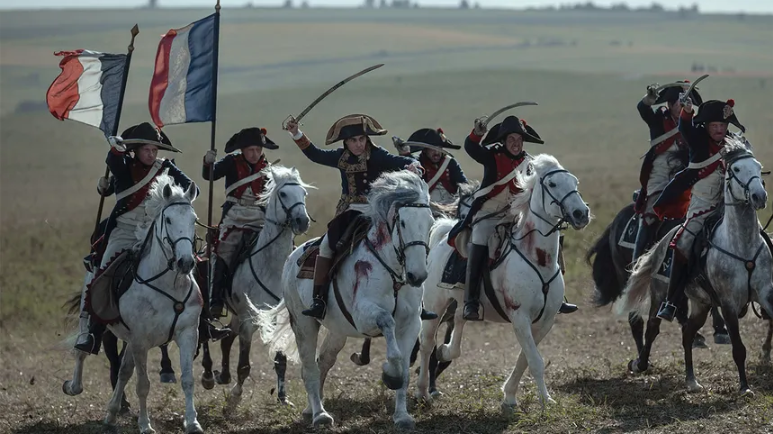
For this week’s musing, I want to comment at least briefly on dust-up surrounding Ridley Scott’s latest film, Napoleon and historians. As was evidently heavily reported, Ridley Scott responded to historians doing critiques of the film’s historical accuracy by telling them to “get a life” and suggesting that the earliest works on Napoleon were the most accurate and that subsequent historians have just progressively gotten more wrong.
I think there are two questions to untangle here: is the film accurate and does it matter? Now I haven’t yet seen the film, I’ve only seen the trailer. But my response to the trailer seems to have been basically every historian’s response to the trailer: Napoleon shows up at all sorts of places, doing all sorts of things he didn’t do. In particular, the battle scenes I’ve seen in the trailer and other snippets bear functionally no relationship to either Napoleonic warfare in general or the Battle of Austerlitz in particular (the bit with large numbers of soldiers drowning in a frozen lake was disconfirmed at the time; the lake was drained and few remains were found).
All of this is not a huge shock. All of Ridley Scott’s historical movies take huge liberties with their source material. Sometimes that’s in the service of a still interesting meditation on the past (Kingdom of Heaven, The Last Duel), sometimes in service of just a fun movie (Gladiator). Ridley Scott, in particular, has never mastered how basically any historical battle was fought and all of the battle scenes in his movies that I’ve seen are effectively nonsense (including Gladiator, which bears functionally no relationship to how Roman armies actually fought open field battles). Cool looking nonsense, but nonsense. Heck, Gladiator‘s entire plot is basically nonsense with some characters sharing historical names and very little else with their actual historical counterparts (the idea of Marcus Aurelius aiming to restore the republic in 180 is pretty silly).
So it isn’t a surprise that Ridley Scott’s grasp on Napoleonic warfare is about at the level of a not particularly motivated undergraduate student or that he has finessed or altered major historical details to make a better story. Its Ridley Scott, that’s what he does. Sometimes it works great (Kingdom of Heaven), sometimes it works poorly (Exodus: Gods and Kings).
Does it matter?
Unsurprisingly, I think that Ridley Scott is being more than a bit silly with his retorts to historians who are using his film as an opportunity to teach about the past. That’s what we do. Frankly, I find the defensiveness of “get a life” more than a bit surprising, as I assumed Ridley Scott knew he didn’t have much of a grasp on the history and was OK with that (or better yet, did have a grasp on it, but chose to alter it; I do not get this sense from his commentary), but it rather seems like he thinks he does know and is now very upset with the D+ he got on his exam and has decided to blame his “nitpicky” professor instead of his not having done the reading.
That said, when it comes to criticism (in the sense of “saying things are wrong“, rather than in the sense of “critical analysis”), I think there is a distinction to make. In the past I’ve framed this as the degree to which works “make the claim” to some kind of historical validity. It might be a fun exercise to talk about the armor in, say, Dungeons and Dragons or The Elder Scrolls and we might even learn something doing that, but neither of those works is making any claim to historical accuracy or rootedness. And so the tenor of the discussion is quite different.
But here I think Ridley Scott is to a significant degree making the claim. Of the battles, Ridley Scott says, “It’s amazing because you’re actually reconstructing the real thing” and that he “started to think like Napoleon”, which is once again both clearly making that claim (“the real thing”) and also just a remarkable thing to say given how much of a mess his battle scenes generally are. He also comments that “the scale of everything is so massive … I’d have 300 men and a hundred horses and 11 cameras in the field” and while that’s far more cameras than were on any Napoleonic battlefield, that’s just not a statement which suggests that Ridley Scott is even very aware of other achievements in recreating historical battles. Gettysburg (1993) had something on the order of five thousand reenactors on the field for filming and it is by no means the largest such effort! Spartacus (1967) had a cast of eight thousand Spanish soldiers to play the Roman legions.
So while I do not know if Napoleon is a good movie or not – I haven’t seen it yet – it seems pretty clear to me that Ridley Scott did make the claim for some of its fundamental historicity and the response of historians has been to reject that claim. And I think it’s actually quite fair to also skewer the apparent whiny arrogance of Scott making that claim baselessly and then responding petulantly when historians handed him that “D+, please come see me after class”. If you want to make historical fiction, by all means do – Scott is very good at it! – but do not be upset if historians call it what it is.
Comments Off on Ridley Scott’s Napoleon


