
Last week’s civil liberties bill was hardly perfect but it’s still a step in the right direction. And, frankly, it’s bonny and startling in equal measure to have a Deputy Prime Minister who says things like this:
“I need to say this — you shouldn’t trust any government, actually including this one. You should not trust government — full stop. The natural inclination of government is to hoard power and information; to accrue power to itself in the name of the public good.”
I’m quite happy to oblige Mr Clegg. I don’t trust this government either. I think it’s intentions are often fine but I doubt whether it has the courage of those convictions. Government necessitates trimming and compromising but the troubling ease with which this crew can be blown off course does not bode well for stormier times ahead. It needs to make a proper — muscular, you might say — defence of its liberalism. Thus far it has been too wimpy by far and, for that matter, too content to try and blame everything on its predecessor. That dog won’t hunt anymore.
Cameron, Clegg, Clarke, Grieve, Gove, Alexander, IDS and so on are, on the whole, decent men with decent ideas. Their government still has a surprising amount of potential and the ability to do some good. But that doesn’t mean they can be trusted.
Alex Massie, “Nick Clegg is Right. Again.”, The Spectator, 2011-02-14
February 15, 2011
QotD: Don’t trust your government
February 14, 2011
The plod may not get around to protecting you, but you’ll be charged if the burglar is hurt while stealing your stuff
Ah, England. Land of green hills, picturesque village pubs, and absolutely daft law enforcement priorities:
A spate of thefts in several towns and villages in Kent and Surrey over the past few months led to many householders taking action to protect their property.
Some have been warned by police that using wire mesh to reinforce shed windows was ”dangerous’’ and could lead to criminals claiming compensation if they ”hurt themselves’’.
Thieves target sheds to steal lawnmowers, power drills, bicycles and a variety of DIY tools.
Thomas Cooper, of Tatsfield, Surrey, used wire mesh to protect three of his garden sheds after two break-ins over the past four years. He decided to take action after reports of a rise in garden raids in the area.
Mr Cooper said: “I reinforced my shed windows with wire mesh, but was told by the police I had to be very careful because thieves can actually sue you if they get hurt.
”It is ridiculous that the law protects them even though they are breaking it.”
It’s getting to the stage that I’m expecting to hear the police in some English town declare that locking your doors and windows will no longer be allowed because of the risks to burglars. That’s only a tiny bit more ridiculous than what they’re already saying.
H/T to Damian Penny for the link.
Update, 2 March: Eugene Volokh does a bit more digging on the original story:
Some readers expressed doubt about the accuracy of the news stories on which I relied, so I e-mailed the Surrey Police Department for more information. Here’s what I learned.
February 9, 2011
LSE to buy TSX
It’s a crafty move, but it’s not clear whether it’s the buyer or the seller being the craftier:
London Stock Exchange Group Plc, the 210-year-old bourse operator, agreed to buy Toronto Stock Exchange owner TMX Group Inc. for about C$3.2 billion ($3.2 billion) in stock as the companies cut costs to counter lost market share. LSE surged to a two-year high.
LSE shareholders will own 55 percent of the company, while TMX investors will hold the rest, the exchanges said today in a statement. TMX shareholders will receive 2.9963 LSE shares for each they own, valuing the Toronto-based company at about C$42.68 a share, 6 percent more than yesterday’s closing price.
Xavier Rolet, LSE’s chief executive officer, will reduce 35 million pounds ($56 million) a year in costs and expand into new businesses such as derivatives as competition from alternative trading platforms increases as do mergers among rivals. His predecessor Clara Furse fought off five takeover offers in two years and bought the operator of the Milan stock exchange. The LSE’s share of U.K. equity trading was 63.8 percent last quarter, compared with 75 percent in 2009, data from the London- based company show.
It could be a way for London to diminish the impact of European rules on their business (by having a non-EU place to land if necessary) or it could be a way for the EU to extend their rule-making to the Canadian market. Or, and this is the least believable scenario, it might just be an ordinary acquisition by a company that happens to run stock markets.
Update: What is presented as a take over in other markets is being positioned (spun?) as a “merger” for domestic consumption:
TMX Group, which operates the Toronto Stock Exchange, and the London Stock Exchange announced Wednesday they are merging to create one of the world’s largest stock exchanges.
The merger, which is subject to regulatory approvals, is unanimously being recommended by the boards of both exchanges.
The merger, if approved, would give the new firm a value of just over $6 billion (Cdn.) and give LSE shareholders just over 50 per cent of the combined company.
TMX Group is valued at $2.99 billion, while the London Stock Exchange Group’s value is slightly higher, around $3.25 billion.
The new company will have the world’s largest number of listing, more than 6,700 companies with an aggregate value of $5.8 trillion, the partners said in a statement early Wednesday.
[. . .]
The company will be co-headquartered in Toronto and London with Xavier Rolet, the CEO of the London Exchange, retaining that position with the new company. The president will be Thomas Kloet, the CEO of TMX. The FO will be Michael Ptasznik, who currently holds the same post with TMX, and the company director will be Raffaele Jerusalmi, the Milan-based CEO of Borsa Italiana.
Expect this deal, even if it eventually gets regulatory approval, to drag on for most of this year.
February 8, 2011
Royal Navy to withdraw patrol from Caribbean
The funding crisis for Britain’s Royal Navy is reported to be the reason for the cancellation of patrols in and around British dependencies in the West Indies:
Britain is to abandon its warship patrols of the Caribbean for the first time since the second world war because of the navy’s funding crisis, the Guardian has learned.
The withdrawal means the navy will no longer provide a warship for anti-narcotic operations in the region, and will have to reduce its role in disaster relief work.
The decision to stop the patrols, which is expected to be confirmed on Tuesday, comes at an embarrassing time for the Ministry of Defence — a documentary series on operations undertaken by the destroyer HMS Manchester in the Caribbean is due to start tonight. The programme on Channel Five follows the ship and crew throughout its seven month deployment last year.
February 4, 2011
As expected, BBC offers apology for Top Gear anti-Mexican remarks
It still won’t change anything:
The BBC has now obliged, with a statement which concedes that while the remarks were “rude” and “mischievous”, there was “no vindictiveness” behind them.
The Corporation continues: “Our own comedians make jokes about the British being terrible cooks and terrible romantics, and we in turn make jokes about the Italians being disorganised and over dramatic, the French being arrogant and the Germans being over-organised.”
It adds that “stereotype-based comedy was allowed within BBC guidelines in programmes where the audience knew they could expect it, as was the case with Top Gear“.
The apology concludes: “Whilst it may appear offensive to those who have not watched the programme or who are unfamiliar with its humour, the executive producer has made it clear to the ambassador that that was absolutely not the show’s intention.”
Indeed, said executive producer apologised personally to señor Medina-Mora Icaza, and we look forward to seeing that meeting on Top Gear in due course, complete with witty commentary from Clarkson, Hammond and May.
February 2, 2011
BBC’s Top Gear team spark hostile response from Mexico
I guess that diplomats must do things like this, but anyone who’s watched more than five minutes of Top Gear would not take them seriously as political commentators. Hilariously funny, yes, but not particularly representative of British or British government views. Mexico, however, has chosen to take offense and has sent a demand to the BBC for a formal apology:
The irreverent British motoring show “Top Gear” has driven into diplomatic hot water after a host branded a Mexican car “lazy, feckless and flatulent” and said it mirrored Mexico’s national characteristics.
Mexico’s ambassador to Britain fired off a letter to the state broadcaster protesting the show’s “outrageous, vulgar and inexcusable insults” and demanding an apology.
In the episode, host Richard Hammond likened a Mexican sports car to “a lazy, feckless and flatulent oaf with a mustache, leaning against a fence asleep, looking at a cactus with a blanket with a hole in the middle on as a coat.”
Co-host James May went on to describe Mexican food as “like sick with cheese on it,” or “refried sick,” while Jeremy Clarkson predicted they would not get any complaints about the show because “the ambassador is going to be sitting there with a remote control, snoring.”
I’m sure the BBC will provide the requested apology, but I doubt that it will change anything. Top Gear without the over-the-top commentary would be just another bloody car show.
UK government trying to further economize on helicopters for Afghan service
Lewis Page is concerned that, on top of the wrong-headed approach to cutting military costs, the coalition government may further reduce the Chinook helicopter plans:
In its last months in office, the previous Labour government announced plans to order 22 new Chinook helicopters (in addition to two which would replace recent combat losses in Afghanistan). The money was to be found by cutting squadrons of fast jets — in particular, Tornado low-level deep strike bombers. The first 10 helicopters were to come into service in 2012-13.
On arrival in office the Coalition carried out a Strategic Defence Review, personally supervised by Prime Minister Cameron, in which it was decided that the Tornado bomber fleet would be preserved intact, the Chinook order would be cut to just 12 — and, controversially, that the Harrier jumpjet fleet would be scrapped entirely.
Even the much reduced Chinook order has so far failed to actually be signed, and there have since been suggestions that the Ministry of Defence financial assumptions which underlay the Review were too optimistic – thus, that more cuts might be required.
February 1, 2011
A nasty bureaucratic trick
Jon, my former virtual landlord, sent along this link describing it as a “creative solution”:
An immigration officer tried to rid himself of his wife by adding her name to a list of terrorist suspects.
He used his access to security databases to include his wife on a watch list of people banned from boarding flights into Britain because their presence in the country is ‘not conducive to the public good’.
As a result the woman was unable for three years to return from Pakistan after travelling to the county to visit family.
The tampering went undetected until the immigration officer was selected for promotion and his wife name was found on the suspects’ list during a vetting inquiry.
The Home Office confirmed today that the officer has been sacked for gross misconduct.
Because these lists are easy to get added to, but nearly impossible to get removed from (and there’s little chance you get told why you’re on the list — or even if you’re on it), this little trick could have continued indefinitely until the perpetrator had to go through security screening for a higher position.
January 29, 2011
A bit of history, from a Yeoman Warder at the Tower of London
H/T to Craig Zeni for the link.
January 27, 2011
UK government officials implicated in ADE-651 bomb detector scam
Remember the ADE-651? The bomb detector that could “detect elephants, humans and 100 dollar bills”? It now appears that British army personnel and civil servants were involved in the effort to sell the bogus device:
The government has admitted that the Army and UK civil servants helped market so-called “bomb detectors”, which did not work, around the world.
Export of the “magic wand” detectors to Iraq and Afghanistan was banned on 27 January 2010 because of the threat they posed to British and allied troops.
The move followed a BBC Newsnight investigation showing they could not detect explosives — or anything else.
Now Newsnight has learned that they are still being sold around the globe.
You can understand the attraction to potential scammers, as the things cost £11 to make (at most) and can be sold for £15,000 to unsuspecting dupes (or willing accomplices, splitting the profits) representing foreign governments.
New entrant into the “Security Theatre Kabuki Hall of Fame”
Step forward, our first inductee for 2011, Gatwick Airport security staff:
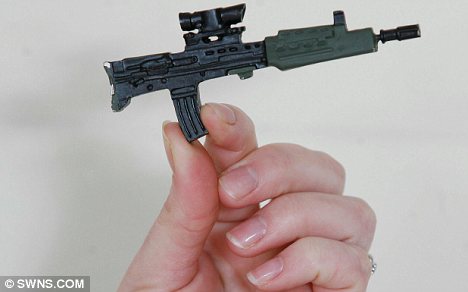
Airport officials ordered a holidaymaker carrying a toy soldier onto a plane to remove its three-inch gun — because it was a safety threat.
Ken Lloyd was stunned when he was told he could not go on the plane with the nine-inch model soldier because it was carrying a ‘firearm’.
The Canadian tourist and his wife had bought the toy, which holds a replica SA80 rifle, during a visit to the Royal Signals Museum at Blandford Camp in Dorset.
Well caught, security super-heroes! Here’s the vicious piece of deadly weaponry they bravely prevented from being smuggled aboard the plane:
Grounding the Nimrod
It’s as predictable as night following day: for every defence cut, you can find retired senior officers getting up on their hind legs and protesting:
Scrapping the RAF’s Nimrod surveillance aircraft will leave a “massive gap” in British security, former defence chiefs warned today.
The controversial decision to get rid of the £4bn fleet was taken on cost grounds as part of the government’s strategic defence and security review last year.
With the process of breaking up the equipment set to begin, a number of service chiefs signed an open letter to the Daily Telegraph warning of the dangers of the move.
“Machine tools have been destroyed; several millions of pounds have been saved but a massive gap in British security has opened,” the letter said.
“Vulnerability of sea lanes, unpredictable overseas crises and traditional surface and submarine opposition will continue to demand versatile responsive aircraft.
There was a number in there that helps to explain the cuts: £4bn. That’s a lot of money. What did the RAF get for their money? In a column from 2009, here’s Lewis Page on the manifold wonders of the Nimrod:
Quite apart from all that, the Nimrod MR2 — being a flying antique — is horribly expensive to run, both in money and in lives. The MR2’s extensive use above Afghanistan in recent times as a flying spyeye and to relay radio messages between ground units in no way justified its continued, very expensive existence; far less could such unimportant work possibly have justified the known risks of refuelling these aged birds in mid-air.
So getting rid of the MR2s loses us nothing important, and will make our service people noticeably safer — the Nimrod has actually killed one of our people for every 15 killed by the Taliban. Better still, this will permit another pricey airbase here in the UK to largely close, saving money to be spent at the front line. As a fringe benefit, the base in question — RAF Kinloss — is in a Scottish National Party constituency, giving people there a taste of the independence from the UK that they have voted for. (Strangely the local SNP member of parliament still isn’t happy.)
So the Nimrod was expensive to buy, eye-wateringly expensive to upgrade, but it must be cheap to operate, right? No:
[. . .] our new fleet of refurbished De Havilland Comet subhunters (sorry, “Nimrod MRA4s”) will cost at least £700m a year to operate. If we put the whole Nimrod force on the scrapheap for which they are so long overdue right now, by the year 2019 we will have saved [. . .] £7bn
That’s from an earlier column in 2009.
Update: Lewis Page says that scrapping the four Nimrods is great news:
The UK press is bursting with indignation today as the process of scrapping the Nimrod MRA4 submarine-hunting aircraft begins. But in fact the four planes now being broken up were a financial and engineering disaster. Had they gone into service they would have become a terrible, cripplingly expensive millstone around the neck of the Ministry of Defence. We are much, much better off without them.
[. . .]
What the ex-brasshats are bemoaning is the UK’s loss of long-range maritime patrol aircraft in general, not the Nimrod MRA4 in particular. They’re wise to draw this distinction, as the MRA4 project has now achieved the unwelcome distinction of producing the most expensive aircraft ever made: with a reported £4.1bn spent, just one is airworthy.
By comparison, a new Space Shuttle would cost about £1.75bn at current rates if it were built today. Even the staggeringly expensive B-2 nuclear Stealth bombers only cost £1.3bn apiece.
Our sole flying Nimrod MRA4 (pictured above) has wound up costing us no less than £4.1bn — and it is not even a new aircraft. All the MRA4s are refurbished and re-equipped Nimrod MR2s, which had already been purchased by the RAF long ago at inflated prices.
But wait . . . it gets even worse:
And make no mistake, scrapping the Nimrods will save money — a lot of money. Support and maintenance of a normal military aircraft can be expected to cost two to three times the acquisition price over its service life — and the Nimrod was far from normal.
In fact, the MRA4s would have been the last nine De Havilland Comet airliner airframes left flying in the world. The Comet, designed in the 1940s, failed commercially and went out of airline service many decades ago — and since then large aircraft have no longer been made in the UK.
The Nimrod/Comet is so old that it belongs to a lost era of manufacturing: this is the main reason why the MRA4 project was so horrifically late and over budget. The planes supplied for upgrading by the RAF had significant differences in size and shape — they had been essentially coach-built, bodged together with the blueprints used more as a guide than followed with any accuracy in the modern sense. Trying to rebuild, re-equip and re-engine them, with no real idea what the physical dimensions and internal layout of any given plane actually were, was a technical nightmare.
January 26, 2011
Be careful with your old, tired URLs
The very first domain name I registered ended up getting hijacked: the ISP I was using got taken over by someone else, and they arbitrarily changed all the contact info for my domain to point to them instead. The domain expired (no notice to me), the grace period for renewal expired (again, no word to me), and suddenly the historical society’s domain name is now a porn site (slightly longer original story here).
That’s why I have some sympathy for this British MP who linked to a site promoting a local concern, which then became a German porn site:
Red-faced Tory MP Francis Maude last night denied all responsibility for the content of a German SmutSite — and then quietly removed a link to it from his own personal front page.
The embarrassment seems to have arisen after Francis Maude, the member for Horsham, and Henry Smith, MP for neighbouring Crawley, got together to sponsor a campaign for an acute hospital to be built in the Pease Pottage area of Sussex. The campaign registered and made use of a domain — c4pph.org (NSFW) — which certainly appears at one time to have been a perfectly respectable site campaigning on this issue.
However, as an official spokeswoman for Francis Maude told us last night: “The campaign … no longer owns or operates the c4pph.org web address and hasn’t done so since last year. We understand the domain name is now under new ownership with no connection to the campaign.”
January 19, 2011
Hollywood gets exposed to “the nihilism of the British way”
Did you watch the Golden Globes awards the other night? I didn’t, but I rather enjoyed watching Ricky Gervais do his introduction (courtesy of YouTube and literally hundreds of contributors). It may be one of the larger gaps between image and reality . . . the way Americans think Brits talk and how they slag one another off:
Anyone from anywhere can be cruel, anyone from anywhere can be witty, but there is something particularly British about cruel wit. John Lennon, with his withering remarks about Ringo Starr (“Not even the best drummer in The Beatles”) and the avant-garde (“French for bullshit”), had it. Writers past (Evelyn Waugh) and present (AA Gill) have it. George Osborne, the chancellor of the exchequer, has it, and gets into political scrapes when he flaunts it.
The anything-goes approach applies as much to everyday conversation as it does to comedy, where the subject of British irreverence has been analysed to death (and where America has plenty of acid-tongued geniuses itself). It feels natural to those of us who grew up with it, but British banter — the playfully barbed conversational style adopted by groups of friends in bars, offices and even classrooms up and down the country — can baffle and perturb foreigners. It is especially jarring when set against the popular image of Britain as a more decorous and civil place than most. Even tamer badinage in this country can, to a foreign ear, sound like enmity. The moment the ice is truly broken between two newly acquainted Britons is when one teases the other about something. Reginald D Hunter, an American comedian who does most of his work over here, says Britain is the only country where people will introduce you to a friend by saying “This is my mate Barry, he’s a bit of a twat.”
America is a land of Regency etiquette in comparison. So much so that it pays any Briton to be a bit more mindful of what he says and how he says it when enjoying the company of Americans (with the exception of fervently Anglophile Americans who, judging by friends of mine who fit that description, are caustic conversationalists). The rules are just different. For example, the c-word, which in Britain has lost much of its toxicity, remains a no-no.
January 17, 2011
Another reason to view self-reported study data with caution
There’s a reason that studies that depend on direct observation/measurement often differ in their results from studies that depend on self-reporting by the group being studied — because people lie:
Many mothers are under so much pressure to appear like perfect parents that they cover up how much television their children watch or what they cook their families, according to a survey.
Such “white lies” also extend to how much “quality time” mothers spend with their partner, website Netmums said its survey of 5,000 people suggested.
The parenting site said mothers often made each other feel “inadequate”.
[. . .]
Almost two-thirds of those surveyed said they had been less than honest with other mothers about how well they were coping and almost half covered up financial worries.
Almost a quarter of mothers admitted to downplaying how much television their children actually watched — and one in five “span a yarn” over how long they played with their children.


