
More about this programme: http://www.bbc.co.uk/programmes/b018ttws Sherlock returns but will things ever be the same again?
August 3, 2013
Sherlock Series 3 Teaser Trailer
Comments Off on Sherlock Series 3 Teaser Trailer
August 2, 2013
The self-inflicted wounds of Britain’s post-war auto industry
Dominic Sandbrook contrasts the rise of the German auto industry from the literal rubble of the post-war world with the slow decline of Britain’s once-mighty car makers:
If you want to know why Angela Merkel calls the shots in Europe, Germany’s car factories are a pretty good place to start.
By contrast, Britain’s car industry is a shadow of its former self. We do still make almost one and a half million cars a year, which is good news for thousands of British engineers. But these days, we make them for other people.
The iconic Mini plant at Cowley, for example, is celebrating its centenary this year. It was founded in 1913 by the entrepreneur William Morris as the home for his legendary Morris Oxford.
Today it still makes thousands of cars — but it makes them for BMW.
It’s a similar story at Crewe, the home of another great British icon, Bentley – which actually belongs to Volkswagen.
Half a century ago, let alone when Morris was at his peak, this would have seemed unimaginable. But the sad truth is that Britain’s car firms only have themselves to blame.
Seventy years ago, at the end of World War II, Germany was on its knees. After the fall of Hitler’s empire, its car industry lay in ruins.
In August 1945 the British Army sent a major called Ivan Hirst to take control of the giant Volkswagen plant in Wolfsburg, which had been built under the Nazis to produce ‘people’s cars’ for the German masses.
Ignoring his sceptical superiors, Hirst could see the potential amid the shattered debris of the Wolfsburg factory.
Rebuilding Volkswagen, he thought, would be a step towards rehabilitating Germany as a prosperous, peaceful European ally. And of course he was right.
In the next few years, Hirst restarted production of a car we know today as the Beetle. And from then on, VW was flying.
Comments Off on The self-inflicted wounds of Britain’s post-war auto industry
August 1, 2013
Stereotypes of pornography consumers
James Delingpole had far too much fun writing this column:
You may be aware that David Cameron — as part of a secret, Lynton Crosby-inspired operation codenamed Suck Up Shamelessly To The Embittered Authoritarian Killjoy Harpies At Mumsnet — has decreed that as from next year the default option when you sign a contract with your new internet provider will be ‘No porn in this household, thank you. I think it’s a disgrace.’
Superficially (and does this coalition ever think any other way?) I can see this makes a lot of sense. After all, what do a growing national debt, falling living standards, rising inflation, skyrocketing energy prices, out-of-control immigration, Weimar-style money-printing, a burgeoning new housing bubble, a failed health service and a collapsing infrastructure matter when you’ve got the most important problem of our times, so to speak, in hand, viz. blokes sneaking a quick one off the wrist while their missus has popped down to Waitrose to stock up on Mabel Pearman’s Burford Brown eggs, Isigny Ste Mere unsalted butter and that Duchy Originals cider on special offer at just £1.45 a bottle?
According to James, nowadays women are about as likely to go looking for pornography on the internet as men are:
But according to some of my techie friends, this isn’t the case at all. They’re the ones who have to clear up all the viruses which you accidentally invited into your computer along when you were trying to Google the weather and mistakenly typed in ‘Romanian donkey babes xxx hardcore’ instead.
Here’s what one of them has to say: ‘The very worst I came across was a shared houseful of young ladies. It took over eight hours to do just the first pass with the antivirus software. That pass removed over 58,000 pieces of malware and spyware, and just under 2,000 viruses. It took all the next day to finish cleaning their computer. I told them it was the worst case of an infected computer I had ever come across, and one asked how it had happened for it to be so bad. Easy I said. Porn sites. They all went bright red and then the hilarity ensued, as the finger pointing started.’
[…]
I realise, of course, that there are still plenty of puritans out there who feel differently. To them I quote first Thomas Sowell: ‘What is ominous is the ease with which some people go from saying that they don’t like something to saying that the government should forbid it. When you go down that road, don’t expect freedom to survive very long.’ And second, Pastor Niemoller: ‘First they came for the wankers…’.
Comments Off on Stereotypes of pornography consumers
QotD: Banksy and the lumpenintelligentsia
Better still is Banksy’s satirical picture, this one on a wall in London’s Essex Road, of two small children pledging allegiance, with hand on heart, to a Tesco plastic bag on a flagpole — actually an electric cable — being run up like a flag by a third child. Tesco is Britain’s largest supermarket chain, and its plastic bags, white with blue stripes and red lettering, litter the countryside, often flapping from trees or disfiguring hedgerows.
Of course, Banksy, as a spoiled child of a consumer society in which real shortage is unthinkable, has all the unexamined anticapitalist prejudices of the lumpenintelligentsia to whom he appeals. But it would be wrong to dismiss the satire of this image out of hand. Tesco, after all, issues a “loyalty card” called a Clubcard; every customer is asked at the checkout, now sometimes by machine, whether he has such a card. The card’s name implies that shopping repeatedly in the stores of one giant corporation rather than in those of another, in the hope of a small price rebate, constitutes membership in a club. You don’t have to be anticapitalist to think that such an idea debases the concept of human clubbability. (In the same way, the word “solidarity” is degraded in France by its association with the payment of high taxes extracted from citizens by force of law.) It is no new thought — but not therefore a false one — that at the heart of consumer society is often a spiritual vacuum, at least for many people. They fill the vacuum with meaningless gestures, such as loyalty to brands almost indistinguishable from one another. I have known murder committed over brands of footwear. Banksy’s image captures, both succinctly and wittily, the vacuum and what fills it.
You also don’t have to be anticapitalist to acknowledge that the power of corporations like Tesco is not altogether benign. The small and beautiful town in which I live when I am in England illustrates this. When my next-door neighbor decided to restore and redecorate his house, which dated from 1709, the local council’s conservation department demanded that the new lead flashing on his roof, invisible from the street, be stamped with a design of bees, presumably because it had been so stamped at some time in history. Certainly conservation is important and cannot be left entirely to individuals. But why was my neighbor bullied in this fashion when Tesco was permitted to open a store not 100 yards away with a frontage completely out of keeping with the town — an eyesore that affects the town’s aesthetic fabric infinitely more than the absence of bees on my neighbor’s invisible lead does? The great majority of British towns have been ruined aesthetically in a similar way, their main streets becoming dispiritingly uniform and ugly, no doubt through some combination of corporate power, bribery, and administrative incompetence. Bullying people like my neighbor is perhaps the officials’ overcompensation for their cowardice or dishonesty in the face of corporations. Banksy’s image therefore has some satirical depth to it.
Banksy’s attitude toward authority and property rights is the standard hostility of the lumpenintelligentsia. Here he is particularly hypocritical because, while maintaining that pose of hostility, he employs lawyers, owns private companies, and is reputed to be highly authoritarian in his dealings with his associates. Inside every rebel, goes the saying, there’s a dictator trying to get out.
Theodore Dalrymple, “The Discriminating Philistine: Banksy’s wit and talent don’t excuse his vandalism and juvenility”, City Journal, 2013-06
Comments Off on QotD: Banksy and the lumpenintelligentsia
July 29, 2013
Spanish border guards stage virtual blockade of Gibraltar
The Spanish claim to Gibraltar is being pursued by other means, it would seem:
Spanish police stopped every one of 10,000 vehicles leaving Gibraltar for the mainland yesterday, causing six-hour traffic jams in the latest escalation in the standoff over the Rock.
Officers from the Royal Gibraltar Police were forced to impose diversions and create beachside holding areas as Spanish authorities ‘choked’ the border, causing massive tailbacks in 30C heat.
It was the second day that border guards had blocked links to the mainland, in a move that seemed calculated to bring Gibraltar to a standstill.
[…]
Most recently Spanish fishermen sparked a stand-off with the Royal Navy as they attempted to disrupt the creation of an artificial reef in the Bay of Gibraltar last week.
The fishermen used fast boats to weave in between British vessels involved in the reef-laying operation in a bid to create large waves to disrupt the work, the Sunday Express reported.
Intervention by a Royal Navy patrol boat brought an end to the protests. A Gibraltar government spokesman has accused Spain of launching the ‘draconian’ border checks which continued yesterday in ‘retaliation’.
He said the decision to lay the reef, which consists of large concrete blocks sunk to the bottom of the bay, had been taken on environmental grounds.
However, he added, it had infuriated Spanish fishermen since it would also foil any attempts by their vessels to carry out illegal trawling of the bottom of the Bay of Gibraltar.
Criticising the Spanish government’s response, the spokesman added to the Sunday Express: ‘Not only are these measures affecting thousands of innocent Spanish workers who make their living on Gibraltar, but we are extremely concerned about pensioners and families with young children being forced to suffer in this way just because they want to visit the mainland.’
Comments Off on Spanish border guards stage virtual blockade of Gibraltar
July 24, 2013
Anti-porn UK MP gets hacked, threatens reporter who publicized the hack
Apparently British Conservative MP Claire Perry doesn’t know a lot about the way the internet works, despite being described as an “architect” for David Cameron’s proposed porn blocker:
Claire Perry is the UK Tory MP who architected David Cameron’s idiotic national porno firewall plan. Her website was hacked and defaced with pornographic gross-out/shock images. When Guido Fawkes, a reporter and blogger, wrote about it on his website, Perry took to Twitter to accuse him of “sponsoring” the hack, and publicly announced that she would be speaking to his editor at the Sun (Fawkes has a column with the tabloid) to punish him for writing about her embarrassment.
Perry is so technologically illiterate that she can’t tell the difference between writing about someone hacking your website and hacking itself. No wonder she’s credulous enough to believe the magic-beans-peddlers who promise her that they’ll keep porn off the British Internet — a feat that neither the Chinese nor the Iranian governments have managed.

Comments Off on Anti-porn UK MP gets hacked, threatens reporter who publicized the hack
Colby Cosh on the constitutional monarchy
I suspect Colby will be getting lots of hate mail from republicans after this column:
The secret of constitutional monarchies is not that they indulge the dynastic impulse, but that they have found a means of circumscribing it without losing the advantages. Chief amongst these, I think, is a sense of historical continuity: we still so clearly remember the new prince’s gin- and horse-loving great-great-grandmother, born in the reign of Victoria, and now comes R.B. himself, unlikely to warm the chair of St. Edward until even the youngest of you reading this are pensioners (if you’re lucky, and if “pensions” are still a thing). It provides a natural, almost enforced occasion for a species of “long now” panoramic, intergenerational thinking that various nerds and hucksters like to profit from.
It’s true that a domestic Canadian dynasty would do that job about as well, and this is the source for much of the odium in which our system is held by republicans. Dammit, Royal Baby isn’t even Canadian Royal Baby! Barring the overthrow of our Constitution, we are never likely to have a “Canadian” head of state who has grown up entirely amongst us. When you are finished having a cry about that, I would suggest reflecting upon the possible benefits: an indigenous Canadian head of state would have to be some particular person, wedded to one of our regions and official languages and political tribes and social classes and, indeed, component nations. Surely there is some merit in having ultimate last-resort legitimacy — an important plus of monarchy, as the Second World War taught — vested in an outsider. Maybe every country should have a king or queen from somewhere else, someone extremely intimate with its constitutional traditions and language but otherwise neutral; rooted, for safety, in other soil.
Or maybe that is the dumbest idea you’ve ever heard. But republicans do need to take the “particularity” factor into account in weighing their long-term chances. Until the debate over the fundamental Constitution gets serious, the choice is “imaginary elected president from my personal fantasies, perhaps a genetic cross between Barack Obama and Justin Timberlake” versus “actual living family that has had various difficulties and embarrassments.” This is inherently good ground for anti-monarchists to fight on, but only when there is no actual fight.
If we had an Australian-style referendum on the monarchy, the republicans would not only have to present an actual alternative system for criticism — which is what befouled the hopes of Australian republicans — undecideds would also be obliged to start imagining a world in which the personal fountainhead of political legitimacy might end up being Don Cherry or Rob Ford or George Stroumboulopoulos. I personally will take my chances with little R.B. God save the Queen.
Comments Off on Colby Cosh on the constitutional monarchy
July 23, 2013
Future monarchs and present-day “republicans”
As you may have noticed, I haven’t devoted any space on the blog to coverage of the Duke and Duchess of Cambridge and their son. It’s not that I’m a rabid republican — I’m as much of a mild monarchist as a libertarian can be. What I have found even more tedious than the celebrity pregnancy coverage of the royal baby is the spitting and moaning coming from the “republican” side. Brendan O’Neill (a noted republican) points out that the moaners don’t actually represent real republicans:
So, the royal baby is finally here, and across Blighty the little people will have made themselves virtually bald through frenzied forelock-tugging, or perhaps busted their backs by bowing and scraping before their mewling future king. At least, that’s the impression that has been given by a certain breed of observer, the ironically public-allergic republicans who seem to hate the monarchy primarily because of the behaviour and emotions it induces in the plebs. Once, being a republican meant trusting the public (the clue was in the name) and believing it had the capacity to think and act rationally. Today, if the ostentatious chattering-class wailing about the mob hysteria over Kate’s baby is anything to go by, it means the opposite — it means despairing of the public and shaking a snobby head over its Stepford-like enthralment to all things monarchical.
As soon as it was announced that Kate was expecting, these shallow republicans started bemoaning the mass hysteria that would ensue. Britain will once again become ‘a nation of forelock-tuggers’, clever broadsheet people warned. Apparently, ‘forelock-tugging is all the rage’ in this supposedly modern nation, where the daft blob formerly known as the public is being kept non-angry about the recession and other horror stories through being dripfed info about Kate, Wills and their baby. In the words of the Mirror’s poetic Brian Reade, ‘Our austere country need not grieve, for Wills’ missus can conceive’. That has been the central message of most of the apparently rad commentary on Kate — that the plebs are easily bought off with photos of a pregnant princess and smiling prince. One columnist wrote of the ‘ready-to-whoop peasants’ waiting for news of Kate’s babe. A writer for the Independent said of Kate’s pregnancy, ‘Everyone laps it up… it makes plebs of us all’.
[…]
There are two annoying things about all this. The first is that it’s plain wrong to depict today’s media and public interest in Kate’s baby as a resuscitation of old-world royalist sentiment. Most of the public relates to Kate in the way they relate to celebs — not as a godly bearer of a babe whom we will one day bow before, but as another preggers celeb in nice clothes we can read about in our spare time; a posher Kim Kardashian, if you will. The House of Windsor has self-consciously cultivated a celebrity image for itself in recent years, sensing that its old imperial, mysterious, God-derived powers and so-called right to rule are on the wane in this era of profound crisis for traditionalism, and that celebrity is now a far more powerful source of authority than kingliness. Indeed, the popularity of Kate as just another celeb, albeit a super-A-list one, speaks to the moral diminution of monarchism as it was once understood, to the emptying-out of its alleged magic and power, not to its rehabilitation.
And secondly, this pleb-mauling republicanism is not republicanism at all. It is very often fuelled by an anachronistic desire to protect Kate from the prying eyes of the princess-hungry throng. We are putting poor Kate in a ‘gilded cage’, lefty columnists fret. Others claim we are hounding her — we have clearly ‘learned nothing since Princess Diana’. It’s a very odd republicanism which feels empathy for individual members of the royal family and disdain for the public. For me, editor of the uber-republican spiked, republicanism is not about sneering, but rather is about engagement, taking ourselves and the public seriously, talking about how society should be run, and by whom. And as the American revolutionary John Adams said, pursuing such republicanism means believing the public can be ‘sufficiently enlightened to disabuse themselves of artifice, imposture, hypocrisy and superstition’. Sadly, too few British republicans believe that these days.
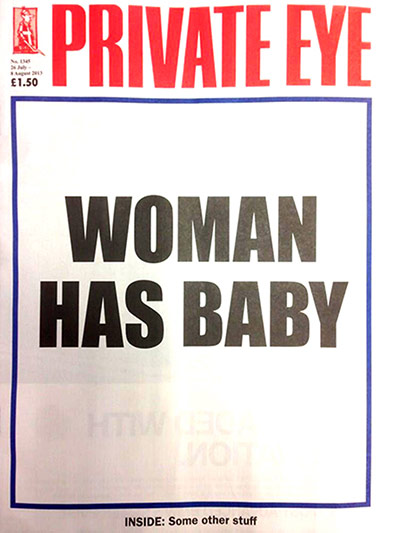
Full points to Private Eye for their royal baby cover:
Update: Charles Stross — another republican — has an almost sympathetic view of the new prince’s future:
The kid is not going to have anything remotely approaching a normal life. For one thing, under current UK law, he isn’t eligible to vote. His ultimate career path is already known and if he doesn’t want to put up with it, tough: the pressure to conform to expectations is enormous — he was born under a life sentence. When he ends up in that final occupation he won’t even be eligible for a passport (for long and complex constitutional reasons). He’s going to be the subject of paparazzi attention for the rest of his life. He’s almost certainly going to be sent to a private boarding school of some variety (probably Eton, as with his father), to ensure that he’s exposed to normal people (for “public schoolboy” values of normality); this is normal for the royal family, and it’s worked on previous generations. The usual recipe is for it to be followed by university, then officer training in one of the branches of the military, before joining the Old Firm and learning the onerous duties of public ceremonies and diplomatic receptions. The royals get a particularly brutal work-out in return for their privileges: what other family business would expect an 87 year old great-grandmother to make over 400 public appearances per year?
But those are the traditional parameters of a crown prince’s upbringing. This prince is going to find things a little different because he’s going to be the first designated future British monarch to grow up in a hothouse panopticon, with ubiquitous surveillance and life-logging …
I expect there to be Facebook account-hacking attacks on his friends, teachers, and associates — and that’s just in the near term. He’s going to be the first royal in the line of succession to grow up with the internet: his father, Prince William, was born in 1982 and, judging by his A-level coursework, is unlikely to have had much to do with computer networking in the late 1990s. This kid is going to grow up surrounded by smartphones, smart glasses (think in terms of the ten-years-hence descendants of Google Glass), and everything he does in public can be expected to go viral despite the best efforts of the House of Windsor’s spin doctors.
Comments Off on Future monarchs and present-day “republicans”
July 20, 2013
UK government inches closer to giving posthumous pardon to Alan Turing
In the Guardian, Nicholas Watt updates the news on a private member’s bill that would give Alan Turing a pardon:
Alan Turing, the Enigma codebreaker who took his own life after being convicted of gross indecency under anti-homosexuality legislation, is to be given a posthumous pardon.
The government signalled on Friday that it is prepared to support a backbench bill that would pardon Turing, who died from cyanide poisoning at the age of 41 in 1954 after he was subjected to “chemical castration”.
Lord Ahmad of Wimbledon, a government whip, told peers that the government would table the third reading of the Alan Turing (statutory pardon) bill at the end of October if no amendments are made. “If nobody tables an amendment to this bill, its supporters can be assured that it will have speedy passage to the House of Commons,” Ahmad said.
The announcement marks a change of heart by the government, which declined last year to grant pardons to the 49,000 gay men, now dead, who were convicted under the 1885 Criminal Law Amendment Act. They include Oscar Wilde.
Update: On the other hand, Matt Ridley thinks that there’s a major problem with this approach.
That Turing deserved an apology in his lifetime for this appalling treatment is not in doubt. What will be debated tomorrow is whether a posthumous pardon from today’s Government is right, or may be a further insult to his memory. After all, the word pardon implies that his crime is still a crime, which it is not, and it will do nothing for the victim (especially since he was an atheist), and do nothing to untarnish his reputation, which history has already fully untarnished. Also it could be unfair to other, less famous convicted gay men and may even seem to rewrite history rather than leaving it starkly to reproach us. By rights, Turing should be pardoning the Government, but that’s not possible.
So it is not easy to judge if a pardon is the right thing. For my part, I think a greater matter is at issue — whether we have done enough to recognise Turing’s scientific reputation and how we put that right. It becomes clearer by the day that, irrespective of his tragic end and even of his secret war service, he ranks for the momentous nature of his achievements with the likes of Francis Crick and Albert Einstein in the 20th-century scientific pantheon. This was not just a moderately good scientist made famous by persecution; this was the author of a really big idea.
[…]
When the war broke out, Turing’s genius proved as practical as it had been ethereal in the 1930s. His crucial contributions to three successive computing innovations at Bletchley Park — the “bombe” machines for replicating the settings of the German Enigma encryption machine, the later cracking of the naval Enigma machine enabling U-boat traffic to be read, and finally the Colossus computer that broke the Germans’ “tunny” cipher machine — provided Churchill with the famous “ultra” decrypts that almost certainly shortened the war and saved millions of lives in battlefields, ships and camps.
For this he was appointed OBE, but secrecy shrouded his work until long after his death, so he wasn’t known to be a hero, let alone the man who saved so many lives. He moved to what would become GCHQ, but in the paranoid days after Burgess and Maclean fled east, his homosexuality conviction categorised him as a security risk.
Comments Off on UK government inches closer to giving posthumous pardon to Alan Turing
July 17, 2013
Matchbox cars at 60
While my childhood toys revolved more around Airfix 1/72nd scale soldiers and Lego blocks (to provide the necessary terrain for the soldiers to fight over), I had a modest collection of Matchbox cars. After reading this article, I realize that if I’d only had the foresight to keep them in their original packaging and never actually playing with them I’d have the core of an expensive collection on my hands (I’d also have completely missed the whole notion of “fun”, but that’s a separate issue):
The concept of these tiny die-cast models was the response of a father, Jack Odell, to a rule at his daughter’s school stating that pupils were only allowed to bring in toys that would fit inside a matchbox. Odell, a school dropout who later joined the Royal Army Service Corps, was by this time working for a die-casting company, Lesney Products (itself set up by two British ex-servicemen, Leslie Smith and Rodney Smith in 1947). Working out of a bombed-out Tottenham pub called The Rifleman, Lesney spent the early Fifties moving away from producing small products for industrial use towards making die-cast toys. Believing this direction to be a lost cause, Rodney Smith quit the company in 1951, leaving it in the hands of Leslie Smith and Odell, who was by then a partner.
A year later Odell had his brainwave, creating a scaled-down version of an existing Lesney toy, the model road roller, packaging it in a matchbox and sending it with his daughter to school. It was an instant hit: with his little toys, Odell was on to something big.
[…]
Matchbox, along with Corgi and Dinky, turned Britain into the dominant force in die-cast models. In the Sixties, Lesney would become the fourth largest toy company in Europe, with 14 factories in and around London producing more than 250,000 models a week. By the end of the decade Matchbox was the biggest-selling brand of small die-cast models in the world.
To date, there have been more than 12,000 individual model lines, and total production exceeds three billion. If placed bumper-to-bumper they would circle the Earth more than six times — assuming they could be prized from the possessive fingers of their owners.
H/T to Blazing Cat Fur for the link.
Comments Off on Matchbox cars at 60
July 15, 2013
Going north to gawp at the natives
Brendan O’Neill on a modern phenomenon:
Normally when a white, middle-class, well-educated Brit wants to rub shoulders with a noble savage, he heads off to Kenya to gawk at the Masai dutifully dancing for his chin-stroking entertainment, or he spends a couple of weeks in Palestine to watch brown people picking olives under the yoke of Israeli intimidation. Not Owen Jones. The Independent’s Left-wing columnist has found an altogether cheaper way to mix with earthy, “authentic” tribes: by hopping on a train to Durham and spending a few hours in the company of that grizzled, largely defeated caste of people known as Miners.
At the weekend Mr Jones spoke at the Durham Miners’ Gala, and the whole thing revealed how anthropological the modern radical Left has become, the extent to which youthful Leftists now treat working-class people as exotic creatures in a political zoo to be photographed and patted. The gala was embarrassingly described by that high priest of chattering-class values, Giles Fraser, as being all about “the banners, the bands and the beer”, a means for former mining communities “colourfully to proclaim [their] nobility”. They’re the salt of the earth, these rough-handed northerners, and no mistake! According to a Sky News report, Mr Jones “spoke for the people”. What people? The London-based media professionals he hobnobs with?
Mr Jones and his media friends treated Durham’s miners the same way other middle-class youngsters treat villagers they happen upon in a rural bit of Rwanda: as intriguingly and effortlessly decent, noble creatures who one must simply be photographed standing next to. They tweeted pics of themselves with these cute creatures. In his speech, Mr Jones referred to the miners as “ordinary working people” (ordinary: “regular, normal, customary” — OED) and said these poor, grafting folk are often “faceless, forgotten, ignored”. Not any more — now they’re all over Twitter and Facebook and are having their nobility celebrated in the Guardian, courtesy of their middle-class, Dickensian patrons down in London.
It’s so extraordinarily patronising. To these anthropological daytrippers, Durham is little more than a Potemkin village, existing primarily as a symbol of something or other rather than as a real place. Perhaps we shouldn’t be surprised that Mr Jones takes this borderline caring/haughty approach to working people. After all, by his own admission his entire career in radical journalism was triggered by feelings of pity for the working classes, or, as he calls them, “the vulnerable” who inhabit “conquered” communities.
Comments Off on Going north to gawp at the natives
If you’re bored with the Stratfordians versus Oxfordians, here’s a new debate
In the Guardian, Saul Frampton looks at the First Folio edition of Shakespeare’s works:
Sometime in 1623, seven years after Shakespeare’s death, the actors John Heminges and Henry Condell published Mr William Shakespeares Comedies, Histories, & Tragedies — what we now know as the First Folio. It was the literary event of the century, recording for all time the sound of Shakespeare’s English and the sweep of his imagination: Elsinore, Egypt and the Forest of Arden; a balcony, a spotted handkerchief and a skull.
Yet despite this shrine to Shakespeare’s memory, erected by those who knew him, sceptics have continued to doubt his authorship of the plays. He was, they insist, inadequately educated, insufficiently travelled, and didn’t know how to spell his own name. A range of alternative candidates have come and gone over the centuries, including Anne Hathaway, the Jesuits, and more recently Edward de Vere, the 17th Earl of Oxford, the subject of Roland Emmerich’s film Anonymous. As always, conspiracy is more fun than consensus, and the doubters have the internet on their side. Shakespeare has thus become the focus of a global conspiracy industry, joining company with reptilian elites, self-destructing lightbulbs and skeletons on the moon.
Scholars have recently fought back against this scepticism, however. Books such as James Shapiro’s Contested Will and Paul Edmondson and Stanley Wells’s Shakespeare Beyond Doubt marshal facts, allusions and funeral monuments to prove that Shakespeare did indeed write the plays and poems attributed to him. Or as Iago says at the end of Othello: “what you know, you know.”
So Shakespeare wrote “Shakespeare”. The printing of the First Folio, however, raises another, ultimately more interesting, question. Without the Folio, Shakespeare’s plays — scattered around in playscripts or in smaller quarto editions — might have been lost to posterity. But did Heminges and Condell edit the text?
H/T to Tim O’Reilly for the link.
Comments Off on If you’re bored with the Stratfordians versus Oxfordians, here’s a new debate
July 13, 2013
The state’s constant interest in what’s in your kid’s lunchbag
James Delingpole on the most recent “Nanny knows best” appointee hoping to dictate what the kids are going to eat for lunch:
“Mr Dimbleby”, it seems to me, is coming perilously close to suggesting that the decision as to what children eat at school should be a matter for the State rather than parents. Can he really believe this? Is there nothing about saying this sort of thing that makes him uneasy?
I mean sure, I agree with him on the principle that a good, well-prepared hot meal at lunchtime is probably more filling and nourishing than a packet-bread sandwich and a packet of crisps. Problem is, not all school canteens offer quite the same range and quality you might find in — oh, I don’t know, let’s pluck a random example from the air, shall we? — Bekynton.
Having put children through the state system myself I know whereof I speak. A new caterer arrived at my daughter’s primary school to much fanfare and for a while the food was great and most parents gratefully abandoned packed lunches (which, let me tell you, are a real hassle for a parent to prepare because they have to be done fresh in the morning when you’re already in a rush having breakfast and getting ready for the school run) and welcomed the new regime. But then standards began slipping to the point where my daughter (who, like a lot of children whose staple diet is gastro-porn TV programmes from the Great British Bake Off to Masterchef, genuinely cares about food) couldn’t eat the stuff any more. Again: is “Mr Dimbleby” seriously suggesting that schools should force children to go on eating in the canteen regardless of how disgusting they find the food?
You hear similar arguments from well-heeled progressive types on the school system generally. “If only public schools were abolished and all those pushy middle-class strivers were forced to put their children through the state system, standards would rise across the board.” Well, possibly. What would more likely happen is that all those scrubbed, diligent, nicely spoken, polite young poshos would be dragged down to the level of the lowest common denominator. And in any case it’s not an experiment which has any right being attempted anywhere in a Western notionally free-market economy. Why not? Because it’s illiberal bordering on the totalitarian, is why.
This is hardly a new topic … last year I said:
I remember what kind of crap my middle and high school cafeterias offered … and if I’d forgotten to bring a sandwich with me that day, going hungry always seemed like the better choice. The food on offer always seemed to manage the difficult stunt of being visually unappealing (sometimes being actually disgusting to look at), nutritionally inadequate, and either utterly flavourless (the better choice) or actively nasty. No wonder the best sellers in the cafeteria were the milk cartons (especially the chocolate milk), pop cans, potato chips, chocolate bars, and Vachon cakes (all of which were pre-packaged and relatively invulnerable to further processing).
Comments Off on The state’s constant interest in what’s in your kid’s lunchbag
July 12, 2013
Mapping the latest British defence “disgrace”
Sir Humphrey on the mapping uproar:
Several UK newspapers reported this week the findings of the UK Parliaments Intelligence & Security Committee report that during OP ELLAMY, the UK had relied on Germany to provide mapping for the RAF to conduct its missions. This was apparently a disgraceful sign of a nation in decline and that we should all be jolly ashamed of ourselves.
The reality (as ever!) is a little different and one worth thinking about. Maps are something that we all take for granted in our daily lives, and they are an utterly indispensable part of modern military operations (even in the hands of a newly appointed young officer). We perhaps take for granted the information on them, without considering how it is obtained. In the UK the Ordnance Survey has over many hundreds of years done a phenomenal job of providing accurate information almost down to the last manhole cover about what lies where. At sea the Hydrographic Service has similarly spent many hundreds of years charting the oceans and waters of the planet — it is not an exaggeration to say that in some of the more remote parts of the globe, the only charts in use date back to the surveys done by Captain Cook or other explorers. As a national asset the Hydrographic Office in particular is absolutely priceless — very few nations run credible hydrographic programmes beyond the UK, US, Russia and China. The Royal Navy, with its extremely effective and very hard worked survey fleet has been able to become a global leader in providing accurate chart information to the world — indeed many countries are enormously reliant on the UK for providing charts for their warships.
But, to put a map or chart together is an enormously complicated piece of work which takes a lot of time and effort. No country on earth currently has the resources to provide a truly global and accurate mapping capability of all the nations and areas that it may need military mapping for. Its not just a case of putting down some generic top level mapping and hoping that’s enough — modern military operations require a lot of detail, and to be able to work effectively, mapping is needed at a very high level of detail. When it comes to targeting, knowing whether a particular target is located at grid reference 123456, or 12345678 can make a huge difference — precision weapons nowadays mean that the chances of hitting the intended spot are much higher than ever before. This means you can destroy a critical node or facility without necessarily doing much in the way of wider damage, which makes rebuilding efforts easier, and also reduces the risk of civilian casualties.
[. . .]
The irony is that amidst the anguish over using German maps, the article skims over the wider point that Defence Intelligence appears to be losing several hundred posts. It is not commonly realised that the DI is responsible for the provision of geographic information to the military, currently via the Defence Geographic Centre in Feltham (for more information see LINK HERE). This sort of service is crucial to help the MOD maintain an edge on operations — it isn’t just about having a good set of weapons, but the ability to know where you are, where you are going and how you can have the best possible military effect that matters. Ironically the papers that got the most irate about the news the UK was relying on the Germans were also the same papers that call the most loudly for ever more civil servants to be fired. The problem is that the people working at the DGC are exactly the sort of civil servants who are not pen pushers, who make a massive, near immeasurable difference to UK security, and who face considerable uncertainty in the future. We perhaps forget at our peril that just because someone doesn’t wear uniform, it doesn’t mean that they don’t play a major role in helping the defence of the UK.
Comments Off on Mapping the latest British defence “disgrace”
July 11, 2013
Rupert “Emmanuel Goldstein” Murdoch
James Delingpole on the quick march to government control over the British media:
I was listening to Radio 4 news yesterday as with salivating glee it reported the recall of Rupert Murdoch to the Culture Media and Sport Select Committee and I thought to myself, not for the first time: “Britain is losing the battle for press freedom.”
What worries me most is that so few of us seem capable of comprehending a) how we’re losing it and b) why it might be a problem. The default assumption behind the BBC’s reportage — and unfortunately, probably, an accurate one — is that most normal people think that Murdoch is the very type of low-down reptilian evil, that he is primarily responsible for dumbing down our culture and abasing standards within our media, and that every time he gets his comeuppance it’s a jolly good thing.
Needless to say, I disagree totally with this analysis — and not purely because I’d love it if he plucked me from obscurity and gave me an incredibly well paid job, writing, say, the James Delingpole Tells It Like It Is column in the Sun. No, I say it because I sincerely believe it. Tabloid media moguls like Murdoch do not create public taste: they reflect it. And if, like me, you believe in free markets and freedom of choice then we should applaud the farsightedness and tenacity with which he broke the print unions at Wapping, and the way he pioneered satellite viewing in Britain with Sky and the way in the US his Fox channel and his Wall Street Journal fight such a heroic and inspiring battle against the liberal consensus. Sure, I’ve no doubt he’s very good at drowning kittens — he’s a ruthless billionaire businessman, for heaven’s sake — but the benefits this buccaneer has brought to our world economically and socially far, far outweigh any he damage he might have done.
Yet you’d never guess this from his treatment in the media nor from the way he’s represented in public debate. Really, he’s like our very own Emmanuel Goldstein — the all-purpose hate-figure created by Big Brother in Nineteen Eighty-Four in order to channel the people’s discontent in the “correct” direction.
Comments Off on Rupert “Emmanuel Goldstein” Murdoch


