
January 15, 2014
Top Gear – Car hit by train – Safety Message
Comments Off on Top Gear – Car hit by train – Safety Message
January 14, 2014
Questions in Parliament – Scotland and the post-referendum military
A few answers to questions in the UK parliament on issues relating to the military in a post-separation Scotland, courtesy of Think Defence. First on the official reactions to the Scottish government’s pre-referendum white paper:
Sovereignty: Scotland
Andrew Rosindell: To ask the Secretary of State for Defence what discussions he has had with Ministers in the Scottish Government on defence prior to the publication of the White Paper on an independent Scotland. [178081]
Dr Murrison: The Secretary of State for Defence, my right hon. Friend the Member for Runnymede and Weybridge (Mr Hammond), did not have any discussions with Ministers in the Scottish Government about the White Paper on an independent Scotland on defence nor were any requested prior to its publication.
10 Dec 2013 : Column 197W
Ann McKechin: To ask the Secretary of State for Defence what representations his Department has received from the Scottish Government in the last 12 months on the proposed reconfiguration of the UK defence estate in the event of Scottish independence, as set out in Scotland’s Future: Your Guide to An Independent Scotland. [178610]
Dr Murrison: None. The Ministry of Defence has not received any representation from the Scottish Government regarding the reconfiguration of the UK defence estate in Scotland in the event of independence.
Ann McKechin: To ask the Secretary of State for Defence what representations his Department has received from the Scottish Government in the last 12 months on the proposed removal of the UK Trident nuclear submarines from Scottish waters in the event of Scottish independence, as set out in Scotland’s Future: Your Guide to An Independent Scotland. [178611]
Dr Murrison: None. The Ministry of Defence has not received any representation from the Scottish Government regarding the removal of the UK’s nuclear deterrent from Scotland in the event of independence.
And again, on the 17th of December:
Sovereignty: Scotland
Ann McKechin: To ask the Secretary of State for Defence what representations his Department has received from the Scottish Government in the last 12 months on the proposed transfer of armed forces personnel in the event of Scottish independence, as outlined in Scotland’s Future: Your Guide to An Independent Scotland. [180163]
Dr Murrison: None. The Ministry of Defence has not received any representation from the Scottish Government regarding the proposed transfer of armed forces personnel in the event of Scottish independence.
And on January 9th, a question on the estimated costs of defending Scotland in either case after the September referendum:
Sovereignty: Scotland
Mr Gordon Brown: To ask the Secretary of State for Defence if he will estimate the pro rata population adjusted cost of defence provision in Scotland in 2016-17; and what the Scottish Government estimates those costs will be for 2016-17 in an independent Scotland. [180865]
Dr Murrison: Defence is organised, resourced and managed on a UK basis to provide high levels of protection and security for all parts of the UK and its citizens at home and abroad. Decisions on spending are based on meeting Defence requirements and ensuring value for money. The Defence budget is for the whole of the UK and is not apportioned on a regional basis. As part of the UK, Scotland benefits from the full range of UK Defence capabilities and activities funded by the Defence budget. The UK Government is confident that the Scottish people will vote to remain part of the United Kingdom and is not planning for an independent Scotland. In the event of a vote to leave the UK, it would be for the Scottish Government to determine the Defence budget for an independent Scottish state.
Comments Off on Questions in Parliament – Scotland and the post-referendum military
January 13, 2014
An independent Scotland and the UK’s existing debts
Robert Peston examines the question of whether a post-referendum Scotland would be debt-free or would have a share in the existing debt obligations of the United Kingdom:
This morning’s statement from the Treasury that the UK will stand behind all its sovereign debts, whether or not Scotland’s people vote for independence, is in a way a statement of the bleedin’ obvious.
That debt, all £1.4 trillion of it, is an obligation of the National Loans Fund.
And nothing can change that — whether Scotland were to decide to secede (or, to pick an unlikely corollary, in the event that the People’s Liberation Army of West Sussex, miffed about fracking, were to declare UDI).
So why has the Treasury chosen to say that the UK will honour its debts, whatever Scotland does?
Well, it is because investors — whom we may think of as sophisticated and informed (ahem) — have been increasingly asking the Treasury and the Debt Management Office for clarification of the status of the UK’s financial obligations in the event of a fracturing of the United Kingdom.
[…]
Who would not vote for independence if an autonomous, separate Scotland would be set free from the burden of UK debts currently equivalent to 76% of GDP or national income (on the latest estimates by the Office for Budget Responsibility)?
Except that even Alex Salmond and the Scot Nats don’t believe that an independent Scotland could, in practice, walk away from its fair share of the UK’s debts — even if they would have the legal ability to do so.
Comments Off on An independent Scotland and the UK’s existing debts
January 9, 2014
The Anti-Social Behaviour, Crime and Policing Bill, “a revolution in law-making, creating an unprecedented form of blank-cheque state power”
Josie Appleton on the amazingly restrictive bill wending its way through the UK parliamentary process:
The bill includes Injunctions to Prevent Nuisance and Annoyance (IPNAs), which can be issued against anybody whose conduct — or threatened conduct — is capable — on the balance of probabilities — of causing nuisance or annoyance to any person.
Few things in the public space are incapable of at least annoying someone. Some people can be annoyed by busking, ball games, skateboarding, street preaching, protests, and all the rest of it. As the former director of public prosecutions Lord Macdonald QC judged: ‘It is difficult to imagine a broader concept than causing “nuisance” or “annoyance”. The phrase is apt to catch a vast range of everyday behaviours to an extent that may have serious implications for the rule of law.’
[…]
However, the problems don’t stop with clause 1. Other clauses in the bill include Public Space Protection Orders (clause 55), which allow local authorities to ban any activity which has a ‘negative effect on the quality of life’ of the area. This ban can be applied to particular groups or individuals, and can also impose conditions with which such groups must comply. This is drafted so broadly it could target anything from sleeping rough, collecting for charity, public drinking, begging, feeding pigeons, or smoking in parks. Indeed, the lead civil servant agrees that the law could be used against groups ‘if there is a localised issue’, such as a ‘group of Goths’ or ‘twentysomethings listening to music in a park’.
At base, this bill represents a revolution in law-making, creating an unprecedented form of blank-cheque state power. The aim is explicit: rather than create specific powers, it seeks to remove limitations to local authorities’ actions. The civil servant says: ‘We don’t want to put too many constraints in the legislation.’ Well, there is no danger of that.
The bill completes the transformation of the role of the British local authority, from a limited body concerned with public provision to a summary law-maker and public-order power.
Comments Off on The Anti-Social Behaviour, Crime and Policing Bill, “a revolution in law-making, creating an unprecedented form of blank-cheque state power”
January 7, 2014
The “politicization” debate about the First World War
In sp!ked, Frank Furedi says that the row in Britain over the centennial of the start of World War 1 isn’t really about the war at all:
Somehow, the First World War has come alive. Suddenly, everyone in Britain seems to have strong views about its causes, meaning and the way it is taught in schools and represented by the entertainment industry.
Boris Johnson, the Conservative mayor of London, is certain that the Germans started the war. Michael Gove, the Conservative secretary of state for education, concurs, insisting that the ‘ruthless social Darwinism of the German elites’ and their ‘aggressively expansionist war aims’ made ‘resistance more than justified’. Gove, who believes Britain fought a ‘just war’ back in 1914, has denounced ‘left-wing academics’ and cynical TV shows like Blackadder for mocking Britain’s role in the conflict.
The Labour Opposition has dutifully done what it always does — attack Gove. Labour’s shadow education secretary, Tristram Hunt, said in response to Gove that ‘few imagined that the Conservatives would be this crass’. He also reminded his opposite number that the left played an honourable role in the Great War. Labour activist Sir Tony Robinson, who played Baldrick in Blackadder, also joined the fray, accusing Gove of ‘slagging off teachers’.
This looks and sounds like a debate about the past — but actually, its main drivers are contemporary conflicts over cultural values and political opinions.
Hunt claims Gove is using history for political ends. No doubt he is right. However, Hunt himself, and other Labour-supporting critics of Gove, fail to acknowledge their own complicity in the politicisation of the current debate on the meaning of the First World War. When they depict Gove’s attack on media cynicism about the war as just another example of him ‘slagging off teachers’, what they’re really doing is continuing today’s education debate under the guise of talking about the past.
Comments Off on The “politicization” debate about the First World War
January 5, 2014
Infamous Edinburgh bodysnatchers’ final five victims?
If you’ve ever visited Edinburgh, you’ll probably have heard about the sinister pairing of Burke and Hare, the bodysnatchers who murdered 16 people and sold the bodies to medical students for dissection. In 2012, five skeletons were uncovered during a townhouse renovation in the Haymarket district, and it’s speculated that the four adults and a child were previously unknown victims:
Archaeologists have only now determined that the five date back to the early 19th century following studies by Historic Scotland and consultants Guard Archaeology.
Altogether around 60 bones were found, including four adult jawbones and others believed to be from a child.
The bodies are thought to be those of criminals or dwellers of the poor houses. Those that were not claimed were frequently used for either dissection, to be anatomical skeletons, or both.
Irish immigrants William Burke and William Hare murdered 16 people in Edinburgh in 1828 and sold the bodies as dissection material, but it is thought unlikely that the pair were responsible for the five found in Grove Street as the notoriety of their crimes means that all their victims are believed to have been accounted for.
John Lawson, from the Edinburgh City Council Archaeology Service, was the first to examine the remains on site.
He said: “At the end of the Enlightenment period there was significant demand for cadavers and which indeed outstripped supply, and that led to a thriving illegal trade, with Burke and Hare clearly the most infamous of those who supplied bodies to medical schools.
“We can’t rule out that those found on Grove Street were sold by the resurrectionists, as they were called, although it might be a stretch to say it was Burke and Hare themselves, given their crimes are well-documented.”
He said that most would be used for dissection, with the skeletons of others used to teach anatomy to students.
But Lawson said it was still unclear why they would have been buried in the garden.
This is a good example of the division of work in the newsroom: the headline says the bodies are linked to Burke and Hare, while the article itself quotes an expert saying it’s “a stretch” to say that. Headlines are usually written by editors, rather than the journalists who put the stories together.
Comments Off on Infamous Edinburgh bodysnatchers’ final five victims?
January 2, 2014
John and Sherlock
The first episode of Sherlock season three was aired in the UK yesterday. On this side of the pond, we won’t get to see it until later in the year, so we have to rely on media reaction to the show, and Tim Stanley wasn’t over-pleased with the producers’ efforts, calling it a “roller-coaster ride” that “leaves you confused and nauseous”:
Holmes has always been a wonder, but here he is wondrous to the point of smug and irritating. How can Watson love him? Presumably because they are such good friends and one of Sherlock‘s strong points is the genuine chemistry between Martin Freeman and Benedict Cumberbatch. But even this comes with an irritating postmodern twist. Everyone presumes they’re gay. Because of course if two men spend more than five minutes in each other’s company they’re obviously candidates for some Brokeback-style hot cowboy action in a tent.
One of the saddest things about our culture is the death of brotherhood. Watch any of the pre-Millennium Sherlocks and you’ll be in no doubt that these men would take a bullet for one another. In the excellent Murder By Decree, Christopher Plummer and James Mason’s heroes are so tender that they share a blanket on a carriage ride — Sherlock gently tucking Watson in. When Vasily Livanov’s Holmes “dies” in the Russian version of The Final Problem, Vitaly Solomin’s Watson collapses against a tree and weeps uncontrollably. But no one ever questions their sexual preference. There’s no need to. They’re just friends.
By contrast, contemporary British culture has become so pornified and sex-obsessed that the running gag in Sherlock is that everyone thinks Cumberbatch and Freeman are in a civil partnership. Don’t get me wrong — I’m sure there’s an enjoyable version of Holmes yet to be written in which they’re at it like knives. But the constant snickering that goes on in Sherlock just adds to a sense of the show’s lack of maturity. It’s knowing, clever-clever, hip, ironic, tech-obsessed, geeky, hipster and just about everything else that gets in the way of a sophisticated yarn well told. For that, you have to go back to the Jeremy Brett Sherlock, which was distinctly lacking in action but high on good prose. Most episodes were an hour of Jeremy sitting in the gloom in Baker Street complaining that he’s got nothing to do. Compulsive viewing.
Comments Off on John and Sherlock
December 27, 2013
QotD: The Church of England
“Getting the PM to choose the right bishop is like a conjuror getting a member of the audience to choose a card. With the Church of England the choice is usually between a knave and a queen.”
“The bench of bishops should have a proper balance between those who believe in God and those who don’t.”
“Bishops tend to live a long time, perhaps because the Almighty is not all that keen for them to join him.”
“The plans for a new church in South London had places for dispensing orange juice, family planning, and organizing demos, but nowhere to celebrate Holy Communion.”
“Theology is a device for helping agnostics to stay within the Church of England.”
“The Queen is inseparable from the Church of England. God is an optional extra.”
Jonathan Lynn, “Yes Minister Series: Quotes from the dialogue”, JonathanLynn.com
Comments Off on QotD: The Church of England
December 24, 2013
The challenge facing all modern armed forces
Sir Humphrey is on-the-money with his disdain for “fantasy fleet” enthusiasts and those nostalgic for the days when the Soviet hordes were poised to descend on Western Europe at the drop of a helmet. While he’s talking specifically about the British army, Royal Navy, and Royal Air Force, the very same issues are being faced in all Western nations. He also explains why cuts to armies are easier to make than cuts to navies or air forces:
In broad terms the General noted the real difficulties for the armed forces in the current operating environment, noting “The advent of more diverse and less state based threats has become an increasing feature of the age. Most mature Western democracies no longer face existential state-on-state threats in classic force-on-force terms. Rather the challenges are more insidious. There are threats which relate to terrorism, to international crime, to energy resources and critical national infrastructure. There are challenges to our human security, our way of life; there are hazards which derive from the dangerous conditions attendant on a warming planet. And these are threats which have emerged in the rising domain of warfare: cyberspace”.
This is a useful reminder to those whose belief that force structures today do not allow us to defend against the encroaching Soviet hordes — there is a very good reason for that! It is genuinely difficult to envision circumstances at present where the UK would be dragged unwillingly into a physically existential battle for survival against another state. Instead our threats are more challenging — if you consider the damage that can be done from a well placed cyber attack, it could be argued that there is no need for a conventional military existential threat now. A well placed cyber unit able to carry out crippling attacks on national infrastructures, power and support services could probably do more damage in one fell swoop than a sustained air campaign could over many months. It may be better to suggest that we simultaneously do not face a credible military existential threat, but there is a very credible existential threat from both nations and third party groups from the cyberspace domain.
The question that always needs to be at the top of the agenda when discussing military spending is “What specific and general threats to the nation need to be warded against?” rather than “How many tanks/planes/ships do we want?” With the F-35 decision looming near for many NATO countries, the initial cost of the planes is only part of the economic picture:
For instance consider the cost of providing a fast jet training pipeline — from the initial flying training through to conversion aircraft and the provision of instructors, tactics schools, opposition jets for sorties etc — to sustain a pipeline for an ever small fast jet fleet looks horrendously expensive. When you consider that most NATO nations are going to be operating fleets of less than 50 fast jets in future, the cost of providing a purely national solution to the pipeline will be an ever larger proportion of the total budget. One can easily see a case for trying to provide a multi-national solution for many of the smaller nations, if only to keep them credibly in the fast jet game, otherwise in a few years time it may well be the case that they simply cannot afford to stay in the fast jet business.
Not to denigrate the army — I was an army reservist in my time — but the cost to train soldiers for the majority of combat or combat support roles is only a fraction of what is needed to train sailors or aircrew:
It is easy to focus on pure numbers and not look beneath at the make up of the force. For instance the Army requires a larger manpower pool, but its manning pyramid is perhaps disproportionately focused on providing lots of junior troops (Pts & Lcpls) who have the lowest salaries and often require the least amount of technical training. There is also some flex in the system in that you can bear a gap of a couple of junior troops or SNCOs on a Company or Battalion sized deployment. By contrast the Royal Navy relies heavily on a very skilled and technical workforce — the days of ships being manned by the press gang being long gone. To operate a Frigate needs highly skilled operators and engineers to run the very complex equipment on board. If you look the collective man years of training required to put a fully effective Frigates crew to sea, you are talking about needing centuries of investment. Even a junior weapons or mechanical engineering rating requires several years of training to be at the stage where they are operationally useful. By contrast an Army private can be doing a role in an infantry unit within a year.
This higher training footprint has several issues — it costs more to run the shore schools like COLLINGWOOD and SULTAN. It means the crews generally require higher salaries and retention incentives to stay in for the medium term, as the private sector will quickly try and lure disaffected sailors with higher pay packets. Additionally the impact of a well-qualified rating leaving can often have a direct impact on the ability of a ship to deploy. For instance, in the nuclear submarine fleet, the loss of a suitably qualified nuclear SNCO watchkeeper could theoretically prevent deployment of a submarine until the gap is filled. It also takes many years to train a replacement — people leaving early will leave gaps in the system that will take years to fill. What this means is that as training cuts bite, and deployments are extended to cover the gaps caused by having less ships available, the pressure on the RN workforce grows. The more people who leave early, the harder it is for the RN to keep ships at sea for the medium term. The problem also grows as the more gaps that exist, the harder those who are left have to work, thus increasing the likelihood of them leaving too.
And the folks whose views of a “proper military” are based on their early collections of Airfix ship and tank models:
It also served as a useful reminder that the ability to rapidly regenerate the front line no longer exists. If you browse the net, you quickly come across ‘fantasy fleet’ sites where discussions quickly veer into the impossible wishlisting of new ships for the RN. What is often forgotten is that to use the ships / tanks / planes, you need the training pipeline in place to support them. People forget that the 2010 SDSR slashed the underpinning training and support services for the front line. Not only were units cut, but the assumptions on how many people would be needed in future was also reduced. This means that the manpower and equipment to rapidly grow the forces doesn’t exist anymore. There is little point in saying ‘we need 20 extra frigates or 3 more Typhoon squadrons’ because the pipeline to produce that many people with the right skills in the right timeline simply isn’t there. The hollow force is a good demonstration of what happens when you focus on buying new equipment over investing in the equally vital support services linked to it.
Comments Off on The challenge facing all modern armed forces
December 21, 2013
QotD: Baldrick and the workhouse Nativity play
Baldrick: I’ve been helping out with the workhouse Nativity play.
Ebenezer Blackadder: Oh, of course. How did it go?
Baldrick: Well, not very well. At the last moment, the baby playing Jesus died!
Ebenezer Blackadder: Oh, dear! This high infant mortality rate’s a real devil when it comes to staging quality children’s theatre. What did you do?
Baldrick: Got another Jesus.
Ebenezer Blackadder: Oh, thank goodness. And his name?
Baldrick: “Spot.” There weren’t any more children so we had to settle for a dog instead.
Ebenezer Blackadder: Oh, dear. I’m not convinced that Christianity would have established its firm grip over the hearts and minds of mankind, if all Jesus had ever said was “woof!”
Baldrick: Well, it went all right until the shepherds came on. See, we haven’t been able to get any real sheep, so we had to stick some wool…
Ebenezer Blackadder: On some other dogs!
Baldrick: Yeah. And the moment Jesus got a whiff of them, he’s away! While the angel’s singing “peace on earth, good will to mankind,” Jesus scampers across and tries to get one of the sheep to give him a piggy-back ride!
Ebenezer Blackadder: Scarcely appropriate behavior for the Son of God, Mister Baldrick! Weren’t the children upset?
Baldrick: No, they loved it! They want us to do another one at Easter. They want to see us nail up the dog!
Blackadder’s Christmas Carol, 1988.
Comments Off on QotD: Baldrick and the workhouse Nativity play
December 19, 2013
QotD: Blackadder greets Queen Victoria and Prince Albert
Ebenezer Blackadder: Cork it, fatso! Don’t you realise that this is the Victorian Age, where apart from Queen Piglet-Features herself, women and children are to be seen and not heard!
Prince Albert: Queen Piglet-Features!
Ebenezer Blackadder: Yes! “Empress Oink,” us lads call her. The only person in the kingdom who looks dafter than her is that stupid Frankfurter of a husband. “The Pig and the Prig,” we call them. How they ever managed to produce their one hundred and twelve children is quite beyond me. The bed-chambers of Buckingham Palace must be copiously supplied with blindfolds!
Blackadder’s Christmas Carol, 1988.
Comments Off on QotD: Blackadder greets Queen Victoria and Prince Albert
December 18, 2013
Bank of England switching to plastic from paper
Following the example of Australia (and more recently, Canada), the Bank of England will be printing bank notes on plastic from 2016 onwards:
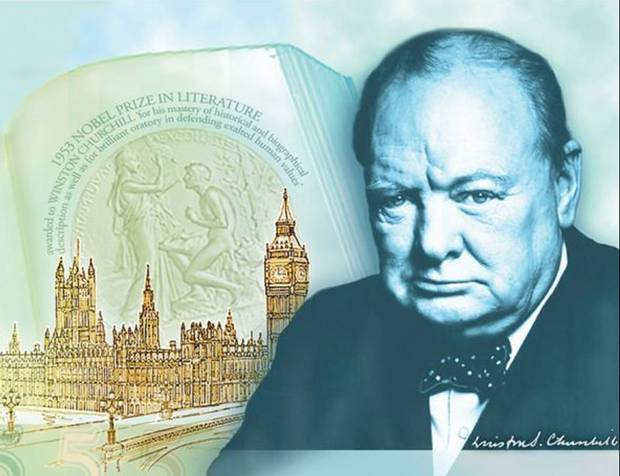
Mark Carney, the governor of the Bank of England, has formally announced that Britain will switch to using plastic banknotes in 2016, ending 320 years of paper money.
After a public consultation in which 87% of the 13,000 respondents backed the new-style currency, the Bank said it would introduce “polymer” notes, as it prefers to call them, in two years’ time, starting with the new £5 note featuring Winston Churchill in 2016 and the Jane Austen £10 a year later.
Speaking at a press conference in the Bank’s Threadneedle Street headquarters, Carney said: “Our polymer notes will combine the best of progress and tradition. They will be more secure from counterfeiting and more resistant to damage while celebrating the history and tradition that is important both to the Bank and the nation as a whole.”
The move follows Carney’s native Canada, where plastic notes are being rolled out, and Australia, where they have been in circulation for more than two decades.
Carney launched a public consultation on polymer banknotes, seen as cleaner and more durable, shortly after arriving at the Bank this summer. However, the Bank’s notes division has been considering plastic money for several years.
I’m still not convinced about the Canadian polymer banknotes: they tend to stick together much more than the paper notes did and they are reportedly susceptible to “fusing” together in high heat.
Comments Off on Bank of England switching to plastic from paper
QotD: Blackadder and Melchet exchange Christmas greetings
Lord Edmund Blackadder: I trust Christmas brings to you its traditional mix of good food and violent stomach cramp.
Lord Melchet: Greetings of the season to you, Blackadder! May the Yule log slip from your fire and burn your house down!
Blackadder’s Christmas Carol, 1988.
Comments Off on QotD: Blackadder and Melchet exchange Christmas greetings
December 17, 2013
Sherlock Series 3 Launch Trailer – BBC One
Comments Off on Sherlock Series 3 Launch Trailer – BBC One


