
Now, no one in my life that I could remember had ever been so damned civil to me, except toad-eaters like Speedicut who didn’t count. I found myself liking his lordship, and did not realize that I was seeing him at his best. In this mood, he was a charming man enough, and looked well. He was taller than I, straight as a lance, and very slender, even to his hands. Although he was barely forty, he was already bald, with a bush of hair above either ear and magnificent whiskers. His nose was beaky and his eyes blue and prominent and unwinking — they looked out on the world with that serenity which marks the nobleman whose uttermost ancestor was born a nobleman, too. It is I the look that your parvenu would give half his fortune for, that unrufflable gaze of the spoiled child of fortune who knows with unshakeable certainty that he is right and that the world is exactly ordered for his satisfaction and pleasure. It is the look that makes underlings writhe and causes revolutions. I saw it then, and it remained changeless as long as I knew him, even through the roll-call beneath Causeway Heights when the grim silence as the names were shouted testified to the loss of five hundred of his command. ‘It was no fault of mine,’ he said then, and he didn’t just believe it; he knew it.
George MacDonald Fraser, Flashman, 1969.
December 17, 2014
QotD: The mark of a true-born nobleman
December 16, 2014
Anton Howes on what caused the industrial revolution
In the first post at his new blog, Anton Howes lays out one of the biggest questions about the 19th century:
What caused the Industrial Revolution?
By the term “Industrial Revolution”, the broadly accepted meaning is of (1) innovation-led, (2) sustained and (3) replicable economic growth.
Each of those adjectives are the source of some of the other important questions in the social sciences. Here are some brief summaries of the issues at hand, which I’ll maybe expand upon separately.
(1) Innovation-led
Innovation-led growth distinguishes itself hugely from what we might call ‘Ricardian’ or ‘Malthusian’ economic growth (it’s usually called ‘Smithian’, but that’s a topic for another time). Capital accumulation, population growth, conquest, and education, can all result in initial surges of economic growth. But this is soon brought to a standstill by the brutal reality of diminishing marginal returns, depreciation, and food shortages.
[…]
(2) Sustained
Innovation existed before the Industrial Revolution. Of course it did – you need look no further than the invention of agriculture, writing, bronze, crop rotations, horse collars, windmills, gunpowder, printing presses, paper, and bills of exchange to know that innovations have occurred throughout history before the IR.
The difference is that these were few and far between. Some of them, often grouped together, resulted in Golden Ages, or “Efflorescences” as Jack Goldstone likes to call them. The 1st Century early Roman Empire; the 8th Century Arab World; 12th Century Sung Dynasty China; the 15th Century northern Italian city-states; and 17th Century Dutch Republic are all good examples.
[…]
(3) Replicable
Perhaps most importantly, this miracle quickly spread. First to Belgium, across the Atlantic to the new-born USA, and then to the Dutch Republic still winding down from its own Golden Age, France, Northern Italy, and the multitude of German principalities.
In the last Century it spread to Japan, South Korea, Singapore, Hong Kong, China, Vietnam and Eastern European countries escaping the shadow of Communism.
In this Century it appears to finally be taking root in various African countries. Kenya, Tanzania and Rwanda in particular seem to be leading the way.
The more recent recipients of the IR are experiencing an unprecedented rate of growth, which in itself provides a further miracle in economic history. Britain’s sustained growth only initially manifested itself at less than 1% per year. It took about 100 years for Britain’s first doubling in GDP to occur.
More recent recipients can expect to grow at 7-10% every year, and sometimes even higher. To put that in perspective, growth at 7% per year would result in a doubling of the size of the economy in only 10 years. 10% a year in only 7 years.
December 15, 2014
UKIP’s changing demographics force changes to ideology
In sp!ked, Patrick West explains why as UKIP’s electoral chances have grown, they’ve been talking less and less like they used to:
This weird synthesis is a product of the global downturn, globalisation and UKIP’s reaction to these developments. In recent years, UKIP has started to pick up voters in the north of England and from traditional Labour constituencies. It’s a different beast to that which, during the 1990s, was supported mostly by middle-class, golf-club types and anti-EU monomaniacs.
UKIP has noticeably moved leftwards in accordance with its broadening appeal. A recent YouGov survey for the The Times showed that 56 per cent of the population wanted the state to take back ownership of utilities, and 59 per cent supported renationalising the railways. But the clamour for renationalisation was even higher among UKIP voters – 64 per cent for utilities and 67 per cent for the railways. UKIP now openly speaks of renationalising the railways, with its financial spokesman, Steven Woolfe, earlier this week saying he was open to the idea.
Indeed, today’s UKIP speaks of a ‘living minimum wage’, a tax on the super rich and protecting the NHS from the private sector. It now comes in for as much criticism from Tories and the libertarian right as from the metropolitan left (check out the hashtag #RedUKIP on Twitter, for instance). Why, asks the right-wing libertarian commentator James Delingpole, is UKIP now ‘flirting with the kind of wealth taxes and turnover taxes you’d more usually associate with the Greens or the Socialist Workers Party?’.
It’s no coincidence that free-market, pro-immigration publications such as The Economist and the Financial Times are as hostile to UKIP as the Guardian is. It’s often said that UKIP wants to ‘turn the clock back’, which is a fair accusation. But keep in mind that its supporters also increasingly want to turn the clock back to a pre-Thatcherite Britain.
December 14, 2014
New BBC historical TV series as accurate as possible … except for the codpieces being “too small”
Apparently, the fear was that US TV audiences would be shocked by authentic sized boasting pieces:
They may have been the crowning glory for any right-thinking Tudor gentleman, but it appears the traditional codpiece may be a little too much for American television viewers.
The stars of Wolf Hall, the BBC’s new period drama based on the novels of Hilary Mantel, have disclosed they have been issued with “smaller”-than average codpieces, out of respect for viewers’ sensibilities.
Mark Rylance, who stars as Thomas Cromwell in the forthcoming BBC series, said programme-makers had decided on “very small codpieces” which had to be “tucked away”.
He suggested allowances had been made amid concerns about the taste of modern audiences, particularly in America, who “may not know exactly what’s going on down there”.
It is one of few concessions permitted by programme-makers, who have otherwise gone to remarkable lengths to ensure historical accuracy, including trips to Shakespeare’s Globe to learn sword-fighting, lessons in etiquette and bowing, and a comprehensive study on spoons.
Mantel has given her seal of approval to the production, issuing a statement of glowing praise for how it has been adapted on screen.
Saying she was pleased programme-makers had resisted the temptation to “patronise” the Tudors to make them “cute”, she said: “My expectations were high and have been exceeded.”
When asked about the costumes in a Q&A to launch the BBC show, alongside actors Damian Lewis and Claire Foy, Rylance said they “did take a while to put on” but praised the overall effect.
“I think the codpieces are too small,” he added. “I think it was a direction from our American producers PBS [the US public service broadcaster] – they like very small codpieces which always seemed to be tucked away.”
When asked to clarify, he said: “I wasn’t personally disappointed by the codpieces: I’m a little more used to them than other people from being at the Globe for ten years.
“But I can see for modern audiences, perhaps more in America, they may not know exactly what’s going on down there.”
H/T to David Stamper for the link(s).
QotD: The voyage of the Rogue
Years ago, when I was young and inexperienced, I hired a yacht myself. Three things had combined to lead me into this foolishness: I had had a stroke of unexpected luck; Ethelbertha had expressed a yearning for sea air; and the very next morning, in taking up casually at the club a copy of the Sportsman, I had come across the following advertisement:
TO YACHTSMEN. Unique Opportunity. Rogue, 28-ton Yawl. Owner, called away suddenly on business, is willing to let this superbly-fitted “greyhound of the sea” for any period short or long. Two cabins and saloon; pianette, by Woffenkoff; new copper. Terms, 10 guineas a week. Apply Pertwee and Co., 3A Bucklersbury.
It had seemed to me like the answer to a prayer. “The new copper” did not interest me; what little washing we might want could wait, I thought. But the “pianette by Woffenkoff” sounded alluring. I pictured Ethelbertha playing in the evening — something with a chorus, in which, perhaps, the crew, with a little training, might join — while our moving home bounded, “greyhound-like,” over the silvery billows.
I took a cab and drove direct to 3A Bucklersbury. Mr. Pertwee was an unpretentious-looking gentleman, who had an unostentatious office on the third floor. He showed me a picture in water-colours of the Rogue flying before the wind. The deck was at an angle of 95 to the ocean. In the picture no human beings were represented on the deck; I suppose they had slipped off. Indeed, I do not see how anyone could have kept on, unless nailed. I pointed out this disadvantage to the agent, who, however, explained to me that the picture represented the Rogue doubling something or other on the well-known occasion of her winning the Medway Challenge Shield. Mr. Pertwee assumed that I knew all about the event, so that I did not like to ask any questions. Two specks near the frame of the picture, which at first I had taken for moths, represented, it appeared, the second and third winners in this celebrated race. A photograph of the yacht at anchor off Gravesend was less impressive, but suggested more stability. All answers to my inquiries being satisfactory, I took the thing for a fortnight. Mr. Pertwee said it was fortunate I wanted it only for a fortnight — later on I came to agree with him — the time fitting in exactly with another hiring. Had I required it for three weeks he would have been compelled to refuse me.
The letting being thus arranged, Mr. Pertwee asked me if I had a skipper in my eye. That I had not was also fortunate — things seemed to be turning out luckily for me all round — because Mr. Pertwee felt sure I could not do better than keep on Mr. Goyles, at present in charge — an excellent skipper, so Mr. Pertwee assured me, a man who knew the sea as a man knows his own wife, and who had never lost a life.
(more…)
December 12, 2014
The Naval Battle At The Falkland Islands – The Death of Maximilian von Spee I THE GREAT WAR Week 20
Published on 11 Dec 2014
Near the far away Falkland Islands the story of the German East Asia Squadron is coming to an end: in a naval battle nearly the entire squadron sunk and Maximilian von Spee dies together with over 2000 German seamen. Meanwhile, the war of attrition is still going on in Europe and Austria-Hungary has to learn that their conquest of Belgrade is not putting a lid on the Serbian resistance.
The British pantomime tradition
Tracy Morgan looks at a British holiday tradition that didn’t seem to travel to the rest of the empire:
An actor in drag endowed with enormous boobs stands alongside an actress in male britches. Every year they tell the same jokes, flirtatiously sing silly tunes, bring a good-over-evil narrative to life and comment on everything — except much about Christmas. Yet theatergoers consider it a great holiday tradition, because nothing says Christmas to Brits quite like cross-dressing slapstick, screaming children and sexual innuendo.
British pantomimes run from late November through mid-January, and the question is not are you going, but which panto are you seeing? “For many people, a trip to the theater to see the pantomime is as big a part of Christmas as roast turkey dinner,” says Simon Sladen, assistant curator of modern and contemporary performance at London’s Victoria and Albert Museum. ’Tis the season for the goodies to take the stage to cheers while baddies slink into view amid boos. A man plays the leading dame, and a woman often plays the starring male role, retelling classic fairy tales like Cinderella or Jack and the Beanstalk with a comedic twist. Chants from ticket holders include “Oh, yes it is” to “Oh, no it isn’t,” or the classic “It’s behind you!” to warn those on stage of imminent danger.
I’d always wondered where those phrases came from…
Unlike its silent namesake, these colorful productions — aka pantos — are a mishmash of very verbal theatrical genres, from Italian commedia dell’arte’s slapstick to the medieval mystery plays and the Everyman play’s morality. Pantomime, which originally meant “imitator of all,” is “reflective of the world around it,” says Sladen, referring to how it incorporates contemporary political and cultural jokes, modern music and fashion. Members of the audience are meant to see aspects of themselves in the characters and identify with their struggles and successes.
Britain in the 50s
Published on 10 Aug 2013
Through the eyes of newsreel cameras and advertising of the time, we present an affectionate look at the way we were in the 1950’s: the way we dressed, the way we laughed (and cried) – even the way we holidayed. In 1950, Britain was working hard to recover from the Second World War. Yet, as the decade went on and the economic conditions improved – prompting PM MacMillan to tell people of Britain “You never had it so good” – a cascade of wonderful gadgets found their way into British homes, and families began holidaying on the beaches and promenades.
By the end of the decade booming Britain was in overdrive with 5.5 million cars on the road, the opening of the M1 and the arrival of the first Mini. The teenager had also come of age with new dance crazes and flamboyant fashions interspersed with bizzare hairstyles – anything to make them stand out in the crowd!
This programme also focuses on the events that shook the world during the decade; the death of George VI in 1952 heralding a new Queen, Elizabeth II, and her Coronation in 1953; the conquering of Everest: the first four minute mile; the last woman to be hanged in Britain; and the tragic Munich air disaster.
December 11, 2014
London’s Transport System During World War Two – 1941
Published on 31 Mar 2013
Filmed after the start of the Blitz, ‘City Bound’ is an exploration of the daily commute into London from the suburbs in 1941.
‘Between half past five and ten o’clock each morning five million people are moved from home to work by London’s transport system. Before this can be done, underground and overground transport must be cleaned and refuelled. Then from the outer ring of London, past green fields and suburban gardens, the move into London begins. Trains, motor omnibuses, and electric trams bring hundreds of thousands into the centre of the city, to work in the shops, offices, and factories of the largest city in the world.’
(Films of Britain – British Council Film Department Catalogue – 1941)
December 10, 2014
Orwell at the BBC
The most recent issue of Intelligent Life looks at the brief interlude of George Orwell’s career while he was working at the BBC during the Second World War:
Orwell spent a mere two years (1941-43) at the BBC, which he joined as a talks assistant in the Indian section of the Eastern Service. No recording survives of him giving a talk, which is perhaps fitting; for what is most striking about his essays and journalism is the tart, compelling timbre of his voice. The critic Cyril Connolly, an exact contemporary, thought that only D.H. Lawrence rivalled Orwell in the degree to which his personality “shines out in everything he said or wrote”. Any reader of Orwell’s non-fiction will pick up on the brisk, buttonholing manner (“two things are immediately obvious”), the ear-catching assertions (“the Great War…could never have happened if tinned food had not been invented”) and the squashing epithets: “miry”, “odious”, “squalid”, “hideous”, “mealy-mouthed”, “beastly”, “boneless”, “fetid” and — a term he could have applied to himself — “frowsy”.
Orwell might well have damned this new honour too. In his studio on the edge of the Blenheim estate in Oxfordshire, Martin Jennings, the sculptor working on the eight-foot likeness, told me that Orwell had made some disobliging remarks about public statues, thinking that they got in the way of perfectly good views. The bronze Orwell will look down on the comings and goings of BBC staff who, returning his gaze, can read some chiselled wisdom from his works on the wall behind him. The Financial Times recently called Orwell “the true patron saint of our profession”, another tribute he would probably resist. “Saints”, he warned, “should always be judged guilty until they are proved innocent.”
Why Orwell? His time at the BBC was ambivalent at best. As students of 1984 soon discover, the novel’s dreary, wartime ambience and the prominence of propaganda owe much to his BBC experiences; Room 101, where Winston Smith confronts his worst nightmares, was named after an airless BBC conference room. “Its atmosphere is something halfway between a girls’ school and a lunatic asylum,” Orwell wrote in his diary on March 14th 1942, “and all we are doing at present is useless, or slightly worse than useless.”
One answer to “why Orwell?” is because of his posthumous career. Five years before his death in 1950, he was, in the words of one of his biographers, D.J. Taylor, “still a faintly marginal figure”. He had published seven books, four of them novels, none of which put him in the front rank of novelists, two of which he had refused to have reprinted. He was acknowledged as a superb political essayist and bold literary critic, but his contemporary and friend Malcolm Muggeridge, first choice as his biographer, frankly considered him “no good as a novelist”. It was only with his last two books, Animal Farm and 1984 (published in 1945 and 1949), that Orwell transformed his reputation as a writer. These two books would change the way we think about our lives.
H/T to Kathy Shaidle for the link.
December 9, 2014
QotD: The rise of the word “fuck” in common usage
During the first World war use of the four-letter word, as it is now called, became universal, or more probably its universal use was first observed by the literate classes. Between the wars the word was presented by writers in a modified form — mucking or flicking — or with its initial only: f—ing. Its use in full — fuck — now seems to be approaching literary, though not conversational, respectability.
A.J.P. Taylor, A History of England: England 1914-1945, 1961.
December 7, 2014
Kings Cross, 1956
Published on 26 Mar 2013
London’s King’s Cross station in the age of steam. Soon diesels would replace steam power and Mr Hammond, General Manager of British Railways Eastern Region, explains how he will reduce his fleet of locomotives by a factor of four. You can also learn how to swing a buckeye coupler. They are very heavy, but the shunter in this film makes it look easy.
December 4, 2014
“Hiram Maxim’s business was secure”
Paul Richard Huard has another in his series of blog posts on the weapons of the 20th century:
During the early morning of Oct. 25, 1893, a column of 700 soldiers from the British South African Police camped in a defensive position next to the Shangani River.
While they slept, the Matabele king Lobengula ordered an attack on the column, sending a force of up to 6,000 men — some armed with spears, but many with Martini-Henry rifles.
Among its weapons, the column possessed several Maxim machine guns. Once a bugler sounded the alert, the Maxims spun into action — and the results were horrific.
The Maxim gunners mowed down more than 1,600 of the attacking Matabele tribesman. As for the British column, it suffered four casualties.
The British military not only measured the Maxim gun’s success by the number of Matabele killed in action. They could gauge the Maxim’s potential as a weapon of psychological warfare.
In the aftermath, several Matabele war leaders committed suicide either by hanging themselves or throwing themselves on their spears. That is how Earth-shattering a weapon the Maxim gun was.
“The round numbers are suspicious,” C.J. Chivers wrote in The Gun, his history of automatic weapons. “But the larger point is unmistakable. A few hundred men with a few Maxims had subdued a king and his army, and destroyed the enemy’s ranks. Hiram Maxim’s business was secure.”
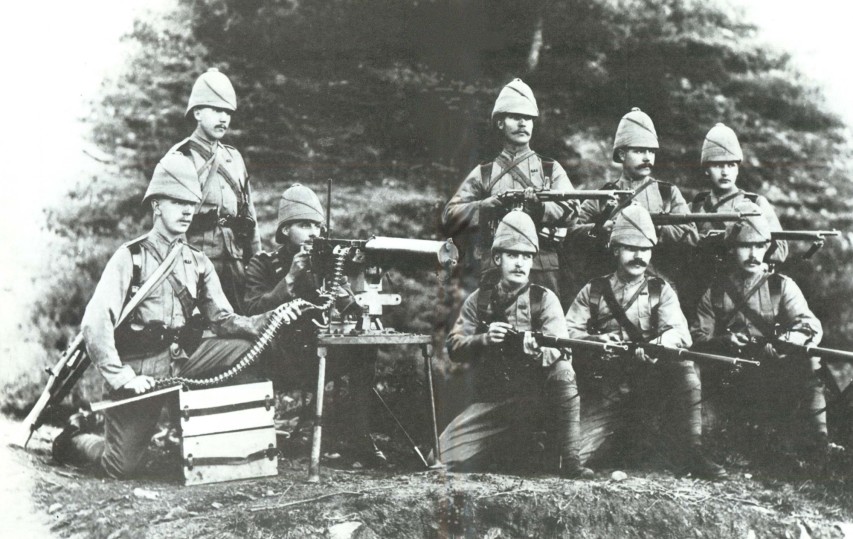
A British Maxim gun section that took part in the Chitral Relief Expedition of 1895. Public domain photo
Fully Fitted Freight (1957)
Published on 29 Nov 2013
How freight was moved around Britain by rail in the 1950s, although in reality a lot of it was unfitted.
If you think your mortgage is bad, here’s a bit of perspective
Britain is deeply in debt, like most western countries, but some of the debt is much longer term than usual:
Britain will pay off all of its debt used to fund World War One next March, when it redeems a government bond first issued more than 80 years ago to help pay for the conflict.
The finance ministry said on Wednesday that it would redeem the 1.9 billion pound ($3 billion), 3.5 percent War Loan — a perpetual bond which means it has no fixed maturity date — on March 9 next year.
Issued in 1932, the War Loan was used to refinance debt accumulated during World War One, which ended in 1918.
Some market experts said they would miss the bond as a rare historical curiosity in modern finance.
“For those of us who’ve been looking at the gilt market for a long time, a little bit of magic has fallen out of the market,” said Barclays fixed income strategist Moyeen Islam.
What needs to be pointed out however, is that they’re not actually paying off the WW1 debt: they’re eliminating that particular interest-bearing bond (because it’s now paying a higher rate of interest than the UK government’s other debt instruments). The money to pay off the current holders of those bonds will be borrowed on the market at current market rates. That’s the government equivalent of paying off one credit card with another … you still have a debt, it’s just being held by a different lender now. Tim Worstall explains:
As background, yes, Britain ran up big debts in WWI. Those were those National War Bonds. And interest rates changed a bit, finances moved around, and in 1927 it was decided that those National War Bonds should be changed. And the change was to turn them into perpetual bonds: the capital would never be paid off, there would just be a stream of interest off into the indefinite future. The government retained the right to buy them in at any point (a “call option” on them) which is what Osborne is exercising now. One more thing: there were other bits and pieces of debt lying around. Odd bits and pieces from the 19th century, debt from the Crimean War, from those (not large enough) attempts to deal with the Great Famine in Ireland, bits and pieces relating to the Napoleonic Wars and even, would you believe it, some parts that related all the way back to the South Sea Company and the South Sea Bubble of the 1720s (although that connection is pretty remote).
All of these pieces were dumped into the same pot and “consolidated” into these perpetual bonds. They were and are thus known as “Consols”.
What Osborne is going to do is exercise that call option and bring those bonds back in. But he’s not actually “paying off” those debts. He’s going to issue other, more conventional, gilts in order to have the money to give to those sending in their Consols. He must be doing that: the government really is borrowing £100 billion a year and change at present. This is no more “paying off” those debts than my taking out a bank loan to pay off my credit card is paying off debts. It might well be a very good idea to do that, given the difference in the terms of the debts and the interest rates, but it’s still not paying off, is it?
H/T to Elizabeth for the original link.


