
… this recent Facebook post by Steve Horwitz:
Instead of “trade wars,” let’s call them what they really are: economic suicide bombings.
Indeed so.
Like physical bombings, the economic suicide bombings that are tariffs and other trade restrictions create particular jobs by destroying real wealth. Those who then resupply the wealth that is destroyed applaud the suicide bombings, and tirelessly repeat ancient, absurd dogmas to justify the bombings. But unlike physical bombings, the victims of economic suicide bombings are largely unseen and, hence, ignored.
The people – and they are many – who cling to the dogma of protectionism do so as a matter of faith. This dogma cannot withstand the scrutiny of reason or be justified by any competent observation of reality. Yet the uncivilized and destructive religion of protectionism nevertheless flourishes, no doubt in no small part because the narrow interests of a relatively small but politically powerful cabal of producers are served by the public taking to be true all the mysticism of protectionism and its alleged miracles.
Whether or not Jesus miraculously created abundance out of the scarcity of five loaves and two fish I will not here say. I am, however, quite confident that when the likes of Donald Trump, Peter Navarro, Chuck Schumer, Bernie Sanders, and Sherrod Brown promise to perform a similar miracle – that is, to create abundance out of artificially contrived scarcity – they are either delusional about their own powers or are cynically playing their congregations for fools.
Don Boudreaux, “Quotation of the Day…”, Café Hayek, 2018-10-12.
November 22, 2018
QotD: They’re not “trade wars”, they’re “economic suicide bombings”
November 21, 2018
Allied War Economy During World War 1 I THE GREAT WAR Special
The Great War
Published on 19 Nov 2018Check Out Supremacy 1914: https://www.supremacy1914.com/index.p…
Financing and supplying the First World War was a huge economic undertaking that influenced the British, French, American and Italian economies profoundly and shaped the global balance of power.
QotD: Occupations and sex differences
Sex differences are a distribution, not a hard, bright line. For example, the women’s world record in the hundred-meter dash is slower than the U.S. high school boys’ record. Men on average are faster than women. But the women at the top of the distribution — those Olympians — are still faster than most men. It would be absurd to say that a woman can’t run the hundred meter in 11 seconds, just because most women can’t. It would be equally absurd to say that men are not, on average, faster than women.
So it’s possible that the distribution of nurturing traits is skewed enough that fewer men will be good at the difficult and emotionally taxing job of providing intimate care for sick and needy people. While there are plenty of health care jobs that don’t require so much direct human interaction, they tend to require more training. And the ability to sit in a classroom and absorb material from a textbook is also a human trait that is unevenly and unfairly distributed. It’s not that no men can succeed in transitioning from old-style “manly” jobs to the pink-collar professions, but that fewer men may be able to do so than we’d like to think.
Megan McArdle, “Some Blue-Collar Workers Probably Shouldn’t Do Pink Jobs”, Bloomberg View, 2017-01-06.
November 16, 2018
The political wrangles ahead over the federal carbon tax
Andrew Coyne — for once not beating the drum for electoral reform — discusses the challenge facing the federal government in the wake of provincial resistance to their carbon tax plans:
But the real test, of course, is yet to come. The provinces cannot stop the tax on their own. The court challenges are likely to fail. Provinces that refuse to implement carbon pricing will simply find the federal “backstop” tax imposed in its place. It is the election that will decide the issue, not duelling governments. Or so Conservatives hope.
Certainly there are abundant grounds to doubt the political wisdom of the Liberal plan. A tax, or anything that resembles it, would be a hard enough sell on its own. But a tax in aid of a vast international plan to save the earth from a scourge that remains imperceptible to most voters, to which Canada has contributed little and against which Canada can have little impact, while countries whose actions would be decisive remain inert? Good luck.
What seems clear is that voters’ support for carbon pricing is shallow and tentative. The Conservative strategist who chortled to the National Post that the Liberals are asking Canadians “to vote with their hearts, not their wallets” — an impossibility, he meant — was correctly cynical. Just because people want to save the planet doesn’t mean they want to pay for it.
The best way to read the public’s mood is in the positions of the political parties, who are in their various ways each trying to assure them that it won’t cost them a dime. The Liberal version of this is to promise to rebate the extra cost of the federal tax to consumers — indeed, they pledge, 70 per cent of households will make a profit on the exchange.
The Conservatives have been less forthcoming, but it would appear their plan is to hide the cost, substituting regulations, whose effects are largely invisible to consumers, for the all-too-visible tax at the pump. Here, too, I suspect they may have a better (i.e. more cynical) read on popular opinion. The public often prefer to have the costs of government hidden from them, even if they know they are paying them — even if they know they are paying more this way, as indeed they are in this case. Do what you want to us, they seem to say, just don’t rub our faces in it.
So I would be skeptical about polls showing majority support for the federal plan: 54 per cent, according to Angus Reid, while Abacus finds 75 per cent would either support or at least accept it (versus 24 per cent opposed). These were taken shortly after the announcement of the federal rebates. Yet it is far from evident the rebates will still register with people a year from now. Indeed, the Conservatives barely paused to acknowledge them as inadequate before going on to pretend they had never been mentioned.
November 15, 2018
Amazon’s HQ$2Bn decision
If you had any doubt that the Amazon HQ2 competition was about anything other than trolling for economic bribes, this should banish the thought:
Amazon is getting some prime real estate.
In exchange for more than $2 billion in economic incentives, the online shopping giant will locate a pair of new corporate headquarters just across the Potomac River from Washington, D.C., and just across the East River from Manhattan. Tuesday’s much-anticipated announcement of the locations for Amazon’s “HQ2” also included details — which had previously been kept from the public — about the economic incentives that successfully lured the Seattle-based firm to the east coast’s political and economic hubs.
Amazon says it will invest $5 billion and create more than 50,000 jobs across the two new locations, with at least 25,000 employees at each of its new corporate campuses, to be located in Virginia’s Crystal City and New York’s Long Island City. Nashville wins a consolation prize: a new supply chain and logistics center that promises 5,000 jobs in exchange for $102 million in economic incentives.
In New York, Amazon will receive $1.2 billion in refundable tax credits through a state-level economic development program and a cash grant of $325 million that’s tied to the construction of new buildings at the Long Island City location over the next 10 years. In Virginia, the state is ponying up $573 million in tax breaks tied to the creation of 25,000 jobs, and the city of Arlington will provide a cash grant of $23 million over 15 years funded by an existing tax on hotel rooms.
Yes, the numbers are staggering — New York state’s pledge of $1.52 billion for 25,000 jobs works out to more than $60,000 in taxpayer support per new job created — but Amazon appears to have selected New York and the D.C. area based on more than just how many zeroes local officials agreed to put on the giant cardboard check.
After all, New Jersey offered Amazon $5 billion (with another $2 billion from Newark), and Maryland offered $8.5 billion. Yet Amazon passed them both over to pick their neighbors.
November 14, 2018
QotD: Protectionism and competition
The ITC [U.S. International Trade Commission] acts as if American companies have a right not to be injured by foreign competition, regardless of how poorly they serve their American customers.
James Bovard, The Fair Trade Fraud, 1991.
November 12, 2018
QotD: The importance of prices
I frequently teach economics principles courses, offering many college students their first exposure to the subject. While we cover all the basics — supply and demand, elasticity (consumer and producer sensitivity to price changes), taxation, trade, and externalities — I’m under no illusion that most of them will remember a lot of the material come a year from now, much less longer.
But there is one thing I hope all my students remember forever — the role of prices and private property. In particular, I want them to remember how these mechanisms are vital for a free and prosperous society. I make it clear to them that I think this material is of the utmost importance. In fact, prior to beginning our discussion of prices, I tell them I will be thrilled if the price system is one thing they remember from the class fifteen years from now.
Prices and private property rights are fundamentally important. Failure to grasp how these forces work leads to positively detrimental outcomes.
Abigail Blanco, “Marxism on the Menu: Why This Communist Restaurant Failed”, Foundation for Economic Education, 2016-12-27.
November 10, 2018
QotD: Protectionism helps domestic producers but hurts domestic consumers
Protectionists always speak of tariffs and other import restrictions as impositions the burdens of which fall exclusively on foreign producers (usually, as in the case of antidumping cases, on foreign producers who have the audacity to sell their wares to us at prices that are especially low). And while domestic protectionist measures do indeed harm foreign producers, every protectionist measure is also – indeed, chiefly – a restriction on the freedom of domestic consumers to spend their money as they choose. Tariffs, antidumping duties, and all protectionist impositions make domestic citizens less free (by closing off areas of voluntary exchange that they would otherwise choose to engage in) and less prosperous (by diminishing the volume of goods and services available in the domestic market for people to consume).
Protectionism is rank economic idiocy and an unquestionable assault on liberty. And it becomes no smarter or prettier just because it is costumed in moralistic language (such as “fair trade” or “leveling the playing field”) or is pushed by your preferred political party rather than by some other political party.
Don Boudreaux, “Quotation of the Day…”, Café Hayek, 2016-12-06.
November 8, 2018
QotD: Imports and exports
The benefit of trade is the import; the cost is the export.
Politicians just don’t seem to get this. President Obama’s official statement on “Promoting U.S. Jobs by Increasing Trade and Exports” mentions exports more than 40 times; imports, not once. His Republican critics agree: Sen. Rob Portman says that a trade agreement “is vital to increasing American exports.” More colorfully, during the 1996 presidential campaign, Pat Buchanan stood at the port of Baltimore and said, “This harbor is Baltimore is one of the biggest and busiest in the nation. There needs to be more American goods going out.”
That’s fundamentally mistaken. We don’t want to send any more of our wealth overseas than we have to in order to acquire goods from overseas. If Saudi Arabia would give us oil for free, or if South Korea would give us televisions for free, Americans would be better off. The people and capital that used to produce televisions – or used to produce things that were traded for televisions – could then shift to producing other goods.
David Boaz, The Libertarian Mind: A manifesto for freedom, 2015.
November 5, 2018
QotD: Technological advance and the Knowledge Problem
Technology’s heightening of society’s complexity outstrips its heightening of the social planner’s informational capabilities. Hayek, like [Adam] Smith, drew a lesson for policy: Except in the most clear-cut cases of systemic harm, like air pollution, the supposition that government officials can figure out how to improve the results of decentralized (i.e., voluntary) decision making becomes more and more outlandish. In his Nobel lecture, Hayek called that supposition the pretense of knowledge. As intellectuals who ponder the complex workings of the social world, we really know little aside from one hardy fact: If those who participate in an activity do so voluntarily, each is probably bettering his or her own condition. The more complex the system is, the more skeptical we ought to be about claims to knowledge that go beyond and against that hardy fact.
Fred Foldvary and Daniel Klein, The Half-Life of Policy Rationales, 2003.
November 4, 2018
That pesky Supreme court ruling on the Churchill Falls deal
I use the term “pesky” in the headline to avoid being slagged by one or possibly even both of my Newfoundland and Labrador readers … to curry favour with them, I’d need to escalate from somewhere between “ethically doubtful” and “outrageous”, and even that might not capture the essence of anger and resentment at Quebec’s amazingly great deal long-term on cheap hydro-electric power from the Churchill Falls facility. It is, as Wikipedia says, “the second largest hydroelectric plant in North America, with an installed capacity of 5,428 MW”, and thanks to Quebec financing and astute negotiations, most of that output is sold to Quebec at a very small proportion of today’s open market price. Colby Cosh arches an eyebrow over a Supreme Court justice’s lone vote of dissent on the case:
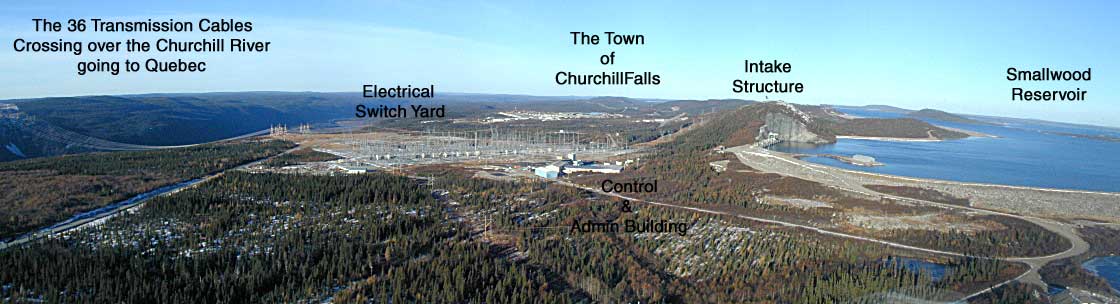
Churchill Falls generating station, Labrador.
Photo via Wikimedia Commons.
It is my solemn duty to perform one of the important functions of a newspaper columnist: raising one questioning eyebrow. On Friday the Supreme Court issued a judgment in the long battle between Churchill Falls (Labrador) Corp., a subsidiary of Newfoundland and Labrador Hydro, and Hydro-Québec. CFLco is the legal owner of the notorious Churchill Falls Generating Station in the deep interior of Labrador, close to the border with Quebec.
The station was built between 1966 and 1971. Hydro-Québec provided backing when the financing proved difficult for the original owner, an energy exploration consortium called Brinco. This led to the signing of Canada’s most famous lopsided contract: a 1969 deal for Hydro-Québec to receive most of the plant’s output for the next 40 years at a quarter of a cent per kilowatt-hour, followed by 25 more years at one-fifth of a cent. The bargain ends in 2041, at which time CFLco will get full use and disposal of the station’s electricity back.
This has been a heck of a deal for Quebec. It took on the risk of financing and building the station in exchange for receiving the electricity at a low fixed price — one that both sides in the court case agree was reasonable at the time. But it meant that Newfoundland saw no benefit from decades of oil price shocks, from the end of nuke-plant construction in the U.S., or from the increasing market advantage hydroelectricity enjoys while dirtier forms of power generation attract eco-taxation.
It has been maddening for Newfoundland to remain poor while Hydro-Québec grows fat on the profits from a Newfoundland river. Quebec, for its part, has never been completely convinced of the legitimacy of its border with Labrador, and it sees its good fortune as a sort of angelic reward for having to be part of Confederation. The Churchill Falls deal is (quite reasonably) regarded as proof that Quebec’s homegrown industrialists were able to beat resource-exploiting Anglo financiers at their own game. There are thus reasons beyond the bottom line that Quebec has never wanted to renegotiate the Churchill Falls contract. But the bottom line is enough.
November 3, 2018
Freedom’s Fighters with Tim Worstall
Adam Smith
Published on 1 Nov 2018Every month the Adam Smith Institute hails one of those who have fought the good fight for freedom over the decades. In this month’s Dr Madsen Pirie interviewed our blog maestro Tim Worstall, who visited the UK from his rather sunnier climes in Portugal.
“[I]t makes no sense to punish Americans with tariffs in order to convince foreign governments to stop punishing their citizens with tariffs”
Veronique de Rugy discusses the mercantilist errors that still influence politicians and voters on free trade policies:
There are many changes to domestic policy that could help protect Americans from the predations of protectionism. For instance, when considering whether or not to grant U.S. firms “trade remedies,” such as countervailing duties, officials should have to take into account the consequences for American consumers of any tariffs they’re thinking of imposing. Policy makers aren’t currently required to do that, and one agency — the International Trade Commission—is actually forbidden from doing so.
This must change. Recent developments prove that it’s dangerous to simply assume all U.S. presidents and a critical mass of legislators will remain committed to the principles of reciprocal free trade. Buyers of imported goods or products made with imported materials — which, to be clear, is all of us — can’t depend on the economic acumen of the policy makers deciding whether or not to impose tariffs. Instead, consumer protections need to be built into the regulatory process. Because there are virtually always more workers in consuming industries downstream of the trade barrier than there are in the sector receiving the protection, a requirement to take the harm to consumers into consideration would make it very hard to impose protectionist policies.
Some free trade sympathizers have floated the possibility of Congress reclaiming its power to impose tariffs from the White House. Sen. Mike Lee (R–Utah), for instance, has introduced the Global Trade Accountability Act, which would require congressional approval for tariff increases or other “unilateral trade actions.” Unfortunately, if this otherwise well-designed bill became the law of the land, it would be akin to guarding the hen house with a hungry dog instead of a fox.
An extensive literature shows that moving tariff-setting policy away from Congress (and its parochial, locally focused interests) was a critical part of reducing protectionist influence in Washington. President Trump is terrible on this issue, but in general, a president is more likely than are members of Congress to consider the interest of the entire country — and, hence, to support broad trade liberalization.
November 2, 2018
Intro to Business Fluctuations
Marginal Revolution University
Published on 11 Apr 2017This wk: Get acquainted with the basics of business fluctuations as we dive back into the final videos of our Macro course.
Next wk: Learn the basics of the aggregate demand-aggregate supply model.
Economic growth doesn’t happen at a steady pace; there are ebbs and flows. Prosperity on the national level depends on a country having good institutions in place. The factors of production – human capital, physical capital, and ideas – are also critical. And these variables often change, sometimes drastically.
In the United States, economic growth has averaged at about 3.2% for the past sixty years. But if you Google “US economic growth FRED,” you’ll quickly see that it’s not a smooth trend up. Instead, there are plenty of peaks and valleys, even though the U.S. has a relatively stable economy. Economists refer to these ups and downs around a country’s long-term GDP growth trend as “business fluctuations.”
“Recessions” are significant and widespread declines in employment and real income. But not only do people become unemployed during a recession, but capital and land often go un- or underused. This suggests that an economy is operating below its potential because resources are being wasted.
Recessions, large or small, are less than ideal states for an economy. We want people and resources well employed to produce more prosperity.
Over the next few videos, we’ll explore the basics of a model of business fluctuations called the aggregate demand-aggregate supply (AD-AS) model. We’ll put the model to use to look at how shocks affect an economy, and what policy can do to minimize the damage. Finally, we’ll apply the model to explain some of the largest economic catastrophes in United States’ history.
November 1, 2018
The Living Wage Makes It Harder to Make a Living
Foundation for Economic Education
Published on 11 Oct 2018We take big risks with people’s livelihoods when we make demand about what people should be paid. The reality is, people don’t necessarily need a “living wage” to make a living.


