ReasonTV
Published on 12 Dec 2018Left-leaning politicians of the 1970s understood that red tape punishes consumers and protects big business. The leading deregulator of that era was none other than Jimmy Carter.
————————
Follow us on Twitter: https://twitter.com/reasonReason is the planet’s leading source of news, politics, and culture from a libertarian perspective. Go to reason.com for a point of view you won’t get from legacy media and old left-right opinion magazines.
————————
When President Donald Trump bragged in his first State of the Union address about cutting red tape, the Democratic response was no surprise. “Deregulation,” warned Center for American Progress Senior Advisor Sam Berger in Fortune, “is simply a code word for letting big businesses cut corners at everyone else’s expense.”But many leading Democrats had the opposite view in the 1970s. Then, at the dawn of the deregulation era, left-leaning politicians and economists understood that excessive government management of industry let the big-business incumbents get away with lousy performance at the expense of competitors, taxpayers, and consumers. The leading figure in that fight to cut red tape and shut down entire federal agencies was none other than Jimmy Carter.
It was Sen. Ted Kennedy who held extensive Senate hearings in the early ’70s, with testimony from the likes of Ralph Nader and liberal economist Alfred Kahn, about the benefits of lifting state controls on the airline industry. The resulting Airline Deregulation Act of 1978, signed by Carter, killed the Civil Aeronautics Board — a federal agency that decided which airlines could fly where, and even what they could charge. The new competition to the old airline cartel reduced fares, expanded destinations, increased safety, and made air travel an option for those of us who aren’t rich.
Carter also lifted stifling government oversight of the rail and trucking industries under a Democrat-controlled House and Senate. The result? Competition intensified, prices dropped, and consumers saved more money on everyday products.
In 1978, President Carter signed a bill that lifted Prohibition-era criminal restrictions on home brewing. The legalization of do-it-yourself beer production unleashed a boom of experimentation, paving the way for the craft beer revolution that is ongoing to this day. The year that Carter loosened the rules, the U.S. was home to a mere 50 breweries. Today there are well over 5,000. In two generations of beermaking, America went from global laughingstock to world leader.
The governor of California during Carter’s presidency was none other than Jerry Brown, then known as “Governor Moonbeam” for his far-out musings, glittery social life, and lefty politics. Yet Brown, too, could be a fiery skeptic of government. In his terrific second inaugural address in 1979, Brown stated that “many regulations primarily protect the past, prop up privilege or prevent sensible economic choices.”
But even while some sectors were unleashed four decades ago by far-seeing Democrats and Republicans alike, too many governments at the local, state, and federal levels have forgotten those lessons, and instead imposed entirely new categories of regulations. Occupational licensing, which applied to about one in 10 jobs 40 years ago, now impacts one in three.
So how did the party of Jimmy Carter and sideburns-era Jerry Brown become the ideological home of Elizabeth Warren and Alexandria Ocasio-Cortez? One explanation may be that Democratic support for deregulation back then was born out of a sense of nearly hopeless desperation in the face of stagflation. Cutting red tape to foster dynamism was about the last move politicians had left.
Our long economic expansion and stock-market boom will soon come to an end, imposing limits on government precisely at the moment when it’s asked to do more. When that day of reckoning comes, the best questions for lawmakers of both parties to ask may just be: What would Jimmy Carter do?
Photo credits: Jimmy Carter Library, Arthur Grace/ZUMA Press/Newscom, Dennis Brack/Newscom, Everett Collection/Newscom, Ron Sachs/CNP/MEGA/Newscom, Brian F. Alpert/ZUMA Press/Newscom, Paul Harris/Pacific Coast Nes/Newscom, Bee Staff Photo/ZUMA Press/Newscom, Dennis Brack/bb51/Newscom, Jonathan Bachman/REUTERS/Newscom, Rick Friedman/Polaris/Newscom
December 13, 2018
When Democrats Loved Deregulation
December 9, 2018
QotD: The western way of war
Free capital is the key to war making on any large scale, what Cicero called “the sinews of war,” without which an army cannot muster, be fed, or fight. Capital is the wellspring of technological innovation, which is inextricably tied to freedom, often the expression of individualism, and thus critical to military success throughout the ages. That capitalism was born in the West, expanded through Europe, survived the alternate Western-inspired paradigms of socialism and communism, and found itself inextricably tied with personal freedom and democracy in its latest global manifestation explains in no small part Western military dominance from the age of Salamis to the Gulf War.
Victor Davis Hanson, Carnage and Culture, 2001.
December 5, 2018
The true lesson to be learned from GM Canada’s economic plight
Andrew Coyne tries to encapsulate the key economic concept that should be taken away from the GM Canada collapse:
Think of it this way. Governments have proven more than ready in the past to pay whatever the auto companies demanded to hold onto threatened jobs. If there were any chance whatsoever of buying the plant’s reprieve, no matter how foolishly or expensively, can there be any doubt they would have? That they did not — apparently GM waved them off — tells you how hopeless the plant’s prospects really are.
Many have recalled that the closure of the Oshawa plant comes less than a decade after the Canadian operations of GM and Chrysler were bailed out with $14 billion in federal and provincial money, $4 billion of which was never recovered. The lesson some have drawn from this is that GM is a devious ingrate, which may be fair comment but is not especially helpful. The real lesson is this: when you try to buy jobs with public money, the jobs last only as long as the money does. In the end, all you will have done is to lure people into taking or staying in jobs that were long since doomed.
Like most of economics, this is wholly alien to popular wisdom. There is a rich vein of commentary to the effect that the laws of economics are effectively optional, something we can resist by force of will: we can either bend to “market forces,” or we can “stand up” to them in some fashion. But in fact the latter option is entirely imaginary, at least in the long run. You can perhaps lure plants and jobs your way at the outset with subsidies and other goodies. But the only assurance they will stay is if it makes economic sense to the company to keep them there.
If not, then all you have won with your subsidy is the right to go on providing more subsidy, which is a fairly accurate description of Canadian automobile policy in recent decades. The workers whose jobs successive governments boasted of creating or saving were effectively hostages; as in all hostage-takings, the payment of ransom only stimulates further demands for ransom. Until one day when the money runs out, and the workers whose jobs were supposedly saved find themselves abandoned. This may be many things, but one thing it is not is compassionate.
November 30, 2018
England: South Sea Bubble – Lies – Extra History
Extra Credits
Published on 9 May 2015Support us on Patreon! http://bit.ly/EHPatreon
____________No historian is perfect, so it’s important we acknowledge our mistakes where we find them (with the help of our viewers, no less)! After we clear up some discrepancies that emerged during the South Sea Bubble series, we turn to answering some common questions that came up during this series on economic history. In a period where financial masterminds like John Blunt engaged in trickery meant to confuse other people and hide his real activities, it’s no wonder that many viewers had questions about what insider trading is and how Blunt could endlessly inflate stock prices for his unprofitable company. This is a history show, but we do our best to explain! As a bonus, James also reads Robert Knight’s letter to Parliament on the eve of his illegal flight and tells some cool stories about Robert “It was Me” Walpole.
November 29, 2018
England: South Sea Bubble – It Was Walpole – Extra History – #5
Extra Credits
Published on 25 Apr 2015Support us on Patreon! http://bit.ly/EHPatreon
____________Robert Walpole’s attempts to use the South Sea Company scandal to enhance his own ambitions are threatened by the appearance of Robert Knight, a former South Sea employee whose records of corporate bribery implicate Walpole and his friends in Parliament. But faced with threats of retribution if he ever shares these records, Knight flees the country rather than face a public inquiry. Although he gets caught and sent to prison in Antwerp, Walpole deftly engineers his release and escape. With Knight finally gone, Walpole teams up with John Blunt to pin the blame for the South Sea stock bubble on his political opponents, conveniently clearing the way for himself to become essentially the first Prime Minister of England. He also makes sure that all of his own supporters get off easy (if not scot free) for their involvement, and even Blunt walks away from the South Sea Bubble with more money than he started with.
November 28, 2018
The bitter economics of North American passenger railways
Earlier this month, I posted an excerpt from The Romance of the Rails, by Randal O’Toole. It’s a book I haven’t yet read, but based on what I’ve heard, his analysis of the state of US and Canadian passenger rail is both savage and accurate — as in, we’re insane to subsidize long-distance or high-speed rail for the wealthy out of the taxes levied on the poor. Recently, Trains columnist Fred Frailey got a chance to chat with O’Toole about his work:
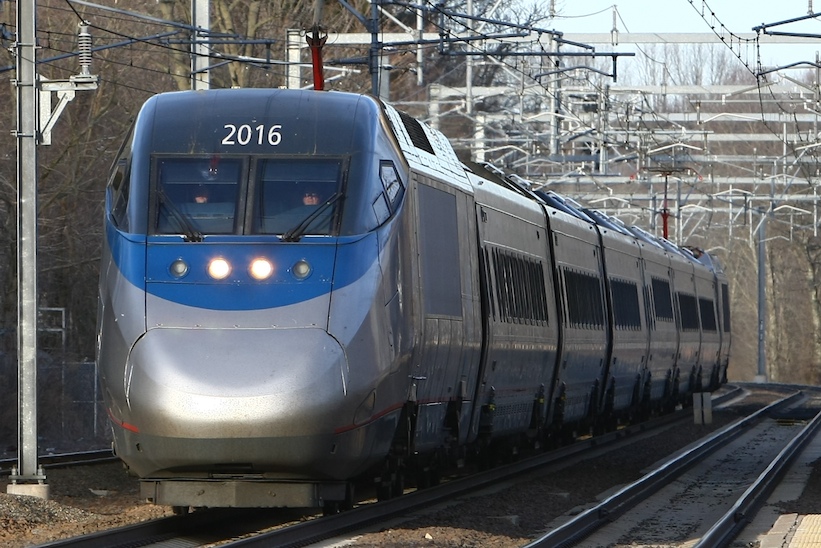
Amtrak Acela passing through Old Saybrook, CT
Photo by Chasesmith via Wikimedia Commons
That was one of the pleasures of reading your book, to discover you are a lover of trains and railroads, and that you marry this with a contrarian way of thinking. Do you take perverse pleasure in that combination? Oh, not at all. To me, it’s really sad. I wish I could support passenger trains, and I do support them as far as riding them and things like that. But I know enough about government subsidies to know that they reduce overall productivity and usually end up taking from the poor and giving to the rich. The people who are riding the Acela are not people in need of government handouts. The people who are riding light rail and things like that are not the poor, by and large.
What is the future of the long-distance trains? The role they fulfill is giving people access to scenery they can’t see in any other way, and really, it ends up being something for the wealthy. I think the Rocky Mountaineer model is the future of long-distance trains, and if you look at the United States, where can we have a Rocky Mountaineer? Certainly, Oakland to Denver, probably Oakland to Los Angeles, and after that, it gets pretty iffy. They would become cruise trains.
You seem almost as uncharitable towards the short-distance passenger trains. Amtrak does its best to deceive people about how well these trains do, for example, counting state subsidies as “passenger revenues,” in order to make itself eligible for more subsidies. I wouldn’t mind short-distance trains if they worked, but the Cascades, the California service, those trains aren’t really doing anything. A lot of money is spent carrying not that many people.
[…]
Statistics of yours that struck me are that public transit paid 90 percent of operating costs in 1964 from fares and just 32 percent today. Why not try to make the rail part of public transit more viable? You don’t address that in your book. You can’t make it more economically viable, simply because buses are so much better in every respect than rails. If you take the rail lines, and pave them over, and turn them into busways, you’ll be able to move more people, faster and cheaper and with far lower maintenance costs. Even if you could make the rails pay for themselves, since the buses are so much cheaper, why would we bother?
You seem most upset at places like Orlando and Dallas and Nashville, where commuter rail or light rail began but so few seem to ride. It this money thrown to the wind? I think so. Why is it that we allowed steam to change to diesel, sailing ships to steam ships — all these different technological evolutions to take place — but when it came to passenger rail, we said, “Halt, we don’t want more technological change.” The answer is threefold. It’s nostalgia. It’s people who are making money from wasting money, such as contactors — crony capitalism. And it’s accidents of history. The accident of history affecting urban rail transit was in 1973. Governor Francis Sargent of Massachusetts asked Congress to let cities substitute capital investments in transit for interstate highway grants. Congress said yes, but you can’t spend that amount of money on new busses. Instead, cities such as Buffalo, Portland, and San Jose built new rail lines with money from cancelled freeways because they are expensive and could use up those federal dollars. That’s what started the light-rail revolution, not because it was cheap, but because it was expensive.
England: South Sea Bubble – The Bubble Pops – Extra History – #4
Extra Credits
Published on 11 Apr 2015Support us on Patreon! http://bit.ly/EHPatreon
____________With the South Sea Company’s value dangerously inflated, Blunt drives one more scheme to raise stock prices – and it finally backfires on him. Early investors (including the famous politician Robert Walpole) seize the opportunity to sell their stock while the value is high, and the general public finally realizes that the South Sea Company has no actual worth. Everyone who didn’t sell their stock in the first round finds themselves suddenly bankrupt as the stock value plummets. Even King George, on vacation when disaster strikes, loses a large amount of the royal fortune. Robert Walpole, however, sees this as an opportunity to make himself a hero of the public. Hiding his own involvement in the South Sea Swindle, he cancels all debts owed for the company’s stock to help put its public investors back on their feet. Despite this, the public demands an inquiry and Walpole must walk a thin line between his facade as defender of the people and the reality of his, his party, and the King’s blatant corruption.
November 27, 2018
Cutting back on ethanol makes financial and environmental sense
Craig Eyermann explains why President Trump’s push to expand the use of ethanol in cars is a bad call for many reasons:
For example, because ethanol packs less energy per gallon than gasoline does, vehicle owners can expect to get even lower fuel mileage from the expansion of E15 fuel (a blend of 15% ethanol with 85% gasoline) under the new mandate to include more ethanol in automotive fuels, which would be 4% to 5% less than they would achieve if they only filled their vehicles with 100% gasoline. Today’s vehicle owners already pay a fuel efficiency penalty of 3% to 4% lower gas mileage from the E10 ethanol-gasoline fuel blend mandated under the older ethanol content rules, where the new rules will require even more fill-ups.
Beyond that, to the extent that it diverts corn from food markets to fuel production, corn-based ethanol production also jacks up the price of food—the corn itself, plus everything that eats corn, like beef cattle. One review of multiple studies found that the U.S. government’s corn-based ethanol mandates added 14% to the cost of agricultural commodity prices from 2005 through 2015.
Last summer, the Environmental Protection Agency also found that burning increasing amounts of ethanol has made America’s air dirtier because it generates more ozone pollution, which contributes to smog formation. Worse, growing the additional corn to make more ethanol has also increased agricultural fertilizer runoff pollution in the nation’s rivers and waterways.
That runoff has been linked to the increased incidence of harmful algal blooms, which have been responsible for contaminating drinking water and contributing to red tide events in coastal regions, where fish and other aquatic organisms have been killed off.
There is a solution to these federal government-generated pollution problems: stop forcing corn-based ethanol to be used in the nation’s fuel supplies. There’s even a case study from Brazil, where the city of Sao Paulo found that its air became cleaner after it switched from ethanol-based fuels to gasoline in the years from 2009 to 2011.
England: South Sea Bubble – Buying Out Britain – Extra History – #3
Extra Credits
Published on 28 Mar 2015Support us on Patreon! http://bit.ly/EHPatreon
____________The time has come for Blunt to enact the final act of his scheme: taking on the 31 million pound British debt. When Parliament initially balks at transferring responsibility for that much money to Blunt’s insolvent South Sea Company, he bribes them with special deals on his own stock. Despite a legal clause that should have locked the stock price until the company began paying off the debt, Blunt keeps introducing new plans to inflate the stock price and pocket the money for himself. He does everything from selling stocks on layaway to loaning people money so they could buy more stocks from him, creating an artificial demand for South Sea Company stock that drives the company’s worth up to 300 million pounds: a staggering ten times the initial value of the already stunning debt it had assumed. His success, founded entirely on speculation with no actual revenue from trade, not only starves out other businesses across Britain but exceeds the total amount of money in the country’s entire economy. This bubble can not last.
November 26, 2018
England: South Sea Bubble – Too Big to Fail – Extra History – #2
Extra Credits
Published on 14 Mar 2015Support us on Patreon! http://bit.ly/EHPatreon
____________Frustrated at every turn by the Whig-controlled Bank of England, Harley and Blunt decide to start their own institution: a trading company that will exchange government debt for stock shares. This new South Sea Company will have a monopoly on trade in the rich new lands of South America, but all the ports there are controlled by Spain, with whom Britain is at war. So Blunt pushes the country into a premature and unfavorable peace with Spain, enlisting famous authors to write his propaganda and convincing Queen Anne herself to tip the balance of Parliament in his favor. After the queen dies and the government changes hands, Blunt kicks Harley and his Tory leaders out of the company. He manages to bring King George I himself on board as a ceremonial leader, linking the success of the South Sea Company with the reputation of the monarchy. But while his maneuvering inflates the value of his company’s stock, it’s never produced anything close to the amount of money he’s convinced people to invest in it.
November 25, 2018
“They said Trudeau was going to be a uniter, but what an accomplishment”
Prime Minister Justin Trudeau visited Calgary this week, just as the city council officially buried its Olympic bid (but somehow decided to try to keep the subsidies from other levels of government for that event). His visit was the target of protests from both organized labour and Albertans angry about the federal government’s part in keeping Alberta oil from getting to market:
The prime minister flew into Calgary on Thursday to meet with Mayor Nenshi, chat with the Chamber of Commerce, and have photos taken at the site of new social housing being built partly on Ottawa’s dime. The PM left no word on what he thought of the whole “let’s buy Calgary an Olympics without going to the trouble of having one” concept. There were unexpected distractions at every turn in Calgary, the main one being a fierce protest outside his temporary headquarters at the downtown Hyatt.
The Herald’s agreed-upon estimate of the size of the anti-Trudeau protest was two thousand people. I am not sure I trust their math, but at any rate the crowd was large enough to snarl traffic and intimidate the police. I say “crowd,” but perhaps the word should be “crowds,” because the protest was actually twofold.
The striking Canadian Union of Postal Workers was there to discourage Trudeau from passing the back-to-work legislation his cabinet is cooking up. And there was also a coinciding protest over the landlocking of Alberta’s oil, which has widened the spread between world oil prices and local spot prices to surreal, unimagined heights. The sluggishness of pipeline construction has left Alberta hydrocarbons all but worthless. And now the world price is tottering from medium-high levels, ending a sunshiny global oil season from which the province got no advantage.
The posties’ chants of “Negotiate!” alternated with the militant oilpatch’s cries of “Build that pipe!” In a way the spectacle was touching. Here, in the streets of Calgary, you had one of the most internationalist and red-dyed corners of Canadian organized labour literally joining forces with its mostly non-union, mostly right-wing working-class brethren. They said Trudeau was going to be a uniter, but what an accomplishment.
This solidarity will, of course, be fleeting. CUPW, having played the Grinch successfully, will either cut a deal or take its medicine when the back-to-work law passes. But Calgary’s resentment of Trudeau will not be so quick to evaporate — nor, perhaps, will the images of our young prime minister facing a display of active mass public hostility for the first time.
England: South Sea Bubble – The Sharp Mind of John Blunt – Extra History – #1
Extra Credits
Published on 28 Feb 2015Support us on Patreon! http://bit.ly/EHPatreon
____________When Robert Harley steps in as England’s new Chancellor of the Exchequer, he discovers that not only is the government deeply in debt, but no one knows quite how much debt it owes. Because vicious political infighting between the Tory and Whig politic parties made it difficult to pass new tax laws, Harley turned to a private financier named John Blunt to help find enough money for England to keep up with its expenses for the year. Using Harley’s government resources, Blunt instigated a series of get-rich schemes that drove artificial demand for unsustainable land and lottery investments with tremendous short term gains. Before the year was done, Blunt had successfully covered the shortfall for the government that year – albeit at the cost of driving England’s already outrageous debt even higher.
November 23, 2018
“These are deficits of choice, not necessity”
The federal government released its fall economic statement the other day. The contents would not really have been a surprise to anyone who’s been paying attention since the last election, as Andrew Coyne explains:
The 2018 fall economic statement begins with a puzzle. Economic growth, it trumpets, is strong — the strongest in the G7 in, er, 2017. Unemployment is at a 40-year low; capacity utilization is back to pre-recession levels; profits are up; wages are growing faster than they have in eight years.
All this good news has produced a bumper crop of revenues to the federal treasury: an average of roughly $5.5-billion more annually over the next couple of years than was projected in the spring budget. Yet deficits are now projected to be … higher than expected — at $19.6 billion and $18.1 billion, respectively, about 10 per cent over forecast.
What explains this surprising result? Simple: as it has done throughout its tenure, the Trudeau government took the revenue windfall, and spent it — every last dollar and then some.
This is what the government calls “carefully managing deficits over the medium term.” It used to talk about reducing or even eliminating deficits. Now it seems devoted to doing whatever it takes to keep them in the $20 billion range, in perpetuity.
To be sure, the current set of projections, like its predecessors, shows deficits declining majestically in later years. But somehow in the here and now they never do. Once upon a time, this was supposed to be owing to a shortfall in revenues, the fruit of the Harper government’s supposed obsession with austerity.
By now this is not even pretended. The last Harper budget projected revenues for the current fiscal year at $326.9 billion, enough for a small surplus. The latest estimate has them at $328.9 billion — yet the deficit stands at $18.1 billion. Even allowing for a couple of billion dollars in accounting adjustments, it’s clear what is going on. These are deficits of choice, not necessity.
The Aggregate Demand Curve
Marginal Revolution University
Published on 18 Apr 2017This wk: Put your quantity theory of money knowledge to use in understanding the aggregate demand curve.
Next wk: Use your knowledge of the AD curve to dig into the long-run aggregate supply curve.
The aggregate demand-aggregate supply model, or AD-AS model, can help us understand business fluctuations. In this video, we’ll focus on the aggregate demand curve.
The aggregate demand curve shows us all of the possible combinations of inflation and real growth that are consistent with a specified rate of spending growth. The dynamic quantity theory of money (M + v = P + Y), which we covered in a previous video, can help us understand this concept.
We’ll walk you through an example by plotting inflation on the y-axis and real growth on the x-axis — helping us draw an aggregate demand curve!
Next week, we’ll combine our new knowledge on the AD curve with the long-run aggregate supply curve. Stay tuned!
November 22, 2018
This is why tax cuts are always criticized for benefitting the rich
Rebecca Zeines and Jon Miltimore explain why newspaper headlines and TV anchors always seem to decry any tax cut as being disproportionally beneficial to the wealthy:
But crucial facts are often missing in these articles. As a recent Bloomberg piece explained, two key points tend to be overlooked in articles written by media outlets and progressive tax proponents:
- The top 1 percent paid a greater share of individual income taxes (37.3 percent) than the bottom 90 percent combined (30.5 percent).
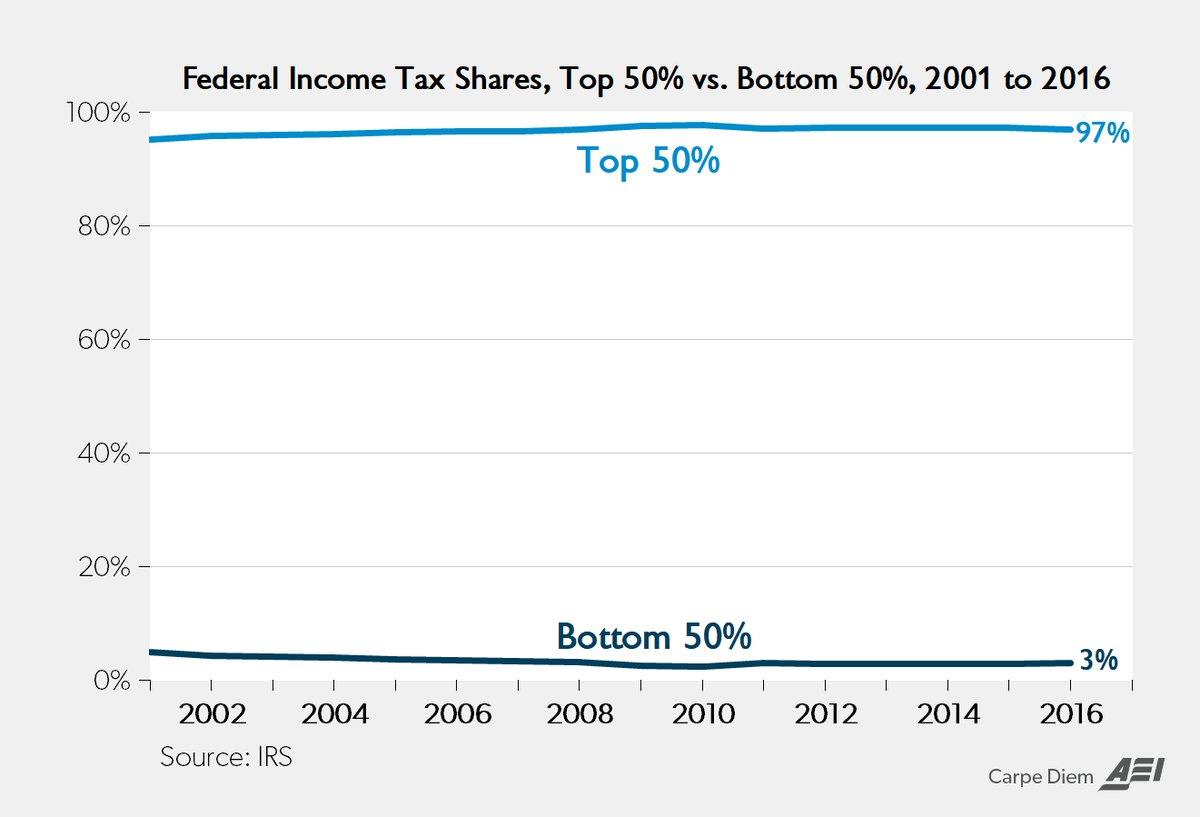
- The top 50 percent of all taxpayers paid 97 percent of total individual income taxes.
These numbers date back to 2016 but remain applicable in 2018.
These data show that the bottom 50 percent of US taxpayers paid just 3 percent of total income taxes in 2016, while the top 50 percent accounted for 97 percent.
Here is a wonderful visual representation of this dynamic, courtesy of Mark Perry of the American Enterprise Institute:
There is a clear correlation between economic freedom and prosperity, and tax climate is a key component of economic freedom.
Economist Dan Mitchell explains it best: Heavy taxation destroys entrepreneurship. The more money is taxed out of the private sector, the less is available for investment, development, and worker compensation (recall that after Trump’s tax bill was enacted, many businesses raised workers’ wages and offered bonuses).
Efforts to improve America’s tax climate are consistently and predictably derided as tax cuts for “the rich.” But, as the above diagram shows, it’s quite impossible to offer people a comparatively huge tax cut when they’re paying a comparatively tiny percentage of income taxes.