
… the discovery by the Mail on Sunday that Enid Blyton — one of Britain’s most enduringly popular and influential children’s authors, creator of Noddy and the Famous Five series — was denied a commemorative 50p coin on the 50th anniversary of her death because a Royal Mint “advisory committee” declared that “she is known to have been a racist, sexist, homophobe and not a very well-regarded writer”.
Enid Blyton was born in 1897. Pretty much everyone of that generation — and of every one preceding it — would qualify as a “racist, sexist, homophobe” by the standards of the modern left.
As for “not very well-regarded”, well she has sold over 600 million books — which probably counts for something, no?
We do not know the identities of this Royal Mint “advisory committee” but we know exactly what type of person they are. They are the same type of people who make up the committee of the Advertising Standards Authority (ASA) which has decided to make adverts that promote “gender stereotypes” effectively illegal in the UK.
[…]
There is no shortage of similar examples of the “political correctness gone mad” which has hijacked British culture. But the people enforcing it are a tiny minority of committed Social Justice Warriors — most of them educated in some worthless degree subject like gender studies, often “working” either in the human resources department or one with “diversity”, “equality”, or “sustainability” in their title — entirely at odds with the way most of the country still thinks.
Like the Soviet Politburo or China’s Central Committee, they are the very few who exert extraordinary — indeed, terrifying — power over the many.
True to Marxist Antonio Gramsci’s call for a “long march through the institutions”, these people have gained key positions of power the length and breadth of British culture.
James Delingpole, “From ‘Sexist’ Advert Bans to ‘Racist’ Enid Blyton, the Left Has Ruined Britain”, Breitbart, 2018-08-27.
November 15, 2023
November 10, 2023
Only a government could waste this much money on the ArriveCAN boondoggle
Chris Selley is in two minds about the ArriveCAN scandal, in that thus far no minister has been implicated but we all may naively assume that the civil service was better than this sort of sleaze:

It’s tempting to want to forget that ArriveCAN, the federal government’s pandemic travel app that collected dead-simple information from arriving travellers and forwarded it to relevant officials for scrutiny, and that somehow cost $54.5 million — a figure no one has come within 100 miles of justifying, and don’t let anyone tell you differently. No one wants to remember the circumstances that supposedly made ArriveCAN necessary.
One could also certainly argue there are aspects of Canada’s pandemic response more desperately needing scrutiny. So, so many aspects.
But whenever the House of Commons operations committee sits down to investigate ArriveCAN, there are fireworks. And you start to think, maybe this godforsaken app is more key to understanding Canada’s pandemic nightmare than you first thought.
The latest blasts came on Tuesday, when Cameron MacDonald, director-general of the Canada Border Services Agency (CBSA) when the pandemic hit, alleged Minh Doan, then MacDonald’s superior and since promoted to chief technological officer of the entire federal government — pause for thought — had lied to the committee on Oct. 24 with respect to who picked GCStrategies to oversee the ArriveCAN project.
Doan told the committee he hadn’t been “personally involved” in the decision. MacDonald, who says he had recommended Deloitte build the app, says that’s garbage. “It was a lie that was told to this committee. Everyone knows it,” he said. “Everyone knew it was his decision to make. It wasn’t mine.” MacDonald said Doan had threatened in a telephone conversation to finger him as the culprit, and that he had felt “incredibly threatened”.
Crikey.
For those who’ve blissfully forgotten, GCStrategies consists of two people who subcontract IT work to teams of experts and takes a cut off the top — in this case a cut of roughly $11 million, for an app that should have cost a fraction of that, if it was to exist at all. Needless to say, that wasn’t the only fat contract GCStrategies — which, again, is two men and an address book — had received from the government over the years. Each GCStrategist made more money off ArriveCAN than I’ll likely make in my life. It makes me want to strap on a bass drum and sing “The Internationale” in public.
November 9, 2023
QotD: The end of the “spoils system” and the professionalization of the bureaucracy
I know, that seems weird, but unless you’ve really studied this stuff — it’s not taught in most high school or even college classes, for some mysterious reason — you probably don’t know that the civil service used to be entirely patronage-based. Our two most famous literary customs inspectors, for instance (Hawthorne and Melville), got their jobs through political connections, and that’s the way it worked for everyone — every time the other party won an election, most of the bureaucrats got turfed out, to be replaced by loyal party men. Trust me: very few of the names on this list would ring much of a bell even to field specialists, but they were big political cheeses in their day; Postmaster General was a plum federal post that was often handed to loyal Party men as a reward for a lifetime of faithful service. And so on down the line, including your local postmaster.
It took until 1883 to finally kill of this last vestige of federalism, but the Pendleton Act did it. Here again, this isn’t taught in school for some mysterious reason, but the political class took a very different lesson from the Civil War than the hoi polloi. While for the proles the Civil War was presented as a triumph of the common man, the elite understood that it was training, logistics, bureaucratization, professionalism that won the war for the Union. The Republicans made a big show of putting up U.S. Grant as “the Galena Tanner” in their campaign rhetoric but Grant had been a bankrupt tanner, and indeed a conspicuous failure at everything except war … and even there, his record was carefully doctored to present an image of a bumbling amateur suddenly being struck by inspiration, when in fact Grant was a West Pointer with an impressive combat record in the Mexican War. Now is not the time or place to discuss the merits, or not, of various Civil War figures, so just go with me on this: Pretty much all the big name generals on both sides of the war were presented to the public as talented gentleman amateurs, and it was heavily insinuated that the ones they couldn’t so portray — McClellan, and especially Robert E. Lee — lost because they were too hidebound, too “professional”.
The reality is almost the complete opposite — yeah, Stonewall Jackson ended the Mexican War as a mere captain (no mean feat in The Old Army, but whatever), but he had a tremendous combat record, and was so much of a military professional that he actually taught at a military academy. This is not to say there weren’t naive geniuses in the Civil War — see e.g. Nathan Bedford Forrest — but the Civil War, like all wars since the invention of the arquebus, was won by hardcore, long-service, well-trained professionals. A naive genius like Forrest might’ve been a better tactician, mano-a-mano and in a vacuum, than a West Point professional like Custer — then again, maybe not — but wars aren’t fought in vacuums. They’re fought on battlefields, and they’re won by supply weenies and staff pogues.
[…]
They took that experience with them into politics, and so it’s no surprise that the Federal government of the Gilded Age, though tiny by our standards, grew into such a leviathan in so short a time. Again, I’m just going to have to ask you to trust me on this, since for some reason it never gets covered in school, but back in the later 19th century words like “efficiency” really meant something to the political class. All those politician-generals (and politician-colonels and politician-majors and all the rest down at the local level) expected the State to function like the Army — that is to say, as a self-enclosed world where efficiency not only counts, but triumphs. An amateur civil service can’t do that, and so the days of the political sinecure had to end.
Severian, “Real Federalism Has Never Been Tried”, Rotten Chestnuts, 2021-05-03.
November 5, 2023
QotD: The Auftragstaktik principle of the Third Reich
Obviously civilian life isn’t as goal-directed as the military in wartime, but a similar principle applied — given a vague set of generalized objectives from the top (Kershaw’s famous “working towards the Führer” thesis), everyone at every level was encouraged to move the ball downfield as he saw fit … with the added twist that, in the absence of a clearly defined, military-style chain of command, the various “subordinates” would ruthlessly battle it out with each other, Darwin-style, for bureaucratic supremacy.
Thus the Nazis’ infamous plate-of-spaghetti org charts. I’m not an expert, but I’m pretty sure there were more than a few guys who held wildly different ranks in various different organizations simultaneously. He might be a mere patrolman in the Order Police, but an officer in the SS, a noncom in the SA (you could be in both, at least in the early days), and so forth. I wouldn’t be surprised if there was more than one guy who technically reported to himself, somewhere deep in the bowels of the RHSA [Reich Security Main Office]. You could spend a lifetime trying to sort this stuff out …
Severian, “The Crisis of the Third Decade”, Rotten Chestnuts, 2021-03-18.
October 29, 2023
Arguments for not buying military kit “off the shelf”
Sir Humphrey provides some of the reasons why it’s not a simple economic case for a nation’s military procurement to buy “off the shelf” equipment even from a close ally:

Not all kit needs to be or can be domestically sourced. The British army uses Apache attack helicopters which are licensed from the original US manufacturer.
Westland Apache WAH-64D Longbow helicopter (UK Army registration ZJ206) displays at Kemble Air Day 2008, Kemble Airport, Gloucestershire, England in June 2008.
Public domain photograph by Adrian Pingstone.
The arguments for buying American are on the face of it reasonable. The US produces good quality equipment able to meet many UK defence needs. There is a strong supply chain in place, ensuring that there are plenty of spare parts in the system to draw on when needed, and at cheaper cost due to bulk buying. The equipment is usually designed to be interoperable with NATO partners, so it can be integrated to work alongside allies and with existing equipment. It can be delivered quickly, it works and lots of other people use it, so why shouldn’t the UK? There are in fact many good reasons why the UK should not exclusively buy American.
Earlier this month, we looked at the Canadian Surface Combatant (CSC) program and why the Canadian Armed Forces never seemed to get the same “bang for the buck” that our American or British allies seem to manage. Here, Sir Humphrey points out that even the British military has to make procurement decisions that weigh cost and convenience with some very significant national security concerns:
To start with, US kit is designed by US companies to meet US requirements, not British ones. This may sound obvious but there is a dangerous view some put forward that “off the shelf” means the UK could just buy something and use it. There is no such thing as “off the shelf” unless you want it as it comes in its US version, with no modifications, changes or installation of British equipment. The moment you do this, you’ve created a UK variant with its own bespoke requirements and supply needs, for which you are dependent on the US defence industry to support – and there is no guarantee that this can or will happen. From the outset you have lost operational sovereignty and control over your military equipment.
Buying from the US means the UK would need to request a Foreign Military Sale (FMS) case through the US government, seeking legislative approval to purchase the equipment. If, for example, the UK wanted to buy a new tank, it would be reliant on US government approval to do so, not just for the initial purchase, but for all spares buy thereafter. The way that FMS works is that it sets out approval not just for purchase, but sets a schedule for spare parts purchases, services, and upgrades, all of which are done at the time and schedule set by US government and industry, and not the British government. This means that the UK would lose control over when to purchase spares or upgrades and would be forced to buy to a foreign governments timetable. This is why FMS is so successful for the US – it offers cheap entry prices but makes a killing in the long-term spares and support market. To buy from the US means to accept that you are handing over control of your spares and logistics chain to a foreign power who determines the timing of when and what you buy. This is fine in small doses but if you buy exclusively from the US, suddenly means you’ve got no control over how you want to support your armed forces.
The next challenge is the integration work needed to make things work for the UK. One of the risks of buying a foreign design is that you lack operational sovereignty over the design and its internal contents. Equipment supplied by the US will often come with a variety of sealed, tamper proof boxes containing US government-controlled technology that cannot be accessed by the purchasing nation. As the operator, you do not have full control over your military equipment, you don’t know what is necessarily in the boxes, and you are reliant on the US to fix issues with them. By contrast any equipment designed and built in the UK means that the MOD has full control and sovereignty over it to open it up, modify, adapt or change it to meet British needs. To buy US means accepting we cannot change a design without a foreign nations’ approval, which in turn means exposing our own sensitive military technology and equipment to the US, to conduct trials to ensure it can work with the US provided equipment. This represents an astounding loss of sovereign control on advanced weapon systems and means potentially giving the US defence industry insight into UK capabilities that manufacturers may want to keep commercially sensitive.
October 26, 2023
“… despite all the evidence, British people still believe the NHS is the single best thing about Britain”
The picture Jess Gill paints of Britain’s National Health Service is equally true of Canada’s various provincially run socialized medical systems, and largely for the same reasons:

Not actually the official symbol of Britain’s National Health Services … probably.
It’s clear that Britain’s National Health Service is failing. 7.6 million people are on a waiting list, and 41% of them say their health has gotten worse while waiting for treatment. Compounding the problem, the UK has significantly fewer hospital beds, doctors, nurses, CT scanners, and MRI units than the OECD average. Furthemore, the UK has the second-highest rate of treatable deaths in Western Europe.
Yet despite all the evidence, British people still believe the NHS is the single best thing about Britain. From the country clapping outside their houses to “thank our NHS” during the Covid-19 pandemic, to the Prime Minister and the Leader of the Opposition attending a mass ceremony to celebrate the NHS’s 75th anniversary, praise for this institution is everywhere.
Even though it’s self-evident the emperor has no clothes, the NHS is treated like a sacred cow. This begs the question: why are people so loyal to a system that is clearly failing them?
There is a prevalent conspiracy theory that the NHS is being intentionally underfunded by the Conservative Government so that the resulting poor outcomes will provide justification for them to privatize it and transform it into the American model of healthcare. This theory is pushed by the establishment: from senior members of the British Medical Association, journalists, and Members of Parliament.
This theory achieves two things. One, it shifts blame for poor outcomes away from the NHS as a system itself and toward the politicians in power. Two, it frames the debate with the assumption that privatization is a bad thing, causing any meaningful reform to be met with fear mongering.
This narrative has caused a massive issue for opponents of the NHS as there are multiple levels of misleading rhetoric. The fact of the matter is that the Conservatives are not privatizing or underfunding the NHS. Furthermore, whether it be a fully privatized system or even the mixed system as seen in other European countries, free-market reform would significantly help patients and doctors.
October 25, 2023
Housing for Hamas leadership … in London
In the non-paywalled part of a post from Ed West, we have a look at the terrible conditions leaders for Hamas and other terrorist organizations have to put up with in the embattled suburbs of … London:

Barnet, to those unfamiliar with this corner of the world, is the most Jewish borough in Britain, an area of north-west London often described as “leafy” and including both pleasant inner suburbs like Finchley as well as areas of genuine countryside. The migration of eastern European Jews in the capital followed an anticlockwise direction from impoverished Whitechapel in east London up through Hackney and Haringey in the north, with Barnet the next stop.
It is also, strangely, home to a leading fundraiser for Hamas, the terrorist group responsible for the murder of 1,400 people in southern Israel earlier this month and quite explicitly committed to the eradication of Jews in the Holy Land.
What with London house prices being what they are, you wonder how he managed it, but of course Muhammad Qassem Sawalha, who “ran the group’s terrorist operations in the West Bank”, according to the Sunday Times, managed to buy his property with help from the council.
Despite being a known and wanted terrorist, Sawalha was allowed to settle in Britain in the 1990s and obtain British citizenship. He continued to work for Hamas, holding talks about committing terrorist acts and laundering money for the group, according to the US Department of Justice. In 2009 he signed the Istanbul Declaration which praised God for having “routed the Zionist Jews”, and called for a “Third Jihadist Front” to be “opened in Palestine alongside Iraq and Afghanistan”, according to the paper.
All the while he was benefitting from Britain’s social housing system. In 2003, Barnet Council made him a council tenant and he was housed in a two-storey property with a garden and garage in the borough, where he still lives.
Two years ago, Sawalha and his wife used the Right to Buy scheme to acquire their home for £320,700, with Barnet Council giving them a £112,300 discount on its market value.
This is despite the fact that in 2006 Panorama reported that Sawalha was “said to have masterminded much of Hamas’ political and military strategy” and that, “although he was known to MI5, the ‘authorities let him operate freely here'”. Not just let him operate freely, but sort him out with a house – and if you think this sounds insane, it is not at all uncommon.
Sawalha’s old comrade, the famous hook-handed hate preacher Abu Hamza, was also given a huge house courtesy of the British taxpayer. The Egyptian was allowed to live rent-free in a five-bedroom house in what the Mail described as “upmarket Shepherd’s Bush”, a phrase I would have found astonishing to read as a teenager in west London.
Shepherd’s Bush is next door to super-rich Holland Park, and private property is extremely expensive there – but it also has high levels of social housing, as with much of central London, so “upmarket” might be stretching it.
October 22, 2023
A lawyer in “deep blue” Pennsylvania discovers that elected bodies don’t have to listen to the voters
Chris Bray on the details of a case from Pennsylvania where an active and involved parent tried to get answers from the elected school board on how they justified imposing masking requirements without a shred of legal power to do so:
In December of 2021, the Pennsylvania Supreme Court ruled that officials in that state had implemented mask mandates that they had no legal authority to impose. The decision in Corman v. Beam is not written in stirring language, and makes no bold declarations about truth, freedom, and the American way; it’s a workmanlike examination of statutory language, quite dull to read. Test me on that characterization, if you want. But the court concluded, importantly, that the mandate had been invalid ab initio — not from the moment the court struck it down, but rather from the moment it was issued. Mask mandates had never been enforceable in Pennsylvania.
In an affluent, deep blue community in the Philadelphia suburbs, a lawyer and parent named Chad Williams took the ruling as vindication. With four children in the local schools, he’d been telling school officials — clearly and often — that they had no legal authority to require masks on campus. To say that they hadn’t listened would be an understatement.
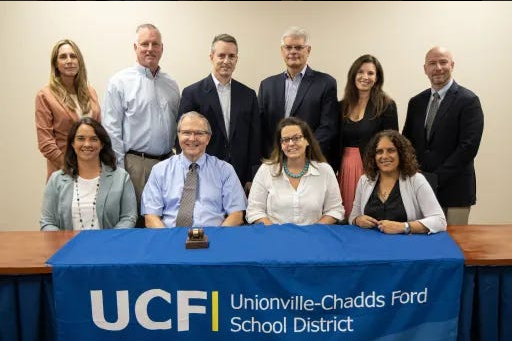
In August of 2020, during a Zoom meeting to decide on in-person school for the soon-to-begin school year, the nine-member Unionville-Chadds Ford school board muted Williams when he asked about the legal basis for the choice.
Repeating the performance, school board members cut the microphones and walked out of one of their own subsequent meetings, in August of 2021, to avoid listening to Williams when he didn’t stop speaking at the three-minute mark during their public comment session. Other parents concerned about forced masking for children received a similarly warm reception. The school board voted unanimously that same night to again impose a mask mandate on their campuses for the new school year.
For Williams, the repeated experience was a shock. He was an experienced lawyer, a parent, an established member of the community, and a volunteer coach at the high school — and he couldn’t get anyone to listen to a reasonable question. He asked his school board to explain the legal basis for a new policy, and “the school board president just cut me off.” Officials were acting in lockstep, without apparent authority, and refusing to explain their choices. “They just wouldn’t answer,” Williams says. Many of us have had this experience.
The school district finally dropped its mask mandate in March of 2022, after the decision from the state Supreme Court. And that was the end — except for one thing. A formal policy of the Unionville-Chadds Ford School District, Policy 906, establishes “a fair and impartial method” for the examination of parent complaints. You can find that policy here, in the section labeled “Community”. The policy is detailed and unambiguous, and starts requiring written reports after the failure of early and informal stages of resolution:
Third Level – If a satisfactory solution is not achieved by discussion with the building principal or immediate supervisor, a conference shall be scheduled with the Superintendent or designee. The principal or supervisor shall provide to the Superintendent or designee a report that includes the specific nature of the complaint, brief statement of relevant facts, how the complainant has been affected adversely, the action requested, and the reasons why such action should be taken or not taken.
Fourth Level – Should the matter not be resolved by the Superintendent or designee or is beyond his/her authority and requires Board action, the Superintendent or designee shall provide the Board with a complete report.
Final Level – After reviewing all information relative to the complaint, the Board shall provide the complainant with its written decision and may grant a hearing before the Board or a committee of the Board.
Williams used Policy 906 to ask the school board to think about what it had done, conducting an independent review of its policy decisions during the pandemic. Why had school officials implemented policies they had no legal authority to impose? Why had they refused to discuss or address parent questions? Why had they stonewalled requests for documents and information — not only from parents, but from a state senator who took an interest in the matter? Williams asked for an apology and “changes in oversight” to prevent a recurrence of unlawful and unexplained policy decisions, using formal school district policy that requires the district to act on complaints.
They haven’t bothered. The Unionville-Chadds Ford School District continues to ignore Williams, not responding to his complaints or opening the inquiry their own policy requires them to pursue. He’s had one sort-of response: In an exchange over the handling of the complaint, the district’s lawyers, at a private law firm, threatened him with legal action — a threat they so far haven’t made good. But from school district officials, the only response to three years of questions is unbroken silence.
October 19, 2023
The evisceration of Bill C-69 (aka the Impact Assessment Act)
The decision of the Supreme Court of Canada to strike down large parts of the federal Impact Assessment Act caught a lot of people by surprise. The court hasn’t made much of a habit of rejecting the federal government’s ever-increasing encroachments on provincial jurisdiction, so this ruling is a bit of a black swan. It’d be nice if the Supremes were going to be more vigilant in future, but that’s unlikely. Colby Cosh explains why this is a “remarkable political moment”:

Environment Minister Steven Guilbeault, 3 February 2020.
Screen capture from CPAC video.
To hear the Liberals talk now, you would think that the Supreme Court’s 7–2 rebuke of C-69 was a mere bump in the road. Steven Guilbeault, the federal environment minister, appeared on CTV’s Question Period to reassure the public that the law can be “redefined” to accomplish its grandiose intentions; it’s just a matter of “course-correct(ing)” the text a smidgen in order to “comply with the spirit” of the ruling.
Here’s an idea for the minister: maybe just go ahead and comply with the ruling, period?
Comply with the spirit, he says. Having taken the trouble to decrypt the ruling, which is not exactly a masterpiece of lucid clarity, I wonder at the environment minister’s priorities. Rather than appearing on television with a bunch of happy talk, he ought to have been mopping up the seas of blood left by the court’s evisceration of his Impact Assessment Act.
In essence, the Liberals created an apparatus whereby a federal panel would perform environmental and social assessments of major infrastructure projects based on the possibility that they might “cause adverse effects within federal jurisdiction”.
The underlying pretext is that the federal government’s powers are sometimes engaged by the creation of mines, wells, roads and other such projects — even when they are confined within one province’s borders — because they can conceivably affect federal matters such as fisheries, migratory birds, Aboriginal welfare, treaty obligations and other “national concerns”.
This is true as far as it goes, but the court majority’s finding was that this constitutional pretext for creating a federal assessment scheme isn’t actually reflected in the scheme itself. The Liberals, asserting a right to investigate hypothetical infringements on the federal sphere of power, created a law that essentially allows them to veto anything that a province might want to permit.
As the law is written, the initial assessment-agency decision to “designate” a project for assessment can be based on just about anything, including “any comments received … from the public” and “any other factor the Agency considers relevant”. In the final decision-making phase, which is to be based on the “public interest”, specific federal heads of power are also cast aside: whoever makes the final call at the cabinet level is to evaluate a project for “sustainability”, for example.
October 16, 2023
In ?praise? of the “spoils system”
Glenn Reynolds on the way the US government’s structure changed from the “spoils system” of the early republic to the modern “professional” civil service of today:

Andrew Jackson sitting on a hog on top of a tomb with the inscription “To the victors belong the spoils”.
Political cartoon by Thomas Nast, Harper’s Weekly, 28 April, 1877.
America’s institutions need structural reform. We need it in academia, we need it in the corporate world, and we need it in government. In all of these fields, the structures, incentives, and institutions that have grown up over time have been destructive, and need to be fundamentally transformed.
I’ll be writing about all of these things down the line, but for now let’s start with government. Though you don’t hear a lot about it on the right, the left is all bent out of shape over the prospect that a Republican administration elected in 2024 might partially deconstruct the existing protected civil service. I, on the other hand, am excited about that prospect, and only wish they’d go farther.
Prior to the adoption of the Pendleton Act in 1883, government employment operated according to the “spoils system”, which meant that hiring in the executive branch was controlled by the Executive. When a new administration came in, everyone’s job was up for grabs, at least potentially. This “rotation in office” had several advantages, which were widely appreciated at the time, and propounded by presidents from Jefferson to Jackson to Lincoln.
Jackson argued that one serving in government for too long would inevitably lose sight of the public interest and come to use office for personal gain. He also maintained that government was or could be made simple enough for men of ordinary ability and experience, so ‘more is lost by the long continuance of men in office than is generally to be gained by their experience’.1
Contrary to popular belief, though, the arrival of a new president didn’t mean that everyone left. Even Andrew Jackson, upon taking office, replaced only about 10% of the federal work force with his own people. Every president understood the value of continuity, and hiring new people is hard work.
But under the spoils system, the fact that the president could replace anyone mean that everyone worked for him. And that meant both that everyone was responsible to the president, and that the president was responsible for everyone in the government, and everything the government did. This is consistent with the Constitution’s vesting clause, which provides that “The executive Power shall be vested in a President of the United States of America.” If the executive branch does it, it’s an executive power, and if it’s an executive power it should be controlled by the president.
Contrast this to a “professional” civil service, in which the president does neither the hiring nor the firing, except with regard to a comparatively small number of senior officials. The civil service doesn’t think of itself as working for the president, really, and will happily drag its feet when it doesn’t like the president’s priorities. And when the bureaucracy misbehaves, or fails to perform, the president can, at least to a degree, blame its recalcitrance for the trouble or lack of results that occurs.
Congress is also let off the hook, yet simultaneously weirdly empowered. Congress can blame “the bureaucracy” for bad things, even when those things result from laws that Congress has passed. Then it can turn around and “help” constituents by intervening with the bureaucracy it has rendered dysfunctional, earning gratitude that may be deserved in a narrow sense, but not in terms of the big picture.
Under a spoils system, on the other hand, nobody gets off the hook. If the bureaucracy misbehaves, the president can fire the misbehavers. If Congress is unhappy with what bureaucrats do, they can demand that the president fire them, and make an election issue out of it if they want.
So why did we wind up with a civil service? As is typical, the fantasy of a neutral, efficient, expert civil service was laid next to the reality of a messy functioning government. But, as is also typical, the fantasy in practice turned out to be considerably less appealing than as proposed.
1. Robert Maranto, Thinking the Unthinkable in Public Administration: A Case for Spoils in the Federal Bureaucracy, Administration & Society, January 1998, 623,625.
October 9, 2023
“Wildly popular public sentiment is disorder, and has to be restrained”
Chris Bray outlines one of the many (many) ways that elected officials are insulating themselves from the voters who elected them to ensure that they only hear what they want to hear from the public … and as little of it as they can get away with:
Wildly popular public sentiment is disorder, and has to be restrained. So here, let’s start with something vital and interesting, and then work our way through the process a local government is using to kill it. As always, the point about this local story isn’t just the local story, since versions of this are happening all over the country (and with federal assistance).
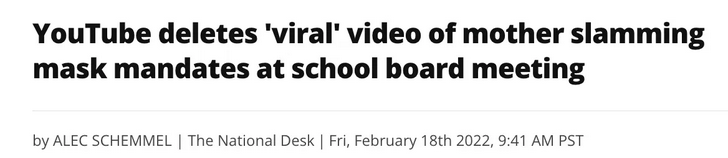
Early last year, an angry Virginia mom spoke to the Prince William County school board, blasting mask mandates in schools. Her fiery three-minute speech went viral, until YouTube, which now seems to mostly exist to prevent discussion, killed it:
It’s back, in a less-watched version that YouTube hasn’t gotten around to cancelling yet:
Here’s a version on Rumble, if you’d rather watch it there, but Substack doesn’t embed Rumble video.
The second thing to notice in that video, after you notice the clarity and strength of Merianne Jensen’s comments, is the response: an enormous audience of parents shouting and cheering in support as another parent sharply criticizes school district policy. The public is present for a government meeting, and the public is engaged. Citizens are participating, enthusiastically and in large numbers, which is supposed to be a thing we regard as an ideal.
[…]
Public comment is limited to one hour, full stop, no matter how many people wish to speak, and no matter how urgent a controversy before the board might be. The public — the entire public — gets an hour. But, second, that hour is alloted through an application process in which people who wish to speak to the school board fill out an online form that a clerk then evaluates and processes, deciding whether or not a request to speak will be granted. Detailed contact information is required before the school district will consider your request to speak, and national organizations and other outsiders have no right to speak at all, since public comment is limited to verified residents of the county. The form is a masterpiece of passive-aggressive nudging, communicating with great clarity that your desire to offer public comment is merely being tolerated. Read this carefully, because in a few minutes we’re going to get to the pernicious way this system is now being gamed:
This form does NOT confirm your request to be added to the list of speakers for Citizen Comment Time. You will receive a separate email indicating the status of your request. As a reminder, speakers are signed up to speak on a first-come, first-served basis.
Thank you again for your interest.
Citizens may sign up to be placed on the list of speakers for the citizen comment period starting at 8:00 a.m. on the Saturday immediately preceding the School Board meeting at which the citizen wishes to speak. Requests received prior to 8:00 a.m. on the Saturday immediately preceding the School Board meeting will not be honored. Speakers will be signed up on a first-come, first-served basis, ending at noon on the day of the meeting. The sign-up list will close once the number of total speakers who have signed up reaches twenty and there will be no sign-up thereafter, nor at the meeting.
That last sentence will become important: twenty commenters are signed up in advance, in the order in which they apply, and then the list for public comment is closed, the end. Can you see where this is going?
Before we get there, I’ll just note that a more detailed board policy on comments, available here, adds that the board chairman can end a public comment session, and ask school district security to remove speakers, if a commenter wanders into “inappropriate topics” or a tone the board regards as uncivil. You can feel the spontaneity and openness being drained.

September 28, 2023
QotD: “Tenure Track” positions in an American university
A tenure-track position begins with a national (or international) search and a fairly long hiring process (from job-posting to job-offer usually takes around 6-8 months). A newly hired professor is an assistant professor, which means they are on the tenure track but do not yet have tenure. Instead, after about five to six years, they’ll go up for tenure review, where a committee of faculty in their department along with some external reviewers will look at all of the work the professor has done since their appointment and either recommend them for tenure or not; the university leadership structure typically has a role in confirming a grant of tenure but this is generally a rubber-stamp role. By far the most important part of tenure review at large universities is research; this is the part of the system that is “publish or perish”.1 Untenured tenure-track faculty (so, assistant professors) represent roughly 9% of all faculty members in the United States, according to the AAUP.
A professor that passes tenure review becomes an associate professor, which confers tenure (making it difficult to fire them) as well as a bump in pay. After another few years, they can go up for review again for promotion to the next rank, simply professor (often termed “full professor” for clarity), which comes with another bump in pay. This second transition is different from the first though; whereas the review from assistant to associate professor is an “up or out” moment (you either get tenure and stay or get rejected for tenure and leave the department), some professors can and do remain associate professors forever. Finally, a handful of professors who really distinguish themselves may wind up with an endowed chair and we tend to call these folks distinguished professors, though their actual job title will usually be something like “the so-and-so Professor/Chair of this-and-that” where the ‘so-and-so’ is the name of the donor that endowed the money being used for the distinguished professorship. Tenured professors represent roughly 24% of all university professors according to the AAUP, meaning that the total slice of tenured or tenure-eligable professors in higher education is just 33% – one third.
Let me say that again: only one third of all faculty work the way all of you think all faculty works. Just one third. This is a big part of what I mean when I say that the United States’ university system is being pillaged without the public knowing; if you told most people “only one third of college instructors are actually professors, most of your little Johnny’s classes are taught by non-professors now“, they’d be shocked! But that’s the current situation.2
Tenure-track professors generally teach a fixed course-load, expressed in most cases as a load over semesters, so a “2/2” (pronounced “two-two”) load is four courses a year (two in each semester). Tenure-track faculties at research-focused universities (which are all of the flagship state schools) generally teach a 2/2 load; mixed research/teaching schools (your third-string state schools and less well-funded private schools) often have 3/3 loads. Teaching-focused institutions may have 4/4 or 5/5 teaching loads (or more) and of course fractional loads (like a 2/3, etc.) do exist, but are less common.
In addition to teaching, tenure-track faculty are expected to publish research and do “service”. We’ll talk in another post more about these demands (indeed, we’ve talked about research already), but they deserve a few words here. The amount of research demanded varies by the level of institution; at an R1 the general expectation for a faculty member going for tenure in a humanities department is that their book is out3 and they have a good number of articles and other publications besides. At less research-focused universities, you might see instead that tenure is set at a certain number of articles and the book is instead at the jump to full professor.
Meanwhile “service” refers to all of the non-teaching roles faculty fill in a department. The university is predicated on self-governing departments of academics (“colleges” in the literal sense of an association of colleagues) and so departments are effectively run by committees and faculty appointed to do various key roles: student advising, graduate admissions committees, hiring committees, committees on teaching, and of course department chair (and possibly vice or assistant chairs) who steers the department. Of course faculty are assisted in those roles by the department staff who handle much of the paperwork, compliance and book-keeping. Some, but by no means all, of these service jobs come with a “course release” which is to say the faculty member teaches less in order to do the extra service, but there is an expectation of a certain amount of service work always being part of the workload mix.4
Finally, the more important service positions are often restricted to either associate or full professors – you have to get tenure first before you get a particularly loud voice in the running of the department. Nevertheless, even assistant professors are going to be “in the room” when decisions about courses, resource allocation, scheduling, and so on are made, which matters quite a lot. Moreover, because even assistant professors are expected to become permanent members of the department, their interests tend to be considered because, well, frankly, the tenured professors have to live with them for the next few decades, so you might as well be friends. This fact is really important for understanding why departments can be so callous to anyone not on the tenure-track (and why tenure-track faculty can be so oblivious to how callous they are being), because NTT faculty are usually not in the room when decisions are made.
Bret Devereaux, “Collections: Academic Ranks Explained Or What On Earth Is an Adjunct?”, A Collection of Unmitigated Pedantry, 2023-04-28.
1. A phrase that I am sick to death of hearing, but it seems to be functionally the only thing most people in the public know about academia and also the thing that select members of the public seem to think we need repeated to us at every possible opportunity, as if we’re not aware. It’s useless in any case, in history at least. Which hiring numbers being what they are now, by far the most common career path is in fact, “publish and then perish”.
2. In fact, COVID made these numbers look better than they had in the years previously, not because universities hired more tenure-line professors (they didn’t), but because they fired a lot of non-tenure line professors due to COVID, taking advantage of their lack of job protection.
3. In yesteryear, a book simply forthcoming was good enough. These days, that might not even be good enough to get hired as this entire system breaks down. By the end of 2022, I had actually qualified for tenure at the institutions which did not hire me in 2020; I still do not have a tenure track job.
4. So for instance being department chair often comes with a course release, but being on a committee or serving as an undergraduate or graduate advisor often doesn’t.
September 20, 2023
QotD: The structure of an American university
So let’s start dividing all of those employees down so we know what we’re dealing with. We can start by splitting the university into faculty and staff (with student-workers as a third group we’ll not discuss this week); faculty teach and do research whereas staff are all of the supporting administrators and workers that make the university function. We’re not going to talk much about staff, but briefly we can divide them quickly into four big groups: leadership (chancellors, deans, and assistant deans of various kinds; of old these used to be professors pulled into leadership temporarily but these days these are professional managers),2 department staff (who work within academic departments handling the scheduling, paperwork and other essential support services), university staff (who staff the university-wide bureaucracies like the registrar or bursar) and finally what I’ll call – somewhat imprecisely – facilities staff (a wide category covering all of the folks who do a lot of the physical work that keeps a university running; repair, grounds-keeping, janitorial tasks, running dining areas, etc. etc.). All of these people are important, but this week’s post isn’t about them; I break them up here so that when I do mention them, you understand who I mean.
Faculty are divided as well into two large groups: tenure track and non-tenure track. Tenure-track jobs are what most people are familiar with, at least in a vague way. The tenure track was supposed to be (and pre-aughts, was) the “standard” career path for an academic at a university. That’s the system everyone knows, if they know a system. But another system was made.3 And that brings us to non-tenure track positions, both permanent and temporary, full-time and (fake) part-time (which are often actually full time), which will consume most of this post. We’re going to break these up primarily between full-time non-tenured or teaching track positions and notionally “part time” or adjunct appointments, but there are a few other types thrown in there. Crucially, this other system makes up the majority of university teachers, around 67% and rising.
Bret Devereaux, “Collections: Academic Ranks Explained Or What On Earth Is an Adjunct?”, A Collection of Unmitigated Pedantry, 2023-04-28.
1. R1 is a term from the Carnegie Classification of Institutions of Higher Education, which classifies colleges and universities by the degrees they grant and how research oriented they are. An “R1” classification indicates the highest level of research focus; nearly all of the large flagship state schools are R1 institutions.
2. Whose stewardship of their universities is somehow almost uniformly worse than what was accomplished by amateur professors who’d rather not have been asked.
3. Please read with the voice of Cate Blanchett intoning, “but another ring was made”.
September 16, 2023
Public health officials don’t seem to realize just how badly they’ve damaged their credibility
Chris Selley on the apparantly huge gap between how ordinary Canadians view their public health officials and how those officials think they’re viewed:

Throughout the pandemic, polls have shown a decline in confidence in public health: Researchers at McMaster University and Vox Pop Labs found that in March 2020, 59 per cent of Canadians had “a great deal of trust” in public health officials. Two years later that had plummeted to 37 per cent.
We have recently enjoyed months of being able to ignore COVID-19. Even the relentlessly, uniquely pessimistic Canadian media seemed to have exhausted themselves. So I found it a bit jarring to see Dr. Theresa Tam, Canada’s chief public health officer, suddenly back on the TV this week admonishing us to “get your mask ready” for fall and book yourself in for a booster. Dr. Kieran Moore, Tam’s counterpart at Queen’s Park, is due in the coming days to give Ontarians what will likely be a similar update.
If this year’s flu/RSV/COVID season is as bad as last, it will be fascinating to see how Canadians react. Perfervid opposition to masking and vaccination are minority positions: In the midst of last year’s autumn surge in childhood hospitalizations, a Nanos Research poll found 69 per cent of Canadians would support a return of mask mandates “if authorities deem(ed) it necessary”.
But are people ready to hear it, again, from the same public-health officials who have all-but destroyed their entire field in the last three years — seemingly without realizing it? It will be intriguing to see.
Tam’s original sins remain totally unexplained — at an official inquiry, for example, hint hint — never mind expiated. For days and weeks in early 2020, while our peer countries were closing borders and preparing for a pandemic, Tam assured us “the risk to Canada is low”. She lied that World Health Organization rules prohibited us from closing borders. She told us masks were worse than useless, and the only excuse anyone can offer is that she was fibbing to prevent Canadians from hoarding PPE. (I think she actually believed it. Either explanation is a firing offence.)
Remember the utterly incoherent advice the Public Health Agency of Canada provided to incoming travellers in the early days? Remember the built-to-fail, purely political quarantine hotels that Tam said weren’t necessary until they suddenly were — just as she said 14-day quarantine at home wasn’t necessary until it suddenly was? We were weeks if not months behind most of our peer countries. Regardless of your position on any given restriction, none of it made any sense.
September 11, 2023
The DOJ versus SpaceX
I was a bit boggled when the US Justice Department announced it was going after Elon Musk’s SpaceX for alleged discriminatory hiring practices:

Image from SpaceX website.
The Justice Department recently filed a lawsuit against SpaceX, the California-based spacecraft manufacturer and satellite communications company founded by Elon Musk.
In its lawsuit, the DOJ accused SpaceX of only hiring U.S. citizens and green-card holders, thereby discriminating against asylees and refugees in hiring, an alleged violation of the Immigration and Nationality Act.
Musk denied the allegations and accused the government of weaponizing “the DOJ for political purposes”.
“SpaceX was told repeatedly that hiring anyone who was not a permanent resident of the United States would violate international arms trafficking law, which would be a criminal offense,” Musk wrote on X, formerly known as Twitter.
It’s uncertain if the DOJ is actually targeting SpaceX (more on that in a minute), but George Mason University economist Alex Tabarrok quickly found a problem with the DOJ’s allegations.
“Do you know who else advertises that only US citizens can apply for a job?” Tabarrok asked. “The DOJ.”
Tabarrok even brought the receipts: a screenshot of the DOJ job website that explicitly states, “U.S. Citizenship is Required.”
So, if Musk is discriminating against non-U.S. citizens in his hiring practices, so is the DOJ.
This makes the lawsuit prima facie absurd on one level. However, one could also argue that there could be good reasons to discriminate in hiring. And as is usually the case, for better or worse, the government gets to decide when it’s OK to discriminate and when it’s not OK.
And that’s where things get hazy.
Musk and others claim that companies such as SpaceX are legally required to hire U.S. citizens because of International Traffic in Arms Regulations, a federal regulatory framework designed to safeguard military-related technologies.
The DOJ disagrees. So who is right? It’s difficult to say, Tabarrok pointed out.
“The distinction, as I understand it, rests on the difference between US Persons and US Citizens,” he wrote on Marginal Revolution, “but [SpaceX is] 100% correct that the DoD frowns on non-citizens working for military related ventures.”
In other words, SpaceX appears to have been trying to comply with Department of Defense regulations by not using non-citizens in military-related work, and in doing so, it may have run afoul of the DOJ.


