
Darbin Orvar
Published on 29 Mar 2019Looking for a #diy place to hold #books? You should build a #library and make your kids smarter.
Rockler Products:
Library Ladder Hardware Kits – https://www.rockler.com/rockler-class…
Library Wood Kits – https://www.rockler.com/8-rockler-cla…Sign up for my free newsletter! http://www.darbinorvar.com/newsletter/
Previous Videos in this Series:
1 – Built-in bookcase over Fireplace w/ Mantel
https://www.youtube.com/watch?v=_mUvQ…
2 – Bottom Units for Library:
https://www.youtube.com/watch?v=5TzPu…
3 – Upper Units & Lights
https://www.youtube.com/watch?v=QCeQX…Mailing Address:
Darbin Orvar
PO BOX 1101
Goochland, VA 23063
April 1, 2019
You Need a Library! w/ a Ladder!
Comments Off on You Need a Library! w/ a Ladder!
March 22, 2019
Debunking Stephen Jay Gould
Several years back, I linked to a David Friedman post on a study that contradicted a key argument in Stephen Jay Gould’s book The Mismeasure of Man. While I’ve read a few of his books, it’s been nearly 15 years since I last read anything by him … by now I only have a vague recollection of what he wrote, but his works were quite popular at the time. Much more recently Russell T. Warne looked at different problems in Gould’s work that are much more damaging to his reputation:
Stephen Jay Gould, the famous 20th century paleontologist, published his most celebrated work, The Mismeasure of Man, in 1981. Gould’s thesis is that throughout the history of science, prejudiced scientists studying human beings allowed their social beliefs to color their data collection and analysis. Gould believed that this confirmation bias was particularly powerful when a scientists’ beliefs were socially important to them. […] The Mismeasure of Man provides a great deal of evidence that scientists’ pre-existing beliefs color their judgment — but not in the way he intended. Rather, the book is a perfect example of the sin it purports to expose in others. Gould’s Marxist political beliefs made him attack intelligence research because he saw it as a threat to his egalitarian social goals. Ironically, it was this allegiance to ideology over data that made Gould himself a classic examplar of a biased scientist.
[…]
Most criticism of The Mismeasure of Man was confined to the recherché world of psychologists who study intelligence. However, a new debate opened up in 2011 when a team of anthropologists argued that Gould’s analysis of the data on cranium measurements from 19th century scientist Samuel George Morton was flawed. Gould cast Morton as a racist who fudged his data to match his beliefs about white racial superiority because of a supposed larger skull capacity. Instead, the anthropologists argued, it was Gould who manipulated the data to support his biases.
This ignited a series of follow-up articles in the scholarly literature by authors taking a variety of positions regarding Morton’s data and Gould’s interpretations. Weisberg believed that the re-analysis was flawed and Gould was mostly correct. Kaplan and his colleagues claimed that Morton’s interpretations were flawed, but that Gould was incorrect in believing that he could discern Morton’s actions and motivations. Finally, Mitchell believed that Morton’s data were accurate and that the interpretations were colored by the racism of the era, but the claim that Morton subtly manipulated the data was a fiction created by Gould.
Though still unresolved, the debate shows that a critical analysis of specific sections of The Mismeasure of Man is warranted. After writing an article about Lewis Terman, an important developer of early intelligence tests, I decided that a 23-page section of The Mismeasure of Man would be a valuable section of the book to analyze. This section is Gould’s description and analysis of the Army Beta test, one of the tests that Terman helped create. The Army Beta was used in World War I to screen illiterate recruits for military service.
Having read some of the primary scholarly work about the Army Beta, I knew that some of Gould’s claims were inaccurate. However, I was unprepared for the level of pervasive deception that I encountered when I carefully checked Gould’s claims against the historical record. Moreover, I discovered overwhelming evidence that any pretense of Gould being “objective” — even if defined as “fair treatment of data” — is a farce. In The Mismeasure of Man, Gould elevates his biases to the status of uncontestable facts and to great lengths to hide the truth from his readers.
Comments Off on Debunking Stephen Jay Gould
March 21, 2019
Theodore Dalrymple reviews a new Jeremy Corbyn biography
It certainly doesn’t paint a pleasant picture of the man:

Jeremy Corbyn, Leader of the Labour Party speaking at a Rally in Hayfield, Peak District, UK on 25th July 2018 in support of Ruth George MP.
Photo by Sophie Brown via Wikimedia Commons.
In normal circumstances, no one would dream of writing a biography of so dreary a man as Jeremy Corbyn; but political correctness has so eviscerated the exercise of wit that dreariness is no obstacle to political advancement and may even be of advantage to it. The dreary, alas, are inheriting the earth.
Tom Bower is a biographer of eminent living persons whose books tend to emphasise the discreditable — of which he usually finds more than enough to satisfy most people’s taste for salacity. His books are not well-written but they are readable; one sometimes dislikes oneself for enjoying them. So Bower’s latest book Dangerous Hero: Corbyn’s Ruthless Plot for Power, is a bit of a surprise.
Jeremy Corbyn is not a natural subject for Bower because he, Corbyn, is not at all flamboyant and has even managed to make his private life, which has been far from straightforward, uninteresting. Corbyn, indeed, could make murder dull; his voice is flat and his diction poor, he possesses no eloquence, he dresses badly, he has no wit or even humour, he cannot think on his feet, and in general has negative charisma. His main assets are his tolerable good looks, attractiveness to women, and an ability to hold his temper, though he seems to be growing somewhat more irritable with age.
Bower has written a book that is very much a case for the prosecution. If he has discovered in Corbyn no great propensity to vice as it is normally understood, neither has he discovered any great propensity to virtue as it is normally understood, for example personal kindness. His concern for others has a strongly, even chillingly abstract or ideological flavour to it; he is the Mrs. Jellyby de nos jours, but with the granite hardness of the ideologue added to Mrs. Jellyby’s insouciance and incompetence.
[…]
His probity, cruelty or stupidity, might appeal to monomaniacs, but it presages terrible suffering for millions if ever he were to achieve real power: for no merely empirical evidence, no quantity of suffering, would ever be able to persuade him that a policy was wrong or misguided if it were in accord with his abstract principle. This explains his continued loyalty to the memory of Hugo Chavez and to his successor. What happens to Venezuelans in practice is of no interest to him whatsoever, any more than the fate of Mrs. Jellyby’s children were of no interest to her. For Corbyn, the purity of his ideals are all-in-all and their consequences of no consequence.
From a relatively privileged background, he formed his opinions early and has never allowed any personal experience or historical reading to affect them. On any case, according to Bower, he reads not at all: in this respect, he is a kind of Trump of the left. He has remained what he was from an early age, a late 1960s and 70s student radical of the third rank.
His outlook on life is narrow, joyless and dreary. He is the kind of man who looks at beauty and sees injustice. He has no interests other than politics: not in art, literature, science, music, the theatre, cinema — not even in food or drink. For him, indeed, food is but fuel: the fuel necessary to keep him going while he endlessly attends Cuban, Venezuelan, or Palestinian solidarity meetings. He is one of those who thinks that, because he is virtuous, there shall be no more cakes and ale.
Comments Off on Theodore Dalrymple reviews a new Jeremy Corbyn biography
March 19, 2019
QotD: Celebrity intellectuals
Tyler Cowen posted his latest Conversations with Tyler. His guest was Malcolm Gladwell, the famous gadfly and popularizer of the blank slate. Of course, Cowen slobbers all over him, because that’s what good thinkers are supposed to do when they get to meet someone like Gladwell. It’s a way of letting the other good thinkers know you are not the sort that colors outside the lines. Gladwell is one of those guys who is more famous for what he represents than anything he has said or written.
Celebrity intellectuals are not famous because they have offered up a great insight or discovery. There’s no money in that. New ideas challenge the orthodoxy. The people with the money to help an aspiring celebrity intellectual live the sort of life they deserve tend not to like challenges to the orthodoxy. Instead they gravitate to people who confirm that the current arrangements are as the heavens ordained. That’s Gladwell. His celebrity is rooted in his ability to flatter the Cloud People.
The typical path to celebrity for these guys is not much different than the way mediocre comics get rich and famous. The game is to flatter the right audience. Making a bunch of bad whites in the hill country feel good about themselves is not a path to the easy life. You can make a nice living, but you’re not going to be doing Ted Talks or getting five figures to do the college circuit. Figure how to let the Cloud People on the Upper West Side feel like champions and you have the golden ticket.
The Z Man, “The Fading Star”, The Z Blog, 2017-03-16.
Comments Off on QotD: Celebrity intellectuals
March 17, 2019
Book Review: FN Browning Pistols by Anthony Vanderlinden
Forgotten Weapons
Published on 17 Feb 2019Get your copy here:
https://www.wetdogstore.com/NEW-FN-BR…Anthony Vanderlinden is a noted FN collector and author of a book on FN Mauser rifles as well as this volume on FN’s Browning pistols. Both are excellent reference works, with a remarkable amount of contextual information in addition to the very specific detail that appeal to the collector. This work begins with about 70 pages on the history of the FN company, detailing its work in firearms, automobiles, and other products through the Great War, the Great Depression, World War Two, and other events. It then spends a period discussing unique and interesting FN pistols, like the presentation guns made for FN’s celebration of producing a million Browning pistols and the guns used by Gavrilo Princip and his cohorts in the assassination of the Archduke Franz Ferdinand. There are then sections on FN’s association with John Browning and on Browning himself, and on the markings and proofs used by FN throughout its history.
The remaining bulk of the book is broken up into chapters covering the development, production, and use of each model of Browning pistol produced by FN (namely the 1899/1900, 1903, 1905, 1910, 1922, Baby Browning, and High Power). These chapters do an excellent job of providing information on the early development of the guns as well as the commercial and military production, often broken down by the different contracts for each model. For instance, the 1922 chapter includes sections on Yugoslav, Dutch, Mexican, Greek, Turkish, French, Romanian, Danish, Finnish, and German procurement of those pistols. For the historian, the context presented does an excellent job of explaining each gun’s significance in larger events. For the collector, the attention to the details of differences in marking and production between each different variant is thorough and very useful.
My only real complaint would be that the book is entirely in black and white. While that does not really hinder the purpose of the photographs in showing variations and such, color photographs would make it nicer to look at. The book was first printed in 2009, with a revised and expanded second edition printed in 2013. That second edition is available direct from Wet Dog Publications for $67.95 plus shipping, and also from Amazon.
http://www.patreon.com/ForgottenWeapons
Cool Forgotten Weapons merch! http://shop.bbtv.com/collections/forg…
Contact:
Forgotten Weapons
PO Box 87647
Tucson, AZ 85754
Comments Off on Book Review: FN Browning Pistols by Anthony Vanderlinden
March 15, 2019
Big business and the rise of Hitler and the Nazi party
Alec Stapp reviews a new book by Tim Wu which contends that big business in the US is going to enable the rise of fascism just as it did in Germany in the 1930s … except that wasn’t how it happened in the Weimar Republic:
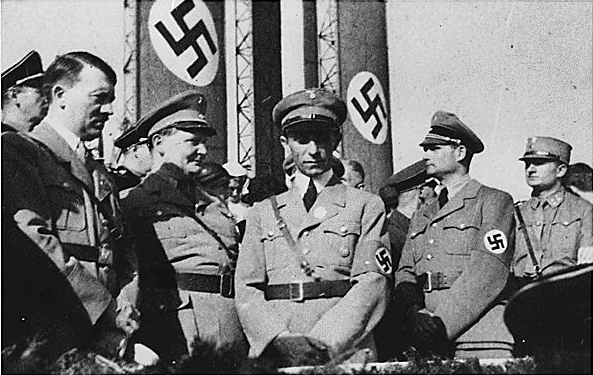
Hitler, Göring, Goebbels and Hess.
Photo via Wikimedia Commons.
The recent increase in economic concentration and monopoly power make the United States “ripe for dictatorship,” claims Columbia law professor Tim Wu in his new book, The Curse of Bigness. With the release of Senator Elizabeth Warren’s proposal to “break up” technology companies like Amazon and Google, fear of bigness is clearly on the rise. Professor Wu’s book adds a new dimension to that fear, arguing that cooperation between political and economic power are “closely linked to the rise of fascism” because “the monopolist and the dictator tend to have overlapping interests.” Economist Hal Singer calls this the book’s “biggest innovation.”
The argument is provocative, but wrong. As I show below, the claim that big business contributed to the rise of the Nazi Party is simply inconsistent with the consensus among German historians. While there is some evidence industrial concentration contributed in Hitler’s ability to consolidate power after he was appointed chancellor in 1933, there is no evidence monopolists financed Hitler’s rise to power, and ample evidence showing industry leaders opposed his ascent.
Thomas Childers, a professor of history at the University of Pennsylvania, calls the idea that Hitler was bankrolled by big corporate donors a “persistent myth.” This, among myriad other reasons, should give us pause before comparing 1930s Germany to the present-day United States. If fascism does come to the United States, big business won’t be to blame.
[…]
In the run-up to the presidential election in the spring of 1932, Hitler gave a speech to “a gathering of some 650 members of the Düsseldorf Industry Club in the grand ballroom of Düsseldorf’s Park Hotel.” British historian Sir Ian Kershaw recounts the event in Hitler: A Biography (p. 224):
Hitler’s much publicized address … did nothing, despite the later claims of Nazi propaganda, to alter the skeptical stance of big business. The response to his speech was mixed. But many were disappointed that he had nothing new to say, avoiding all detailed economic issues by taking refuge in his well-trodden political panacea for all ills. And there were indications that workers in the party were not altogether happy at their leader fraternizing with industrial leaders. Intensified anti-capitalist rhetoric, which Hitler was powerless to quell, worried the business community as much as ever. During the presidential campaigns of spring 1932, most business leaders stayed firmly behind Hindenburg, and did not favour Hitler … The NSDAP’s funding continued before the ‘seizure of power’ to come overwhelmingly from the dues of its own members and the entrance fees to party meetings. Such financing as came from fellow-travellers in big business accrued more to the benefit of individual Nazi leaders than the party as a whole. Göring, needing a vast income to cater for his outsized appetite for high living and material luxury, quite especially benefited from such largesse. Thyssen in particular gave him generous subsidies, which Göring — given to greeting visitors to his splendrously adorned Berlin apartment dressed in a red toga and pointed slippers, looking like a sultan in a harem — found no difficulty in spending on a lavish lifestyle.
As Ralph Raico, a professor of history at Buffalo State College, points out, the aim of these “relatively minor subsidies” to particular Nazis “was to assure (the donors) of ‘friends’ in positions of power, should the Nazis enter the state apparatus.” In Hitler: Ascent, 1889-1939, German historian and journalist Volker Ullrich details the extent of the industrialists’ support for center-right parties during the time of the Düsseldorf speech (p. 292):
[T]he American historian Henry A. Turner and others following in his footsteps have corrected this outmoded narrative about the relationship between National Socialism and major German industry. By no means had the entire economic elite of the Ruhr Valley attended Hitler’s speech… The crowd’s reaction to Hitler was also by no means as positive as (Nazi Press Chief Otto) Dietrich’s report had its readers believe. When Thyssen concluded his short word of thanks with the words “Heil, Herr Hitler,” most of those in attendance found the gesture embarrassing. Hitler’s speech also did little to increase major industrialists’ generosity when it came to party donations. Even Dietrich himself admitted as much in his far more sober memoirs from 1955: “At the ballroom’s exit, we asked for donations, but all we got were some well-meant but insignificant sums. Above and beyond that there can be no talk of ‘big business’ or ‘heavy industry’ significantly supporting, to say nothing of financing, Hitler’s political struggle.” On the contrary, in the spring 1932 Reich presidential elections, prominent representatives of industry like Krupp and Duisberg came out in support of Hindenburg and donated several million marks to his campaign.
The period immediately following Hitler’s speech to the Düsseldorf Industry Club was similarly fruitless for fundraising, as Richard J. Evans, a professor of history at the University of Cambridge, describes in The Coming of the Third Reich (p. 245):
Neither Hitler nor anyone else followed up the occasion with a fund-raising campaign amongst the captains of industry. Indeed, parts of the Nazi press continued to attack trusts and monopolies after the event, while other Nazis attempted to win votes in another quarter by championing workers’ rights. When the Communist Party’s newspapers portrayed the meeting in conspiratorial terms, as a demonstration of the fact that Nazism was the creature of big business, the Nazis went out of their way to deny this, printing sections of the speech as proof of Hitler’s independence from capital. The result of all this was that business proved not much more willing to finance the Nazi Party than it had been before.
Hitler lost the spring 1932 presidential election to Hindenburg. But the Nazi party achieved a plurality of seats in parliament for the first time in the July 1932 elections. Unable to form a government without Nazi cooperation after yet another round of elections in November 1932, Hindenburg appointed Hitler chancellor on January 30, 1933. With Hitler now in power, things changed.
In a 2014 review, Larry Schweikart wrote:
Still, more than a few voices critical of such historical hanky-panky have been raised. Perhaps the most influential is that of Henry A. Turner, Jr., who has provided an accurate and verifiable history of the Weimar period in his German Big Business and the Rise of Hitler. Turner sensibly avoids class struggle as a theme and simply asks if big business liked Hitler. Did business leaders support him? Did they give him money? Turner concludes that they did not. Only “through gross distortion can big business be accorded a crucial, or even major, role in the downfall of the Republic” (p. 340). Turner claims that bias “appears over and over again in treatments of the political role of big business even by otherwise scrupulous historians” (p. 350).
In his own examination of the evidence, Turner looked at the correspondence of German business leaders, minutes of their meetings, and their contributions. While it might be reassuring for some to think that Hitler came to power through the financial support of a few evil businessmen, the facts are that most of the Nazis’ money came from the German people. Turner carefully discusses Hitler’s policy stances toward business. Hitler was always wary of alienating the businessmen, but his failure to present a clear, procapitalistic economic program made the corporate leaders all the more leery of him. Modern Marxists, quite naturally, would like to implicate capitalism in the Holocaust. But, of course, Hitler’s themes were those of Stalin and, in our own day, Gorbachev. Nazism, as Turner suggests but never makes sufficiently clear, resembled Marxism in many ways, including Jew-hatred and hostility to the individual. In any case, Turner’s book has completely refuted the accepted notions that German corporations supported Hitler.
H/T to Colby Cosh for the initial link.
Comments Off on Big business and the rise of Hitler and the Nazi party
March 8, 2019
QotD: Wine books as hagiography
Disasters of this sort happen much more rarely in books of the second category. Or rather, the things that do go wrong are sent from outside to try the heroic château-owners: items such as the French Revolution, the German occupation, hail, drought, floods, phylloxera, mildew and oidium. Disasters are there to be triumphed over; owners (or, at any rate, recent owners) are always doing their best, even when the world is less than the best possible. Greed, corruption, exploitation of employees and sharp practice turn up as rarely in the literary genre that is the château profile as does premarital bonking in Barbara Cartland. (And just out of interest, were there no collaborators in the vineyards during the last war? I’ve yet to read of any.) Of course, these books tend to be commissioned when the château is rich and its label famous; even so, it would be a nice change to read some day of an estate where the vineyards were wrecked, the workforce pissed, the proprietors fraudulent and the wine disgusting. In the meantime we have Asa Briggs: ‘I would not have written this book, however, had I not been invited to do so by the Duc and Duchesse de Mouchy, and they, along with other members of the Dillon family (who now own the vineyard) on both sides of the Atlantic, have given me great encouragement – and offered me memorable hospitality – throughout the inevitably protracted period of my research.’ Well, yes. Briggs does his little nods and bows, and writes with the bonhomie of a trusted courtier. He imparts all the key information that official sources will disclose about Haut-Brion; he writes effectively about the wider history of the Bordeaux wine trade (which perhaps should have been his subject in the first place), and fascinatingly about the city under the Revolution, when the owner of Haut-Brion was sent to the guillotine. But it is not for nothing that the name Asa Briggs, as a New Statesman competition entrant pointed out, is an anagram of Sir Gasbag. He just can’t help the pompous and the self-referential: ‘The year 1938, when I went up to university, was only an ‘average year’, rather like 1939, the first year I visited Bordeaux before war reached it … I have never tasted the 1955, the year of my marriage’. He is also a generous quoter of the gasbaggery of others. Take this insight from that ‘great citizen and long-time Mayor of Bordeaux’, Jacques Chaban-Delmas: ‘The spirit of a city takes bodily shape, so to say, across time and across the history that defines, affims and perpetuates both its identity and its raison d’être.’ Not much will have gone missing in the translation.
It is, no doubt, the fault of the genre, but Haut-Brion avoids controversy like a corked bottle. Briggs praises Edmund Penning-Rowsell’s ‘thoughtful and wide-ranging’ The Wines of Bordeaux, but does not quote its author’s judgement that ‘vinously the château has had its ups and downs in this century’. Briggs is ‘deeply impressed’ by Robert Parker and his ‘outstanding personality’, but does not refer to Parker’s assertion that the château produced ‘simplistic’ claret in the years 1966-74: ‘Whether this was intentional,’ Parker writes in Bordeaux, ‘or just a period in which Haut-Brion was in a bit of a slump remains a mystery. The staff at Haut-Brion is quick-tempered and sensitive about such a charge.’ Briggs also manages to blandify the potentially interesting anecdote. There is a story about Malcolm Forbes (‘who died while I was carrying out research for this book’), who at one extreme famously bought a bottle of Jefferson claret for $156,000, and at the other several hundred bottles of 1965 Haut-Brion for $5 a throw. ‘Forbes described himself as an appreciator of wine rather than as a collector, and he was a shrewd appreciator at that, a man who liked a bargain,’ Briggs notes. He records Forbes’s opinion that the 1965 got ‘better and better’ each time he drank it, the owner of Haut-Brion’s view that Forbes had been ‘quite right’ to have bought the wine, and ends by nervelessly quoting the Haut-Brion brochure to the effect that the wine is ‘astonishing for the vintage’. Sir Gasbag concludes: ‘Six thousand cases of Haut-Brion were produced in 1965. The comparative figures for 1964 and 1966 were 17,500 and 19,500. Forbes obviously knew what rarity meant.’ Among the fawning and the back-slapping lies a moderately interesting story about the penny-pinching of the super-rich. Of course, the reason the 1965 is ‘rarer’ than those on either side of it was because of climactic conditions which made it one of the crappiest of all postwar vintages, in which Haut-Brion produced a marginally less crappy wine than some of the other first growths. And would any vineyard-owner ever willingly dump on his own wine in overt contradiction of a millionaire client? I once attended a vertical tasting of a second-growth claret in the presence of the owner and her business manager. Among several excellent vintages there was an obvious super-dud of a 1958, which should long since have been emptied straight into the vinegar mother. When the owner arrived for the tasting she asked her manager in some puzzlement why they were showing the 1958. Because we have several hundred cases of it left,’ he replied. Whereupon, a few minutes later, she rose to her feet and gave measured praise to the lesser-known but arguably undervalued 1958.
Julian Barnes, “Did You Get Black Truffles on the Nose?”, Literary Review, 1994-10.
Comments Off on QotD: Wine books as hagiography
March 6, 2019
Dune – Maud’dib – Extra Sci Fi – #4
Extra Credits
Published on 5 Mar 2019Charismatic leadership can conceal corruption, and Frank Herbert saw how dangerous this was in the political events he lived through. Leto Atreides, Valdimir Harkonnen, and Paul Atreides (Maud’dib) each represent different types of charismatic but very faulty leadership practices.
Join us in a few months for the continuation of Extra Sci Fi on Tuesdays! http://bit.ly/SubToEC
Comments Off on Dune – Maud’dib – Extra Sci Fi – #4
March 1, 2019
Dune – Wandering in the Desert – Extra Sci Fi – #3
Extra Credits
Published on 26 Feb 2019Dune is an ecological novel. Nature isn’t just the background setting, but firmly integrated into the science and systems of the world. Frank Herbert explores big ideas around environmental conservation, through the spice that must flow.
Comments Off on Dune – Wandering in the Desert – Extra Sci Fi – #3
Theodore Dalrymple on Michel Houellebecq: “Houellebecq runs an abattoir for sacred cows”
At the New English Review:
Not reading many contemporary French novels, I am not entitled to say that Michel Houellebecq is the most interesting French novelist writing today, but he is certainly very brilliant, if in a somewhat limited way. His beam is narrow but very penetrating, like that of a laser, and his theme an important, indeed a vital one: namely the vacuity of modern life in the West, its lack of transcendence, lived as it is increasingly without religious or political belief, without a worthwhile creative culture, often without deep personal attachments, and without even a struggle for survival. Into what Salman Rushdie (a much lesser writer than Houellebecq) called “a God-shaped hole” has rushed the search for sensual pleasure which, however, no more than distracts for a short while.
Something more is needed, but Western man — at least Western man at a certain level of education, intelligence and material ease — has not found it. Houellebecq’s underlying nihilism implies that it is not there to be found. The result of this lack of transcendent purpose is self-destruction not merely on a personal, but on a population, scale. Technical sophistication has been accompanied, or so it often seems, by mass incompetence in the art of living. Houellebecq is the prophet, the chronicler, of this incompetence.Even the ironic title of his latest novel, Sérotonine, is testimony to the brilliance of his diagnostic powers and his capacity to capture in a single word the civilizational malaise which is his unique subject. Serotonin, as by now every self-obsessed member of the middle classes must know, is a chemical in the brain that acts as a neurotransmitter to which is ascribed powers formerly ascribed to the Holy Ghost. All forms of undesired conduct or feeling are caused by a deficit or surplus or malalignment of this chemical, so that in essence all human problems become ones of neurochemistry.
On this view, unhappiness is a technical problem for the doctor to solve rather than a cause for reflection and perhaps even for adjustment to the way one lives. I don’t know whether in France the word malheureux has been almost completely replaced by the word déprimée, but in English unhappy has almost been replaced by depressed. In my last years of medical practice, I must have encountered hundreds, perhaps thousands, of depressed people, or those who called themselves such, but the only unhappy person I met was a prisoner who wanted to be moved to another prison, no doubt for reasons of safety.
Houellebecq’s one-word title captures this phenomenon (a semantic shift as a handmaiden to medicalisation) with a concision rarely equalled. And indeed, he has remarkably sensitive antennae to the zeitgeist in general, though it must be admitted that he is most sensitive to those aspects of it that are absurd, unpleasant, or dispiriting rather than to any that are positive.

Comments Off on Theodore Dalrymple on Michel Houellebecq: “Houellebecq runs an abattoir for sacred cows”
February 27, 2019
QotD: When progressives took over SF publishing
When I sold my first novel in the late 90s. Most Americans might not be that sensitive to the “climate” but I was. I had after all grown up in a socialist (at best, during the better times) country where to graduate you had to present the proper progressive front. I knew the signs and the hints and social positioning of “further left than thou.” For instance, my first SF cons, as an author, in the green room, I became aware that “a conservative” was a suitable, laughter inducing punchline for any joke; that all of them believed the Reagan years had set us on course to total dystopia; that the US was less enlightened/capable/free than anywhere else; that your average Republican or even non-Democrat voter was the equivalent of the Taliban.
As for Libertarians, I will to my dying day cherish the dinner I had with my then editor to whom I was describing a funny incident at MileHi where for reasons known only to Bob, I found myself in an argument with someone who wanted to ban the internal combustion engine. My editor perked up and (I swear I’m not making this up) said “Oh, a Libertarian.” At which point my husband squeezed my thigh hard enough to stop me answering. But yeah. That was a not uncommon idea of a libertarian. If it was completely insane and involved banning something, then it was a libertarian.
I once overheard the same editor talking to a colleague and saying that if she got submissions across her desk and they were – dropped and horrified voice – somewhat conservative she recommended they try Baen.
Which the other editor (from a different house) agreed with, because after all, they weren’t in the business of publishing conservative works.
This immediately put me on notice that in the field if you were a conservative (I presume libertarians were worse, or at least they seemed to induce more mouth foaming. And though I was solidly libertarian and – at the time – might have qualified as a Libertarian, I suspect if faced with my real positions they would have classed me as conservative, because my positions were self-obviously not left and that’s all it took.) there was only one house that would take you, and if what you wrote/wanted to write wasn’t accepted by then, then you were out of luck.
After that I lived in a state of fear
I imagine it was similar to living in one of the more unsavory periods of the Soviet Union. You saw these purges happen. Whisper-purges. You got the word that someone was “not quite the thing” or that they associated with so and so who associated with so and so who was a – dropped voice – conservative. Suddenly that person’s books weren’t being bought and somehow people would clear a circle around them, because, well, you know, if you’re seen with a – dropped voice – conservative they might think you’re one too. And then it’s off to Never-Never with you.
I found a few other conservatives/libertarians (frankly, mostly libertarians) in the field, all living in the same state of gut clenching fear.
We did such a dance to test both the reliability and discretion of the other before revealing ourselves that we might as well have developed a hanky code. [Blue for true blue Conservative, white for pure Libertarian, red for the blood of our heroes, brown for OWL (older, wiser libertarian), purple for squishy conservative, powder blue for Brad Torgersen. (The powder blue care bear, with the bleeding heart… and the flame thrower.)]
Conventions were nerve wracking because I watched myself ALL the TIME. And you never knew how much you had to watch yourself. Suddenly, out of the blue, at a World Fantasy the speaker, a well known SF/F writer went on about Dean Howard, our next president. The room erupted in applause, some people stood to clap, and I sat there, frozen, unable to actually fake it to that point but too shocked to even put a complaisant expression on my face.
Sarah Hoyt, “Say Goodbye To The State Of Fear”, According to Hoyt, 2017-03-11.
Comments Off on QotD: When progressives took over SF publishing
February 24, 2019
Another review of Curl’s Making Dystopia
Having read a few reviews of James Stevens Curl’s recent Making Dystopia: The Strange Rise and Survival of Architectural Barbarism, I’m likely to add it to my booklist (when I have a budget for new books again, that is). Here, Michael Mehaffy shares his comments on the book:

Cumbernauld Shopping Centre, voted as Britain’s most hated building in a Channel 4 poll.
Photo by Ed Webster via Wikimedia Commons.
For most reform-minded urbanists today, the complicity of architectural Modernism in the urban fiascoes of the last century is not in dispute. A representative (and seminal) criticism was Jane Jacobs’ withering 1961 attack, in The Death and Life of Great American Cities, in which she described Le Corbusier’s “wonderful mechanical toy” that “said everything in a flash, like a good advertisement” — but as to how a city actually works, it told “nothing but lies.” Jacobs’s work was of course a major inspiration in forming the Congress for the New Urbanism, along with the work of other reformists like Leon Krier, Christopher Alexander and Vincent Scully.
In fact, the 1996 Charter of the New Urbanism almost precisely inverts Le Corbusier’s 1933 Athens Charter: in place of the Modernists’ functional segregation, we would have mixed use; in place of their dominance of fast-moving vehicles (especially cars), we would have walkability and multi-modal streets; in place of wholesale demolition of historic districts and prohibition of historic styles, we would have preservation and renewal, and buildings that “grow from local climate, topography, history, and building practice.”
Yet in the last few decades, architectural Modernism has enjoyed a resurgence among some New Urbanists, as it has in the wider profession of architecture. For them, it’s reasonable to separate the urban mistakes of Modernism from its alleged architectural genius, which, as they see it, continues to offer inspiring building design ideas that can take their place happily within great new cities.
Of course, many critics would not agree — including many of the profession’s most prominent insiders. For them, the building-scale and urban-scale failures of Modernism have been of a piece, borne of a totalizing but defective theory of habitat, and even a dubious theory of architectural form itself. As the Post-Modernist Rem Koolhaas observed (in his 1995 book S,M,L,XL), “Modernism’s alchemistic promise, to transform quantity into quality through abstraction and repetition, has been a failure, a hoax: magic that didn’t work.” Nor was Koolhaas the first to attack the ideological foundations of Modernism. Similar criticisms came from earlier insiders like Sibyl Moholy-Nagy, wife of Bauhaus pioneer Lazslo, whose stinging 1968 essay on the Bauhaus labeled it “Hitler’s Revenge.” Its built works in the US carried, for her, “the browbeating symbolism of a negative ideology that was already bankrupt when the dying German Republic unloaded it on America.”
Yet for a movement that has been so frequently discredited, Modernism still has a curious grip on the profession even today. That’s because from the beginning, according to historian James Stevens Curl, the movement has been populated by “architectural bullies” who would stop at nothing to seize power, extinguish its competitors, re-write history, forbid all other styles (especially those with any ornament), and otherwise enforce a radical agenda — one that only seemed to offer all things alluring, progressive and historically inevitable. Beneath that marketable cover story, he says, the real agenda was an exhilarating quest for power and dominance, and especially later, for the wealth generated by a profitable industrialization of the human environment. Modernism sold, and no matter if it also sold out—cities, people, history, the future. For Curl, that approach was (and is) nothing less than “architectural barbarism.”
Comments Off on Another review of Curl’s Making Dystopia
The Hobbit: The Desolation of Warners (Part 3/2)
Lindsay Ellis
Published on 20 Apr 2018Nothing is pure.
From the comments:
Special Agent Washing Tub
2 months agoMe; * watching this and feeling my childhood shatter*
“Why does it hurt so much?”
Lindsay: “BECAUSE IT WAS REAL.”
Comments Off on The Hobbit: The Desolation of Warners (Part 3/2)
QotD: Wine books
There are three categories of wine book. The first are guides, like those of Robert Parker, which seek to offer practical help in the purchase and consumption of wines – though their effects are often contrary, adding feverishness to the acquisition (‘I’ve landed a 95-pointer!’) and self-consciousness to the drinking (‘Did you get black truffles on the nose?’). The second category consists of historical surveys and château profiles, the latter often little more than disguised puffery, since the author will have been given privileged access to the archives, and will have been vetted, if not actually chosen, by the château, will have been wined and dined until he – or, occasionally, she – is practically wearing the château’s label as a blazer badge. Famous wine houses are nowadays international businesses, and no less good at promoting themselves than Nike and Benetton. Thirdly, there are books of almost no practical value but which appeal to the nostalgic, fetishistic or cork-sniffing side of oenophilia: celebrations, anthologies, reminiscences of the wine country and its colourful characters, evocations of people and vintages often long since dead. The wine buff will often buy such useless treasures second-hand and will employ them to induce harmless reverie, rather like leafing through an old Sears Roebuck catalogue.
Julian Barnes, “Did You Get Black Truffles on the Nose?”, Literary Review, 1994-10.
Comments Off on QotD: Wine books
February 23, 2019
The Hobbit: Battle of Five Studios (Part 2/2)
Lindsay Ellis
Published on 3 Apr 2018So we’ve looked into what the problems were with these movies, the question now is … why? What happened, Peter Jackson? WHAT HAPPENED?
From the comments:
app
5 months agoThat interview clip with John Callen near the end broke my heart. I also grew up with the hobbit and was bored to tears by the movies. But I never thought about the actors of the Dwarves and how important it was that they got pushed aside. The hobbit could have been amazing if it was this band of actors, dressed like dwarves, trying to reclaim their culture and finding out what that really means. It’s a pure idea, and ironically it was corrupted by greed… you reminded me what I loved about the book! :'(
Comments Off on The Hobbit: Battle of Five Studios (Part 2/2)


