Hey, did you know The Stepford Wives was published 50 years ago today? Salon does:
Why feminist horror novel The Stepford Wives is still relevant, 50 years on
But before we get to the fisking (I’m running on fumes, y’all; the end of the summer is always the worst time for me), let’s pause for a moment to consider the TV show. You’d think there’d be one, right? Either that, or this is stoyak — The Stepford Wives, coming fall 2022 to Disney Plus. But it doesn’t appear to be. I googled “stepford wives tv show” and got this, which looks trashy enough, but in no way related to the book or movie. There was a remake of the 1970s movie back in 2004, but it bombed.
Odd, no? You’d think that shit would be chick crack — all those Strongk Confidant Wahmens digging into conspiracies and Sticking it to the Man ™. At least, that’s what I thought back in 2004. I thought the casting was dodgy — Kidman was too old (and too glamorous; you really need a pretty-but-not-Hollywood-pretty type) and Matthew Broderick too nebbishy. Nonetheless, I thought the premise would be strong enough to overcome it — oh, you poor, put-upon ladies! But nope.
And then The Handmaid’s Tale happened, as my students would’ve written back in the days, and now I understand why I’m wrong. I should’ve seen it 20 years ago, but better late than never, right? Let’s all have a good laugh at the really obvious thing I missed back in 2004: Strongk, Confidant Wahmens are neither strong nor confident, nor do they want to be either. They want the thinnest veneer of the pretense of the fantasy of those things, delivered to them by a man who comes on like Chad Thundercock, but always somehow has the time to listen to her.
The Handmaid’s Tale, that’s the real chick crack. It’s highbrow bondage porn for the kind of tertiary-educated lady who thinks Fifty Shades of Gray is way too trashy to rent (except, you know, one Girls’ Night with a box of white whine, as a “guilty pleasure”). It gets her all fired up for busting balls at the next partners’ meeting down at the law firm. So empowering!
In The Stepford Wives, book and original movie, the housewives are replaced by robots. The author, Ira Levin, was a guy, and I bet you could tell that just from the one-sentence plot summary. Being replaced by a robot isn’t a “feminist” fear, it’s a male fear. The worry that you’re nothing but a wallet with a criminally underserved dick attached has been pervasive among men since probably the Puritans. It’s a neat trick on Levin’s part, racking up mucho feminist street cred by selling them the #1 male neurosis of the postwar world.
Severian, “SJWs Always Project”, Founding Questions, 2022-08-08.
December 15, 2022
QotD: From The Stepford Wives to The Handmaid’s Tale
December 13, 2022
Egypt’s postwar Nazi military advisors
In The Critic, James Barr reviews a book on the roles of former Nazi military and political figures in the Egyptian forces, Nazis on the Nile: The German Military Advisers in Egypt 1949-1967 by Vyvyan Kinross:
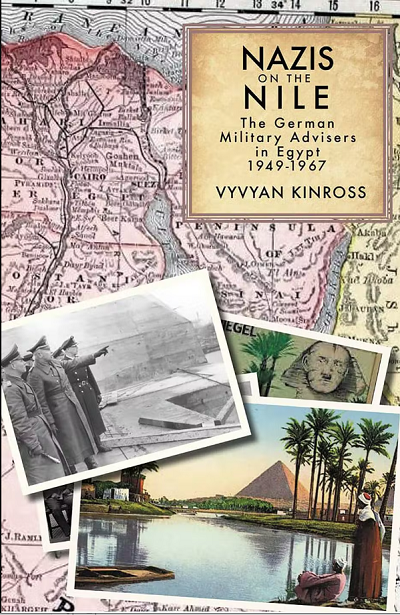
One of the paradoxes of the early postwar era is that, after Germany’s defeat, the Nazis were vilified at the same time that their expertise was sought after by both Cold War superpowers. Germans played key roles in both sides’ space programmes. Less infamous is the part they also went on to play in the Egyptian rocket programme, one of the subjects in this fascinating and disturbing book.
After suffering a humiliating defeat in the war that followed the establishment of Israel, the Egyptians wanted revenge. As the British had refused to help them — despite maintaining a deeply unpopular and large presence astride the Suez Canal — Egypt’s sybaritic King Farouq turned to his enemy’s enemy instead. In 1949 he commissioned an Afrika Korps general, Artur Schmitt, to review the Egyptian army.
Having checked in to a Cairo hotel under the name “Herr Goldstein”, Schmitt inspected Egyptian units and went on to Syria to survey Israel from the Golan Heights. The Egyptians’ failure to combine tanks, artillery and infantry effectively, he decided, explained their “inability to take advantage of the early stages of fighting to wipe the State of Israel off the map”.
Schmitt’s forthright conclusions were unwelcome, and he did not stay long. But some younger Egyptian army officers shared his views and, after they had overthrown Farouq in 1952, they picked up where the king had left off. Within days they offered Fritz Voss, the former head of the Skoda arms factory in Pilsen, the job of masterminding the retraining of the army and the establishment of a military industrial base that could produce jet aircraft and missiles.
Voss in turn invited old contacts to join him, including Wilhelm Beisner, an SS officer who had been part of Einsatzkommando Egypt, which would have spearheaded the Holocaust in Palestine had Rommel won at El Alamein. The Germans found Egyptian working conditions challenging. “Here one has to act much more slowly than in Prussia,” complained a German instructor who found “Oriental sloppiness” irritating. Of forty tanks lined up for a parade to celebrate the first anniversary of the coup, just twelve made it past the junta’s rostrum.
The author, Vyvyan Kinross, is a consultant by profession. He has advised Arab governments and clearly understands the fundamental problems. “The battle” for the Germans, he writes, “was always to reconcile finance, resourcing and the expertise required to execute a sophisticated manufacturing process with the challenging conditions and logistics that prevailed in a country that was late to industrialise and financially underpowered.”
December 12, 2022
“The reason that Canada’s arts do not resonate with 95% of Canadians is that they are products of socialist realism’
Elizabeth Nickson on the parasitic world of official “Canadian culture” with its gatekeepers, subsidies, and luxury beliefs:
When I say society, I don’t mean the upper reaches of the wealthy. While we do have the very rich in Canada, they are rigorous in their hiddenness because we have the worst lefties on the continent and that is saying something. The safe thing for any wealthy family is give $ to socialists, bow and scrape to the harpies at the CBC and hope they don’t notice your bank balance. Anyway, these dreadful people arrived post WW2 with their hideous Frankfurt School ideas and just preyed on the simplest most innocent well-meaning good white people you could ever imagine, and literally ate, ravenous and braying all the while, the country’s potential.
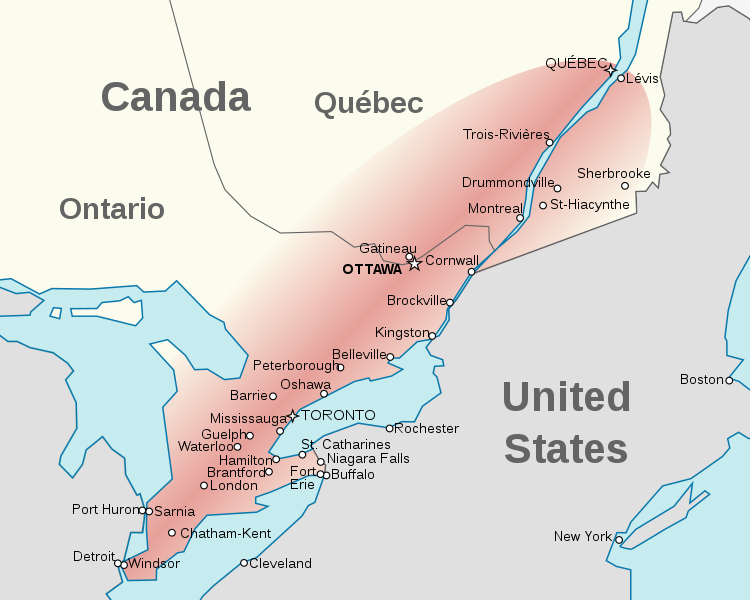
So the scandal took place among them, or rather the world they created, which is basically a clutch of 150,000 grifters located between Ottawa, Toronto and Quebec City, whose only mission is to divest the government of as much public money as possible. This is particularly true of their defensive line which consists of the arts and journalism. Theirs is a world where no stone is left unsubsidized by taxes on the hidden rich, waitresses at truck stops in Kamloops and anyone who dares to make money unapproved by the CBC. They are, as a former editor swore to me, the gatekeepers. That was before her circulation collapsed by 65%., but no doubt she still believes it.
The arts and media in Canada are constructed entirely for the 5%, consumed by those who live the lush subsidized life — or those who want to — whether in government or in semi-independent corporations or businesses who require government help and “seed” money etc. (There are a hundred terms for the grift.)
Books, if you look at their sales, are tragic. There have been a handful of impressive films, despite the literal billions thrown at filmmakers over the past 20 years. Most of them are catastrophically depressing, the books make you want to cut out your heart with a grapefruit spoon. Painters paint, if you subtract all the hectoring from minor artists, from forced inclusion, some of them are very good. We can create good art. But not with our current curators.
The reason that Canada’s arts do not resonate with 95% of Canadians is that they are products of socialist realism. They describe humans and human life as they either believe it to have been (dark and in need of enlightened beings like themselves) or as they feel it must be in the future (filled with people expressing their oppression and being paid for it). It’s basically fantasy, and no one likes it, watches it, reads it.
The rest of Canada is a centre-right country, a gut-it-out-and-build-it-kind of place. I know that is the exact opposite of the propaganda, but Conservatives win a majority of the votes in every election, yet still only amount to 40%. We have five parties, and four of them are leftie — their platforms are all “more money for us” — but the big party, the one that receives about 30% of the vote is so crafty, so embedded in our vast vast bureaucracy that fixing the game is child’s play. Informed by their Frankfurt School gurus, they have been in power 100 years, with brief Conservative interludes.
We take in about half a million immigrants a year, and most of them are from desperate places. Vote harvesting in those neighborhoods is done by leaders in each immigrant community. These men and women are the strongest, most educated and frankly from the ones I’ve met, thuggish, and through them comes all access to government programs, housing and education. Therefore, when they collect your vote, you know for whom your vote is meant. The thing about immigrants though is that they were coming for the old Canada, not the new Commie police state.
But for now? Easy. No one investigates this. Why not? Our media is subsidized. ALL of it.
The British Empire(s)
At Spiked, James Heartfield discusses the changing attitudes toward British imperial history:

Renewed interest in the history of the British Empire has generated a great amount of fascinating research and reflection. Over the past decade or more, there have been many books written about the empire – popular, academic, polemical and picaresque. There has been Akala’s Natives, William Dalrymple’s The Anarchy, Shashi Tharoor’s Inglorious Empire and Caroline Elkins’ Legacy of Violence, to name just a few.
Today’s approach to the British Empire is invariably critical – often stridently so. It marks a change to the attitude widely held half a century ago, when books on the empire tended to be elegiac farewells, like Paul Scott’s novel, The Jewel in the Crown, or Jan Morris’s Pax Britannica. Today’s critical approach to the empire is certainly a far cry from that which prevailed for a brief moment around the time that Margaret Thatcher was taking back the Falkland Islands. Back then, there was even an attempt at the moral rehabilitation of the empire.
[…]
But there are downsides to the self-excoriating criticism of Britain’s past. Often this approach to history turns into a debilitating exercise in self-loathing, an act of guilt-mongering. Many others have pointed out the limitations of this kind of morbid raking over the coals. But what is just as worrying is that the more we posture over Britain’s colonial past, the less we seem to understand it.
The moralistic framework in which we teach and discuss colonial history reduces our understanding to a single note of complaint. Hence, many historians today now write as if they have to make a case against the empire. This is just kicking at an open door. The empire has very few champions today. And the great British public is certainly not nostalgic for its return, despite some commentators arguing otherwise. Indeed, an ever growing majority think that the empire was a bad thing.
There is another problem with this approach to Britain’s colonial past. It situates readers outside of history. It encourages them to adopt a moralistic rather than historical approach to colonialism. They can do little more than judge the empire as evil. And in doing so, it flattens out the different periods of the colonial project into one long uniform timeline of subjugation. Collapsing distinct periods and stages together leads to a great confusion. For instance, in many accounts, there appears to be little difference between 18th-century British colonialism, which was dominated by slave trading, and the British colonialism of the late 19th century, which was marked by anti-slavery. It is important not to reduce the long history of the empire to a single motivating cause, be it the “English genius” of earlier celebratory accounts or today’s contention that it was all driven by “white supremacy”.
I seek to address these problems in my new book, Britain’s Empires: A History, 1600-2020. There I draw out the differences between the distinctive stages of Britain’s colonial history.
To do this, it is necessary to step back from moral judgement, which foregrounds our attitudes today, in order to try to understand what motivated people back then. That often means looking at a society’s changing social and economic organisation. Britain’s Empires is a history of the empire that holds on to a sense of historical change, and tries to understand the interrelation of its component parts.
The distinct eras of British colonialism are: the Old Colonialism (1600 to 1776); the Empire of Free Trade (1776-1870); the New Colonialism (1870-1945); and the period of decolonisation during the Cold War era (1946-1989). Britain’s Empires ends with an account of the “humanitarian imperialism” of the 1990s up until the present day. This periodisation aims to reflect the objective moments of transition.
December 10, 2022
QotD: The Western Roman Empire – “decline and fall” or “change and continuity”?
With that out of the way, the old view, that of Edward Gibbon (1737-1794) and indeed largely the view of the sources themselves, was that the disintegration of the western half of the Roman polity was an unmitigated catastrophe, a view that held largely unchallenged into the last century; Gibbon’s great work, The History of the Decline and Fall of the Roman Empire (1789) gives this school its name, “decline and fall“. While I am going at points to gesture to Gibbon’s thinking, we’re not going to debate him; he is the “old man” of our title. Gibbon himself largely exists only in historiographical footnotes and intellectual histories; he is not at this point seriously defended nor seriously attacked but discussed as the venerable, but now out of date, origin point for all of this bickering.
The real break with that view came with the work of Peter Brown, initially in his The World of Late Antiquity (1971) and more or less canonically in The Rise of Western Christendom (1st ed. 1996; 2nd ed. 2003, 3rd ed. 2013). The normal way to refer to the Peter Brown school of thought is “change and continuity” (in contrast to the traditional “decline and fall”), though I rather like James O’Donnell’s description of it as the Reformation in late antique studies.
Among medievalists this reformed view, which focuses on continuity of culture and institutions from late antiquity to the early Middle Ages, remains essentially the orthodoxy, to the point that, for instance, the very recent (and quite excellent) The Bright Ages: A New History of Medieval Europe (2021) can present this vision as an uncomplicated fact, describing the “so-called Fall of Rome” and noting that “there was never a moment in the next thousand years in which at least one European or Mediterranean ruler didn’t claim political legitimacy through a credible connection to the empire of the Romans” and that “the idea that Rome ‘fell’ on the other hand, relies upon a conception of homogeneity – of historical stasis … things changed. But things always change” (3-4, 12-3). As we’ll see, I don’t entirely disagree with those statements, but they are absolute to a degree that suggests there is no real challenge to the position. There have been a few cracks in this orthodoxy among medievalists, particularly the work of Robin Flemming (a revision, not a clear break, to be sure), to which we’ll return, but the cracks have been relatively few.
While some ancient historians also bought into this view, purchase there has always been uneven and seems, to me at least, now to be waning further. Instead, a process of what James O’Donnell describes as a “counter-reformation” (which he stoutly resists with his own The Ruin of the Roman Empire; O’Donnell is a declared reformer) is well underway, a response to the “change and continuity” narrative which seeks to update and defend the notion that there really was a fall of Rome and that it really was quite bad actually. This is not, I should note, an effort to revive Gibbon per se; it does not typically accept his understanding of the cause of this decline (and often characterizes exactly what is declining differently). Nevertheless, this position too is sometimes termed the “decline and fall” school. My own sense of the field is that while nearly all ancient historians will feel the need to concede at least some validity to the reformed “change and continuity” vision, that the counter-reformation school is the majority view among ancient historians at this point (in a way that is particularly evident in overview treatments like textbooks or the Cambridge Ancient History (second edition)). We’ll meet many of the core works of this revised “decline and fall” school as we go.
As O’Donnell noted in a 2005 review for the BMCR, the reformed school tends to be strongest in the study of the imperial east rather than the west (something that will make a lot of sense in a moment), and in religious and cultural history; the counter-reformation school is stronger in the west than the east and in military and political history, though as we’ll see, to that list must at this point now be added archaeology along with demographic and economic history, at which point the weight of fields tends to get more than a little lopsided.
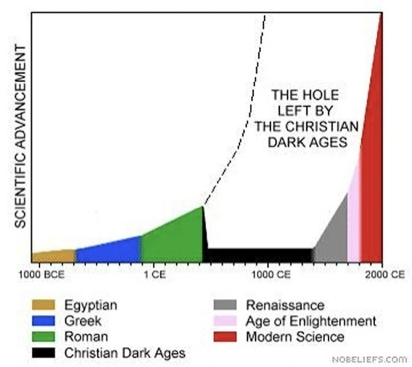
Those are our two knights – the “change and continuity” knight and the “decline and fall” knight (and our old man Gibbon, long out of his dueling days). To this we must add the nitwit: a popular vision, held by functionally no modern scholars, which represents the Middle Ages in their entirety as a retreat from a position of progress during the Roman period which was only regained during the “Renaissance” (generally represented as a distinct period from the Middle Ages) which then proceeded into the upward trajectory of the early modern period. Intellectually, this vision traces back to what Renaissance thinkers thought about themselves and their own disdain for “medieval” scholastic thinking (that is, to be clear, the thinking of their older teachers), a late Medieval version of “this ain’t your daddy’s rock and roll!”
But almost every intellectual movement represents itself as a radical break with the past (including, amusingly, many of the scholastics! Let me tell you about Peter Abelard sometime); as historians we do not generally accept such claims uncritically at face value. For a long time, well into the 19th century, the Renaissance’s cultural cachet in Europe (and the cachet of the classical period where it drew its inspiration) shielded that Renaissance claim from critique; that patina now having worn thin, most scholars now reject it, positioning the Renaissance as a continuation (with variations on the theme) of the Middle Ages, a smooth transition rather than a hard break. At the same time, knowledge of developments within the Middle Ages have made the image of one unbroken “Dark Age” untenable and made clear that the “upswing” of the early modern period was already well underway in the later Middle Ages and in turn had its roots stretching even deeper into the period. It is also worth noting here, that the term “Dark Age” has to do with the survival of evidence, not living conditions: the age was not dark because it was grim, it was dark because we cannot see it as clearly.
The popular version of this idea continues, however, to have a lot of sway in the popular conception of the Middle Ages, encouraged by popular culture that mistakes the excesses of the early modern period for “medieval” superstition and exaggerates the poverty of the medieval period (itself essentialized to its worst elements despite being approximately a millennia long), all summed up in this graph:
We are mostly going to just dunk relentlessly on this graph and yet we will not cover even half of the necessary dunking this graph demands. We may begin by noting that in its last century, the Roman Empire was Christian, a point apparently missed here.
While that sort of vision is not seriously debated by scholars, it needs to be addressed here too, in part because I suspect a lot of the energy behind the “change and continuity” position is in fact to counter some of the worst excesses of this thesis, which for simplicity, we’ll just refer to as “The Dung Ages” argument, but also because assessing how bad the fall of the Roman Empire in the West was demands that we consider how long-lasting any negative ramifications were.
Bret Devereaux, “Collections: Rome: Decline and Fall? Part I: Words”, A Collection of Unmitigated Pedantry, 2022-01-14.
December 9, 2022
Caesar versus Cato
In The Critic, Daisy Dunn reviews Uncommon Wrath: How Caesar and Cato destroyed the Roman Republic by Josiah Osgood:
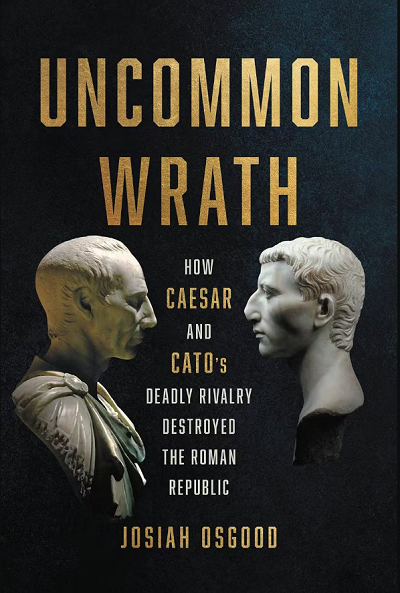
If there was one thing the Romans did well — aside from sanitation, irrigation and concrete — it was polemic. Cicero composed fourteen fiery Philippics against Mark Antony in the 40s BC, and Catullus jibed at Julius Caesar so profusely in his poems that he had to issue an apology. Less famous, but equally explosive, was Caesar’s own collection of vitriol. The Anticato survives today only in fragments, but according to an ancient satirist, it was originally so long that it took up two scrolls and almost outweighed the penis of Publius Clodius Pulcher, apparently among the best-endowed politicians in Rome.
Caesar wrote it shortly before he became dictator, with the intention of denigrating the memory of Marcus Porcius Cato, “Cato the Younger”. For years the two men had been locked in furious rivalry. Caesar blasted Cato as cold and miserly. Cato despaired at Caesar’s profligacy and tireless womanising. If Caesar was louche in his barely-belted toga and exotic unguents, Cato was positively austere — a prime hair-shirt candidate — with his bare feet, rustic diet, extreme exercise and strict sexual mores; it was most unusual for a Roman to make his wife the first woman he slept with.
Few would argue with Josiah Osgood, Professor of Classics at Georgetown, when he describes Caesar and Cato as opposites. Even Donald Trump and Joe Biden have more in common than they did. Caesar was the nephew of the wife of Gaius Marius, the populist enemy of Sulla, who as dictator had thousands of Italians proscribed and killed in his bid to restore the authority of the Senate. Cato could count Sulla as an old family friend. Caesar belonged to a well-established Roman family and claimed descent from Venus via her son Aeneas. Cato’s family was Sabine, and his most famous ancestor was a mere mortal in the shape of the plebeian writer and highly conservative statesman Cato the Elder.
The differences between Caesar’s and Cato’s personalities mattered because they reflected the differences in their visions for Rome. Osgood sums these up as “an empire wielding its power for the people” (Caesar) versus “a Senate protecting the people from the all-powerful empire builders” (Cato). It is little wonder they came to blows.
Osgood takes the tense relationship between Cato and Caesar as the central focus of his book. He argues that their feud has been overlooked as a contributing factor to the civil war that erupted in 49 BC and brought the Roman Republic crashing to the ground. Blame for this war has more usually been placed on the collapse of the First Triumvirate — an illegal alliance for power forged between Julius Caesar, Pompey the Great and Marcus Licinius Crassus in 60 BC — and the breakdown in relations between Caesar and Pompey in particular. But all wars have long-term and short-term causes. For Osgood, the dispute between Caesar and Cato was significant in at least the medium term.
December 2, 2022
Legends Summarized: The Trojan War
Overly Sarcastic Productions
Published 29 Jul 2022The grandest epic cycle this side of the Aegean! Today let’s talk about the tale of which The Iliad only makes up a tiny (if impressive) fraction!
Pst! Wanna know more about Quintus Smyrnaeus’s Posthomerica? Watch Blue’s Historymaker video about him HERE: https://www.youtube.com/watch?v=wfHGQ…
And if you want to know more about the historical, archaeological precedent that indicates some form of this story REALLY HAPPENED, watch Blue’s video on Mycenaean Greece HERE: https://www.youtube.com/watch?v=cki-9…
(more…)
November 30, 2022
James Gillray
In The Critic, James Stephens Curl reviews a new biography of the cartoonist and satirist James Gillray (1756-1815), who took great delight in skewering the political leaders of the day and pretty much any other target he fancied from before the French Revolution through the Napoleonic wars:
During the 1780s Gillray emerged as a caricaturist, despite the fact that this was regarded as a dangerous activity, rendering an artist more feared than esteemed, and frequently landing practitioners into trouble with the law. Gillray began to excel in invention, parody, satire, fantasy, burlesque, and even occasional forays into pornography. His targets were the great and good, not excepting royalty. But his vision is often dark, his wit frequently cruel and even shockingly bawdy: some of his own contemporaries found his work repellent. He went for politicians: the Whigs Charles James Fox (1749-1806), Edmund Burke (1729-97), and Richard Brinsley Butler Sheridan (1751-1816) on the one hand, and William Pitt (1759-1806) on the other. Fox was a devious demagogue (“Black Charlie” to Gillray); Burke a bespectacled Jesuit; and Sheridan a red-nosed sot. But Gillray reserved much of his venom for “Pitt the Bottomless”, “an excrescence … a fungus … a toadstool on a dunghill”, and frequently alluded to a lack of masculinity in the statesman, who preferred to company of young men to any intimacies with women, although the caricaturist’s attitude softened to some extent as the wars with the French went on.
As the son of a soldier who had been partly disabled fighting the French, Gillray’s depictions of the excesses of the Revolution were ferocious: one, A Representation of the horrid Barbarities practised upon the Nuns by the Fish-women, on breaking into the Nunneries in France (1792), was intended as a warning to “the FAIR SEX of GREAT BRITAIN” as to what might befall them if the nation succumbed to revolutionary blandishments. The drawing featured many roseate bottoms that had been energetically birched by the fishwives. He also found much to lampoon in his depictions of the Corsican upstart, Napoléon.
[…]
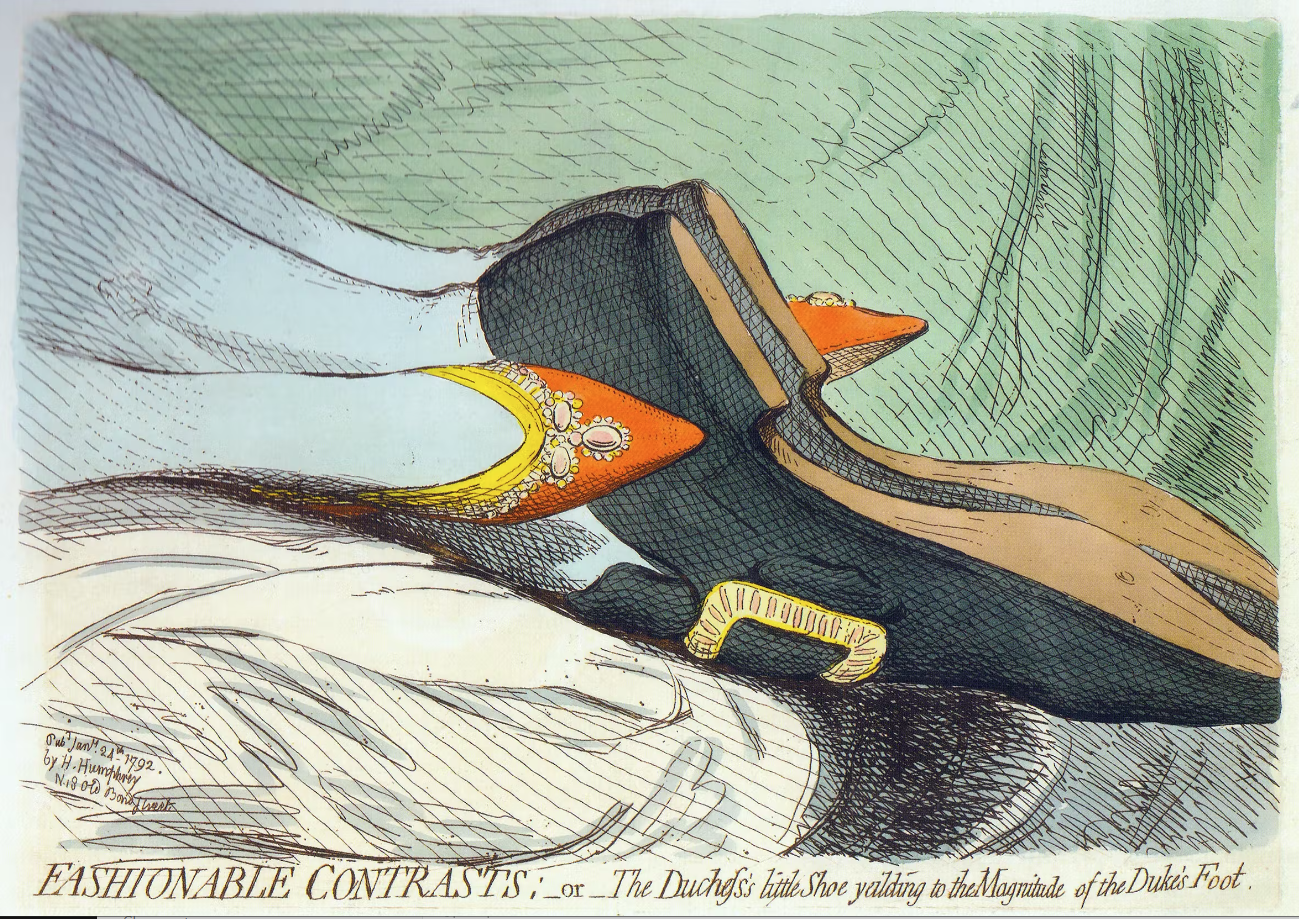
Some of Gillray’s works would pass most people by today, thanks to the much-trumpeted “world-class edication” which is nothing of the sort: one of my own favourites is his FASHIONABLE CONTRASTS;—or—The Duchefs’s little Shoe yeilding to the Magnitude of the Duke’s Foot (1792), which refers to the remarkably small hooves of Princess Frederica Charlotte Ulrica Catherina of Prussia (1767-1820), who married Frederick, Duke of York and Albany (1763-1827) in 1791: their supposed marital consummation is suggested by Gillray’s slightly indelicate rendering, in which the Duke’s very large footwear dwarfs the delicate slippers of the Duchess.
“In 1791 and 1792, there was no one who received more attention in the British press than Frederica Charlotte, the oldest daughter of the King of Prussia, whose marriage to the second (and favorite) son of King George and Queen Charlotte, Prince Frederick, the Duke of York set off a media frenzy that can only be compared to that of Princess Diana in our own day.”
Description from james-gillray.org/fashionable.htmlAll that said, this is a fine book, beautifully and pithily written, scholarly, well-observed, and superbly illustrated, much in colour. However, it is a very large tome (290 x 248 mm), and extremely heavy, so can only be read with comfort on a table or lectern. The captions give the bare minimum of information, and it would have been far better to have had extended descriptive captions under each illustration, rather than having to root about in the text, mellifluous though that undoubtedly is.
What is perhaps the most important aspect of the book is to reveal Gillray’s significance as a propagandist in time of war, for the images he produced concerning the excesses of what had occurred in France helped to stiffen national resolve to resist the revolutionaries and defeat them and their successor, Napoléon, whose own model for a new Europe was in itself profoundly revolutionary. What he would have made of the present gang of British politicians must remain agreeable speculation.
November 27, 2022
Aleksandr Solzhenitsyn and One Day in the Life of Ivan Denisovich
In Quillette, Robin Ashenden discusses the life experiences of Aleksandr Slozhenitsyn that informed the novel that made him famous:
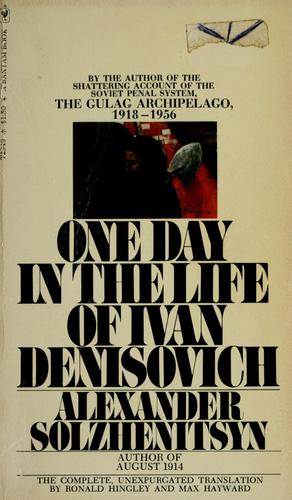
The book was published less than 10 years after the death of Joseph Stalin, the dictator who had frozen his country in fear for nearly three decades and subjected his people to widespread deportation, imprisonment, and death. His successor Nikita Khrushchev — a man who, by his own admission, came to the job “elbow deep in blood” — had set out on a redemptive mission to liberalise the country. The Gulags had been opened and a swathe of prisoners freed; Khrushchev had denounced his predecessor publicly as a tyrant and a criminal and, at the 22nd Party Congress in October 1961, a full programme of de-Stalinisation had been announced. As for the Arts, previously neutered by the Kremlin’s policy of “Socialist Realism” — in which the values of Communism had to be resoundingly affirmed — they too were changing. Now, a new openness and a new realism was called for by Khrushchev’s supporters: books must tell the truth, even the uncomfortable truth about Communist reality … up to a point. That this point advanced or retreated as Khrushchev’s power ebbed and flowed was something no writer or publisher could afford to miss.
Solzhenitsyn’s book told the story of a single day in the 10-year prison-camp sentence of a Gulag inmate (or zek) named Ivan Denisovich Shukhov. Following decades of silence about Stalin’s prison-camp system and the innocent citizens languishing within it, the book’s appearance seemed to make the ground shake and fissure beneath people’s feet. “My face was smothered in tears,” one woman wrote to the author after she read it. “I didn’t wipe them away or feel ashamed because all this, packed into a small number of pages … was mine, intimately mine, mine for every day of the fifteen years I spent in the camps.” Another compared his book to an “atomic bomb”. For such a slender volume — about 180 pages — the seismic wave it created was a freak event.
As was the story of its publication. By the time it came out, there was virtually no trauma its author — a 44-year-old married maths teacher working in the provincial city of Ryazan — had not survived. After a youth spent in Rostov during the High Terror of Stalin’s 1930s, Solzhenitsyn had gone on to serve eagerly in the Red Army at the East Prussian front, before disaster struck in 1945. Arrested for some ill-considered words about Stalin in a letter to a friend, he was handed an eight-year Gulag sentence. In 1953, he was sent into Central Asian exile, only to be diagnosed with cancer and given three weeks to live. After a miraculous recovery, he vowed to dedicate this “second life” to a higher purpose. His writing, honed in the camps, now took on the ruthless character of a holy mission. In this, he was fortified by the Russian Orthodox faith he’d rediscovered during his sentence, and which had replaced his once-beloved, now abandoned Marxism.
Solzhenitsyn had, since his youth, wanted to make his mark as a Russian writer. In the Gulag, he’d written cantos of poetry in his head, memorized with the help of matchsticks and rosary beads to hide it from the authorities. During his Uzbekistan exile, he’d follow a full day’s work with hours of secret nocturnal writing about the darker realities of Soviet life, burying his tightly rolled manuscripts in a champagne bottle in the garden. Later, reunited with the wife he’d married before the war, he warned her to expect no more than an hour of his company a day — “I must not swerve from my purpose.” No friendships — especially close ones — were allowed to develop with his fellow Ryazan teachers, lest they take up valuable writing time, discover his perilous obsession, or blow his cover. Subterfuge became second nature: “The pig that keeps its head down grubs up the tastiest root.” Yet throughout it all, he was sceptical that his work would ever be available to the general public: “Publication in my lifetime I must put out of my mind.”
After the 22nd Party Congress, however, Solzhenitsyn recognised that the circumstances were at last propitious, if all too fleeting. “I read and reread those speeches,” he wrote later, “and the walls of my secret world swayed like curtains in the theatre … had it arrived, then, the long-awaited moment of terrible joy, the moment when my head must break water?” It seemed that it had. He got out one of his eccentric-looking manuscripts — double-sided, typed without margins, and showing all the signs of its concealment — and sent it to the literary journal of his choice. That publication was the widely read, epoch-making Novy Mir (“New World”), a magazine whose progressive staff hoped to drag society away from Stalinism. They had kept up a steady backwards-forwards dance with the Khrushchev regime throughout the 1950s, invigorated by the thought that each new issue might be their last.
November 26, 2022
Indigo vastly prefers selling pillows, candles, and tchotchkes of all kinds rather than – ugh! – books
In the latest SHuSH newsletter, Ken Whyte explains why it’s becoming harder and harder to find actual books in Canada’s biggest bookstore chain … because they no longer want to be a bookstore chain:
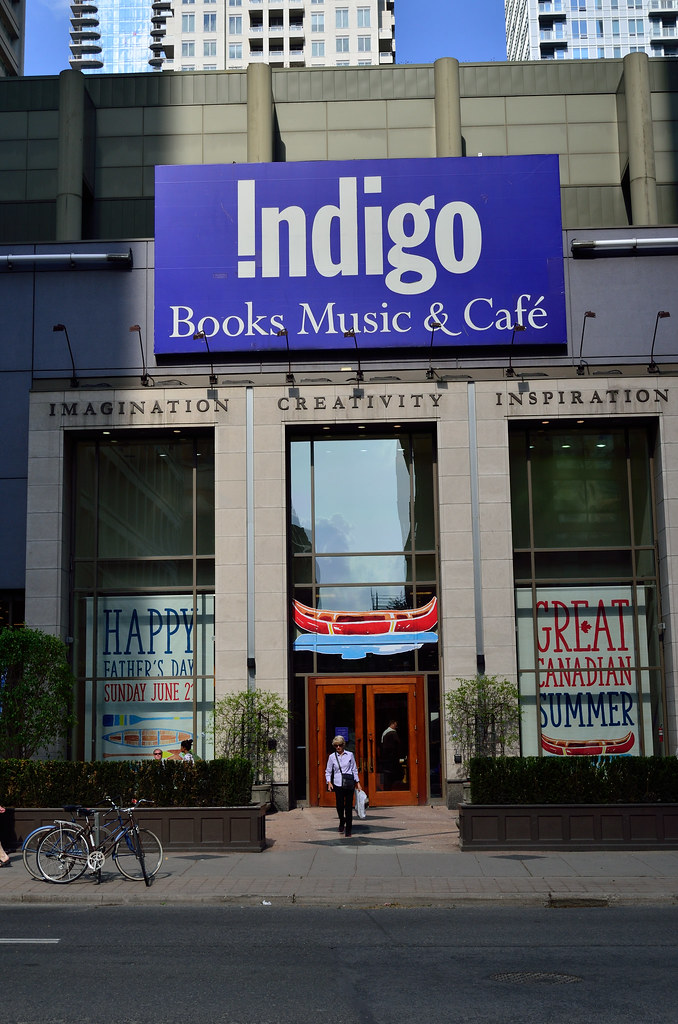
“Indigo Books and Music” by Open Grid Scheduler / Grid Engine is licensed under CC0 1.0

We need to talk about Indigo. As you know, it’s Canada’s biggest bookstore chain, with 88 superstores and 85 small-format stores. It sells well over half the books that are bought in stores in Canada, with Walmart, Costco, and independent bookstores accounting for most of the rest.
One problem with Indigo is that it’s failing. The other problem is that it’s abandoning bookselling. Yes, that sounds like a Woody Allen joke, but it’s not funny from a publishing perspective. We depend on Indigo.
The company’s finances have been ugly for some time. It lost $37 million in 2019, $185 million in 2020, and $57 million in 2021. Things looked somewhat better in 2022 with a $3 million profit, but the first two quarters of 2023 are now in the books (it has a March 28 year end) and Indigo has already dropped $41.3 million.
[…]
Indigo hasn’t come right out and said we’re through with books. It can’t, given that Heather [Reisman] has spent the last twenty-five years building herself up as the queen of reading in Canada. Also, the Indigo brand is still associated with books in most people’s minds and that won’t change overnight no matter how many cheeseboards it stocks. So Heather talks about a gradual, natural transition: “We built a wonderful connection with our customers in the book business. Then, organically, certain products became less relevant and others were opportunities.”
To be clear, books are irrelevant; general merchandise is the opportunity. Heather recently appointed as CEO a guy named Peter Ruis who has no experience in books. He comes from fashion retail, most recently the Anthropologie chain, which sells clothing, shoes, accessories, home furnishings, furniture, and beauty products. Anthropologie was hot in 2008, and it seems to be where Indigo wants to go today.
Fair enough. You own a company, you can take it in any direction you want, so long as your shareholders will follow. I don’t blame Heather for having second thoughts about the book business. (I have them every week. It’s a tough business.) But where does that leave readers, writers, agents, publishers, and everyone else who remains committed to books?
You’ll recall that Indigo and Chapters, between them, decimated the independent bookselling sector in Canada in the nineties. They are the principal reason Canada has so few independent bookstores today. You could probably fit the combined stock of all our independents into a handful of Heather’s stores.
The federal government let Heather’s Indigo buy Larry Stevenson’s Chapters in 2001, which gave her a ridiculously large share of the market. That shouldn’t have happened.
At the same time, with the help of some lobbying by Heather, the federal government made it clear that the US chains, Borders and Barnes & Noble, weren’t welcome up here. The argument was that bookselling was a crucial part of our cultural sector and needed to be protected from foreign domination by the Canadian government.
In that spirit, Indigo also asked the federal government to prevent Amazon from opening warehouses in Canada. That request was denied in 2010, which is about when Indigo began its transition out of books.
One can see how Heather might feel betrayed by the federal government. Instead of protecting bookselling, it swung the door wide open for Amazon. You said I wouldn’t have to compete!
November 24, 2022
Pavlov’s House, codenamed “Lighthouse” in Stalingrad
In The Critic, Jonathan Boff reviews The Lighthouse of Stalingrad: The Hidden Truth at the Centre of WWII’s Greatest Battle by Iain MacGregor:
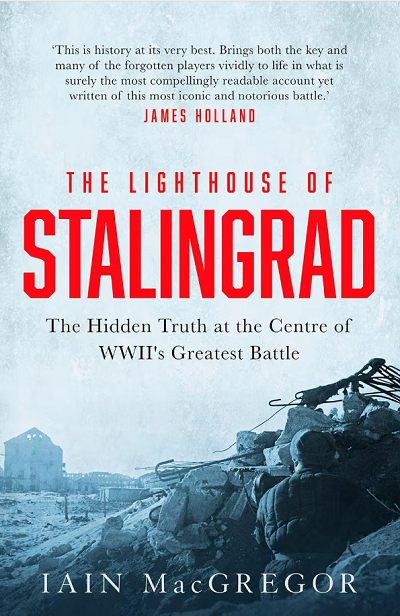
In the summer of 1942, with the German army deep inside the Soviet Union, Adolf Hitler launched Operation Blue, an attack from around Kharkiv in south-east Ukraine across hundreds of miles of steppe towards the oil fields of the Caucasus. Part of the plan required the German Sixth Army under General Paulus to secure the flank by seizing the industrial city of Stalingrad on the banks of the Volga.
By the middle of September Paulus’s troops were fighting their way, street by street, building by building, and sometimes room by room, through a city reduced to ruins by artillery shelling and the bombs of the Luftwaffe. The fighting was ferocious. Although by November most of Stalingrad was in German hands, several pockets of resistance still held out. Meanwhile, the Red Army was secretly massing for a counter-attack in the open terrain on either side of the city.
On 19 November 1942, General Zhukov unleashed a giant pincer attack which quickly overran the Romanian, Hungarian and Italian forces protecting Paulus’s flanks. Within days the German Sixth Army found itself trapped in a giant pocket, cut off from the rest of the German army. Here, in the depths of a Russian winter, nearly 300,000 surrounded men tried to hold out as their supplies of food, fuel, ammunition and medicine dwindled away.
By the end of January 1943, all hope of relief was gone. To Hitler’s disgust, Paulus ordered the remnants of his army to lay down their weapons. Of the 91,000 German soldiers sent into captivity in Siberia, only 5,000 would survive to ever see their homes again. Immense and terrible as the battle was — we will never know exactly how many troops took part, nor how many died, but it is probable that the total of dead, wounded and captured on both sides reached two million — Stalingrad was not the biggest battle of the war, nor even the bloodiest. Nonetheless, it remains, alongside Dunkirk and D-Day, among the touchstones of the Second World War, largely because it encapsulates three linked but distinct stories. Iain MacGregor does a fine job of covering each in his rich study.
First, Stalingrad was one of the most important battles of the war. It marked the high-water mark of the Nazi invasion of the USSR and an end to Hitler’s genocidal dreams of destroying the Soviet Union. Before Stalingrad, and the other crushing defeats the Axis suffered at around the same time in Tunisia and the Solomon Islands, the initiative had always lain with Germany and Japan. Afterwards, the Allies decided where, when and how the war would be fought.
MacGregor establishes this context neatly. He explains with just the right amount of detail why Operation Blue was launched and what it hoped to achieve. He offers a clear discussion of the decisions taken, and mistakes made, on both sides; and he hints at the logistical weaknesses that probably damned the Germans to disappointment from the start.
The strongest point of this book, however, is its description of the street-fighting in the heart of the city around a building known as “Pavlov’s House” (codename Lighthouse: hence the title of the book). Here the German 71st and Soviet 13th Guards rifle divisions fought for months. By focusing on this small area and these two formations, MacGregor is able to dig deep enough into the tactical detail to give us a clear sense of the difficulty, violence and terror of urban warfare, without swamping us with repetitive detail. His descriptions of fighting have a cinematic quality, swooping smoothly from panoramic tracking shots of the initial German charge down towards the waters of the Volga into close-ups of bullet-riddled mannequins fought over in the ruins of a department store.
November 23, 2022
QotD: Humour and political correctness
But I never fully understood Wilde’s caustic satire of Victorian philanthropists and humanitarians until the present sludgy tide of political correctness began flooding government, education, and media over the past two decades. Wilde saw the insufferable arrogance and preening sanctimony in his era’s self-appointed guardians of morality.
We’re back to the hypocrisy sweepstakes, where gestures of virtue are as formalized as kabuki. Humor has been assassinated. An off word at work or school will get you booted to the gallows. This is the graveyard of liberalism, whose once noble ideals have turned spectral and vampiric.
Camille Paglia, “Hillary wants Trump to win again”, Spectator USA, 2018-12-04.
November 22, 2022
“Andrew Doyle is a dangerous man, and this is a dangerous book”
I missed this review when it first got posted at The Critic, which is why I’m only linking to it now. Stephen Daisley reviews The New Puritans: how the Religion of Social Justice Captured the Western World:
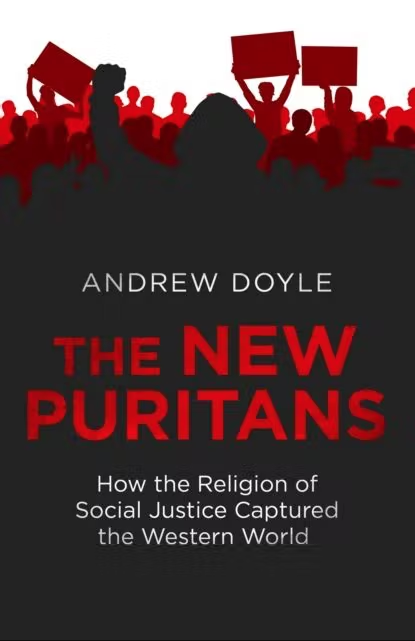
Andrew Doyle is a dangerous man, and this is a dangerous book. Don’t take my word for it: the bloke’s own mates think he’s one for the watching. Like the pal he tells us about who pegged him as “a fucking Nazi cunt”. Admittedly, vodka martinis had been taken and the friend’s evidence of fascist proclivities was Doyle’s vote to leave the EU and his satires of progressivism, but you can never be too careful.
So it was with some trepidation that I opened my copy of The New Puritans during a recent stay in hospital. I had lost patience with a John Grisham grabbed from the shop, which was largely concerned with how racist and stupid everyone is south of the Mason-Dixon Line. When did the gutsy master of Southern populist pulp turn into a sneering liberal bigot? A shift to the right was in order, so Doyle’s book it was.
As Nazi polemics go, The New Puritans is something of a disappointment. It’s a better read than Mein Kampf and less esoteric than The Myth of the Twentieth Century, but it’s pretty light on the old blood and soil. It turns out Doyle isn’t a Nazi at all, just a bog-standard, run-of-the-John-Stuart-Mill liberal. The New Puritans, far from a tract on Aryan racial purity, is an admonition against authoritarian trends in identity politics. Boy, are there going to be some red faces at the next Britain First reading group.
A broadcaster and stand-up comedian, Doyle is also a recovering academic with a PhD in “Renaissance discourses of gender and sexuality”, which takes some recovering from. It has, however, gifted him an intimate insight into a political insurgency that, in just a few years, has seized the commanding heights of government, law, medicine, education, journalism, the arts and private enterprise.
The architects of this movement are “the new puritans” and their religion is critical social justice, Doyle’s term for what is more commonly known as wokeism. They are “a prohibitionist and precisionist tendency who seek to refashion society in accordance with their own ideological fervour”. Their zealotry, philistinism and spiteful exercise of power over others reminds Doyle of the Salem Witch Trials and the vicious little girls whose “lived experience” sent 19 innocent women to the gallows.
Where Abigail Williams and her finger-pointing acolytes saw witches, their ideological descendants see racists and transphobes. They do so by applying a doctrine called intersectionality, which asserts interlocking systems of oppression as the basis of Western societies. They harness the power of social opprobrium to punish transgressors and sceptics. This is cancel culture — “retributive and performative mass denunciation in order to destroy lives and enforce conformity” — and today it rages on Twitter rather than a colonial settlement in Massachusetts.
In addition to punishment, the new puritans exercise prior restraint by banishing speech they disapprove of as harmful, a practice known as safetyism. Doyle notes how routinely this involves the privileged imposing their preferences on the lower orders. “Imagine,” he ventures, “Debrett’s guide to etiquette having been rewritten by someone with a histrionic personality disorder.”
November 20, 2022
Printing books in China is economical, but also allows China to censor what you print
In the latest SHuSH newsletter, Kenneth Whyte explains why some of Sutherland House’s books are now being printed in China … and illustrates some of the risks of having them printed there:
We decided last spring to offshore some of our book printing to China (see “The Crisis in Book Publishing”, SHuSH 138). It was not a difficult decision. The difference in price is enormous.
For instance. Next week we’re releasing a book called The Prison Lady: True Stories and Life Lessons from Both Sides of the Bars by Phyllis Taylor. Presales have been strong. We need to print more copies. We can’t go back to the original Chinese printer, which charged us $2.08/copy, because it takes months to get books from Guangzhou to Toronto. We need the books now. So we shopped around. The best North American price we could find is $4.39/copy.
Why is that a problem? The book is a paperback priced at $22.95. The retailer takes half that, leaving us $11.50. After our distributor and sales agent take their fees and we pay the author her royalty, we’re left with $6.32 out of which we pay for editing, cover art, design, overhead, and shipping. And printing. If the printing bill comes to $4.39 a copy, we make no money.
Those of the economics of a straightforward paperback. A friend of mine recently called about a quote from a Canadian printer for a full-color illustrated book that came in at $15.31/copy. It seemed steep, so I sent the exact same specs to a Chinese printer who quoted $5.27/copy.
[…]
Our initial plan was to print four of our spring books in China (we’re also using printers in Turkey and India). The files for the first two of the four were delivered last month. On Nov. 7, we received the following email from the printer:
After more detailed review of some of the written content of these two books, there are some significant censorship concerns related to certain references to Taiwan, Hong Kong, and China.
As you may be aware, China vehemently enforces a “one China” principle in which Hong Kong and Taiwan are part of the “one China”. Therefore, China censorship will not allow any reference to either Hong Kong or Taiwan as its own country.
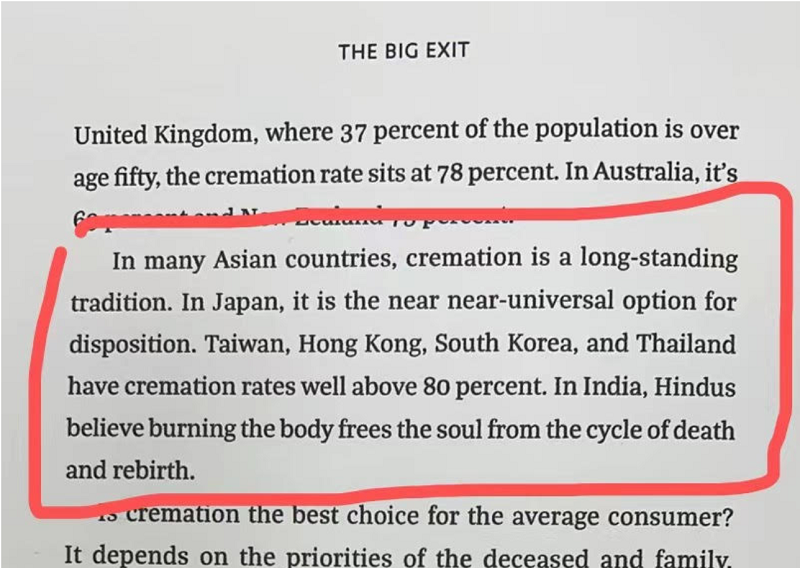
With this in mind, there is some “sensitive wording” on page 46 of The Big Exit that would not be possible to print in China due to it implying that Hong Kong and Taiwan are “countries”.
The Big Exit isn’t about politics. It’s a book about end-of-life choices or, more particularly, how we can dispose of the remains of a billion boomers over the next several decades without wrecking the planet (conventional burial and cremation are both environmentally reckless). The censorship issue arose in this paragraph, which the printer helpfully circled in bright red:
I grant that while Hong Kong still shows up in a lot of data as its own country, it is technically an administrative region of China. Taiwan’s independence is also disputed by China. Against China’s claims, we have the Frank Zappa rules of diplomacy which recognize as “a real country” any place with its own beer and its own airline. Taiwan and Hong Kong both qualify.
In any event, we are now printing The Big Exit in India.
November 17, 2022
“The most disturbing concept Freud ever invented – and he had a few, that bloke – is Thanatos, or the ‘death instinct'”
Ted Gioia on the apparent death wish of the academic publishing industry:
The most disturbing concept Freud ever invented — and he had a few, that bloke — is Thanatos, or the “death instinct”. This is an alleged drive among living organisms to destroy themselves.
Many have disputed that such a thing exists. Instincts preserve life — that’s their evolutionary purpose. The idea of a death instinct is impossible, so the critics claim. It’s like that Peacekeeper Missile or soft rock or marijuana initiative or any of those other two-word combinations of things that don’t belong together.
I’ve often criticized Freud, but I’ve come to accept this Thanatos notion, at least as a sociocultural concept. It explains so many otherwise inexplicable happenings in our society.
Take, for example, academic publishers. They are clearly imbued with a death instinct, no? How else can you explain their self-destructive behavior?
Universities have been publishing books for almost 500 years — dating back to 1534 A.D. when King Henry VIII allowed Cambridge University to set up a printing press. Running one of these publishing outfits is almost a requirement if a college wants to rise in the rankings, but I wonder how much longer this can last. After all, how can you succeed as a publisher if you put so little energy into selling books?
I know one academic publisher that previously sent out two hundred or more review copies of each new book — because they obviously wanted publicity for these titles. Those days are gone. Nowadays their preferred strategy is to send out zero physical copies to reviewers. I’m not exaggerating — I’ve heard it straight from their mouths: their goal is to distribute absolutely no hard copies to media outlets and book critics.
College students are spending 26% less on textbooks this year. That’s a bloodbath for the publishers. But this is the inevitable result whenever you assume the customer has no choice — because, sooner or later, they actually do.
Okay, I don’t blame the publishers entirely — just consider how rarely the New York Times reviews books from academic presses. You might think the cultural elites in New York would give some support to their fellow travelers in idea-mongering, but no dice. They treat those academic books like they’re toxic.
(By the way, I’m grateful to the Times Literary Supplement over in London, which still takes time to tell me about important scholarly works, most of them ignored in US media. But even that last holdout in Britain feels precarious — I fear they’ve been too contaminated by Yankee values.)
Yankee values? That’s up there with the Peacekeeper Missile.
But the lack of review copies is just one symptom among many. Let’s look at a few others.
Just consider the flurry of rebranding efforts in academic publishing. As I’ve explained elsewhere, successful organizations rarely redesign their logos or “refresh” their brands. They don’t have time for such nonsense. But even more to the point, when you’re thriving, your logo is part of that success — it’s a sign of your strength, and you just don’t mess with it.
But that’s clearly not the case in academia nowadays.
I could give you countless examples from college campuses — where “rebranding” is more popular than a hot high school football prospect on a recruiting visit. But I’ll settle for two instances:
My only disappointment is that these brand redesigns didn’t come packaged with a new slogan. May I suggest something along the lines of: Information Solutions for a Changing World.
Or maybe, if we can be a bit more boastful: The Ultimate in Handheld Data Storage.
Does anybody still believe in this rebranding malarkey? Surely any reasonable person can see it’s all smoke and mirrors? But that hardly matters, because the brand redesign has tremendous symbolic value.
That’s why they do it.
The road to hell was once paved with good intentions — but nowadays we settle for symbolic gestures. They’re much cheaper than good intentions. And there’s no shortage of symbolic gestures nowadays — more than enough to pave that whole damned highway to hell.
It’s a shame that symbolism doesn’t pay the bills. Or fix problems. And it certainly won’t sell books.