
World War Two
Published on 22 Dec 2018While the Winter War continues with a Soviet armoured attack at Summa and the Lähde Road and the British attack the Germans from the skies in the first official aerial battle of World War Two, there’s trouble in China. Chiang Kai Shek is looking for ways to gain a new advantage on the Japanese.
Follow WW2 day by day on Instagram @World_war_two_realtime https://www.instagram.com/world_war_t…
Between 2 Wars: https://www.youtube.com/playlist?list…
Join us on Patreon: https://www.patreon.com/TimeGhostHistory
Or join The TimeGhost Army directly at: https://timeghost.tvWritten and Hosted by: Indy Neidell
Produced and Directed by: Spartacus Olsson and Astrid Deinhard
Executive Producers: Bodo Rittenauer, Astrid Deinhard, Indy Neidell, Spartacus Olsson
Research by: Indy Neidell
Edited by: Iryna Dulka
Map animations by: Mikk Tali aka Eastory
Community Manager: Joram AppelColorizations by Spartacus Olsson and Norman Steward.
Photos of the Winter War are mostly from the Finnish Wartime Photograph Archive (SA-Kuva).
Eastory’s channel: https://www.youtube.com/channel/UCEly…
Archive by Screenocean/Reuters https://www.screenocean.comA TimeGhost chronological documentary produced by OnLion Entertainment GmbH
December 23, 2018
Trouble in China – WW2 – 017 22 December 1939
December 22, 2018
Christmas Dishes From Around the World – Anglophenia Ep 44
Anglophenia
Published on 16 Dec 2015Join us for an international holiday feast, as Anglophenia’s Kate Arnell takes a look at several traditional Christmas dishes from around the world. Starting with the U.K., of course…
December 20, 2018
China’s Cultural Revolution
In Quillette, James David Banker describes the beginnings of Mao Zedong’s Cultural Revolution:
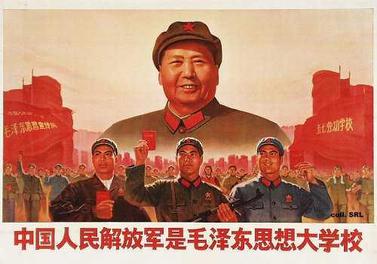
“The Chinese People’s Liberation Army is the great school of Mao Zedong Thought”, 1969.
A poster from the Cultural Revolution, featuring an image of Chairman Mao, published by the government of the People’s Republic of China.
Image via Wikimedia Commons.
“Nobody is more dangerous than he who imagines himself pure in heart,” wrote James Baldwin, “for his purity, by definition, is unassailable.” This observation has been confirmed many times throughout history. However, China’s Cultural Revolution offers perhaps the starkest illustration of just how dangerous the “pure in heart” can be. The ideological justification for the revolution was to purge the Chinese Communist Party (CCP), and the nation more broadly, of impure elements hidden in its midst: capitalists, counter-revolutionaries, and “representatives of the bourgeoisie.” To that end, Mao Zedong activated China’s youth — unblemished and uncorrupted in heart and mind — to lead the struggle for purity. Christened the “Red Guards,” they were placed at the vanguard of a revolution that was, in truth, a cynical effort by Mao to reassert his waning power in the Party. Nevertheless, it set in motion a self-destructive force of almost unimaginable depravity.
The Cultural Revolution commenced in spirit when Mao published a letter indicting a number of Party leaders on May 16, 1966. But it was a seemingly minor event nine days later that ignited the revolution in effect: a young philosophy professor at Peking University named Nie Yuanzi placed a “big-character poster” (a handwritten propaganda sheet featuring large Chinese characters) on a public bulletin board denouncing the university president and others in the administration as bourgeois revisionists. Mao immediately endorsed her protest, which set off a chain reaction of student revolt that swept through China.
That chain reaction was accelerated by “working groups” of ideologues sent to administer schools. Under their tenure, schools became centers of activism rather than learning. Students were encouraged to create big-character posters exposing their own teachers, officials, and even parents. The accused were humiliated in daily “struggle sessions” in which their students and colleagues interrogated them and demanded confessions. The viciousness of these sessions rapidly intensified. Students beat, spat upon, and tortured — in horrifically creative ways — their often elderly teachers and professors. In one case, students demanded their biology professor stare at the sun with wide open eyes. If he blinked or looked away, they beat him. Even middle and elementary school students participated in the struggle sessions, sometimes beating their teachers to death with sticks and belt buckles.
Students were also encouraged to turn on their classmates. As the sins of one generation passed to the next, a new hierarchy was born: the children of revolutionaries on top and the children of “landlords,” “capitalists,” and “rightists” at the bottom. These students were labeled “rotten eggs” and were fair game for the same treatment meted out to their parents. The current president of the People’s Republic of China, Xi Jinping, endured this fate. He was only 15 years old when his father, a loyal Maoist and one-time propaganda chief, was purged, his sister executed, and his own mother forced to denounced Xi as a reactionary. Amid the hysteria, teachers, professors, and intellectuals did not dare to stand up to the students or defend their colleagues lest they suffer similar fates. But they could not escape by being bystanders. With every word and action becoming potential evidence of capitalist sympathy, teachers and intellectuals enthusiastically joined their students in the struggle sessions and screaming rallies.
QotD: An “authentic” peasant diet
The fact is that you wouldn’t want to eat like a European peasant of yesteryear, or a Chinese peasant, either. Sure, peasants ate well when the garden was producing and the harvest was ripe. A lot of the year, they ate pretty meager, dull fare. Many of the spices we now take as ordinary — salt and pepper, for example — were pretty pricey. So were meat and cheese, which, like everything else, tended to get pretty scarce in winter. When you read about what people were actually eating most of the year, you realize that diets were dull, repetitive, and heavy on grains and legumes, lightly complimented by salted and dried things (home canning, like many of the other things we think of as traditional, was another Industrial Revolution contribution, and before modern farming practices, cows tended to be “dried off” in the winter to save the expense of the extra feed a milking cow needed). And this stayed true throughout the 19th century for large swaths of the population in both America and abroad.
The farther north you went, the more this was true — it’s probably no accident that Ireland and Scandinavia are not, let us say, renowned for their fantastic contributions to world cuisine. When your growing season is a short cloudy period between miserable winters, you don’t have the raw materials to construct amazing dining experiences. (Sure, every country has at least one or two really good fairly traditional foods. But the shorter the time fresh ingredients are available, the fewer culinary marvels you’ll be able to produce.)
Too, we must remember that not everyone was a good cook. Cooking was a job, not an absorbing hobby, and as with any other job, many people did it badly. Every farm wife could produce enough calories to feed her family (at least, if the raw materials were available). Not all of them could produce anything you’d want to eat. Modern food-processing technology has relieved us of that most “authentic” culinary experience: boring ingredients processed by an indifferent cook into something that you’d only voluntarily consume if you were pretty hungry. Even the memory of these cooks has fallen away, though you’ll encounter a lot of them if you read old novels.
Megan McArdle, “‘Authentic’ Food Is Not What You Think It Is”, Bloomberg View, 2017-02-24.
December 17, 2018
Sun Yat-sen – A Killing in Hong Kong – Extra History – #1
Extra Credits
Published on 15 Dec 2018Growing up in Honolulu, Sun Yat-sen had an expansive, exciting education, which would inspire him when he moved to Hong Kong as a young adult ready to change the world as a doctor — and as the leader of the “Revive China Society” interested in overthrowing the Qing government.
Sun Yat-sen was a dangerous man. The Qing were right to fear him. After all, he’d bring 2,000 years of imperial rule crashing down.
Join us on Patreon! http://bit.ly/EHPatreon
December 16, 2018
Perkele! Finland Strikes Back – WW2 – 016 15 December 1939
World War Two
Published on 15 Dec 2018In the second week of the Winter War, during multiple counteroffensives, including the famous Sausage War, the Finnish Defence Forces dash any hopes of a quick victory that the Red Army and Stalin might have had.
WW2 day by day on Instagram @World_war_two_realtime https://www.instagram.com/world_war_t…
Between 2 Wars: https://www.youtube.com/playlist?list…
Join us on Patreon: https://www.patreon.com/TimeGhostHistory
Or join The TimeGhost Army directly at: https://timeghost.tvWritten and Hosted by: Indy Neidell
Produced and Directed by: Spartacus Olsson and Astrid Deinhard
Executive Producers: Bodo Rittenauer, Astrid Deinhard, Indy Neidell, Spartacus Olsson
Research by: Indy Neidell
Edited by: Wieke Kapteijns
Map animations by: Mikk Tali aka Eastory
Community Manager: Joram AppelColoring by Spartacus Olsson
Thumbnail depicting Finnish soldiers using a slingshot to lob grenades at the Red Army. Colorized by Cassowary https://www.flickr.com/photos/cassowa…
Eastory’s channel: https://www.youtube.com/channel/UCEly…
Archive by Screenocean/Reuters https://www.screenocean.comA TimeGhost chronological documentary produced by OnLion Entertainment GmbH
The Last British Battleship?
Mark Felton Productions
Published on 13 Nov 2018Does a British battleship still exist? Yes, but not in Britain. Find out the full fascinating story of the last of her kind.
Support my channel by becoming a Patron: https://www.patreon.com/markfeltonpro…
Photos: Nesmad, Ningyou, nattou, Mikasa Historic Memorial Warship
Video: YouTube Creative Commons
December 9, 2018
Everyone please update your Newspeak dictionaries…
Mark Steyn suggests we’ll soon be unable to use compass directions in spoken or written work, for fear of causing offence:
Things you can no longer say:
I was in the big city earlier this week, and so saw for the first time in ages a physical copy of The New York Times. It contained an interview with James Dyson, the brilliant re-inventor of vacuum cleaners and much else. The Times felt obliged to preface Sir James’ words with a health warning for the easily triggered:
In this interview, Mr. Dyson expressed antiquated and at times offensive views on “racial differences” and Japanese culture. He also referred to growth markets in Asia as the “Far East.”
He used the term “Far East”!!! What the hell was he thinking?????? Good thing he has no plans to run for public office or host a cable show. The old British Foreign Office joke about the “Near East” (which is more generally referred to as the Middle East) is that they call it the Near East because it’s always nearer than you think. But start referring to the Far East and the instant vaporization of your entire career is a lot nearer than you think.
“Far East” is, I suppose, literally Eurocentric. But then so is “Midwest”. Perhaps the Times now finds any point of view or perspective “offensive”. Perhaps it is time to ban such “antiquated” concepts as north, south, east and west – and indeed the very compass. The abolition of instruments of navigation would seem a necessary condition for the future we’re sailing to.
December 7, 2018
“A date that will live in infamy” – Speech
FootageArchive – Videos From The Past
Published on 19 Mar 2015Welcome to FootageArchive! On this channel you’ll find historic and educational videos from the 1900s. Watch, learn, and take a trip back in time as we gain insight into a previous time. Subscribe for more.
Note: this video contains archived public domain / licensed footage. This footage serves documentary purposes on world history and is to be viewed as educational.
December 6, 2018
Izanami and Izanagi – Underworld Blues – Extra Mythology
Extra Credits
Published on 3 Dec 2018Join the Patreon community! http://bit.ly/EMPatreon
When Izanami died giving birth to Kagu-Tsuchi, the incarnation of fire, Izanagi visited the underworld to try to get her back, not realizing the dreadful terrors he would face. But from that bitter journey, sprung the life of new Japanese gods…
Watch the Overly Sarcastic Productions crossover episode: https://www.youtube.com/watch?v=clJ0F…
December 2, 2018
The Winter War – WW2 – 014 December 1 1939
World War Two
Published on 1 Dec 2018On the last day of November 1939 the Red Army of the USSR invades Finland and the Winter War begins.
WW2 day by day, every day is now live on our Instagram account @World_war_two_realtime https://www.instagram.com/world_war_t…
Between 2 Wars: https://www.youtube.com/playlist?list…
Join us on Patreon: https://www.patreon.com/TimeGhostHistory
Or join The TimeGhost Army directly at: https://timeghost.tvWritten and Hosted by: Indy Neidell
Produced and Directed by: Spartacus Olsson and Astrid Deinhard
Executive Producers: Bodo Rittenauer, Astrid Deinhard, Indy Neidell, Spartacus Olsson
Research by: Indy Neidell
Edited by: Iryna Dolka
Community Manager: Joram AppelColoring by Spartacus Olsson and Norman Stewart
Norman’s pictures https://oldtimesincolor.blogspot.com/Archive by Screenocean/Reuters https://www.screenocean.com
A TimeGhost chronological documentary produced by OnLion Entertainment GmbH
November 27, 2018
QotD: Gandhi’s view of India as a nation
No one questions that the formative period for Gandhi as a political leader was his time in South Africa. Throughout history Indians, divided into 1,500 language and dialect groups (India today has 15 official languages), had little sense of themselves as a nation. Muslim Indians and Hindu Indians felt about as close as Christians and Moors during their 700 years of cohabitation in Spain. In addition to which, the Hindus were divided into thousands of castes and sub-castes, and there were also Parsees, Sikhs, Jains. But in South Africa officials had thrown them all in together, and in the mind of Gandhi (another one of those examples of nationalism being born in exile) grew the idea of India as a nation, and Muslim-Hindu friendship became one of the few positions on which he never really reversed himself. So Gandhi — ignoring Arabs and Turks — became an adamant supporter of the Khilafat [Caliphate] movement out of strident Indian nationalism. He had become a national figure in India for having unified 13,000 Indians of all faiths in South Africa, and now he was determined to reach new heights by unifying hundreds of millions of Indians of all faiths in India itself. But this nationalism did not please everyone, particularly Tolstoy, who in his last years carried on a curious correspondence with the new Indian leader. For Tolstoy, Gandhi’s Indian nationalism “spoils everything.”
Richard Grenier, “The Gandhi Nobody Knows”, Commentary, 1983-03-01.
November 26, 2018
Will the Kriegsmarine Rule the Waves? – WW2 – 013 24 November 1939
World War Two
Published on 24 Nov 2018The European Allies seek a countermeasure to the mysterious German mines, in China the Japanese advance, and in Poland it is the beginning of the Warsaw Ghetto.
WW2 day by day, every day is now live on our Instagram account @World_war_two_realtime https://www.instagram.com/world_war_t…
Join us on Patreon: https://www.patreon.com/TimeGhostHistory
Or join The TimeGhost Army directly at: https://timeghost.tvWritten and Hosted by: Indy Neidell
Produced and Directed by: Spartacus Olsson and Astrid Deinhard
Executive Producers: Bodo Rittenauer, Astrid Deinhard, Indy Neidell, Spartacus Olsson
Research by: Indy Neidell
Edited by: Wieke Kapteijns and Spartacus Olsson
Community Manager: Joram AppelColoring by Spartacus Olsson and Norman Stewart
Norman’s pictures https://oldtimesincolor.blogspot.com/Archive by Screenocean/Reuters https://www.screenocean.com
A TimeGhost chronological documentary produced by OnLion Entertainment GmbH
November 18, 2018
New research shows 536AD to have been the true annus horribilis
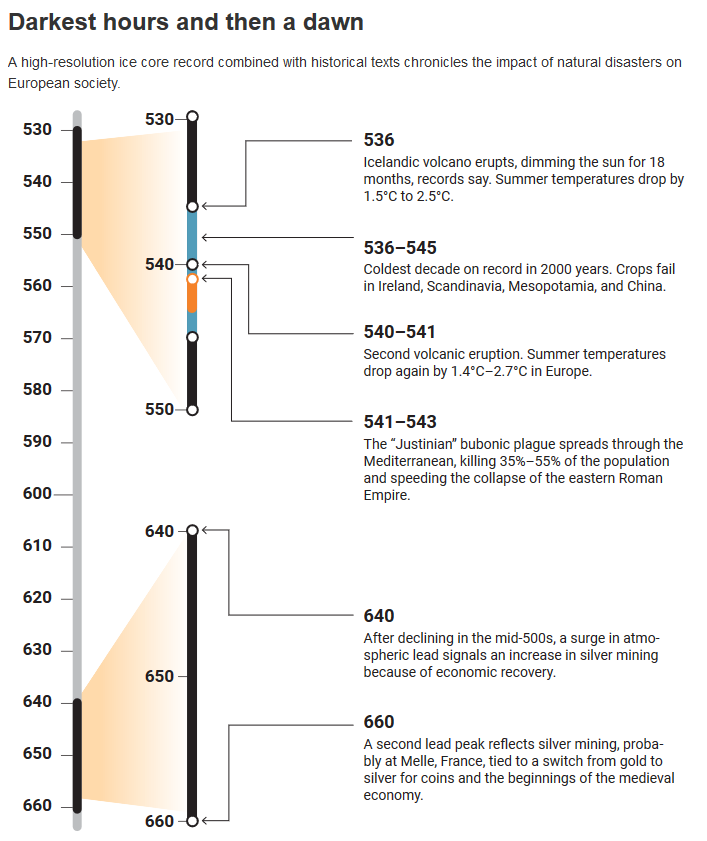
There have been bad years in human history. There have been worse days in human history. But according to a recent study summarized in Science magazine, the worst year in recorded history was 536AD:
Ask medieval historian Michael McCormick what year was the worst to be alive, and he’s got an answer: “536.” Not 1349, when the Black Death wiped out half of Europe. Not 1918, when the flu killed 50 million to 100 million people, mostly young adults. But 536. In Europe, “It was the beginning of one of the worst periods to be alive, if not the worst year,” says McCormick, a historian and archaeologist who chairs the Harvard University Initiative for the Science of the Human Past.
A mysterious fog plunged Europe, the Middle East, and parts of Asia into darkness, day and night — for 18 months. “For the sun gave forth its light without brightness, like the moon, during the whole year,” wrote Byzantine historian Procopius. Temperatures in the summer of 536 fell 1.5°C to 2.5°C, initiating the coldest decade in the past 2300 years. Snow fell that summer in China; crops failed; people starved. The Irish chronicles record “a failure of bread from the years 536–539.” Then, in 541, bubonic plague struck the Roman port of Pelusium, in Egypt. What came to be called the Plague of Justinian spread rapidly, wiping out one-third to one-half of the population of the eastern Roman Empire and hastening its collapse, McCormick says.
Historians have long known that the middle of the sixth century was a dark hour in what used to be called the Dark Ages, but the source of the mysterious clouds has long been a puzzle. Now, an ultraprecise analysis of ice from a Swiss glacier by a team led by McCormick and glaciologist Paul Mayewski at the Climate Change Institute of The University of Maine (UM) in Orono has fingered a culprit. At a workshop at Harvard this week, the team reported that a cataclysmic volcanic eruption in Iceland spewed ash across the Northern Hemisphere early in 536. Two other massive eruptions followed, in 540 and 547. The repeated blows, followed by plague, plunged Europe into economic stagnation that lasted until 640, when another signal in the ice — a spike in airborne lead — marks a resurgence of silver mining, as the team reports in Antiquity this week.
H/T to Blazing Cat Fur for the link.
November 15, 2018
Colt Model 639: MACVSOG’s Vietnam Carbine
Forgotten Weapons
Published on 24 Oct 2018http://www.forgottenweapons.com/colt-…
http://www.patreon.com/ForgottenWeapons
The Colt Model 639 was the export version of the Colt Model 629, which was type classified by the US military as the XM177E2 and issued to MACVSOG special operations units in 1967 and 1968. Improved from the Model 609 carbine, the 629/639 has an 11.5 inch barrel and an interesting small muzzle device (“moderator”) which served to change the signature of its firing to sound much more like an AK-type rifle than an M16. The device does that job well – at least until it had been fired extensively, which slowly fills up the (non-disassemblable) unit with carbon and powder residue, substantially reducing its effectiveness. It has a full-fence lower, standard carbine buffer and spring, and a two position aluminum collapsing stock. It is the iconic weapon of US special forces in Vietnam.
Only about 100 of the Model 639 were made in the early 1970s, and many of those were sent back to Colt in 1975 under a recall. At that time, the ATF decided to classify the muzzle device as a silencer, prompting Colt to recall the guns and remove and destroy the devices. Some owners, however, kept their carbines and instead registered the muzzle devices, allowing them legally remain on the guns.
Contact:
Forgotten Weapons
PO Box 87647
Tucson, AZ 85754If you enjoy Forgotten Weapons, check out its sister channel, InRangeTV! http://www.youtube.com/InRangeTVShow


