
India played a large role in the development of European conceptions of race. In 1786 British judge William Jones delivered a lecture in Calcutta suggesting that Sanskrit, Greek, and Latin were all descended from the same lost language, a ghost tongue now called Proto-Indo-European.
Jones went on to hypothesize that an ancient invasion of Dravidian-speaking India by Proto-Indo-European-speaking Aryans from Iran could help explain the curious distribution of language, skin color, and caste within the Hindu world today.
Jones’ ideas had unfortunate influence. Reich writes:
To the Nazis and others, the distribution of the Indo-European language family, linking Europe to India … spoke of an ancient conquest moving out of an ancestral homeland, displacing and subjugating the peoples of the conquered territories, an event they wished to emulate.
Hitler thus culturally appropriated the Hindu swastika.
Since 1945, the notion of Aryan invaders has been unsurprisingly unpopular.
In Europe, anthropologists have promoted the “pots not people” theory to argue that trade and changes in fashion must explain why Corded Ware pots suddenly showed up all over Europe about 4,900 years ago. (So did battle axes; indeed, early scientists called this the Battle Axe Culture. But that sounded too awesome. Hence, more recent academics renamed it after its pottery style to make these brutal barbarians sound dweebier and thus less interesting to boys.)
In India, the notion of Hindu culture as a giant conspiracy by Aryan invaders to enshrine their descendants at the top of the social order for the rest of eternity perhaps struck a little too close to home.
Steve Sailer, “Reich’s Laboratory”, Taki’s Magazine, 2018-03-28.
June 19, 2020
QotD: We call it the Corded Ware culture, not the Battle Axe culture to make it less interesting to boys
June 17, 2020
Alcibiades, the first recorded iconoclast, but far from the last
James Heartfield on the modern day resurgence of iconoclasm:
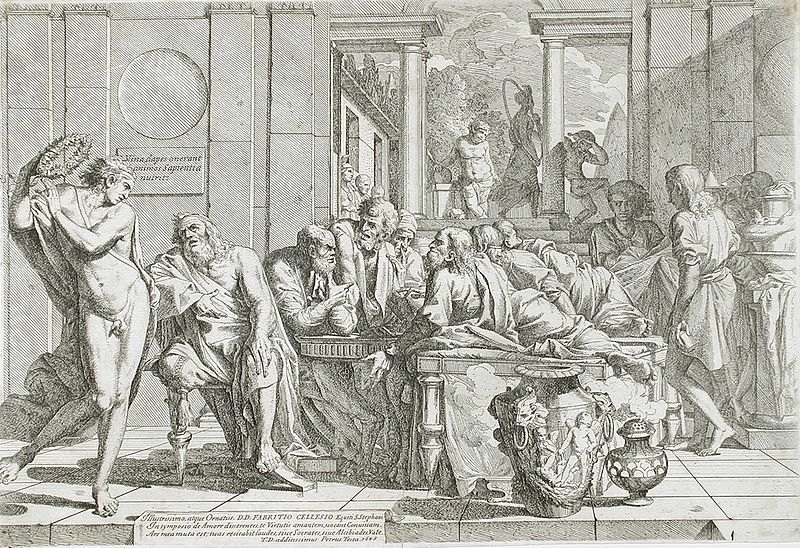
“Drunken Alcibiades interrupting the Symposium”, an engraving from 1648 by Pietro Testa (1611-1650)
Via Wikimedia Commons.
… far more often, the attacks on public symbols are indicative of a breakdown in social solidarity — often with alarming consequences. For activists seeking to win popular support, knocking down statues is a high-risk strategy that can provoke the opposite sentiments to those hoped for. The futurist Marinetti’s proposal to fill in the canals of Venice with concrete to make modern roads is a witty way to make a point, but not a sound policy.
Alcibiades was perhaps the first recorded statue vandal. One night in 415 BC he knocked all the stone cocks off the statues of Hermes in Athens. In 1497, the friar Girolamo Savonarola launched a Bonfire of the Vanities in which artworks, books and statues were destroyed out of a fear they would tempt people away from God. As any lover of old English churches knows, the furies of the Puritan revolution led to the destruction and defacing of Catholic saints’ statues and paintings.
In the modern era, the temptation to destroy monuments has been strong. In the First World War, Britain’s local authorities changed German-sounding names of streets like Bismarck Road — now Waterlow Road — while bully boys attacked German-owned shops. In 1933, Nazi students in Germany organised bonfires of subversive books, while the Reich organised an exhibition of “degenerate” modernist art. The burning of books only served as a trial run for the extermination of people, as the symbolic slaughter failed to yield the results of a “cleansed” Germany.
People often make the point that there are no statues of Hitler in Germany — though those were not taken down by Germans, but by the Allied occupiers. You can still see Albert Speer’s Zeppelinfeld and grandstand in Nuremberg, where many of Hitler’s rallies took place, though not much else of his Nazi architecture survives. Mussolini’s architects, Giuseppe Terragni and Marcello Piacentini, did better — much of their absurdly grandiose work survives. The model of an Allied-led “denazification” was in the minds of the US-led forces that overthrew Saddam Hussein in 2003. The destruction of his statue in Baghdad was largely staged by the allies.
Under the Maoist regimes in China and the Khmer Rouge in Cambodia, some of the worst atrocities after the Nazis were carried out. Mao’s “Cultural Revolution” against the “four olds” led to the destruction of books and artworks. Later, there were showtrials and the politically incorrect were battered by the mob. In the wreckage of Cambodia, Pol Pot led a terrifying war on alleged capitalist-roaders and even intellectuals — who could be handily identified by the fact they wore glasses — that led to millions being killed. Pol Pot declared a “year zero” — that all civilisation before the Khmer Rouge took power would be cancelled. Tragically, the wholesale wiping out of Cambodian culture was only a prelude to the extermination of much of its population. The sentiment of wiping out the wrong history was repeated in the war that al-Qaeda-inspired regimes in Afghanistan and Mali conducted against books and statues that did not match their own Islamist views.
In Soviet Russia, when the communist-allied artists of the Proletkult organisation argued that all Tsarist culture should be expunged, the Bolshevik leader Lenin took them to task for “rejecting the most valuable achievements of the bourgeois epoch”. Instead, he said, they should assimilate and re-work “everything of value in the more than 2,000 years of the development of human thought and culture”. Sadly, Lenin’s wise advice was lost on the Stalinist regimes that followed, during which the policy oscillated between futurist iconoclasm and maudlin Russian sentimentality. History got its revenge in eastern Europe when most of the ubiquitous Lenin and Marx statues came down in the 1990s.
June 16, 2020
Legends Summarized: The Journey To The West (Part VI)
Overly Sarcastic Productions
Published 14 Dec 2018JOURNEY TO THE WEST KAI, EPISODE 3: FAMILY FEUD!
Action! Excitement! Faces from the past! Kuan Yin discovers an exciting new acupuncture technique! Pigsy is unexpectedly skilled at CPR!
PATREON: https://www.patreon.com/user?u=4664797
MERCH LINKS:
Shirts – https://overlysarcasticproducts.threa…
All the other stuff – http://www.cafepress.com/OverlySarcas…Find us on Twitter @OSPYouTube!
June 11, 2020
Black Death Mystery Solved – Not Bubonic Plague – Pandemic History 02
TimeGhost History
Published 10 Jun 2020From the day the Black Death starts to ravage humanity in 1347, there will be speculation about what it is. It will take until 2017 for science to give us a conclusive answer to the riddle how so many people could die so fast all over Europe, Africa, and Asia in only five years.
Join us on Patreon: https://www.patreon.com/TimeGhostHistory
Hosted by: Indy Neidell and Spartacus Olsson
Written by: Indy Neidell and Spartacus Olsson
Directed by: Astrid Deinhard
Executive Producers: Astrid Deinhard, Indy Neidell, Spartacus Olsson, Bodo Rittenauer
Creative Producer: Joram Appel
Post-Production Director: Wieke Kapteijns
Research by: Spartacus Olsson, Indy Neidell, and James Currie
Edited by: Karolina Dołęga
Sound Engineer: Marek Kamiński
Graphic Design: Ryan WeatherbyVisual Sources:
Welcome Images
Mark and Delwen from Flickr: https://www.flickr.com/photos/markand…
Smarteeee from Wiki CommonsIcons from The Noun Project by: arif fajar yulianto, James, Maxim Kulikov, Jejen Juliansyah Nur Agung, Gan Khoon Lay, Alfonso Melolonta Urbán
Laymik, parkjisun, Eucalyp, Adrien Coquet & Mahmure Alp.Music:
“Barrel” – Christian Andersen
“Symphony of the Cold-Blooded” – Christian Andersen
“Potential Redemption” – Max Anson
“Moving to Disturbia” – Experia
“Superior” – Silver Maple
“Please Hear Me Out” – Philip Ayers
“Guilty Shadows 4” – Andreas Jamsheree
“Deadline” – Marten Moses
“Endlessness” – Flouw
“Moving to Disturbia” – ExperiaArchive by Screenocean/Reuters https://www.screenocean.com.
Research Sources:
Quinto Tiberio Angelerio and New Measures for Controlling Plague in 16th-Century Alghero, Sardinia, Raffaella Bianucci, Ole Jørgen Benedictow, Gino Fornaciari, and Valentina Giuffra
“The Path to Pistoia: Urban Hygiene Before the Black Death”, G. Geltner, Past & Present, Volume 246, Issue 1, February 2020, Pages 3–33
Encyclopedia of the Black Death, Joseph Patrick Byrne
“Epidemiological characteristics of an urban plague epidemic in Madagascar, August–November, 2017: an outbreak report”, The Lancet, Rindra Randremanana, PhD *Voahangy Andrianaivoarimanana, PhD Birgit Nikolay, PhD Beza Ramasindrazana, PhD Juliette Paireau, PhD, Quirine Astrid ten Bosch, PhD et al
“Yersinia pestis, the cause of plague, is a recently emerged clone of Yersinia pseudotuberculosis” Mark Achtman, Kerstin Zurth, Giovanna Morelli, Gabriela Torrea, Annie Guiyoule, and Elisabeth Carniel
“Insights into the evolution of Yersinia pestis through whole-genome comparison with Yersinia pseudotuberculosis“, P.S.G. Chain, E. Carniel, F.W. Larimer, J. Lamerdin, P.O. Stoutland, W.M. Regala, A.M. Georgescu, L.M. Vergez, M.L. Land, V.L. Motin, R.R. Brubaker, J. Fowler, J. Hinnebusch, M. Marceau, C. Medigue, M. Simonet, V. Chenal-Francisque, B. Souza, D. Dacheux, J.M. Elliott, A. Derbise, L.J. Hauser, and E. Garcia
“Distinct Clones of Yersinia pestis Caused the Black Death”, Stephanie Haensch, Raffaella Bianucci, Michel Signoli, Minoarisoa Rajerison, Michael Schultz, Sacha Kacki, Marco Vermunt, Darlene A. Weston, Derek Hurst, Mark Achtman, Elisabeth Carniel, Barbara BramantiA TimeGhost chronological documentary produced by OnLion Entertainment GmbH.
From the comments:
TimeGhost History
2 days ago
There is much we can learn from history and as you will see in the next two episodes of our impromptu pandemics series it takes a long time for us to make these learnings. Many of the mistakes made during the outbreak of the Black Death are still an issue as we respond to COVID-19 almost 700 years later. This episode was also a very personal learning experience for us, Indy and Spartacus. Both of us read and studied a lot about the plague when we were younger in the 1980s, Indy even did his BA paper in history on the plague. Back then there was a lot of speculation about what the Black Death actually was (although the general consensus was that it must have been bubonic plague based on the findings made in the 20th century, after the discovery of the Yersinia Pestis bacteria). But that conclusion was a bit problematic — the Black Death was too lethal, spread too fast, and killed people too quickly for bubonic plague. Until we started researching these episodes we hadn’t spent much thought on the topic, so imagine our surprise when we discovered that bacteriologists, epidemiologists, and archeologists had come together to solve the mystery after two chance occurrences of unusual plague outbreaks in 2014 and 2017. To paraphrase Lord Marlborough: if you want to truly learn something about a topic, there’s no better way than to make a video about it.

June 9, 2020
Legends Summarized: The Journey To The West (Part V)
Overly Sarcastic Productions
Published 9 Feb 2018JOURNEY TO THE WEST KAI, EPISODE 2: LOS DEMONIOS HERMANOS!
It’s yet another episode almost a year in the making! (sorry again 🙊) Today our heroes face off against a deadly duo of conveniently color-coordinated scoundrels, equipped with an impressive array of sacred treasures! Will Monkey be able to prioritize the well-being of his friends over his love of shiny things? Probably not, but find out now!
PATREON: https://www.patreon.com/user?u=4664797
MERCH LINKS:
Shirts – https://overlysarcasticproducts.threa…
All the other stuff – http://www.cafepress.com/OverlySarcas…Find us on Twitter @OSPYouTube!
June 5, 2020
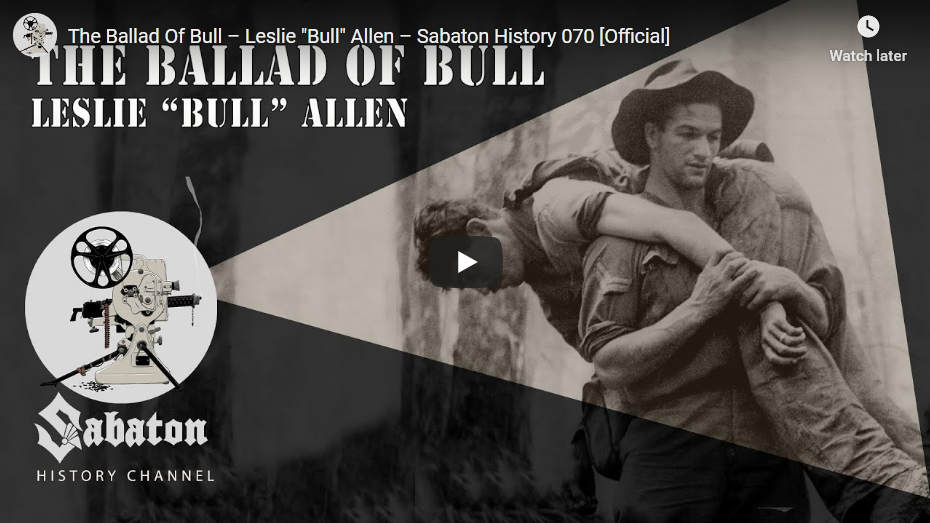
“The Ballad Of Bull” – Leslie “Bull” Allen – Sabaton History 070 [Official]
Sabaton History
Published 4 Jun 2020Sometimes war is killing, sometimes it’s saving lives. This week we turn a soldier who became a hero, not for killing his foes, but for saving his fellow men. Medic Leslie “Bull” Allen’s story is a story about courage in the face of fire. The battle for Mount Tambu in 1943 in Papua New Guinea was vicious and bloody, and the field was soon littered with many wounded men crying for help. Without much regard for his own safety, “Bull” Allen stormed forward into the fray. 12 times he went, and 12 times he came back with a wounded soldier on his back.
Support Sabaton History on Patreon: https://www.patreon.com/sabatonhistory
Listen to “The Ballad Of Bull” on the album Heroes here:
CD: http://bit.ly/HeroesStore
Spotify: http://bit.ly/HeroesSpotify
Apple Music: http://bit.ly/HeroesAppleMusic
iTunes: http://bit.ly/HeroesiTunes
Amazon: http://bit.ly/HeroesAmz
Google Play: http://bit.ly/HeroesGooglePCheck out the trailer for Sabaton’s new album The Great War right here: https://www.youtube.com/watch?v=HCZP1…
Listen to Sabaton on Spotify: http://smarturl.it/SabatonSpotify
Official Sabaton Merchandise Shop: http://bit.ly/SabatonOfficialShopHosted by: Indy Neidell
Written by: Markus Linke and Indy Neidell
Directed by: Astrid Deinhard and Wieke Kapteijns
Produced by: Pär Sundström, Astrid Deinhard and Spartacus Olsson
Creative Producer: Joram Appel
Executive Producers: Pär Sundström, Joakim Broden, Tomas Sunmo, Indy Neidell, Astrid Deinhard, and Spartacus Olsson
Post-Production Director: Wieke Kapteijns
Edited by: Iryna Dulka
Sound Editing by: Marek Kaminski
Maps by: Eastory – https://www.youtube.com/c/eastoryArchive by: Reuters/Screenocean https://www.screenocean.com
Music by Sabaton.Sources:
– State Library Victoria
– Motorboat sound by bockelsound from freesound.orgAn OnLion Entertainment GmbH and Raging Beaver Publishing AB co-Production.
© Raging Beaver Publishing AB, 2019 – all rights reserved.
June 3, 2020
Inglis High Power: How a Chinese Whim Became A British Service Pistol
Forgotten Weapons
Published 25 Jan 2018Sold for $3,163.
During World War Two, the Canadian government set up a loan program to help Chinese companies provide all manner of material aid to Canada’s allies. Among many others, one recipient of this aid was the Nationalist Chinese government under Chiang Kai Shek. Chinese representatives asked the John Inglis company to manufacture no less than 180,000 Browning High Power pistols, and the company agreed.
After some wrangling, Inglis acquired a license from FN representatives to make the guns, got a complete technical package through the British government and FN’s representatives in exile, and the direct personal aid of Laloux and Saive from FN. Delivery proved difficult, though, with only about 4000 guns being shipped to Karachi and then needing to be flown over The Hump in cargo planes, along with massive amounts of other aid — and a few pistols didn’t get a lot of priority there.
By the fall of 1944, the contract was cancelled under concerns that it was not really contributing to any progress in the war against the Japanese, along with insistence from American General Stilwell that the Chinese forces be armed with weapons that could be supplied more easily through the American logistic network. Production restarted after the defeat of Germany, with another 40,000 or so being made and delivered before it was cancelled again when the Nationalist Chinese forces were seen to be clearly losing to their Communist opponents.
Each of these pistols was supplied with a combination shoulder stock and holster. In the US, attaching a stock to a pistol would normally subject it to registration as a Short Barreled Rifle, but the Inglis High Powers are among the guns exempted from this requirement. They are, in fact, among the least expensive and most modern guns to be exempted in this way.
http://www.patreon.com/ForgottenWeapons
Cool Forgotten Weapons merch! http://shop.bbtv.com/collections/forg…
If you enjoy Forgotten Weapons, check out its sister channel, InRangeTV! http://www.youtube.com/InRangeTVShow

June 2, 2020
Legends Summarized: The Journey To The West (Part IV)
Overly Sarcastic Productions
Published 19 Mar 2017JOURNEY TO THE WEST KAI, EPISODE 1: SKELE-FUN!
It’s the episode almost a year in the making! (sorry 🙊) The saga of the monk Tripitaka, his bodyguard the Monkey King, and the rest of his merry band of pilgrims continues in this dramatic episode! Friendships are tested! Unlikely heroes rise to the occasion! Somebody throws a punch!
PATREON: https://www.patreon.com/user?u=4664797
MERCH LINKS:
Shirts – https://overlysarcasticproducts.threa…
All the other stuff – http://www.cafepress.com/OverlySarcas…Find us on Twitter @OSPYouTube!
May 31, 2020
Sink the Bismarck! – The Pride of the Kriegsmarine‘s Demise – WW2 – 092 – May 30 1941
World War Two
Published 30 May 2020This week, the Battle of Crete continues as the Bismarck and Prinz Eugen set sail to the Atlantic, starting one of the most dramatic episodes in the histories of the Royal Navy and the Kriegsmarine.
Join us on Patreon: https://www.patreon.com/TimeGhostHistory
Or join The TimeGhost Army directly at: https://timeghost.tvFollow WW2 day by day on Instagram @World_war_two_realtime https://www.instagram.com/world_war_t…
Between 2 Wars: https://www.youtube.com/playlist?list…
Source list: http://bit.ly/WW2sourcesWritten and Hosted by: Indy Neidell
Director: Astrid Deinhard
Producers: Astrid Deinhard and Spartacus Olsson
Executive Producers: Astrid Deinhard, Indy Neidell, Spartacus Olsson, Bodo Rittenauer
Creative Producer: Joram Appel
Post-Production Director: Wieke Kapteijns
Research by: NN
Edited by: Iryna Dulka
Sound design: Marek Kamiński
Map animations: Eastory (https://www.youtube.com/c/eastory)Colorizations by:
– Norman Stewart – https://oldtimesincolor.blogspot.com/
– Daniel Weiss
– Jaris Almazani (Artistic Man), https://instagram.com/artistic.man?ig…
– Carlos Ortega Pereira, BlauColorizations, https://www.instagram.com/blaucoloriz…Sources:
– Imperial War Museum: A 6152, A 6155, A 3898, IWM A4057, HU 50190, HU 374, FL 2120, E 3464, E 450
– U.S. Naval History and Heritage Command Photograph
– Narodowe Archiwum Cyfrowe
– Drawing of Churchill from Museon
– Battlecruiser Renown shape by Emoscopes from WikimediaArchive by Screenocean/Reuters https://www.screenocean.com.
A TimeGhost chronological documentary produced by OnLion Entertainment GmbH.
May 26, 2020
Legends Summarized: The Journey To The West (Part III)
Overly Sarcastic Productions
Published 13 Apr 2016At last! The saga continues, as our troupe of compadres grows from three to five and the story can REALLY get started!
In case you were wondering, this ISN’T the only origin of the five-man-band archetype, although it certainly accounts for a lot of the associated tropes. The Mahabharata is another classic example, with the five Pandava brothers filling out the classic roles very well.
HEADS UP! We have a twitter now! Find us at https://twitter.com/OSPyoutube for all your dorky book-humor needs!
May 24, 2020
Invasion of Crete: a Bloody Mess – WW2 – 091 – May 23 1941
World War Two
Published 23 May 2020Operation Mercury commences as fallschirmjäger airborne troops land on the Greek island of Crete. A bloody and messy battle follows as it turns out to be costly in more ways than one.
Join us on Patreon: https://www.patreon.com/TimeGhostHistory
Or join The TimeGhost Army directly at: https://timeghost.tvFollow WW2 day by day on Instagram @World_war_two_realtime https://www.instagram.com/world_war_t…
Between 2 Wars: https://www.youtube.com/playlist?list…
Source list: http://bit.ly/WW2sourcesWritten and Hosted by: Indy Neidell
Director: Astrid Deinhard
Producers: Astrid Deinhard and Spartacus Olsson
Executive Producers: Astrid Deinhard, Indy Neidell, Spartacus Olsson, Bodo Rittenauer
Creative Producer: Joram Appel
Post-Production Director: Wieke Kapteijns
Edited by: Iryna Dulka
Sound design: Marek Kamiński
Map animations: Eastory (https://www.youtube.com/c/eastory)Colorizations by:
– Julius Jääskeläinen – https://www.facebook.com/JJcolorization/
– Dememorabilia – https://www.instagram.com/dememorabilia/
– Norman Stewart – https://oldtimesincolor.blogspot.com/
– Jaris Almazani (Artistic Man), https://instagram.com/artistic.man?ig…
– Carlos Ortega Pereira, BlauColorizations, https://www.instagram.com/blaucoloriz…Sources:
– Imperial War Museum: A 28473, E 3064E, A 4154, A 4153, A 4149, A 4144, E 3066E, E 3023E, A 4156, E 6066
– Archives municipales de Brest
– Museums Victoria
– Bundesarchiv, CC-BY-SA 3.0: Bild_141-0816, Bild_183-L04232, Bild_101I-166-0527-10A, Bild 101I-166-0527-22 / Weixler, Franz Peter, Bild_183-L19019, Bild 146-1977-115-04, Bild 141-0823, Bild_101I-166-0512-39, Bild_146-1981-159-22, Bild_146-1980-090-34, E 3022EArchive by Screenocean/Reuters https://www.screenocean.com.
A TimeGhost chronological documentary produced by OnLion Entertainment GmbH.
May 21, 2020
1949: Death and Sovereignty | The Indonesian War of Independence Part 5
TimeGhost History
Published 20 May 2020The Dutch reconquered most of the Indonesian cities on Java and Sumatra, but the Indonesian War of Independence continues as the international community grows tired of the Dutch attitude.
Join us on Patreon: https://www.patreon.com/TimeGhostHistory
Hosted by: Indy Neidell
Written by: Isabel Wilson and Joram Appel
Director: Astrid Deinhard
Producers: Astrid Deinhard and Spartacus Olsson
Executive Producers: Astrid Deinhard, Indy Neidell, Spartacus Olsson, Bodo Rittenauer
Creative Producer: Joram Appel
Post-Production Director: Wieke Kapteijns
Research by: Isabel Wilson and Joram Appel
Edited by: Karolina Dołęga
Maps: Ryan Weatherby
Sound design: Marek KamińskiColorizations:
Carlos Ortega Pereira (BlauColorizations) – https://www.instagram.com/blaucoloriz…Bibliography: https://bit.ly/IndoSources
Image Sources:
Nationaal Archief
Tropenmuseum, part of the National Museum of World Cultures
Journal of the Humanities and Social Sciences of Southeast Asia
Tukangpulas – https://www.instagram.com/tukangpulas…The icons from The Noun Project by Adrien Coquet
Archive by Screenocean/Reuters https://www.screenocean.com.
A TimeGhost chronological documentary produced by OnLion Entertainment GmbH.
From the comments:
TimeGhost History
1 day ago
We have seen two colonial offensives, two peace agreements, civil wars and multiple foreign interventions. And yet, 1949 is the most deadly year of the entire Indonesian War of Independence. And, without spoiling the episode, stuff doesn’t end in 1949. Indonesia will stay the stage of revolts, colonialism, civil war and ideological purges for decades to come. We won’t get to cover that in these series, as these are exclusively about the Indonesian War of Independence from 1945 to 1949. We might revisit the area in the future though. If you want to support that, and share in the decision of what series to make next, you can support us on www.patreon.com/timeghosthistory or https://timeghost.tv.
Cheers, Joram and Izzy
May 19, 2020
Legends Summarized: The Journey To The West (Part II)
Overly Sarcastic Productions
Published 14 Jan 2016The eponymous Journey actually begins! Sure hope this doesn’t take another eighty-three chapters. OH WAIT
Sun Wukong is back, and better than ever! Or … well, or worse, depending on your point of view. He’s getting up to shenanigans again, which is generally pretty problematic — but you know what, he’s doing stuff, and that’s the important thing.
May 17, 2020
China sees their public image damaged in the wake of the Wuhan Coronavirus
Arthur Chrenkoff on the ways other countries regard China after the epidemic spread beyond their borders and the Chinese Communist Party’s antics on the world stage:
Welcome to the political chaos theory – or, should we say, fact: a bat flapping its wings in China produces a hurricane… pretty much everywhere around the world. It seems likely that three decades’ worth of good PR painstakingly build up by the Chinese authorities after the downer of the Tiananmien Massacre have all been undone in a few short months of domestic and international missteps, from initially covering up the truth about COVID, through gifting or selling faulty personal safety and medical goods around the world, to now retaliating against countries like Australia which are asking some uncomfortable questions about the origins of the virus.
Earlier today, Australia’s Lowy Institute has released the results of its COVID poll on public attitudes about the Corona pandemic. Of particular interest, the perception of China’s rulers:
At the same time, 37 per cent of Australians think that China will emerge more powerful after the dust (or the viral load) settles, while 36 per cent believe in no change, and only 27 per cent think China will be weaker in the aftermath. By contrast, a majority of 53 per cent and a plurality of 48 per cent believe that the United States and Europe respectively will be less powerful in the post-pandemic future. Reading the two sets of figures together it seems that the prospect of China’s rebound to international power is viewed more with apprehension rather than enthusiasm.
As Lowy’s Natasha Kassam observed, the public trust in China has been already declining, falling dramatically from 52 to 32 per cent in just one year between 2018 and 2019. It will be interesting to see the figure for this year. It’s unlikely that the behaviour of the communist government so far in 2020 would have improved the perception.
Such findings mirror similar public opinion research elsewhere. Pew Research Center’s polling last month showed that the negative view of China in the United States has risen from 47 per cent in 2017 to 66 per cent this year. Seventy-one per cent have no confidence in China’s President for Life Xi and 61 per cent view China’s power and influence as a major threat.

May 15, 2020
QotD: Gandhi and the rise of Hitler
When Hitler attacked Poland, however, Gandhi suddenly endorsed the Polish army’s military resistance, calling it “almost nonviolent.” (If this sounds like double-talk, I can only urge readers to read Gandhi.) He seemed at this point to have a rather low opinion of Hitler, but when Germany’s panzer divisions turned west, Allied armies collapsed under the ferocious onslaught, and British ships were streaming across the Straits of Dover from Dunkirk, he wrote furiously to the Viceroy of India: “This manslaughter must be stopped. You are losing; if you persist, it will only result in greater bloodshed. Hitler is not a bad man …”
Gandhi also wrote an open letter to the British people, passionately urging them to surrender and accept whatever fate Hitler had prepared for them. “Let them take possession of your beautiful island with your many beautiful buildings. You will give all these, but neither your souls, nor your minds.” Since none of this had the intended effect, Gandhi, the following year, addressed an open letter to the prince of darkness himself, Adolf Hitler.
The scene must be pictured. In late December 1941, Hitler stood at the pinnacle of his might. His armies, undefeated — anywhere — ruled Europe from the English Channel to the Volga. Rommel had entered Egypt. The Japanese had reached Singapore. The U.S. Pacific Fleet lay at the bottom of Pearl Harbor. At this superbly chosen moment, Mahatma Gandhi attempted to convert Adolf Hitler to the ways of nonviolence. “Dear Friend,” the letter begins, and proceeds to a heartfelt appeal to the Führer to embrace all mankind “irrespective of race, color, or creed.” Every admirer of the film Gandhi should be compelled to read this letter. Surprisingly, it is not known to have had any deep impact on Hitler. Gandhi was no doubt disappointed. He moped about, really quite depressed, but still knew he was right. When the Japanese, having cut their way through Burma, threatened India, Gandhi’s strategy was to let them occupy as much of India as they liked and then to “make them feel unwanted.” His way of helping his British “friends” was, at one of the worst points of the war, to launch massive civil-disobedience campaigns against them, paralyzing some of their efforts to defend India from the Japanese.
Here, then, is your leader, O followers of Gandhi: a man who thought Hitler’s heart would be melted by an appeal to forget race, color, and creed, and who was sure the feelings of the Japanese would be hurt if they sensed themselves unwanted. As world-class statesmen go, it is not a very good record. Madeleine Slade was right, I suppose. The world certainly didn’t listen to Gandhi. Nor, for that matter, has the modern government of India listened to Gandhi. Although all Indian politicians of all political parties claim to be Gandhians, India has blithely fought three wars against Pakistan, one against China, and even invaded and seized tiny, helpless Goa, and all without a whisper of a shadow of a thought of ahimsa. And of course India now has atomic weapons, a satyagraha technique if ever there was one.
Richard Grenier, “The Gandhi Nobody Knows”, Commentary, 1983-03-01.


