In China, The Communist Party’s Latest, Unlikely Target: Young Marxists. “Young people who belong to Marxist groups have recently become the unlikely targets of a state crackdown due to their zeal to help educate and mobilize China’s working class to fight for their rights. The conflict has exposed a paradox between a party founded on Marxist principles and the very young people it has tasked with carrying those principles out.”
It’s not really a paradox. Communism is just a con. When the true believers get in the way of the con, they have to be shut up.
The old Soviet joke went like this: General Secretary Brezhnev shows his mother his palatial apartment in Moscow, his fancy dacha in the countryside, his chauffer-driven limousine, his personal helicopter, etc. and says “See mom, I’ve really made it. Aren’t you proud?”
“Very much so,” she says. “But I’m worried, too.”
“What are you worried about?” asks Brezhnev.
“Well, Leonid — what if the communists come back?”
Glenn Reynolds, “This Reminds Me Of The Old Soviet Joke About Leonid Brezhnev And His Mother”, Instapundit, 2018-11-24.
August 9, 2021
QotD: Leonid Brezhnev and his mother
August 8, 2021
Guadalcanal – Allies Take the Initiative – WW2 – 154 – August 7, 1942
World War Two
Published 7 Aug 2021The Axis Forces are on the move on the Eastern Front and in the Caucasus, but this week the Allies begin an offensive of their own: this week come Allied landings and attacks on Guadalcanal and nearby islands, the first American offensive against the Japanese.
(more…)
August 1, 2021
Not a Step Back! – Wehrmacht Closes in on Stalingrad – WW2 – 153 – July 31, 1942
World War Two
Published 31 Jul 2021Operation Edelweiss opens with a blast, and as the Wehrmacht closes in on Stalingrad, Stalin issues that famous order. There aren’t just big actions in the East, the Japanese have landed in New Guinea, the Allies try one more offensive at El Alamein, and the Americans have locked in on Guadalcanal.
(more…)
Christopher Hitchens on George Orwell
DailyHitchens
Published 22 Jan 2010Aug 7, 2009. Christopher Hitchens talks with EconTalk host Russ Roberts about George Orwell. Drawing on his book Why Orwell Matters, Hitchens talks about Orwell’s opposition to imperialism, fascism, and Stalinism, his moral courage, and his devotion to language. Along the way, Hitchens makes the case for why Orwell matters. For more videos, updates and info on Christopher Hitchens, please visit http://www.dailyhitchens.com

July 31, 2021
English sea-borne trade in the early 17th century
In the latest Age of Invention newsletter, Anton Howes reviews a book on English trade … a very old book:
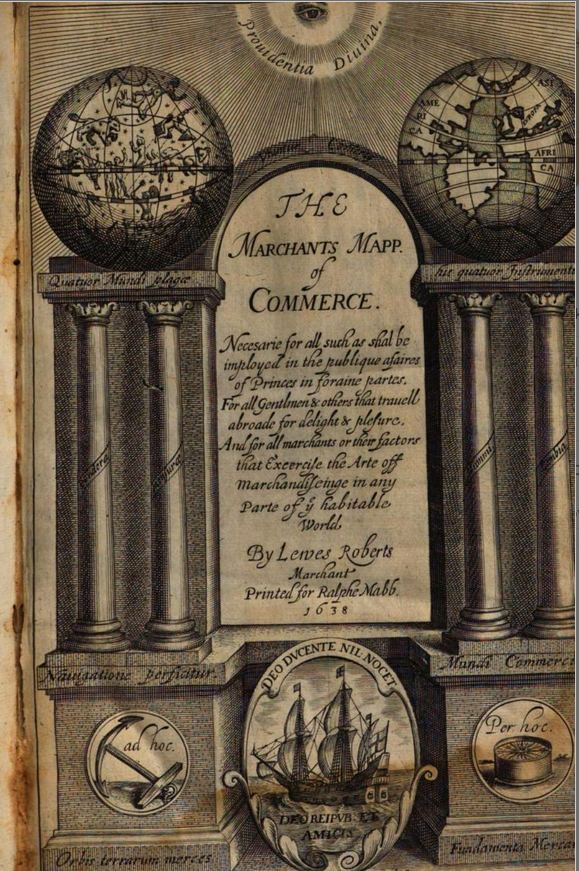
I’ve become engrossed this week by a book written in 1638 by the merchant Lewes Roberts — The Marchant’s Mappe of Commerce. It is, in effect, a guide to how to be a merchant, and an extremely comprehensive one too. For every trading centre he could gather information about, Roberts noted the coins that were current, their exchange rates, and the precise weights and measures in use. He set down the various customs duties, down even to the precise bribes you’d be expected to pay to various officials. In Smyrna, for example, Roberts recommended you offer the local qadi some cloth and coney-skins for a vest, the qadi‘s servant some English-made cloth, and their janissary guard a few gold coins.
Unusually for so many books of the period, Roberts was also careful to be accurate. He often noted whether his information came from personal experience, giving the dates of his time in a place, or whether it came second-hand. When he was unsure of details, he recommended consulting with better experts. And myths — like the rumour he heard that the Prophet Muhammad’s remains at Mecca were in an iron casket suspended from the ceiling by a gigantic diamond-like magnet called an adamant — were thoroughly busted. Given his accuracy and care, it’s no wonder that the book, in various revised editions, was in print for almost sixty years after his death. (He died just three years after publication.)
What’s most interesting about it to me, however, is Roberts’s single-minded view of English commerce. The entire world is viewed through the lens of opportunities for trade, taking note of the commodities and manufactures of every region, as well as their principal ports and emporia. A place’s antiquarian or religious tourist sites, which generally make up the bulk of so many other geographical works, are given (mercifully) short shrift. Indeed, because the book was not written with an international audience in mind, it also passes over many trades with which the English were not involved, or from which they were even excluded. It thus provides a remarkably detailed snapshot of what exactly English merchants were interested in and up to on the eve of civil war; and right at the tail end of a century of unprecedented growth in London’s population, itself seemingly led by its expansion of English commerce.
So, what did English merchants consider important? It’s especially illuminating about England’s trade in the Atlantic — or rather, the lack thereof.
Roberts spends remarkably little time on the Americas, which he refers to as the continents of Mexicana (North America) and Peruana (South America). Most of his mentions of English involvement are about which privateers had once raided which Spanish-owned colonies, and he gives especial attention to the seasonal fishing for cod off the coast of Newfoundland — a major export trade to the Mediterranean, and a source of employment to many English West Country farmers, who he refers to as being like otters for spending half their lives on land and the other half on sea.
But as for the recently-established English colonies on the mainland, which Roberts refers to collectively as Virginia, he writes barely a few sentences. Although he reproduces some of the propaganda about what is to be found there — no mention yet of tobacco by the way, with the list consisting largely of foodstuffs, forest products, tar, pitch, and a few ores — the entirety of New England is summarised only as a place “said to be” resorted to by religious dissenters. The island colonies on Barbados and Bermuda were also either too small or too recently established to merit much attention. To the worldly London merchant then, the New World was still peripheral — barely an afterthought, with the two continents meriting a mere 11 pages, versus Africa’s 45, Asia’s 108, and Europe’s 262.
The reason for this was that the English were excluded from trading directly with the New World by the Spanish. It was, as Roberts jealously put it, “shut up from the eyes of all strangers”. The Spanish were not only profiting from the continent’s mines of gold and silver, but he also complained of their monopoly over the export of European manufactures to its colonies there. It’s a striking foreshadowing of what was, in the eighteenth century, to become one of the most important features of the Atlantic economy — the market that the growing colonies would one day provide for British goods. Indeed, Roberts’s most common condemnation of the Spanish was for having killed so many natives, thereby extinguishing the major market that had already been there: “had not the sword of these bloodsuckers ended so many millions of lives in so short a time, trade might have seen a larger harvest”. The genocide had, in Roberts’s view, not only been horrific, but impoverished Europe too (he was similarly upset that the Spanish had slaughtered so many of the natives of the Bahamas, known for the “matchless beauty of their women”).
July 25, 2021
The plight of the Uyghurs in China
In this week’s excerpt from his full Weekly Dish, Andrew Sullivan considers the Chinese government’s ongoing suppression of the Uyghur minority:
There’s a story in a recent Atlantic memoir by a Uyghur refugee that lingers in the mind. The Chinese authorities in Xinjiang Province now regard the possession of any religious literature, including the Koran, as prima facie evidence of terroristic activities. Terrified Uyghurs in Urumqi, the regional capital, have learned these past few years to quickly dispose of any such items — some throwing out books into the streets overnight so they could not be traced to their households. But one old man in his seventies forgot about a Koran he had possessed, and, coming upon it late, was too scared to hand it over, so threw it into a river. Alas,
the authorities had installed wire mesh under all bridges, and when the mesh was cleaned, the Quran was found and turned over to the police. When officers opened it, they found a copy of the old man’s ID card: In Xinjiang, the elderly have a habit of keeping important documents in frequently read books, so that they are easily found when needed. The police tracked down the old man and detained him on charges of engaging in illegal religious activities. He was sentenced to seven years in prison.
The “prisons” this elderly, devout Muslim was shipped off to now have a capacity of around one million people. They have been built at breakneck speed. Buzzfeed News has found “more than 260 structures built since 2017 and bearing the hallmarks of fortified detention compounds.” The more recent building suggests they are going to become permanent parts of a bid to wipe Uyghur culture from the face of the earth.
The Atlantic story helps you understand how eerily reminiscent this campaign is to the early Nazi-era treatment of Jews, all the way down to the initial disbelief that the genocidal campaign was beginning, to the slow creeping oppression, the sudden new checkpoints and security procedures, the separation of Han and Uyghurs, knocks on the door at night, the attempts of some to escape without detection, and the sudden disappearances of friends, relatives, co-workers — never to be heard of again.
We cannot know for sure what happens inside the camps, but reports from survivors include torture, starvation, force-feeding, solitary confinement, and brainwashing. And in some ways, the entire region is now an open-air prison: security cameras are everywhere, the imprisoned are pressured to incriminate others, police go house to house searching for illicit materials, mosques and neighborhoods are razed, Uyghur language is banned, phones monitored, face recognition technology is ubiquitous. Family members, waiting for their turn to be arrested, leave notes like this one from a husband to his wife:
If they arrest me, don’t lose yourself. Don’t make inquiries about me, don’t go looking for help, don’t spend money trying to get me out. This time isn’t like any time before. They are planning something dark. There is no notifying families or inquiring at police stations this time … I’m not afraid of prison. I am afraid of you and the girls struggling and hurting when I’m gone. So I want you to remember what I’m saying.
It’s important to note that the concentration camps for Muslims in China are not extermination camps. (At least not yet. “They are planning something dark” is not a sentence one ever wants to read.) But it is the greatest, systematic detention of a religious minority since the Second World War, championed by a newly emerged dictator-for-life, Chinese President Xi. And it is not going to stop any time soon.
July 23, 2021
FDR Knew about Pearl Harbor?! – WW2 – Reading Comments
World War Two
Published 22 Jul 2021Here is another installment of Across the Airwaves where Indy and Sparty take the opportunity to directly address some of the comments left by our community. In this episode, we take a look at some of the more controversial comments left on our videos.
(more…)
Panic is infectious, and the dying media are a primary vector
In City Journal, John Tierney looks at the two lethal waves of contagion the world has suffered since 2019, the Wuhan Coronavirus itself and the media-driven panic that almost certainly resulted in far more deaths than the disease that triggered it:

Wuhan Institute of Virology.
Wikimedia Commons.
Instead of keeping calm and carrying on, the American elite flouted the norms of governance, journalism, academic freedom — and, worst of all, science. They misled the public about the origins of the virus and the true risk that it posed. Ignoring their own carefully prepared plans for a pandemic, they claimed unprecedented powers to impose untested strategies, with terrible collateral damage. As evidence of their mistakes mounted, they stifled debate by vilifying dissenters, censoring criticism, and suppressing scientific research.
If, as seems increasingly plausible, the coronavirus that causes Covid-19 leaked out of a laboratory in Wuhan, it is the costliest blunder ever committed by scientists. Whatever the pandemic’s origin, the response to it is the worst mistake in the history of the public-health profession. We still have no convincing evidence that the lockdowns saved lives, but lots of evidence that they have already cost lives and will prove deadlier in the long run than the virus itself.
One in three people worldwide lost a job or a business during the lockdowns, and half saw their earnings drop, according to a Gallup poll. Children, never at risk from the virus, in many places essentially lost a year of school. The economic and health consequences were felt most acutely among the less affluent in America and in the rest of the world, where the World Bank estimates that more than 100 million have been pushed into extreme poverty.
The leaders responsible for these disasters continue to pretend that their policies worked and assume that they can keep fooling the public. They’ve promised to deploy these strategies again in the future, and they might even succeed in doing so — unless we begin to understand what went wrong.
The panic was started, as usual, by journalists. As the virus spread early last year, they highlighted the most alarming statistics and the scariest images: the estimates of a fatality rate ten to 50 times higher than the flu, the chaotic scenes at hospitals in Italy and New York City, the predictions that national health-care systems were about to collapse. The full-scale panic was set off by the release in March 2020 of a computer model at the Imperial College in London, which projected that — unless drastic measures were taken — intensive-care units would have 30 Covid patients for every available bed and that America would see 2.2 million deaths by the end of the summer. The British researchers announced that the “only viable strategy” was to impose draconian restrictions on businesses, schools, and social gatherings until a vaccine arrived.
This extraordinary project was swiftly declared the “consensus” among public-health officials, politicians, journalists, and academics. Anthony Fauci, director of the National Institute of Allergy and Infectious Diseases, endorsed it and became the unassailable authority for those purporting to “follow the science”. What had originally been a limited lockdown — “15 days to slow the spread” — became long-term policy across much of the United States and the world. A few scientists and public-health experts objected, noting that an extended lockdown was a novel strategy of unknown effectiveness that had been rejected in previous plans for a pandemic. It was a dangerous experiment being conducted without knowing the answer to the most basic question: Just how lethal is this virus?
The most prominent early critic was John Ioannidis, an epidemiologist at Stanford, who published an essay for STAT headlined “A Fiasco in the Making? As the Coronavirus Pandemic Takes Hold, We Are Making Decisions Without Reliable Data.” While a short-term lockdown made sense, he argued, an extended lockdown could prove worse than the disease, and scientists needed to do more intensive testing to determine the risk. The article offered common-sense advice from one of the world’s most frequently cited authorities on the credibility of medical research, but it provoked a furious backlash on Twitter from scientists and journalists.
July 20, 2021
An unlikely survivor in India, His Highness the Prince of Arcot
Ned Donovan explains why there is still a Prince of Arcot, despite the Indian government having abolished all the titles and privileges of the nearly 600 “Maharajas, Maharanas, Rajas, Nawabs, Khans and so on” of the Princely states that were incorporated into modern India after Partition in 1947:
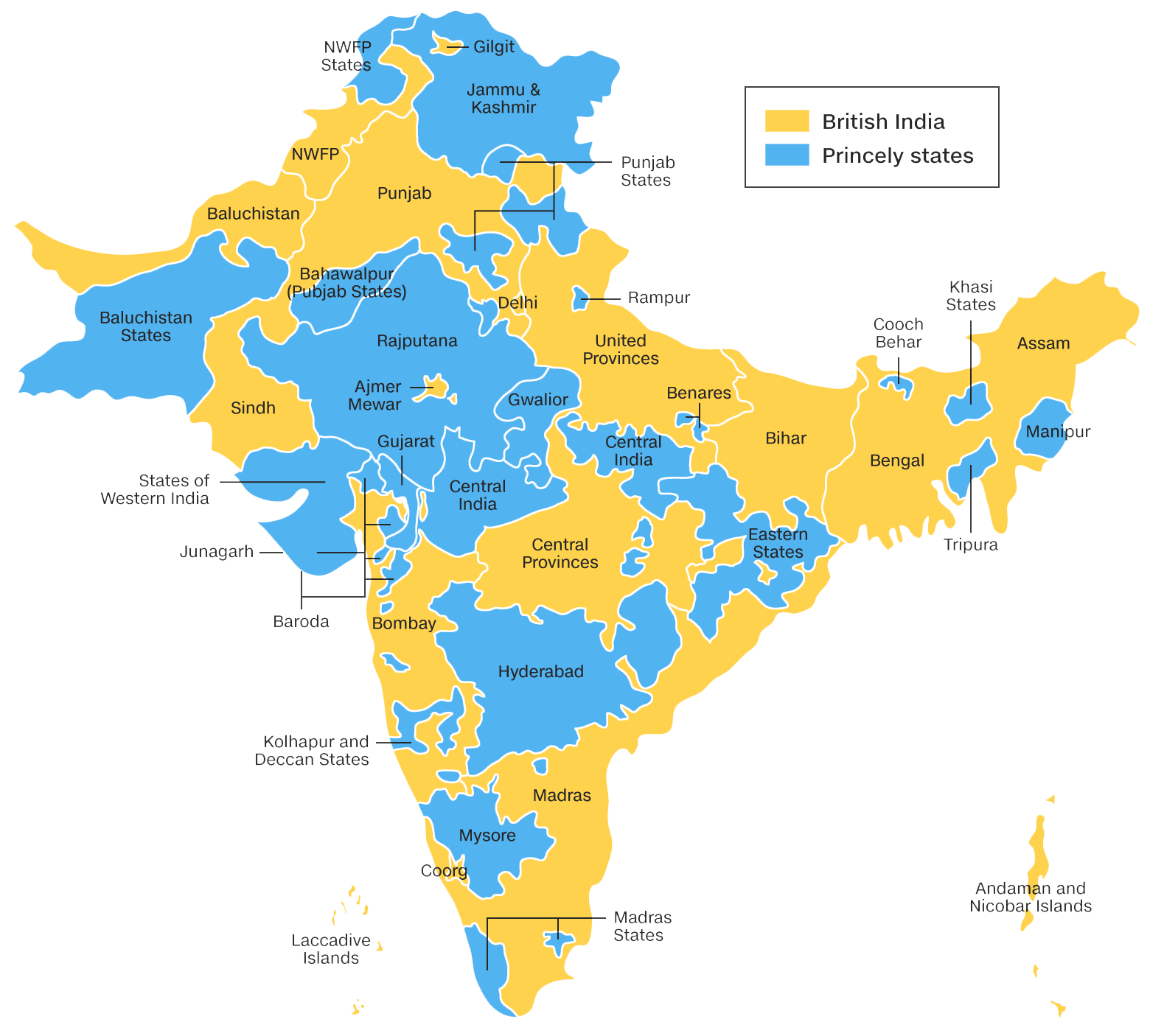
A significant amount of effort was taken during the process of independence to integrate these princely states into the newly independent countries. Almost all of the rulers acceded quickly and peacefully in return for recognition of their symbolic status and titles by the new republics who also promised perpetual large annual payments to sweeten the deal. A handful of princely states were stubborn and were integrated by force, with issues as a result to this day, such as Jammu and Kashmir.
As a result, for the first few decades of independent India, there existed a class of royals recognised within the republic, with privileges and financial support not that different to what they received during the period of British rule. But in 1971 this came tumbling down.
The then-Prime Minister Indira Gandhi amended the Indian Constitution to abolish all privileges and titles, along with any financial subsidies. She believed the whole system to be at odds with the secular socialist republic she was attempting to perfect. The move also had financial benefits: the large princely subsidies stopped being a drain on the Indian treasury while much of the royals’ gold and property were seized by the Government in the process. In 1972, Pakistan followed suit and similarly abolished its remaining princes’ titles.
But the title “Prince of Arcot” somehow escaped to carry on to the modern day … thanks to an unusual historical situation and the presentation of letters patent from Queen Victoria:
In 1855, the 13th Nawab of Arcot died without children. The British, influenced by the East India Company, declared the kingdom had lapsed as a result and annexed it entirely. As a token compensation, Queen Victoria in 1870 gave the last Nawab’s uncle a pension and the title of “His Highness the Prince of Arcot” for him and his descendants in perpetuity. This was granted in a type of royal charter, known as letters patent.
As there was no land still to rule, the Princes of Arcot existed in a strange realm of being kings without a kingdom but with significant influence and prestige. The title continued to pass down through the original holder’s family and they built a large palace, Amir Mahal, in Madras that became a centre of culture instead of one of government.
H/T to Colby Cosh for the link.
July 19, 2021
George Orwell: The Uncompromising Visionary
Biographics
Published 29 Nov 2019This video is #sponsored by NordVPN.
Credits:
Host – Simon Whistler
Author – Morris M
Producer – Jennifer Da Silva
Executive Producer – Shell HarrisBusiness inquiries to biographics.email@gmail.com
Source/Further reading:
Britannica’s Orwell Bio: https://www.britannica.com/biography/…
Excellent, very informative ONDB biography (paywall for non-UK users. UK users need only enter library card number to access): https://www.oxforddnb.com/view/10.109…
Spanish civil war: https://encyclopedia.ushmm.org/conten…
https://www.history.com/this-day-in-h…
Orwell’s mistakes on the Spanish Civil War: https://www.theguardian.com/books/201…
Orwell at the BBC: https://www.bbc.com/news/entertainmen…
July 15, 2021
QotD: Macaulay’s prescription for ruling India
Macaulay was arguing that British Government should spend money on educating those it found under its rule. So it came to be as Britain ruled over the most heavily-populated and most valued part of its empire for another century.
Jawaharlal Nehru, the Prime Minister who led India to independence from Britain, studied at Trinity College, Cambridge, and at the Inner Temple, and was closely connected to the Fabian Society. Nehru’s rival, Muhammad Ali Jinnah, the founder of Pakistan, studied law at the Lincoln’s Inn, and was strongly influenced by English utilitarianism and French positivism. Nehru was an agnostic who requested a secular burial (this was denied him), while Jinnah was a gin-drinker whose religious attachments were more a matter of identity than belief.
Nehru and Jinnah led India and Pakistan to independence as the brown-skinned Westerners Thomas Macaulay had envisioned a century earlier. South Asian in appearance and pedigree, the leaders of these two nations nevertheless personified a fundamental truth about the Western orientation of the new Asian states. Pakistan was aligned with the United States, while socialist India was nominally non-aligned but clearly tilted toward the Soviet bloc. Though the populace of these nations were mostly illiterate, poor and detached from the cosmopolitan currents of the world, their elites were integrated among the English-speaking peoples. Nehru’s daughter, Indira Gandhi, attended Somerville College, Oxford. His grandson, Rahul Gandhi, whose mother is Italian, studied at Harvard and Trinity College.
Razib Khan, “Why the West lost India’s culture wars”, UnHerd, 2021-04-13.
July 13, 2021
Is the PRC really a paper dragon?
Sarah Hoyt is tired of finding posts on MeWe that fluff up the ChiComs as a way of “conservatives” scoring points against “progressives” in the US political context:
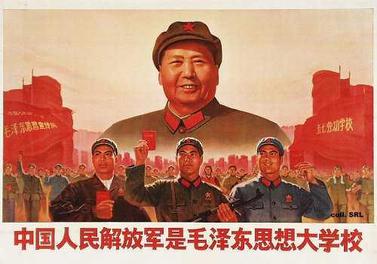
“The Chinese People’s Liberation Army is the great school of Mao Zedong Thought”, 1969.
A poster from the Cultural Revolution, featuring an image of Chairman Mao, published by the government of the People’s Republic of China.
Image via Wikimedia Commons.
What bilge? Oh, memes extolling the Chinese in relation to us. And all conservatives pick this crap up and echo it, because it happens to “side rail” against things they hate (and which it’s valid to hate.)
But the memes are crap. The aggrandizing of the Chinese bastards is crap. They’re either outright lies or laughable lies. And the memes, somehow, never hit the Chinese where it hurts: the fact their economy is so f*cked most of their people live like Medieval peasants; the fact their army of little emperors cried when they went up against India; the fact that they are having trouble feeding their own population; the crumbling empty cities they think are “investments”; their population collapse; Xi’s pretensions to world leadership; their slave camps. Which you know, tells you exactly where the meme factory is and who is propagating it.
The problem being when conservatives seize the memes and distribute, they are actively collaborating in the aggrandizing of China and putting down the US. They are also convincing the Chinese their victory over us will be easy. (This is good and bad, but if you have friends and relatives in large cities, think about the chances of it ending up with one of those catching a nuke because the idiots get cocky, okay?)
Chinese are masters of propaganda and psychological warfare, while Americans are so bad at it that it hurts. If you loved 2020 keep collaborating with the enemy.
If not, listen up:
Yeah, sure, the fact that the usurpers of our governmental institutions are making our armed forces participate in inclusivity and CRT training, and prioritizing bullshit SJW goals over preparedness IS a problem. But that doesn’t mean we’re not still the best fighting force in the world. Sure, it’s damning with faint praise, but comparing us to China and saying they’re “prepared for war” and “will win” is bullshit. You know it’s bullshit, I know it’s bullshit. It’s bullshit so rank I can smell it through the internet.
The Chinese have Little Emperors — single descendants of multiple families — who are no more prepared to risk themselves in war than I’m prepared to fly unassisted. Their army is bullshit.Why is it bullshit? Because they don’t have a fighting force. The only fighting strength they ever had was the ability to submerge any enemy in a wave of people. But they can’t. Because the communists destroyed that too.
Their weapons are bullshit. I’d like independent confirmation of their “achievements in space”. Why? Because, well, the USSR achievement in space was a) what they could steal from us b) flimsy and c) mostly trumped up. In the sense that they only publicized their wins, while it might be one in ten that succeeded.
Look, by definition an authoritarian regime sucks at tech. I’m not saying anything about “capabilities of the people” (duh) but seriously? If you can’t report failed experiments, failed assemblies or builds that need to be improved, you’re going to have crappy tech. And you can’t report any of that, because in a centralized authoritarian regime you’ll be punished for failure, even if it’s not your fault. And you might get accused of doing it on purpose.
When nothing less than 100% success is allowed, the process is corrupt and the result is excrement. (Look at our “science” right now. No, seriously. We’re sliding that way.)
So, no matter how made you are at what the army and our government is doing, stop echoing Xi’s bullshit. And counter it every time you see it. This is war by other means, or in the ancient Chinese tradition, softening the enemy so they’ll surrender at first attack.
Japanese Armour Doctrine, 1918-1942
The_Chieftain
Published 11 Jul 2021Sources include:
Japanese tanks and armoured Warfare 1932-45, David McCormack
WW2 Japanese Tank Tactics, Gordon Rottmen, Akira Takizawa
Japanese Tanks, Tactics and anti-tank weapons, Donald McLean
Type 89 and Tankette books, Kazunori YoshikawaContinuing on this series of videos supporting the WW2 Channel, I look at what I can find about how the Japanese thought of tanks and their usage, tempered by quite a bit of combat experience.
Improved-Computer-And-Scout Car Fund:
Patreon: https://www.patreon.com/The_Chieftain
Direct Paypal https://paypal.me/thechieftainshat

July 12, 2021
Shooting the Ishapore MkIII Vickers-Berthier LMG
Forgotten Weapons
Published 20 Sep 2017http://www.patreon.com/ForgottenWeapons
Cool Forgotten Weapons merch! http://shop.bbtv.com/collections/forg…
The Vickers-Berthier MkIII was adopted by the Indian army in 1933, and served through World War Two and into the 1970s (at least). It is chambered for the standard .303 British cartridge, fires from an open bolt, and uses top-mounted 30-round magazines. I didn’t know exactly what to expect when I had the chance to fire this one — and it turned out the be an excellent experience.
The rate of fire on the Vickers-Berthier is relatively low, and I found it to be an exceptionally stable and controllable gun to fire from its bipod. I don’t know if it’s the unusual muzzle brake design or other factors as well, but the sight picture remains stable and clear in a way that few other LMGs have matched in my experience.
Thanks to Marstar for letting me examine and shoot their Vickers-Berthier!
If you enjoy Forgotten Weapons, check out its sister channel, InRangeTV! http://www.youtube.com/InRangeTVShow

July 11, 2021
History and Disassembly of the Vickers-Berthier MkIII LMG
Forgotten Weapons
Published 19 Sep 2017http://www.patreon.com/ForgottenWeapons
Cool Forgotten Weapons merch! http://shop.bbtv.com/collections/forg…
The Vickers-Berthier was initially designed by Andre Berthier in France prior to World War One. It went through a number of substantial design changes before the war, and was actually ordered in quantity by the United States right at the end of WWI — but the order was cancelled with the armistice. In the 1920s, Berthier sold the design to the Vickers company in England, which wanted a light machine gun to market alongside its Vickers heavy machine gun.
When the British military decided to replace its Lewis and Hotchkiss light machine guns, the Vickers-Berthier was one of the leading contenders, although in the endurance trials it was edged out by the Czech ZB-33, which would ultimately be adopted as the Bren. However, the Indian Army opted to take the Vickers-Berthier, and it was put into production at the Ishapore Rifle Factory and saw substantial use in World War Two.
Mechanically, the Vickers-Berthier is a tilting bolt design with a long stroke gas piston. It has a thorough set of covers over the magazine well and ejection port, and a relatively slow rate of fire. The barrel is quick-changeable, and it feeds from top-mounted 30-round magazines, with an aperture type rear sight being offset to the left side of the gun to clear the magazine.
Thanks to Marstar for letting me examine and shoot their Vickers-Berthier!
If you enjoy Forgotten Weapons, check out its sister channel, InRangeTV! http://www.youtube.com/InRangeTVShow