
The Korean War by Indy Neidell
Published 21 Feb 2025Millions of Chinese served in the Korean War, but until very recently the People’s Liberation Army was by no means the only army in China. A lot has changed in this country in a very short time, with tens of millions of deaths in World War Two, and a brutal civil war that has raged both before and afterwards. How did the PLA become what it is today, and what became of Mao Zedong’s old adversaries?
(more…)
February 22, 2025
The Grim Fate of the Chinese Army – a Korean War Special
Comments Off on The Grim Fate of the Chinese Army – a Korean War Special
February 20, 2025
Retaking Burma with the Fourteenth Army in 1945
Dr. Robert Lyman discusses the start of the campaign to reconquer Burma from the Japanese led by Lieutenant General Bill Slim and the Fourteenth Army:
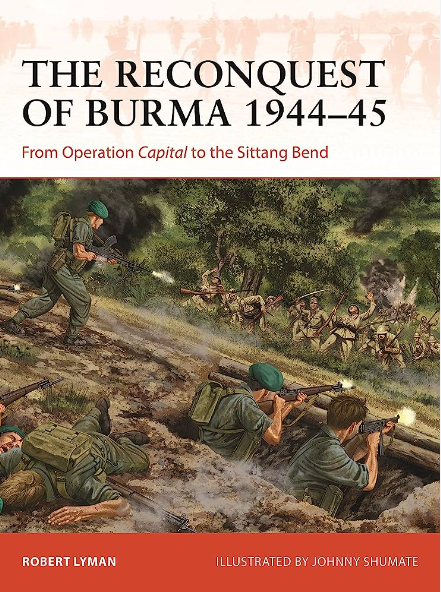
Why Burma? Because in Burma in 1945 a series of marvellous military miracles (is there a synonym starting with “m” for concatenation?) engineered by General Bill Slim and his mighty 14th Army, broke the back of the Japanese Burma Area Army and smashed forever Tokyo’s dreams of an empire in South East Asia. 1945 is worth celebrating!
Even today, few people are aware of just how dramatic these events were, and just how spectacular was the victory wrought by the Indian, British, African, US and Chinese forces in the country.
Indeed, at the start of 1945 few people would have predicted the extraordinary outcome of the developing campaign. If Lieutenant General Sir Bill Slim (he had been knighted by General Archibald Wavell, the Viceroy, the previous October, at Imphal) had been asked in January 1945 to describe the situation in Burma at the onset of the next monsoon period in May, I do not believe that in his wildest imaginings he could have conceived that the whole of Burma was about to fall into his hands. After all, his army wasn’t yet fully across the Chindwin. Nearly 800 miles of tough country with few roads lay before him, not the least the entire Burma Area Army under a new commander, General Kimura. The Arakanese coastline needed to be captured too, to allow aircraft to use the vital airfields at Akyab as a stepping stone to Rangoon. Likewise, I’m not sure that he would have imagined that a primary reason for the success of his Army was the work of 12,000 native levies from the Karen Hills, under the leadership of SOE, whose guerrilla activities prevented the Japanese from reaching, reinforcing and defending the key town of Toungoo on the Sittang river. It was the loss of this town, more than any other, which handed Burma to Slim on a plate, and it was SOE and their native Karen guerrillas which made it all possible.
Crossing the Irrawaddy
(Victoria State Archives)The potential of a Karenni-based resistance raised the possibility, long argued by old Burma hands, of a British armed and trained fifth column operating behind Japanese lines for the purpose of gathering battlefield intelligence and undertaking limited guerrilla action. Slim had long complained about the poor quality of the battlefield intelligence (as opposed to the signals intelligence, about which he was well provided) that he and his Corps commanders received. He was concerned, among other things, about knowing “what was on the other side of the hill”, the product of information provided – where it existed – by effective combat (ground and air) reconnaissance. There was no shortage of organisations attempting to assist in this task – at least twelve – but their coordination was poor and most reported to SEAC or parts of India Command, rather than to 14 Army. Slim dismissed most of these as “private armies” which offered no real help to the task of defeating the enemy on the battlefield. One of the groups, part of Force 136 (i.e. Special Operations Executive, or SOE), which had operated in front of 20 Indian Division along the Chindwin between 1943 and early 1944 under Major Edgar Peacock (and thus known as “P Force”) did sterling work with local Burmese and Karen agents reporting on Japanese activity facing 4 Corps. Persuaded that similar groups working among the Karens in Burma’s eastern hills – an area known as the Karenni States – could achieve significant support for a land offensive in Burma, Slim (to whom Mountbatten transferred responsibility for Force 136 in late 1944 for this purpose) authorised an operation to the Karens. Its task was not merely to undertake intelligence missions watching the road and railways between Mandalay and Rangoon, but to determine whether they would fight. If the Karens were prepared to do so, SOE would be responsible for training and organising them as armed groups able to deliver battlefield intelligence directly in support of the advancing 14 Army. The resulting operation – Character – was so spectacularly successful that it far outweighed what had been achieved by Operation Thursday the previous year in terms of its impact on the course of military operations in pursuit of the strategy to defeat the Japanese in the whole of Burma. It has been strangely forgotten, or ignored, by most historians ever since, drowned out perhaps by the noise made by the drama and heroism of Operation Thursday, the second Chindit expedition. Over the course of Operation Extended Capital some 2,000 British, Indian and Burmese officers and soldiers, along with 1,430 tons of supplies, were dropped into Burma for the purposes of providing intelligence about the Japanese that would be useful for the fighting formations of 14th Army, as well as undertaking limited guerrilla operations. As historian Richard Duckett has observed, this found SOE operating not merely as intelligence gatherers in the traditional sense, but as Special Forces with a defined military mission as part of conventional operations linked directly to a strategic outcome. For Operation Character specifically, about 110 British officers and NCOs and over 100 men of all Burmese ethnicities, dominated interestingly by Burmans (which now also included 3-man Jedburgh Teams) mobilised as many as 12,000 Karens over an area of 7,000 square miles to the anti-Japanese cause. Some 3,000 weapons were dropped into the Karenni States. Operating in five distinct groups (“Walrus”, “Ferret”, “Otter”, “Mongoose” and “Hyena”) the Karen irregulars trained and led by Force 136, waited the moment when 14 Army instructed them to attack.

Comments Off on Retaking Burma with the Fourteenth Army in 1945
February 19, 2025
The Korean War 035 – The Battle of Chipyong-ni – February 18th, 1951
The Korean War by Indy Neidell
Published 18 Feb 2025Chinese Commander Peng Dehuai has launched his 4th Phase Offensive, pushing the UN forces back in the center of Korea, and should his forces take Chipyong-ni, they will compromise the entire UN position. Chipyong-ni must hold!
Chapters
00:00 Intro
00:50 Recap
01:21 4th Phase Offensive
03:07 Retreat from Hoengsong
06:27 Chipyong-Ni Must Hold!
08:50 First Relief Attempt
10:22 The Battle of Chipyong-Ni
15:34 Battle Side Notes
17:36 29th Brigade
19:36 Summary
19:59 Conclusion
(more…)
Comments Off on The Korean War 035 – The Battle of Chipyong-ni – February 18th, 1951
February 17, 2025
France Starts the Vietnam War – W2W 005
TimeGhost History
Published 16 Feb 2025In 1946, tensions in Indochina explode into full-scale war. As France struggles to reclaim its empire, Ho Chi Minh’s Viet Minh fight for independence, setting the stage for a brutal conflict that will shape the next three decades. With international powers pulling the strings, Vietnam becomes the first battleground of the post-war era’s colonial struggles.
(more…)
Comments Off on France Starts the Vietnam War – W2W 005
The growing problem of “America’s hat”
John Carter’s latest post is excellent — but that’s his usual standard — but it’s of particular interest to inhabitants of what used to be the proud Dominion but who now live in a “post-national state” with “no core identity” as our outgoing prime minister so helpfully explained it:

Canada and the US have been frenemies for most of the last two hundred years. With the exception of some spats in the 19th century, they’ve fought on the same side in all major wars, and haven’t taken up arms against one another. At the same time, Canada has from the very beginning fiercely guarded its independence. Through the 1950s, this came from Canada’s self-conception as an outpost of sober, orderly British traditionalism, in stark contrast to the chaotic liberal revolutionaries across the border. Following the Liberal Party’s cultural revolution in the 1960s, Canada increasingly came to see itself as different from the US primarily in that it was more liberal, in the modern sense, than it’s Bible-thumping, gun-toting redneck cousins – which is to say more socialist, leftist, multicultural, gay-friendly, internationalist, feminist, and so forth. In fairness to Canada, the British government, having long-since fallen under the sway of the Labour party, had followed the same ideological trajectory, so Canada was really just taking its cue from Mother England as it always had. In further fairness to Canada, all of this has been aggressively pushed by Blue America, which has been running American culture (and therefore everyone else’s) until about five minutes ago.
Despite these differences, the US could always rely on Canada being a stable, competently run, prosperous, and happy neighbour – perhaps a bit on the prickly side, given the inferiority complex, but much less of a headache than the entropic narcostate to the south that keeps sending its masses of illiterate campesinos flooding over the banks of the Rio Grande. Canada might be annoying sometimes, but it didn’t cause problems. To the contrary, Canada and the US have maintained one the world’s most productive trading relationships for years: America gets Canadian oil, minerals, lumber, and Canada gets US dollars, technology, and culture.
Now, however, Canada has become a problem for America. Not yet, perhaps, the biggest problem – America has a very large number of extremely pressing problems – but a significant one nonetheless, with the potential to become quite acute in the near future.
The problem is that Canada has become a security threat.
[…]
The next security problem is the border, an issue which Trump has repeatedly stressed as a justification for tariffs. The 49th Parallel is famously the longest undefended border on the planet. It is much longer than the Southern border; there are no barbed wire border fences; most of the terrain is easily traversed – forest, lake, or prairie – in contrast to the punishing desert running across the US-Mexico border. Militarizing the US-Mexico border is already a huge, costly undertaking. Doing the same on the Canadian border would be vastly more challenging.
Canada’s extraordinarily lax immigration policy has, in recent years, led to a much higher encounter rate at border crossings with suspects on the terrorism watch list. These people come into Canada legally, part of the millions of immigrants Ottawa has been importing, every year, for the last few years. When you’re bringing in over one percent of your country’s population every single year, it is simply not possible to properly vet them, and it seems that Ottawa barely even bothers to try. Given that not every such person of interest will get stopped at the border, and that not every terrorist is on a watch list, one wonders how many enemies have already slipped across into the US by way of Canadian airports.
RCMP officers with their haul from a fentanyl superlab. Only one person was arrested.
The second border problem is fentanyl. Like the US, Canada has a raging opiod epidemic. We’ve got tent cities, zombies in the streets, needles in the parks, and this is not limited to the big cities – it spills out into the small towns, as well. Like Mexico, Canada has fentanyl laboratories. Precursor chemicals are imported from China by triads, turned into chemical weapons in Canadian labs, and then distributed within Canadian and American markets by predominantly Indian truckers. The occasional busts have turned up vast quantities of the stuff, but have resulted in very few arrests. The proceeds are then laundered through casinos or fake colleges, with the laundered cash then parked in Canadian real estate. There are estimates that the volume of fentanyl money flowing through Canada’s housing markets is significant enough to be a major factor (immigration is certainly the main factor) distorting real estate prices – keeping the housing bubble inflated, propping up Canada’s sagging economy, and pricing young Canadians out of any hope of owning a home or, for that matter, even renting an apartment without a roommate or three.
It’s generally understood, though essentially never acknowledged at official levels, that poisoning North America with opiods is deliberate Chinese policy, both as revenge for the Opium Wars of the 19th century, and as one element in their strategy of unrestricted warfare i.e. the covert but systematic weaponization of every point of contact – economic, industrial, cultural, etc. – between Chinese and Western societies. By allowing the fentanyl trade to continue, the Canadian government is complicit in an act of covert war being waged by a foreign power, one whose casualties include the Canadian government’s own population.

Comments Off on The growing problem of “America’s hat”
Forgotten War Ep 9 – Kohima – Hell in the Hills
HardThrasher
Published 16 Feb 2025The Battle of Kohima.
Please consider donations of any size to the Burma Star Memorial Fund who aim to ensure remembrance of those who fought with, in and against 14th Army 1941–1945 — https://burmastarmemorial.org/
(more…)
Comments Off on Forgotten War Ep 9 – Kohima – Hell in the Hills
February 13, 2025
From Ruins to Recovery: The Fight to Rebuild – W2W 004
TimeGhost History
Published 12 Feb 2025In 1946, the world is struggling to rebuild from the devastation of WWII. Cities lie in ruins, economies are shattered, and millions are displaced. As the old powers of Britain and France weaken, the rising superpowers — the U.S. and USSR — compete to shape the new world order. Will reconstruction lead to stability, or is the world heading for another conflict?
(more…)
Comments Off on From Ruins to Recovery: The Fight to Rebuild – W2W 004
February 12, 2025
The Korean War 034 – Four Chinese Armies Target Wonju – February 11, 1951
The Korean War by Indy Neidell
Published 11 Feb 2025The anticipated Chinese counterattack begins to take shape. Chinese commander Peng Dehuai and US 8th Army Commander Matt Ridgway both know the significance of what comes next. These next days will decide the future of the Korean Peninsula. UN troops dig in, and Chinese troops prepare to advance. The time is now, and the stakes have never been higher.
(more…)
Comments Off on The Korean War 034 – Four Chinese Armies Target Wonju – February 11, 1951
February 6, 2025
Forgotten War Ep 8 – Imphal 44 Pt2 – Edge of Chaos
HardThrasher
Published 4 Feb 2025A video discussing the Battles of Imphal and Kohima at the start of 1944.
Please consider donations of any size to the Burma Star Memorial Fund who aim to ensure remembrance of those who fought with, in and against 14th Army 1941–1945 — https://burmastarmemorial.org/
(more…)
Comments Off on Forgotten War Ep 8 – Imphal 44 Pt2 – Edge of Chaos
February 5, 2025
The Korean War 033 – A Deadly Game: China & US Both Attack! – February 4, 1951
The Korean War by Indy Neidell
Published 4 Feb 2025The fate of the Korean Peninsula stands on a knife edge as Peng Dehuai’s mighty armies gear up to make their move. The US 8th Army continues to push towards Seoul, now backed up by Edward Almond’s 10th Corps to the east. Violent clashes towards the end of the week confirm what both sides already suspect: a great battle is coming, and in this deadly game of thrust and riposte, there can be but one victor.
Chapters
00:00 Intro
00:47 Recap
01:02 Thunderbolt Continued
06:47 All’s Well That Ends Well
11:38 The Twin Tunnels
15:49 Conclusion
(more…)
Comments Off on The Korean War 033 – A Deadly Game: China & US Both Attack! – February 4, 1951
February 3, 2025
A New World Order – War 2 War 01 – Q4 1945
TimeGhost History
Published 1 Feb 2025World War Two is over. The anti-Axis alliance has promised that their victory shall usher in a time of peace, stability, and freedom. They have pledged to uphold new values of humanity, tolerance, solidarity, and the right to self determination. Have they spoken the truth or has it been a string of lies all along?
(more…)
Comments Off on A New World Order – War 2 War 01 – Q4 1945
February 1, 2025
China produced DeepSeek, Britain is mired in deep suck
In the Sean Gabb Newsletter, Sebastian Wang discusses the contrast between China’s recent release of the DeepSeek AI platform that appears to be eating the collective lunches of the existing LLM products by US firms and the devotion of the British Labour government to plunge ever deeper into their Net Zero dystopian vision:

Net Zero image from Jo Nova
For those few readers who may be unaware, DeepSeek is an advanced open-source artificial intelligence platform developed in China. Released in late 2024, it has set a new standard in AI, outperforming American counterparts in adaptability and capability. It excels in natural language processing, machine learning, and data analysis, and — critically — it is open source. Unlike the proprietary models that dominate the American tech landscape, DeepSeek allows anyone to adapt, improve, and use it as he sees fit. It’s not just a technological triumph for China; it’s a serious challenge to American domination of information technology and an opportunity for those who want to break free from the stranglehold of Silicon Valley.
As a Chinese person, I take pride in this achievement. It’s a testament to what my people can achieve with focus and ambition. But my concern is less about taking pride in what China has done and more about lamenting how little Britain has contributed to this revolution. Britain, the birthplace of the Industrial Revolution, seems to have no place in this new world of AI-driven progress. The question is why?
The answer is simple: The people who rule Britain have chosen decline. Crushing taxes on income and capital gains, and inheritance taxes, punish those who want to create wealth. Endless regulations stifle ambition, making it easier to conform than to innovate. Worst of all, there are the net zero policies, which have made energy costs the highest in the world, making electricity unaffordable and unreliable. Industries that depend on energy have been priced out of existence, and the dreamers and doers who might have built the next DeepSeek are being ground down by a system designed to reward mediocrity.
Net zero is not a noble goal born of misconception; it’s a disaster by design. It’s a wealth transfer scheme that takes from ordinary working people and hands billions to a small clique of green profiteers. The winners are the wind farm builders, the financiers running opaque carbon trading schemes, and the activists cashing in on government handouts. The losers are everyone else — families struggling to pay energy bills, businesses forced to close, and an entire country left unable to compete.
Compare this to China. DeepSeek wasn’t luck — it was the product of a system that rewards innovation. Electricity in China is cheap and reliable. Regulations focus on enabling progress, not blocking it. Ambition is celebrated, not treated as a threat. The ruling class there, for all its many and terrible faults, understands the value of creating wealth and technological self-reliance. Britain’s ruling class, by contrast, has abandoned the idea of building anything. They’d rather sit in the City of London, counting money made elsewhere, than see industry and innovation flourish in the country at large. They have chosen decline — not for them, but for us.
Comments Off on China produced DeepSeek, Britain is mired in deep suck
January 29, 2025
The Korean War 032 – Thunderbolt! US Troops Go On the Offensive – January 28, 1951
The Korean War by Indy Neidell
Published 28 Jan 2025Peng Dehuai’s armies rest and recuperate on the banks of the Han River, nursing their supply issues, and the initiative has firmly swung in favor of the UN side. The North Koreans in the east are fleeing, and Matt Ridgway’s latest offensive in the west gets underway without a hitch. Are we about to see yet another reversal of fortune and pursuit up the Korean Peninsula?
Chapters
00:00 Intro
01:11 Recap
01:33 An Aggressor Nation?
07:38 Chinese Sit-Rep
10:59 Operation Thunderbolt
14:56 Summary
15:14 Conclusion
(more…)
Comments Off on The Korean War 032 – Thunderbolt! US Troops Go On the Offensive – January 28, 1951
January 26, 2025
Imperial reparations to India are not economically or historically realistic
Apparently the idea of demanding financial reparations from Britain has once again become a talking point among India’s chattering classes. In The Critic, Tirthankar Roy explains why the basis for the demands do not meet economic or historic criteria necessary for the demands to be justified:

The State Entry into Delhi – Leading the 1903 Delhi durbar parade, on the first elephant, “Lakshman Prasad”, the Viceroy and Vicereine of India, Lord and Lady Curzon. Their elephant was lent by the Maharaja of Benares. On the second elephant, “Maula Bakhsh”, the Duke and Duchess of Connaught representing the British royal family. Their elephant lent by the Maharaja of Jaipur. There were 48 elephants of the Main Procession, shown winding its way past the north side of the Jama Masjid.
Painting by Roderick MacKenzie from the Bristol City Museum and Art Gallery via Wikimedia Commons.
Oxfam, in its report “Takers not Makers” claims that imperialist Britain “extracted” $85 trillion from India, “enough to carpet London with £50 notes” four times over. Oxfam took this number from calculations others have done before. The origin of the claim goes back to Dadabhai Naoroji writing 125 years ago, who called the outflow drain. Oxfam uses the number to support a modern movement: a case for reparations that Britain should pay India. With British public finances in a rut, the report’s timing is not ideal. But how good is the case?
[…]
Why did Chaudhuri say drain was “confused” economics? The figure of $85 trillion builds on three bases. First, in the 1760s, as the East India Company started sharing the governance of Bengal with the Nawab’s regime, a part of the taxes of Bengal was used to fund business investment (export of textiles). Second, in the nineteenth century, Indian taxes were used to fund an army that fought imperialist wars to no benefit of India. Third, India maintained an export surplus, which went to fund payments to Britain on mainly four heads: debt service, railway guarantees, pensions to expatriate officers, and repatriated profits on private investment. Naoroji said that these outflows were payment without benefit to India, a drain, and happened because India was a colony. Did he discount the benefits of these transactions?
The Company was a body of merchants who became kingmakers between 1757 and 1765, resulting in a government in Bengal where private and public interests often conflicted. No one knows how serious the conflict was since the Nawab was a partner in the rule. No matter, the case that tax was used for commerce is weak. Within a few years after the transition, the Parliament started taking control of Indian governance, which meant refusing to fund business with taxes. By 1805, the process was complete when Governor Cornwallis declared that “the duties of territorial government [would take] the place of buying and selling”. In between, public finance data are so patchy that it is impossible to find out how much of the Company’s commercial investment was funded by a budgetary grant, borrowings, and profits.
What is the big deal anyway? The Company’s investment of $60 million around 1800 was a tiny 0.06% of India’s GDP. Its textile business generated employment and externalities in India. And the real drain was not the export, but the profits upon exports. We are dealing with an almost invisible transaction, so small it was.
Consider the criticism of the army. British Indian budget, the argument went, paid for the Indian army, which fought wars beyond Indian borders, a subsidy Indian taxpayers paid to the Empire. This claim misreads what the land army really did. The reason it was very big and funded by India was that it was a deterrent to potential conflict amongst the 550 princely states. Interstate conflicts claimed enormous human and economic cost in the late-eighteenth century. The army ended that and effectively subsidised the defences of the princely states. Similarly, the British state subsidised Indian naval capability. Until World War I, the deployment of the army beyond India caused little controversy. The army protected the huge diaspora of Indian merchants and workers. Without the empire’s military might, we would not get Indians doing business in Hong Kong, Aden, Mombasa, or Natal. The War changed the benefit-cost estimates, and in the 1920s, the arrangement ended.
The third point, that export surplus was drain, is the most bizarre. India normally had a commodity export surplus, in effect payment for services purchased by India from Britain. Naoroji thought this was a waste of money. His followers insisted it was. But these claims follow no economic logic. No economics in the world will tell us that an outflow makes a country poor. That assessment depends on what value the payment creates at home. In activist history, there is no discussion of the value, because there is no acknowledgement there could be a value.
Comments Off on Imperial reparations to India are not economically or historically realistic
January 23, 2025
The Google of the early modern era
Ted Gioia compares the modern market power of the Google behemoth to the only commercial enterprise in human history to control half of the world’s trade — Britain’s “John Company”, or formally, the East India Company which lasted over 250 years growing from an also-ran to Dutch and Portuguese EICs to the biggest ever to sail the seas:
No business ever matched the power of the East India Company. It dominated global trade routes, and used that power to control entire nations. Yet it eventually collapsed — ruined by the consequences of its own extreme ambitions.
Anybody who wants to understand how big businesses destroy themselves through greed and overreaching needs to know this case study. And that’s especially true right now — because huge web platforms are trying to do the exact same thing in the digital economy that the East India Company did in the real world.
Google is the closest thing I’ve ever seen to the East India Company. And it will encounter the exact same problems, and perhaps meet the same fate.
The concept is simple. If you control how people connect to the economy, you have enormous power over them.
You don’t even need to run factories or set up retail stores. You don’t need to manufacture anything, or create any object with intrinsic value.
You just control the links between buyers and sellers — and then you squeeze them as hard as you can.
That’s why the East India Company focused on trade routes. They were the hyperlinks of that era.
So it needed ships the way Google needs servers.
The launch of the massive East India merchant ship, the Edinburgh — which brought tea from China.
The seeds for this rapacious business were planted when the British captured a huge Portuguese ship in 1592. The boat, called the Madre de Deus, was three times larger than anything the Brits had ever built.
But it was NOT a military vessel. The Portuguese ship was filled with cargo.
The sailors couldn’t believe what they had captured. They found chests of gold and silver coins, diamond-set jewelry, pearls as big as your thumb, all sorts of silks and tapestries, and 15 tons of ebony.
The spices alone weighed a staggering 50 tons — cinnamon, nutmeg, cloves, pepper, and other magical substances rarely seen in British kitchens.
This one cargo ship represented as much wealth as half of the entire English treasury.
And it raised an obvious question. Why should the English worry about military ships — or anything else, really — when you could make so much money trading all this stuff?
Not long after, a group of merchants and explorers started hatching plans to launch a trading company — and finally received a charter from Queen Elizabeth in 1600.
The East India Company was now a reality, but it needed to play catchup. The Dutch and the Portuguese were already established in the merchant shipping business.
By 1603, the East India Company had three ships. A decade later that had grown to eight. But the bigger it got, the more ambitious it became.
The rates of return were enormous — an average of 138% on the first dozen voyages. So the management was obsessed with expanding as rapidly as possible.
They call it scalability nowadays.
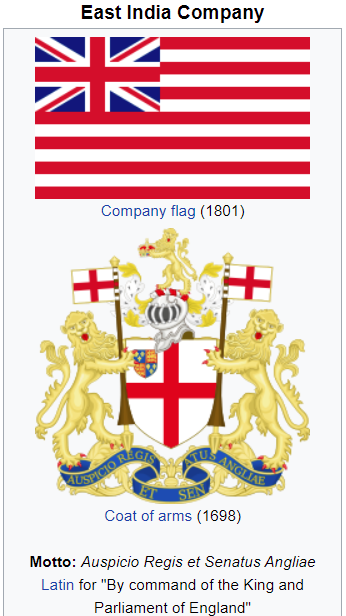
But even if they dominated and oppressed like bullies, these corporate bosses still craved a veneer of respectability and legitimacy — just like Google’s CEO at the innauguration yesterday. So the company got a Coat of Arms, playacting as if it were a royal family or noble clan.

As a royally chartered company, I believe the EIC was automatically entitled to create and use a coat of arms. Here’s the original from the reign of Queen Elizabeth I:

Comments Off on The Google of the early modern era


