
The Korean War by Indy Neidell
Published 12 Aug 2025UN Commander Matt Ridgway is extremely frustrated by the Communist delegation’s unyielding stance on the 38th Parallel at the Kaesong peace talks. Chinese violations of the neutral zone highlight the fact that the war still goes on, though, as do the preparations for a UN offensive soon to be launched, to really reignite the active war in a big way.
Chapters
00:00 Hook
00:50 Recap
01:15 Ridgway’s Frustration
05:01 Neutral Zone Violations
08:57 Van Fleet’s Plans
12:28 Conclusion
13:50 Call to Action
(more…)
August 13, 2025
The Korean War Week 60: Neutral Zone Violations and the 38th Parallel Standoff – August 12, 1951
Comments Off on The Korean War Week 60: Neutral Zone Violations and the 38th Parallel Standoff – August 12, 1951
August 10, 2025
August 8, 2025
Debunking the idea that Japan was about to surrender anyway
Dr. Robert Lyman on the common misunderstanding of Japan’s situation in July and August of 1945 — no, they weren’t “on the brink of surrender so atomic bombing was unjustified” … instead, they were intending to make the assault on the Home Islands the biggest bloodbath ever:
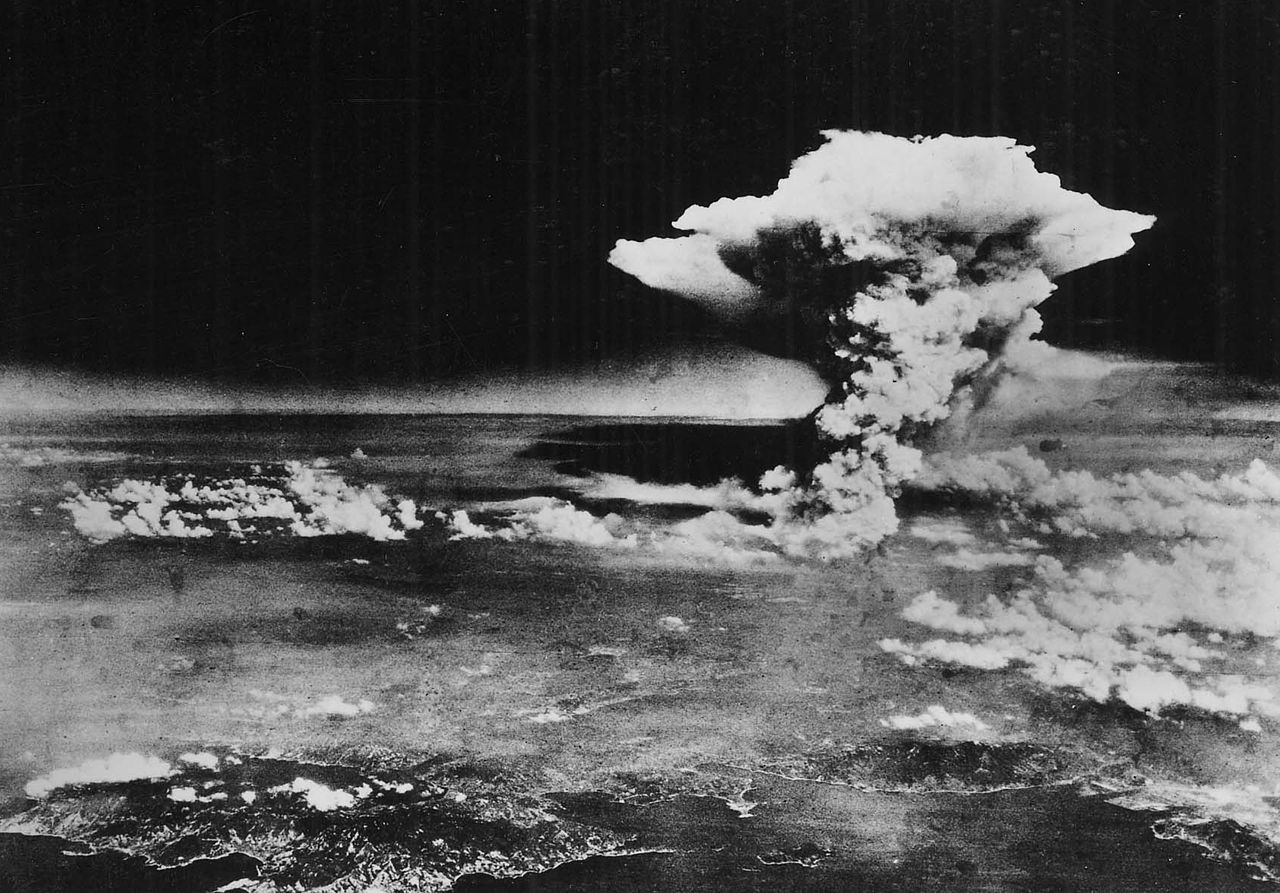
Atomic cloud over Hiroshima, taken from “Enola Gay” flying over Matsuyama, Shikoku, 6 August, 1945.
US Army Air Force photo via Wikimedia Commons.
It’s the anniversary of Hiroshima again today. I wasn’t going to write anything to mark the event (more coming next week on VJ Day), but I’ve been triggered already by nonsense on the radio which suggests that the atomic bombs on Hiroshima and Nagasaki were unnecessary, because Japan was about to surrender.
Nonsense. There is not a shred of real evidence to support this idea. In fact, the evidence that Japan wanted to keep on fighting is irrefutable. And yet this lie persists, despite the deluge of scholarly work demonstrating Japan’s commitment to the ritual suicide of its entire nation right until the end, when Hirohito pulled the plug. If you are in any doubt about the facts of the case, as opposed to the propaganda, read Toland’s Rising Sun (1970), Frank’s Downfall (2001), Spector’s In The Ruins of Empire (2007), Pike’s Hirohito’s War and, more recently, Stewart Binn’s Japan’s War (2025). All are excellent, clear, analytical and well researched. There are lots more, too.
Why does this canard keep on popping up? Is it because people don’t read? Or is it that they just don’t want to believe in the necessity of such a dramatic event to force Japan to surrender and thus bring about an end to the greatest man-made tragedy the world has ever suffered? The origins of this wishful myth in fact derives from hard right nationalist propaganda in post-war Japan (driven by Admiral Suzuki himself), quickly lapped up by the gullible and wishful thinkers in the West. Its one of the most enduring of the Hiroshima and Nagasaki myths, in part because it seems palatable to many, and because it is inherently anti-American.
What is the real story? In short, the Allies tried hard to persuade Japan to surrender. They demonstrated unequivocally to Japan that it was going to lose the war by defeating its armies and by beginning the long, slow and painful crawl towards the Japanese home islands. All the books I’ve mentioned note the extreme chaos of Japanese decision-making before and during the war. Who really was in charge? Who could one talk to, to secure a commitment to negotiate? In any case, the chaotic government under Koiso which replaced that of General Tojo following the fall to the Americans of Saipan in 1944, made not a single effort to engage with the Allies to seek terms. This government also collapsed on 5 April 1945. The replacement prime minister was Admiral Suzuki, and it was from this man that the myth seems to have arisen, after the war, that Japan was considering surrender and that the A-bombs were unnecessary. This is not true. During his entire time as Prime Minister he resolutely refused to do anything but continue to fight, unless the ending of the war could be secured on Japan’s terms. There were some initiatives to persuade the Suzuki government to surrender, but none of them amounted to much, because they didn’t engage directly with the government in Tokyo, and they didn’t derive from the Allied powers. The evidence that peace-feelers were being put out by various sources (such as the Vatican) in 1944 and 1945 is evidence only that the Japanese government ignored them. None were taken seriously in Tokyo.
Indeed, throughout the period of the Suzuki government, the war parties were dominant. In early June the military Supreme Command submitted a paper entitled The Fundamental Policy to be Followed Henceforth in the Conduct of the War, in which it demanded that the government confirmed that Japan would fight to the very last Japanese in an act of national suicide leading to the “honourable death of the hundred million”:
With a faith born of eternal loyalty as our inspiration, we shall – thanks to the advantages of our terrain and the unity of our nation, prosecute the war to the bitter end in order to uphold our national essence, protect the Imperial land and achieve our goals of conquest.
The proposition was passed, not unanimously, but overwhelmingly nonetheless.
There were some in the government – interestingly including Tojo himself – who saw that this was self-defeating, and that Japan must negotiate to secure acceptable peace terms. Naively, it was hoped that this would enable it to retain parts of its empire. Suzuki was part of this group who thought that Japan could negotiate favourable terms to end the war, in the form of a negotiated settlement such as that had brought about the end of the Russo-Japanese war in 1905, but when he suggested this in parliament on 13 June he was shouted down by the war mongers. Hirohito then endorsed an approach to the Soviets in late June. Bizarrely – though Moscow was neutral in the Far Eastern war at this point – Tokyo’s emissaries suggested that the USSR and Japan join forces to rule the world. It was yet more evidence of how Tokyo fundamentally misunderstood the world, and its enemies, and the way the war would have to end: complete and utter surrender by Japan.
Moscow, of course, scorned these “negotiations” as meaningless.
Comments Off on Debunking the idea that Japan was about to surrender anyway
China’s short- to medium-term reaction to Trump’s tariffs
In Reason, Liz Wolfe outlines some of the reasons China has not been suffering under the tariffs President Trump has levied on them over the last few months (unlike, say, Canada):
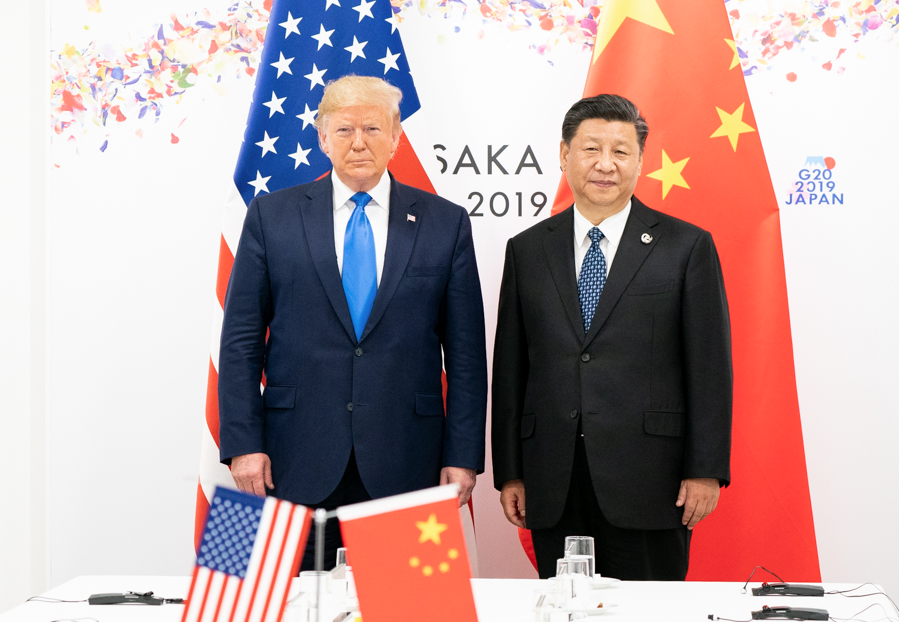
President Donald Trump and PRC President Xi Jinping at the G20 Japan Summit in Osaka, 29 June, 2019.
Cropped from an official White House photo by Shealah Craighead via Wikimedia Commons.
Total Chinese exports surged in July … but not to us. Compared to July 2024, Chinese exports were up 7.2 percent last month. “Its exports to Southeast Asia and Africa, key regions for reshipment to the United States, rose more than twice as fast as its overall exports”, per The New York Times‘ reading of the data. “China’s exports to the European Union, its main alternative to the American market, were also up very strongly.”
Specifically, “data released Thursday by the customs authorities showed the pickup was driven by strong growth in shipments to the European Union, Southeast Asia, Australia, Hong Kong and other markets, which more than made up for the fourth month of double-digit declines in US purchases”, reports Bloomberg.
Predictably, even the threat of tariffs has been enough to dampen trade. Remember, Washington and Beijing are still operating under a 90-day truce — set to expire on August 12, though it could be extended if a new agreement is reached — that holds off the imposition of higher tariff levels, namely, the tit-for-tat tariff increases that both countries had threatened. The truce also staves off export controls on certain critical rare-earth minerals and items that fall into the technology category. But still, current tariff levels mean a baseline 30 percent tariff on Chinese imports, which has been enough to depress trade.
For those in the Trump administration who are worried about trade deficits in particular, I suppose the good news is that we’ve made progress there: “For the last several decades, China has been selling as much as $4 worth of goods to the United States for each $1 of American goods that it buys”, reports The New York Times. Following China’s admission into the World Trade Organization, the trade deficit rose. Now, “tariffs have begun to reduce the imbalance. The United States announced on Tuesday that its overall trade deficit had narrowed in June to $60.2 billion, the smallest in nearly two years.”
It’s not clear why Trump administration officials, and the president himself, are so worried about trade deficits as something to eliminate for their own sake. We are dependent on Chinese goods to a rather substantial degree, which would pose a problem in the event of war with China (which is why the previous administration focused on improving our semiconductor manufacturing capabilities back in 2022). But you can just as easily make the case that it’s the vast volume of trade between the two countries — the deeply intertwined economies so reliant on each other (despite China’s claims of autarky and, more amusingly, communism) — that are incentivizing continued decent relations.
A few factors are at play that might help to explain why you likely haven’t felt a drastic increase in prices just yet. First, since there’s been a long lead-up to this trade war, many larger importers have stockpiled product over the last few months, so shortages haven’t been felt yet — they’ve just been selling off product they’ve been storing. Second, China has already managed to divert some stages of manufacturing to other countries—namely Vietnam — and some larger companies already have factories up and running in other Southeast Asian countries to avoid the “made in China” or “shipped from China” labeling. Expect more transshipping and manufacturing-locale creativity as a means of throwing customs officials off the scent.
Comments Off on China’s short- to medium-term reaction to Trump’s tariffs
August 6, 2025
The Korean War Week 59 – Who’s Really Running the Korean War? – August 5, 1951
The Korean War by Indy Neidell
Published 5 Aug 2025The Kaesong peace talks keep dragging on, and where any demarcation line should be drawn continues to the biggest obstacle to progress. The war continues, though, and plans for new offensives and blockades are being hashed out. But who exactly are the forces fighting this war? This week we take a closer look at the Communist forces and the American chain of command.
Chapters
00:00 Hook
00:37 Intro
00:50 Recap
01:11 The 38th Parallel Issue
02:51 War Without Victory
04:58 US Chain of Command
09:21 Plans and Alternatives
10:58 UN Air Power
13:19 The Communist Forces
18:28 Summary
18:49 Conclusion
19:45 CTA
(more…)
Comments Off on The Korean War Week 59 – Who’s Really Running the Korean War? – August 5, 1951
August 5, 2025
Origin of the China-Taiwan Conflict: Chinese Civil War 1945-1949
Real Time History
Published 21 Feb 2025With the Japanese surrender in September 1945, the Second World War comes to an end. But for China there won’t be peace right away because the nationalists under Chiang Kai-Shek and the communists under Mao Zedong still haven’t resolved their struggle and so the Chinese Civil War will flare up once again.
Chapters:
00:00 Japanese Surrender
03:44 Opposing Forces
07:33 KMT Offensives
12:18 CCP vs KMT Strategy
14.45 CCP Counterattack
19:19 Civilian Experience
23:23 CCP Huaihai Campaign
26:30 Final CCP Offensives
29:31 KMT Escape to Taiwan
31:59 Why did the Communists Win?
36:07 The United States and Taiwan
(more…)
Comments Off on Origin of the China-Taiwan Conflict: Chinese Civil War 1945-1949
July 30, 2025
The Korean War Week 58 – The Empire Strikes Back – July 29, 1951
The Korean War by Indy Neidell
Published 29 Jul 2025The Kaesong peace talks drag on, with the main sticking point being the Communist refusal to consider any demarcation line other than the 38th Parallel. UN Commander Matt Ridgway is asking for more force from home, but at least he get some organized force from elsewhere — as various brigades are organized into the 1st Commonwealth Division.
Chapters
00:00 Hook
00:21 Intro
00:56 Recap
01:22 UN Perspective and UN Needs
04:40 US Reserves?
06:31 The Commonwealth Division
09:44 38th Parallel or Nothing
15:03 Summary
15:16 Conclusion
(more…)
Comments Off on The Korean War Week 58 – The Empire Strikes Back – July 29, 1951
July 29, 2025
QotD: Thucydides wasn’t articulating a deterministic law of geopolitics – he was writing a tragedy
If you’re 45 and above, you will remember how much fear Japan stoked in the hearts of Wall Street in the 1980s when their economy was booming and their exports sector exploding. There were major concerns that the Japanese economy would leap ahead of the USA’s, and that it would result in Japan discarding its constitutional pacifism in order to spread its wings once more throughout the Pacific.
These concerns were not limited to the fringes, they were real. So real were they that respected geopolitical analysts like George Friedman (later of Stratfor) wrote books like [The Coming War With Japan] The argument was that an upstart like Japan would crash head first into US economic and security interests, sparking another war between the two. This conflict was inevitable because challengers will always seek the crown, and the king will always fight to maintain possession of it.
Suffice it to say that this war did not come to pass. The Japanese threat was vastly overstated, and its economy has been in stagnation-mode for decades now (even though living standards remain very high in relative terms). What may seem inevitable need not be.
The next several years will see marked increase in tension between the USA and China, as the former completes its long awaited “Pivot to East Asia”. So anxious are the Americans to pivot that they have been threatening to “walk away” from Ukraine if they cannot hammer down a peace deal in the very near future. This indicates just how serious a threat they view China’s ascent to be to its economic and security interests. If they are willing to sacrifice more in Ukraine than originally intended, the implication is that China’s rise is a grave concern, and that a clash between the two looks very likely … some would argue that it is inevitable, appealing to a relatively new IR concept called the “Thucydides Trap“.
Andrew Latham explains the concept to us, arguing that Thucydides is misunderstood, making conflict between rising powers and hegemons not necessarily inevitable:
The so-called Thucydides Trap has become a staple of foreign policy commentary over the past decade or so, regularly invoked to frame the escalating rivalry between the United States and China.
Coined by political scientist Graham Allison — first in a 2012 Financial Times article and later developed in his 2017 book Destined for War — the phrase refers to a line from the ancient Greek historian Thucydides, who wrote in his History of the Peloponnesian War, “It was the rise of Athens and the fear that this instilled in Sparta that made war inevitable.”
Distortion:
At first glance, this provides a compelling and conveniently packaged analogy: Rising powers provoke anxiety in established ones, leading to conflict. In today’s context, the implication seems clear – China’s rise is bound to provoke a collision with the United States, just as Athens once did with Sparta.
But this framing risks flattening the complexity of Thucydides’ work and distorting its deeper philosophical message. Thucydides wasn’t articulating a deterministic law of geopolitics. He was writing a tragedy.
This essay might be an exercise in historical sperging, but I think it has value:
Thucydides fought in the Peloponnesian War on the Athenian side. His world was steeped in the sensibilities of Greek tragedy, and his historical narrative carries that imprint throughout. His work is not a treatise on structural inevitability but an exploration of how human frailty, political misjudgment and moral decay can combine to unleash catastrophe.
That tragic sensibility matters. Where modern analysts often search for predictive patterns and system-level explanations, Thucydides drew attention to the role of choice, perception and emotion.
His history is filled with the corrosive effects of fear, the seductions of ambition, the failures of leadership and the tragic unraveling of judgment. This is a study in hubris and nemesis, not structural determinism.
Much of this is lost when the phrase “Thucydides Trap” is elevated into a kind of quasi-law of international politics. It becomes shorthand for inevitability: power rises, fear responds, war follows.
Therefore, more of a psychological study of characters rather than structural determinism.
Giving credit to Allison:
Even Allison, to his credit, never claimed the “trap” was inescapable. His core argument was that war is likely but not inevitable when a rising power challenges a dominant one. In fact, much of Allison’s writing serves as a warning to break from the pattern, not to resign oneself to it.
Misuse:
In that sense, the “Thucydides Trap” has been misused by commentators and policymakers alike. Some treat it as confirmation that war is baked into the structure of power transitions — an excuse to raise defense budgets or to talk tough with Beijing — when in fact, it ought to provoke reflection and restraint.
To read Thucydides carefully is to see that the Peloponnesian War was not solely about a shifting balance of power. It was also about pride, misjudgment and the failure to lead wisely.
Consider his famous observation, “Ignorance is bold and knowledge reserved”. This isn’t a structural insight — it’s a human one. It’s aimed squarely at those who mistake impulse for strategy and swagger for strength.
Or take his chilling formulation, “The strong do what they will and the weak suffer what they must”. That’s not an endorsement of realpolitik. It’s a tragic lament on what happens when power becomes unaccountable and justice is cast aside.
and
In today’s context, invoking the Thucydides Trap as a justification for confrontation with China may do more harm than good. It reinforces the notion that conflict is already on the rails and cannot be stopped.
But if there is a lesson in The History of the Peloponnesian War, it is not that war is inevitable but that it becomes likely when the space for prudence and reflection collapses under the weight of fear and pride.
Thucydides offers not a theory of international politics but a warning — an admonition to leaders who, gripped by their own narratives, drive their nations over a cliff.
Latham does have a point, but events have a momentum all their own, and they are often hard to stop. Inevitabilities do exist, such as Israel and Hezbollah entering into conflict with one another in 2022 after their 2006 war saw the latter come out with a tactical victory. Barring a black swan event, the USA and China are headed for a collision. The question is: in what form?
Niccolo Soldo, “Saturday Commentary and Review #188 (Easter Monday Edition)”, Fisted by Foucault, 2025-04-21.
Comments Off on QotD: Thucydides wasn’t articulating a deterministic law of geopolitics – he was writing a tragedy
July 24, 2025
The vicious competition for Indian civil service jobs
Once upon a time in most of the Anglosphere, the advantage of civil service jobs was that they were nearly impossible to get fired from and had a relatively good pension at the end of a long career. Private sector jobs were far less permanent, but paid more, had better benefits, and more prestige. Over the last fifty years, little of that is still true — civil servants still have fantastic job security, but they’re also better paid, have better benefits, and for many there are opportunities to retire and get re-hired back into a similar position with even higher pay while collecting a generous pension. The private sector no longer pays better nor offers significantly better benefits, so lots of people look to get into the civil service who once would have shunned positions like that.
It’s apparently much worse in India:

In India, government jobs pay far more than equivalent jobs in the private sector — so much so that the entire labor market and educational system have become grossly distorted by rent-seeking to obtain these jobs. Teachers in the public sector, for example, are paid at least five times more than in the private sector. It’s not just the salary. When accounting for lifetime tenure, generous perks, and potentially remunerative possibilities for corruption, a government job’s total value can be up to 10 times that of an equivalent private sector job. (See also here.)
As a result, it’s not uncommon for thousands of people to apply for every government job — a ratio far higher than in the private sector. In one famous example, 2.3 million people submitted applications for 368 “office boy” positions in Uttar Pradesh.
The consequences of this intense competition for government jobs are severe. First, as Karthik Muralildharan argues, the Indian government can’t afford to pay for all the workers it needs. India has all the laws of, say, the United States, but about one-fifth the number of government workers per capita, leading to low state capacity.
But there is a second problem which may be even more serious. Competition to obtain government jobs wastes tremendous amounts of resources and distorts the labor and educational market.
If jobs were allocated randomly, applications would be like lottery tickets, with few social costs. Government jobs, however, are often allocated by exam performance. Thus, obtaining a government job requires an “investment” in exam preparation. Many young people spend years out of the workforce studying for exams that, for nearly all of them, will yield nothing. In Tamil Nadu alone, between one to two million people apply annually for government jobs, but far fewer than 1% are hired. Despite the long odds, the rewards are so large that applicants leave the workforce to compete. Kunal Mangal estimates that around 80% of the unemployed in Tamil Nadu are studying for government exams.
Classical rent-seeking logic predicts full dissipation: if a prize is worth a certain amount, rational individuals will collectively spend resources up to that amount attempting to win it. When the prize is a government job, the “spending” is not cash, but years of a young person’s productive life. Mangal calculates that the total opportunity cost (time out of the workforce) that job applicants “spend” in Tamil Nadu is worth more than the combined lifetime salaries of the available jobs (recall that jobs are worth more than salaries, so this is consistent with theory). Simply put, for every ₹100 the government spends on salaries, Indian society burns ₹168 in a collective effort of rent-seeking just to decide who gets them.
The winners are happy but the loss to Indian society — of unemployed young, educated workers who do nothing but study for government exams — is in the billions. Indeed, India spends about 3.86% of GDP on state salaries (27% of state revenues times 14.3% of GDP). If we take Mangal’s numbers from Tamil Nadu, a conservative (multiplier of 1 instead of 1.68) back-of-the-envelope estimate suggests that India could be wasting on the order of 1.4% of GDP annually on rent-seeking. (Multiply 3.86% of GDP by 15 (30 years at 5% discount) to get lifetime value, and take 0.025 as annual worker turnover.) Take this with a grain of salt, but regardless, the number is large.
Comments Off on The vicious competition for Indian civil service jobs
July 23, 2025
The Korean War Week 57: Behind the Talks – A New Battle Is Brewing – July 22, 1951
The Korean War by Indy Neidell
Published 22 Jul 2025The Kaesong negotiations continue, hopefully to bring about a cease fire, but is this even possible, considering the wishes and demands of each side? They can’t even agree on what a “foreign soldier” is, let alone whether such troops should leave Korea. And both sides still prepare for war, even as they try to bring about some sort of peace.
Chapters
00:00 Hook
00:58 Recap
01:07 Kaesong Negotiations Continue
04:09 Ridgway’s Machinations
07:15 What China Has Gained
09:40 The Commonwealth Forces
11:34 Byers Takes Over
13:11 Conclusion
13:47 Summary
(more…)
Comments Off on The Korean War Week 57: Behind the Talks – A New Battle Is Brewing – July 22, 1951
July 22, 2025
Battle for Gaza 1917: The Palestinian Campaign of WW1
The Great War
Published 14 Feb 2025The ongoing Israel-Palestine conflict has its roots in another war more than a century ago. When the First World War began in 1914, the territory of today’s Israel and Palestine was part of the Ottoman Empire. But in 1917 the British Empire began a campaign that would change history: there would be bitter fighting in Gaza, wild cavalry charges, even talk of a modern crusade. And it would lay the foundations for a century of violence.
(more…)
Comments Off on Battle for Gaza 1917: The Palestinian Campaign of WW1
July 17, 2025
Afghan refugees and the British government
On Substack, Fergus Mason explains why the British government got deep into a secretive program to bring thousands of former Afghan soldiers and their families to Britain:
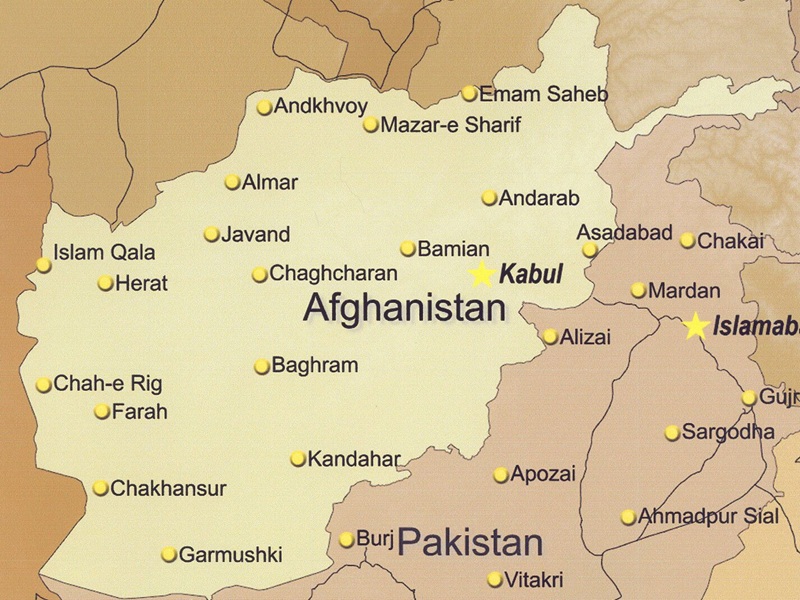
So here’s what we know so far. In February 2022 a Royal Marine officer, working for the Director of Special Forces, sent an email to several Afghans in Britain. These people were involved in the effort to rescue former interpreters and Afghan National Army special forces soldiers who were at risk of reprisals from the Taliban regime, and the Marine wanted to know whether some Afghans who claimed to be ex-special forces really were. The officer intended to attach a filtered list of around a hundred names from an Excel spreadsheet, but inadvertently attached the whole file — which contained around 25,000 names. One of the Afghans he sent the list to immediately passed it on to someone else – this time in Afghanistan. MoD sources are stressing that these were all trusted Afghans, but … well, we’ll get to that shortly.
And then nothing much happened for 18 months. The Taliban didn’t round up and shoot everyone on the list, even though they now claim to have had it since early 2022. But then, in August 2023, an Afghan man — a former soldier who had applied for asylum in Britain, but been rejected — popped up on Facebook. He promptly released part of the spreadsheet, then threatened to post all of it. At this point the government swung into action. First, it pressured Meta, which owns Facebook, to shut down the group the data was posted in and remove the user. Then the Ministry of Defence, under former defence secretary Ben Wallace, applied for a super-injunction to prevent the media from reporting anything about the leak, what the government planned to do about it, or what it was going to cost. It even banned anyone from revealing the existence of the injunction itself. That injunction was granted to Wallace’s successor, Grant Shapps, and the entire story was killed before it became public. The government was already drawing up a plan to bring tens of thousands more Afghans to Britain; the media and Parliament weren’t allowed to mention it; the British people, of course, were not to be allowed to know a thing. The degree of secrecy imposed was truly extraordinary.
And, over the last 18 months or so, the government has quietly been running a huge and very expensive operation to bring those identified as being at risk to Britain. From those listed on the spreadsheet, 23,900 former Afghan soldiers, policemen and intelligence officers were deemed to be in danger because of the leak. So, of course, were their families. How many people does the government plan to bring in under this scheme, in total? Nobody knows. Early estimates, according to court documents, were that 43,000 Afghans would be given asylum in Britain. Yesterday, officials insisted the real total was 6,900; even that dramatically lower number is a big addition to the 24,000 Afghans the government has admitted to bringing in under other, declared schemes. However, horrifyingly, last June three judges — Sir Geoffrey Vos, Lord Justice Singh and Lord Justice Warby — issued a written (but, of course, secret) ruling that up to a hundred thousand people could be at risk if the Taliban got their hands on the list.
Embarrassment for the British government, certainly, both for the initial cock-up and the ridiculous follow-up. It’s going to be expensive to resettle all those refugees and their often quite large families (guesstimates range from £850 million up to £6 billion), but not really a big deal, right? Well, about that …
I’ve already mentioned Afghan culture’s horrific misogyny. This leads to some truly dire attitudes towards women who don’t comply with Afghan society’s draconian rules of female behaviour (which boil down to having no rights and not being allowed to leave the house without a burqa and a male relative). One of the consequences of this is that Afghan men have unleashed a tidal wave of sexual assaults across Europe. At least one migration expert has noted that as well as their frequency, assaults by Afghans are remarkable for their brutality, audacity and often downright stupidity. Austrian political scientist Cheryl Benard wrote:
Can these men possibly expect that their attempts will be successful? Do they actually think they will be able to rape a woman on the main street of a town in the middle of the day? On a train filled with other passengers? In a frequented public park in the early afternoon? Are they incapable of logical thought — or is that not even their aim? Do they merely want to cause momentary female hysteria and touch some forbidden places of a stranger’s body? Is that so gratifying that it’s worth jeopardizing their future and being hauled off to jail by scornful and disgusted Europeans? What is going on here? And why, why, why the Afghans? According to Austrian police statistics, Syrian refugees cause fewer than 10 percent of sexual assault cases. Afghans, whose numbers are comparable, are responsible for a stunning half of all cases.
Type two words into Google — Afghane and Vergewaltigung — and a cornucopia of appalling incidents unfolds before you.
Incidentally, to all you lefties who’re undoubtedly sputtering with fury as you read this, don’t even think of writing Benard off as an anti-Afghan racist. Her husband is former US ambassador Zalmay Khalilzad, who is Afghan.
But surely, the “trusted” former Afghani soldiers, police and intelligence officers being brought in are bound to be much better able to adapt to British culture, right? Uh, well …
The government has been very reluctant to release — or even admit it possesses — statistics on the link between nationality and crime, but under pressure from independent MP Rupert Lowe it finally did so in March. This showed that among Afghans in Britain, 59 per 10,000 have been convicted of a sexual offence — 22.18 times higher than British men, at 2.66 per 10,000:
By the way, yes, I know the graph is from the Centre for Migration Control — but the data is from the Ministry of Justice and was obtained by a Freedom of Information request. I’ve checked the graph against the data, and it’s accurate.
[…]
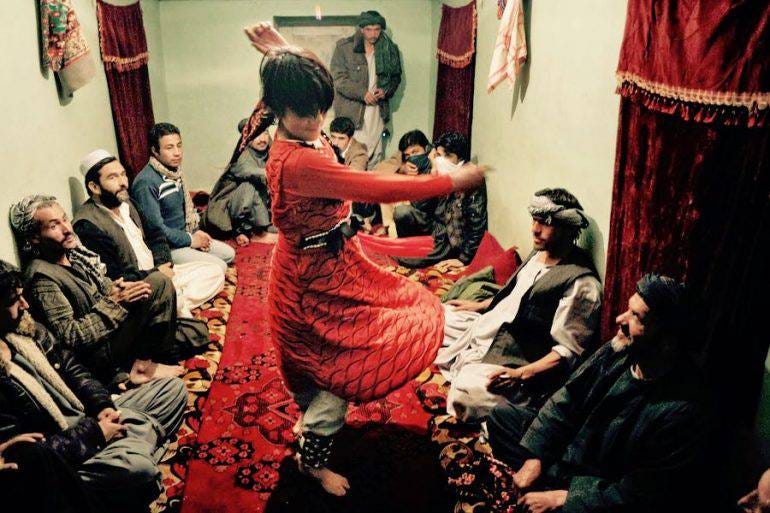
Does this photo of Afghan men watching a young boy dance give you the creeps? It should.
It’s not only women at risk, by the way. Afghan men aren’t averse to raping young boys, either. One of the most revolting aspects of Afghan culture — and that’s saying something — is the tradition of bacha bazi (Dari for “boy play”). Prepubescent boys are forced to dress up as girls then dance for, and “entertain”, men. This strain of paedophilia was common among anti-Taliban warlords and the Afghan security forces, particularly the police. The Taliban claim to be against the practice; their founder, the late Mullah Omar, actually was violently opposed to it. However, many prominent Taliban commanders also enjoy a spot of recreational pederasty.
Of course the obvious answer to this is “But most Afghan men aren’t rapists!” I agree; most of them aren’t. But an alarmingly high percentage of them are, and our governments clearly can’t keep the rapey ones out. The graph and its underlying statistics prove that beyond any possible doubt. And while it’s easy to downplay the statistics by saying it’s still “only” 77 sexual offences committed by Afghans over a two-year period, bear in mind that a) that’s 77 offences that wouldn’t have happened if we hadn’t let any Afghans in and b) this number is only convictions. In Britain just 3.1% of sexual offences reported to the police (around a third of which are rapes) lead to a conviction, which brings the potential number of Afghan suspects up to 2,484. The police estimate that only 10-15% of sexual offences are even reported; that could mean Afghans committed between 16,500 and 25,000 sexual offences across that same two-year period. Afghans would have to be bringing stupendous benefits to this country to make 25,000 sexual offences a worthwhile price to pay; indeed, many (emphatically including me) would argue that it wouldn’t be an acceptable price under any circumstances.

In Spiked, Tim Black on the government’s decision to hide everything for as long as they possibly could … for reasons:
Yet as catastrophic an error as this data leak was, the state has somehow managed to compound it with a series of decisions that made a terrible situation even worse. Successive Conservative and Labour governments effectively mounted a cover-up of both the data breach itself and the response. They slowly undertook a secret evacuation and relocation programme for the Afghans without telling even the Afghans affected about the data breach and the fact their lives were at risk. At the same time, they sought to hide all this from the British public, too, even while thousands of Afghan refugees were quietly being deposited in hotels and in military accommodation across the country. All with no explanation.
It is this de facto cover-up, this attempt on the part of ministers and senior officials to hide state errors and actions from public view, which is the most disturbing aspect of this whole sorry affair. They set about shielding a data breach followed by a costly, large-scale asylum scheme from any form of accountability, criticism or debate. And they did so by exploiting a legal tool that has never been used before by a British government – namely, the superinjunction.
This effective cover-up did not happen immediately. In fact, it wasn’t until early August 2023, a whole 18 months after the data breach took place, that the leak was finally brought to the attention of officials. A support worker responsible for settling Afghans in the UK emailed Luke Pollard, Labour MP for Plymouth, and James Heappey, the then Conservative defence minister, warning them that he’d seen the database circulating online. Days later, journalists also became aware of the leak. It was this that finally prompted the Ministry of Defence and the government to launch a covert mission, codenamed Operation Rubific, to shut down the leak and help Afghans put at risk get to the UK (after being vetted in Pakistan).
It was at this point that the authorities took the unprecedented step of applying for a superinjunction. This legal tool doesn’t only prevent journalists from reporting on the subject of the injunction. It also prevents anyone from acknowledging that the injunction even exists. Ministers argued that this extreme free-speech-defying measure was necessary to prevent the Taliban from becoming aware of the datasheet’s existence. Granted in September 2023, the superinjunction acted like a form of legal dark magic, rendering the data breach and the government response to it invisible. It insulated both from even the possibility of scrutiny.
Members of parliament could have still used their parliamentary privilege to speak up. But since all reporting had been prohibited, MPs found themselves in the same place as the wider public – in the dark. For nearly two years, then, we have all borne blind witness to the state’s conspiracy of silence. Until this week, that is, when defence secretary John Healey decided the superinjunction was no longer necessary.
It wasn’t just the British having issues with Afghan forces, as @InfantryDort recounts on the social media site formerly known as Twitter:
Among the Wildflowers @deaflibertarian
Did the high ranks really tell American soldiers to stand down and not interfere when children were being sexually assaulted in the Middle East region?TLDR, but you need to read it to get what I’m saying. I know it may be hard to understand how American Soldiers could witness horrors in Afghanistan and feel powerless to stop them. But let me try to explain. Fellow veterans, feel free to add on or correct me, because this rot ran deep.
1. We were forged to kill, then reprogrammed to hesitate. The warrior was replaced with a social worker in a helmet. Instead of rehearsing “react to contact,” we sat through PowerPoints on cultural sensitivity. Our edge dulled by doctrine that taught us empathy for the enemy and suspicion of ourselves.
2. We were ordered to practice “courageous restraint”. Sounds noble. It wasn’t. It meant ignoring your instincts. It meant second-guessing every shot, every step. The Army trained us to fight, then punished us for following that training. We were told killing the enemy might make things worse, as if leaving them alive made anything better.
3. Every success was credited to the Afghan army. Every failure pinned on us. We propped up a Potemkin military, full of cowards and thieves, and were ordered to salute the illusion. We whispered truths in smoke pits while speaking lies in briefings.
4. Under certain generals, aggressiveness was punished harshly. They’d clip the wings of the hawks and reward the peacocks. It’s like blaming a wolf for baring its teeth when surrounded by jackals.
5. “Green on Blue” attacks poisoned every partnership. The Taliban infiltrated Afghan ranks so deeply we stopped sleeping. Trust vanished. No one dared provoke them. Not over child rape, not over beatings, not over anything. Every Blue 1 report was a career landmine, so the truth stayed buried.This was the cocktail we drank every day:
• Restraint over reaction
• Illusion over integrity
• Shame over strengthWe were taught to see women as property, not to intervene. To accept children as sexual currency for Afghans, not to interfere. That the blame for every failure lay with us, not the corrupt warlords we empowered.
And was it non-consensual sexual currency? Because the culture was so backwards, we were told villagers would give their kids to powerful Afghans as tribute. And that the kids themselves understood the assignment. How f****d is that? How evil? How diametrically opposed to everything we believe?
And once you’re complicit in enough sin, it gets easier to stay silent. When you’ve spent years maintaining a lie, the truth becomes radioactive. Ripping off the bandage would mean admitting the whole war was infected.
We stood “shonna ba shonna” or shoulder to shoulder with some of the worst people humanity ever produced. And we called it partnership.
That’s how this happened.
A culture of confusion.
A doctrine of deceit.
A war that killed our ability to fight the very evil we were sent to destroy.There is a silver lining here. History has proven that our suspicions were right. And luckily, many of us are still in uniform or in charge of the DoD apparatus. We will NEVER let this happen again. And I will shout this from the rooftops to make sure that’s the case.
Infantry Dort, X.com, 2025-07-16.
QotD: War elephants in India
This may seem a strange approach to use to end a discussion of war elephants – after all, these are war elephants – but as will soon become apparent, war elephants are almost impossible to fully understand outside of the social and political context in which they are most useful.
First, we are going to look at how elephants fit into the ancient and medieval political systems which used them as weapons of war. I want to stress very strongly here that what I am presenting is essentially the main argument of Trautmann’s Elephants and Kings (2015), not something I dreamed up. For the sake of brevity, I am leaving out a lot of detail here – but you know where to go to find the argument in full.
Last time, we introduced a problem: while awesome, war elephants were very expensive and relatively easy to counter on the battlefield. This answered the question of why the Romans and Chinese mostly ignored the elephant as a weapon-system despite having access to it, but it raised a second question: if the elephant was at best a limited weapon, why did its use persist in India? After all, if the Romans could figure out how to beat these things, surely the Indians could too!
Part of the answer, of course, is that some of the logistical problems that existed for states located at the edges of elephant’s natural range simply don’t apply to states closer to the source. Indian kings could (and did!) deploy elephants in far greater numbers than Seleucid or Roman armies could. In particular, North Indian rulers, rather than relying on long distance trade, could acquire elephants through trade relations with “forest peoples” in their own hinterland. We have reports of armies with not hundreds but thousands of elephants from, for instance, the Nanda or Maurya empires. Nevertheless, while these factors simplified elephant logistics, they hardly made the use of the animals cheap.
What Trautmann instead observes is that the rise of war elephants occurred specifically in the context of kingship in India. Indeed, elephants were associated with kingship through royal elephant hunts and domesticated elephants kept for show even before war elephants were developed. Around 1400 B.C. the chariot arrives in India, bringing with it a military aristocracy where the nobles – and the noblest of all nobles is, of course, the king – rode into battle.
(I keep finding myself recommending it, but I’ll again note – for a good rundown of the value of chariots as royal symbols more than battlefield weapons, check out chapter 2 of Lee, Waging War (2016).)
That was the context the war elephant emerged into. By the fifth century or so, the war elephant seems to be displacing the chariot as the quintessential vehicle of the warrior-aristocrat (and thus the ultimate warrior-aristocrat, the king). Interestingly, the Mahabharata (fourth century B.C., but with components that may date as early as the ninth) preserves some of this shift, with a mix of aristocrats on chariot and aristocrats on elephant. As chariots faded (they were tactically inferior to true cavalry which was arising at this time), elephants progressively became the vehicle for the important warriors.
It’s not hard to see the appeal. For the warrior-aristocrat, battle isn’t just about winning, but is also about social status and position. Put another way: why does anyone put up with warrior-aristocrats, who get to live in luxury and boss everyone around? The implicit reason (sometimes explicit) across cultures is that it is the martial prowess – typically the personal, physical combat skill – that justifies the existence of the military aristocrat. You need Sir-Better-Than-You (to use a European framing) because you need someone who has mastered a difficult combat art (mounted combat) and is very, very good at it.
The warrior-aristocrat needs to be seen being a warrior aristocrat. For this purpose the elephant (much like its chariot forerunner) is perfect. Fighting from the back of an animal is a difficult skill which requires a lot of training the common folk do not have time to do. It also requires being able to afford and maintain a very expensive military asset commoners cannot afford. And not only does it allow the warrior-aristocrat to have an out-sized impact on the battle, but it literally elevates him over his fellow men so he can be seen (and it could not have escaped anyone that this was a physical realization of his actual high status). So long as the elephant remained even moderately militarily valuable, it was a perfect vehicle for a warrior-aristocrat to display his power and prowess.
And even more so for the king. Not only can the king ride his own elephant, but with his vast resources, he can procure elephants for his retainers. What is more impressive than a warrior aristocrat who has his own elephant? A warrior-king who has hundreds or thousands of elephants and his own warrior aristocrats to mount them. The thing is, a king’s actual power derives from the perception of his power – showing off the king’s military might makes him more likely to be obeyed (in ways – like tax collection – which allow him to further enhance his military might). This isn’t just a vanity project for the king (though it is that too) – extravagant displays of royal power are a key component of remaining king (the key big-word idea here is legitimacy).
This pattern in turn becomes self-reinforcing: as kings use elephants to show off (and thus reinforce) their power, elephants become symbols of royal power all on their own. Trautmann (2015) tracks this spread, particularly in South-East Asia – as the Indian model of kingship spreads into that region, war elephants spread with it. Whereas in places where there is plenty of contact, but the institution of Indian-style kingship doesn’t spread, war elephants are used rarely, if at all.
This in turn answers another quandary: why war elephants appealed to Hellenistic (that is, the heirs of Alexander) monarchs. Macedonian monarchy was not a form of Indian kingship – it had grown up in Macedon and been influenced by exposure to the Great Kings of Persia all on its own – but it was very similar in many ways. Compatible, we might say. Macedonian monarchs did not ride elephants (they rode horses), but they did need to be seen demonstrating martial excellence before their armies, just like Indian kings. In that context, the display of wealth and royal power implied by fielding a large elephant corps could be powerful, even if the king himself didn’t ride on an elephant. This is, perhaps most vividly demonstrated with Seleucus I Nicator, who earned himself the nickname “The Elephant King” and even produced coins advertising that fact […] This tie between elephants and kings seems to have been quite strong. Trautmann (2015) notes that even within India, states without kings (oligarchies, independent tribes and cities, etc) only rarely acquired elephants and never in the same sort of numbers as kings. So even when elephants are cheaper – because they are close by – unless you need elephants as physical symbols of the power and legitimacy of the king and his warrior-aristocrats, they are largely not worth the effort to procure.
The one great exception is Carthage – by the time it was using war elephants, Carthage was a mixed republic (much like Rome), and yet employed elephants extensively. Unfortunately, we have no sense of if Carthage – like Rome – would have abandoned elephants given time. The earliest attestation we have of Carthaginian war elephants is 262 B.C. (although they would have encountered them earlier from Pyrrhus of Epirus) and Carthage is completely gone in 146 B.C. It is possible Rome simply caught Carthage in the same “trying them out” phase of elephant use Rome would undergo in the second century B.C. and that Carthage may too have largely abandoned war elephants had it not been destroyed.
Bret Devereaux, “Collections: War Elephants, Part III: Elephant Memories”, A Collection of Unmitigated Pedantry, 2019-08-09.
Comments Off on QotD: War elephants in India
July 16, 2025
The Korean War Week 56: Ceasefire Talks Start – With Threats, Tricks, and Delays
The Korean War by Indy Neidell
Published 15 Jul 2025This week might be a big turning point in the war, for this week, ceasefire negotiations begin in Kaesong. Both sides have sent delegations, and both sides have different goals they wish to achieve. The big question is, though: what is each side willing to concede in order to create a lasting peace?
Chapters
00:00 Intro
00:53 Recap
01:27 The Communist Delegates
04:34 The First Session
08:40 The Next Few Days
11:38 Future Planning
13:21 Conclusion
(more…)
Comments Off on The Korean War Week 56: Ceasefire Talks Start – With Threats, Tricks, and Delays
July 15, 2025
Why France Couldn’t Crush the Viet Minh – W2W 36
TimeGhost History
Published 13 Jul 2025Why couldn’t France crush the Viet Minh after war broke out in Vietnam? In this episode we dive into the brutal opening years of the First Indochina War, from the outbreak of violence in Hanoi in December 1946 to France’s failed military campaigns and the rise of Vietnamese resistance.
Despite having superior weapons, colonial experience, and Foreign Legion reinforcements, France failed to defeat Ho Chi Minh’s forces. We explore why early offensives like Operation Léa and Ceinture fell short, how the Viet Minh’s rural strategy kept them alive, and why French hopes of ending the war quickly vanished.
As Mao Zedong’s Communist China consolidates power just across the border, the Viet Minh gain strength, support, and a long-term advantage that France simply cannot match.
This video is part of War 2 War, our Cold War history series covering the decade after WW2, a time of seismic global transformation.
(more…)
Comments Off on Why France Couldn’t Crush the Viet Minh – W2W 36


