Quotulatiousness

February 1, 2011

A nasty bureaucratic trick

Filed under: Asia, Britain, Bureaucracy, Liberty — Tags: , , , — Nicholas @ 09:47

Jon, my former virtual landlord, sent along this link describing it as a “creative solution”:

An immigration officer tried to rid himself of his wife by adding her name to a list of terrorist suspects.

He used his access to security databases to include his wife on a watch list of people banned from boarding flights into Britain because their presence in the country is ‘not conducive to the public good’.

As a result the woman was unable for three years to return from Pakistan after travelling to the county to visit family.

The tampering went undetected until the immigration officer was selected for promotion and his wife name was found on the suspects’ list during a vetting inquiry.

The Home Office confirmed today that the officer has been sacked for gross misconduct.

Because these lists are easy to get added to, but nearly impossible to get removed from (and there’s little chance you get told why you’re on the list — or even if you’re on it), this little trick could have continued indefinitely until the perpetrator had to go through security screening for a higher position.

January 27, 2011

Viewing the new plutocrats: Indian and Chinese variants

Filed under: China, Economics, Government, India — Tags: , — Nicholas @ 07:40

The Economist has a compare-and-contrast piece on how the ultra-rich are viewed in India and in China:

India’s movers and shakers all seem to know each other. The Indian elite have created their own islands, frowns a cabinet minister: “It’s a bit unhealthy.” They send their kids to private schools. They have their own water and electricity. So they barely notice how bad the government is at delivering power, water and schooling to the other 1.2 billion Indians.

Yet to many Indians the nation’s tycoons are heroes. A few made their fortunes corruptly, but the software moguls of Bangalore created a huge export industry out of nothing, and many others helped to spur India’s galloping growth. Ratan Tata, the soon-to-retire boss of a conglomerate that produces everything from tea to cars, lives modestly and treats his employees well. The brothers Anil and Mukesh Ambani are more controversial, but they have turned the family business into two global giants, with interests from chemicals to entertainment.

Some Indian gazillionaires are flashy. Mukesh Ambani’s house has 27 stories, three helipads and three floors of hanging gardens. Vijay Mallya, a beer-and-airlines magnate, constantly amuses the newspaper-reading public with his speedboats and sports teams. But for most of the country’s elite the most conspicuous item of consumption is sending their children to university in America.

India’s super-rich are very different from their Chinese counterparts, however:

The relationship between rich and poor in China is different. China’s stellar growth has lifted some 500m people out of poverty. Much of the credit belongs to Chinese entrepreneurs. Since Mao’s boot was lifted from their necks, they have built marvels, from the skyscrapers of Shanghai to the factories of Guangdong. Yet mainland Chinese business leaders operate in the shadow of a secretive and unaccountable ruling party. To get on, many join it. Some do so reluctantly, to avoid being crushed. Others do so gladly, hoping to use the power of the state to enrich themselves.

Individual party members are not entirely above the law. If a local bigwig behaves so appallingly that the resulting protests are heard in Beijing, the party may cut him down to size. In October last year the son of Li Gang, a senior police officer in Baoding, killed a pedestrian while allegedly drink-driving. He sped off, shouting, “report me if you dare; my dad is Li Gang!”

News of the incident went viral in the Chinese blogosphere. Pop songs with the refrain “My dad is Li Gang!” quickly circulated. Li Gang was forced to make a televised apology. His son was arrested. China’s leaders would like the 95% of the population who are not members to think that the party cares. But the most revealing fact is that Mr Li junior evidently thought he could get away it.

January 26, 2011

QotD: The elephant in the living world

Filed under: Economics, Japan, Quotations — Tags: , , , — Nicholas @ 12:56

Here in peaceful and progressive Canada, it is so easy to feel smug towards larger countries that get their hands dirty in the world arena. Especially that one country built on the conquest and near eradication of its peaceful natives who have received hardly any compensation or even an apology. You know, the one founded on belligerent exceptionalism and manifest superiority over other cultures that was turned into a national religion that has historically led to imperialist conquest and mass slaughter. This country still has an actual federal law that requires all foreigners to carry their papers with them at all times, or risk being deported by any policeman who can, simply on a whim, question and detain them. The country so primitive and barbaric that it actively uses the death penalty, shrugging off international protests about it just as coldly as it does in important environmental issues. Its provincial masses bitterly cling to their traditional values while their media feeds them a constant diet of mindless pap and actively hushes up embarrassing facts. They rarely travel abroad, being not just obsessed with ethnic purity and deeply suspicious, even afraid, of anything foreign, but also unapologetically sexist and classist, especially towards this one minority they consider dirty, criminal and less evolved. We can only sigh in relief that sun is finally setting on the once so unstoppable economic juggernaut… of Japan.

Ilkka, “The elephant in the living world”, The Fourth Checkraise, 2011-01-20

Nostalgia for the Dreadnought era?

Filed under: China, Economics, Germany, History, WW1 — Tags: — Nicholas @ 09:03

Ambrose Evans-Pritchard finds the parallels between the rise of Imperial Germany in the years leading up to the first world war and attitudes toward China today:

And we all learned how the Kaiser overplayed his hand. That much was obvious.

Yet it is difficult to pin-point exactly when the normal pattern of great power jostling began to metamorphose into something more dangerous, leading to two rival, entrenched, and heavily armed alliance structures unable or unwilling to avert the drift towards conflict. The Long Peace died by a thousand cuts, a snub here, a Dreadnought there, the race for oil.

[. . .]

Is China now where Germany was in 1900? Possibly. There are certainly hints of menace from some quarters in Beijing. Defence minister Liang Guanglie said over New Year that China’s armed forces are “pushing forward preparations for military conflict in every strategic direction”.

Professor Huang Jing from Singapore’s Lee Kwan Yew School and a former adviser to China’s Army, said Beijing is losing its grip on the colonels.

“The young officers are taking control of strategy and it is like young officers in Japan in the 1930s. This is very dangerous. They are on a collision course with a US-dominated system,” he said.

The problem with drawing parallels from history is that it’s never as neat and clean-cut as you’d expect. First, China is supposed to be like Kaiser Wilhelm’s Germany, then more like Japan after WW1. I have to say I’m not totally following this line of thought. But, getting back to today’s situation:

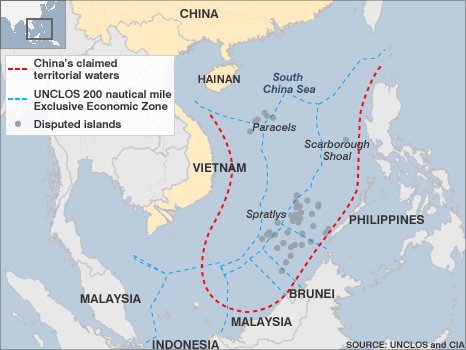
There is a new edge to Chinese naval policy in the South China Sea, causing Japan, Vietnam, Indonesia, and the Philippines to cleave closer to the US alliance. Has Beijing studied how German naval ambitions upset the careful diplomatic legacy of Bismarck and pushed an ambivalent Britain towards the Entente, even to the point of accepting alliance with Tsarist autocracy?

Factions in Beijing appear to think that China will win a trade war if Washington ever imposes sanctions to counter Chinese mercantilism. That is a fatal misjudgement. The lesson of Smoot-Hawley and the 1930s is that surplus states suffer crippling depressions when the guillotine comes down on free trade; while deficit states can muddle through, reviving their industries behind barriers. Demand is the most precious commodity of all in a world of excess supply.

H/T to Jon, my former virtual landlord, for the link.

January 23, 2011

Lawrence Solomon on the coming crash in China

Filed under: China, Economics, Government — Tags: , , — Nicholas @ 12:17

If you think I’ve been too chipper and dismissive on the medium-to-long term issues that could cause a Chinese meltdown, you’ll enjoy Lawrence Solomon’s article:

In China, the resentments are palpable. Many of the 300 million people who have risen out of poverty flaunt their new wealth, often egregiously so. This is especially so with the new class of rich, all but non-existent just a few years ago, which now includes some 500,000 millionaires and 200 billionaires. Worse, the gap between rich and poor has been increasing. Ominously, the bottom billion views as illegitimate the wealth of the top 300 million.

How did so many become so rich so quickly? For the most part, through corruption. Twenty years ago, the Communist Party decided that “getting rich is glorious,” giving the green light to lawless capitalism. The rulers in China started by awarding themselves and their families the lion’s share of the state’s resources in the guise of privatization, and by selling licences and other access to the economy to cronies in exchange for bribes. The system of corruption, and the public acceptance of corruption, is now pervasive — even minor officials in government backwaters are now able to enrich themselves handsomely.

[. . .]

The corruption extends to the enforcement of regulatory standards for health and safety, which few in China trust. In recent years China has endured a tainted milk scandal and a tainted blood scandal, each of which implicated corrupt officials in widespread death and debilitation. In a devastating 2008 earthquake, some 90,000 perished, one-third of them children buried alive in 7,000 shoddily built “tofu schools” that skimped on materials. Nearby buildings for the elites that met building standards, including a school for the children of the rich, were largely unscathed.

[. . .]

China is a powder keg that could explode at any moment. And if it does explode, chaos could ensue — as the Chinese are only too well aware, the country has a brutal history of carnage at the hands of unruly mobs. For this reason, corrupt officials inside China, likely by the tens of thousands, have made contingency plans, obtaining foreign passports, buying second homes abroad, establishing their families and businesses abroad, or otherwise planning their escapes. Also for this reason, much of the middle class supports the government’s increasingly repressive efforts.

Compared to my rather milder criticisms, this is strong stuff indeed.

H/T to my former virtual landlord for the link, who referred to this as my “hobby horse in full gallop”.

January 21, 2011

Remaking Red Dawn as a metaphor for US fear of China

Filed under: China, Economics, Media, USA — Tags: , , , , — Nicholas @ 12:59

David Harsanyi notes the remake of the 1980’s movie Red Dawn with the Chinese taking the place of the original film’s Soviet and Cuban troops:

Doubtlessly, the remake will be entertaining and offer a far more plausible plot line than the original — seeing that the Chinese, well, they have a proper army. Producers will almost certainly capitalize on a growing alarmism regarding China’s growth. Few issues, in fact, can bring right and left together in this polarized world of ours than a shared knowledge that China is bad news.

Now, the American populace can typically be divided into two categories: 1. Those who don’t care one whit about foreign policy. 2. Newspaper editors.

So before Chinese President Hu Jintao was here meeting with the president, Andrew Kohut of the Pew Research Center took to the pages of The Wall Street Journal and explained what we think about the topic.

Apparently, 47 percent of those he surveyed cited China as the world’s top economic power. (Only 31 percent properly identified it as the U.S., which has an economy nearly three times the size.) Another Pew survey from last year found that 47 percent of us consider China’s growth a “bad thing” for the United States. A new CNN poll found that 58 percent of us believe that China’s “wealth and economic power” are a threat to the U.S.

I’m certain our relationship with China is layered with international complexity and fraught with danger. But why would we fear the aspects of China’s ascendancy — its “wealth and economic power” — that pose the least threat to United States? Unlike ideological clashes, economic competition can be mutually beneficial. A country with real economic wealth is typically free and doesn’t look kindly on radical behavior. Suicide bombers rarely drive top-of-the-line BMWs.

I have a long history of doubting the stated size and growth of the Chinese economy and therefore feeling that the “threat” they pose is overstated. Overall, the economic growth in China is a good thing, both for China and for the world economy, but there’s still too much malignancy from the “bad old days” of the command economy that haven’t been properly dealt with. China is big, and getting bigger, but will face severe problems the longer these historical artifacts remain unexamined and unresolved.

January 20, 2011

In case you weren’t worried enough about the rise of China

Filed under: China, Economics, Government, Media, USA — Tags: , , , — Nicholas @ 16:23

The Wall Street Journal rounds up the leading indicators of the current “USA sliding down the ladder” worries:

Of all the differences between dictatorship and democracy, probably none is so overlooked as the ability of the former to project strength, and the penchant of the latter to obsess about its own weakness.

In 1957 the Soviets launched Sputnik and the U.S. went into a paroxysm of nerves about our supposed backwardness in matters ballistic. Throughout the 1980s Americans lived with “Japan as Number One” (the title of a book by Harvard professor Ezra Vogel, though the literature was extensive) and wondered whether Mitsubishi’s purchase of Rockefeller Center qualified as a threat to American sovereignty.

Now there’s China, whose President is visiting the U.S. this week amid a new bout of American hypochondria. In an op-ed last week in these pages, Andrew Kohut of the Pew Research Center noted that a plurality of Americans, 47%, are under the erroneous impression that China is the world’s leading economy. News reports regarding Chinese military strides, or the academic prowess of Shanghai high school students, contribute to Western perceptions of Chinese ascendancy. So does the false notion that Beijing’s holdings of U.S. debt amounts to a sword of Damocles over Washington’s head.

Oh, we nearly forgot: Tough-as-nails Chinese mothers are raising child prodigies (a billion of them!) while their Western counterparts indulge their kids with lessons in finger-painting.

There you go, more than enough to keep you up late tonight worrying about the inevitability of China’s rise to top economic dog in the pack. Of course, most of it is misinterpretation of the facts, but you can worry about it if you want.

H/T to Jon, my former virtual landlord, for the link.

January 18, 2011

Singapore diplomats caught speaking very undiplomatically

Filed under: Asia, China, India, Japan — Tags: , , , , — Nicholas @ 08:15

Sometimes, the information in the various WikiLeaks releases shocks and surprises. Other times, it merely confirms common beliefs:

Singaporean officials are putting up a brave face after highly embarrassing Wikileaks’ disclosures. They have rubbished the leaked cables as “cocktail talk” and accused the media of blowing the casual remarks out of context. Singapore-specific cables have shown that diplomats and officials of this tiny but prosperous city state have scant regard for leaders of neighboring countries and have insulted their neighbors with disparaging remarks.

[. . .]

Tommy Koh, a senior diplomat of Singapore, took pot shots at Japan and said that Japan was “the big fat loser” in the larger strategic matrix as China’s relations with ASEAN nations continued to improve. This is not insulting had Koh stopped at that only. However, the Singaporean diplomat blabbed on and blamed Japan’s “stupidity, bad leadership, and lack of vision.” Koh dragged in the Indians as well and called India “stupid” for being “half-in, half-out” of ASEAN.

Another leaked cable quotes Peter Ho, Singapore’s former Minister of Foreign Affairs and Permanent Secretary, telling a U.S. official in March 2008 that Malaysian Prime Minister Najib Razak was an “opportunist”. Another Singapore diplomat remarked senior colleague in Singapore’s foreign ministry, Bilahari Kausikan, told US Deputy Secretary of Defence for South that ousted Thailand leader Thaksin Shinawatra was ‘corrupt’, along with “everyone else, including the opposition.”

The art of diplomacy is saying in public what your government wants everyone to believe, while saying to your government what is really happening.

January 15, 2011

Indian model photoshopped against her will

Filed under: Health, India, Media, Technology — Tags: , , , , — Nicholas @ 09:43

It’s no secret that most of the images used for magazine covers have had a healthy dose of Photoshoppery, but this is a few filters too far:

Leave it to ELLE Magazine to photochop the world’s most beautiful woman. Aishwarya Rai, the reigning queen of Indian cinema, model and classically trained dancer is currently on the cover of ELLE India — several shades lighter. Rai’s skin has been lightened and her dark brown hair appears to have a red tint to it.

The Times of India reported the former Miss World is “furious with the bleaching botch-up” and is considering taking legal action against ELLE.

ELLE’s mission is to make women “chic and smart, guide their self-expression, and encourage their personal power,” but their recent covers could lead readers to believe that “chic, smart and personal empowerment” only comes to those with light skin.

H/T to Tim Harford for the link.

January 12, 2011

“Tiger mother”: Chinese-style parenting

Filed under: China, USA — Tags: , , — Nicholas @ 12:38

If you think typical western parenting styles have not served children well, you might be interested in Amy Chua’s new book:

The Tiger, Chua explains, is “the living symbol of strength and power”, inspiring fear and respect. And as a “Tiger mother” herself, she assumed the absolute right to dictate her children’s activities and demand rigorous academic standards of them at all times, ridiculing them if necessary to spur them on to greater efforts.

Her children were never allowed to attend a sleepover, have a playdate, watch TV or choose their own extracurricular activities. They were also expected to be top in every subject (except gym and drama) and never get anything other than A-grades — because, Chua explains, Chinese parents believe it is their responsibility to ensure their children’s academic achievement above everything else.

Chua argues that western parents. with their emphasis on nurturing their children’s self-esteem and allowing free expression, have set their children up to accept mediocrity. “Western parents are concerned about their children’s psyches. Chinese parents aren’t. They assume strength, not fragility, and as a result they behave very differently,” she says. If their child doesn’t achieve perfect exam results, the Chinese parent assumes it’s because he or she didn’t work hard enough. “That’s why the solution to substandard performance is always to excoriate, punish and shame the child,” Chua says. And it is crucial for a mother to have the “fortitude” to override her children’s preferences, because to enjoy anything you have to be good at it, to be good at it you have to work, and children on their own never wish to work, she adds.

Update: Barbara Kay disagrees with Chua about the need to oppress your children to get them to excel:

This article and the book will spark furious discussion in the media. Coincidentally, in today’s Post, Dan Gardner’s column, “From Haiti to Harvard, culture matters,” bolsters the idea that culture is the single greatest predictor for academic success, and it is well worth reading in tandem with “Why Chinese mothers are superior.” He is right, of course, even though political correctness forbids us to say so, and even though Ms Chua’s extreme methods are unnecessary, as the Jewish experience — high expectations, high sensitivity to children’s psychic needs — proves.

It’s too bad Ms Chua’s extremism will become the focus of interest. The larger issue is worthy of respectful attention. As Gardner notes, the reason Asian students are so wildly disproportionately represented in universities (3% of the population, about 25% on campus) is because they came from homes in which “Chinese mothers” ruled the roost. It isn’t racism to say so.

Update, 23 January: Lawrence Solomon thinks the threat of “Tiger Mothers” is overstated:

The statistics seem to bear her out — Asians disproportionately make it to elite schools in the West — they represent 5% of the U.S. population but 20% of the student body at Ivy League schools, for example. No one can but marvel at the uniformly successful students turned out by the “tenacious practice, practice, practice” and “rote repetition” that she considers “crucial for excellence.”

But such statistics don’t tell the whole story. In truth, Chinese Mothers fare poorly in achieving excellence compared with western mothers, even western mothers burdened by political correctness.

[. . .]

Practice and rote learning have their limits. While imposing single-minded discipline on children will dramatically raise test scores and technical proficiency, and for most children may represent the best strategy for accomplishment and satisfaction, it can come at the cost of curbing the creativity necessary for true excellence. Chinese Mothers make great moms, as evidenced by the unusual cohesiveness of the Chinese family: Chinese kids clearly understand whatever berating they absorb as the tough love intended. Chua is justified in saying western parents are doing their underperforming kids no favours in failing to confront them.

But Western parents retain the edge in producing the next generation of creators — those whose breakthroughs will cure cancer or supplant the Internet. Here, too, Chua may be pointing to the right balance in her personal life, by choosing as her husband and father of her children someone who is anything but single-minded. Jed Rubenfeld, an American Jew determined to avoid a career in academia, waffled as a student, starting with philosophy and psychology at Princeton, switching to acting at Julliard, then moving to law at Harvard before accepting an academic position at Yale, where he is now professor and assistant dean of law.

Update, 2 February: Bryan Caplan (who has an upcoming book, Selfish Reasons to Have More Kids) addresses the downside of the Tiger Mother approach:

No wonder Chua confesses that, “For the first few weeks after Lulu’s decision [to radically reduce her musical practice time], I wandered around the house like person who’d lost their mission, their reason for living.” If I’d lived through thousands of hours of drudgery and cruelty for nothing, I’d be despondent, too.

But hasn’t all the musical practice indelibly shaped Chua’s children’s characters? Highly unlikely. Behavioral genetics finds roughly zero effect of parents on personality. And contrary to teachers’ fantasies about changing their students’ lives, learning is highly specific. Practicing X makes you better at X — and little else. Furthermore, the effects of environmental intervention erode over time — that’s fade-out for you. Chua seems to know this on some level: She favorably quotes a music teacher who says that, “Every day you don’t practice is a day that you’re getting worse.”

But all social science aside, Chua’s own life history raises severe doubts about the character-shaping power of mastering an instrument. Yes, she practiced piano as a child, but not to excellence. And what became of her? She became a Yale professor and best-selling author anyway!

In the most insightful passage in Battle Hymn of the Tiger Mother, cost-benefit analysis finally makes an appearance:

Why torture yourself and your child? What’s the point? If your child doesn’t like something — hates it — what good is forcing her to do it?

But Chua immediately represses her thought crime: “As a Chinese mother I could never give in to that way of thinking.” My response: You can and should give in, because this way of thinking is true. Cost-benefit analysis is not a Western prejudice. “Give up when the costs exceed the benefits” is one of the universally-valid maxims that allows millions of Chinese businesses to survive and thrive. Why shouldn’t Chinese mothers use it too?

December 21, 2010

This goes far beyond accepting the end of “DADT”

Filed under: Asia, Health, Military — Tags: , , , , , — Nicholas @ 13:40

As I posted back in January, one of the problems western troops have in dealing with Pashtuns in Afghanistan is the radically different sexual culture, including barely concealed pedophilia:

The vast gulf between U.S. and Afghan attitudes about homosexuality and pedophilia has generated concern among U.S. advisers in Afghanistan since the American presence there began to expand.

In late 2009, U.S. and British forces ordered a study of Pashtun male sexuality. They were worried that homosexuality and pedophilia among Afghan security forces and tribes could create cultural misunderstanding with allied troops, according to a copy of the report obtained by The Washington Examiner.

[. . .]

“I know Marines and soldiers who have refused to work with Afghan military or police,” said one U.S. military official, who spoke on condition of anonymity. “It’s not about homosexuality as much as it is about the young boys. Some of them like to show pictures on their cell phone — that should be illegal. Some of the Afghans have their own young boys they use for sexual purposes and we can’t do anything about it.”

[. . .]

“Homosexuality is strictly prohibited in Islam, but cultural interpretations of Islamic teaching prevalent in Pashtun areas of southern Afghanistan tacitly condone it in comparison to heterosexual relationships,” the study states.

For a male to have sex with a boy is considered a “foible,” the report said. By contrast, having sex with an “ineligible woman” would set up “issues of revenge and honor killings.”

Years of living under that cultural construct have greatly altered sexual attitudes, the study said. “One of the country’s favorite sayings is ‘women are for children, boys are for pleasure,” the report noted.

Do not attempt to change planes in Bombay

Filed under: Bureaucracy, India — Tags: , — Nicholas @ 12:45

India is a rising economic power in the world, but it still has lots and lots of problems. Sean had to change planes in Bombay. It wasn’t a pleasant experience:

It wasn’t just one person who’d fucked up. This was no single, lone fuck-up cascading through the nooks and crannies of a complex system, like a butterfly causes a hurricane; everybody who touched my life that day, apart from, thankfully, the pilot and the airframe maintenance crew and my rickshaw driver, was busy fucking up in one way or another, sometimes spectacularly so. The guy who had all that time to anticipate the Diwali crush and thousands of rebookings fucked up. The guy who’d arranged the airport signs fucked up. So did the guy who cleaned the floors. The women representing Air India and India Air were a pair of fucknuts; the baggage handlers were probably already pretty fucked up before they even got to work, which of course fucked things up even worse. And the guy who designed the airport had, at some point well in the past, fucked up pretty royally. Even my taxi driver was a complete fuckup. The president of Air India? That guy’s totally fucked in the head. What was most remarkable about it, though, is that despite things being so thoroughly fucked, I did eventually get where I was going. With my western eye, all I could see was disaster, chaos, and impossibility; what I couldn’t see, until a good samaritan made it clear, is that there was in fact a solution. I’d been told that this is a common thing in India, that life there can be a series of 11th-hour miracles.

And all this, at the freakin’ airport. If there was going to be more of the same in India, I’d better get used to it — and learn to navigate it better — before I tried to ride my scooter from one end of the country to the other.

H/T to Damian Penny for the link.

December 18, 2010

Unwelcome discoveries in China’s past

Filed under: China, History, Science — Tags: , — Nicholas @ 12:38

Strategy Page looks at some recent archaeological and DNA study results that are not popular with China’s government:

Chinese scientists, conducting genetic research in western China, recently tested the people in an ancient, and remote, village, and found that the DNA of the villagers was 56 percent Caucasian (Indo-European). The current theory is that these people are descendants of Roman soldiers who were long rumored to have established an outpost on this eastern end of the ancient Silk Road (the caravan route from China to the Middle East.) The Chinese are not happy with findings like this.

The Chinese government has long been uneasy about archeologists and anthropologists finding evidence of European peoples living, and settling, in western China thousands of years ago. The Chinese have a high opinion of themselves (often justified), but because of the European role in humiliating China in the 18th and 19th centuries, they are uncomfortable with the idea that the damn Europeans have been in their neighborhood even earlier. Earlier discoveries included very old (more than 3,000 years ago) burial sites containing tall, blonde, warriors. There was also a village of ancient Jews in western China, where the people had only stopped practicing Jewish religious rituals in the last century.

[. . .]

The Chinese may be unhappy simply because they have to give the “northern barbarians” credit for driving the Indo-Aryan tribes away, rather than letting Chinese soldiers do it. Thus it’s currently a big deal in China anytime Chinese technology, or diplomats, beats the Westerners. In the Chinese universe, it’s the supreme insult for foreigners to best the Chinese, militarily or otherwise. But for the last few centuries, that is what happened. China isn’t really looking for a war with the West, but politicians find it easy to win approval by playing up the might of the motherland, and what China can do (in theory) if anyone messes with us. That process induces some amnesia about what has really happened in the past, but that’s what nationalism and demagoguery are all about.

The fascinating economics of Chinese manufacturing

Filed under: China, Economics, Tools, Woodworking — Tags: , — Nicholas @ 11:17

An interesting post at the Bridge City Tools blog about how Americans (and Canadians) are actually willing to pay the outrageous price of $5 for a single 1/8″ drill bit:

About 10 years ago I was in an OEM Chinese factory that made bench grinders. You have seen them, 1/2 HP motor, two 6” grinding wheels, pig tail cord, a small plastic face shield and no nameplate — these would be attached by the American companies that bought them. The total cost per grinder, landed in the US was $7.15. Of course at this price it would be asking too much for a UL tag.

These grinders were, and still are being sold here and the prices range from $49 to $200 — awesome margins by any standard.

Behind the factory floor there was a small mountain of insulated wire that had been pulled from old cars, appliances, televisions and the like and it was replenished daily. Surrounding the wire mountain were a couple of dozen women who were stripping the wire of insulation. These wire remnants were then spliced together and used in the grinder motor windings. Completely illegal, and dangerous. But cheap.

I thought I was shocked until I walked into the factory section that made twist drill bits. Here they were making, for the AMERICAN MARKET, those 59, 89, 119 pc drill sets found at the box stores and other discount joints for $19.95. Again, there were rows of women who were dipping the bits in what looked like Easter egg dye.

I asked the interpreter what they were doing. He replied, “They are making all the bits the same color as these four.” The four bits he pointed out were the 1/8”, 1/4”, 3/8” and the 1/2”.

I asked why.

I learned that those four bits were properly hardened. The remaining 115 bits were made with what I call pot metal. The reason?

“Because those are the only four hole sizes that Americans use.”

I asked, as politely as I could, if there was any guilt or remorse for duping their American customers. The reply was shocking.

“In America, if it cost less than $20, nobody complains about quality — everybody in China knows this.”

It’s an interesting explanation . . . and has the ring of truth to it: I’ve got several sets of drill bits, most of them bought from a reputable source (Lee Valley Tools), but I have one “big” set bought from a big box store (I think it’s branded as DeWalt, but probably made in China).

Most of the sizes of drill I use in woodworking are from the Lee Valley sets, but I think I’ve only used the 1/16″ and 1/8″ bits from the big box set. I wonder what’d happen if I tested all the rest of that set?

I have to admit being guilty of this:

More recently, I found myself at the local paint shop to purchase a Purdy paint brush — I have always liked them. So when I walked into the store I asked the sales rep to show me the most expensive brushes…

“I don’t get asked that very often…” he replied.

I then learned that the cheapest brushes outsell the flagged end bristle brushes by about 20 to one. The reason?

So people can throw them away rather than clean them.

In my defence, I can say that I get several uses from each of the “disposable” brushes because I do clean them after each use, but I do eventually throw them away. Once the quality of the applied stain or finish starts getting worse, it’s time to get rid of the brush.

December 16, 2010

Japan tries to restrict adult-oriented manga

Filed under: Economics, Japan, Media — Tags: , , , , — Nicholas @ 09:51

Having solved all other problems, the Japanese government is now attempting to impose stricter controls on the thriving Manga book industry:

A battle has erupted between the normally placid manga community and Tokyo’s conservative governor over a new law that heavily restricts sales in the city of manga comic books with what the ordinance calls “extreme” depictions of sex.

The brouhaha has become so big that even Prime Minister Naoto Kan is attempting to bridge the divide between the industry, producer of one of Japan’s most cherished cultural exports, and Tokyo’s metropolitan government. A group of manga artists and publishers has said it will boycott Tokyo’s massive International Anime Fair in March.

That threat could hobble sales of the country’s beloved comic books. As Japan’s economic star continues to be eclipsed by China, cultural exports remain one of Japan’s few globally robust sectors.

Of course, there’s more to the story than the headlines indicate, as not all manga produced finds markets overseas:

The vast majority of manga in Japan aren’t pornographic, with internationally known titles such as “Dragon Ball,” “Naruto” and “Sailor Moon” attracting global readers of all ages.

But what sets Japan apart from much of the West is that here it is considered socially acceptable to read manga depicting sexually explicit acts. It is common to sit next to a suit-wearing Japanese commuter who is nonchalantly paging through cartoon sex scenes. Pornographic magazines with women dressed as Japanese schoolgirls on the cover are available at convenience stores around Tokyo, without anything obscuring the cover.

The only concession is that such publications are labeled “adult-only” and sealed shut, preventing browsers from peeking inside.

« Newer PostsOlder Posts »

Powered by WordPress