Quotulatiousness

February 9, 2012

Paul Wells: Harper’s trip to China is going well

Filed under: Cancon, China, Economics, Media — Tags: , , , — Nicholas @ 11:22

In his Maclean’s column, Paul “Inkless” Wells talks about the state of play in prime minister Stephen Harper’s visit to China:

The old-timers in the press gallery know how to defuse an announcement like this. We dust a toolkit from the early Chrétien days off. A Canadian prime minister shows up in a fancy Beijing ballroom with a bunch of business executives wielding Montblanc pens. A big number is being tossed around — say, “$3 billion.” But if we subtract the deals that would have happened anyway, and then subtract the deals that aren’t really deals — then we can wear that number down to some innocuous nub.

But while individual elements of Stephen Harper’s signing ceremony Thursday night in a fancy Beijing ballroom may not pan out, at some point the weight of evidence starts to suggest something real is going on. The evidence at hand comes, not just from Canadian sources, but from Chinese.

The first source of the morning was the semi-official English-language China Daily, which reserves real excitement for vice-premier Xi Jingping’s upcoming trip to the United States but which has been respectful, and a little more than that, toward Stephen Harper all week.

Later in the day came Harper’s bilateral meeting with Hu Jintao. Here, no trace of scolding for time spent posturing in the early years of Harper’s term as prime minister. Now, Hu said, “Mr. Prime Minister, you put a lot of value on Canada’s relationship with China and are strongly committed to promoting the practical cooperation between our two countries. I appreciate your efforts.” Translation: You’re out of the doghouse. Come here, ya big lug.

Update: David Akin contrasts the glowing reviews Harper is getting in the Chinese press this time with his 2009 visit:

I’ve travelled to a lot of spots around the world covering Prime Minister Stephen Harper’s international travels and I cannot recall him ever generating the kind of positive press he’s getting in this morning’s China Daily, the English-language state-run daily newspaper here.

A picture of Harper chatting with Chinese chess players during a visit Wednesday to the Temple of Heaven is the front-page top-of-the-fold main art here with a generally positive article about the two countries improving trade relationship. Inside, there’s two other pieces involving Canada and Harper.

[. . .]

Read between the lines here and China’s government is approvingly showing Canada’s prime minister to be a decent, pious individual deserving of China’s friendship and support.

That’s a sharp contrast to the China Daily‘s coverage of Harper’s 2009 visit. There was front-page coverage then too — of how Premier Wen dressed down Harper for letting the China-Canada relationship languish. The narrative in 2009 was that the Canadian prime minister was a wayward supplicant coming to China to seek forgiveness for his sins. Not this time: He is being profiled in the press as the leader “of a strong delegation of five ministers and 40 business leaders” who, along with Wen, witnessd “the signing of nine deals.” The reader of the China Daily on this Harper visit is meant to be impressed.

February 2, 2012

Is Sino-Forest a typical Chinese company?

Filed under: China, Economics, Government, Law — Tags: , , , — Nicholas @ 09:52

Colby Cosh posted an initial article on the investigation into Sino-Forest’s business back in June:

Timber company Sino-Forest is locked in a fascinating battle for survival against Carson Block, a stock analyst with a mixed record of publicity attacks on Chinese-based enterprises. With professional analysts reluctant to say what they make of Block’s “strong sell” report on Sino-Forest, I’m in no position to endorse it as a piece of financial advice or investigative journalism. Considered strictly as entertainment, however, the report is remarkable.

Block has documented that Sino-Forest operates with extraordinary opacity for a company whose holdings are surely very widely distributed — particularly, one assumes, within Canada. Sino-Forest claims to be doing hundreds of millions of dollars’ worth of sales through mostly unidentified “authorized intermediaries” in China — traders who are apparently happy to let the company buy title to trees, hold them as they appreciate, take on the bulk of the costs and risks in the meantime, and then snap up revenues when the trees are eventually converted into wood products. Block, having poked around a bit in the literal Chinese backwoods, questions whether much if any of the reported underlying activity is happening.

[. . .]

Sino-Forest is refusing, despite intense pressure, to make a full disclosure of the identities of the “authorized intermediaries” who are making its money. The company claims that to do so would put it at a competitive disadvantage, which makes one wonder why its business model ought to depend so heavily on sheer obscurity. One possible answer is that Sino-Forest’s real, fundamental business is some sort of cryptic regulatory arbitrage; that seems like a game potentially worth playing with paper assets in places that have a strong rule of law, but it is surely a dangerous one in a nominally Communist country, where a nationalization could be arranged in the space of an afternoon. (Or where some regional Party functionary could simply be bribed to “lose” crucial paperwork.)

Today, he posted a follow-up report:

Could a curious investor look at actual maps of timber controlled by Sino-Forest agents, you ask? Well, you see, it’s not exactly kosher for foreigners to carry around maps of remote parts of China. You can borrow them from forestry officials if you really need to. Will the local forestry bureaus confirm Sino-Forest’s claims about plantations operated by its agents? Well, sometimes they’ll give you a certificate of sorts, for all the good it might do. “The confirmations are not title documents, in the Western sense of that term,” the committee report notes. (As I understand it, the Western meaning of “title document” is that it gives one an unquestioned, justiciable claim to ownership of something, whether the Party or the Army or the good Lord in heaven approve or not.)

[. . .]

The impression given is that you need influential “backers” to do business in China. The question for the Western investor, though it’s probably now moot, is whether the real role of these backers is to help exploit Chinese resources for the benefit of the Western shareholders or to help fleece Western shareholders for the benefit of Chinese suppliers and bureaucrats.

As Jon, my former virtual landlord puts it, this is a hobby horse I like to ride now and again.

January 29, 2012

China and the censorship state

Filed under: China, Government, Liberty, Media — Tags: , , , , , — Nicholas @ 12:02

Rebecca MacKinnon in the National Post on the ways and means of ensuring “harmony” in China’s corner of the internet:

In fall 2009, I sat in a large auditorium festooned with red banners and watched as Robin Li, CEO of Baidu, China’s dominant search engine, paraded onstage with executives from 19 other companies to receive the “China Internet Self-Discipline Award.” Officials from the quasi-governmental Internet Society of China praised them for fostering “harmonious and healthy Internet development.” In the Chinese regulatory context, “healthy” is a euphemism for “porn-free” and “crime-free.” “Harmonious” implies prevention of activity that would provoke social or political disharmony.

China’s censorship system is complex and multilayered. The outer layer is generally known as the “great firewall” of China, through which hundreds of thousands of websites are blocked from view on the Chinese Internet. What this system means in practice is that when one goes online from an ordinary commercial Internet connection inside China and tries to visit a website such as hrw.org, the website belonging to Human Rights Watch, the web browser shows an error message saying, “This page cannot be found.” This blocking is easily accomplished because the global Internet connects to the Chinese Internet through only eight “gateways,” which are easily “filtered.” At each gateway, as well as among all the different Internet service providers within China, Internet routers — the devices that move the data back and forth between different computer networks — are all configured to block long lists of website addresses and politically sensitive keywords.

These blocks can be circumvented by people who know how to use anti-censorship software tools. It is impossible to conduct accurate usage surveys, but it is believed likely that hundreds of thousands of Chinese Internet users deploy these tools to access Twitter and Facebook every day. Yet researchers estimate that out of China’s 500 million Internet users, only about 1% or so (a number somewhere in the single-digit millions — still a large number of people but not enough percentage-wise to shape majority public opinion) use these tools to get around censorship, either because most do not know how or because they lack sufficient interest in, or awareness of, what exists on the other side of the “great firewall.”

January 27, 2012

Popehat‘s Censorious Asshat round-up

Filed under: Cancon, India, Law, Liberty, Media — Tags: , , , , — Nicholas @ 09:14

If you’re not already following the adventures of Ken at Popehat, you’re really missing some entertainment. Here are a couple of items from this week’s round-up of the folks who want to shut you up when you say things they don’t like using the legal system as a large club:

First up, we have Dr. Randeep Dhillon! Dr. Dhillon is suing Jay Leno. Is he suing Jay Leno for being a trite, phone-it-in placeholder? NO! There’s no California cause of action for that! SAG would never allow it! No, Randeep Dhillon is suing Jay Leno for a lame joke about Mitt Romney suggesting that his vacation home was the Golden Temple of Amritsar, a holy site for Sikhs! [. . .]

Congrats, Dr. Dhillon! You win a date with California’s robust anti-SLAPP statute! You’re going to pay Jay Leno’s attorney fees in this case, which I will estimate to be $50,000! And because some people will generalize about Sikhs based on the act of one asshole — you — you’ve just done more to expose Sikhs to hatred, contempt, ridicule, and obloquy than that threadbare hack Leno ever could! Way to go!

And from closer to home (and, I note, the very first time I’ve needed to use the New Brunswick tag):

Next, ladies and gentlemen, we travel North, to Canada, and the Fredericton, New Brunswick Police Department! The Fredericton Police just staged a eight-officer raid of the apartment of Charles LeBlanc! Is Charles LeBlanc breaking bad with a meth lab? Does he have children in cages? Is he a gun-runner? No! He’s a blogger, and he’s being raided for criminal libel for criticizing the Fredericton Police! That’s right! The Fredericton Police Department not only thinks it is appropriate to serve search warrants on bloggers who say mean things to them, they think that they should execute the search warrants themselves, even though they are the alleged victims of the criminal libel! That’s the New Professionalism in action, ladies and gents! Stand and be amazed!

Update, 4 May, 2012: The charges against Charles LeBlanc have been dropped after the New Brunswick Attorney General determined that Alberta, Ontario, Saskatchewan and Newfoundland and Labrador have all found Section 301 to be unconstitutional and that no New Brunswick court would be likely to disagree with those decisions. More information at the CBC website.

January 20, 2012

Paul Wells on the shady characters behind “Ethical Oil”

Filed under: Cancon, China, Economics, Environment, Government — Tags: , , , — Nicholas @ 11:09

He pretty much blows the lid off this conspiracy to sell Canadian oil to unaware, easily duped foreigners who don’t realize how evil the conspirators are:

In hindsight, Stephen Harper’s new fight against the world’s oil sands detractors was a long time coming. Last November in Vancouver, the Prime Minister gave a local television interview in which he warned that “significant American interests” would be “trying to line up against the Northern Gateway project,” Enbridge’s proposed $3.5-billion double pipeline from near Edmonton to a new port at Kitimat, B.C.

“They’ll funnel money through environmental groups and others in order to try to slow it down,” Harper told his hosts. “But, as I say, we’ll make sure that the best interests of Canada are protected.”

In early November, U.S. President Barack Obama announced he was putting off final approval of TransCanada’s $7-billion Keystone XL pipeline until after this November’s presidential election. Harper has long viewed Obama as an unsteady ally. Now he’d had enough. “I’m sorry, the damage has been done,” he told CTV before Christmas. “And we’re going to make sure we diversify our energy exports.”

The anti-Top Gear crowd: “In certain quarters, Clarkson-bashing has started to replace tennis as a favourite pastime”

Filed under: Britain, Humour, India, Media — Tags: , , , , , — Nicholas @ 09:28

Patrick Hayes on the tut-tutting, disapproving folks who only watch Top Gear to generate more outrage at Jeremy Clarkson’s antics:

I wonder what proportion of the five million viewers of the Top Gear India Special over Christmas were desperate-to-be-offended members of the chattering classes? Skipping the second instalment of Great Expectations, they no doubt sat through the show solely to tweet about how awful Jeremy Clarkson and Co’s monkeying about on the road to the Indian Himalayas was.

In certain quarters, Clarkson-bashing has started to replace tennis as a favourite pastime. He was chastised for offending blind people when he called former UK prime minister Gordon Brown a ‘one-eyed Scottish idiot’, censured for driving while sipping a gin and tonic en route to the North Pole, and generated fury when a couple of years ago he called for the Welsh language to be abolished. But never has he generated so much controversy as the Twitch-hunt that took place against him at the end of last year, after he made a quip that public sector strikers ‘should all be shot’.

This was so evidently a joke, although a crap one, that you had to wonder whether the tens of thousands of ‘offended’ people who took to their keyboards to campaign to get him sacked were for real. Is it humanly possible to be that po-faced? Evidently so. Irony-phobic Labour leader Ed Miliband led the way, calling the comments ‘absolutely disgraceful and disgusting’. A sour-mouthed trade union rep even compared his comments to the atrocities carried out by former Libyan tyrant Muammar Gaddafi.

[. . .]

For these petty censors, it’s not enough simply to change the channel. The danger, so the argument goes, is that Clarkson could become a red-blooded role model to millions of impressionable viewers who will mimic his expressions and share his juvenile, PC-averse passions. Attempts to tame Jezza are invariably attempts to try to reform the viewing public, too. If not stopped now, it would seem, Top Gear could generate an army of misogynistic, environment-despoiling racists-in-the-making.

The danger doesn’t come from Clarkson, however. It comes from these Clarkson-bashing killjoys who are intolerant of informal banter, suspicious of anything ‘fun’, taking every word said in jest literally and moaning to the authorities because Clarkson sets a bad example. These are the ones who, to steal a phrase from the man himself, ‘should be avoided like unprotected sex with an Ethiopian transvestite’.

January 12, 2012

This time it’s India that gets the Top Gear treatment

Filed under: Humour, India, Media — Tags: , , , , , — Nicholas @ 12:12

I haven’t seen the Top Gear special in question, but from the complaints, it sounds like a pretty typical outing for the boys:

In the letter, published in the Daily Telegraph, the HCI criticised a lack of cultural sensitivity and called on the BBC to take action to pacify those offended.

One Indian diplomat told the BBC News website: “People are very upset because you cannot run down a whole society, history, culture and sensitivities.

“India is a developing country, we have very many issues to address, all that is fine but it is not fine to broadcast this toilet humour.”

He added: “There are many parts of the programme that people have complained about.

“It’s not only Indians, it’s also our British friends — it goes much beyond.”

The diplomat cited an “offensive” banner placed on the side of a train — reading “the United Kingdom promotes British IT for your company” — which read quite differently when the carriages were parted.

And he also criticised a scene in the programme which showed Clarkson taking off his trousers at a party to demonstrate how to use a trouser press.

Showing off the customised Jaguar, complete with toilet roll on its aerial, presenter Jeremy Clarkson said on the programme: “This is perfect for India because everyone who comes here gets the trots.”

Update: Jeremy Clarkson strikes again, this time agitating the folks on the Isle of Sheppey and recent immigrants:

Clarkson wrote: “Mostly, the Isle of Sheppey is a caravan site.

“There are thousands of thousands of mobile homes, all of which I suspect belong to former London cabbies, the only people on Earth with the knowledge to get there before it’s time to turn round and come home again.”

“And what of the locals? Well, they tend to be the sort of people who arrived in England in the back of a refrigerated truck or clinging to the underside of a Eurostar train.”

“And that reinforces my point rather well.

“Mboto has somehow evaded the gunmen and the army recruiters in his remote Nigerian village. He walked north, avoiding death and disease, and then somehow made it right across the Sahara desert to Algeria.

“Here, he managed to overwhelm the security men with their AK-47s and get on a boat to Italy, where he sneaked past the guards.”

The article in Top Gear mag adds: “He made it all the way across Europe to Sangatte, from which he escaped one night and swam to Kent.

“But that stumped him. Getting out of there was impossible, so he decided to make a new life in Maidstone.”

January 11, 2012

An unlikely source of healthcare innovation: Singapore

Filed under: Asia, Economics, Health — Tags: , — Nicholas @ 00:10

In a post from a few years ago, Bryan Caplan sings the praises of the very different approach to public healthcare practiced in Singapore:

In The Undercover Economist, Tim Harford highly praised the health care policies of Singapore. But it wasn’t until I read the section on health care in Ghesquiere’s Singapore’s Success that I realized how amazing the official numbers are. If the following is true, all the comparisons showing that the U.S. greatly outspends Europe without getting better health are beside the point, because Singapore makes Europe look like the U.S.:

    The Singapore government spent only 1.3 percent of GDP on healthcare in 2002, whereas the combined public and private expenditure on healthcare amounted to a low 4.3 percent of GDP. By contrast, the United States spent 14.6 percent of its GDP on healthcare that year, up from 7 percent in 1970… Yet, indicators such as infant mortality rates or years of average healthy life expectancy are slightly more favorable in Singapore than in the United States… It is true that such indicators are also related to the overall living environment and not only to healthcare spending. Nonetheless, international experts rank Singapore’s healthcare system among the most successful in the world in terms of cost-effectiveness and community health results.

How does Singapore do it? Singapore is no libertarian health care paradise, but it does self-consciously try to maintain good incentives by narrowly tailoring its departures from laissez-faire:

    The price mechanism and keen attention to incentives facing individuals are relied upon to discourage excessive consumption and to keep waste and costs in check by requiring co-payment by users.

    […]

    The state recovers 20-100 percent of its public healthcare outlay through user fees. A patient in a government hospital who chooses the open ward is subsidized by the government at 80 percent. Better-off patients choose more comfortable wards with lower or no government subsidy, in a self-administered means test.

I’ve heard a lot of smart people warn that co-payments are penny-wise but pound-foolish, because people cut back on high-benefit preventive care. Unless someone is willing to dispute Singapore’s budgetary and health data, it looks like we’ve got strong counter-evidence to this view: Either Singaporeans don’t skimp on preventive care when you raise the price, or preventive care isn’t all it’s cracked up to be.

January 1, 2012

Gordon Chang still bearish on China

Filed under: China, Economics, Politics — Tags: , , , — Nicholas @ 10:54

He predicted the fall of the Communist China within a decade — back in 2001 — but he isn’t worried that his prediction hasn’t come true yet:

Why has China as we know it survived? First and foremost, the Chinese central government has managed to avoid adhering to many of its obligations made when it joined the WTO in 2001 to open its economy and play by the rules, and the international community maintained a generally tolerant attitude toward this noncompliant behavior. As a result, Beijing has been able to protect much of its home market from foreign competitors while ramping up exports.

[. . .]

Don’t believe any of this. China outperformed other countries because it was in a three-decade upward supercycle, principally for three reasons. First, there were Deng Xiaoping’s transformational “reform and opening up” policies, first implemented in the late 1970s. Second, Deng’s era of change coincided with the end of the Cold War, which brought about the elimination of political barriers to international commerce. Third, all of this took place while China was benefiting from its “demographic dividend,” an extraordinary bulge in the workforce.

Yet China’s “sweet spot” is over because, in recent years, the conditions that created it either disappeared or will soon. First, the Communist Party has turned its back on Deng’s progressive policies. Hu Jintao, the current leader, is presiding over an era marked by, on balance, the reversal of reform. There has been, especially since 2008, a partial renationalization of the economy and a marked narrowing of opportunities for foreign business. For example, Beijing blocked acquisitions by foreigners, erected new barriers like the “indigenous innovation” rules, and harassed market-leading companies like Google. Strengthening “national champion” state enterprises at the expense of others, Hu has abandoned the economic paradigm that made his country successful.

Second, the global boom of the last two decades ended in 2008 when markets around the world crashed. The tumultuous events of that year brought to a close an unusually benign period during which countries attempted to integrate China into the international system and therefore tolerated its mercantilist policies. Now, however, every nation wants to export more and, in an era of protectionism or of managed trade, China will not be able to export its way to prosperity like it did during the Asian financial crisis in the late 1990s. China is more dependent on international commerce than almost any other nation, so trade friction — or even declining global demand — will hurt it more than others. The country, for instance, could be the biggest victim of the eurozone crisis.

Third, China, which during its reform era had one of the best demographic profiles of any nation, will soon have one of the worst. The Chinese workforce will level off in about 2013, perhaps 2014, according to both Chinese and foreign demographers, but the effect is already being felt as wages rise, a trend that will eventually make the country’s factories uncompetitive. China, strangely enough, is running out of people to move to cities, work in factories, and power its economy. Demography may not be destiny, but it will now create high barriers for growth.

H/T to Chris Myrick for the link.

December 28, 2011

Going beyond merely precut lumber for homebuilding

Filed under: Japan, Technology, Woodworking — Tags: , , , — Nicholas @ 10:52

Precut – Modern Japanese Timber Construction from BAKOKO on Vimeo.

H/T to Popular Woodworking for the link.

December 27, 2011

The plight of Japan’s “herbivore men”

Filed under: Japan, Media, Technology — Tags: , , — Nicholas @ 10:52

Think you had it tough as a teen? It’s not a good time to be a teenage boy in Japan:

It’s not easy being a young man in Japan today. Every few months sees the release of a new set of figures, stats and stories trumpeting the same meme: today’s Japanese men are unmanly — and worse, they don’t seem bothered by it.

Tagged in the domestic media over the past few years as hikikomori (socially withdrawn boys), soshoku danshi (grass-eating/herbivore men, uninterested in meat, fleshly sex and physical or workplace competition), or just generally feckless, Japan’s Y-chromosomed youth today elicit shrugs of “why?”, followed by heaving sighs of disappointment from their postwar elders and members of the opposite sex. With the country’s economy stagnant at best, its geopolitical foothold rapidly slipping into the crevice between China and the United States, and its northeast coastline still struggling with the aftermath of disaster and an ongoing nuclear crisis, the reaction to a failure of Japan’s men to take the reins, even symbolically, has evolved from whispers of curiosity to charges of incompetence.

[. . .]

Why the generational malaise and indifference to sex? Theories abound. The most provocative to me, a Japanese-American and longtime Tokyo resident, is that Japanese women have become stronger socially and economically at the very same time that Japanese men have become more mole-ish and fully absorbed in virtual worlds, satiated by the very technological wizardry their forebears foisted upon them, and even preferring it to reality. “I don’t like real women,” one bloke superciliously sniffed on Japan’s 2channel, the world’s largest and most active internet bulletin board site. “They’re too picky nowadays. I’d much rather have a virtual girlfriend.”

[. . .]

The phrase “herbivore men” was coined by a female Japanese journalist in 2006. By 2009, the Japanese male’s lack of ambition, sexually or otherwise, had become a media meme. With the latest reports in Japan, of men who can’t get it up for real women who won’t get married or have kids, the mutual gender-chill phenomenon has become mainstream. It may be the future, but is it really Japanese?

“Maybe we’re just advanced human beings,” says a Japanese friend of mine over dinner this week in Tokyo, who won’t let me use her real name. She is an attractive, 40-something editor at one of Japan’s premier fashion magazines, and she is still single. “Maybe,” she adds, “we’ve learned how to service ourselves.”

December 20, 2011

QotD: Inside the world of Kim Jong-Il

Filed under: Asia, Quotations — Tags: , , — Nicholas @ 14:00

Kim Jong-il enjoyed the life of a spoiled playboy — fast cars, fast women, cellars of vintage French wines and a passion for Rambo and Daffy Duck videos. He was also said to take pleasure in caviar, Hennessy Cognac and his troupe of 2,000 dancing girls, recruited from the country’s high schools as teenagers to perform in “pleasure groups” in the dictator’s 32-odd villas and palaces — before being pensioned off at 25. Each pleasure group was composed of three teams: a “satisfaction team,” which performed sexual services; a “happiness team,” which provided massage; and a “dancing and singing team.” Visitors were treated to choreographed stripteases, though only Mr. Kim was allowed to avail himself of the other services.

Ian Vandaelle, “Inside the world of Kim Jong-il: The Glorious General and his ‘pleasure groups’”, National Post, 2011-12-20

December 16, 2011

The Philippines seek some cheap aircraft

Filed under: Asia, China, Military, Pacific, USA — Tags: , , , — Nicholas @ 09:14

Strategy Page, on the Philippines’ financial and strategic problems:

The Philippines is asking the U.S. for some used F-16 jet fighters. The Philippines is broke, so the proposed deal is for free F-16s, with the Philippines paying for any upgrades or modifications needed for service in the Philippines Air Force. Normally, the Philippines has no practical need for a jet fighter force. But this has changed because of possible clashes with China, the Filipinos are being practical. China is claiming Filipino territorial waters, including places where the Philippines authorized drilling for oil and gas. The Philippines could never afford to buy, or even just maintain warplanes sufficient to deal with a Chinese air threat. The Philippines depends on its friendship with the United States for protection. American warplanes provide better protection than any jet fighters the Philippines could put in the air. But the Philippines would like a dozen or so F-16s just so they can chase away Chinese warplanes that increasingly fly into Filipino air space.

Six years ago, the Philippines removed from service its eight F-5 fighters. These 1960s era aircraft were not much of a match for more recent warplanes, and were expensive to maintain. In the meantime, the Philippines has been using armed trainer aircraft for strikes against Moslem and communist rebels.

December 15, 2011

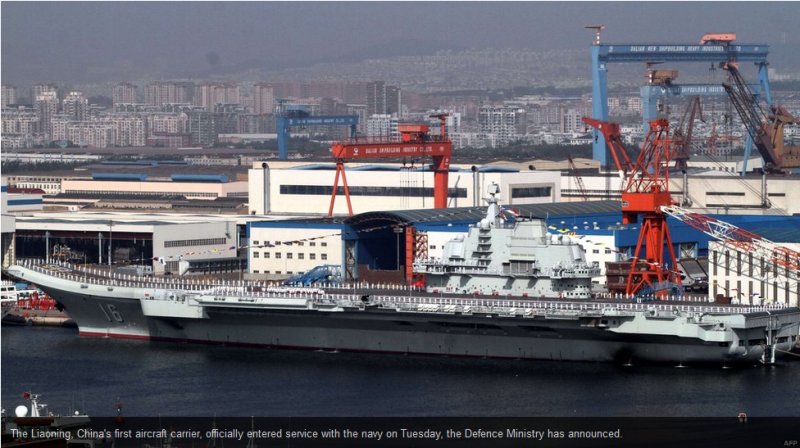
China’s first aircraft carrier at sea

Filed under: China, Military, Pacific — Tags: , , , — Nicholas @ 12:17

From the Guardian, including this satellite image:

A US satellite company says it has taken a photograph of China’s first aircraft carrier during trials in the Yellow Sea.

It is believed to be the first time the 300-metre ship, a refitted former Soviet carrier, has been photographed at sea since it was launched in August.

DigitalGlobe said one of its satellites took the picture on 8 December and an analyst at the firm spotted the ship this week while searching through images.

Stephen Wood, director of DigitalGlobe’s analysis centre, said he was confident the ship was the Chinese carrier because of the location and date of the image. The carrier has generated intense international interest because of what it might portend about China’s intentions as a military power.

The former Soviet Union started building the carrier, which it called the Varyag, but never finished it. When the USSR collapsed, the ship ended up in Ukraine.

December 14, 2011

Revolt in a Chinese fishing village

Filed under: China, Government, Media — Tags: , , , — Nicholas @ 13:08

Local unrest is hardly uncommon in China, but unrest of this nature is almost unheard of:

For the first time on record, the Chinese Communist party has lost all control, with the population of 20,000 in this southern fishing village now in open revolt.

The last of Wukan’s dozen party officials fled on Monday after thousands of people blocked armed police from retaking the village, standing firm against tear gas and water cannons.

Since then, the police have retreated to a roadblock, some three miles away, in order to prevent food and water from entering, and villagers from leaving. Wukan’s fishing fleet, its main source of income, has also been stopped from leaving harbour.

The plan appears to be to lay siege to Wukan and choke a rebellion which began three months ago when an angry mob, incensed at having the village’s land sold off, rampaged through the streets and overturned cars.

Of course, one of the reasons we rarely hear about protests of this nature is that the Chinese government actively suppresses media coverage. This is only coming to our attention because western journalists are there and able to communicate with their employers.

H/T to Jon, my former virtual landlord, who commented “You have to admire these 20,000 future organ donors for their intestinal fortitude”.

« Newer PostsOlder Posts »

Powered by WordPress