
Invicta
Published on 4 Sep 2017Alexander the Great is one of the most famous historical figures of all time. Yet many are unaware of the 9 times he cheated death over the course of his epic campaigns into the east!
Support future documentaries: https://www.patreon.com/InvictaHistory
Twitter: https://twitter.com/InvictaHistoryVideo Credits:
Research – Invicta
Script: Invicta
Narration – Invicta
Artwork – Robbie McSweeney (https://www.artstation.com/artist/rob…)Bibliography:
Alexander the Great by Phillips Freeman
The Campaigns of Alexander by ArrianMusic: “Rome: Total War OST” by Jeff van Dyck
“Total War: Rome II OST” by Richard Beddow
April 7, 2019
Epic Moments in History – The 9 Lives of Alexander the Great
Comments Off on Epic Moments in History – The 9 Lives of Alexander the Great
March 31, 2019
QotD: Gandhi’s not-so-non-violent followers
… it is not widely realized (nor will this film tell you) how much violence was associated with Gandhi’s so-called “nonviolent” movement from the very beginning. India’s Nobel Prize-winning poet, Rabindranath Tagore, had sensed a strong current of nihilism in Gandhi almost from his first days, and as early as 1920 wrote of Gandhi’s “fierce joy of annihilation,” which Tagore feared would lead India into hideous orgies of devastation — which ultimately proved to be the case. Robert Payne has said that there was unquestionably an “unhealthy atmosphere” among many of Gandhi’s fanatic followers, and that Gandhi’s habit of going to the edge of violence and then suddenly retreating was fraught with danger. “In matters of conscience I am uncompromising,” proclaimed Gandhi proudly. “Nobody can make me yield.” The judgment of Tagore was categorical. Much as he might revere Gandhi as a holy man, he quite detested him as a politician and considered that his campaigns were almost always so close to violence that it was utterly disingenuous to call them nonviolent.
For every satyagraha true believer, moreover, sworn not to harm the adversary or even to lift a finger in his own defense, there were sometimes thousands of incensed freebooters and skirmishers bound by no such vow. Gandhi, to be fair, was aware of this, and nominally deplored it — but with nothing like the consistency shown in the movie. The film leads the audience to believe that Gandhi’s first “fast unto death,” for example, was in protest against an act of barbarous violence, the slaughter by an Indian crowd of a detachment of police constables. But in actual fact Gandhi reserved this “ultimate weapon” of his to interdict a 1931 British proposal to grant Untouchables a “separate electorate” in the Indian national legislature — in effect a kind of affirmative-action program for Untouchables. For reasons I have not been able to decrypt, Gandhi was dead set against the project, but I confess it is another scene I would like to have seen in the movie: Gandhi almost starving himself to death to block affirmative action for Untouchables.
From what I have been able to decipher, Gandhi’s main preoccupation in this particular struggle was not even the British. Benefiting from the immense publicity, he wanted to induce Hindus, overnight, ecstatically, and without any of these British legalisms, to “open their hearts” to Untouchables. For a whole week Hindu India was caught up in a joyous delirium. No more would the Untouchables be scavengers and sweepers! No more would they be banned from Hindu temples! No more would they pollute at 64 feet! It lasted just a week. Then the temple doors swung shut again, and all was as before. Meanwhile, on the passionate subject of swaraj, Gandhi was crying, “I would not flinch from sacrificing a million lives for India’s liberty!” The million Indian lives were indeed sacrificed, and in full. They fell, however, not to the bullets of British soldiers but to the knives and clubs of their fellow Indians in savage butcheries when the British finally withdrew.
Richard Grenier, “The Gandhi Nobody Knows”, Commentary, 1983-03-01.
Comments Off on QotD: Gandhi’s not-so-non-violent followers
March 14, 2019
Tyler Cowen’s tips on visiting India
Although the blog post is nearly a month old, I completely missed it when it was first posted. It’s called “How to travel to India”, but it’s really more about how to get the best of your visit while you’re there. I’ve never been to India (and it seems unlikely I’ll ever get to visit), but from reading the accounts of other visitors, Tyler has some excellent advice here:
4. Every single part of India is interesting and worth visiting, as far as I can tell after five trips. That said, I find Bangalore quite over-visited relative to its level of interest.
5. My favorite places in India are Mumbai, Chennai, Rajasthan, and Kolkaata. Still, I could imagine a rational person with interests broadly similar to my own having a quite different list.
6. India has the best food in the world. It is not only permissible but indeed recommended to take all of your meals in fancy hotel restaurants. Do not eat the street food in India (and I eat it virtually everywhere else). It is also permissible to find two or three very good hotel restaurants — or even one — and simply run through their menus. You won’t be disappointed.
7. Invest in a very, very good hotel. It is affordable, and you will need it, and it will be a special memory all its own.
8. Being driven around in the Indian countryside is terrifying (and I have low standards here, I do this all the time in other non-rich countries). If it were safer, I would see many more parts of India. But it isn’t. So I don’t.
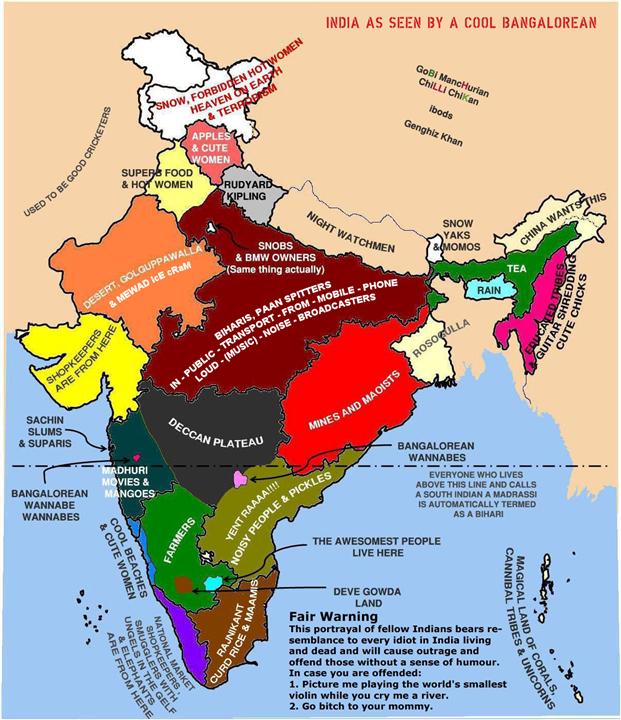
I’ve posted this before, and it doesn’t really relate to Tyler’s travel tips, but I still find it amusing:
Comments Off on Tyler Cowen’s tips on visiting India
March 12, 2019
9 British Dishes Everyone Should Try – Anglophenia Ep 2
Anglophenia
Published on 22 May 2014British food has a bad reputation, but Siobhan Thompson’s here to set the record straight, offering nine tasty U.K. dishes that will quiet the naysayers.
Visit the Anglophenia blog at http://www.bbcamerica.com/anglophenia
Photos via Fotolia.
Follow Anglophenia on Twitter: http://www.twitter.com/anglophenia
Follow Siobhan Thompson on Twitter: http://www.twitter.com/vornietom
Comments Off on 9 British Dishes Everyone Should Try – Anglophenia Ep 2
March 4, 2019
QotD: Gandhi and the partition of India
Anyone who wants to wade through Gandhi’s endless ruminations about himsa and ahimsa (violence and nonviolence) is welcome to do so, but it is impossible for the skeptical reader to avoid the conclusion — let us say in 1920, when swaraj (home rule) was all the rage and Gandhi’s inner voice started telling him that ahimsa was the thing — that this inner voice knew what it was talking about. By this I mean that, though Gandhi talked with the tongue of Hindu gods and sacred scriptures, his inner voice had a strong sense of expediency. Britain, if only comparatively speaking, was a moral nation, and nonviolent civil disobedience was plainly the best and most effective way of achieving Indian independence. Skeptics might also not be surprised to learn that as independence approached, Gandhi’s inner voice began to change its tune. It has been reported that Gandhi “half-welcomed” the civil war that broke out in the last days. Even a fratricidal “bloodbath” (Gandhi’s word) would be preferable to the British.
And suddenly Gandhi began endorsing violence left, right, and center. During the fearsome rioting in Calcutta he gave his approval to men “using violence in a moral cause.” How could he tell them that violence was wrong, he asked, “unless I demonstrate that nonviolence is more effective?” He blessed the Nawab of Maler Kotla when he gave orders to shoot ten Muslims for every Hindu killed in his state. He sang the praises of Subhas Chandra Bose, who, sponsored by first the Nazis and then the Japanese, organized in Singapore an Indian National Army with which he hoped to conquer India with Japanese support, establishing a totalitarian dictatorship. Meanwhile, after independence in 1947, the armies of the India that Gandhi had created immediately marched into battle, incorporating the state of Hyderabad by force and making war in Kashmir on secessionist Pakistan. When Gandhi was assassinated by a Hindu extremist in January 1948 he was honored by the new state with a vast military funeral — in my view by no means inapposite.
Richard Grenier, “The Gandhi Nobody Knows”, Commentary, 1983-03-01.
Comments Off on QotD: Gandhi and the partition of India
February 18, 2019
Forgotten history of India’s Thermopylae
The History Guy: History Deserves to Be Remembered
Published on 20 Jun 2017The History Guy tells the forgotten history of the World War II battle of Imphal also known as India’s Thermopylae.
The History Guy uses images that are in the Public Domain. As photographs of actual events are often not available, I will sometimes use photographs of similar events or objects for illustration.
Patreon: https://www.patreon.com/TheHistoryGuy
The History Guy: Five Minutes of History is the place to find short snippets of forgotten history from five to fifteen minutes long. If you like history too, this is the channel for you.
The episode is intended for educational purposes. All events are presented in historical context.
Comments Off on Forgotten history of India’s Thermopylae
February 16, 2019
Indian government considers hiking the national minimum wage
Tim Worstall explains why this is a bad idea that won’t do much — if anything — to improve the lot of workers already earning the current minimum wage, and might well make things worse:
It’s not surprising that this is happening, India mooting a rise in the national minimum wage. There is, after all, an election in the offing. Just when we would expect crowd pleasing but bad ideas to surface. The problem here is that the Indian minimum wage is already too high. Increasing something that’s too high is not sensible policy. […]
Sure, we can declare a floor price and that will be valid wherever the government’s writ runs. Which, in the Indian economy, isn’t all that far.
The national minimum wage could be set at Rs 9,750 per month, almost double the current level, along with an additional Rs 55 per day of average HRA for urban workers, an expert committee has submitted. The January report, which went public for suggestions on Thursday, has also suggested an alternate plan, with a range of Rs 8,892-11,622 per month of national minimum wage for five different regions as they have diverse socio-economic and labour market situations, The Indian Express reported.
The specific details don’t matter all that much because the Indian government isn’t that powerful in economic matters.
The point being that any formal minimum wage will only apply to people in the formal economy. Depending upon who you want to believe between 80 and 90% of the Indian economy is over in the informal sector. That’s the part of the economy that doesn’t have health and safety standards, proper contracts and minimum wages. And our proof that the current minimum wage is too high is exactly that, that most of the economy isn’t in the formal sector where it applies.
In one manner raising that Indian minimum wage is an irrelevance because it affects so few people. In another it’s actively bad, as it makes it more expensive to join that formal economy, thus making it less likely. Thus it’s a bad idea either way. But you know, elections, politics.
Comments Off on Indian government considers hiking the national minimum wage
February 13, 2019
The origins of the word “loot”
William Dalrymple wrote about the Honourable East India Company for the Guardian a few years back, including the way the word “loot” entered common English usage:
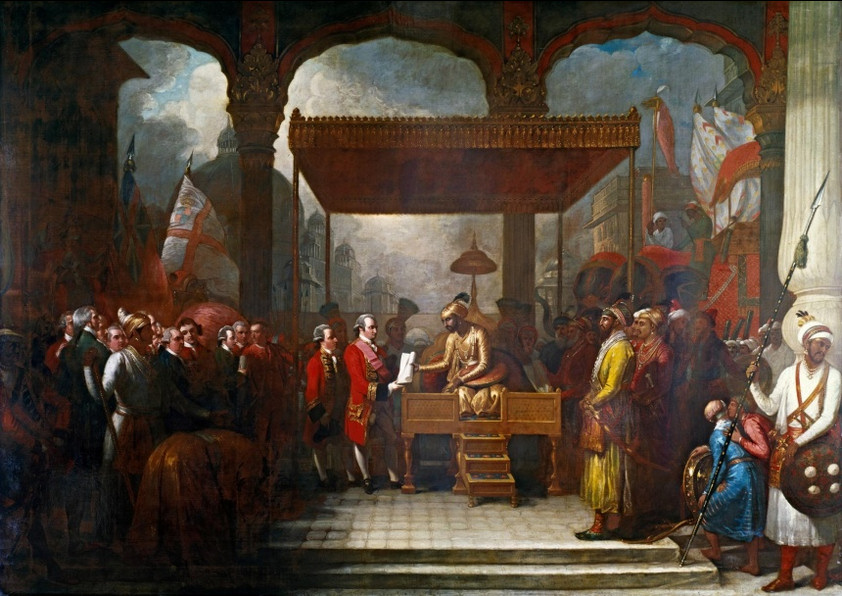
The Mughal emperor Shah Alam hands a scroll to Robert Clive, the governor of Bengal, which transferred tax collecting rights in Bengal, Bihar and Orissa to the East India Company, August 1765.
Oil painting by Benjamin West (1738-1820) via Wikimedia Commons.
One of the very first Indian words to enter the English language was the Hindustani slang for plunder: “loot”. According to the Oxford English Dictionary, this word was rarely heard outside the plains of north India until the late 18th century, when it suddenly became a common term across Britain. To understand how and why it took root and flourished in so distant a landscape, one need only visit Powis Castle.
The last hereditary Welsh prince, Owain Gruffydd ap Gwenwynwyn, built Powis castle as a craggy fort in the 13th century; the estate was his reward for abandoning Wales to the rule of the English monarchy. But its most spectacular treasures date from a much later period of English conquest and appropriation: Powis is simply awash with loot from India, room after room of imperial plunder, extracted by the East India Company in the 18th century.
There are more Mughal artefacts stacked in this private house in the Welsh countryside than are on display at any one place in India – even the National Museum in Delhi. The riches include hookahs of burnished gold inlaid with empurpled ebony; superbly inscribed spinels and jewelled daggers; gleaming rubies the colour of pigeon’s blood and scatterings of lizard-green emeralds. There are talwars set with yellow topaz, ornaments of jade and ivory; silken hangings, statues of Hindu gods and coats of elephant armour.
Such is the dazzle of these treasures that, as a visitor last summer, I nearly missed the huge framed canvas that explains how they came to be here. The picture hangs in the shadows at the top of a dark, oak-panelled staircase. It is not a masterpiece, but it does repay close study. An effete Indian prince, wearing cloth of gold, sits high on his throne under a silken canopy. On his left stand scimitar and spear carrying officers from his own army; to his right, a group of powdered and periwigged Georgian gentlemen. The prince is eagerly thrusting a scroll into the hands of a statesmanlike, slightly overweight Englishman in a red frock coat.
The painting shows a scene from August 1765, when the young Mughal emperor Shah Alam, exiled from Delhi and defeated by East India Company troops, was forced into what we would now call an act of involuntary privatisation. The scroll is an order to dismiss his own Mughal revenue officials in Bengal, Bihar and Orissa, and replace them with a set of English traders appointed by Robert Clive – the new governor of Bengal – and the directors of the EIC, who the document describes as “the high and mighty, the noblest of exalted nobles, the chief of illustrious warriors, our faithful servants and sincere well-wishers, worthy of our royal favours, the English Company”. The collecting of Mughal taxes was henceforth subcontracted to a powerful multinational corporation – whose revenue-collecting operations were protected by its own private army.
It was at this moment that the East India Company (EIC) ceased to be a conventional corporation, trading and silks and spices, and became something much more unusual. Within a few years, 250 company clerks backed by the military force of 20,000 locally recruited Indian soldiers had become the effective rulers of Bengal. An international corporation was transforming itself into an aggressive colonial power.
Using its rapidly growing security force – its army had grown to 260,000 men by 1803 – it swiftly subdued and seized an entire subcontinent. Astonishingly, this took less than half a century. The first serious territorial conquests began in Bengal in 1756; 47 years later, the company’s reach extended as far north as the Mughal capital of Delhi, and almost all of India south of that city was by then effectively ruled from a boardroom in the City of London. “What honour is left to us?” asked a Mughal official named Narayan Singh, shortly after 1765, “when we have to take orders from a handful of traders who have not yet learned to wash their bottoms?”
Comments Off on The origins of the word “loot”
February 11, 2019
QotD: Gandhi’s conflicted views of war and pacifism
… the real center and raison d’être of Gandhi is ahimsa, nonviolence, which principle when incorporated into vast campaigns of noncooperation with British rule the Mahatma called by an odd name he made up himself, satyagraha, which means something like “truth-striving.” During the key part of his life, Gandhi devoted a great deal of time explaining the moral and philosophical meanings of both ahimsa and satyagraha. But much as the film sanitizes Gandhi to the point where one would mistake him for a Christian saint, and sanitizes India to the point where one would take it for Shangri-la, it quite sweeps away Gandhi’s ethical and religious ponderings, his complexities, his qualifications, and certainly his vacillations, which simplifying process leaves us with our old European friend: pacifism. It is true that Gandhi was much impressed by the Sermon on the Mount, his favorite passage in the Bible, which he read over and over again. But for all the Sermon’s inspirational value, and its service as an ideal in relations among individual human beings, no Christian state which survived has ever based its policies on the Sermon on the Mount since Constantine declared Christianity the official religion of the Roman empire. And no modern Western state which survives can ever base its policies on pacifism. And no Hindu state will ever base its policies on ahimsa. Gandhi himself — although the film dishonestly conceals this from us — many times conceded that in dire circumstances “war may have to be resorted to as a necessary evil.”
It is something of an anomaly that Gandhi, held in popular myth to be a pure pacifist (a myth which governments of India have always been at great pains to sustain in the belief that it will reflect credit on India itself, and to which the present movie adheres slavishly), was until fifty not ill-disposed to war at all. As I have already noted, in three wars, no sooner had the bugles sounded than Gandhi not only gave his support, but was clamoring for arms. To form new regiments! To fight! To destroy the enemies of the empire. Regular Indian army units fought in both the Boer War and World War I, but this was not enough for Gandhi. He wanted to raise new troops, even, in the case of the Boer and Kaffir Wars, from the tiny Indian colony in South Africa. British military authorities thought it not really worth the trouble to train such a small body of Indians as soldiers, and were even resistant to training them as an auxiliary medical corps (“stretcher bearers”), but finally yielded to Gandhi’s relentless importuning. As first instructed, the Indian Volunteer Corps was not supposed actually to go into combat, but Gandhi, adamant, led his Indian volunteers into the thick of battle. When the British commanding officer was mortally wounded during an engagement in the Kaffir War, Gandhi — though his corps’ deputy commander — carried the officer’s stretcher himself from the battlefield and for miles over the sun-baked veldt. The British empire’s War Medal did not have its name for nothing, and it was generally earned.
Richard Grenier, “The Gandhi Nobody Knows”, Commentary, 1983-03-01.
Comments Off on QotD: Gandhi’s conflicted views of war and pacifism
February 8, 2019
History Summarized: The Portuguese Empire
Overly Sarcastic Productions
Published on 9 Nov 2018Play World of Warships for free: http://bit.ly/2zyT191. New players will receive 1 MILLION free credits, the historical premium ship HMS Campbeltown and more by using my code PLAYWARSHIPS2018
What happens when you spend a few decades casually getting really good at seafaring, only to find that there’s suddenly a whole new world that’s only accessible to societies with exceptional sailing prowess? — You get fabulously rich, that’s what. Watch along and learn all about the surprising success of Portugal!
PATREON: http://www.patreon.com/OSP
From the comments:
BenficaHaze 1904
1 month ago
Portugal didn’t follow Spain. Portugal started the discoveries 60-70 years before SpainPietro SF
1 month ago
The video already starts badly by suggesting Portugal only entered the Discoveries as a response to the Spaniards, when in reality the Portuguese pioneered the Age of Discovery, starting it half a century before Columbus’ Voyage.Daniel Ghan
1 month ago
Nice video, but 2 significant errors:
1) Columbus didn’t motivate Portugal’s exploration as the video implies; rather, it was the other way around. The Portuguese began searching for a way to India around Africa after the fall of Constantinople in 1453. Columbus, who was Italian, asked the Portuguese king to finance his expedition but was refused, and only then went to Spain.
2) Magellan (Magalhães) was Portuguese but his expedition was sponsored by Spain and he had a Spanish crew. So the expedition would not have returned to Lisbon.Metriximor
1 month ago
Alright, Portuguese here, just wanna say overall you did a great job but I wanna clear a few misconceptions.Portugal didn’t just spring up into action because of Columbus, in fact, he even asked the Portuguese Crown for funding before he asked the Spanish Crown. Portuguese discoveries began in 1418 with Madeira, 1427 we found Açores, then in 1434 Gil Eanes goes around Cape Bojador, 1472 we found Newfoundland, but most importantly, in 1487 Bartolomeu Dias goes around the Cape of Storms, and looking out at the huge possibilities of his accomplishment he declares it to be the Cape of Good Hope.
This was all before Columbus even thought of sailing the Atlantic(1488) or contacting the Spanish(1489), so saying Portugal just began exploring because of him is downplaying it a lot.
Otherwise, fantastic work, love your channel and content keep it up 😀
PORTUGAL CARALHO
Comments Off on History Summarized: The Portuguese Empire
January 22, 2019
Ending India’s longstanding caste system privileges
In the Continental Telegraph, Tim Worstall outlines the political change that might end up undermining the caste system to a large degree:
India has long had a series of reservations and quotas for varied classes. Dalits – formerly the untouchables – have long had privileges in access to university and government jobs for example. Over time, as such political systems do, the list of those classes privileged has grown.
Obviously enough, as such political systems do work, a major cause of unrest has been further classes, castes and groupings demanding that they be added to the list of groups that receive such privileges. And given electoral cycles that list has grown. The cynic will not be surprised to find that the surest method of a group being added to the list is to be the swing vote in a hotly contested election. We’re not talking about purity of motive here.
Of course, such a system eats away at the nation – we get into that communal division of the spoils rather than the lovely capitalist and free market game of increasing the spoils to be argued over. Which leaves us with a certain problem, leaves India with a certain problem.
[…]
If everyone’s covered by a reservation, if all are so privileged, then sure, we’ve an inefficient system still but we have also effectively abolished the value of having a reservation, a privilege. Thus the solution, the end game. So devalue the privilege as to make it effectively not exist by extending it to everyone.
Comments Off on Ending India’s longstanding caste system privileges
January 13, 2019
Canada’s role in India’s nuclear weapons development program
Canadian nuclear technology was critical to India for helping them develop their first nuclear weapons (although the Canadian reactor was supposed to be used only for civilian purposes):
Maybe you have heard the story of how India got the Bomb with Canada’s inadvertent help. We sold India a nuclear reactor called CIRUS in 1954 on an explicit promise that the facility would only be used for peaceful purposes. When India astonished the world with its first nuke test in May 1974, having upgraded the fuel output from CIRUS, it duly announced that it had successfully created a Peaceful Nuclear Explosive. The permanent consequence was, for better or worse, a nuclear-armed Subcontinent.
This is old news to enthusiasts of Cold War history. Here’s the new news: it almost happened twice. Canadian technology was almost used by another country to break into the nuclear club.
In November, historians David Albright and Andrea Stricker published a new book called Taiwan’s Former Nuclear Weapons Program: Nuclear Weapons On-Demand. The book pulls together the previously sketchy story of Nationalist China’s covert nuclear research, which had its roots in the postwar exodus of Chiang Kai-shek and the Kuomintang party (KMT). Albright and Stricker describe decades of effort by the offshore Republic of China on Taiwan to play a double game with nuclear weapons.
At first Taiwan engaged in sneaky nuclear research — it turns out that if you research nuclear safety you learn a lot about nuclear explosions — and it tried to create a plutonium stockpile on the sly. But their scientists left too many clues: a plutonium-based nuke requires processed plutonium metal, and that is hard to make without raising suspicions. The Indian test of 1974 was an important wake-up call to the world, and the nonproliferation establishment and the U.S. Department of State started to get nervous about Taiwan.
After a 1977 confrontation with American officials, who could hardly be ignored by the vulnerable Republic of China, the KMT deep state tried subtler methods to create the “on-demand” weapon described in the title. Taiwan committed formally to nonproliferation and full U.S. inspections of their facilities, but sought to be able to make low-yield nukes within three to six months in the event of a Communist invasion from the mainland.
Comments Off on Canada’s role in India’s nuclear weapons development program
The Chainsmokers – Closer | Scotland the Brave | Bagpipe Cover
TheSnakeCharmer
Published on 18 Jan 2017The Chainsmokers’ “Closer” meets traditional Scottish tune “Scotland the Brave”. Watch how magical it sounds together when played on Bagpipes. Don’t miss the dance action in between the video!
Please SHARE the video if you enjoyed watching 🙂Special thanks to Wenom (Dance Crew) for being a part of my video
Check them out here – https://www.youtube.com/channel/UCZoA…Support me here on Patreon – https://www.patreon.com/thesnakecharmer
Track Produced by Karan Katiyar
Check out his awesome metal parody channel here – www.youtube.com/bloodywoodVideo Editing – Karan Katiyar
Video Shoot – Aditi Verma
TGKI Productions
Comments Off on The Chainsmokers – Closer | Scotland the Brave | Bagpipe Cover
January 7, 2019
The Private Army of the British East India Company
Brandon F.
Published on 15 Dec 2018Before the days of the Raj, British India was ruled by a private corporation: The Honourable East India Company. The Company, which began in India as a purely mercantile institution, eventually came to control vast territories across the subcontinent. These wild frontiers and busy cities required garrisons to defend them, and the expansion of Company interests demanded the ability to wage war. To do this, the Company commanded a massive private army. Made up of both European and Indian soldiers, and working in close — if not always frictionless — tandem with H.M.’s regiments, it was a fascinating institution that only came to an end with the massive Sepoy Mutiny of 1857 and the dissolution of Company rule.
In this video, I discuss the organization of this army, and the way in which it related to government forces.
If you would like to support the Channel on Patreon:
https://www.patreon.com/BrandonF
Comments Off on The Private Army of the British East India Company
January 5, 2019
Irish Punjabi Party (New Way Forward) – The Snake Charmer ft. Raoul Kerr
TheSnakeCharmer
Published on 10 Dec 2018Bringing together a blend of cultures yet again in this fun and dancy tune popularly heard in Titanic called “Irish Party in third class”. Giving it The Snake Charmer effect we remade this song into something fun and pass a message of how some things like art, culture and ideas are better when brought and shared together. In this case blending a traditional Irish folk tune into electronic dubstep music with bhangra and punjabi beats. Today you can watch me because of the internet and i feel that using the internet to create a shared global culture is the way forward.
Music stays undivided 🙂Support me on:
Patreon – https://www.patreon.com/thesnakecharmer
iTunes – https://apple.co/2QLYaFn
Google Play – http://tiny.cc/2xam1y
Spotify – http://tiny.cc/xyam1yArchy J (The Snake Charmer) – Bagpipes
Raoul Kerr (Rapper)
Dhol – Sarthak Pahwa
Irish Dancers – Laura Whistler and her dancers
NCEA CCF Band (UK)Original Song is a Irish folk song called “Blarneys Pilgrim”
Comments Off on Irish Punjabi Party (New Way Forward) – The Snake Charmer ft. Raoul Kerr


