
On his Substack, Christopher Schwarz recounts a visit to the historical remains of the town of Herculaneum under the volcano that erupted in 79 AD, killing many thousands, but preserving a lot of the Roman town under many metres of volcanic ash:
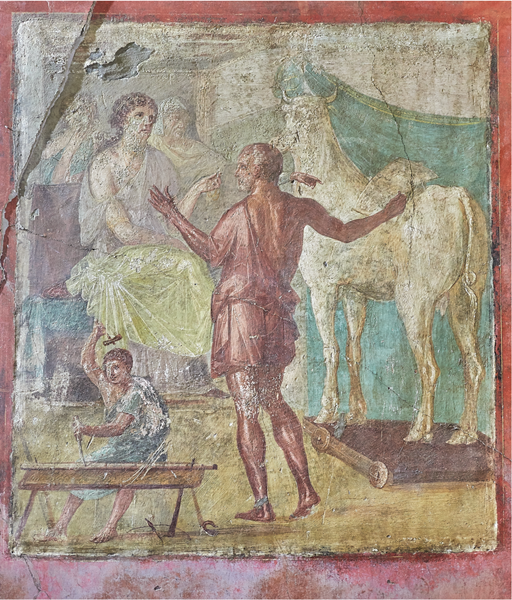
The beginning. In the House of the Vetti, this dining room fresco is perhaps the earliest depiction of a workbench in the West. (Photo by Narayan Nayar)
The journey to the summit of Mount Vesuvius has all the romance of visiting an unlicensed reptile farm. It begins in Ercolano, Italy, a touristy village in the shadow of the volcano and home to Herculaneum, one of the towns buried by Vesuvius’s eruption in 79 C.E.
As Narayan Nayar (the photographer for the journey) and I stepped off the train from Naples we were assaulted by young, attractive Italians. Their job: Bait tourists to nearby restaurants. We glanced around and saw only one escape route from the train station’s cul-de-sac. So, we plowed through the crowd of eager human fishing lures.
We emerged from the other side a bit relieved. Then we realized we’d scurried past the bus company that was supposed to drive us up the volcano. We turned around and dove back into the swarm of too-perky people in order to catch our bus.
The twisty-turny bus ride ended 660 feet below the volcano’s summit, and we then climbed a steep trail to the volcano’s rim. The top resembles a gravel pit where one of Frank Herbert’s worms might emerge. There’s no deep hole for tossing human sacrifices – throw a virgin into Vesuvius and she’s only going to get skinned knees and a sunburn. I looked around the volcano and promptly excused the early settlers of the area for building their homes at the base of Vesuvius. The only evidence you’re on a volcano (besides the little gift shops) is the occasional tiny plume of gas and the odd rocks below your feet.
I picked up a few rocks. For rocks, they were young – likely the result of the 1944 eruption, which destroyed several villages. I looked out from our 4,200-foot perch at the buildings in every direction below, which are built on top of villages that were covered in ash from earlier eruptions. It’s a grim scene if you think about it too much – 600,000 people now live in the so-called “red zone” for a future eruption.
And yet, as I fondled the rocks in my hand I felt only gratitude for this deadly, fire-breathing mountain.
The Earliest Workbenches
The recorded history of woodworking begins with the Egyptians. But the recorded history of workbenches begins (for now) with Vesuvius. Its massive eruption in 79 C.E. buried Pompeii, Herculaneum and other sites, preserving frescoes, buildings, pottery, human remains and even wooden furniture.
At Pompeii, the ash blanketed a fresco showing a low, four-legged workbench being used for mortising by a man in Greek attire. At nearby Herculaneum, the eruption preserved a fresco showing “erotes” – what we might call “buck nekkid cupids” – sawing a board at an eight-legged low workbench. It features a holdfast and other holdfast holes. This fresco has since been destroyed, but we have engravings that were made soon after its discovery (more on both the frescoes’ stories is ahead).
These two images are the earliest representations of workbenches of which I’m aware. And they launched my interest in exploring knee-high workbenches and how to use them to build furniture, boats, storage containers and wagon wheels.
The conventional wisdom is that these low benches were used in former times for simple work and were replaced by superior modern benches, which are thigh-high or taller. But the more I studied low benches, the more I found that they never disappeared. They are still in use. Additionally, these low benches can be used for complex work, including steam bending compound shapes and lutherie.
The low bench is more than a thick plank of wood with legs. It’s also a collection of simple jigs and appliances that allow you to do remarkable work while sitting comfortably on an easy-to-build platform. For centuries, these simple jigs remained hidden in plain sight in paintings and drawings in museums. And their appliances have been proven to work, both at my low benches and by the modern craftsmen who still use them.


