
Devon Eriksen explains the different purposes of the metric and Imperial systems:

Okay, time to explain the Imperial system, the metric system, and why attempts to replace either with the other are all retarded.
They have two different purposes.
The metric system is designed around precise measurement of objects. Its goal is to make engineering and scientific calculations simple.
The Imperial system is designed around humans. Its goal is to make calculation unnecessary.
100 degrees is really hot. 0 degrees is really cold. Anything that starts with a 5 is cool, anything that starts with an 8 is warm. No computation.
6 feet is tall, 5 feet is short.
100 pounds is light, 200 pounds is substantial, 300 pounds is heavy.
A 1000 square foot house is small, a 2000 square foot house is medium, a 3000 square foot house is large.
1 mile is a short walk, 2 miles is a medium walk, after that it takes a while.
1 acre of land is a homestead, 10 acres is an estate, 100 acres and up is a ranch or a farm.
Do you see now why it is so strange and awkward to convert from miles to feet?
It’s because converting from miles to feet is not something you’re supposed to do in the first place. Yes, they are both measures of length, so they are technically convertible, and yes, on rare occasions, you might need to do that.
But feet are for measuring humans, and things built around humans, like doorways, and mattresses. Miles are for measuring travel distance.
You wouldn’t measure the distance between Seattle and Portland in feet for the same reason you wouldn’t measure the distance between Tokyo and Osaka in mattress-lengths.
It would be silly.
This is why Americans so fiercely resistant to any notion of “conversion” to the metric system. Because it makes no sense. We already use the metric system for what it’s good for, which is doing physics and chemistry and whatnot.
But converting everyday measurements to the metric system would be less useful, generally inconvenient, and serve no purpose other than to make petty government bureaucrats happy that everything is now tidy, orderly, and worse, three qualities that bureaucrats love.
I thought about this carefully when I wrote my first science fiction novel. In the world of the 22nd century, extraterrestrial settlers (“Orbitals”) use three systems of measurement.
They measure themselves in feet, inches, and pounds.
They measure the spacecraft and habitats they build in meters and centimeters, grams and kilograms.
And they measure space travel distances in light-seconds and light-minutes.
Each system has its own natural scale.
The sole exception to this is when Marcus doses himself with drugs for high-g resistance, Miranda objects that he has taken too much, and Marcus responds by stating his mass … in kilograms.
Why?
Because they’re talking about drug doses, a engineering measurement. Drugs are dosed in milligrams per kilogram.
So, yes, the Imperial system makes perfect sense when you understand what it’s for, and no, we ain’t changing.
And, as a general rule, when an entire civilization of smart people does something for centuries, and it makes no sense to you, they’re probably not being silly.
It’s more likely there’s something you don’t know.
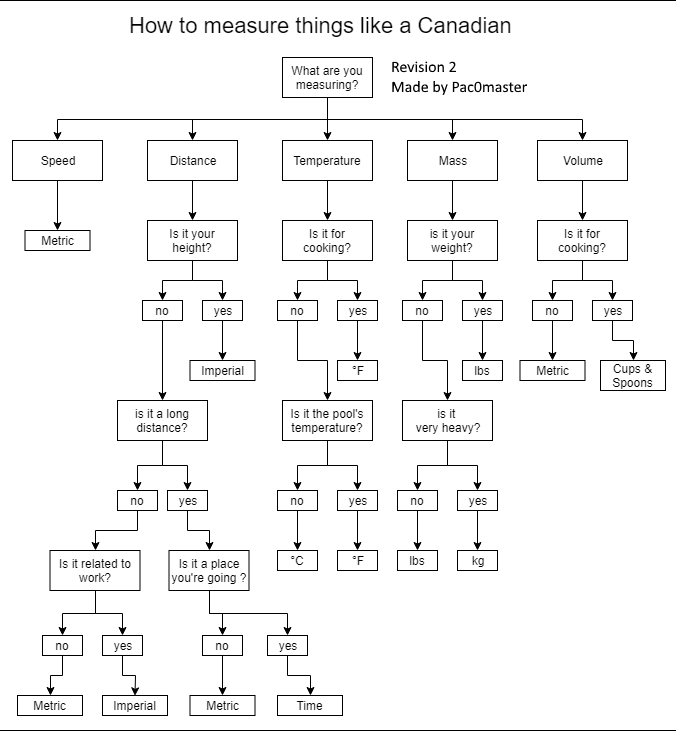
Most of the world switched over to the metric system, but some, like Britain and Canada still use both in a confusing-to-an-outsider idiosyncratic way:



Americans do not use the Imperial System. Americans have never used the Imperial System. The laws establishing the Imperial System in the British Empire were adopted in 1824 and took effect in 1826 — a half-century after the US had declared independence. The US government consciously and deliberately did not adopt the Imperial System. Americans have, since the Founding, simply and persistently kept using their non-system of accreted customary measures. When industrialization lead to an increased need for rigor, rather than make any reference to the Imperial System, the US independently defined its customary units in terms of metric units.
Comment by Annoyed Anonymous — June 24, 2026 @ 02:50
The more I’ve studied the Imperial system, the more I appreciate it. It was developed as a way to semi-standardize units in an era when literacy was basically nil. A foot was your foot. An inch was your thumb. A yard was your pace. A cup is what you can hold in your hands, and a gallon is what you need to drink a day to survive. Doesn’t really matter, in rural pre-industrial settings, what the specific distances are; when you’re building a cart or a house or a trebuchet by hand as long as your body remains consistent the measurements work. And this made it, as you say, ideal for measuring things related to humans. These are the measurements we in fact deal with, because they’re the way our bodies work.
The oft-stated idea that metric units are more precise, more scientific, more accurate is entirely nonsense. Look at the problems we have with defining the kilogram–it’s defined by a literal object, which is subject to radioactive decay and thus variable. Likewise, the definition of the meter has to change periodically. The reason is simple: They are arbitrary units of measurement, no less so than a yard or a pound.
For those really into the minutia of measurements, check out the definition of the foot in the USA. There are at least two–standard and survey feet. The difference is slight, but adds up quickly! If your survey is consistently 3 feet or so off what it should be, odds are you’re using the wrong foot.
Comment by Dinwar — June 24, 2026 @ 14:34
There are times I really “get” Grandpa Simpson …
Comment by Nicholas — June 24, 2026 @ 15:06