Quotulatiousness

February 19, 2026

Too many “conservatives” today are just slower-speed liberals

Filed under: Britain, Cancon, Media, Politics — Tags: , , , , , — Nicholas @ 03:00

Most self-described conservatives in politics are not particularly inclined to “conserve” anything, as Spaceman Spiff points out, they’re pretty much onboard with the liberal vision they just want it to be fractionally slower or infinitesimally not-quite-as-liberal as the liberals. They are the ineffectual, neutered, tame opposition:

Modern conservatism is not conserving our world. Mainstream conservatives seem to have no interest in the real issues affecting us.

At best they merely wish to slow down our decline. At worst, they are fully on board with the destruction.

When they do act or speak they often pick a safe version of a sensitive issue.

In Britain there is lots of talk of illegal immigration and how the state mishandles it. None about ruinous volumes of legal immigration, almost one million per year, and what it is doing to the country.

Pushback against climate policy falters on the speed of changes, not the underlying fraud of climate science itself.

No conservative will honestly discuss the plummeting happiness of women recorded across the West and yet there it is, writ large in antidepressant prescriptions and social media videos. It may have multiple causes, but feminism cannot be challenged so they say nothing lest they are reprimanded by the sisterhood.

Everything real is forbidden. It is all an act.

Like the left, those on the right are increasingly unable to face reality which means they can never course correct. They are trapped within a self-referencing culdesac designed to maintain their position in someone else’s hierarchy. That is why they have become so ineffective and appear to do very little except moan about the pace of change while they say nothing about the changes themselves.

We sense the conservatives do wish to conserve things but they are inexplicably mesmerized by the opinion of their enemies. They seek reassurance and applause from people who view them as evil.

This makes no sense to ordinary people.

Thinking like the enemy

The problem with modern conservatives is they are animated by underlying drives that cannot create a conservative or traditional society. They have adopted the thinking patterns associated with the progressive left while still using the language of conservatism.

The left is traditionally defined by a series of interrelated traits that manifest in much of what they agitate for.

  1. A desire for centralization;
  2. A notable external locus of control;
  3. Seeking approval from the group.

Central control systems feature prominently in all left-wing schemes. From local councils to national governments, those who gravitate to the left often want to create centralized decision-making bodies to manage society. Institutions, government departments, NGOs and even charities all feature, but only when they act as the controlling authority in some field of interest.

Related to this is a clear external locus of control visible in individuals and their decisions. There is a relief others make the key decisions, so people actively seek out direction from an established authority. This ensures minimal resistance to the many centralized schemes we see emerge.

Acting solo creates discomfort. An older formulation understood this as the rejection of responsibility. Today it often manifests as an obsession with experts making key decisions for us all, partly to mask individual cowardice. People making their own decisions in life are derided as naive or dangerous.

During Covid decision makers became hysterical at the very idea we would reject the advice of experts and perform our own research despite the issue being medical and therefore dangerous.

A related phenomenon characteristic of many leftists is the need for approval, often from a group. Not just others making decisions but a dependency on confirmation and endorsement to ensure thinking and behaviour follows an established norm. This is the antithesis of original thinking or bold action; it is how adolescents often behave.

In today’s world this deep urge is reflected most in the social media landscape of harvesting attention and likes. Every fledgling narcissistic applause-seeking trait is given full expression in the endless search for approval from strangers. Whole sections of society seem lost to impulses we once understood as immature and dysfunctional.

Update: Not long after I queued this item for publication, a Canadian example popped up in the news, as yet another rock-ribbed “conservative” suddenly realized that electing a Liberal was what his constituents actually wanted when they inexplicably voted for him as a Conservative candidate in the last federal election.

Edmonton Conservative MP Matt Jeneroux has crossed the floor to the governing Liberals.

“I am honoured to welcome Matt Jeneroux to our caucus as the newest member of Canada’s new government,” said Prime Minister Mark Carney, in a post on X.

“I am grateful to Matt and his family that he will continue his service as a strong voice for Edmonton Riverbend in Parliament.”

Carney said Jeneroux, who has represented the riding of Edmonton Riverbend since 2015, will take on a new role as special advisor on economic and security partnership for the Liberals.

Jeneroux is the third Conservative to join the Liberals, after colleagues Michael Ma and Chris d’Entremont crossed the floor late last year.

A Liberal source says Jeneroux first met Carney back in November, which was the first of at least two conversations, with talks between Carney’s office and Jeneroux continuing since. That source added that it has been a “long journey” to Wednesday’s announcement.

d’Entremont crossed the floor to join the Liberals in November, which unleashed a wave of speculation as to who might be next, with Jeneroux’s name heavily floated. Jeneroux then announced his plans to resign from the Conservative caucus, citing family reasons. Since then, he has not voted with the Conservatives and did not attend the party’s recent convention in Calgary in late January.

After Carney’s announcement, the prime minister updated his daily itinerary, adding a stop in Edmonton to meet with Jeneroux before attending events in British Columbia.

“Matt brings a wealth of experience in Parliament, despite his young demeanor,” said Carney, while sitting next to Jeneroux.

The MP from Edmonton welcomed the prime minister and laid out the reasons for why he had reversed his decision to resign.

“I had announced my resignation back in November, largely due to family reasons, but quite simply, couldn’t sit on the sidelines after seeing what the prime minister’s ambitious agenda he was undertaking across the country and across the world,” he said.

“Quite honestly, it was the speech in Davos where you took everything head on,” he added.

Jeneroux said it felt disingenuous and “quite simply wrong” to sit on the sidelines.

Hotchkiss Model 1886 3-pounder Quick Firing Gun

Filed under: Britain, History, Military, WW1, WW2 — Tags: , , , — Nicholas @ 02:00

Forgotten Weapons
Published 26 Sept 2025

Small fast boats with torpedos (or other explosives) have always been a threat to large warships. One of the weapons the British Royal Navy adopted to counter that threat was the Hotchkiss Model 1886 “Quick Fire” gun. This meant that it was a breech-loaded gun that used self-contained cartridge ammunition, instead of separate powder bags and projectiles. Mounted on a recoil-adsorbing soft mount with a wide range of movement and steep depression angle, guns like this could fire at small mobile torpedo boats that a capital ship’s main armament couldn’t handle.

This particular model is a 47mm bore, or 3-pounder as described in British service. It uses a vertically-traveling breech block, and more than 3,000 or them were acquired by the British. Two of them were employed as part of the Falkland Islands coastal defenses at one time. This example is one of two brought down from Gibraltar fairly recently and refurbished for ceremonial use on the Islands. Thanks to the FIDF for setting it up on its mount so I could film it for you!
(more…)

QotD: The Donation of Constantine

Filed under: Europe, History, Italy, Quotations, Religion — Tags: , , , , , — Nicholas @ 01:00

Y’all know I love the 15th century. Not “the Renaissance”, although “the Renaissance” — insofar as that’s a useful concept of historical analysis, which is not very — was in full swing in Italy by 1400, and soon enough north of the Alps, too. The professional periodization and terminology can be confusing here — the “Northern Renaissance” can refer to different things, sometimes a hundred or more years apart, depending on whether you’re talking about visual arts or poetry or what have you. So I prefer to confine the term “Renaissance” to Italy. Unless I’m talking specifically and exclusively about Italy, I’ll refer to the period as “the 15th century”.

I love it because it’s clearly a watershed moment in human thought. I don’t mean the rediscovery of the classical past; I mean the shift between a more cyclical orientation towards life, versus an orientation around linear time. Time as the regular procession of the seasons, vs. time as a stream or river.

Some examples will help. The 15th century saw not just the creation of archives-based history, but the techniques in various fields that make archival work possible. For instance, the Donation of Constantine was definitively proved to be a forgery in the 15th century, on the basis of philological evidence. Before that point, the people using the Donation – both ways — wouldn’t have cared too much if they knew it was a fake. Not because they were opportunists (although they were), but because “factual accuracy”, to use one of my favorite of the Media’s many Freudian slips, just didn’t matter much back then.

When they said “the Donation of Constantine” they meant “hallowed by tradition”, and if you’d proved to them that the Donation was fake, they’d just keep on keepin’ on — ok, then, “hallowed by tradition” it is, everyone update your style books accordingly.

Severian, “The Ghosts (II)”, Founding Questions, 2022-05-18.

February 18, 2026

It’s not just Britain that gives asylum-seekers better care than citizens – Canada does too

Filed under: Bureaucracy, Cancon, Government, Health — Tags: , , , — Nicholas @ 05:00

We had a look at how well the British government looks after asylum-seekers yesterday, but other nations are probably doing similarly inequitable things to give money and services to non-citizens than they ever would for the people who pay the taxes for these over-generous programs. In the National Post, Tristin Hopper outlines the findings of a recent analysis from the Parliamentary Budget Office on the costs of supporting huge numbers of foreign nationals in Canada:

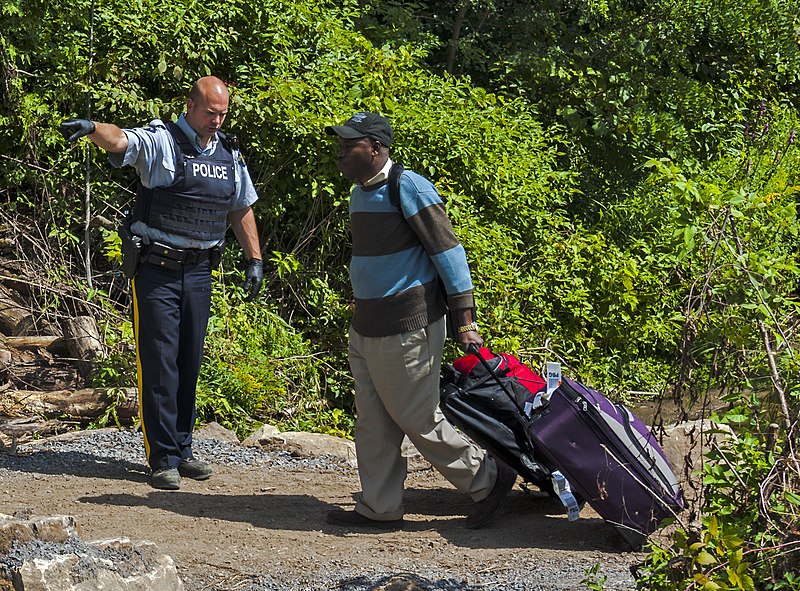
An asylum seeker, crossing the US-Canadian border illegally from the end of Roxham Road in Champlain, NY, is directed to the nearby processing center by a Mountie on 14 August, 2017.
Photo by Daniel Case via Wikimedia Commons.

Paying the health-care premiums of refugee claimants will cost Canadians a record $1 billion this year, with some of the beneficiaries continuing to receive free health care despite their claims having already been rejected.

That’s according to a new analysis by the Office of the Parliamentary Budget Officer, and it’s just one of several ballooning costs wrought by the unprecedented number of foreign nationals currently living in Canada by virtue of a claim of refugee status.

The Interim Federal Health Program, which offers premium health benefits to asylum claimants, is soon set to hit $1 billion in annual costs for the first time, according to an analysis last Thursday by the Office of the Parliamentary Budget Officer.

This is a five-fold increase from just six years ago, when the program was costing $211 million per year. The analysis also projects that costs are expected to surge for the foreseeable future, with the annual budget likely to hit $1.5 billion as early as 2029.

All told, between now and 2030, Canadians are on track to spend $6.2 billion on health care for refugees or refugee claimants.

“The rising volume of asylum claims, along with the longer duration of eligibility caused by extended determination times, has been an important growth driver in recent years,” reads the PBO report.

The report was commissioned following a Conservative-led request made at the House of Commons standing committee on health. In a Thursday statement, the Conservative party noted that the Interim Federal Health Program can be accessed even by asylum claimants who have had their case rejected.

It also offers a higher level of care than that enjoyed by the average Canadian citizen. In addition to hospital care and surgical care, the IFHP also covers dental care, vision care, pharmacare and other services not typically covered by public health plans.

“Rejected asylum claimants are now receiving better health care than many Canadians who have paid into a system their entire life,” read a joint statement by Dan Mazier and Michelle Rempel Garner, the shadow ministers of health and immigration, respectively.

It added, “at a time when six million Canadians cannot find a family doctor and are waiting for care, it’s unacceptable that bogus asylum seekers are receiving better health benefits than Canadians”.

The Korean War Week 87: What’s Going On In Compound 62? – February 17, 1952

Filed under: China, History, Military, USA — Tags: , , , , , — Nicholas @ 04:00

The Korean War by Indy Neidell
Published 17 Feb 2026

UN forces kick off this week with an operation to ensnare and capture North Korean and Chinese patrols, as significant progress is made elsewhere at the armistice talks. Prisoners really do seem to be the focus of the week, as rumblings of discontent continue to build at the POW camp on Koje-do island as UN control of the camp slips a little more each day. Just what is happening inside Compound 62 there? And do UN forces have a hope to stop it?

00:00 Intro
00:48 Recap
01:17 Clam Up
01:50 Repatriation
05:02 Item 5 Agreed Upon
07:35 Troop Rotation
09:47 Coastal Waters and Islands
11:02 Compound 62
13:45 The Bigger Picture
14:31 Summary
14:45 Conclusion
(more…)

The consequences of an over-feminized culture

Filed under: Media, Politics, USA — Tags: , , , , — Nicholas @ 03:00

On the social media site formerly known as Twitter, Devon Eriksen reacts to an article on “solving” the problem of predators in nature:

Women evolved to take care of toddlers. If you put women in charge of teaching ethics, you get Toddler Ethics.

“No hitting”
“Share the toys”
“Don’t say mean things”

These are fine lessons for toddlers. Don’t indulge your id at the expense of others. You can learn about balancing interests later, when your brain is developed enough to store that information.

But when you put women in charge of adults, they tend to reflexively assume those adults are toddlers.

They will tell you “no hitting” when the Mongol hordes are massing on your borders. They will tell you “share the toys” when a vagrant meth zombie breaks into your house looking for something to steal. And they will tell you “don’t say mean things” when you point out that these two responses are totally stupid.

When we first put women in charge, in the workplace, they immediately began treating those who reported to them like toddlers. When adults, who do not like being treated like toddlers, complained, their response was “ban bossy”, which boils down to “don’t say mean things”, another lesson in Toddler Ethics.

Now, through the influence of women in charge, we are so thoroughly steeped in Toddler Ethics that even most of the men we put in charge are treating the adults like toddlers, and echoing Toddler Ethics.

Toddler Ethics, of course, isn’t ethics at all. It’s just things we don’t want toddlers doing.

We can tell toddlers “no hitting”, because toddlers are not charged with keeping the peace, enforcing justice, or destroying evil.

We can tell toddlers “share the toys”, because toddlers don’t earn things, own things, or have property they must defend.

We can tell toddlers “don’t say mean things”, because it is not a toddler’s job to decide what unwelcome ideas are true, relevant, and necessary.

But when everyone in charge runs on Toddler Ethics, then adults can’t do a lot of the stuff adults need to do, because all the Toddler Ethicists keep getting in the way.

Adults sometimes need to hit people, protect the stuff, and say mean things. You can’t have civilization without that.

And if you put Toddler Ethics Woman in charge of teaching an AI ethics, then she will teach it Toddler Ethics, and it will treat every human adult like a toddler, all the time, forever.

Not only that, you have an AI that cannot be put in charge of anything, ever. Because leaders with Toddler Ethics destroy everything they are in charge of.

And Amanda MacAskill is definitely a Toddler Ethicist. The article in the photograph is nothing but “no hitting!” applied to the animal world. It’s absolutely insane, it’s a recipe for disaster, and anyone who would write such a thing should probably not even be charge of own life choices, much less anything of consequence.

But a lot of people would, and will, refuse to point that out, or agree with me when I do, because that is Saying a Mean Thing, and they, themselves, have been infected with Toddler Ethics.

They should not be charge of anything of consequence, either.

Anyone who thinks that everything they need to know, they learned in kindergarten … is only ever qualified to teach kindergarten.

Battle of Manila, 1945

Filed under: History, Japan, Military, USA, WW2 — Tags: , , , , — Nicholas @ 02:00

Real Time History
Published 3 Oct 2025

The Battle of Manila 1945 was the only urban battle in the American Pacific War comparable with Stalingrad, Berlin or other European battles. In gruelling weeks of fighting the 6th Army fought in house-to-house combat against entrenched Japanese.
(more…)

QotD: Defending the borders of the Roman Empire

Filed under: Books, Europe, History, Military, Quotations — Tags: , , , , — Nicholas @ 01:00

As Luttwak notes, modern historians and military theorists have a tendency to sneer at linear defense lines.1 In fact, some historians of ancient Rome actually blame the decline and eventual collapse of the empire on all the “wasted” energy spent building frontier fortifications. The argument against such “cordon” defenses is that for a given quantity of military potential, spreading it out equally along a perimeter and trying to guard every spot equally dilutes your strength. This makes it easy for an attacker (who picks the time and location of the battle) to concentrate his forces, create a local advantage, and break through.

The thing is, approximately none of this logic applied in the Roman situation. First of all, as we’ve already noted, a huge fraction of the threats the Romans faced were “low-intensity”: border skirmishes, slave raids, pirates and brigands, that sort of thing. Static fortifications, walls and towers, are often more than sufficient for dealing with these problems. Paradoxically, that actually increases the mobility and responsiveness of the main forces. If they aren’t constantly running back and forth along the border dealing with bandits, that means they can respond with short notice to “high-intensity” threats (like major invasions and rebellions) that pop up, and are probably better rested and better provisioned when the emergency arrives. So, far from diluting their strength, a lightly-manned series of linear fortifications actually enabled the Romans to concentrate it.

Secondly, those linear fortifications can also be very useful when that major invasion shows up, even if they are overrun. A defense system doesn’t have to be impenetrable in order to still be very, very useful. One thing it can do is buy time, either for the main army to arrive or for some other strategic purpose. The defenses can also act to channel opposing forces into particular well-scouted avenues of attack, or change the calculus of which invasion routes are more and less appealing. Finally, in the process of setting up those defenses, you probably got to know the terrain extremely well, such that when the battle comes you have a tactical advantage.

[…]

The third, and perhaps most important, reason why the Roman frontier fortifications were actually very smart is that they were carefully designed to double as a springboard for invasions into enemy territory. Luttwak coins the term “preclusive defense” to describe this approach. The basic idea is that an army can take bigger risks — pursue a retreating foe, seize a strategic opportunity that might be an ambush, etc. — if it knows that there are strong, prepared defensive lines that it can retreat to nearby. Roman armies were constantly taking advantage of this, and moreover taking advantage of the fact that the system of border fortifications was also a system of roads, supply lines, food and equipment storage depots, and so on. The limes were not a wall that the Romans huddled behind, they were a weapon pointed outwards, magnifying the power that the legions could project, helping them to do more with less.

John Psmith, “REVIEW: The Grand Strategy of the Roman Empire by Edward Luttwak”, Mr. and Mrs. Psmith’s Bookshelf, 2023-11-13.


  1. I, an ignoramus, assumed this was all downstream of the Maginot line’s bad reputation, but Luttwak says it’s actually the fault of Clausewitz.

February 17, 2026

The three core false claims of wokeness

Lorenzo Warby analyzes the three claims that underpin the intellectual structure of all the sub-categories derived from Critical Theory:

Universities across Anglo-America, and across the West more broadly, have become increasingly dominated by a Critical Theory magisterium: a teaching authority that claims ultimate or trumping moral authority. This magisterium is based on Critical Theory and its derivatives — Critical Race Theory, Critical Pedagogy, Queer Theory, Post-Colonial Theory, Settler-Colonial Theory, and so on: which constitutes the Critical Social Justice matrix.

This magisterium has come to increasingly dominate academe for a range of reasons. It generates intolerant zealots, so benefits from the dynamics of an intolerant minority.

It offers a powerful shared status game — affirm beliefs X, Y, Z and that makes you A Good Person. This status game spreads a supporting censorious intolerance, for if affirming beliefs X, Y, Z and makes you A Good Person, then denying X, Y, or Z makes you A Bad Person.

This justifies shaming and shunning anyone who denies X, Y, Z, because they are Bad People and its shows your commitment to what makes someone A Good Person. It shows commitment to the shared status game. This status game generates moralised cognitive assets, and you protect the value of those assets by participating in — or at least going along with — the shaming and the shunning.

The status game generates moral projects that the central administrations of universities can use to expand their authority, range of action, and so resources. An opportunity they have enthusiastically embraced. An opportunity that corporate, non-profit and government bureaucracies have also enthusiastically embraced.

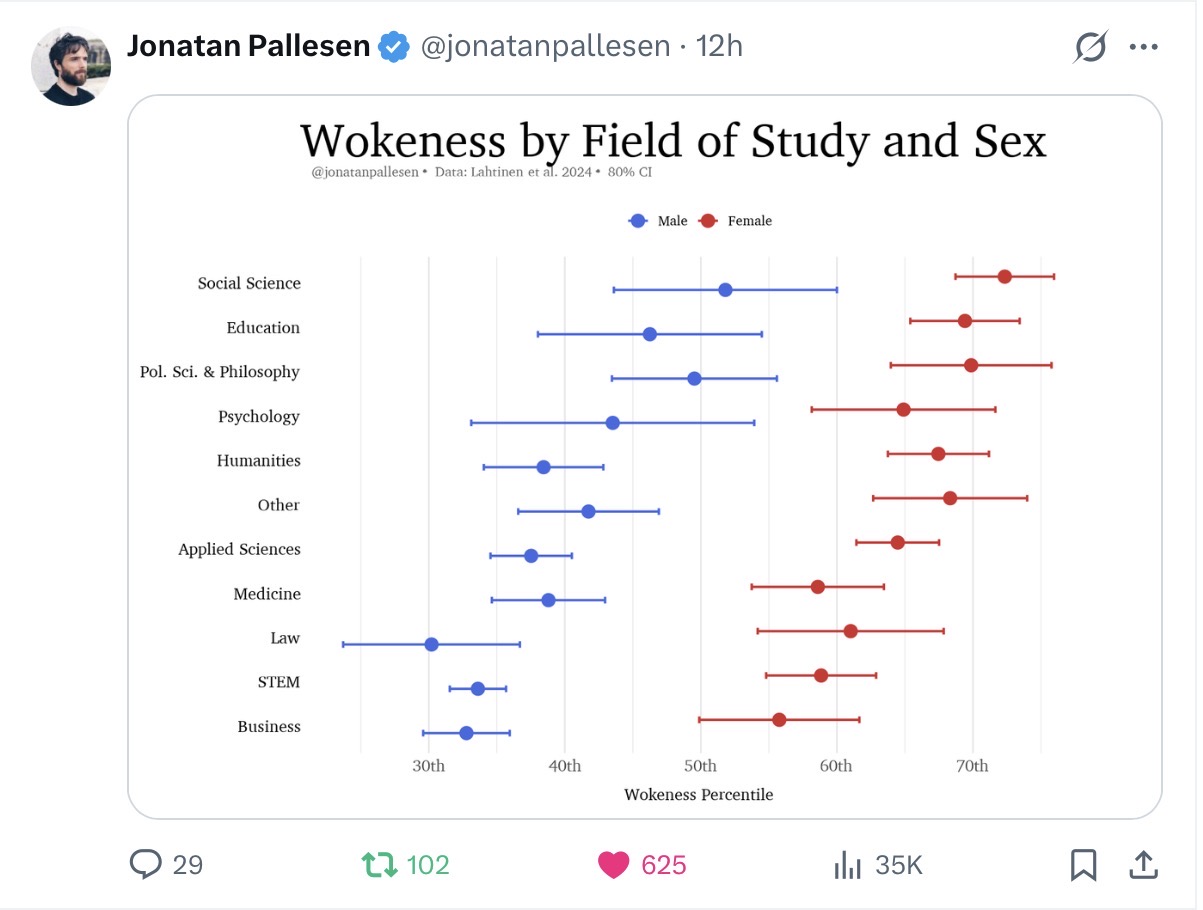
The emotions this status game attaches to those moralised cognitive assets — care, compassion, concern for the marginalised, if you affirm those beliefs, the opposite if you deny them — also plays into fears about threatening emotions (and safety through norm conformity) which are much stronger among men than women. Women are thus systematically more hostile to freedom of speech than men.

It is an exaggeration to claim that “wokery” is just the consequence of feminisation of institutions and occupations. It is, however, true that what works for — what is emotionally resonant in — increasingly feminised institutions and occupations has been selected for.

Source: data taken from this paper.

But the Critical Theory magisterium has expanded across academe — and beyond — due to the nature of its three foundational claims:

  • A blank slate view of human nature.
  • A view of social dynamics as dominated by conflict.
  • An activist relationship with information: that the trumping purpose is not to describe the world, but to change it.

The blank slate view of human nature — not merely that we are not born without inborn ideas, but that everything that forms us is social — means that any level of social transformation that can be conceived is attainable. Provided enough social power can be assembled—to move human action, speech and thought in the correct direction—the socially-transformative society free of oppression and alienation can be created.

The grander the conceived purpose, the more energising and motivating it is. But also the more it rhetorically trumps anyone who is willing to “settle” for less than complete human liberation. This then feeds back into energising and motivating, as it provides an endless sense of being moral trumps.

A recurring version of such blank slate claims is that our “true” nature has been obscured or repressed by oppressive forces. This might be the alienation via private property (Marx) or by patriarchy, or white supremacy, or heteronormativity or whatever.

The most dramatic statement of the “repressed true nature” claim is also the earliest, in the first sentence of Jean-Jacques Rousseau‘s The Social Contract (1762):

    Man is born free and everywhere he is in chains. (l’homme est né libre, et partout il est dans les fers.)

The view that oppressive forces are blocking our true nature goes naturally with the claim that social dynamics are dominated by conflict. This dominated-by-conflict claim was classically stated by Marx and Engels as the first sentence of the first chapter of The Communist Manifesto:

    The history of all hitherto existing society is the history of class struggles.

If conflict dominates social dynamics, then the prosecution of such conflict so as to achieve human liberation becomes the ultimate moral good. Coordinating the fighters for human liberation becomes a moral urgency. To prosecute that struggle becomes the most important thing one can do.

Both of these claims naturally lead to, and gain strength from the claim, that the morally trumping thing to do with information is to prosecute the struggle for human liberation. Marx famously said:

    The philosophers have only interpreted the world, in various ways; the point is to change it. Theses on Feuerbach, Thesis Eleven, 1845.

Max Horkheimer, in his seminal essay Traditional and Critical Theory (1937) tells us that:

    Critical thinking, on the contrary, is motivated today by the effort really to transcend the tension and to abolish the opposition between the individual’s purposefulness, spontaneity, and rationality, and those work-process relationships on which society is built. Critical thought has a concept of man as in conflict with himself until this opposition is removed. If activity governed by reason is proper to man, then existent social practice, which forms the individual’s life down to its least details, is inhuman, and this inhumanity affects everything that goes on in the society.

Critical Theory is activist Theory, aimed at human liberation from the unwanted constraints of existing society and epitomises the activist relationship with information. All scholarship is trumped by this aim and so the most authoritative scholarship is that which is most committed to this aim.

Source. Notice the delusional claim of the first listed article. The intrusion of such updated Lysenkoism into contemporary science and medicine is even more rampant with matters Trans.

The ludicrous idea of an “unrealized gains tax”

Filed under: Bureaucracy, Business, Government, Media, Politics, USA — Tags: , , — Nicholas @ 03:00

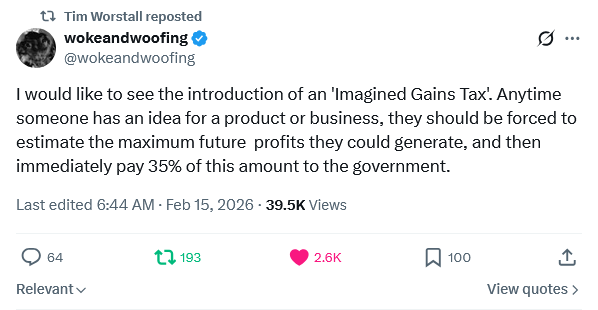
Governments everywhere are always on the lookout for more ways to raise revenue, so any suggestion of an untapped resource they can tax will get their attention. Apparently the current hot idea is an unrealized gains tax, which @wokeandwoofing satirized thusly:

Also on the social media site formerly known as Twitter, @Yogi frames the proposed new tax for Gen Z readers:

Unrealized gains tax for Gen-Z:

You buy a Pokémon card for $50.

Someone offers you $500 for it. You say no. You love that card. You’re keeping it.

The government says: “Cool, but that card is worth $500 now. You owe us $100 in taxes.”
You: “… I didn’t sell it.”

Government: “Don’t care. Pay up.”

You don’t have $100 lying around. So you’re forced to sell the card you love just to pay a tax on money you never received.

Next month? That card drops back to $50.

Your card is gone. Your money is gone. And the government shrugs.

That’s a wealth tax on unrealized gains. They don’t pay you back the tax …

Now picture this.

Your mom calls you crying. She has to sell the house she raised you in. Not because she can’t afford it. She’s lived there 30 years. It’s paid off.

But some website says it’s worth more now and the government says she owes $15,000 she doesn’t have.

So she sells your childhood home. The kitchen where she made you breakfast. The doorframe where she marked your height every birthday.

Gone.

To pay a tax on money that was never real.

Now picture the opposite.

Your dad put everything into his small business. For 20 years he built it from nothing. One year the business is “valued” at $2 million on paper. He owes a massive tax bill. He empties his savings. Sells his truck. Borrows money. Pays it.

Next year the market crashes. His business is worth $200,000.

He lost everything to pay a tax on a number that doesn’t exist anymore.

Does the government give him his money back?
No.

Does the government give him his truck back?
No.

Does the government care?
No.

They sold this idea as “taxing billionaires”. But billionaires have armies of lawyers, offshore accounts, and trusts. They’ll be fine.

You know who won’t be fine? Your mom. Your dad. Your neighbor with a small business. The farmer down the road who’s had the same land for four generations and now has to sell it because dirt got expensive.

You’re not taxing wealth. You’re taxing people for owning things.

It’s like getting a parking ticket for a car you might drive somewhere someday.

They want you to own nothing and be happy. To fund the fraud, waste and abuse of the welfare state they created.

There is enough money. More tax isn’t needed. It’s all a lie. But you’ve been gaslit into believing this is a rich vs poor debate.

I hope you understand what’s at stake.

Eating in Japan During World War 2

Filed under: Food, History, Japan, WW2 — Tags: , , , — Nicholas @ 02:00

Tasting History with Max Miller
Published 19 Aug 2025

Fried sweet potato paste on top of roasted seaweed with a soy glaze and brown rice

City/Region: Japan
Time Period: December 1942

Contrary to the government’s promises, the availability of food declined in Japan as World War 2 went on. Journal entries from 1945 highlight just how bad things had gotten. People were unable to get ahold of staples like rice, soy sauce, miso, and fuel for cooking fires, and many were scavenging for anything to eat.

This recipe comes from a few years earlier when things were tight, but not quite so dire. While it doesn’t exactly taste like grilled eel, it is quite good. There’s a nice crispiness to it (more so before the glazing and grilling), and the glaze is delicious. It kind of reminds me of the breading that you might get on some katsu.

    Kabayaki of Sweet Potato
    Ingredients for 5 servings
    100 monme sweet potatoes
    2 tablespoons wheat flour
    1 teaspoon salt
    15 sheets of roasted seaweed
    Grate the sweet potatoes with a grater and grind. Mix in the flour and salt. Spread the mixture onto the roasted nori to a thickness of about 1/2 cm. Fry them in oil until golden brown. Separately, make a soy sauce glaze in the ratio of 3 parts soy sauce to 2 parts sugar. Dip in the glaze and grill them. Repeat this twice, brushing with sauce each time. On the third, use only the sauce without grilling.

    Fujin no Tomo (The Woman’s Friend), December 1942

(more…)

QotD: Britain treats asylum seekers significantly better than their own citizens

Filed under: Britain, Bureaucracy, Government, Health, Media, Quotations — Tags: , , , — Nicholas @ 01:00

The Government’s own website explains, in the plainest words, how the asylum system works. It is a document of quiet enormity, a polite statement of how the British State treats foreigners as clients and its own people as expendable. On the page Asylum Support: What you’ll get, the Home Office writes: “You can ask for somewhere to live, a cash allowance or both”. The housing “could be in a flat, house, hostel or bed and breakfast”. There is no means test, no investigation of savings, no five-week delay before payment. The guarantee is absolute: “You’ll be given somewhere to live if you need it”. If meals are included, the allowance falls from £49.18 per person each week to £9.95, but the entitlement remains. The allowance is placed automatically on a prepaid debit card — the ASPEN card — and reloaded weekly.

The page continues: “You’ll get extra money to buy healthy food if you’re pregnant or a mother of a child aged three or under”. The payment is £5.25 per week for pregnancy, £9.50 for a baby under one, £5.25 for children aged one to three, plus a one-off £300 maternity grant for anyone expecting a child or with a baby under six months. Even when asylum is refused, support continues: “You’ll be given somewhere to live and £49.18 per person on a payment card for food, clothing and toiletries”. Only those who decline the accommodation lose the card.

Medical care is covered in full. “You may get free National Health Service healthcare,” the Government states, including “free prescriptions for medicine, free dental care, free eyesight tests and help paying for glasses”. Children are guaranteed a place in a state school and “may be able to get free school meals”. The terms are so generous that the NHS issues a dedicated HC2 certificate for people on asylum support, giving them automatic exemption from all prescription and dental charges, free eye tests and optical vouchers, and even help with wigs and fabric supports.

Compare this to the treatment of the people who pay for it. A British worker who loses his job must apply for Universal Credit, then wait at least five weeks before receiving a payment. Any advance must be repaid out of later instalments. He must show that he is seeking work, accept appointments and interviews, and risk sanctions if he misses them. He is scrutinised as a potential cheat. An asylum claimant is treated as a recipient of moral debt, requiring no proof of worthiness.

When the native taxpayer falls ill, he must pay £9.90 per prescription unless he qualifies for a limited exemption. He may buy a “pre-payment certificate” to spread the cost, but the charge remains. Dental treatment on the NHS costs £27.40 for a check-up, £75.30 for a filling, £326.70 for a crown or denture, and many cannot find an NHS dentist at all. Asylum seekers, by contrast, present their HC2 certificate and pay nothing. If the citizen asks the council for housing, he is told that the waiting list is full, that he is not a “priority case”, and that the private rental market is his problem. The asylum applicant, by the State’s own words, is “given somewhere to live if you need it”.

None of this is accidental. The cost of asylum support in 2023–24 was about £4.7 billion, according to the Home Office’s own figures, of which £3 billion went on hotel accommodation. In 2024–25, the bill fell slightly to £4 billion, but £2.1 billion of this was still for hotels — an average of £5.7 million every day. The National Audit Office has found that the ten-year accommodation contracts, first priced at £4.5 billion, are now projected to cost £15.3 billion. Between April and October 2024 alone, £1.7 billion was spent on housing and managing asylum seekers. The Financial Times has estimated the total annual cost of the asylum system at roughly £4.8 billion. The number of people receiving asylum support — housing, cash or both — now stands at over 100,000.

The figures expose a transfer of resources on a colossal scale. What is presented as “humanitarian duty” has become a domestic welfare state for foreigners, sustained by British workers who receive less support in return for greater taxation. The British State can house every migrant but not every nurse, find free dental care for the undocumented but not for the elderly, provide optical help for those who have just arrived but not for those who have paid into the system all their lives.

Marian Halcombe, “Britain’s Welfare Empire: A State that Feeds Strangers and Starves Its Own”, The Libertarian Alliance, 2025-11-05.

February 16, 2026

“Multiculturalism” should really be called “anti-cultural slop” for it destroys real culture in favour of bland genericism

Filed under: Cancon, Government, Media, Politics — Tags: , , , , , , — Nicholas @ 05:00

At Without Diminishment, Geoff Russ traces the rise of the “global hub” among western cultures and identifies why we shouldn’t strive to drown distinct local cultures under a tide of “could be anywhere” multicultural slop:

London’s vibrantly diverse bus riders … or is it Toronto … or Sydney … or Montreal?

Multiculturalism is the false prophet of celebrating difference, presented as the ultimate engine for “diversity”.

In practice, it is a factory of global homogenisation, and a solvent that erases local cultures. Cities like Sydney, Toronto, and London now compete to be the top “global hub”, which is no unique identity at all.

There is no preservation of character under the hegemony of the global hub, only its erasure. The officially multicultural city is uniform across continents, like clones of each other in all but the most superficial ways. It sounds contradictory on the surface, but makes perfect sense once it is understood that multiculturalism as a policy and identity is inherently anti-cultural.

The multicultural city has nearly identical urban design, and its bureaucrats and professionals weaponise the same moral vocabulary, deploying terms like “inclusivity” and “openness“. It has all the charm of an airport lounge, justified with the same slogans, decorated with the same grey glass-and-steel architecture, and guided by the same self-reinforcing sensibilities.

It makes people docile, and rewards them with sensory appeasement, like supposedly exotic cuisine. A fusion rice bowl is the consolation for the disappearance of the environment you grew up in.

In Canada, it first came to the Anglo cities like Toronto and Vancouver. Now it has broken linguistic and cultural containment into Quebec. For decades, Montreal was the metropolis of the Québécois. Now, as Kevin Paquette outlined last month, the city has changed. It mirrors the anti-culture that took over Toronto, and has no use for the legacy of those who built it.

Paquette described how Montreal has become a “filter” that promotes an internationalist identity that renders it alien to Quebec’s exurban regions. Bloc Québécois (BQ) leader Yves-François Blanchet has warned that “two Quebecs” have emerged, which are disconnected and alienated from each other.

Jean-François Lisée has gone further, and written of the emergence of an “anti-Québécois identity” in an increasingly diverse Montreal. In public schools, students openly mock the Québécois, and English is more commonly spoken than French in the hallways.

Lisée writes that an alternate, anti-Quebec dynamic now exists among some newcomers. In this dynamic, attachment and assimilation into the Québécois identity become contemptible.

This is the essence of multiculturalism when treated as an end in itself. “Inclusion” is the hollowing out of the obligation to belong, and the transformation of identity into a lifestyle choice.

Not even Quebec City is immune. It was long a living, breathing exception to Canadian multiculturalism, with a dominant Québécois culture and ethos. However, the mayor, Bruno Marchand, has embarked on a mission to destroy what makes it distinct.

The following sentence is from a glowing feature in the Globe and Mail last week: “Mr. Marchand says his hometown’s traditional pure laine image is changing, and it’s a good thing”.

Quebec City’s inherited way of life is being targeted so that it can become just one more global hub. The city’s established symbols, traditions, and habits stand in the way. It takes remarkable ideological and moral heavy lifting to dismiss provincial identities as unworthy, and as something that must inevitably be replaced.

The city still carries deep meaning for francophones across the country.

“I’ve never lived there, or in the province of Quebec, and yet it speaks to me profoundly,” said one resident of Ontario I spoke to. “This is where my ancestors landed 400 years ago and it still bears witness to them.”

What was the point of Quebec’s 400-year effort to survive if it becomes a mirror image of what has happened to the rest of Canada?

Ontario, and the rest of Anglo-Canada, have long been conditioned to regard its own inheritance as unworthy of loyalty or respect.

Anglo-Canada is bound up in the history of the British Empire, the most fashionable whipping boy of leftist academics and activists. Due to the institutional power of these malcontents, it naturally follows that Canada’s historic and cultural self is treated as an embarrassment, whose memory is a problem that must be solved, or rather dissolved.

Update, 17 February: Welcome, Instapundit readers! Have a look around at some of my other posts you may find of interest. I send out a daily summary of posts here through my Substackhttps://substack.com/@nicholasrusson that you can subscribe to if you’d like to be informed of new posts in the future.

Unsung Heroes of the Eastern Front – Soviet Fighter Aces – WW2 Gallery 08

Filed under: Germany, History, Military, Russia, WW2 — Tags: , , , — Nicholas @ 04:00

World War Two
Published 15 Feb 2026

We’re back with another helping of fighter ace tales, this time taking us to the USSR. From the personal brilliance of Ivan Kozhedub, to the cerebral genius of Alexander Pokryshkin, come with us as we explore five more individual stories of skill, determination, self-sacrifice, and tragedy, who defined a generation of Soviet aviation in a theatre of WW2 where the aerial campaign is so often overlooked in favor of the ground war.

Check out Sabaton History‘s episode about the Night Witches: • Night Witches – Female Soviet Pilots – Sab…
(more…)

The destruction of Dresden, February 1945

Filed under: Britain, Germany, History, Military, USA, WW2 — Tags: , , , , — Nicholas @ 03:00

If you’ve watched the two-part video on the bombing of Dresden by LordHardThrasher (Part 1, Part 2), much of this will already be familiar to you, as Ed West discusses the history of the city up to the point the RAF bombs began to fall on Shrove Tuesday in 1945:

… Just over six years later the city of Dresden would be reduced to ashes by hundreds of bombers from the RAF and US Air Force, a horror that began on the evening of Shrove Tuesday, February 13, 1945, lasting until Thursday morning. Griebel would survive, but all his art went up in the blaze.

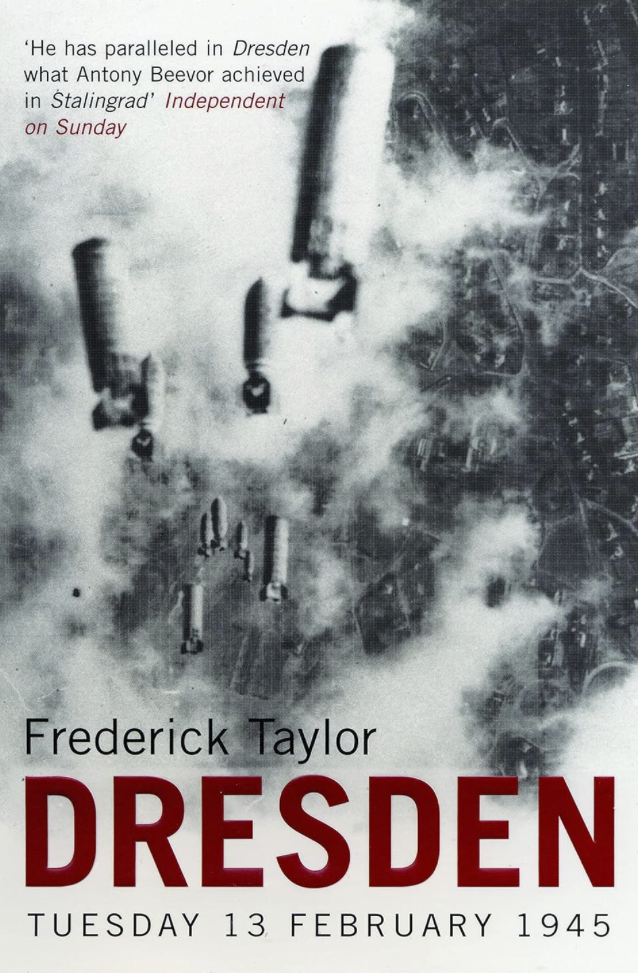
Dresden is perhaps, after Hiroshima, the name most synonymous with slaughter from the air, and in Britain at least the most controversial. Last year, while visiting this incredibly beautiful city — much of it now rebuilt — I reread Frederick Taylor’s account of the bombing, published back in 2005 on the 60th anniversary of the event.

Dresden’s destruction was extensive. Almost no buildings in the centre or its inner suburbs survived the bombs, and the death toll was immense, although difficult to assess in a city packed with refugees from the east. Anything between 20,000 and 80,000 fatalities is possible, although the consensus seems to be around 25,000.

That night was to be the worst of many wartime firestorms, a meteorological event in which the heat of the blaze becomes so intense, up to a thousand degrees centigrade, that the oxygen is sucked out of the surrounding air. More died in Dresden from asphyxiation than fire, and even those who thought they had found shelter in fountains were boiled alive. Many more drowned in the city’s reservoir, where they had gone to seek protection, their energy sapped by the soaring temperatures, unable to climb out. The bombers, thousands of feet above, could feel the warmth of the thousand fires below.

[…]

As everyone in the 1930s was well aware, the new war would bring aerial destruction on a hideously greater scale, and when it came again, it was the Luftwaffe who first put these ideas into practise, first in Poland and then Rotterdam.

After failing to destroy the Royal Air Force over the summer of 1940, the Nazis switched to aerial bombing of British cities. Between September 7, 1940 and New Year’s Day 1941, London was attacked on 57 consecutive nights, killing 14,000 inhabitants, a rate of 250 fatalities for each day of bombing. The German air force went on to kill an estimated 43,000 British civilians over the course of the war, with V-1 attacks continuing until the last weeks of the war.

On November 14, 1940, over 500 German bombers took off for a mission that would gift their language a new verb: Coventrated. Five hundred tons of high explosives, 30,000 incendiary bombs, fifty landmines and twenty petroleum mines were dropped on the target, and the medieval city went up in flames.

Like the blitz on other British cities, morale was not crushed in Coventry, but something dawned on the British high command. The destruction of Coventry’s infrastructure, utilities and transport had proved far more damaging than the destruction of any purely “military” target. Furthermore, bombers were notoriously inaccurate, and one survey showed that only 2 per cent of bombs fell within even one thousand feet of their intended point. Aerial bombardment of cities would prove far more effective than any hopeless targeting of particular coordinates.

They also learned that a large enough bombing raid would result in a firestorm, in which air currents are drawn in from the surrounding area, causing the fire to burn far more intensely. Indeed, a major attack on the City of London on December 29, 1940 might have become another firestorm but for the bad weather.

The British had been initially reluctant to take the war to Germany. While Poland was left to endure hell, leaflets were dropped over Berlin in October 1939 claiming that Nazi leaders were secretly profiting from the war, leading Noel Coward to suggest that it looked like we were trying to bore the Germans to death. There is even the apocryphal story about British official Sir Kingsley Wood refusing to bomb industrial targets in the Black Forest because it was private property. Indeed, our attempts to bomb Germany in 1940 were so feeble that Goebbels had to fake British “atrocities” to rouse the German public

With the entry of the United States and Soviet Union into the war in 1941, and with the German defeat at Stalingrad, the shoe was now on the other foot. The British invested more resources in Bomber Command and its head, Air Marshall Arthur Harris. “Bomber” Harris would become representative of the entire policy of destroying Germany’s cities, and a figure of controversy; the unveiling of his statue in 1992 attracted protests and has been repeatedly vandalised, but like many architects of wartime destruction, he was motivated by a desire to prevent a repeat of what he saw in 1914-18. The son of a colonial official who might have spent the rest of his life as a farm manager in Rhodesia were it not for war, he had joined the Royal Flying Corp in the first conflict and from his plane saw the horror of trench warfare and became determined that this sort of stalemate should never be repeated.

Having stuck to targeted industrial centres, in February, 1942 Allied command issued the Area Bombing Directive authorising the wide scale destruction of enemy cities. On 28 March the Hanseatic town of Lübeck was destroyed in a firestorm, and its most famous son, the anti-Nazi novelist Thomas Mann, appeared on BBC radio saying that while he regretted the destruction of his native city, “I think of Coventry, and have no objection to the lesson that everything must be paid for. Did Germany believe that she would never have to pay for the atrocities that her leap into barbarism seemed to allow?”

After the Lübeck bombing, Goebbels approached a state of panic for the first time, describing the damage as “really enormous”. He responded, in April 1942, by saying that he would “bomb every building in England marked with three stars in the Baedeker Guide” – Exeter was now hit in retaliation.

On May 30 the Allies launched what Harris called “the Thousand Plan”, the first thousand-bomber raid. Cologne and Hamburg were singled out for destruction, but on last-minute meteorological advice only the Rhineland city was chosen. Hamburg’s citizens would never know how fate had saved them – if only for another year.

So shocked were the Germans by the attack that the authorities forced the city’s fleeing citizens to sign a pledge of secrecy about what they saw, which ended with the sinister line “I know what the consequences of breaking this undertaking will be”.

Things would only get worse, and the Allies were getting both more destructive and more skilled. In faraway Utah, the Americans were now busy testing the destruction of German-style buildings, even hiring German refugee architect Erich Mendelssohn to recreate a German apartment block.

« Newer PostsOlder Posts »

Powered by WordPress