
Forgotten Weapons
Published 26 Aug 2015The FN Model 1903 was a Belgian-made scaled-up version of John Browning’s model 1903 pocket hammerless pistol. The pocket hammerless was made in .32 ACP and .380 calibers for (primarily) the civilian market in the US by Colt, and the FN model was chambered for the more powerful 9x20mm Browning Long cartridge, with military and police contracts in mind. The most common source of the FN pistols in the US is from the Swedish contract for the guns, but they were sold to a number of other nations as well.
This example is from the Russian contract, which included shoulder stocks with the pistols. Many military automatic pistols from this time were offered with the option of combination holster/stock units, which could be used to provide improved accuracy to the shooter. The stock for the FN 1903 is a bit different than most, in that it requires the use of an extended 10-round magazine instead of the standard flush-fit 7-rounder. As with most such original guns, these have been specifically exempted from NFA regulation in the US.
August 16, 2025
Stocked FN Model 1903
QotD: Rich anarchists
So you talk about mobs and the working classes as if they were the question. You’ve got that eternal idiotic idea that if anarchy came it would come from the poor. Why should it? The poor have been rebels, but they have never been anarchists; they have more interest than anyone else in there being some decent government. The poor man really has a stake in the country. The rich man hasn’t; he can go away to New Guinea in a yacht. The poor have sometimes objected to being governed badly; the rich have always objected to being governed at all. Aristocrats were always anarchists …
G.K. Chesterton, The Man Who Was Thursday, 1908.
August 15, 2025
The Royal Canadian Navy should go for the GLAAM
At True North Strategic Review, Noah returns to a familiar topic when discussing the Royal Canadian Navy’s current and future needs, in this case he recommends that the RCN goes for the GLAAM:

Photo from True North Strategic Review
One thing I neglected to fully discuss during that piece, and one that always comes back to me time and time again, is the Global Logistics, Aviation, Amphibious, Medical Support Platform from Davies, aka GLAAM.
This is quite funny, as I have had somewhat of a monopoly on the GLAAM subject, which is probably why it keeps coming back to me. I think I’m one of the few who ever brings it up, and probably the one who does most frequently.
Maybe that’s why it always surprises people when I don’t throw my support behind it. In fact, historically, like most larger vessel proposals, I have been fairly unsupportive of talks of acquisition. As I stated in my Support Ship post, I believe priorities are needed elsewhere, on getting more important things done, and given the River-class, subs, and CDC are a decade out, there is little pressing need for anything beyond the two JSS in the immediate term.
At least not to the point of urgency. I would rather see CPSP fully funded along with CDC before any talks of new vessels like GLAAM. I have always made that clear. That remains my overall position now.
However, in the last few months, I’ve been surprised to see just how much universal support the proposal has, both from the average online reader and those in the navy. There is a fairly broad love for GLAAM, even among those who would rather have JSS — there is always some love to be thrown its way, even as an “if only x and x allowed it” conversation piece.
And let it be known, I don’t dislike GLAAM at all. I think it’s cool. I think it’s unique and has capabilities I like. Even if it didn’t make it into my initial assessment, I focused on vessels a lot smaller like the Vard 7 313, that doesn’t mean we can’t acknowledge GLAAM and its potential.
So. What is GLAAM?
First, what is GLAAM? For those unaware, GLAAM is a proposal from Davies Shipyard for, essentially, a Multi-Functional Support Ship. One could even call it a Joint Support Ship! In fact, looking at GLAAM you can see a lot of what was originally demanded from the Joint Support Ship in its first proposals with the Afloat Logistics Support Capability (ALSC).
Of course, ALSC would evolve into the JSS project and over time drop the amphibious, RO/RO, and vast majority of HADR capabilities. Of course, that’s another conversation for another day, but a lot of GLAAM, at least to me, reminds me of that concept—and then some.
Visually and capability-wise, she is very similar to the HNLMS Karel Doorman. In fact, you could almost call them sisters. They share many design features and capabilities that take a step above the traditional Landing Platform Dock we see in other navies.
“HNLMS Karel Doorman, which GLAAM shares a striking resemblance to.”
Photo and caption from True North Strategic Review

The pen that ended WWII: Inside Field Marshal Slim’s hidden collection
BFBS Forces News
Published 14 Aug 2025Ahead of VJ Day — go behind the scenes for a rare glimpse into the private collection of Field Marshal Slim’s wartime artefacts.
In this exclusive film, Tim Cooper visits Viscount Slim — grandson of the legendary Second World War commander — for an intimate look at a treasure trove of historical items. From a razor-sharp Japanese sword surrendered in 1945, to the pen that signed peace, and even the stark telegram announcing Britain’s entry into war, each item tells a powerful story.
(more…)
Ted Gioia on Hunter S. Thompson
I must admit that I got hooked on Hunter S. Thompson’s writing very early. I read Fear and Loathing in Las Vegas in my mid-teens and it blew my mind. I couldn’t actually believe everything he wrote, but I couldn’t completely discount it either. I certainly haven’t read everything he wrote … especially his later sports commentary, but I have read most of the best-known books. On his Substack, Ted Gioia is running a three-part series on the writer and his work:

That’s Hunter Thompson. There’s always someone in control behind the wheel — even when he seems most out of control.
This hidden discipline showed up in other ways. Years later, when he ran for sheriff in Aspen or showed up in Washington, D.C. to cover an election for Rolling Stone, savvy observers soon grasped that Thompson had better instincts and organizational skills than some of the most high-powered political operatives. People rallied around him — he was always the ringleader, even going back to his rowdy childhood. And hidden behind the stoned Gonzo exterior was an ambitious strategist who could play a long term game even as he wagered extravagantly on each spin of the roulette wheel that was his life.
“I don’t think you have any idea who Hunter S. Thompson is when he drops the role of court jester,” he wrote to Kraig Juenger, a 34-year-old married woman with whom he had an affair at age 18. “First, I do not live from orgy to orgy, as I might have made you believe. I drink much less than most people think, and I think much more than most people believe.”
That wasn’t just posturing. It had to be true, merely judging by how well-read and au courant Thompson became long before his rise to fame. “His bedroom was lined with books,” later recalled his friend Ralston Steenrod, who went on to major in English at Princeton. “Where I would go home and go to sleep, Hunter would go home and read.” Another friend who went to Yale admitted that Thompson “was probably better read than any of us”.
Did he really come home from drinking binges, and open up a book? It’s hard to believe, but somehow he gave himself a world class education even while living on the bleeding edge. And in later years, Thompson proved it. When it came to literary matters, he simply knew more than most of his editors, who could boast of illustrious degrees Thompson lacked. And when covering some new subject he didn’t know, he learned fast and without slowing down a beat.
But Thompson had another unusual source of inspiration he used in creating his unique prose style. It came from writing letters, which he did constantly and crazily — sending them to friends, lovers, famous people, and total strangers. Almost from the start, he knew this was the engine room for his career; that’s why he always kept copies, even in the early days when that required messy carbon paper in the typewriter. Here in the epistolary medium he found his true authorial voice, as well as his favorite and only subject: himself.
But putting so much sound and fury into his letters came at a cost. For years, Thompson submitted articles that got rejected by newspapers and magazines — and the unhinged, brutally honest cover letters that accompanied them didn’t help. He would insult the editor, and even himself, pointing out the flaws in his own writing and character as part of his pitch.
What was he thinking? You can’t get writing gigs, or any gigs, with that kind of attitude. Except if those cover letters are so brilliant that the editor can’t put them down. And over time, his articles started resembling those feverish cover letters — a process unique in the history of literature, as far as I can tell.
When Thompson finally got his breakout job as Latin American correspondent for the National Observer (a sister publication to the Wall Street Journal in those days), he would always submit articles to editor Clifford Ridley along with a profane and unexpurgated cover letter that was often more entertaining than the story. In an extraordinary move, the newspaper actually published extracts from these cover letters as a newspaper feature.
If you’re looking for a turning point, this is it. Thompson now had the recipe, and it involved three conceptual breakthroughs:
- The story behind the story is the real story.
- The writer is now the hero of each episode.
- All this gets written in the style of a personal communication to the reader of the real, dirty inside stuff — straight, with no holds barred.
Why can’t you write journalism like this? In fact, a whole generation learned to do just that, mostly by imitating Hunter S. Thompson …
The History of Pancit in the Philippines
Tasting History with Max Miller
Published 11 Mar 2025Rice and egg noodles cooked with shrimp and pork belly, and garnished with calamansi and hard-boiled egg
City/Region: Manila
Time Period: 1919Pancit, a distinctly Filipino dish, has its roots in the food brought and cooked by Chinese immigrants who began moving to the Philippines in significant numbers by the 15th century. Like many immigrant communities, the Chinese in the Philippines cooked and sold food from, or close to, that of their homeland.
The flavor in this dish is so wonderful and complex and I really like the texture of the thin rice noodles and thicker egg noodles. The homemade shrimp liquor not only reduces waste, but adds so much flavor.
A note on ingredients: Some of the Filipino ingredients may be hard to come by, so I’ve included some substitutions in the ingredients list that may be easier to find.
1/8 kilo miki
1/8 kilo bijon
1/8 kilo pork
25 shrimps
3/4 cup water
1/2 head garlic
1 tablespoon kinchay
1/2 onion
1 cake bean cake
1 hard-boiled egg
1 tablespoon patis
6 calamansis
Cut the bean cake in small pieces. Peel the shrimps; pound the shells in a mortar; strain the juice and save it. Cook the pork; add the bean cake. Sauté the shrimps; when cooked, remove them and the bean cake from the carajay. Fry the onion and the garlic; remove from the carajay. Put the pork, the shrimps, and the bean cake in the carajay; add the patis; cook a few minutes. Soak the bijon in water 4 minutes. Wash the miki. Add the miki and the bijon to the mixture in the carajay; add the shrimp liquor. Cover and cook slowly 10 minutes. Serve with fried garlic and with slices of boiled egg. Cut the calamansis in halves and serve with pansit.
— Housekeeping: A Textbook for Girls in the Public Intermediate Schools of the Philippines by Susie M. Butts, 1919
QotD: American Puritanism
H.L. Mencken, “Puritanism As a Literary Force”, A Book of Prefaces, 1917.
August 14, 2025
The “Big Mac Index” is bogus and Purchasing Power Parity (PPP) is wrong
I started reading The Economist when I was in college in the early 1980s. I subscribed after I left college, no longer having access to the school library’s copies, and I continued my subscription for about 20 years. Eventually, I gave up on The Economist as their editorial stance shifted further and further leftward. One of the things they ran regularly was their “Big Mac Index” which compared prices of McDonalds’ Big Mac hamburgers across a range of countries to show the Purchasing Power Parity of the respective countries’ currency against the US dollar. I thought it was a neat way to use readily available data in a form that most consumers would be familiar with to illustrate a wider economic fact. But, as Tim Worstall points out here, the index isn’t actually measuring what it claims to be measuring at all:

Purchasing Power Parity (PPP) constitutes a foundational concept within mainstream international economics, asserting that, over the long term, real exchange rates will naturally adjust to equalize the purchasing power of currencies across nations. This suggests that the cost of an identical basket of goods should, in principle, be uniform globally once currency exchange rates are applied. This notion is frequently popularized through informal measures such as the Big Mac Index. PPP is conceptualized as a specific application of the Law of One Price (LOOP), which posits that, when abstracting from transactional frictions like transportation costs, tariffs, and taxes, any particular commodity traded or purchased should sell for a similar price regardless of its geographical location.
Aaaand, no. The Law of One Price says that a *traded* commodity should be at the same price everywhere, absent transport costs, tariffs and all the rest. Anything that’s not traded this will not be true of. For example, to use an example provided to us:
For instance, if a Starbucks coffee is considerably more affordable in Tokyo than in Manhattan, Purchasing Power Parity (PPP) would indicate an undervalued Yen.
No, Starbucks coffee is not a tradeable item. Coffee beans are globally traded, yes, and coffee beans are the same price the world over — given transport costs, tariffs and so on. But the coffee bean is pennies on the dollar of a Starbucks coffee.
The use of the Big Mac in The Economist‘s popular version of PPP actually runs entirely the other way around. The note is that a Big Mac is made the same way around the world. But it’s always made of *local* ingredients, not internationally traded ones. Therefore we are not measuring whether tradeable goods are the same price in different places at all — we’re measuring what local goods cost in different places.
Comparative advantage, whereby nations specialize in their most efficient productions for reciprocal benefit, is a myth. Absolute advantage reigns supreme.
Then there’s that as well. Which is to misunderstand comparative advantage as well. The insight is not about whether Britain makes cloth better than Portugal and then the same again with wine in reverse. Which is indeed absolute advantage. It’s about whether Britain makes cloth better than Britain makes wine, whether Portugal makes wine better than it does cloth. Each should do what they are *least bad at* and then share the increased production making both richer.
It’s also, once we move away from Ricardo, nothing to do with countries either. It’s something that applies to each and every individual. We should all do what we’re least bad at then swap the production. This does produce an interesting result for given how good, *ahem*, my economic writing is take a guess at how skilled I am at other ways of making a living? Quite.
So, you know, not getting PPP, LOOP nor comparative advantage — but still ending up calling for world government and that proper democratic control of the economy. Ah well, at least it’s fashionable even if incorrect.
D-Day’s Flat Pack Ports OR Lord HT Gets Cross with The Fat Electrician
HardThrasher
Published 13 Aug 2025In which we use the @the_fat_electrician as an excuse to talk about the Mulberry Harbours, make a specific threat to a building in the United States and get to oogle at giant bits of floating concrete.
Primary Source – Codename Mulberry – Guy Hartcup, Pen & Sword Military. Kindle Edition 2014 (org. 1977)
(more…)
“Just war” theory and nuclear weapons practice
On Substack, Nigel Biggar discusses the postwar argument about whether the use of nuclear weapons against Japan was justified or not:
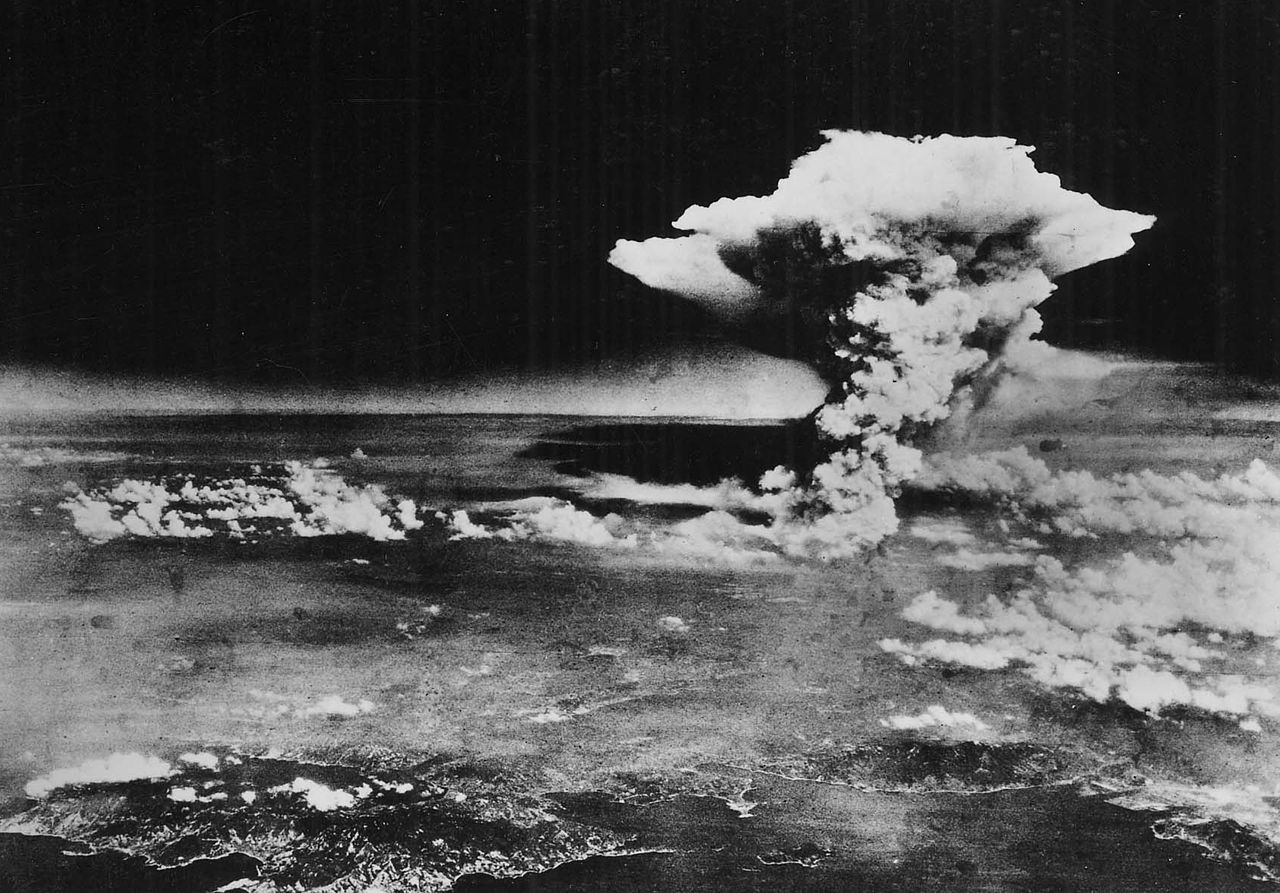
Atomic cloud over Hiroshima, taken from “Enola Gay” flying over Matsuyama, Shikoku, 6 August, 1945.
US Army Air Force photo via Wikimedia Commons.
For pacifists, Christian or otherwise, the answer is clear: since any deliberate killing is wrong, the dropping of atomic bombs on Hiroshima and Nagasaki on 6 and 9 August 1945 was wrong about two hundred thousand times over.
But that clear answer generates further questions whose answers aren’t so obvious. If killing is always wrong, then the United States should never have gone to war against Imperial Japan and therefore its ally, Hitler’s Germany. What, then, would have stopped the triumph of brutally racist Japanese imperialism in Asia and massively murderous Nazism in Europe? The noble witness of innocent non-violence?
Unfortunately, the historical evidence is that the kind of people who ran the slave-labour camps in Burma, and the likes of Dachau in Germany and Auschwitz in Poland, were not at all shamed by the face of vulnerable innocence; on the contrary, it excited their lust for domination and they fed upon it.
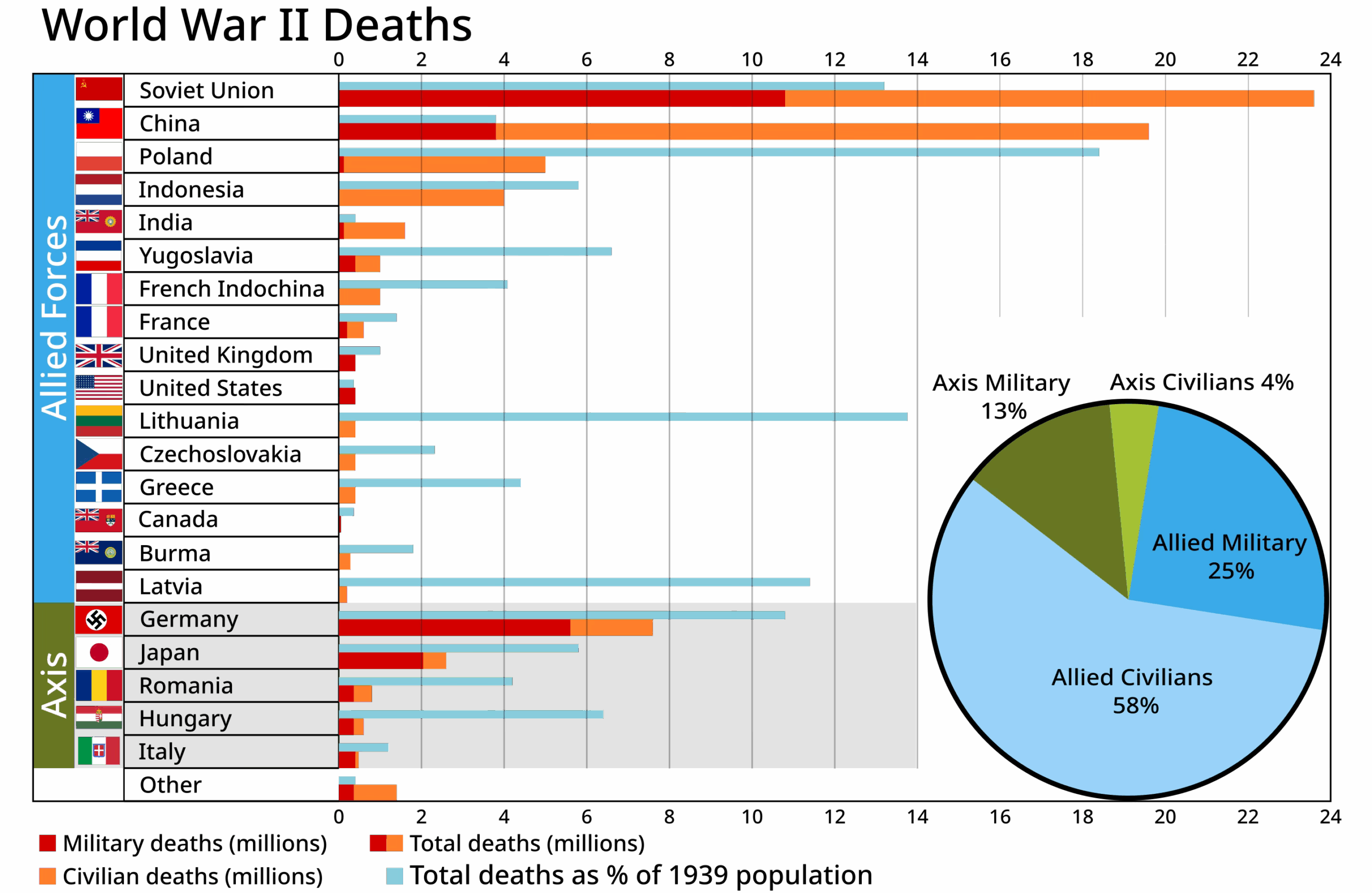
On the other hand, those who think that war can sometimes be justified, might judge that the mass killing of civilians by the atomic bombs was, simply by its massive extent, indiscriminate and therefore unjust. But there are two problems here. The first is that the vast majority of people, certainly in the UK and the USA, regard the war against Hitler and his allies as morally justified, notwithstanding the fact that that cost between 60 and 80 million deaths, well over half of them civilian.
Image credit – Wikipedia
And the second problem is that the ethical tradition of “just war” thinking doesn’t say that we may not kill civilians, even on a massive scale; it only says that we may not kill them intentionally. If a military objective can’t be achieved except by risking the possible or probable deaths of civilians, then it may still be attempted, provided that the objective is sufficiently important, militarily, and that all reasonable measures are taken to avoid or minimise the side-effect of civilian casualties. The reason for this permissiveness is that in most circumstances just war would be impossible to prosecute otherwise.
So, for the “just war” proponent, if the intention in dropping the atomic bombs on Japan was to destroy vital military or military-related targets, and if there was no more discriminate way of achieving that end, then the bombing was morally justified. It was deeply, deeply tragic—but nevertheless just.
QotD: It’s not hypocrisy when progressives do it …
Severian, “Fade to Black”, Founding Questions, 2022-01-23.
August 13, 2025
The Korean War Week 60: Neutral Zone Violations and the 38th Parallel Standoff – August 12, 1951
The Korean War by Indy Neidell
Published 12 Aug 2025UN Commander Matt Ridgway is extremely frustrated by the Communist delegation’s unyielding stance on the 38th Parallel at the Kaesong peace talks. Chinese violations of the neutral zone highlight the fact that the war still goes on, though, as do the preparations for a UN offensive soon to be launched, to really reignite the active war in a big way.
Chapters
00:00 Hook
00:50 Recap
01:15 Ridgway’s Frustration
05:01 Neutral Zone Violations
08:57 Van Fleet’s Plans
12:28 Conclusion
13:50 Call to Action
(more…)
“[A]ll those land acknowledgments weren’t just symbolic: they [were] advance notice”
In The Free Press, Rupa Subramanya discusses the — in my opinion, insane — court ruling in British Columbia that invalidated existing land titles in part of the Vancouver area, handing the titles to the properties over to the Cowichan First Nation:

A B.C. Supreme Court judge has granted several First Nations a portion of a 1,846-acre land claim on Lulu Island. B.C. Supreme Court
It turns out that all those land acknowledgments weren’t just symbolic. They may have been advance notice.
When Canada adopted its constitution in 1982, Prime Minister Pierre Trudeau slipped in a ticking time bomb: an explicit recognition of indigenous land rights without constitutional protection for property rights for other Canadians. That constitutional clause has fueled decades of lawsuits from First Nations — Canada’s indigenous people — asserting claims to huge portions of their ancestral territories.
Last Thursday, the British Columbia Supreme Court ruled that the Cowichan Nation holds “Aboriginal title” to about 1,846 acres of land on the south shore of Lulu Island in Richmond, and constitutionally protected rights to fish in the south arm of the Fraser River.
This 275,000-word judgment doesn’t just affect government-owned lands. It also includes private property now owned by third parties. So if you’re a Canadian who is a property owner in British Columbia and not indigenous, your claim on what you think you own has just been superseded by indigenous claims, called a “senior” claim in legalese. Down the road, your land or house could be expropriated by the federal government and turned over to an indigenous group that claims ownership.
That has already happened in Ontario, where three northern Ontario First Nations claimed in a lawsuit last month that a 14-acre public park in Kenora called Anicinabe Park is actually unceded territory and should be returned.
“In constitutional terms, aboriginal rights trump private property rights,” Bruce Pardy, a professor of constitutional law at Queen’s University in Kingston, Ontario, told me. He pointed to last November’s ruling by a New Brunswick judge that the court might be in position to order the government to seize private property and turn it over to an indigenous group making a claim on it.
As Prime Minister Mark Carney tries to fast-track major infrastructure projects — roads, bridges, pipelines, power plants, and more — all part of his plan to boost Canada’s global competitiveness and reduce reliance on the U.S., some of those ambitions might be snarled by indigenous land claims that take years to resolve. The British Columbia case began in 2019 and is considered to be the longest trial in Canadian history.
The day before the Cowichan Nation ruling in British Columbia, a Yukon First Nation announced that it would oppose all new mining claims on its traditional territory while a regional land-use plan is developed. Yukon First Nations leaders said that new claims are “unwelcome” and “unlawful”, and that they plan to challenge the mining industry to protect the land from further industrial activity.
Stefan Labbé in BIV last week:
A B.C. court has handed the Cowichan Tribes and other First Nations title over a chunk of federal and city land in Richmond that for centuries was used as a winter fishing village, before colonial administrators evicted the people who lived there.
The landmark Aug. 7 ruling was handed down after more than 500 days of litigation before the B.C. Supreme Court.
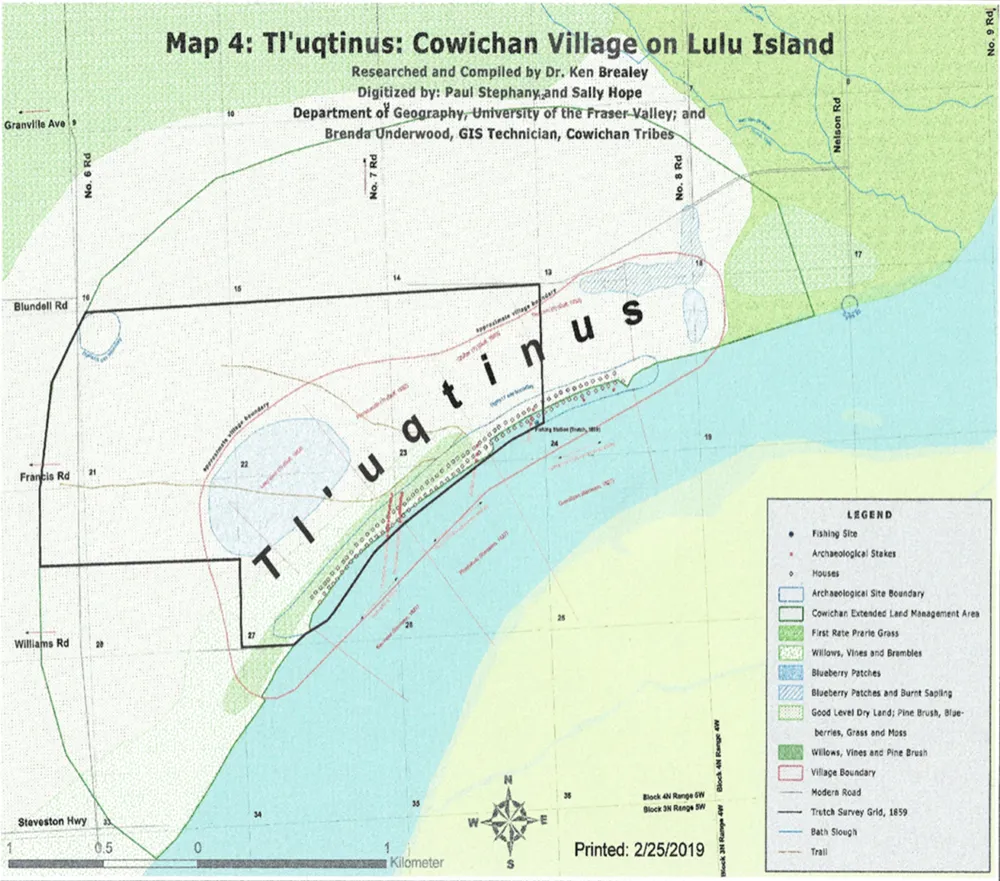
It gives the Cowichan Tribes, the Stz’uminus First Nation, Penelakut Tribe, Halalt First Nation — as well as the Lyackson First Nation in a supporting role — Aboriginal title over the Tribes’ historic Tl’uqtinus village on the southeast side of Lulu Island.
The ruling also gives the First Nations fishing rights at the mouth of the Fraser River.
In a joint statement, the First Nation plaintiffs said: “We raise our hands to the generations of leaders” who fought for the return of the Tl’uqtinus village lands and their fishing rights in the Fraser River.
B.C. Supreme Court Justice Barbara Young suspended her decision for 18 months “to allow for an orderly transition of the lands” in keeping with the principle of reconciliation.
“Now that this multi-year journey has concluded, it is my sincere hope that the parties have the answers they need to return to negotiations and reconcile the outstanding issues,” she wrote.
Jamie Sarkonak in the National Post wrote on Monday:
This case of “land back” in action (Cowichan Tribes v. Canada) casts a shadow over the country’s property system. It jeopardizes the default means of owning land in Canada — the estate in fee simple, where owners have exclusive rights to sell land — wherever Aboriginal title is found to exist.
Aboriginal title is the right of an Indigenous group to use, control and reap benefits from the land. It’s granted to claimant groups that can prove they are descended from the sole occupants of an area at the time the British asserted sovereignty. Unlike regular fee simple ownership, it’s enshrined in Section 35 of the 1982 Constitution and impossible to sell to anyone but the Crown.
The Cowichan claim covered the site of their summer village near the mouth of the Fraser River, where they had established continuous, exclusive seasonal occupancy dating back to European contact in the 1790s.
In 1846, the British Crown asserted sovereignty over that land and the rest of what would become B.C. The following years would see property being surveyed and auctioned off to public and private buyers — but not the Cowichan summer village. Instead, it was set aside in 1860 and continued to be used as a settlement for the group. Colonial officials considered the possibility of making it into a reserve, and took initial steps to do so. After B.C. joined Canada in 1871, however, the summer village was carved into parcels and sold over the years until 1914. Purchasers included private parties (including “well-placed men” in the colony) and even the municipality itself; some of the land purchased privately would eventually be sold back to the Crown. Today, about half of these lots are held by public bodies, with the other half falling under private ownership.
A map shows the Cowichan title lands outlined in black. (B.C. Supreme Court) Photo by B.C. Supreme Court
The question before the B.C. Supreme Court was whether the taking of those village lands was legal to begin with. Justice Barbara Young (a Harper appointee, by the way) concluded it was not.
The Dispossessed: State Happens
Feral Historian
Published 21 Mar 2025Ursula K. le Guin’s The Dispossessed is one of the most in-depth examinations of how a large anarchist society might function, addressing both the problems it solves and those it creates for itself. It’s a must-read for anyone interested in the communist-leaning variants of anarchism in particular.
00:00 Intro
01:58 Anarres is not an Island
04:45 Shevek goes to Urras
07:00 Abolition of Property
08:30 Social Pressures and Pravic
12:30 Necessity and Ossification
14:45 Necessity of Conflict
15:45 Shevek’s Wild RideThis video is in part a companion to this one — Cloak of Anarchy : Gradations of Stat… from a few weeks ago. The original cut of that one had a brief mention of a couple details from The Dispossessed, but it really needed its own video.


