This is what happens when malevolent narcissists don’t get slapped and thrown to the ground. The kind of psychology we’re seeing, over and over again, overwhelmingly from the left, is an exercise in bad faith, a fundamental dishonesty. It therefore isn’t amenable to correction with facts or debate, or appeals to reciprocity or some higher purpose. Tolerating such behaviour — and worse, deferring to it — will only encourage an escalation of vanity, malice and sociopathy. It may, however, be discouraged with reminders of physical consequences. Ideally, physical humiliation. A reminder that nasty little egos can be publicly broken.
These are people who will lie as readily as breathing in order to excuse their antisocial urges. They aren’t being obnoxious reluctantly, in desperation, or under duress. They harass, provoke and delight in domination because it gives them pleasure. It makes them feel important and powerful. Power being conceived solely as power over others. It’s a focus for their spite. Anything else is a fig leaf, a pretext. Among Portland’s identikit radicals, the ones exulting in the alarm and misery of others, there is no good faith. And so, you can’t engage with such creatures on their own ostensible terms.
David Thompson, “Shamelessly, He Quotes Himself”, David Thompson, 2020-08-22.
August 24, 2020
QotD: Progressive malevolent narcissism
August 23, 2020
The right of asylum
Tim Worstall is writing here about the situation in the United Kingdom, with would-be asylum claimants risking their lives to cross the English Channel so they can legally claim asylum in Britain, but exactly the same situation should apply with claimants entering Canada from the United States:

An asylum seeker, crossing the US-Canadian border illegally from the end of Roxham Road in Champlain, NY, is directed to the nearby processing center by a Mountie on 14 August, 2017.
Photo by Daniel Case via Wikimedia Commons.
Everyone at even risk – let alone reality – of substantial discrimination in their home country has the right, the right, to asylum. This is one of those international things that we should indeed agree with too. Few of us have anything but contempt for those who wouldn’t let Holocaust fleeing Jews (and or gypsies, gays, whatever, it’s just that we have substantial documented evidence about Jews who were turned away) tarnish their national doormats. Few of us think those who abused such limitations are anything but heroes. I even know of one monk who married Jewesses multiple times to bring them out by train. Umm, married multiple people, not one many times. People working within the too restrictive rules even gave us one of the finest moments of TV ever.
So, asylum, good thing.
And here’s the next thing. That right is restricted. To claiming it in the first safe place you get to. This has some oddities, if you leave Sudan by plane and step off at Heathrow then the UK is where you can – righteously – claim asylum. If you come by land then you have passed through many safe places before reaching the UK. You don’t have the right to asylum in the UK and, to be strict about it, don’t even have the right to apply.
So, people drowning in the Channel because they have to make their asylum application once in the UK? This could be true of those who are being oppressed in France. It’s not true of anyone not being oppressed in France. So there is not that need to take the open boat the 26 miles.
Sure, there’s the desire, we all understand that. But that’s a desire, not a right to asylum.
Here in Canada, we had this arrangement with the American government under the Canada-United States Safe Third Country Agreement, which our Federal Court struck down last month — incorrectly, in my opinion — as being in violation of section 7 of the Canadian Charter of Rights and Freedoms. The court allowed six months for the federal government to act, but as we all know, the federal government is unlikely to do anything as politically radioactive as passing legislation that could — and would — be seen as anti-refugee.
“There are no Soviet Prisoners of War, only Traitors” – WW2 – 104 – August 22, 1941
World War Two
Published 22 Aug 2020Josef Stalin is forming new armies to fight off the German onslaught, and yet it continues gaining ground both in the north and in the south. He also issues Draconian orders to the Red Army concerning any form of surrender.
Join us on Patreon: https://www.patreon.com/TimeGhostHistory
Or join The TimeGhost Army directly at: https://timeghost.tv
Check out our TimeGhost History YouTube Channel: https://www.youtube.com/c/timeghost?s…Follow WW2 day by day on Instagram @World_war_two_realtime https://www.instagram.com/world_war_two_realtime
Between 2 Wars: https://www.youtube.com/playlist?list…
Source list: http://bit.ly/WW2sourcesWritten and Hosted by: Indy Neidell
Director: Astrid Deinhard
Producers: Astrid Deinhard and Spartacus Olsson
Executive Producers: Astrid Deinhard, Indy Neidell, Spartacus Olsson, Bodo Rittenauer
Creative Producer: Joram Appel
Post-Production Director: Wieke Kapteijns
Research by: Indy Neidell
Edited by: Iryna Dulka
Sound design: Marek Kamiński
Map animations: Eastory (https://www.youtube.com/c/eastory)Colorizations by:
– Jaris Almazani (Artistic Man) – https://instagram.com/artistic.man?ig…
– Norman Stewart – https://oldtimesincolor.blogspot.com/
– Dememorabilia – https://www.instagram.com/dememorabilia/
– Olga Shirnina, a.k.a. Klimbim – https://klimbim2014.wordpress.com/
– Julius Jääskeläinen – https://www.facebook.com/JJcolorization/
– Cassowary Colorizations – https://www.cassowarycolor.com/Sources:
– Imperial War Museum: E 5057
– Bundesarchiv, CC-BY-SA 3.0: Bild_101III-Alber-096-34, Bild_101I-136-0877-08Archive by Screenocean/Reuters https://www.screenocean.com.
A TimeGhost chronological documentary produced by OnLion Entertainment GmbH.
From the comments:
World War Two
3 days ago (edited)
Orders, orders and more orders this week as both Stalin and Hitler try and get hold of the vast and chaotic situation along the battlefront, but nefarious war crimes and atrocities continue to lurk in the background. We cover the humanitarian crisis created both deliberately and by collateral effects that the war has on the world population in our War Against Humanity series that is now coming out every second week to keep up with the increasing pace of terror. To get the full experience of the chronological developments, follow those formats too:WW2 Day by Day on Instagram: https://www.instagram.com/world_war_two_realtime/
War Against Humanity playlist: https://www.youtube.com/playlist?list=PLsIk0qF0R1j4cwI-ZuDoBLxVEV3egWKoM

Trudeau’s hopes for re-election hinge on promising “an organic chicken in every pot and a solar panel on every shed”
The Line wonders who the hell the Liberals think they are:
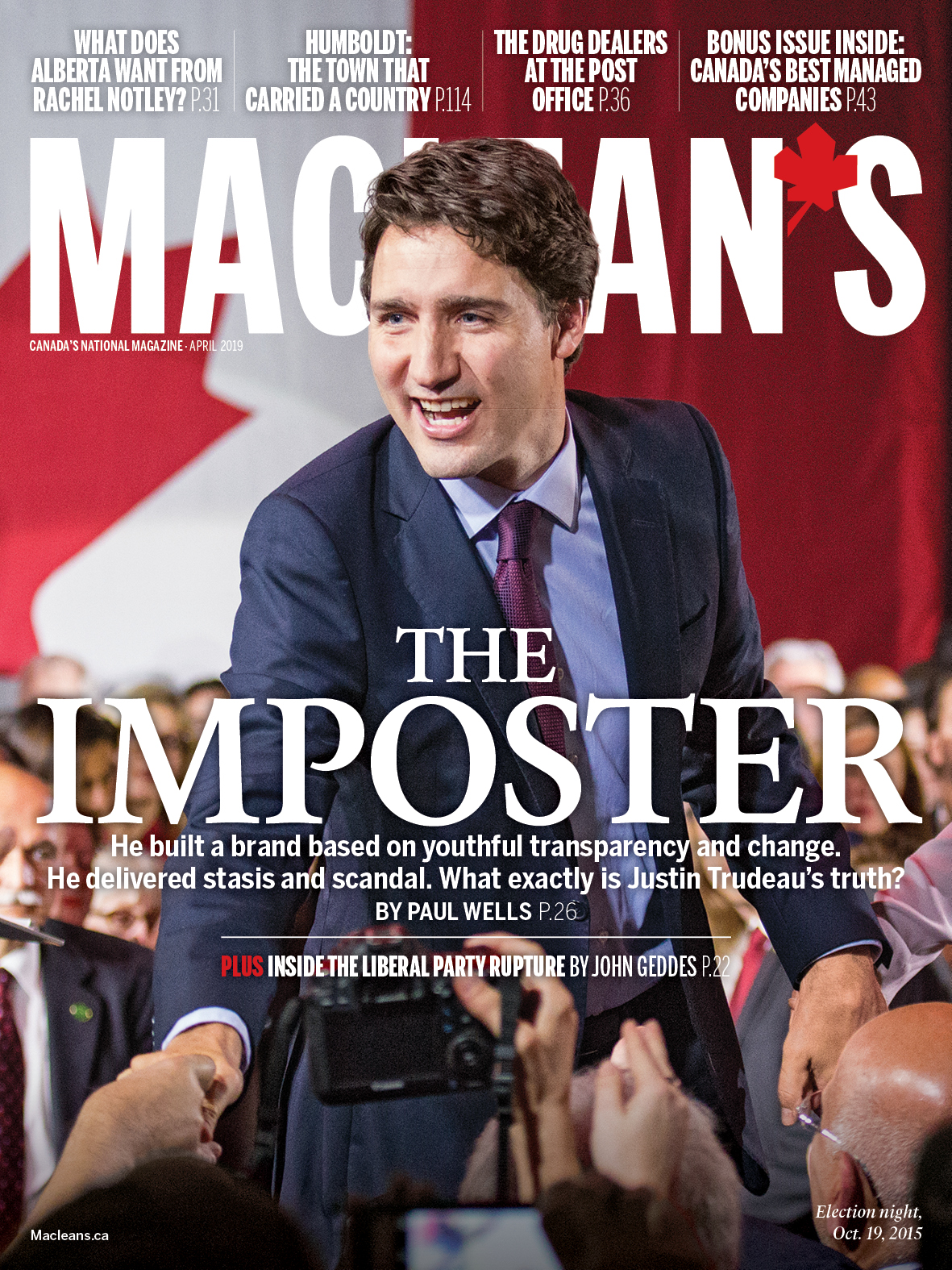
It may have been easy to miss amid the news coming out of Ottawa, but as the government lost its finance minister, appointed Chrystia Freeland to yet another job, prorogued parliament, halted testimony into its latest scandal, prepared for the announcement of a new Conservative Party of Canada leader and braced for a likely second wave of COVID-19, the prime minister promised to announce a transformative agenda. One that promises sweeping social change, and a wholesale re-invention of our economy in line with the greenest ambitions. We here at The Line have but one question.
Who the hell do these people think they are?
It is obvious to anyone who has been reading the news and possesses even residual brain function why the prime minister would like to be talking about a plan for transformative change. Talking about all the amazing things he could do for Canadians with borrowed money beats talking about his government’s bumbling of the WE file and the departure of now-former finance minister Bill Morneau.
Promising an organic chicken in every pot and a solar panel on every shed is obviously more appealing to Trudeau than repeating the last month. But it is astonishing to us — as jaded as we have undeniably become — that the government is talking about this instead of the necessary steps needed to shore up this country ahead of a likely second wave of COVID-19.
This government has a mandate to respond to the emergency, by mere unlucky virtue of being in power at the moment the virus hit. It is the duty of every Canadian government to safeguard the wellbeing of the population, full stop. But the emergency, contrary to what you may believe if you’ve been reading Liberal Party HQ memos, is not over. We have an urgent need to secure more medical equipment, to harden our long-term care facilities, to prevent any further lockdowns from derailing a fragile economic recovery, to ensure the resiliency of critical supply chains, and to shore up our health-care system. This is what every Canadian official should be focused on right now.
[…]
But can anyone maintain faith that the Liberals will stick to their knitting when we hear buzzwords like “transformative” social change? Sweeping climate-change reforms? Engineering a new green economy? They are all fine notions — let’s put them to the people and vote on them. Until calling that election is feasible (mid-pandemic, it is not) this government simply does not have the mandate to undertake such far-reaching efforts.
It’s easy to forget now, but only nine months ago this government was reduced to a minority of seats in parliament. The Liberals lost the popular vote, and saw one million of their own prior voters abandon them. They are only in government because the Conservatives, to the surprise of no one, found several novel and exciting new ways to fail.
Variations of the .455 Webley Fosbery Automatic Revolver
Forgotten Weapons
Published 17 Apr 2020https://www.instagram.com/rockislanda…
https://www.youtube.com/user/RockIsla…
These are lots #558, 559, 1585, 1586, 3535, and 3536 in the upcoming RIA Premier Auction. It was scheduled for April, but has been postponed — check their web site for upcoming Online Only auctions every month, though!
Today we are taking a look at the different variations in .455 caliber Webley-Fosbery automatic revolvers. The two main types are the Model 1901 and Model 1903 (the Model 1902 was the very rare .38 caliber version). The main change between the two is the change from a coil mainspring to a V mainspring, to improve reliability when dirty; done in response to British military testing. In addition the 1903 has an improved fire control mechanism, a lower hammer profile and a new cylinder removal system.
Within the Model 1903, there is also a change from a standard frame and cylinder to shortened versions of both. These changes occurred at about serial number 3350, in 1912. The shortened cylinder was made to fit the new Webley MkII ammunition, which was notably shorter than the MkI type — and a shorter cylinder reduced weight.
http://www.patreon.com/ForgottenWeapons
https://www.floatplane.com/channel/Fo…
Cool Forgotten Weapons merch! http://shop.bbtv.com/collections/forg…
Contact:
Forgotten Weapons
6281 N. Oracle #36270
Tucson, AZ 85740

QotD: Herbert Hoover and the American tourists
The US Consulate in London didn’t know how to solve these problems either. But Herbert Hoover, still high on his decision to pivot to philanthropy and public service, calls them up and asks if he can help. They say yes, definitely. Hoover gets in touch with his rich friends, passes around the collection plate, and organizes a Committee For The Assistance Of American Travelers. Then he gets to work, the way only he can:
Within 24 hours, Hoover’s committee had its own stationery, and within forty-eight it was operating a booth in the ballroom of the Savoy Hotel as well as three other London locations. Through his business connections, Hoover managed to bypass restrictions on telegraph service and open a transatlantic line to allow Americans to wire money to stranded friends and relatives. In a city suddenly flooded with refugees, he reserved for American travelers some two thousand rooms in hotels or boardinghouses. He issued a press release proclaiming that his Residents’ Committee was assuming charge of all American relief work in the city, and that in doing so it had the blessings of its honorary chairman, Walter Hines Page, the US ambassador to London.
… which is totally false. Hoover is starting to display a pattern that will stick with him his whole life – that of crushing competing charities. He begins a lobbying effort to get the US Embassy to ban all non-Hoover relief work, focusing on the inefficiency of having multiple groups working on the same problem. When the US Assistant Secretary Of War arrives in London to coordinate a response, he is met on the dock by Hoover employees, who demand he consult with Hoover before interfering in the US tourist issue. Eventually the Embassy, equally exasperated by Hoover’s pestering and impressed with his results, agrees to give him official control of the relief effort.
After two months of work, Hoover and his Committee have repatriated all 120,000 US tourists, supporting them in style until it could find them boat tickets. All of its loans and operating costs have been repaid by grateful tourists, and its budget is in the black. The rescued travelers are universal in their praise for Hoover, partly because Hoover has threatened to ruin any of them who get too critical:
Other complainants were received with less patience, including a hotheaded professor of history from the University of Michigan, who wrote to accuse the Residents’ Committee of mistreatment. Hoover refuted his charges indignantly and comprehensively, copying his response to the president of the university and its board of regents. After a meeting with his employer, the professor returned Hoover an abject retraction and apology.
Scott Alexander, “Book Review: Hoover”, Slate Star Codex, 2020-03-17.
August 22, 2020
Creoles, Kaintucks, and the Culture War of Early New Orleans (feat. The Cynical Historian)
Atun-Shei Films
Published 21 Aug 2020For #ProjectFrance, I collaborated with @The Cynical Historian to teach y’all about the cosmopolitan cultural exchange between revolutionary France and a country called the United States of America in the late 18th and early 19th century. In this video, I discuss the contentious relationship between Anglo-Americans and French Creoles in New Orleans in the years after the Louisiana Purchase.
Support Atun-Shei Films on Patreon ► https://www.patreon.com/atunsheifilms
Leave a Tip via Paypal ► https://www.paypal.me/atunsheifilms (All donations made here will go toward the production of The Sudbury Devil, our historical feature film)
Buy Merch ► teespring.com/stores/atun-shei-films
#NewOrleans #History
Watch our film ALIEN, BABY! free with Prime ► http://a.co/d/3QjqOWv
Reddit ► https://www.reddit.com/r/atunsheifilms
Twitter ► https://twitter.com/atun_shei~REFERENCES~
[1] Lo Faber. “Anglo-Americans” (2018). 64Parishes https://64parishes.org/entry/anglo-am…
[2] Richard Campanella. Bienville’s Dilemma: A Historical Geography of New Orleans (2008). University of Louisiana at Lafayette, Page 170-171
[3] Peter J. Kastor. “Louisiana Purchase and Territorial Period” (2018). 64Parishes https://64parishes.org/entry/louisian…
[4] Daniel Rasmussen. American Uprising: The Untold Story of America’s Largest Slave Revolt (2011). Harper Perennial, Page 16
[5] Kimberly S. Hanger. Bounded Lives, Bounded Places: Free Black Society in Colonial New Orleans, 1769-1803 (1997). Duke University Press, Page 54-56
[6] Mary Gehman. The Free People of Color of New Orleans (2009). Sheridan Books, Page 49-51
[7] Rasmussen, Page 159-163
Debra Soh’s new book is “a cancel-culture grenade”
Jen Gerson knows that any positive mention of Debra Soh’s The End of Gender: Debunking Myths About Sex and Identity has a strong resemblance to square-dancing in a minefield. Cancellations may fall like raindrops on the career of anyone so unenlightened as to even acknowledge the existence of such a work:

For that, at its heart, is what Soh’s book is: a lucid discussion of the best science we have to date on the nature of gender and sex, written for a lay audience. What gives the title its sizzle is not the content, but rather the cultural climate in which it is being published.
It maps the depth, scope and scale of current Culture War trenches in this particular theatre of battle. The End of Gender stomps on tripwires like the gender binary, whether transgender women are women, autogynephilia, Rapid Onset Gender Dysphoria, bathroom bans, and more.
It’s a cancel-culture grenade.
That’s not because these subjects ought to be contentious. Soh’s approach and tone are largely neutral. Rather, the controversy the book will inevitably incite is a reflection of a culture that has been warped into a state of existential terror by the very notion that these ideas can be responsibly discussed.
Soh begins by defining her terms.
So much of the debate around the most difficult topics of sex and gender stem from the simple fact that we are misusing the basic language. For example, sex and gender are not interchangeable concepts, even though they are often treated as such.
Sex is a term of biology. One’s sex, Soh argues, is determined by his or her gametes. With the exception of rare intersex disorders, 99 per cent of the population has a clearly defined biological sex that slots into one of two dimorphic categories: male or female.
Gender is more complicated. It’s now popular to state that there are more than two genders, but Soh disputes this. She argues that gender — or the set of characteristics that signal one’s sex to society — is also dimorphic. For 99 per cent of the population, gender correlates with sex. Further, even when expressions of gender are at odds with one’s biological sex, this, too, is mediated by biology. Whether one presents as gender typical or gender atypical is the result of prenatal testosterone exposure.
Soh notes that claiming to be gender non-binary, or gender fluid — or any one of a thousand variations that transcend the limiting concepts of male and female — is increasingly trendy, especially among teenagers and young adults. It seems to be the latest form of identity experimentation.
There are two reasons for this trend.
The first is that seeing the world through an intersectional framework encourages progressives to reverse the traditional hierarchies of race, sex and power. Therefore, claiming a marginalized identity — like genderqueer non-binary unicorn — accrues status within progressive peer circles.
The second is that the culture has undergone a massive awakening to transgender rights over the past decade. This has contributed expressive categories and vocabularies for people who otherwise might have struggled to find the language to explore their most authentic selves. As the cues, like cosmetics and dress, that we used to signal our gender are socially constructed, gender expression is limited only by our creativity.
History-Makers: Thucydides
Overly Sarcastic Productions
Published 21 Aug 2020Start your free trial at http://squarespace.com/overlysarcastic and use code
OVERLYSARCASTICto get 10% off your first purchase.Ahh ancient Greece, it has been entirely too long. Today we’ll take a look at the foundational work of my entire career path — Thucydides’ History of the Peloponnesian War, a book that almost single-handedly set the standard for how we engage in historical inquiry. Also it has the added benefit of being about Ancient Greece so win-win!
SOURCES & Further Reading: History of the Peloponnesian War by Thucydides, Histories by Herodotus, Hellenica by Xenophon, and the 4 straight years I spent studying this in university — Boy do I love doing a video about a topic I’m specifically trained in.
This video was edited by Sophia Ricciardi AKA “Indigo”. https://www.sophiakricci.com/
Our content is intended for teenage audiences and up.PATREON: https://www.Patreon.com/OSP
DISCORD: https://discord.gg/kguuvvq
MERCH LINKS: https://www.redbubble.com/people/OSPY…
OUR WEBSITE: https://www.OverlySarcasticProductions.com
Find us on Twitter https://www.Twitter.com/OSPYouTube
Find us on Reddit https://www.Reddit.com/r/OSP/
John Cabot’s patent monopoly grant and the rise of the modern corporation
In the latest Age of Invention newsletter, Anton Howes traces the line of descent of modern corporate structures from the patent granted to John Cabot to explore (and exploit) a trade route to China:
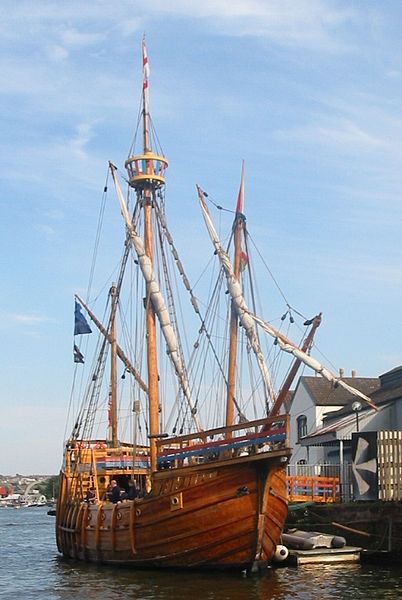
The replica of John Cabot’s ship Matthew in Bristol harbour, adjacent to the SS Great Britain.
Photo by Chris McKenna via Wikimedia Commons.
I discussed last time [linked here] how the use of patent monopolies came to England in the sixteenth century. Since then, however, I’ve developed a strong hunch that the introduction of patent monopolies may also have played a crucial role in the birth of the business corporation. I happened to be reading Ron Harris’s new book, Going the Distance, in which he stresses the unprecedented constitutions of the Dutch and English East India Companies — both of which began to emerge in the closing years of the sixteenth century. Yet the first joint-stock corporation, albeit experimental, was actually founded decades earlier, in the 1550s. Harris mentions it as a sort of obscure precursor, and it wasn’t terribly successful, but it stood out to me because its founder and first governor was also one of the key introducers of patent monopolies to England: the explorer Sebastian Cabot.
As I mentioned last time, Cabot was named on one of England’s very first patents for invention — though we’d now say it was for “discovery” — in 1496. An Italian who spent much of his career serving Spain, he was coaxed back to England in the late 1540s to pursue new voyages of exploration. Indeed, he reappeared in England at the exact time that patent monopolies for invention began to re-emerge, after a hiatus of about half a century. In 1550, Cabot obtained a certified copy of his original 1496 patent and within a couple of years English policymakers began regularly granting other patents for invention. It started as just a trickle, with one 1552 patent granted to to some enterprising merchant for introducing Norman glass-making techniques, and a 1554 patent to the German alchemist Burchard Kranich, and in the 1560s had developed into a steady stream.
Yet Cabot’s re-certification of his patent is never included in this narrative. It’s a scarcely-noted detail, perhaps because he appears not to have exploited it. Or did he? I think the fact of his re-certification — a bit of trivia that’s usually overlooked — helps explain the origins of the world’s first joint-stock corporation.
Corporations themselves, of course, were nothing new. Corporate organisations had existed for centuries in England, and indeed throughout Europe and the rest of the world: officially-recognised legal “persons” that might outlive each and any member, and which might act as a unit in terms of buying, selling, owning, and contracting. Cities, guilds, charities, universities, and various religious organisations were usually corporations. But they were not joint-stock business corporations, in the sense of their members purchasing shares and delegating commercial decision-making to a centralised management to conduct trade on their behalves. Instead, the vast majority of trade and industry was conducted by partnerships of individuals who pooled their capital without forming any legally distinct corporation. Shares might be bought in a physical ship, or even in particular trading voyages, but not in a legal entity that was both ongoing and intangible. There were many joint-stock associations, but they were not corporations.
And to the extent that some corporations in England were related to trade, such as the Company of Merchant Adventurers of London, or the Company of Merchants of the Staple, they were not joint-stock businesses at all. They were instead regulatory bodies. These corporations were granted monopolies over the trade with certain areas, or in certain commodities, to which their members then bought licenses to trade on their own account. Membership fees went towards supporting regulatory or charitable functions — resolving disputes between members, perhaps supporting members who had fallen on hard times, and representing the interests of members as a lobby group both at home and abroad — but not towards pooling capital for commercial ventures. The regulated companies were thus more akin to guilds, or to modern trade unions or professional associations, rather than firms. Members were not shareholders, but licensees who used their own capital and were subject to their own profits and losses.
Before the 1550s, then, there had been plenty of unincorporated business associations that were joint-stock, and even more unincorporated associations that were not joint-stock. There had also been a few trade-related corporations that were not joint-stock. Sebastian Cabot’s innovation was thus to fill the last quadrant of that matrix: he created a corporation that would be joint-stock, in which a wide range of shareholders could invest, entrusting their capital to managers who would conduct repeated voyages of exploration and trade on their behalves.
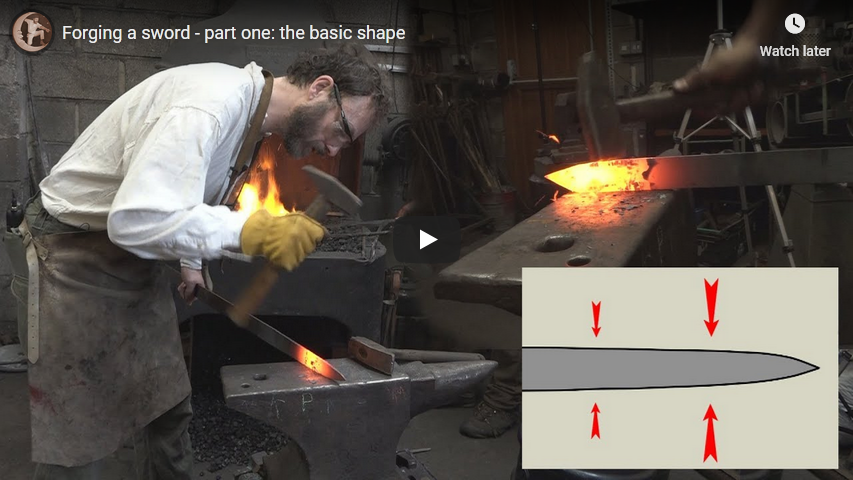
Forging a sword – part one: the basic shape
Lindybeige
Published 8 Feb 2018Hammering hot metal into shape is quite a satisfying task, when it goes well. Here you see me shaping out my sword.
Support me on Patreon: https://www.patreon.com/Lindybeige
I was invited by the Cut and Thrust Collective to go to Glastonbury and make my own sword. In an earlier video, you saw my training (forging a nail), and immediately after that we started on the sword. Thom Leworthy was the bladesmith showing me how it is done.
The Cut and Thrust Collective:
glastonburysmith@gmail.comBuy the music – the music played at the end of my videos is now available here: https://lindybeige.bandcamp.com/track…
Lindybeige: a channel of archaeology, ancient and medieval warfare, rants, swing dance, travelogues, evolution, and whatever else occurs to me to make.
▼ Follow me…
Twitter: https://twitter.com/Lindybeige I may have some drivel to contribute to the Twittersphere, plus you get notice of uploads.
website: http://www.LloydianAspects.co.uk
QotD: Sex-differentiated status hierarchies
Girls can win by winning in their own hierarchy — by being good at what girls value, as girls. They can add to this victory by winning in the boys’ hierarchy. Boys, however, can only win by winning in the male hierarchy. They will lose status, among girls and boys, by being good at what girls value. It costs them in reputation among the boys, and in attractiveness among the girls. Girls aren’t attracted to boys who are their friends, even though they might like them, whatever that means. They are attracted to boys who win status contests with other boys.
“whatever that means”. Heh. Shivvy way to say, “which means nothing”.
When JP discusses sex differences, he could be reading CH posts. Whatever one thinks of the criticisms leveled against him (some are valid), he does have a decent grasp of the sexual market and how men and women navigate divergent routes through an ocean of mate prospects to get what they want.
However, this is one of the rare instances when I disagree with his premise. He’s generally correct that, at least within the bounds of our current cultural arrangement, women have two status hierarchies available to them while men only have one. Our gynarcho-tyranny not only encourages but aggressively impresses upon women the urgency and even moral duty of succeeding in male domains (leaning in), while simultaneously encouraging men to sacrifice their status within their own male domains to make way for more women (and consequently rendering themselves less sexually attractive to women who are now their equal or higher in social status).
Women who do succeed in the man’s world can expect to ascend the intrafemale status ladder (more precisely, the intra-feminist status ladder), but where JP is wrong is assuming these women don’t also suffer an SMV status loss the near-equivalent of the SMV status loss suffered by men who succeed at girlie games of one-uppance.
Just as girls aren’t attracted to effeminate males, and other men are repulsed by nancyboys, the inverse is as true: men aren’t attracted to masculine, status-striving girls, and other women don’t subconsciously look up to mouthy careerist shrikes with the same mix of envy and admiration that they look up to physically beautiful women.
CH, “Sex-Based Status”, Chateau Heartiste, 2018-06-04.
August 21, 2020
British Deserters, Sword Fights, and Poison Gas – WW2 – OOTF 016
World War Two
Published 20 Aug 2020What happened to deserters in the British Army? Did Chinese and Japanese troops ever engage in sword to sword combat? Why didn’t Germany use poison gas on the battlefield? Find out the answers to all these questions in today’s Out of the Foxholes!
Join us on Patreon: https://www.patreon.com/TimeGhostHistory
Or join The TimeGhost Army directly at: https://timeghost.tvFollow WW2 day by day on Instagram @World_war_two_realtime https://www.instagram.com/world_war_two_realtime
Between 2 Wars: https://www.youtube.com/playlist?list…
Source list: http://bit.ly/WW2sourcesHosted by: Indy Neidell
Written by: Rune Væver Hartvig
Director: Astrid Deinhard
Producers: Astrid Deinhard and Spartacus Olsson
Executive Producers: Astrid Deinhard, Indy Neidell, Spartacus Olsson, Bodo Rittenauer
Creative Producer: Joram Appel
Post-Production Director: Wieke Kapteijns
Research by: Rune Væver Hartvig
Edited by: Jakub Janiec
Sound design: Marek KamińskiColorizations:
Mikołaj UchmanVisual Sources:
Imperial War Museums: HU 762498, Q 79508, El Alamein 1942, E 18542, B5114, MH 26392, F2845,
Library of Congress
Antoine from Flickr.com
National Archives NARA
Bundesarchive
Narodowe Archiwum Cyfrowe
The icons from Noun Project by: Milinda Courey, Arthur Shlain, Delwar Hossain, ahmad, Muhamad Ulum, Rooty, Simon Child, carlotta zampini, Wonmo Kang, Vectors Point, EucalypMusic:
“Break Free” – Fabien Tell
“Ancient Saga” – Max Anson
“Defeated” – Wendel SchererArchive by Screenocean/Reuters https://www.screenocean.com.
A TimeGhost chronological documentary produced by OnLion Entertainment GmbH.
Geography works against CANZUK ever happening
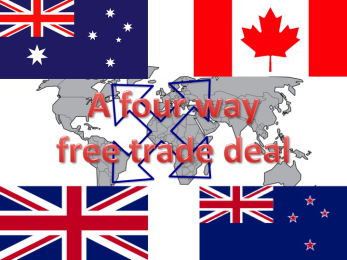
Ted Campbell is a big fan of the CANZUK scheme (Canada-Australia-New Zealand-United Kingdom) to create an “anglosphere” power alongside the current economic big-hitters on the world stage like the United States, China and the European Union. I agree it has historical, nostalgic appeal, but as Aris Roussinos points out, geography is a big stumbling block to it ever being much more than an idea:
Since losing the empire, Britain has notoriously struggled to find a role on the world stage. Initial attempts to piggyback on the power of our successor as global hegemon, the United States, by acting as a guiding force — a Greece to America’s Rome, in Harold Macmillan’s phrase — faltered due to the total absence of interest ever shown in this arrangement by any American administration.
The subsequent attempt to remould Britain as a European power acting in concert with its continental neighbours through the European Union was an unhappy marriage, and has ended in a rancorous divorce whose final settlement is still to be determined. Adrift on the world stage, we are in need of good ideas.
Instead, we are offered CANZUK, a reheated Edwardian fantasy of a globe-spanning Anglosphere acting as a world power which excites the enthusiasm of a small coterie of neoliberal and neoconservative ideologues, if no one else.
In a recent piece for the Wall Street Journal, the historian and Churchill biographer Andrew Roberts argued that the CANZUK nations — Canada, Australia, New Zealand and the UK — ought to establish “some form of federation among them” as a “second Anglospheric superpower” combining “free trade, free movement of people, a mutual defense organization and combined military capabilities” , which would “create a new global superpower and ally of the U.S., the great anchor of the Anglosphere”.
One cannot fault Roberts for the grandeur of his vision, even if the details of how this would actually work are left to others to fill in. Instead, we are reassured, this would not be a centralising project like the hated EU; rather, “its program for a loose confederal state linking the Westminster democracies would be clearly enunciated right from the start.” Already, we see the harsh hand of reality ready to crush this initially appealing vision. On the one hand, CANZUK is a globe-spanning superpower ready to be born; on the other, it is merely a loose grouping of separate national governments, which would, like all national governments, act according to their own interests above all.
By totting up the different GDP figures of the various CANZUK nations, Roberts claims that his proposed Empire 2.0 “would have a combined GDP of more than $6 trillion, placing it behind only the U.S., China and the EU,” while “with a combined defense expenditure of over $100 billion, it would also be able to punch above its weight”.
Yet the flaws of this argument are obvious. As other critics have noted, only a minuscule proportion of the CANZUK nations’ trade is with each other, save New Zealand, an economic satellite of Australia. Australia is a great East Asian trading power, and will remain so. Canada is enmeshed in the greater North American trading sphere, as are we with Europe, whatever Brexiteers may wish. As always, the simple matter of geography trumps the affective bonds between far-flung kith and kin, whatever their emotional appeal.
“Uprising” Pt. 2 – The Liberation of Paris 1944 – Sabaton History 081 [Official]
Sabaton History
Posted 20 Aug 2020Mid-August 1944. The battle for France enters its decisive phase. With the Allied spearheads just 100 km away from Paris, the Résistance prepares for its long-awaited uprising. While collaborators and fascist officials flee the city in panic, many insurgents are eager to immediately rise up against the occupation and fight the Germans in the streets. But there is need for caution. The Germans are still there in force, and they have tanks and machine guns. The fear that this might turn into “another Warsaw” if the Allies don’t show up in time is very real.
Support Sabaton History on Patreon: https://www.patreon.com/sabatonhistory
Listen to “Uprising” on the album Coat Of Arms:
https://music.sabaton.net/CoatOfArmsWatch the Official Music Video of “Uprising”:
https://www.youtube.com/watch?v=01IaK…Listen to Sabaton on Spotify: http://smarturl.it/SabatonSpotify
Official Sabaton Merchandise Shop: http://bit.ly/SabatonOfficialShopHosted by: Indy Neidell
Written by: Markus Linke and Indy Neidell
Directed by: Astrid Deinhard and Wieke Kapteijns
Produced by: Pär Sundström, Astrid Deinhard, and Spartacus Olsson
Creative Producer: Maria Kyhle
Executive Producers: Pär Sundström, Joakim Broden, Tomas Sunmo, Indy Neidell, Astrid Deinhard, and Spartacus Olsson
Post-Production Director: Wieke Kapteijns
Editor: Iryna Dulka
Sound Editor: Marek Kaminski
Archive by: Reuters/Screenocean https://www.screenocean.com
Community Manager: Maria Kyhle
All music by SabatonSources:
– Imperial War Museum: B 9298
– Bundesarchiv, CC-BY-SA 3.0: Bild_101I-027-1477-16, Bild_183-2008-0710-500, Bild_183-2003-1112-500
– lubini from freesound.orgAn OnLion Entertainment GmbH and Raging Beaver Publishing AB co-Production.
© Raging Beaver Publishing AB, 2019 – all rights reserved.